Latest: the loss stage is identified by known photons
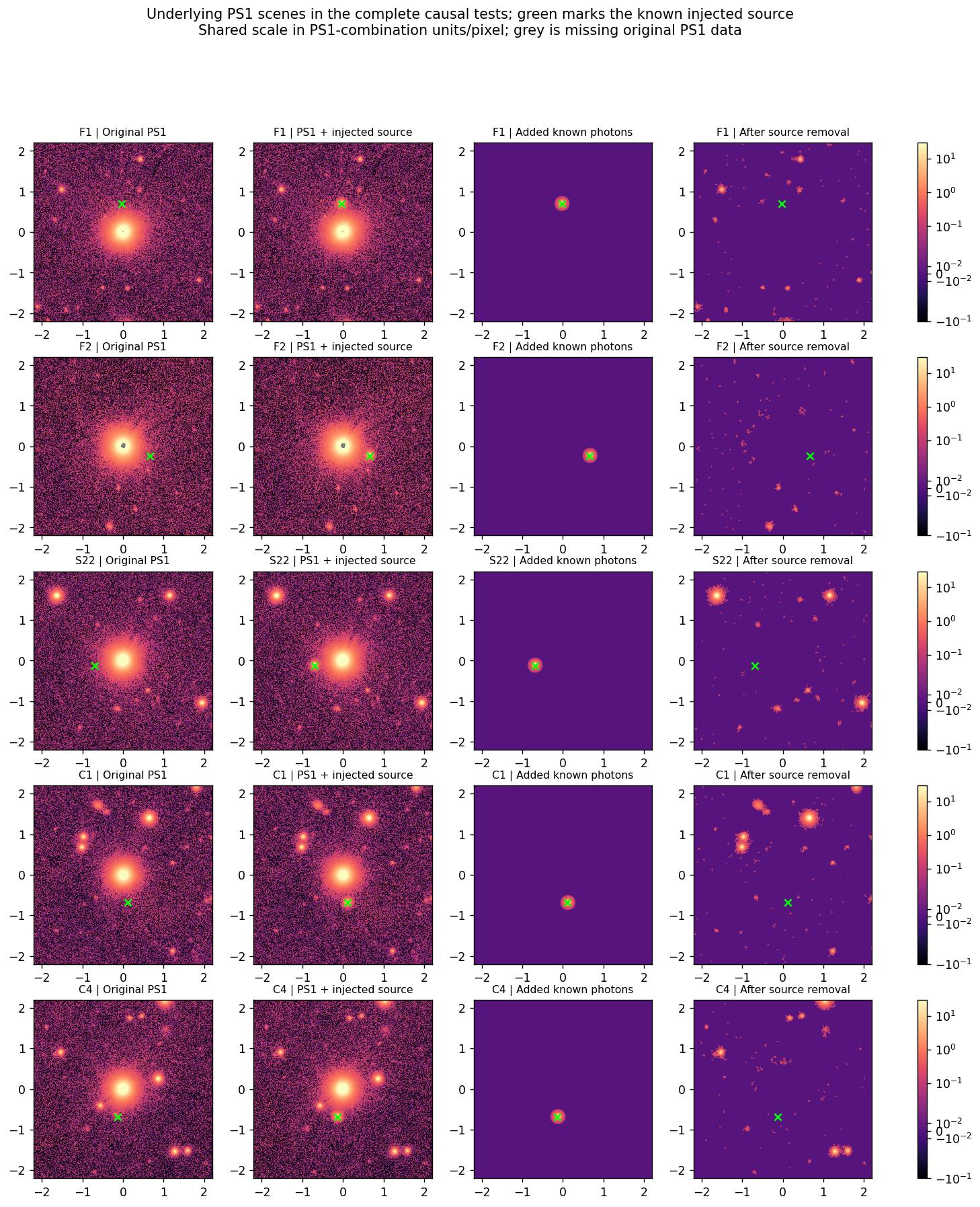
Full causal-test report, equations, commands, errors and limitations. The same raw PS1 scene is processed with and without an injected source. All original masks and the original noise realization are preserved. Tagged injected photons are separated from collateral changes to the existing scene.
There are 900 injections: 30 real host configurations across five fields, three catalogue-equivalent brightness levels, five nominal radii, and paired clean-sky controls. At nominal 0.7 TESS pixel, the T17 near-source packets retain 99.78% of their light after detection, then 0% after footprint removal. Clean controls retain 98.93%. Every near T17 injection is recorded as catalog_neighbor.
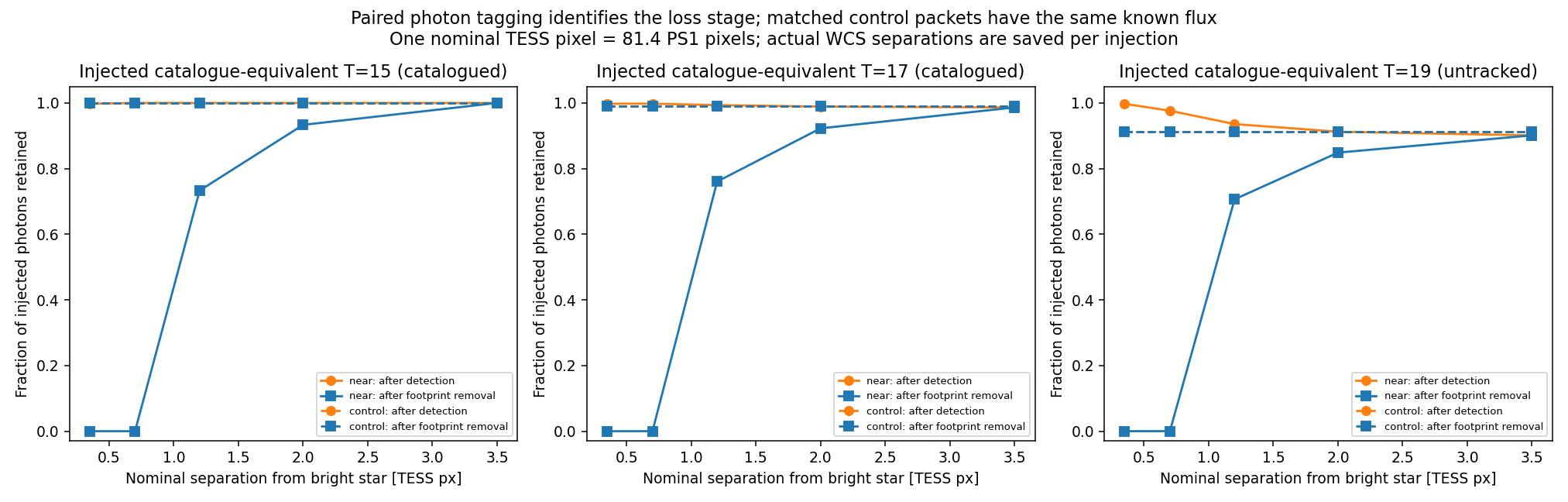
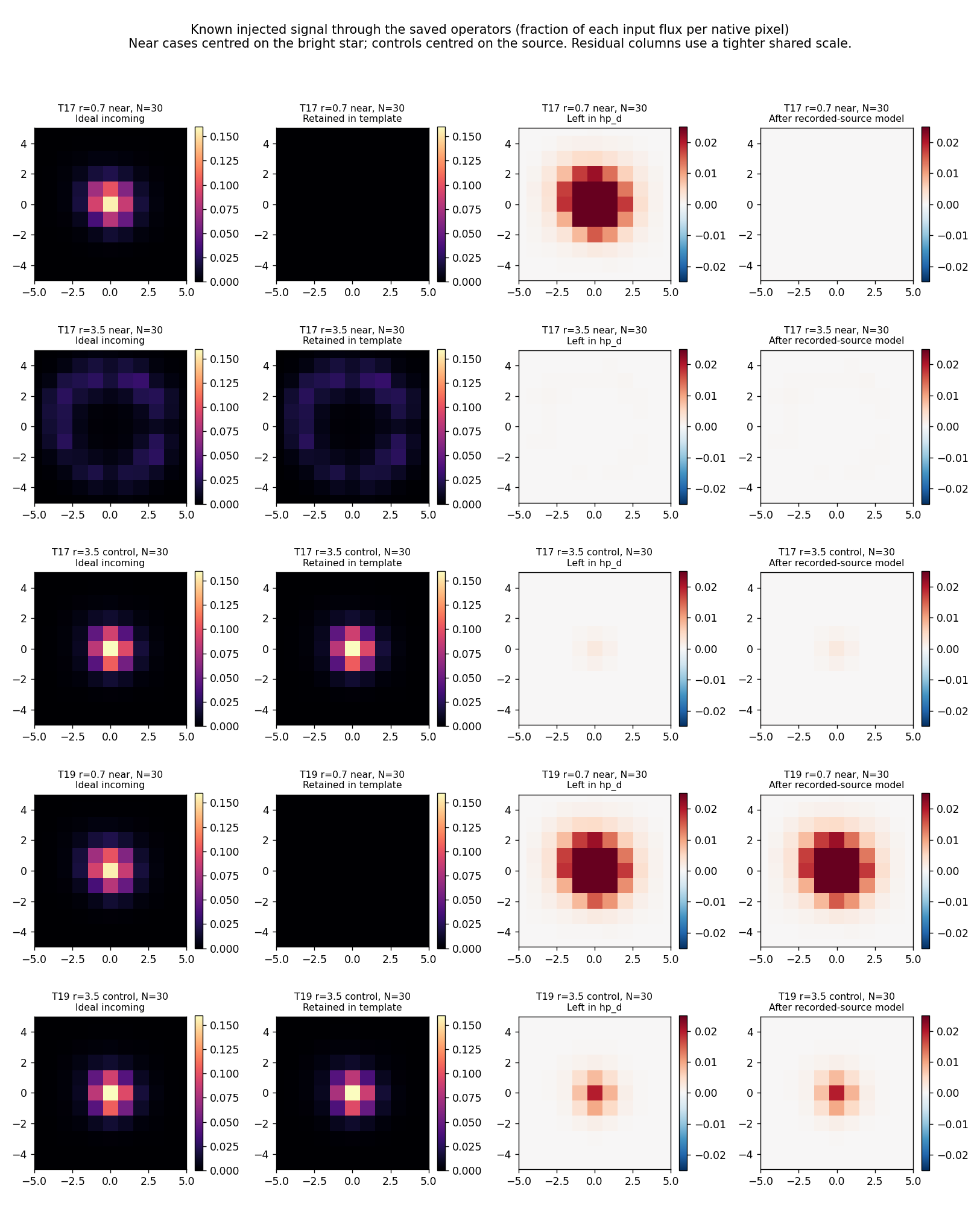
Faint-wing clipping is a separate effect: clean controls retain about 99.99%, 98.93% and 91.17% of tagged T15, T17 and T19 light for these profiles/noise maps. Those are not universal net photometric corrections, because changing detection masks also changes some original scene pixels.
The real removal records are not being consumed by the fit
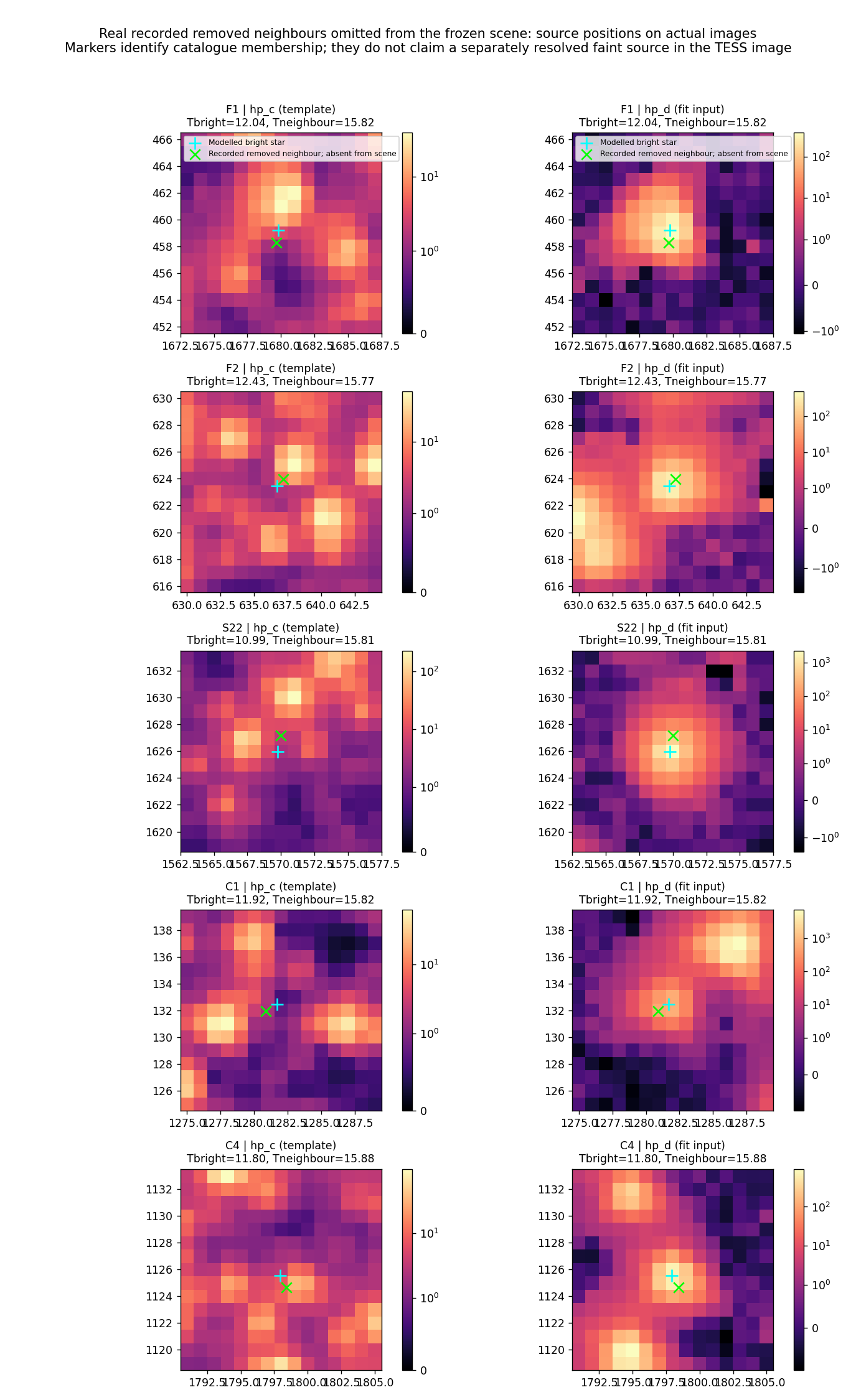
The actual five scene_boot bundles have tmag_max=13. Their source-ID lists contain none of the fainter removed neighbours. Existing “nuisance” entries are demoted stars from that original source list; they are not the erased faint population.
| Field | Recorded faint neighbours in audited region | Included in scene | Omitted centres on valid fitted pixels |
|---|---|---|---|
| F1 | 5,990 | 0 | 3,952 |
| F2 | 5,708 | 0 | 3,185 |
| S22 | 4,224 | 0 | 2,659 |
| C1 | 3,584 | 0 | 2,478 |
| C4 | 10,288 | 0 | 6,700 |
18,974 omitted centres fall on valid fitted pixels. These are exact source-list/support counts, not measurements of each neighbour’s flux. The builder swaps new hp_d pixels into an old source scene without adding the newly removed sources: build_scene.
Including the erased neighbour removes the controlled bright-flux error
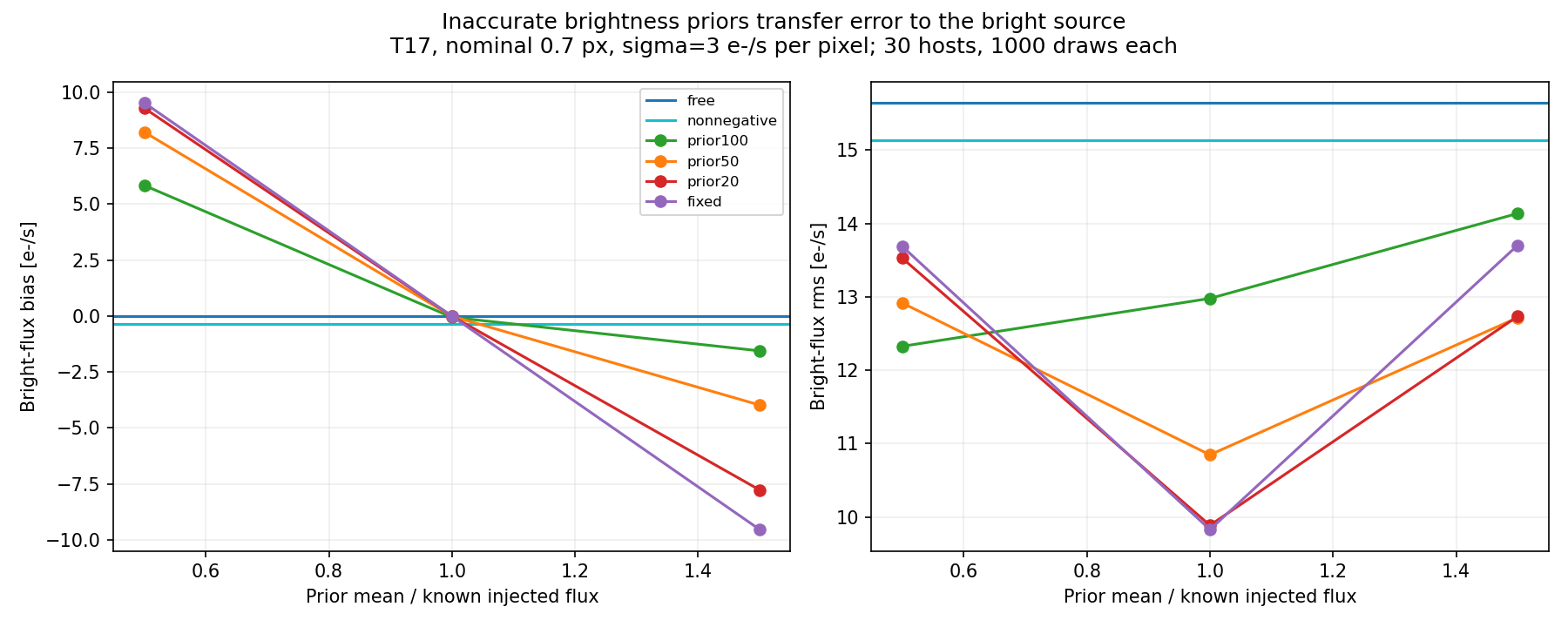
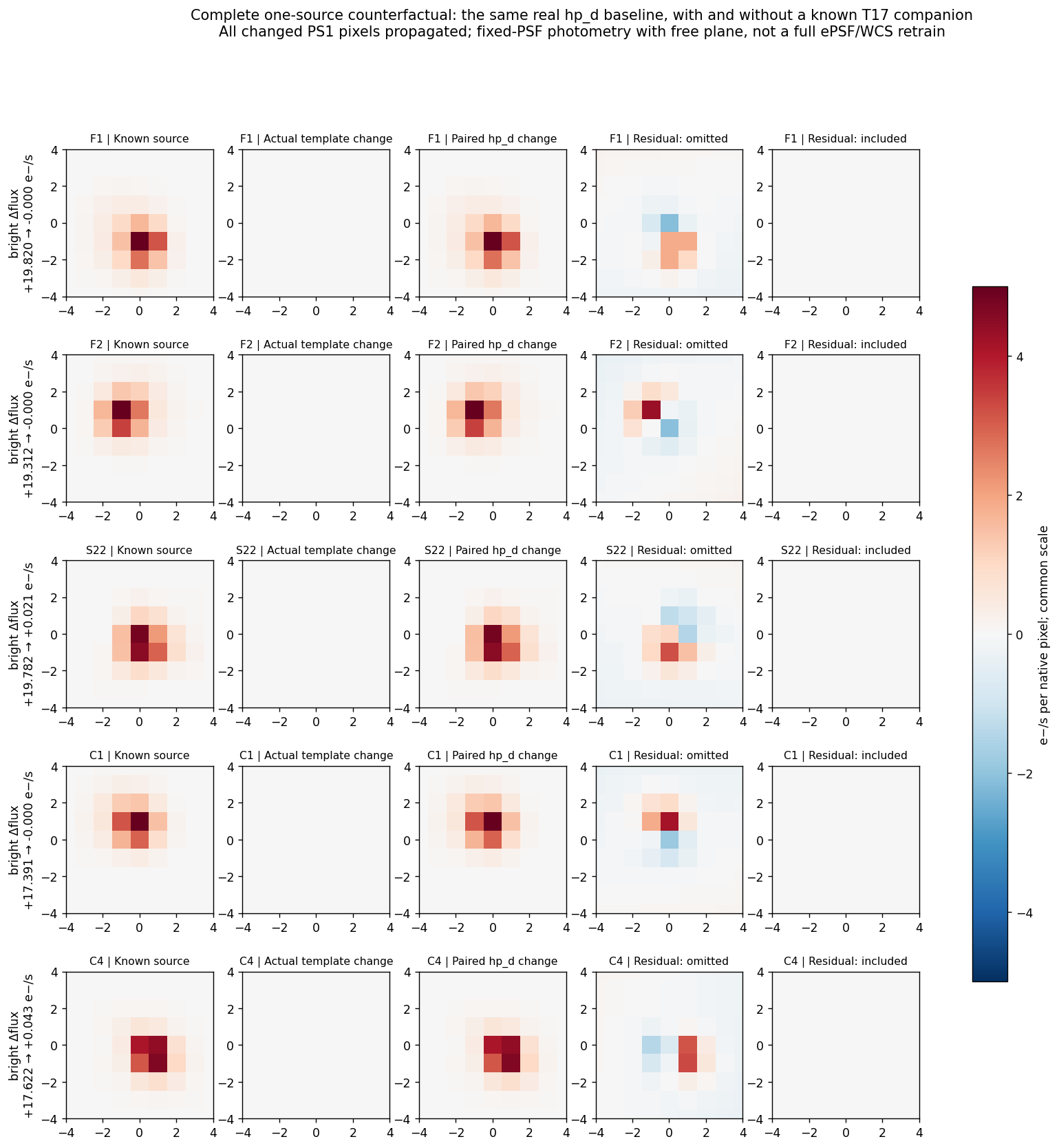
One T17 source was injected alone at a preselected host in each field. Every changed PS1 pixel, including collateral changes outside the source packet, was propagated through the saved operators. The same real hp_d baseline was fit before and after the perturbation, with fixed PSFs/positions, flat weights and a free background plane.
| Field | Bright-flux error: neighbour omitted | Neighbour included |
|---|---|---|
| F1 | +19.8201 e−/s | ≈0 |
| F2 | +19.3121 e−/s | ≈0 |
| S22 | +19.7817 e−/s | +0.02125 e−/s |
| C1 | +17.3911 e−/s | ≈0 |
| C4 | +17.6223 e−/s | +0.04284 e−/s |
“≈0” is below 4 × 10⁻⁷ e−/s. These are deterministic recovery errors for known added signals of 24.4–25.4 e−/s, not estimates of the real population’s bias. The same known PSF is used for injection and recovery; this is not a production ePSF/WCS retrain.
Photon accounting, normalization checks and limitations
$I$ is the original finite PS1 image in PS1 flux units/pixel; $S$ is the realized added signal on available pixels; $Z$ is the actual removal operator. Original unavailable pixels remain unavailable during processing. $M_+$ and $M_0$ are its binary retention masks with and without the source. The first term is surviving injected photons; the second is collateral change to real scene light. Both are measured. Net collateral changes range from about −0.7% to +7.7% of an arm’s incident flux, motivating the full one-source checks.
$S_{\rm ideal}$ is the full incident source packet. $L_0$ propagates it through the saved Gaussian, mapping and Hotpants kernel without PS1 bad-pixel suppression; $L_M$ includes the actual bit-12 suppression on the processed template. Both map to e−/s per native pixel. $\Delta d$ is the paired change left in hp_d; the saved constant background cancels. The experiment keeps uncertainty fixed and adds no separate random-noise realization.
Baseline replay is exact. Catalogue-on/off repeats produce identical image pixels in every field. Gaussian and unmasked-binning flux checks close below 8.4 × 10⁻⁹; there is no unmapped injected flux. Configured bit-12 suppression reaches 1.70% for individual sampled packets and is accounted separately.
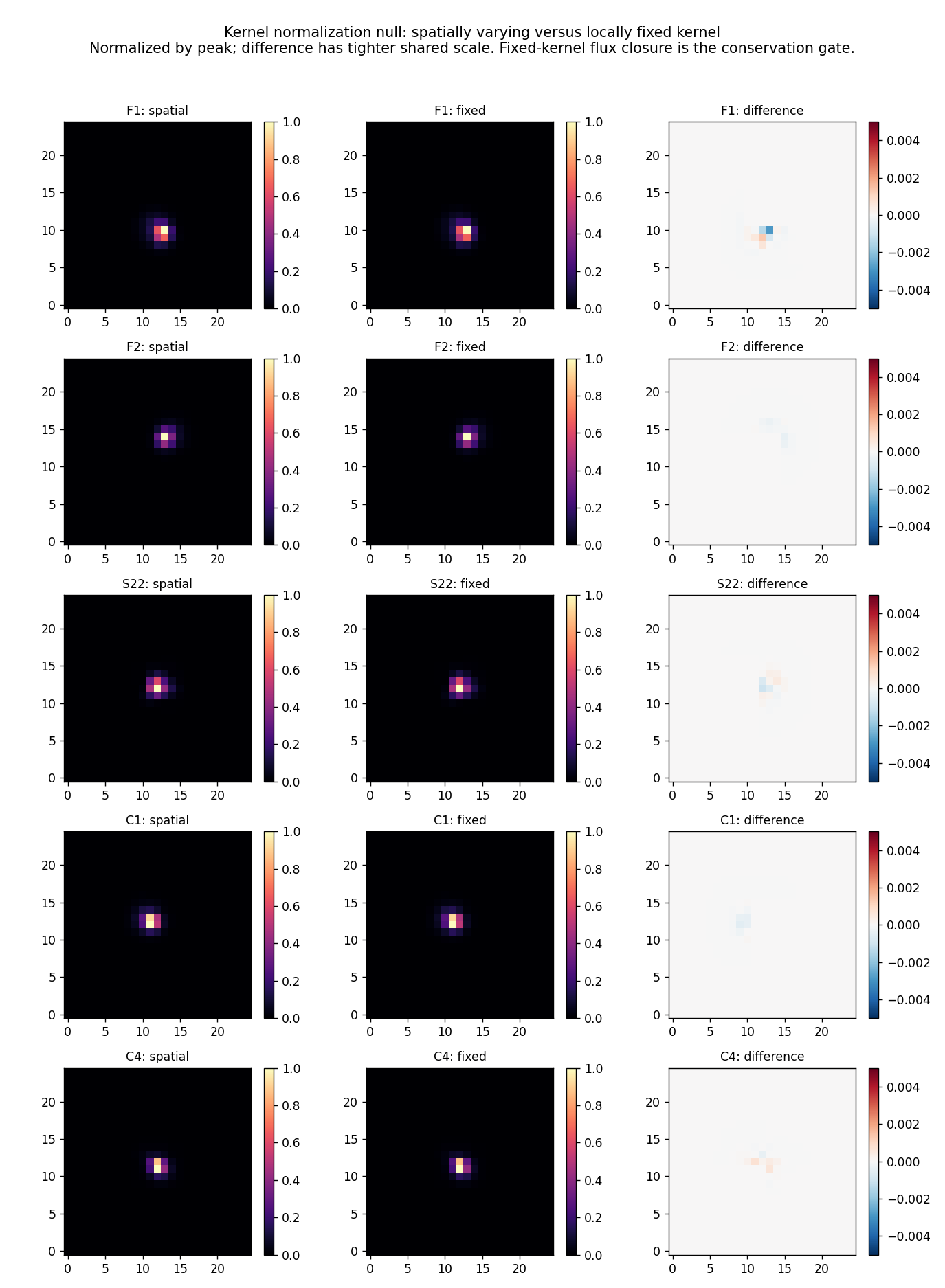
The first kernel-normalization gate made an incorrect assumption: equal local kernel sums do not guarantee exact point-source flux conservation when coefficients vary across blocks. A fixed-local-kernel null closes within 2.6 × 10⁻⁸; actual spatial point gain differs from the DC approximation by at most 0.021–0.065%, depending on field. Actual propagated ideal sources are the reference, and this small effect is not called zero.
S22’s first preparation had only two eligible hosts before any response was measured; the next preselected skycell supplied five with unchanged gates. Host migration interrupted some jobs; checkpoint copies resumed into separate directories. Initial scheduler resumes failed environment activation, so completion was established from actual saved data and gates. No production file or fitted parameter was changed.
Conclusion: the dominant near-star photon loss is the configured footprint removal; the concrete modelling bug is that recorded erased neighbours are absent from the fitting scenes. Add the actually removed Gaia neighbours as nuisance sources, preserve the bright training cutoff, and then validate real held-out fits. No evidence here calls for a flat template pedestal or an unexplained convolution-loss correction.
Do not overinterpret: this does not make the old population-stack contrast a direct missing-flux measurement. Known-neighbour omission cannot directly explain all of a strictly zero-recorded-neighbour subset. Selection, untracked faint light and detection/mask losses remain distinct contributions. Their exact real-sky shares have not been measured by this experiment.
The sections below preserve the preceding five-field trace and original C4 investigation as history. The paired injection and scene audit above are the latest causal result.
Preceding result: the same check on all five selected FFIs
Full five-field report, commands and limitations. Each field uses nine cells selected on a 3×3 detector grid, with a fresh raw-band replay in the centre cell. All input FFI/template/hp_c/kernel hashes were unchanged during the checks.
| Field | Sector / camera / CCD | FFI | hp_c replay RMS (e−/s/pixel) |
|---|---|---|---|
| F1 | 24 / 2 / 2 | tess2020120182919 | 7.97 × 10⁻⁷ |
| F2 | 20 / 3 / 3 | tess2020013215923 | 8.01 × 10⁻⁷ |
| S22 | 22 / 3 / 3 | tess2020071012921 | 7.69 × 10⁻⁷ |
| C1 | 24 / 1 / 2 | tess2020118235919 · corrected WCS | 7.23 × 10⁻⁷ |
| C4 | 23 / 4 / 2 | tess2020087042920 | 9.37 × 10⁻⁷ |
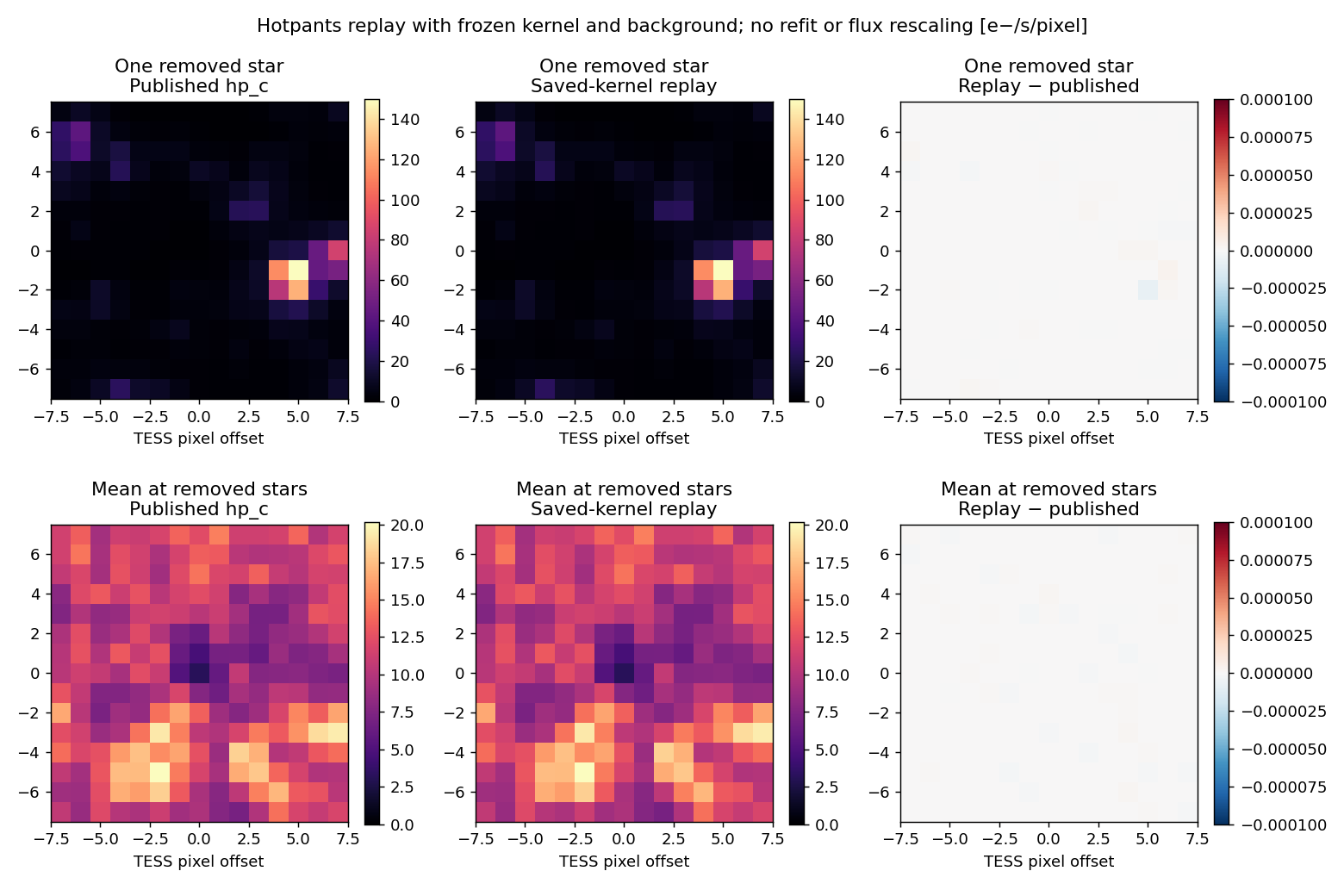
Across the five fresh centre cells, 199,540,467 raw-removal output pixels match exactly. Direct binning checks 3,124,925 interior OS4 pixels; saved contributions equal the published template exactly there. There are 135 strict-interior Gaussian cutout checks and 2,145 saved-kernel replay patches, including 526 removed-star centres. Maximum hp_c replay difference is 3.05 × 10⁻⁵ e−/s/pixel.
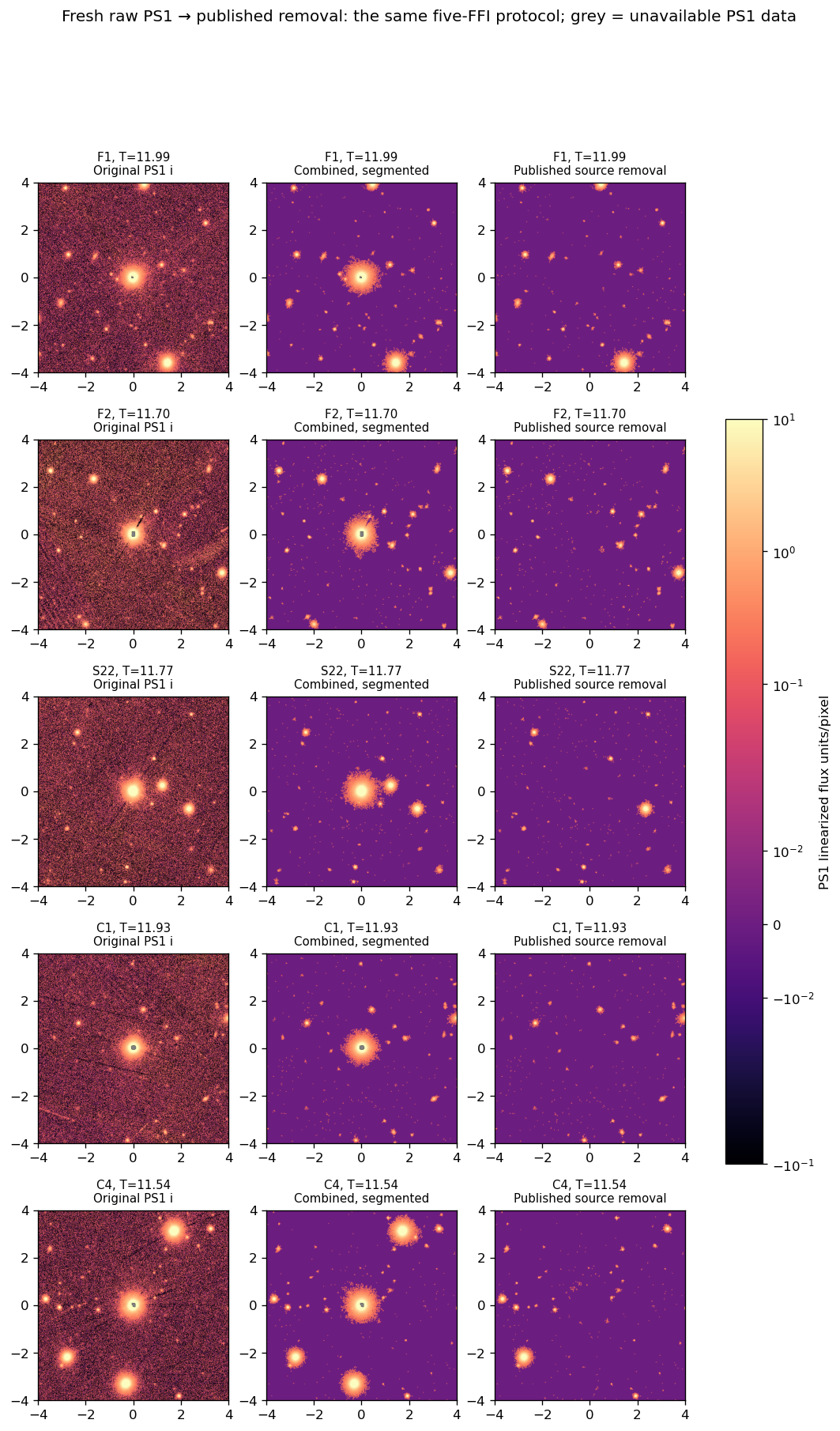
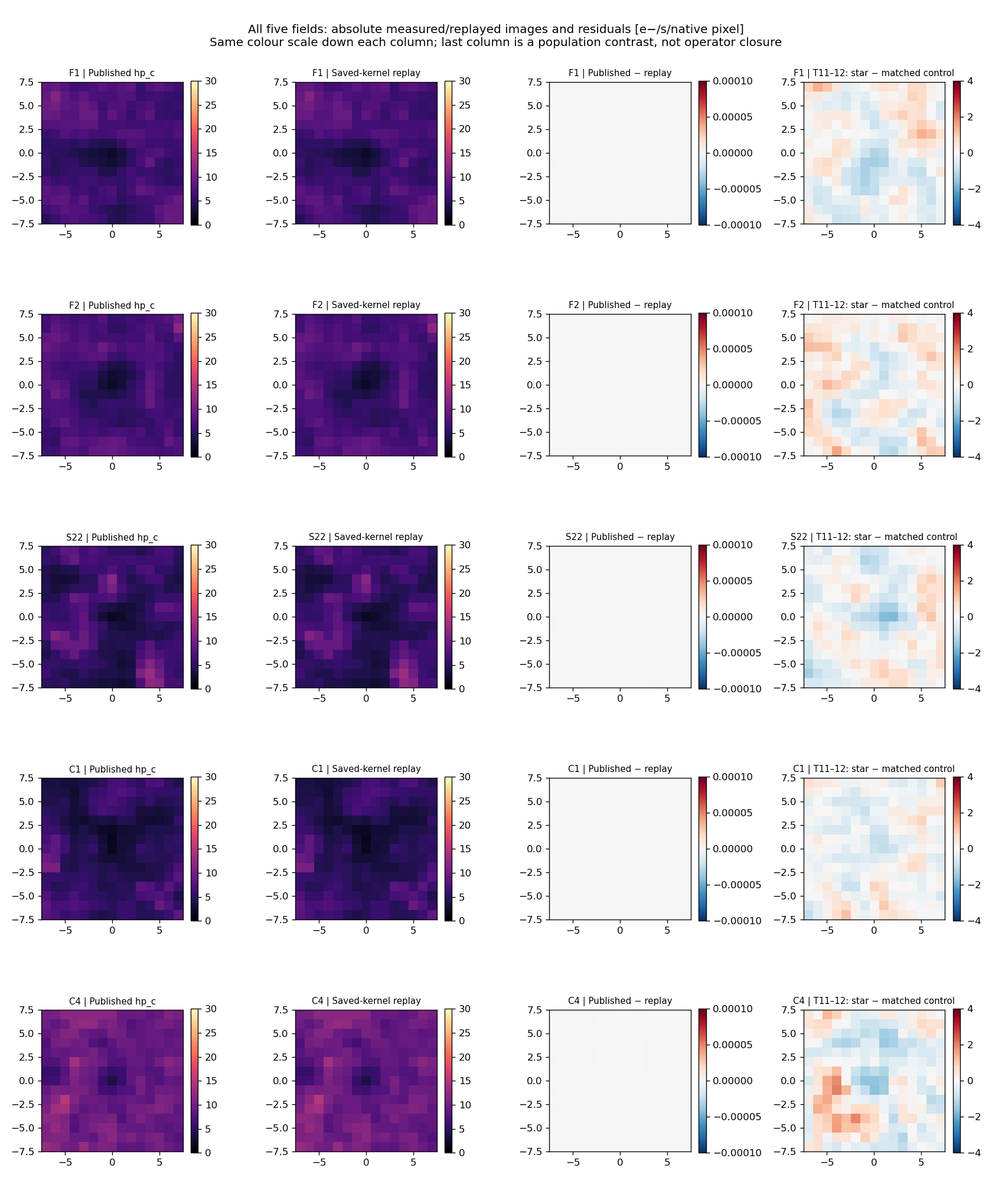
Matched controls reduce the contrast in every field
For the common TESS magnitude interval 11–12, after requiring zero recorded deleted neighbours:
| Field | Stars | Original control (e−/s) | Matched control (e−/s) |
|---|---|---|---|
| F1 | 1,292 | −42.6 ± 6.7 | −16.9 ± 4.7 |
| F2 | 1,256 | −22.2 ± 7.0 | −4.3 ± 7.8 |
| S22 | 1,243 | −32.2 ± 7.3 | −16.7 ± 5.1 |
| C1 | 1,128 | −27.1 ± 6.1 | −10.5 ± 4.2 |
| C4 | 1,240 | −42.6 ± 7.4 | −17.6 ± 5.5 |
Values are sums within 3 native pixels after local annulus subtraction; errors bootstrap 128-pixel detector cells. Matching uses detector cell and nearest retained-source distance, with both real and control positions away from other bright stars. It does not use central template intensity. Source brightness and the full neighbour scene remain unmatched systematic uncertainties.
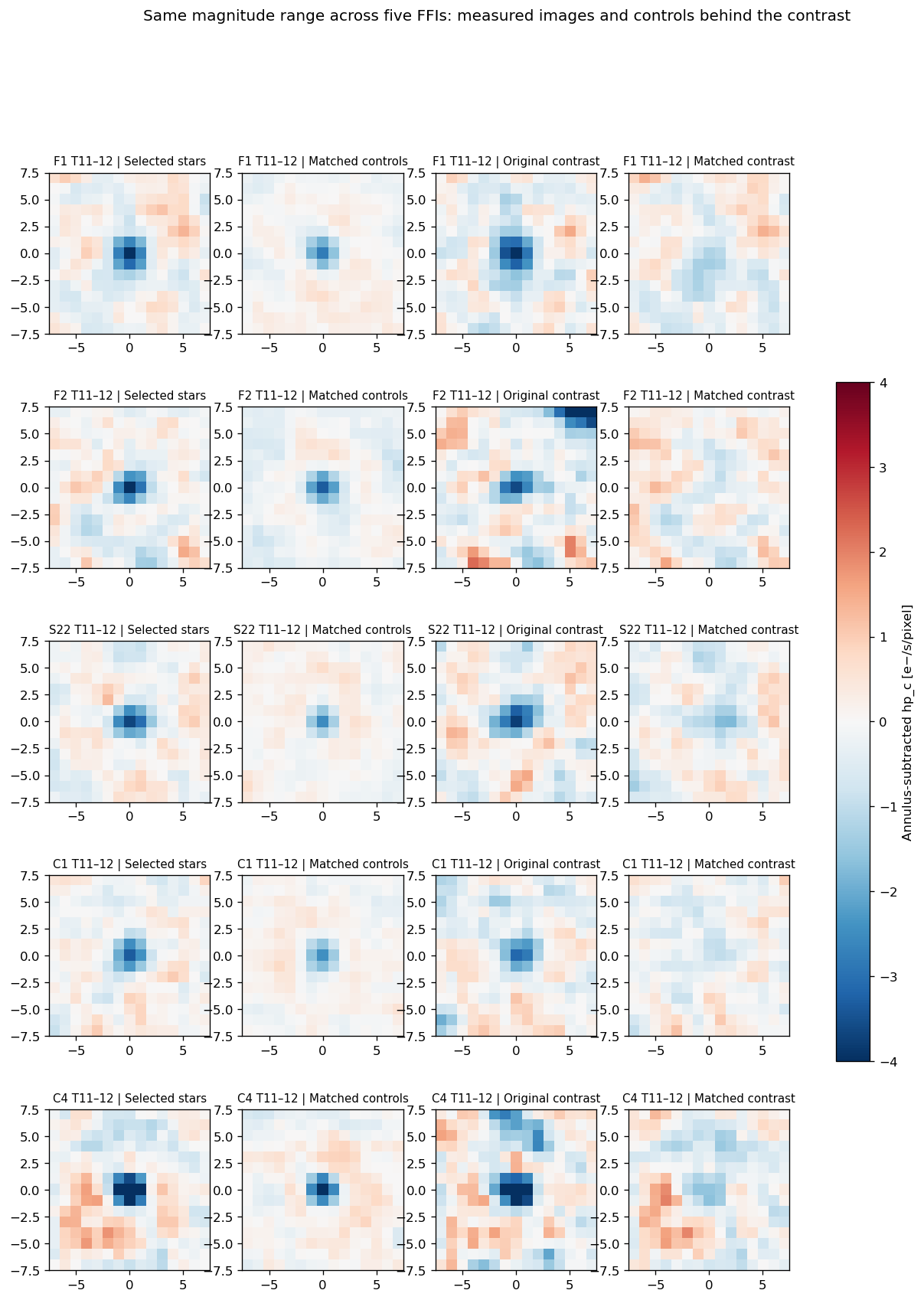
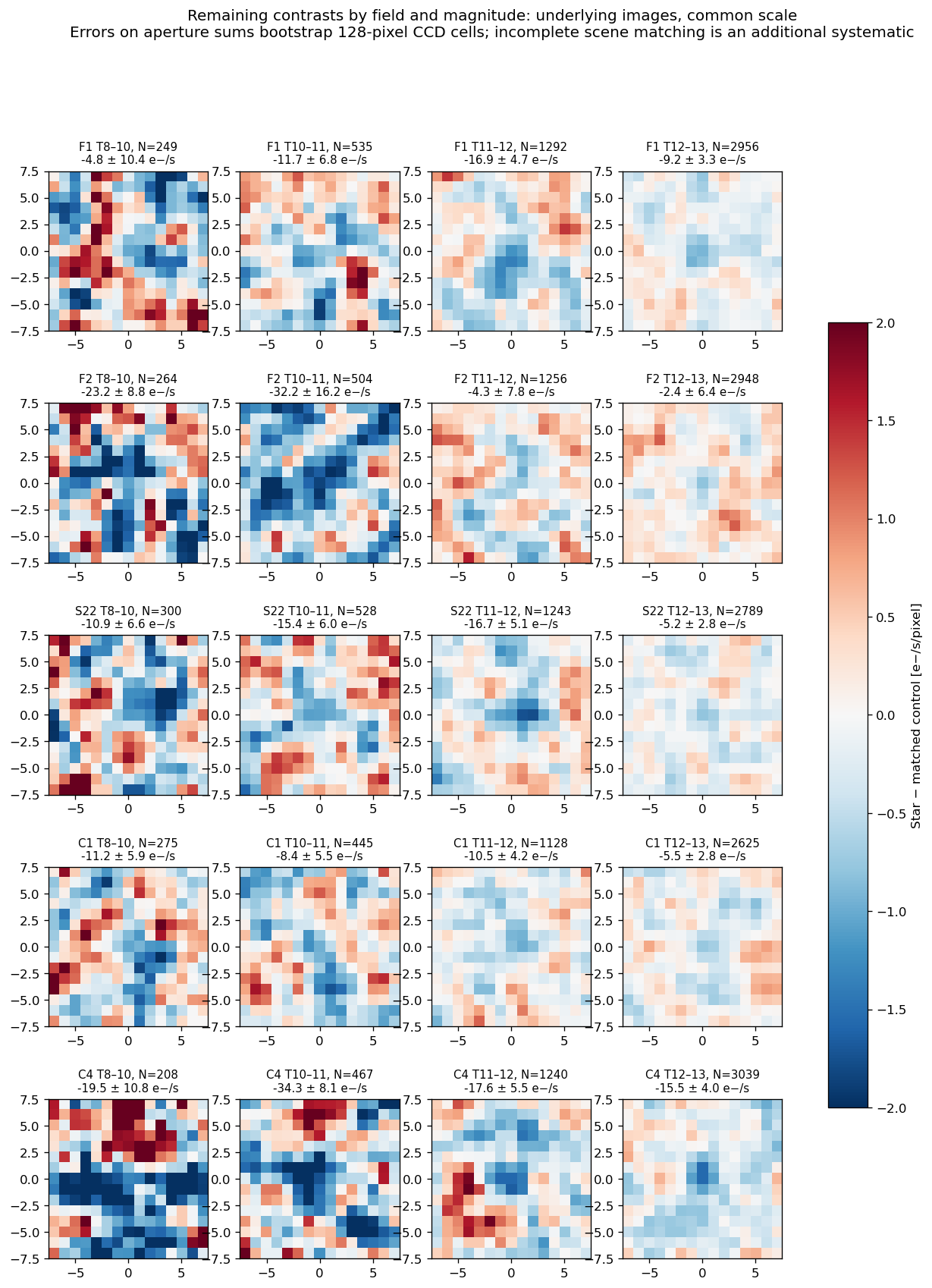
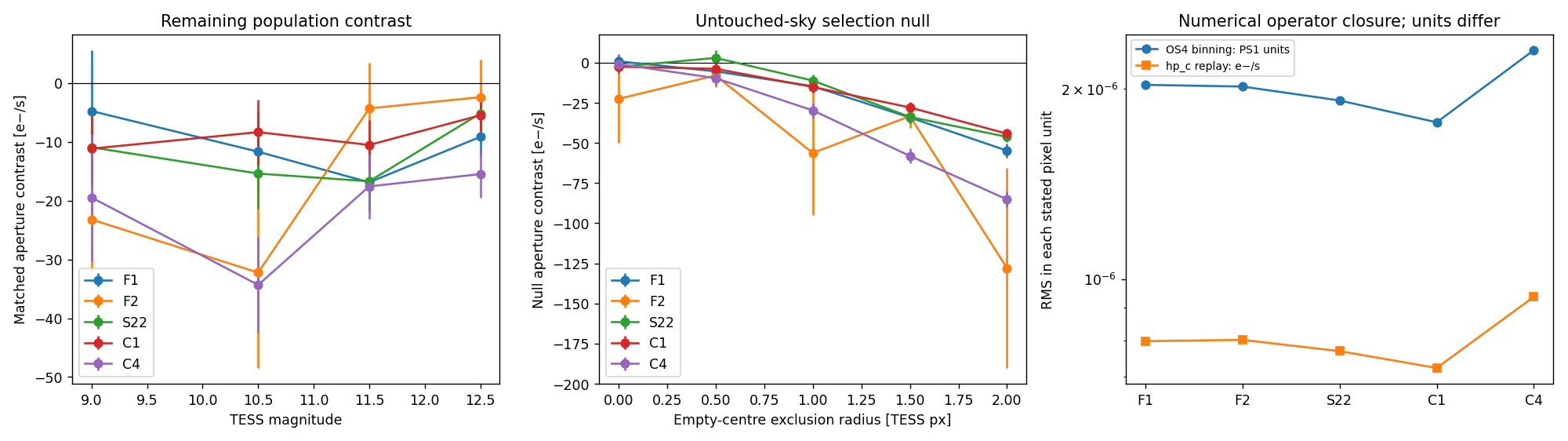
Per-field measured stage images and nine-cell residual maps
Bookkeeping correction: the earlier zero-neighbour test omitted some cross-cell associations and neighbours without usable magnitudes. This extension preserves all associations before deduplicating sources. Four common stars in each of C4 and F2 change from “zero” to having recorded neighbours, too few to explain the broad effect. C4 was also rerun with the same WCS/catalogue and spatial-sampling protocol as the other fields; use this section for cross-field numerical comparisons.
Conclusion: the tested stage implementation is consistent across all five original bootstrap templates. The apparent hole cannot be read directly as lost stellar flux. A smaller population contrast remains; paired known-flux injection is still needed to establish or exclude photometric bias. Overlap seams and the separate v3 rebuild are outside this interior audit.
The sections below retain the original C4 investigation and its narrower sample as history. The common five-field results above are the latest comparison.
1. Verify the original PS1 pixels
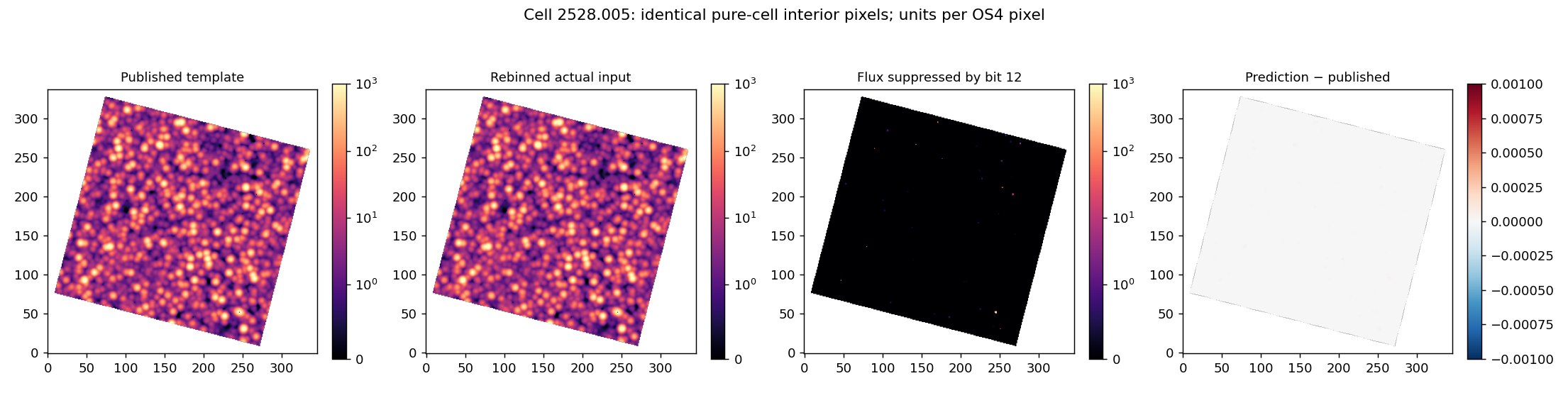
The original r, i, z and y bands for cell 2528.005 were downloaded again. Pinned band combination reproduces the cached image, mask and uncertainty exactly, including missing-data patterns. Replaying segmentation and bright-star removal then reproduces all 39,942,231 published pixels and the same 60 removal records.
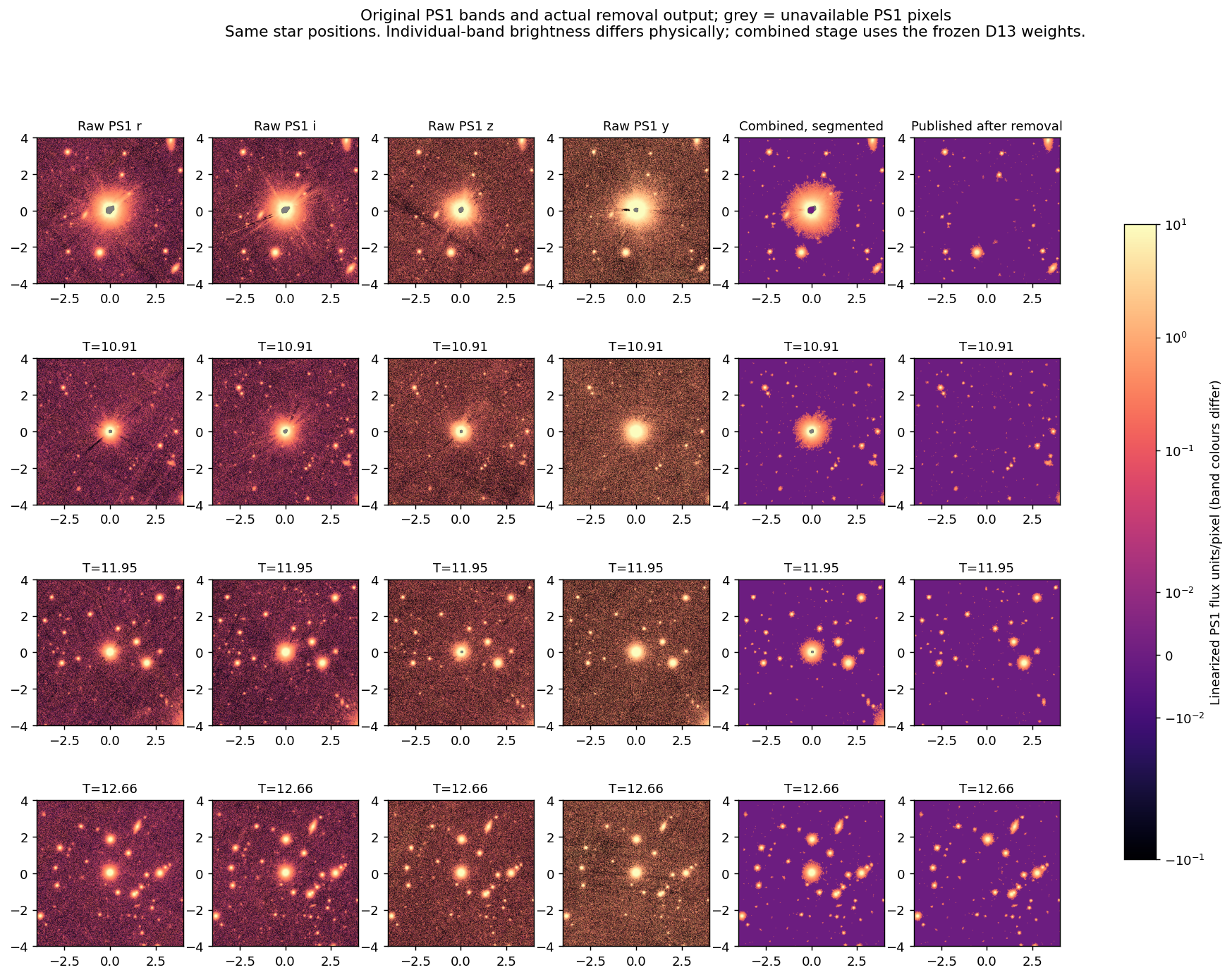
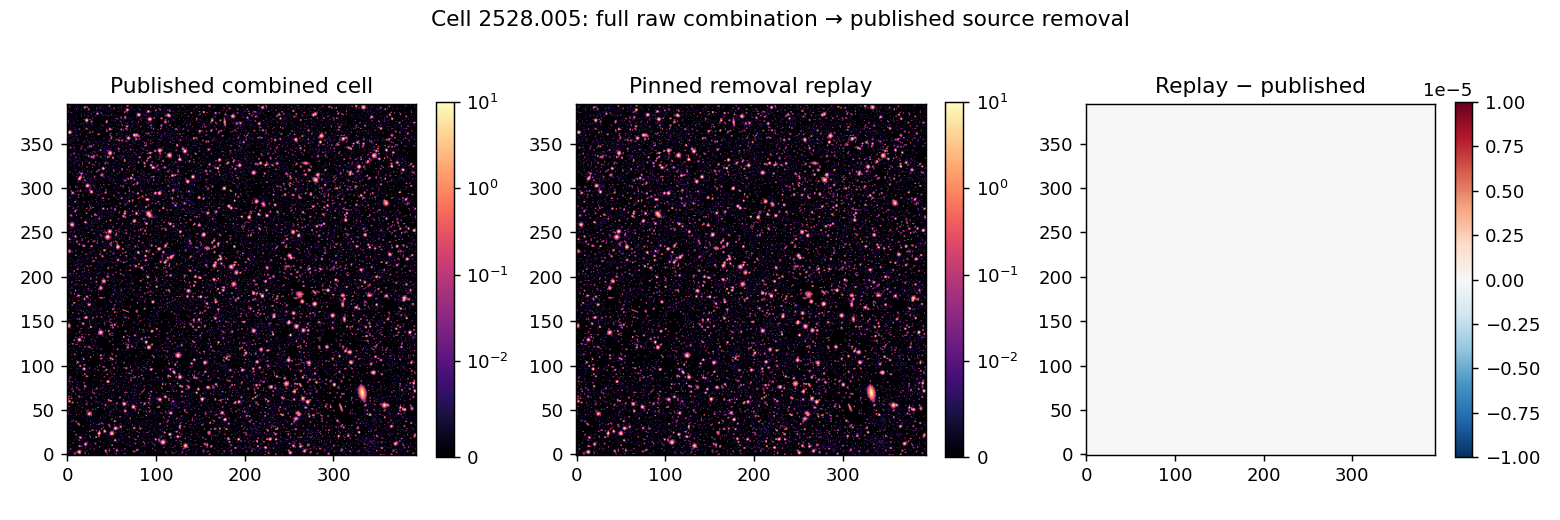
2. Follow the same pixels to the TESS template
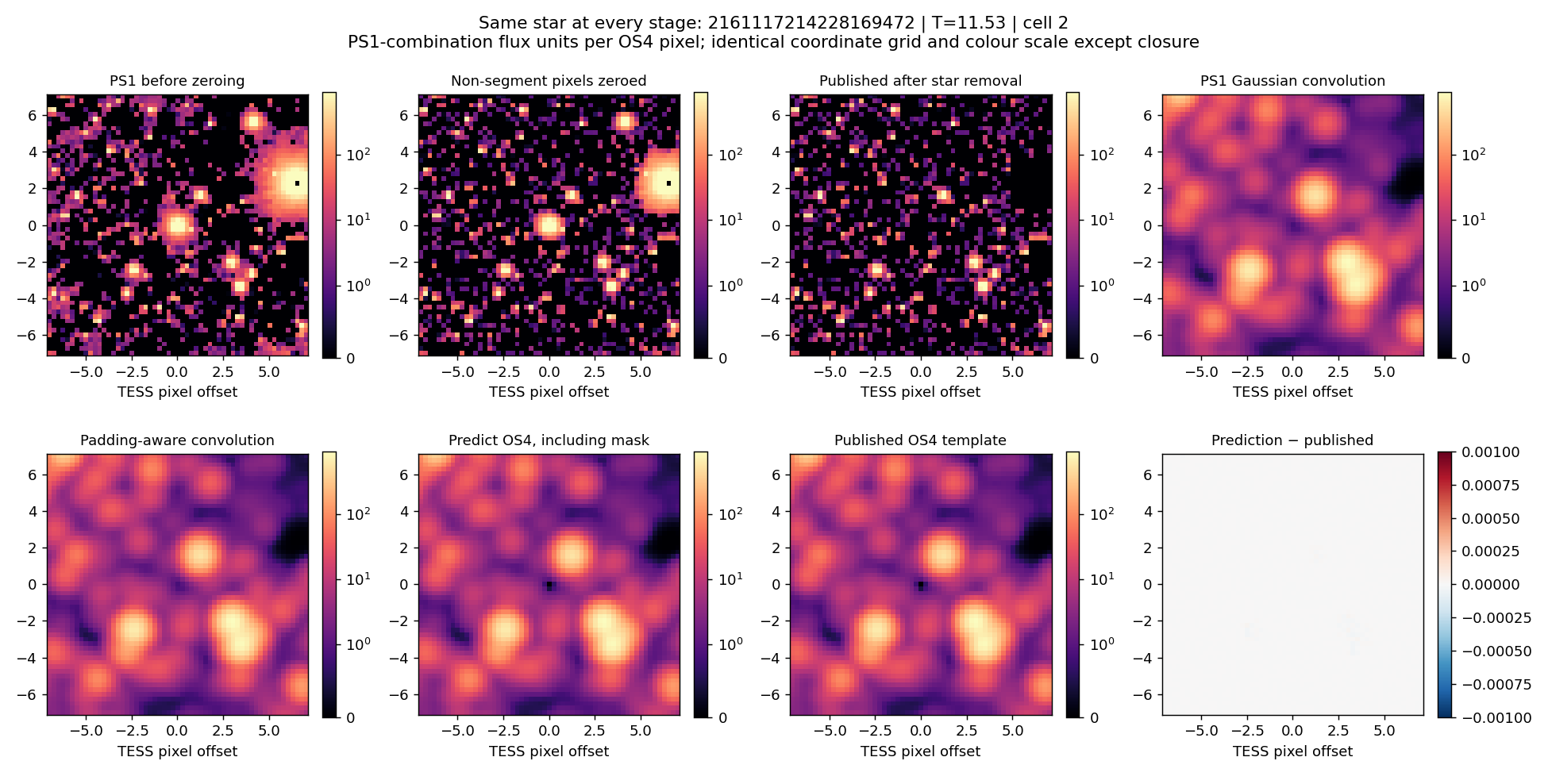
Eight cached cells were checked. The comparison uses the frozen PS1-to-TESS assignments, the actual bit-12 mask and the saved padding-aware input. It excludes assignment seams. No flux rescaling or new fitted model is used.
| Comparison | Measured closure | Scope |
|---|---|---|
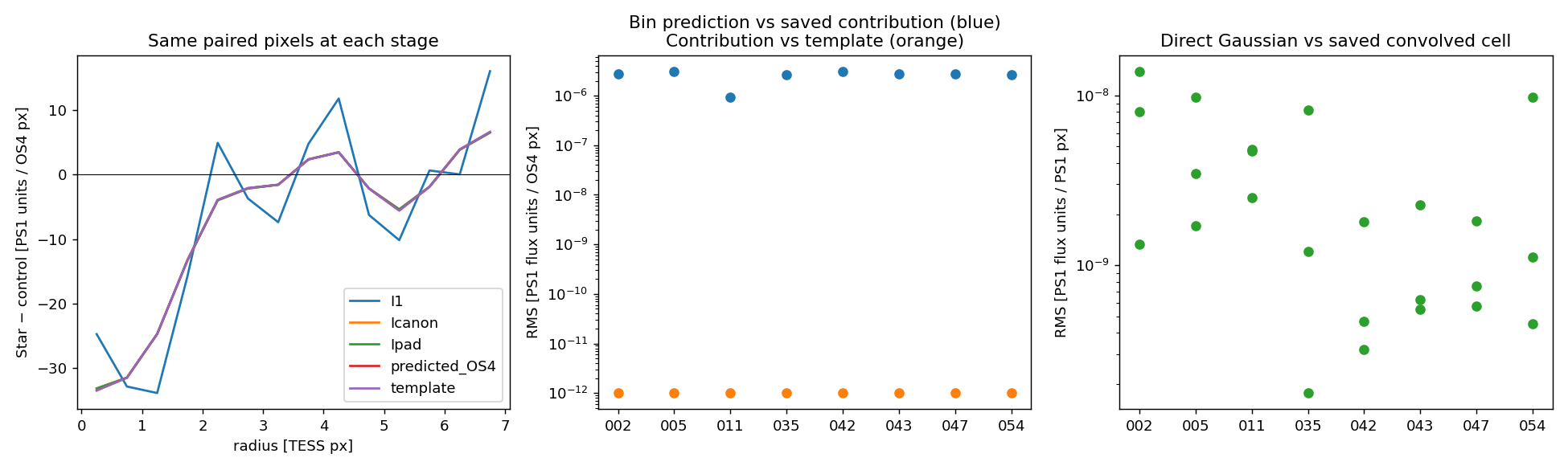
| Direct binning → saved contributions | RMS 2.85 × 10⁻⁶ PS1 units / OS4 pixel | 319,888 interior output pixels |
| Saved contributions → published template | Exactly equal | Same interior pixels |
| Saved Hotpants kernel → published hp_c | RMS 1.35 × 10⁻⁶ e−/s/pixel; max 3.05 × 10⁻⁵ | 356 patches, including 87 removed-star centres |
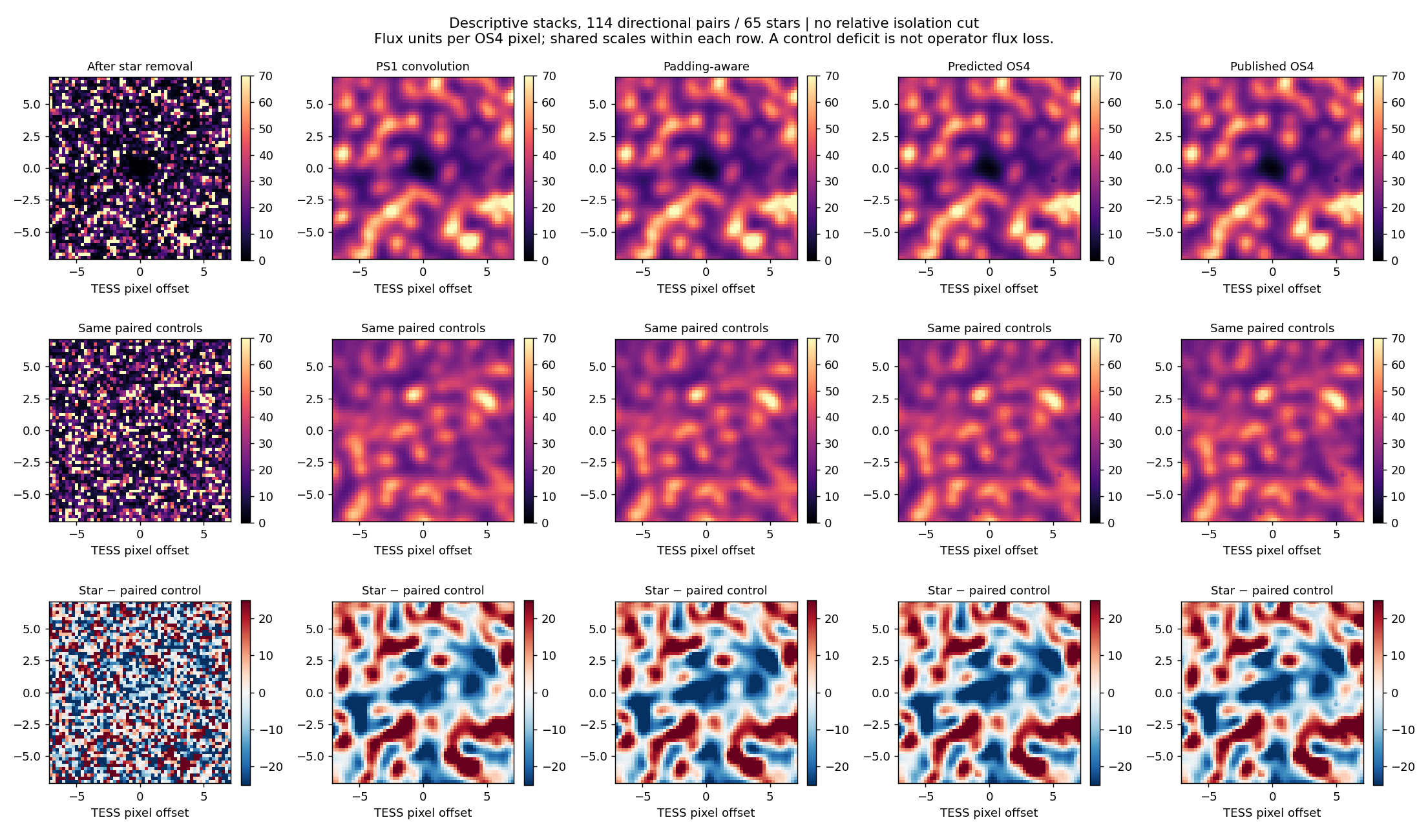
Show the same individual star through all stages
3. A negative stack can appear without a central source removal
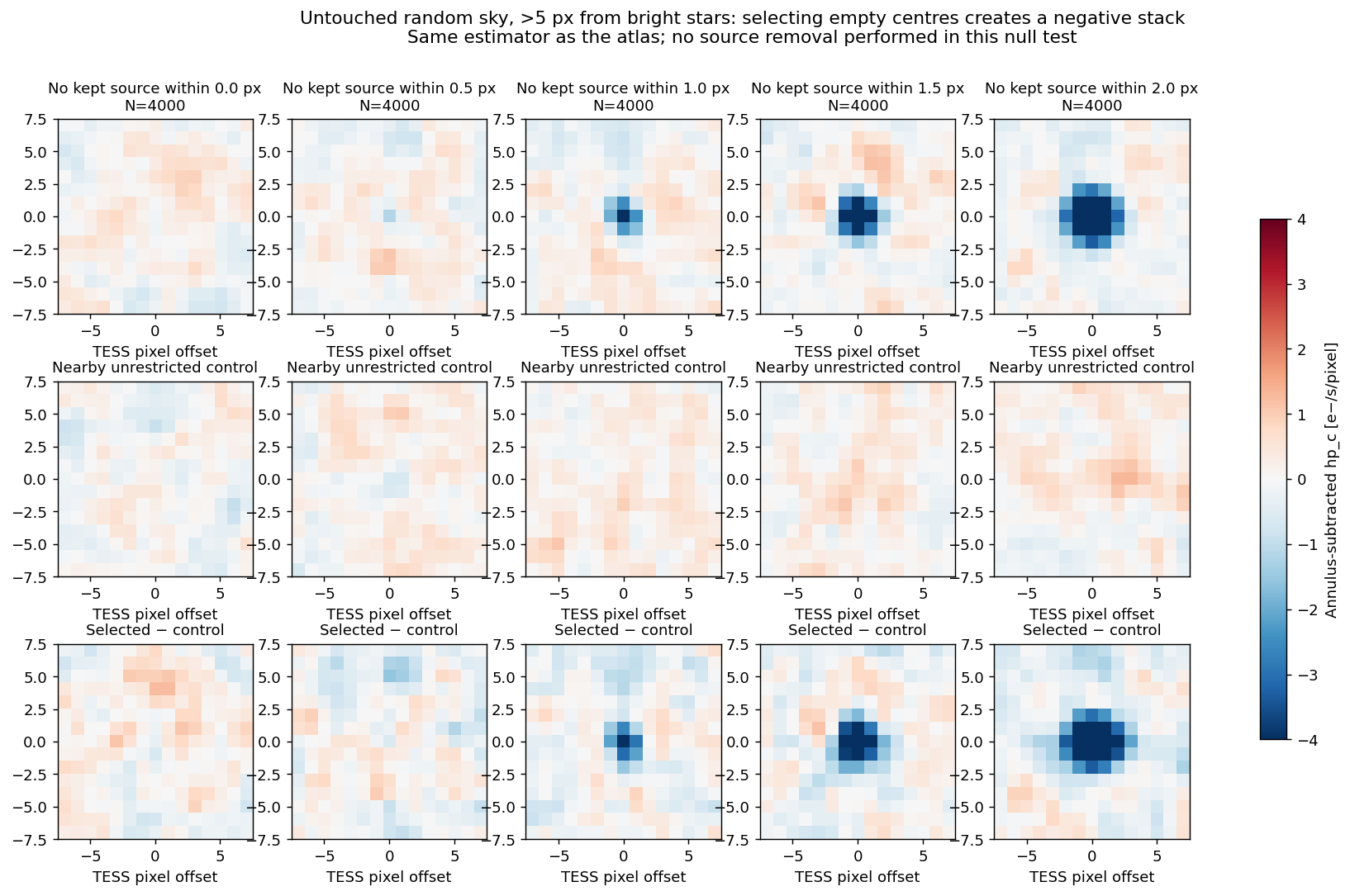
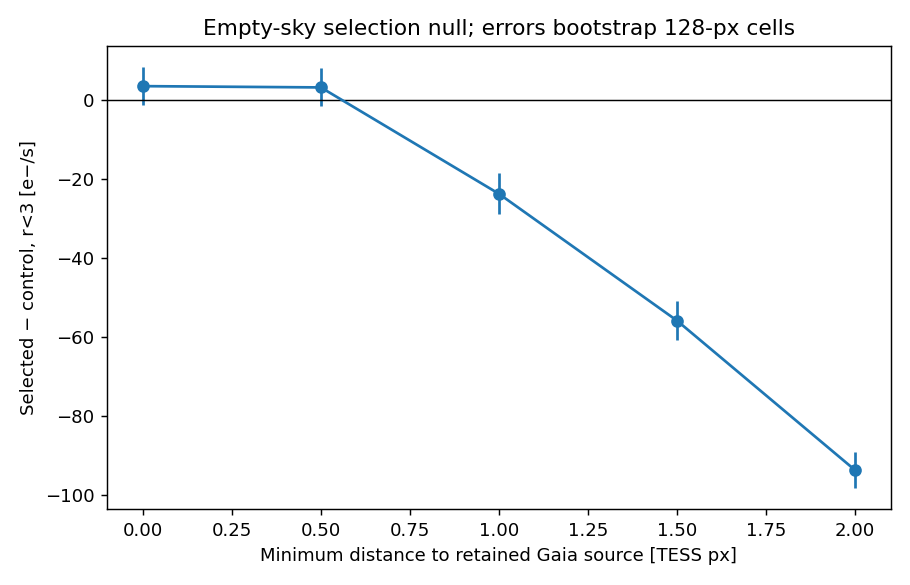
Select unmodified random sky positions, each more than 5 pixels from a bright star, and compare with nearby controls. Requiring the selected centres to lack retained Gaia sources produces a dark central stack. The images have not been edited.
| No retained source within | Aperture contrast, r < 3 px |
|---|---|
| No restriction | +3.5 ± 4.8 e−/s |
| 1 native pixel | −23.7 ± 5.2 e−/s |
| 1.5 native pixels | −55.8 ± 4.9 e−/s |
| 2 native pixels | −93.7 ± 4.6 e−/s |
Each setting samples 4,000 positions. Errors bootstrap 128-pixel detector cells. This is a counterexample to the former inference that the zero-neighbour deficit uniquely diagnoses extra missing light.
4. More comparable controls reduce, but do not erase, the real-star contrast
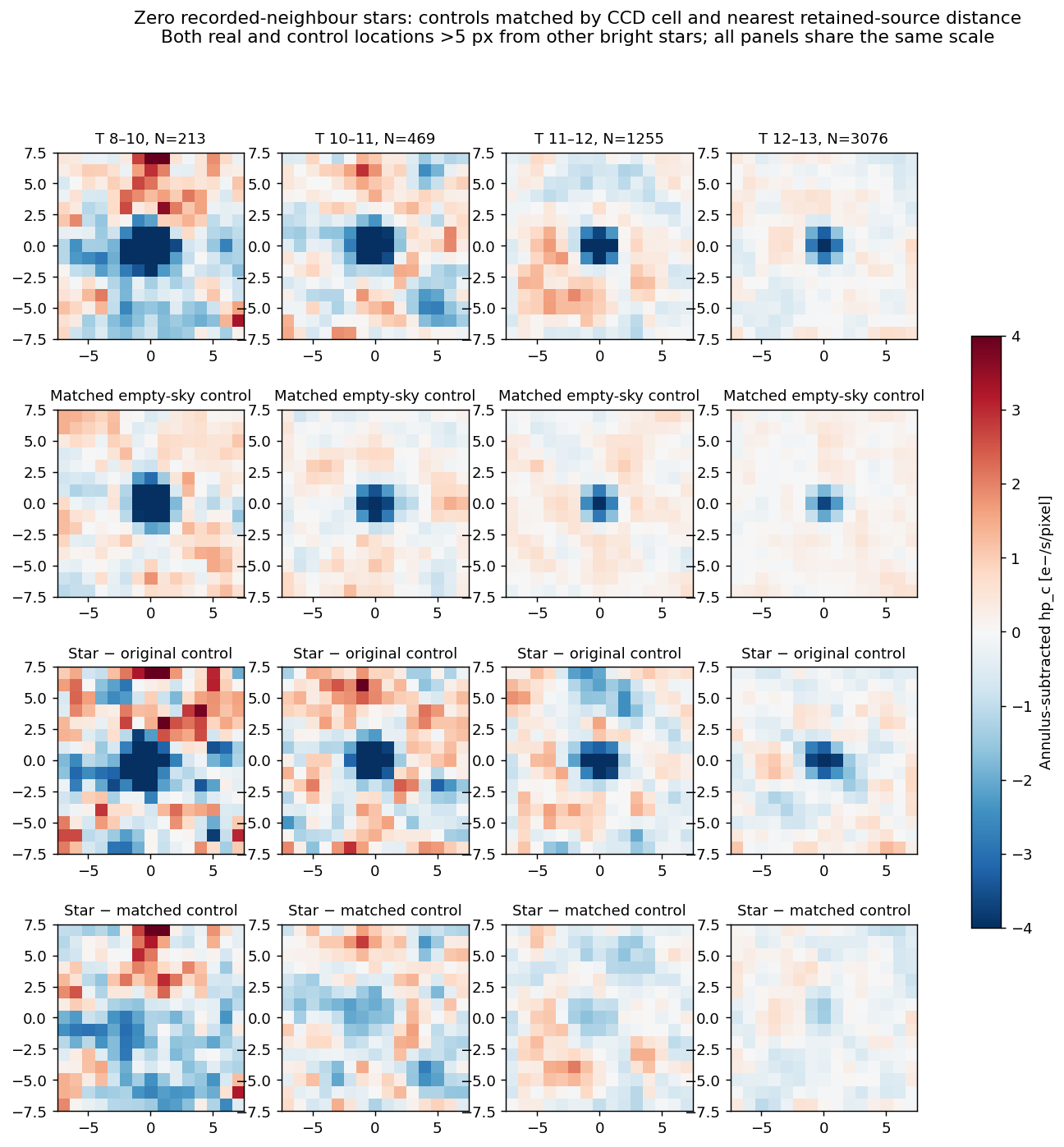
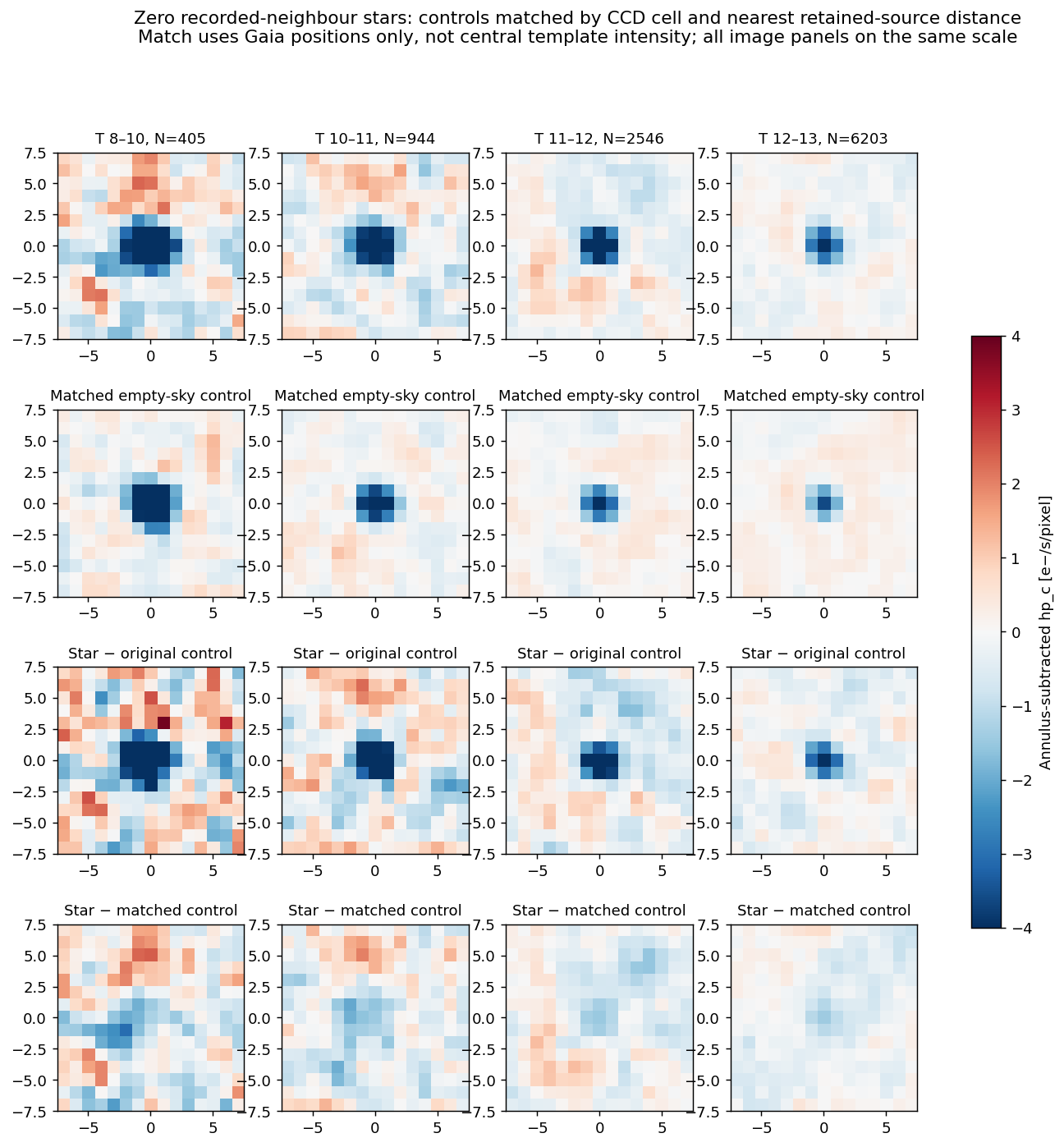
For stars with zero recorded deleted neighbours, match four controls by 128-pixel detector cell and nearest retained-source distance (0.2-pixel bins). The stricter comparison also puts both real and control locations more than 5 pixels from other bright stars. No match uses central template intensity.
| TESS magnitude | Stars | Original control | Matched control |
|---|---|---|---|
| 8–10 | 213 | −88.1 ± 17.4 | −26.7 ± 10.5 |
| 10–11 | 469 | −61.1 ± 12.7 | −25.4 ± 7.5 |
| 11–12 | 1,255 | −44.1 ± 7.3 | −16.8 ± 5.7 |
| 12–13 | 3,076 | −36.9 ± 5.1 | −9.8 ± 3.9 |
Values are electron/s in the same 3-pixel aperture, with spatial-bootstrap errors. The smaller residuals are approximately 2.5–3.4 statistical standard errors per bin. Source brightness and the full neighbour scene are not matched, so these errors omit that systematic uncertainty.
Show the first match without the additional other-bright-star cut
5. What was tested
Definitions: $I_0$ is the original band-combined PS1 image; $Z$ is the pinned segmentation and source-removal rule; $I_1$ is its published output. Both images have PS1 flux units per PS1 pixel. $G_{40}$ is the normalized, configured Gaussian of standard deviation 40 and truncation radius 470 PS1 pixels; $*$ denotes convolution. $C_{\rm pad}$ is the saved padding-aware convolution. $M$ is the binary bit-12 mask. $B$ sums the actual pixel assignments onto the OS4 grid. $T$ is the published template in PS1 flux units per OS4 pixel. $K_\theta$ applies the saved fitted spatial kernel coefficients $\theta$ and sums to native pixels. $b$ is the saved constant background, 0.1569122709 e−/s/pixel. $H$ is published hp_c in e−/s/native pixel.
Operator closure compares each prediction with its actual saved output. The earlier statistic compared star apertures with unrelated sky apertures. It need not equal the flux removed from any individual star’s neighbourhood.
$D$ is the mean aperture contrast in e−/s. $A$ sums within 3 native pixels after subtracting the mean 20–30-pixel annulus, reproducing the old estimator. $\boldsymbol{x}_s$ and $\boldsymbol{x}_c$ are selected and control positions in crop-local TESS pixels. Angle brackets denote a mean over positions. New control-test errors bootstrap detector cells rather than pretending all overlapping apertures are independent.
Provenance: C4 paper frame tess2020087042920, recipe e17a198a4942aa2d, pinned processing commit 648c0bc. Frozen r/i/z/y weights: 0.254 / 0.4368 / 0.1654 / 0.1438. Diagnostic branch codex/ps1-stage-trace. Full commands and input paths are in the linked report.
6. Original C4 corrections and conclusion
Historical conclusion before the paired injections. The recommended injection test has now been completed; see the causal result above.
- The former claim that extra loss must enter after the PS1 cells is superseded for these tested interiors. Smoothing an existing hole broadens it without introducing a new loss.
- The zero-recorded-neighbour test used different source populations at stars and controls. Its failure cannot uniquely identify an untracked pedestal or rule out a scene-model contribution from deleted neighbours.
- The first replay assertion exposed unused tail slots in the saved Hotpants coefficient allocation. Background is at index 722, not the final array element. Corrected before accepting any result.
- A tiny Gaussian discrepancy in an initial cutout touched the adjacent-cell overlap through the kernel support. The final check explicitly excludes that overlap. Seams themselves remain outside this audit.
- Raw masked PS1 cores are unavailable data; reproducing their pipeline zero treatment is not a measurement of sky underneath the star.
Conclusion: the observed template depression is real, but the old 0.3–3% “photometric bias” interpretation was not established by those stacks. Direct tracing finds no unexplained downstream loss in the tested interiors. Better controls remove a large part of the signal; a smaller residual remains.
Next discriminating test: inject known faint sources into matched raw PS1 scenes and propagate paired with/without-source differences through removal and template construction. Check whether the downstream scene model includes the sources recorded as removed. This gives a known photon budget, unlike a star-minus-random-sky contrast. No template pedestal should be added based only on the old statistic.