Complete Markdown record · Pooled results
2026-10-02. Complete. Question: should erased neighbours have free amplitudes or uncertain catalogue brightness priors?
Fit erased neighbours as nuisance sources. A soft brightness prior reduces noise amplification in close faint blends, but an inaccurate tight prior transfers brightness error to the bright star. Free-flux and prior-perturbed references are necessary. Positivity alone can cause a one-sided photometric bias. These tests do not identify an optimal real-data prior width.
Try the corrected real scenes with free flux and broad 50%/100% prior candidates. Calibrate prior centres and scatter on isolated real sources before adoption. The tested percentages are stress parameters, not measured catalogue uncertainties. Fixed catalogue flux and 20% priors should remain robustness tests until their accuracy is established.
30 previously selected bright hosts across F1/F2/S22/C1/C4. Three injected nominal magnitudes T15/T17/T19 and two separations 0.35/0.7 nominal TESS pixel give 180 tagged-component configurations, with 30 hosts per magnitude/separation bin. Five complete T17/0.7 cases additionally include every collateral PS1 pixel change; these reuse a subset of the hosts, not five new independent populations.
Source: `epsf_stage_trace_20261002/injection/{C4,resumed/F1,resumed/F2,resumed/S22,resumed/C1}`. Actual saved PSF templates and paired perturbations are reused. The real hp_d baseline supplies the finite-pixel support; this is a radius-5 native-pixel conditional fit with fixed positions, fixed PSFs, free bright-flux change and background plane. The nuisance prior concerns the **known added-neighbour amplitude in the paired perturbation**, not absolute source brightness fitted to the pre-existing sky.
Independent Gaussian noise levels of 1,3,10 e/s per pixel are chosen stress scenarios, not measured FFI variances. There are 1000 draws/configuration, seed 20261002; every method and model-error variant for a configuration shares the same draws. This is one effective noisy measurement of a paired perturbation, not two separately noisy FFIs. Prior means deliberately equal 0.5,1,1.5 times known incident faint-source flux. Neither real catalogue uncertainty nor a Gaia-to-TESS flux conversion is calibrated here.
The close T15/T17 sources were completely erased; the tiny surviving T19 contribution is retained in its actual saved perturbation. Nominal radii and actual WCS separations follow the preceding experiment. No ePSF/WCS training or production modification occurred.
$p$ indexes a native TESS pixel in the fitting support. $m_p$ is the model perturbation in e/s per pixel. $B_p$ and $N_p$ are the saved bright/neighbour templates, normalized to unit sum over the 25-by-25 saved patch, in source-flux fraction per pixel. $a$ is the fitted bright-flux change in e/s; its true value is zero, so its fitted value is the error. It is unrestricted, as a flux difference can be negative. $f$ is the fitted added-neighbour amplitude in e/s. The background coefficients $c_0,c_x,c_y$ are fitted in e/s per pixel, and $u_p,v_p$ are horizontal/vertical pixel offsets; 5 is the fixed fitting-radius normalization in native pixels.
$Q$ is a dimensionless twice-negative-log-posterior up to constants. $d_p$ is the saved paired image change plus controlled Gaussian noise in e/s per pixel. $\sigma$ is its chosen pixel-noise standard deviation (1,3,10 e/s per pixel). $\mu=kF$ is the controlled prior centre in e/s, where $F$ is the known incident faint flux after frozen propagation and $k=0.5,1,1.5$ is its error factor. $\tau=q\mu$ is prior width in e/s, where $q=1,0.5,0.2$ for prior100/prior50/prior20. Inaccurate means therefore also change absolute prior width. This is a truncated Gaussian MAP prior, not a lognormal prior or posterior marginalization.
Omitted fixes $f=0$; free removes the prior and the positivity bound; nonnegative has the bound without a brightness prior; fixed sets $f=\mu$. Bright and plane terms are projected out for an exact scalar neighbour solve. Forty independent augmented-design `scipy.optimize.lsq_linear` checks agree to a maximum coefficient difference of 6.4e-14 e/s. A first plotting attempt used the pandas T transpose property rather than the magnitude column; corrected final plots were regenerated.
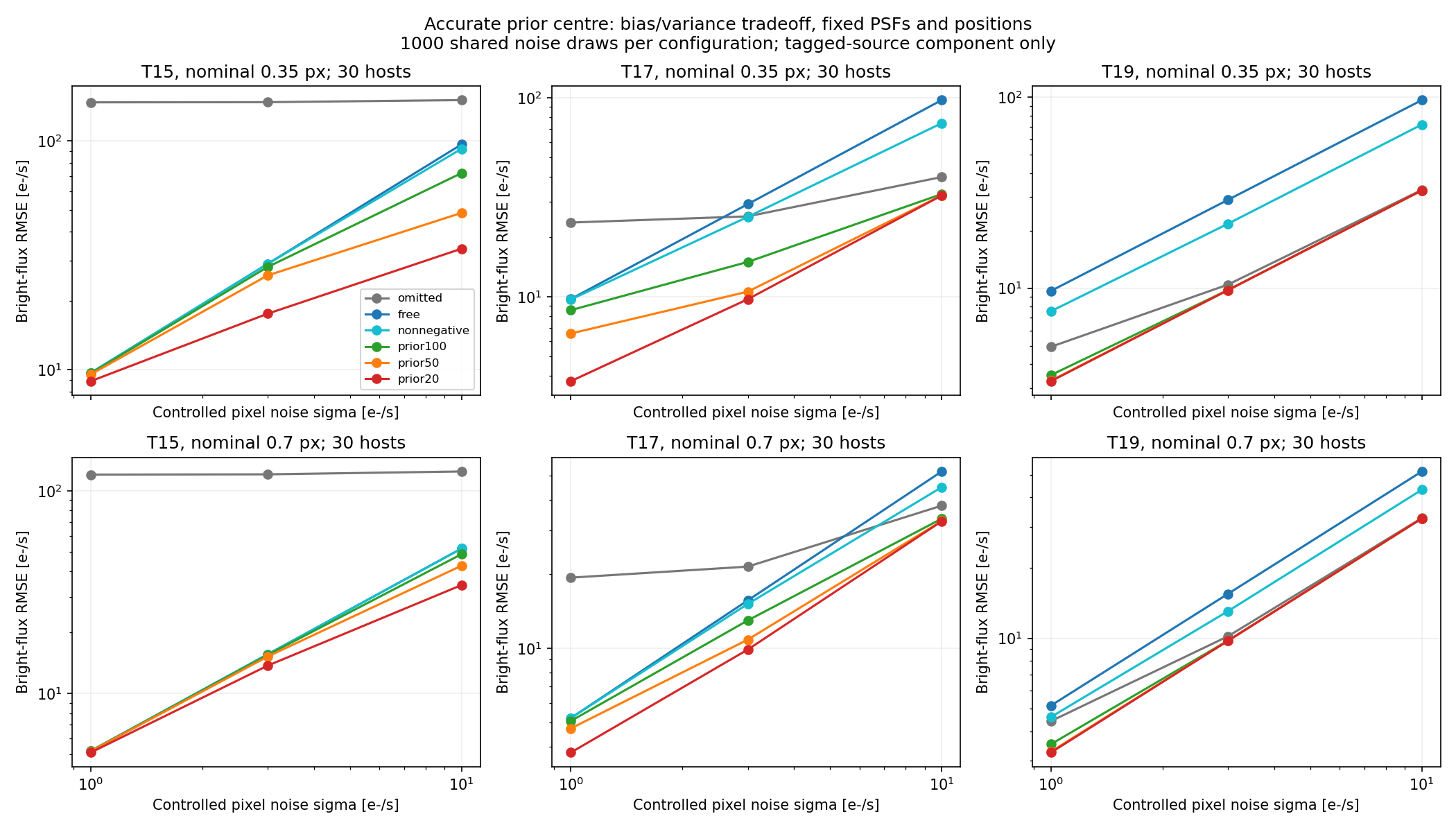
The following table has accurate prior centres. Bias is mean bright-flux error; RMSE includes bias and variance, pooled over 30,000 draws (30 host configurations). The free-mean Monte Carlo noise floor is about 0.09 e/s; it is not a real-sky significance estimate.
| Method | Mean bright bias (e/s) | Bright RMSE (e/s) |
| omitted | +19.043 | 21.450 |
| free | -0.020 | 15.645 |
| nonnegative | -0.338 | 15.132 |
| prior100 | -0.056 | 12.979 |
| prior50 | -0.014 | 10.847 |
| prior20 | -0.010 | 9.886 |
The correct-centre 50% prior reduces RMSE from 15.645 to 10.847 e/s, about a third. This is variance reduction, not additional correction of noiseless contamination. A 100% prior gives 12.979 e/s. A correct narrow 20% prior gives 9.886 e/s, but depends strongly on centre accuracy.
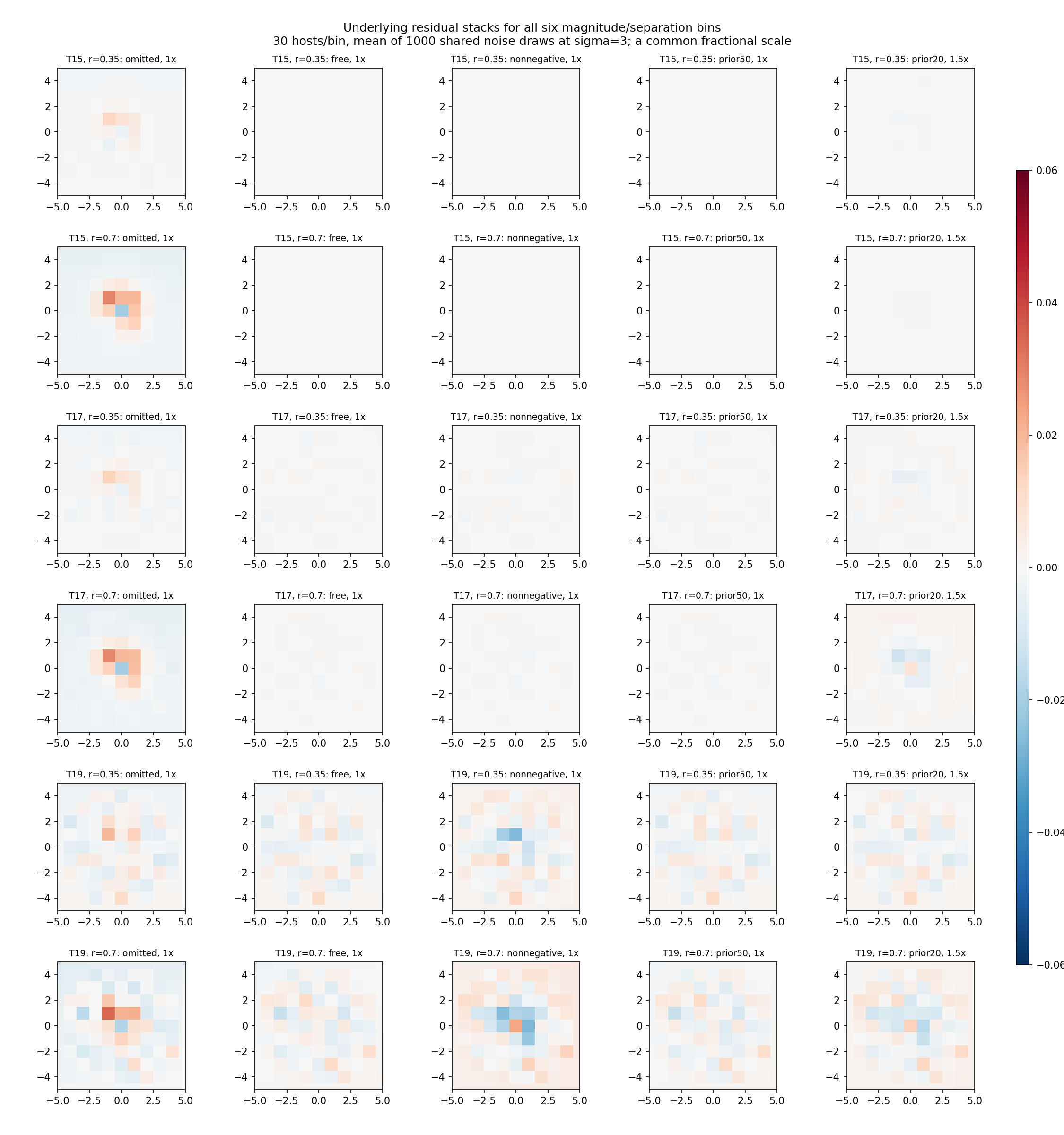
The following images are the residual stacks behind those curves, at sigma=3: each bin averages 1000 draws for each of 30 hosts, after dividing residuals by each host's known faint-source flux. All panels share a fractional scale. Finite Monte Carlo noise is visible for T19 because its source flux is small. Nearly zero pixel residuals can still conceal exchanged amplitudes between overlapping source models.
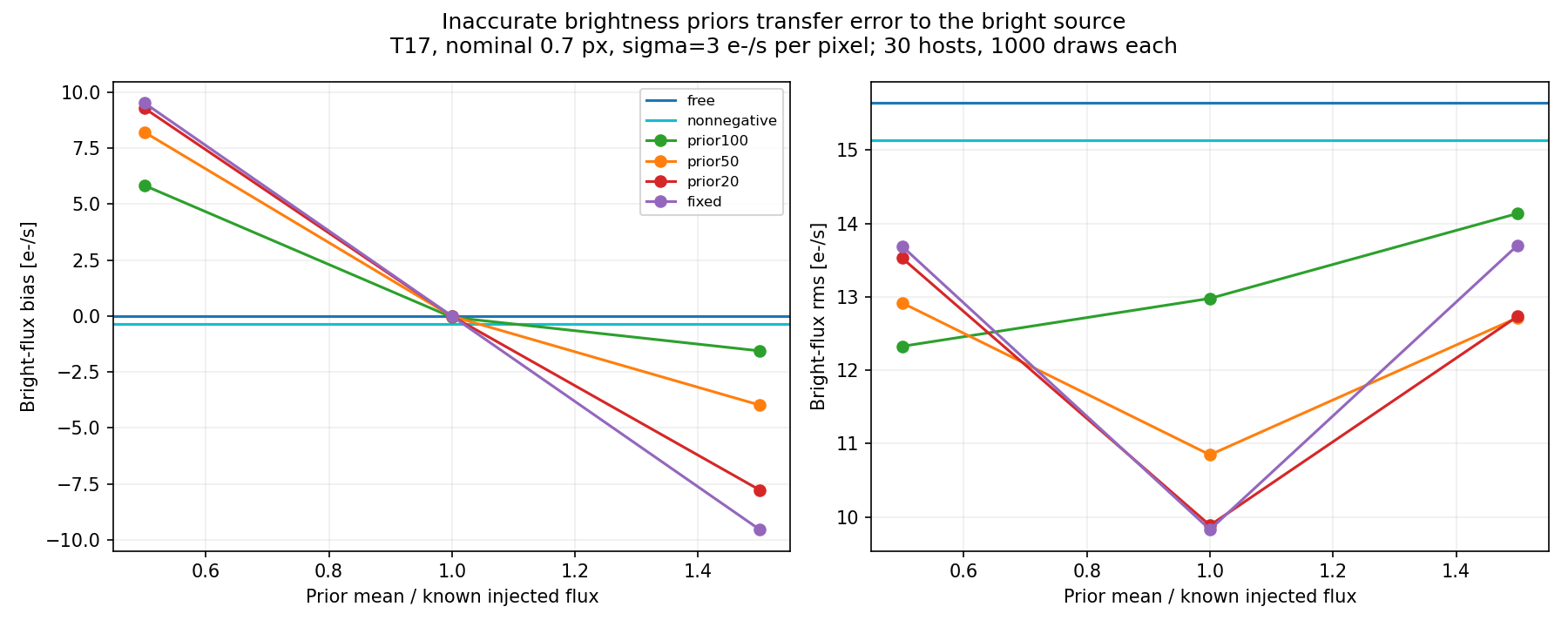
For T17/0.7/sigma=3, a 20% prior centred 50% too faint produces mean bright error +9.281 e/s; 50% too bright gives -7.768 e/s. A 50% prior gives +8.212/-3.976 e/s; a 100% prior gives +5.831/-1.556 e/s. Free flux has mean -0.020 e/s here and does not depend on a catalogue centre, at the cost of higher variance.
A wrong tight prior can lower RMSE while introducing an unacceptable systematic trend. RMSE alone cannot choose the science model. The asymmetry arises because absolute prior width scales with its changed mean. Controlled catalogue errors here are not a measured distribution of actual catalogue errors.
For T19/0.35/sigma=3, free neighbour flux is negative in about 45% of draws. Clipping at zero gives mean bright bias -9.062 e/s (RMSE 21.749), compared with free mean +0.077 (RMSE 29.029). Omission gives +3.695 (RMSE 10.440). This does not justify omitting real neighbours: it shows that nearly unconstrained faint components and clipped MAP values are poor estimators in this regime. Accurate-centre priors stabilize this controlled case, but their centres are supplied truth. Real data need calibrated brightness uncertainty or another tested inference scheme.
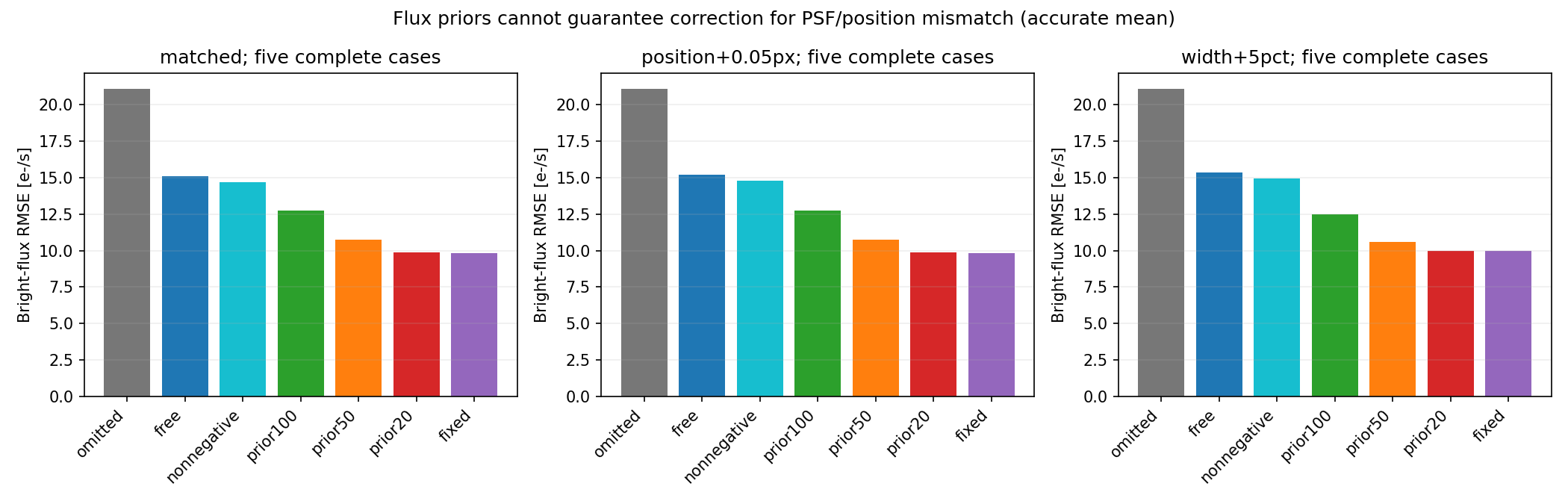
At sigma=3, the five complete cases give free RMSE 15.123 e/s, 50%-prior RMSE 10.778 with a correct centre, and omission 21.118. The following image shows one shared noisy realization per field, not the pooled Monte Carlo estimates. Noise partly hides systematic features, hence the ensemble and noiseless residual images are also provided.
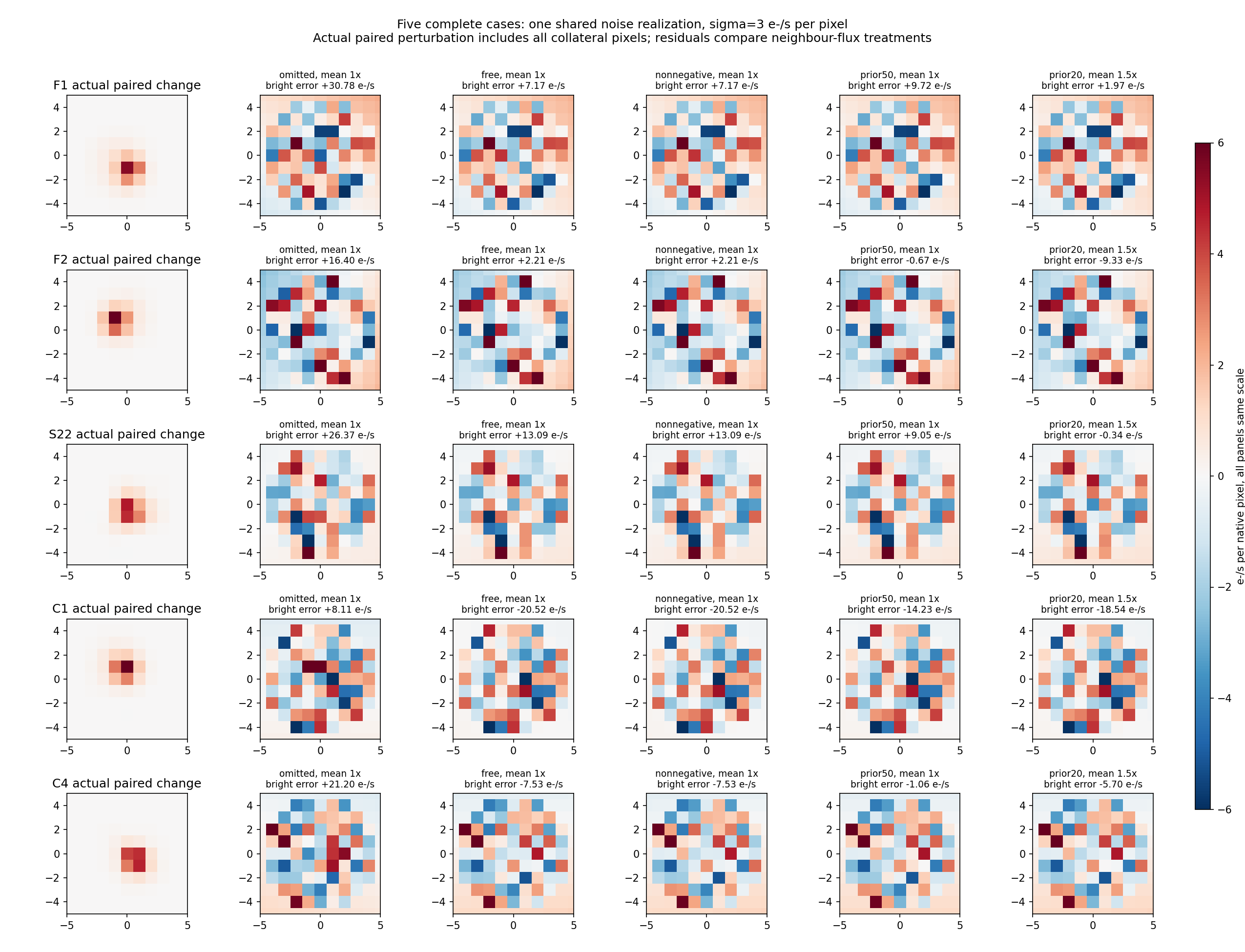
In the five complete cases, a deliberate 0.05-pixel horizontal model-neighbour shift gives noiseless free bright errors from -1.106 to +0.808 e/s. Broadening its model by 5% about the neighbour centroid gives -0.663 to -0.306 e/s. Brightness priors do not guarantee recovery when source shape or position is wrong. These are chosen stress errors, not measured inaccuracies. The image scales reveal small asymmetric/width residuals that the noisy RMSE bars alone hide.
1. Append actually removed catalogue neighbours as nuisance sources at consistent WCS positions, preserving the bright calibration-star selection.
2. Render neighbours with the scene PSF and solve their amplitudes jointly. For partially removed sources, include the retained template contribution explicitly; adding their full catalogue light to hp_d can otherwise double-count what was already subtracted. These close full-removal examples avoid that main ambiguity.
3. Compare free amplitudes with soft calibrated priors; bracket 50% and 100% as initial real-scene test arms. Keep prior-centre perturbations and 20%/fixed arms as robustness checks. These tests do not validate a default real prior width.
4. For weak close blends, investigate shared nuisance brightness over appropriate frames or marginalization; neither is tested here, and variable sources need separate treatment.
5. Validate on held-out real pixels and inspect bright bias versus colour/magnitude/separation, inferred nuisance flux, residual images, and PSF/WCS changes. A good image residual alone is insufficient.
Code branch `codex/ps1-stage-trace`, nested dev worktree. After mamba activate syndiff with OPENBLAS_NUM_THREADS=1 and OMP_NUM_THREADS=1:
python /home/kshukawa/syndiff_pipeline/dev/.claude/worktrees/codex-ps1-stage-trace/forward_epsf_wcs/diagnostics/ps1_neighbour_priors.py
DONE.json records input hashes, counts, seed and test parameters. tables/results.csv retains per-case metrics; tables/summary.csv pooled metrics; tables/solver_validation.json the independent algebra gate. All six figures were inspected. The standard training residual grid does not apply: there was no scene/ePSF training. This study complements the prior causal result rather than superseding it.
**Final conclusion:** model erased neighbours with fitted nuisance amplitudes. Soft brightness priors can help weak close blends, but inaccurate tight priors and positivity alone cause bright-flux bias. Preserve free-flux and prior-perturbed comparisons, calibrate prior uncertainty, and select the real-data treatment through corrected-scene validation.