TESS ePSF Atlas
How the effective PSF of a single raw TESS FFI depends on detector position, star colour and brightness, measured without a trained model, and what that implies for the ePSF/WCS fit.
Where things stand
Spatial shape validated
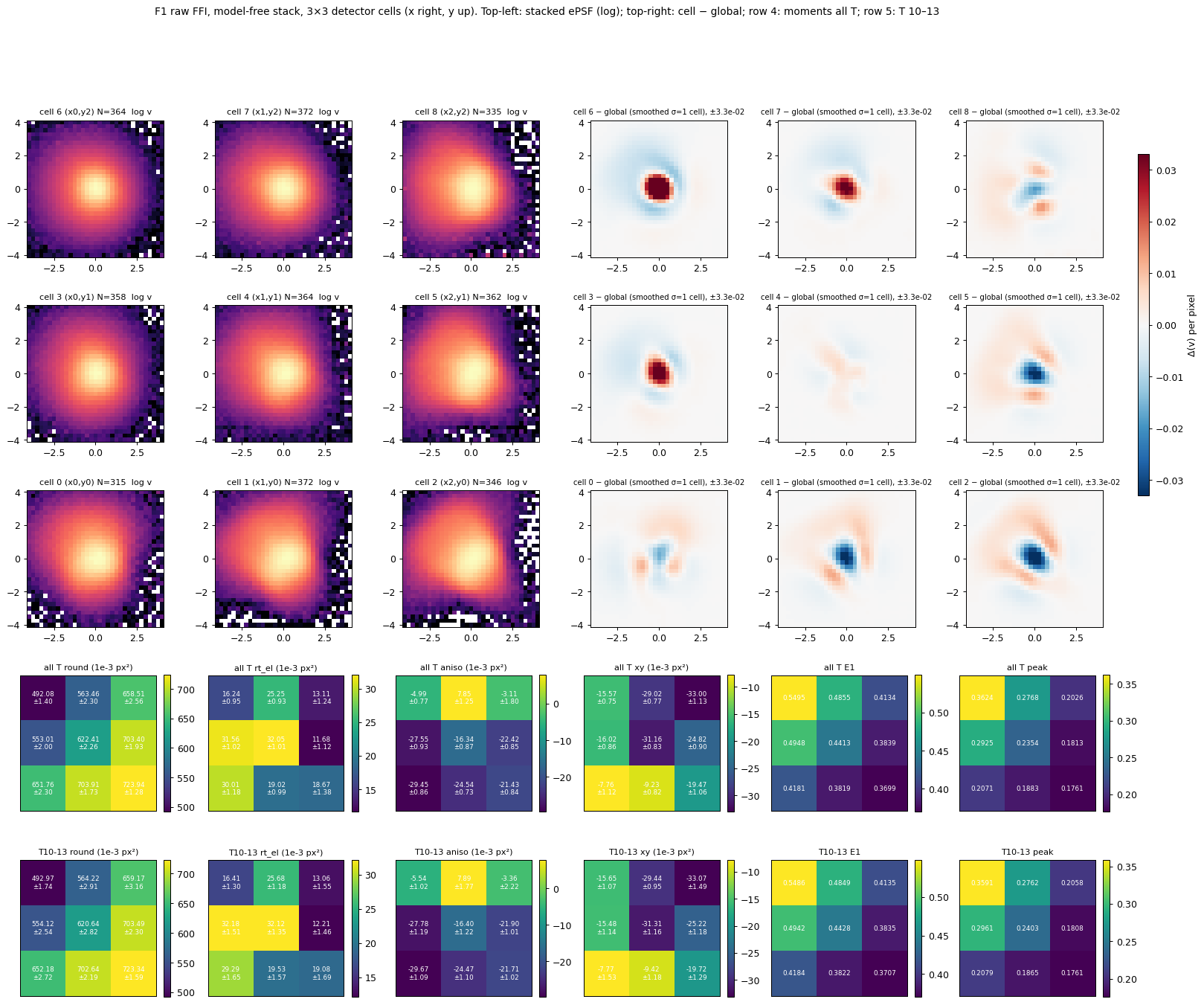
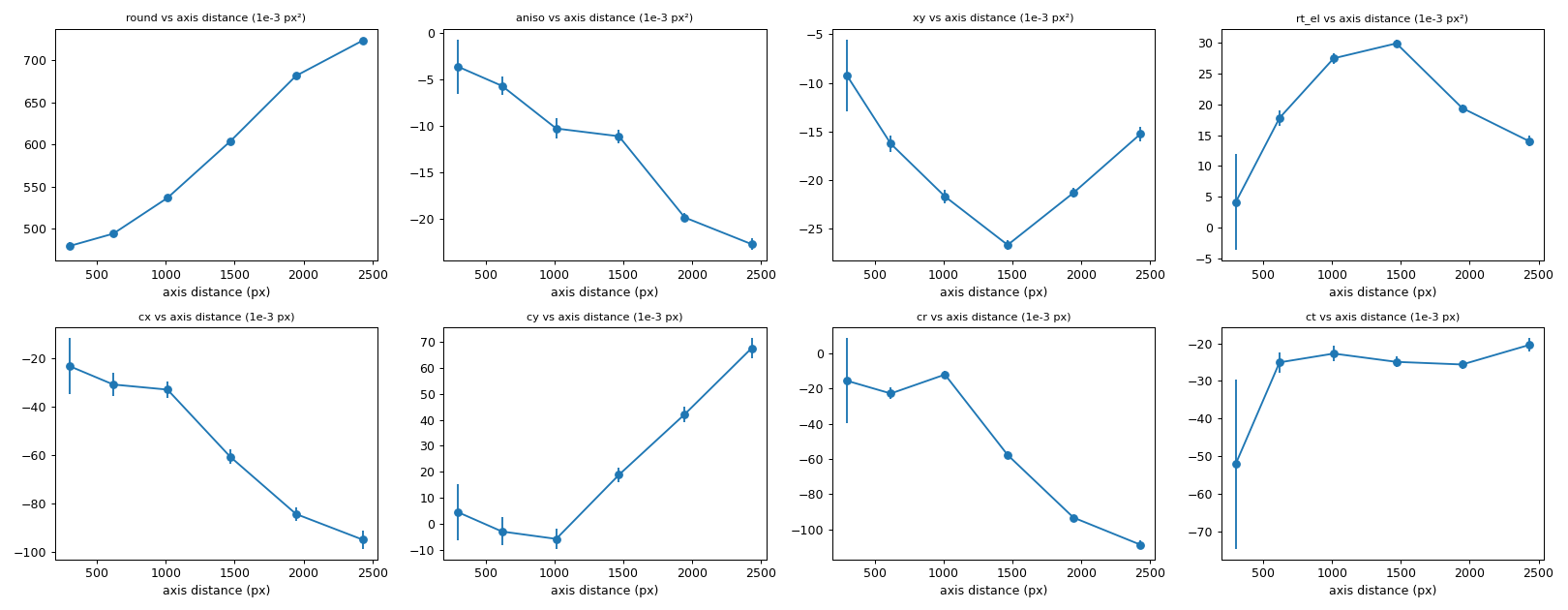
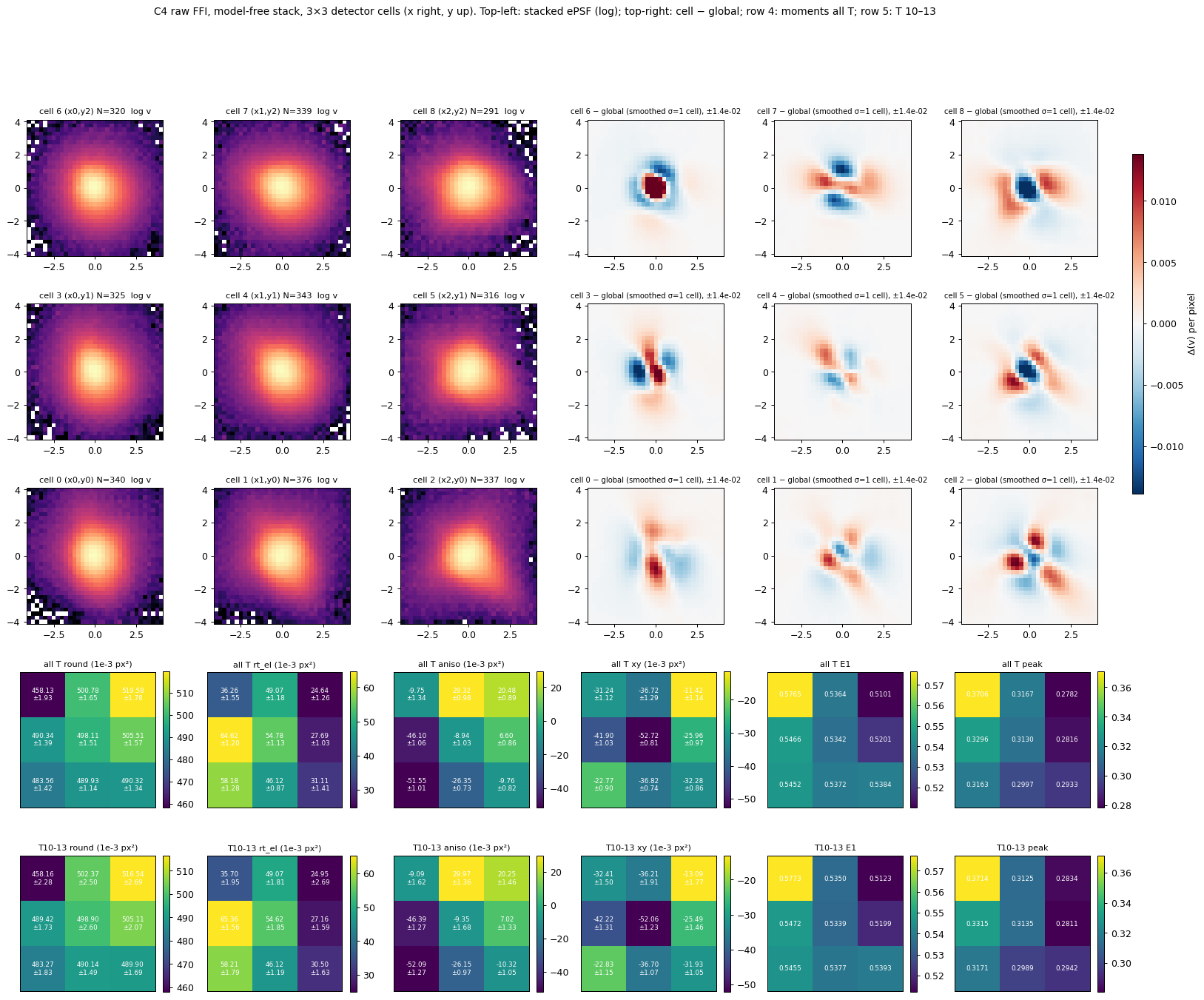
The PSF changes strongly and smoothly across the CCD: sharpest next to the optical axis (peak pixel fraction 0.36) and broadest at the far corner (0.18). It is elongated radially everywhere, plus a detector-frame anisotropy that rotates across the CCD.
Colour slopes validated
Red light lands radially outward of blue light (lateral colour), and red stars are sharper. Both are close to linear in colour. No colour-dependent elongation, and the colour effect is the same for bright and faint stars.
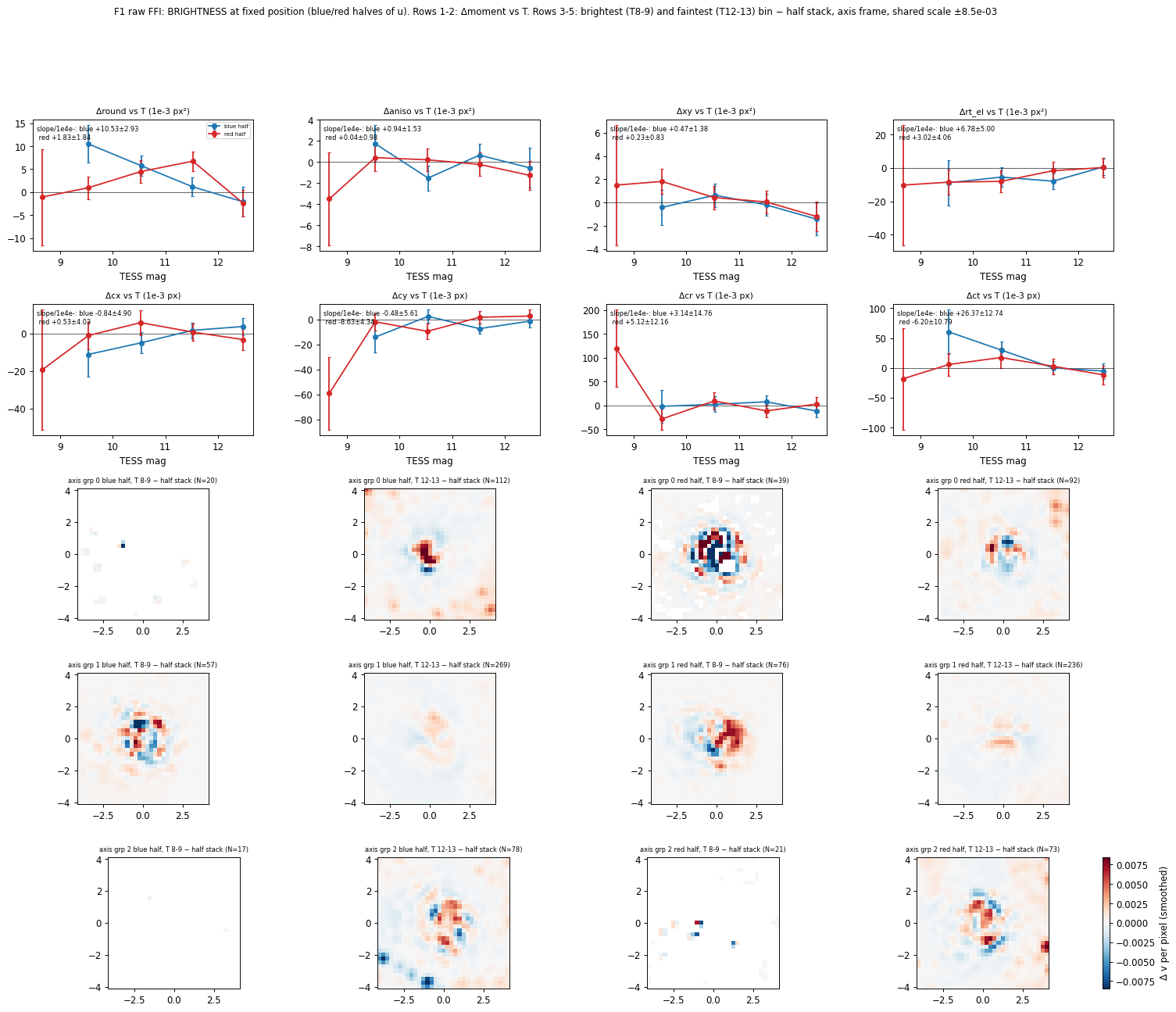
Brightness not measured yet
Single-frame stacks are too noisy at the bright end and their brightness slope fails the synthetic null. The main estimator (cross-fitted AK ePSF) will measure it once its validation gate passes.
hp_d vs raw footprint deficit
Shape, elongation and colour slopes agree between raw and hp_d. hp_d has extra light locked to the star positions. The real part is a deficit in the template inside each removed T<13 star's PS1 footprint (≲ 1–2 px). Everything under the footprint is zeroed, so hp_d gets back 0.3–3 % of the star's flux. The rest of the published feature (2–5 px) was a selection effect of my isolation cut. ks_b and the kernel are not responsible.
Method
Stars are stacked into a finely sampled empirical PSF per bin, aligned on their Gaia positions through a per-frame WCS refit (no per-star centre fit, so alignment noise does not depend on brightness). Each star is normalised by its flux inside 3.5 px, background is a plane fitted beyond 5.5 px, every star has equal weight, and the stack uses a 0.25 px grid with 10 % trimmed means and star-bootstrap errors. Colour and brightness are compared inside 3×3 detector cells and then combined, so spatial variation cannot leak into them. About 3,000 stars per field (8 ≤ T ≤ 13, unsaturated, neighbour light within 4 px < 10 %).
Shape is read from Gaussian-windowed moments of each stacked PSF:
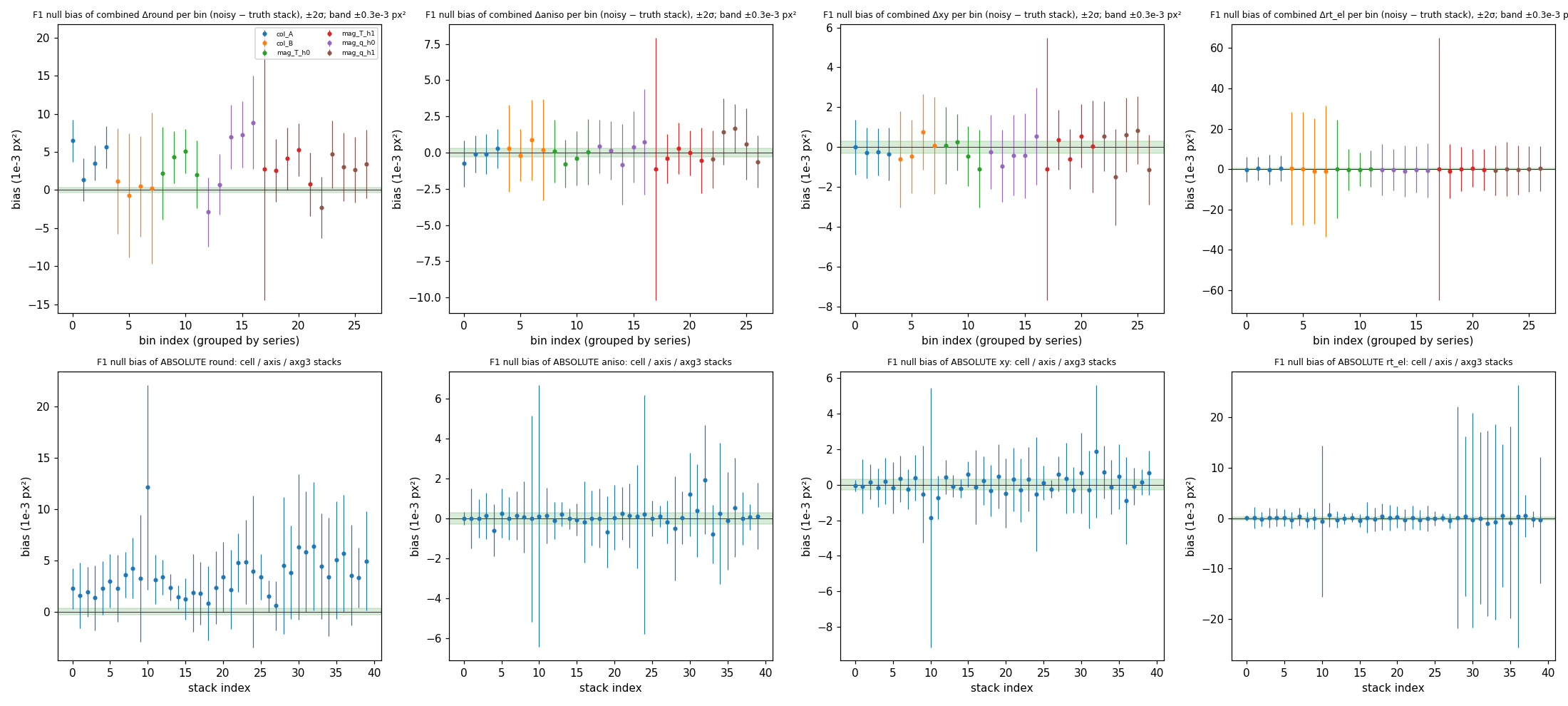
Validation colour + shape pass round level fails
The same pipeline was run on synthetic stamps with a realistically sharp truth PSF (central-pixel fraction 0.42 → 0.19 across the field), real positions, fluxes, neighbours and noise, and compared against stacks of the noise-free truth.
Spatial dependence
Colour dependence at fixed position
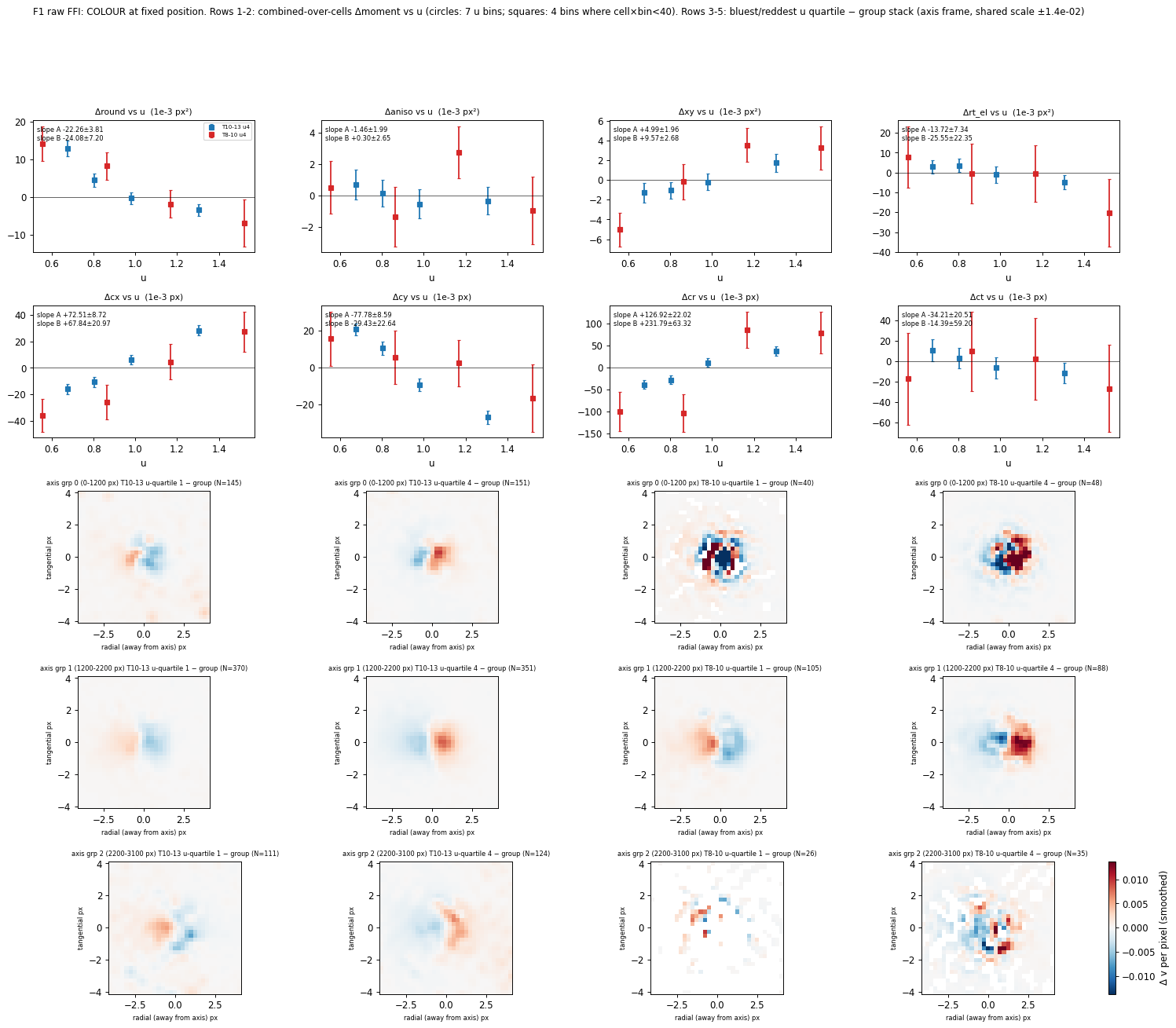
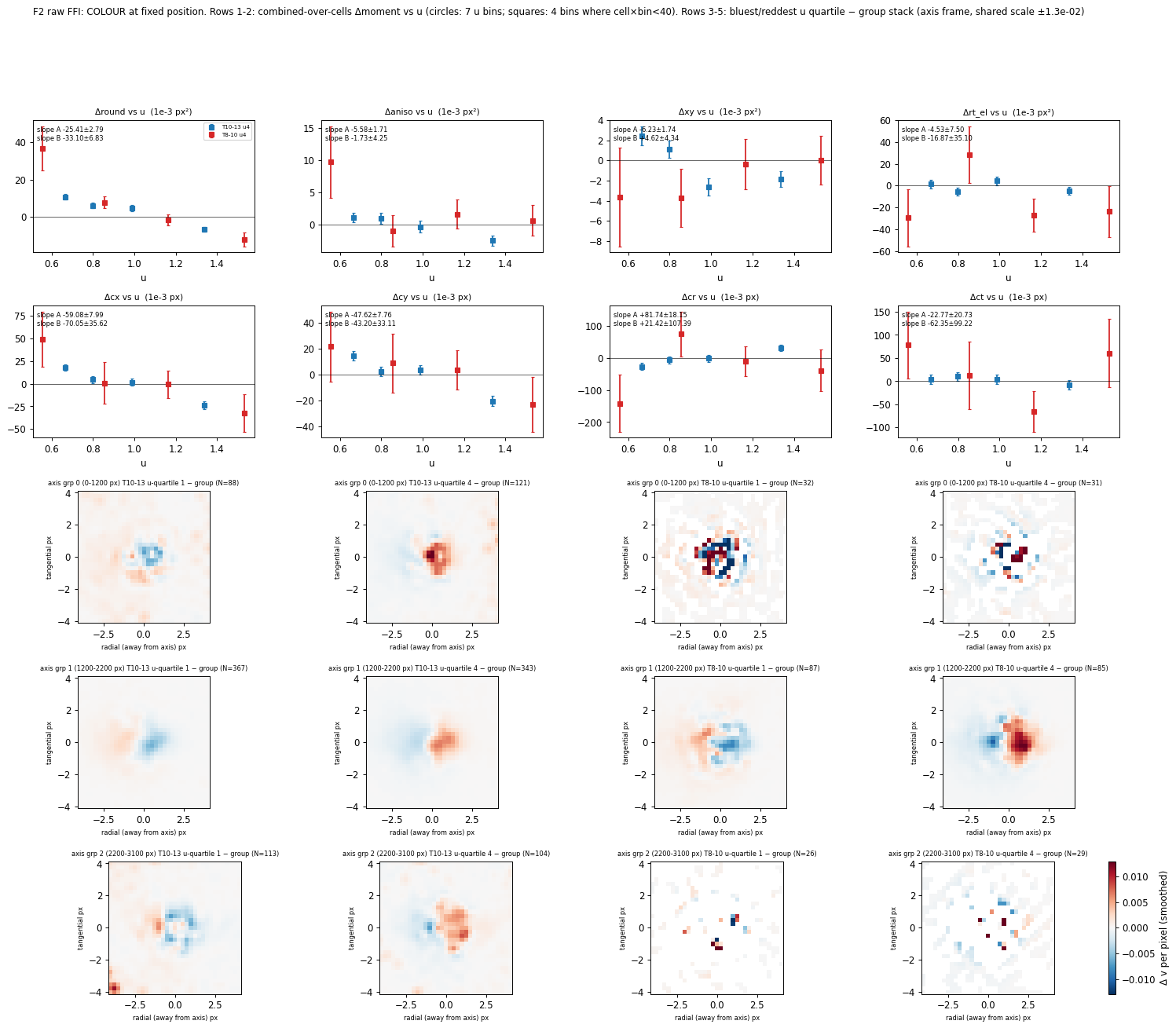
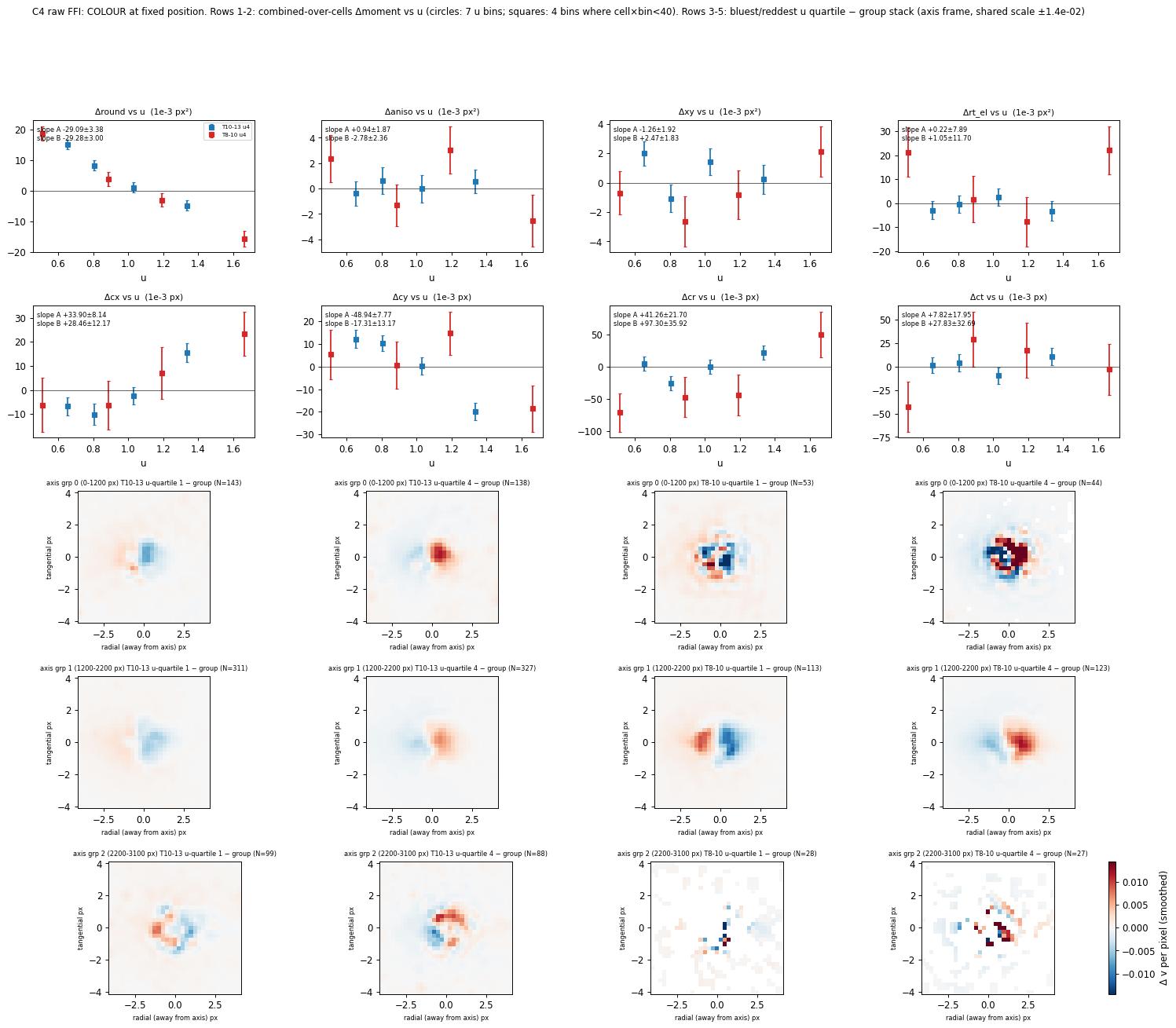
| Slope per unit u | F1 | F2 | C4 | Unit |
|---|---|---|---|---|
| Δround, T10–13 | −22.3 ± 3.8 | −25.4 ± 2.8 | −29.1 ± 3.4 | 1e-3 px² |
| Δround, T8–10 | −24 ± 7 | −33 ± 7 | −29.3 ± 3.0 | 1e-3 px² |
| Δcr (radial centroid), T10–13 | +127 ± 22 | +82 ± 18 | +41 ± 22 | 1e-3 px |
| Δrt_el (radial − tangential) | −14 ± 7 | −4.5 ± 7.5 | +0.2 ± 7.9 | 1e-3 px² |
| Δaniso / Δxy | −1.5 / +5.0 (±2) | −5.6 / −6.2 (±1.7) | +0.9 / −1.3 (±1.9) | 1e-3 px² |
Brightness dependence inconclusive
Raw FFI vs hp_d (paired, same stars and masks)
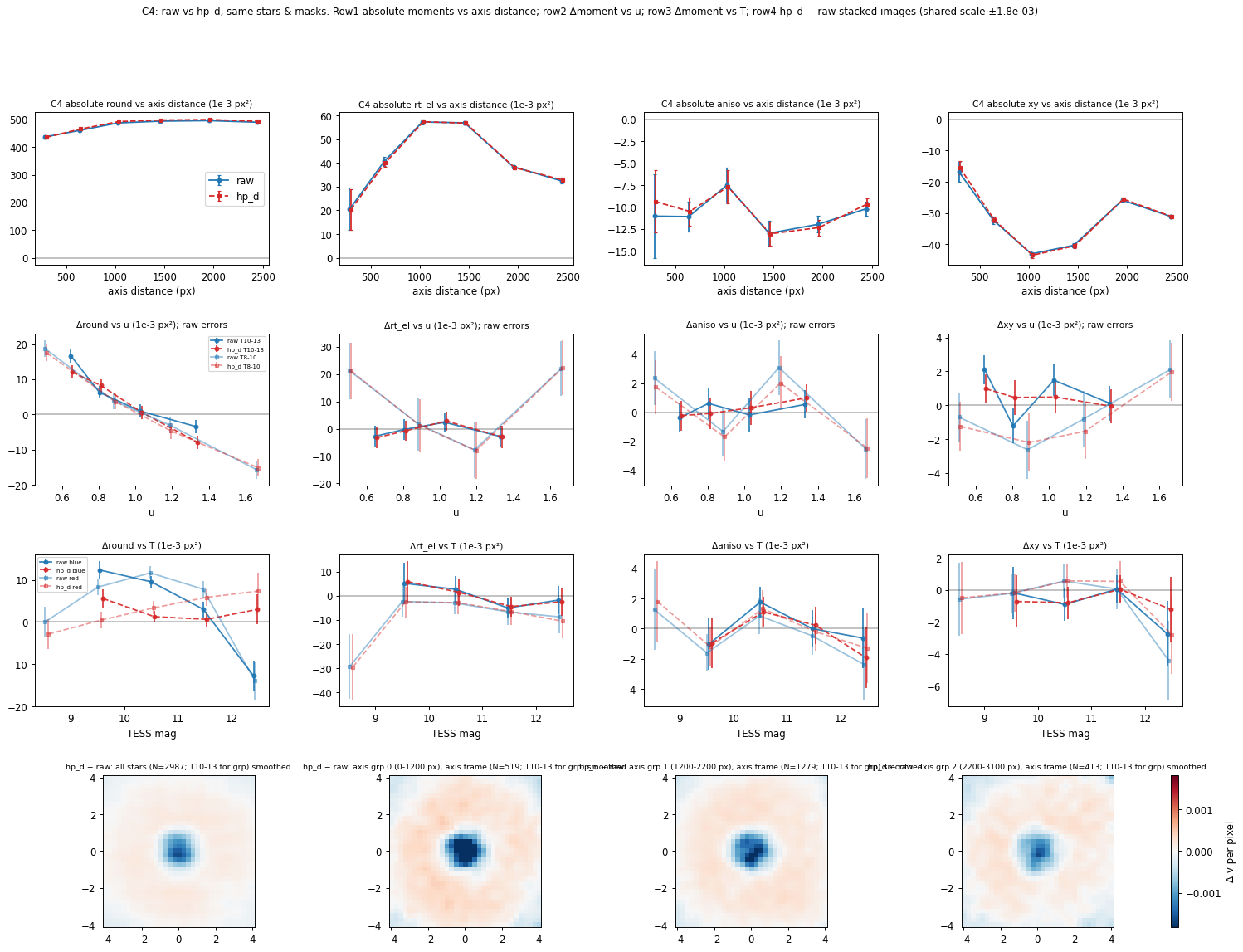
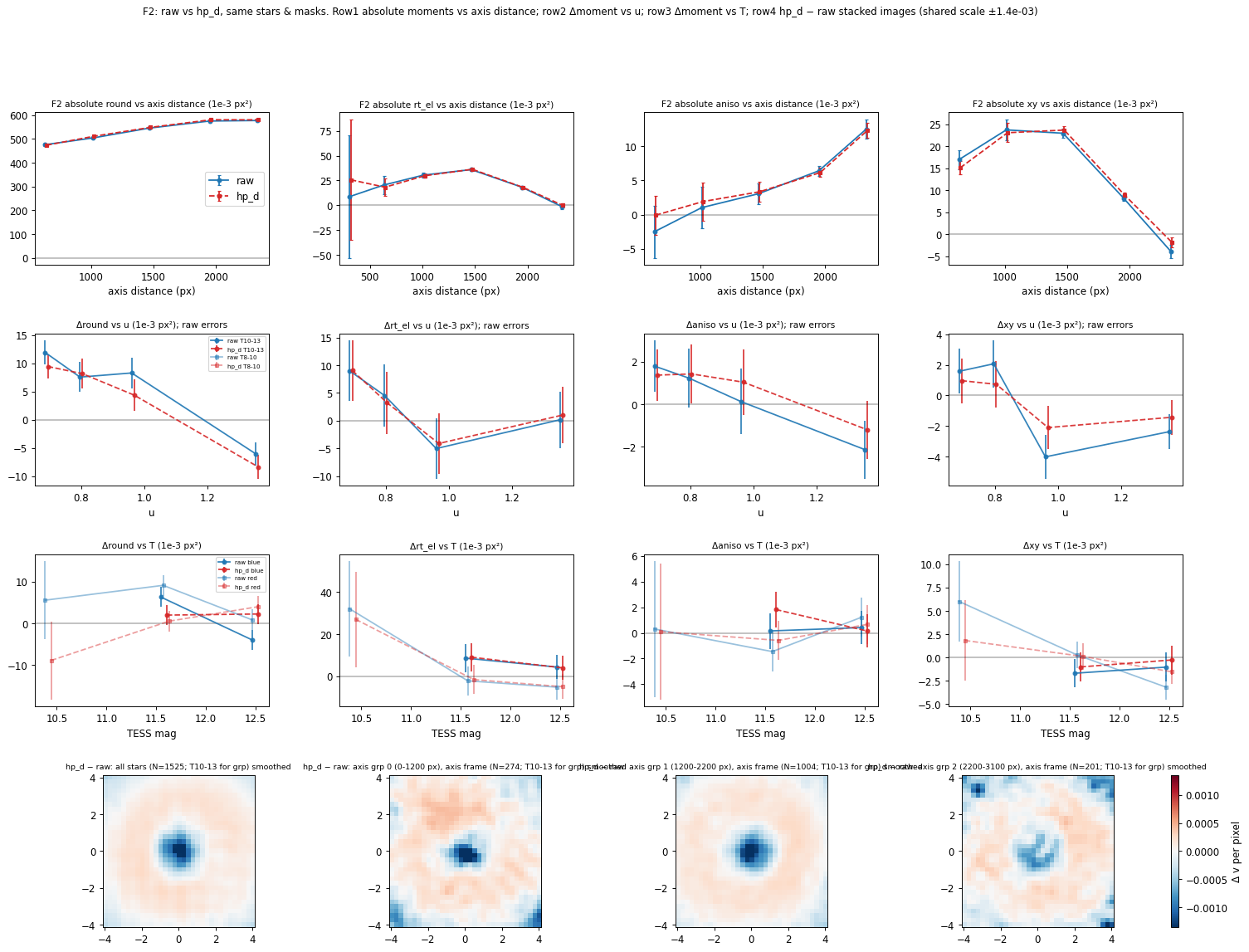
Where the hp_d − raw feature comes from
The difference image is built exactly as
$$d = S - b_{ks} - c,$$where $d$ is hp_d (e-/s), $S$ is the raw calibrated FFI (e-/s), $b_{ks}$ is the method-A background ks_b (e-/s), and $c$ is hp_c, the template convolved with the Hotpants kernel (e-/s). Hotpants also fits a constant offset (0.16 e-/s on C4, 0.10 on F2), which the plane fit removes. On the full 2048² images the residual of this identity has rms 5e-5 e-/s. Therefore $d - S = -b_{ks} - c$ exactly, with no third term.
Each term is stacked on the same stars with a common mask and normalised by the raw flux. A control stack at star-free positions 20–30 px away is subtracted, which removes the bias of the plane fit. All errors come from 200 paired bootstrap resamples.
| C4 | F2 | |
|---|---|---|
| Total Δround, control-corrected (1e-3 px²) | +9.14 ± 0.55 | +13.85 ± 0.91 |
| from the template term −hp_c | +8.08 ± 0.45 (88 %) | +13.84 ± 0.86 (100 %) |
| from the background term −ks_b | −0.37 ± 0.02 (−4 %) | −0.73 ± 0.05 (−5 %) |
| T-slope of total (hp_c alone), per mag | +11.0 ± 0.7 (+9.6 ± 0.7) | +14.0 ± 1.4 (+13.2 ± 1.2) |
| hp_c hole at the core (e-/s) | −3.55 ± 0.21 | −1.87 ± 0.16 |
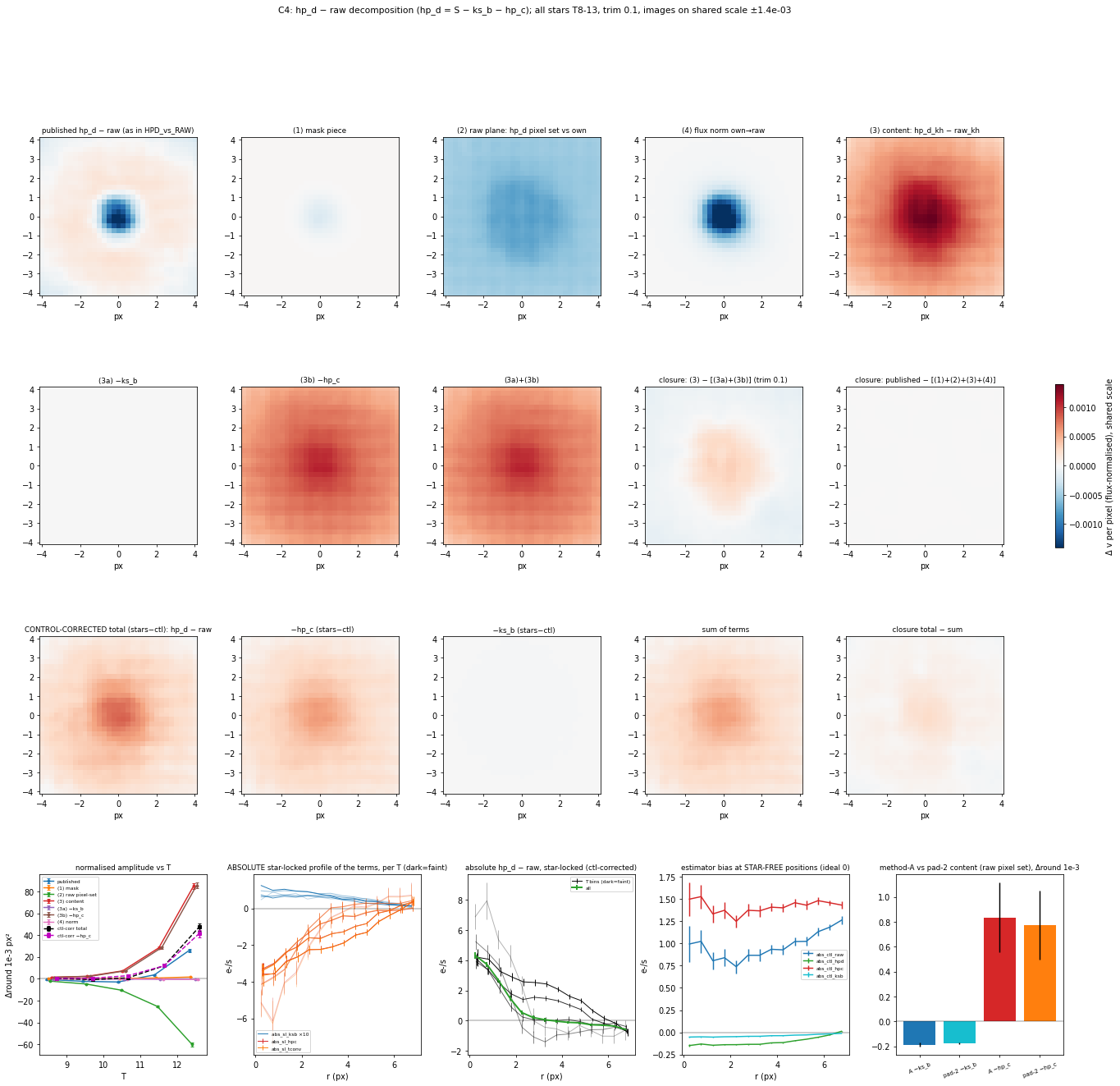
Row 1: the published hp_d − raw splits into four pieces. Two large pieces (plane-fit pixel set and content) cancel. The flux-normalisation piece produces the whole central "deficit".
Row 2: the content equals −hp_c. The −ks_b image is blank, and both closure images are near zero.
Row 3: the control-corrected total is a broad positive bump, carried by −hp_c.
Bottom row, second panel: the absolute hp_c profile is a hole of about −3.5 e-/s that fills in by r ≈ 5–6 px and is roughly the same for every T bin. The fourth panel shows the plane-fit bias at star-free positions: +0.8 to +1.0 e-/s on raw.
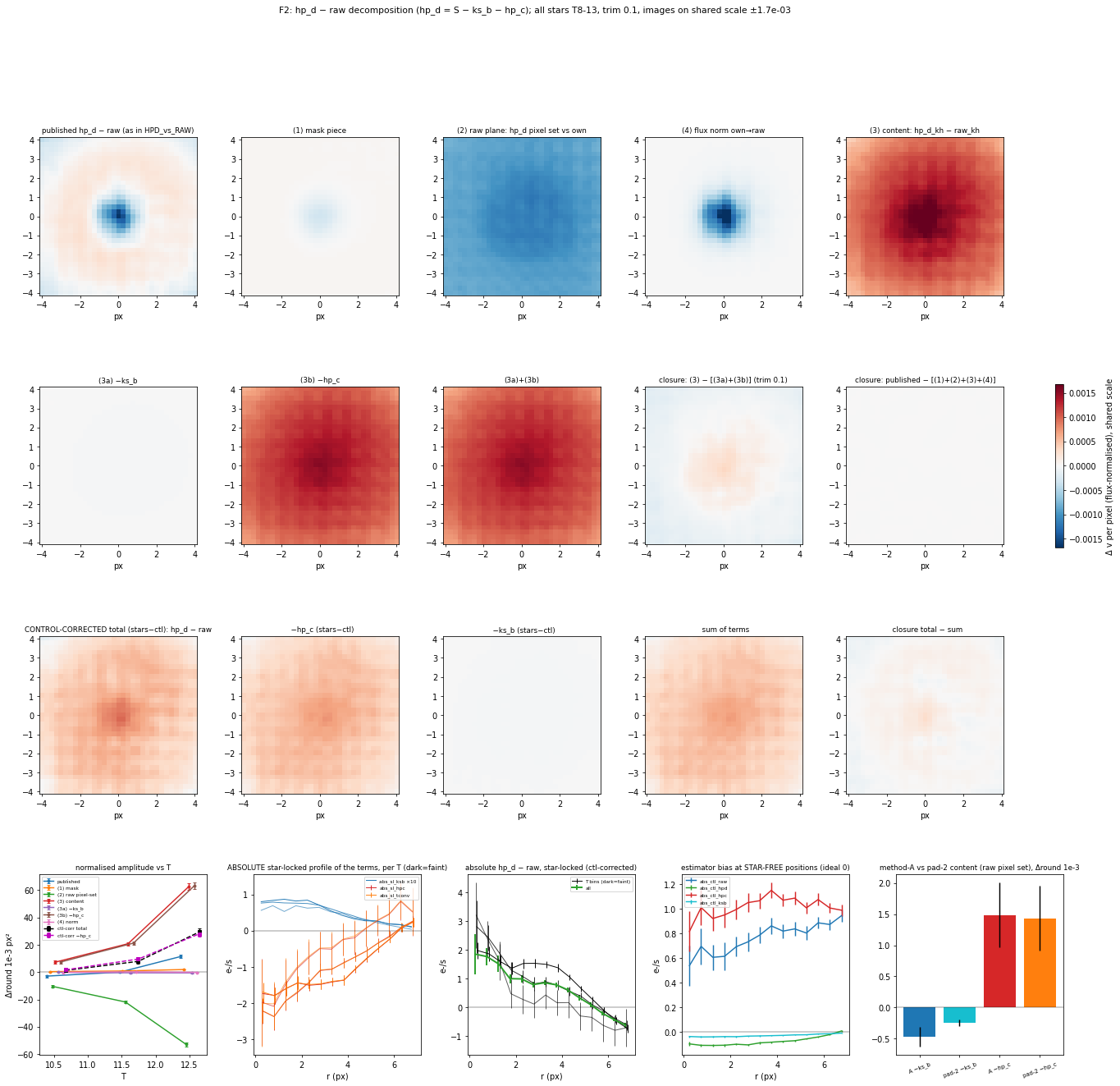
Conclusion (revised 10-01 evening after the PS1 check below). The hp_d − raw feature has two parts. (1) A real template deficit inside each removed star's PS1 footprint, r ≲ 1.2 TESS px for T 11–13 and ≲ 2 px for T<11: everything under the footprint is zeroed, including the faint-source light that the template keeps everywhere else. (2) A selection effect of my own isolation cut (cont4 < 0.1) at r ≈ 2–5 px. That part is not a pipeline problem. My earlier statements, that the hole reaches 6–7 px and scales with the local template level, came from mixing the two and are withdrawn.
Back to the PS1 skycells (8 C4 cells, recipe e17a198a)
Method.
I0: each cell rebuilt from the streamed raw PS1 r, i, z, y bands with the pinned code (648c0bc) and D13 weights.
Ibk: I0 with every non-segment pixel set to 0, using the identical SEP call.
I1: the published cell from which the template is built.
Wherever I1 ≠ 0 it equals Ibk exactly (max difference 0 in all 8 cells), so the rebuild is exact.
All 296 T<13 Gaia stars in the cells were removed.
Comparison positions: 159 kept stars with 13 ≤ T < 14 that are more than 400 PS1 px from any T<13 star, and 1600 control positions more than 300 PS1 px from any T<13 star.
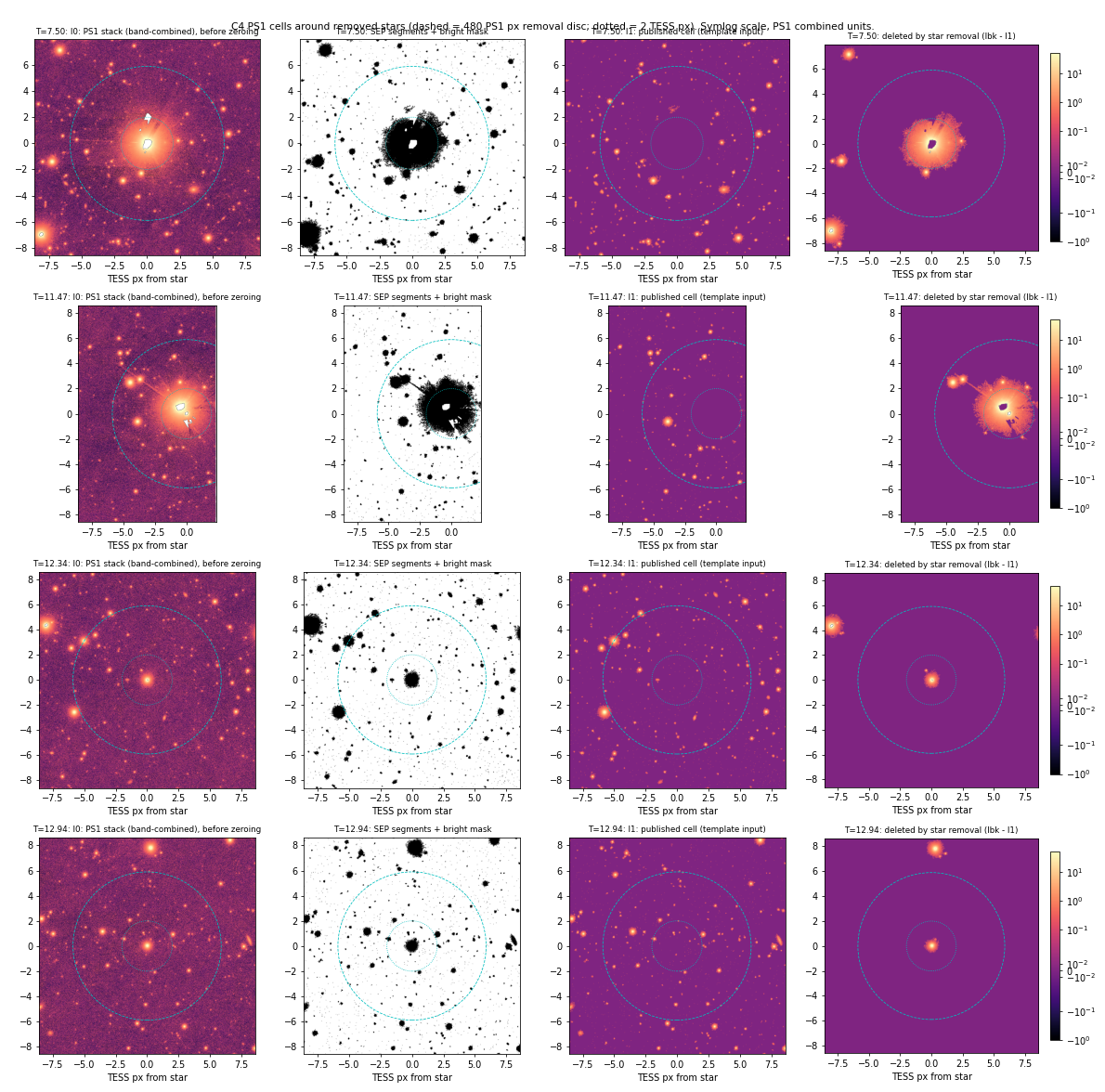
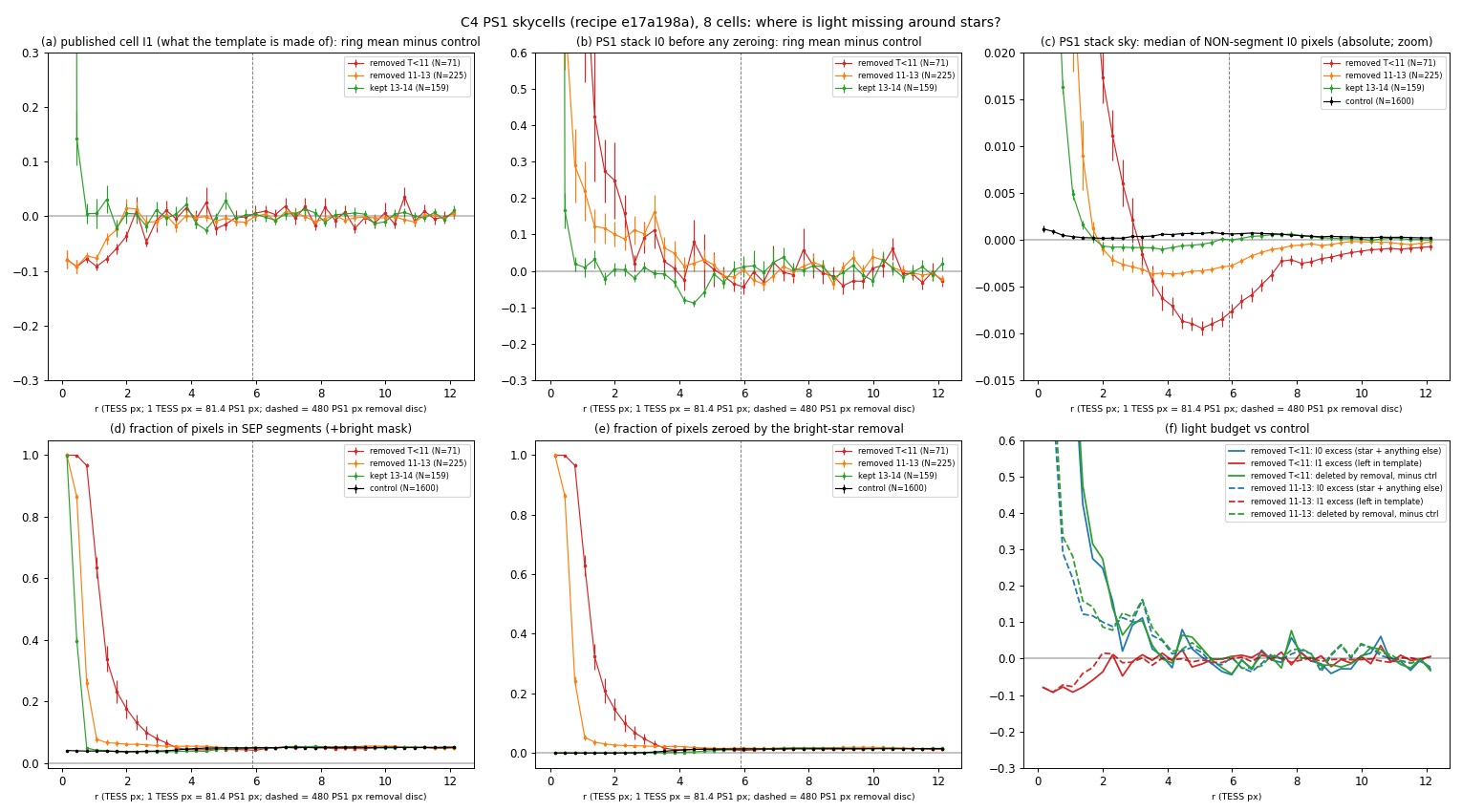
(a) Published cell minus control. Around removed stars the cell is −0.08 to −0.09 inside about 1.2 px (T 11–13) or 2 px (T<11); the control level is 0.075–0.08 PS1 units per pixel, so 100 % of the local light is missing there. From 2 px out the cell equals the control (±0.01). Kept stars show no deficit.
(f) The star's own light (I0 excess) is all deleted, and none is left in the template.
(c) The PS1 stack itself has an over-subtracted sky ring around bright stars: −0.009 at about 5 px for T<11 and −0.0035 for T 11–13. Those are non-segment pixels, which the template sets to 0, so this ring does not reach the template.
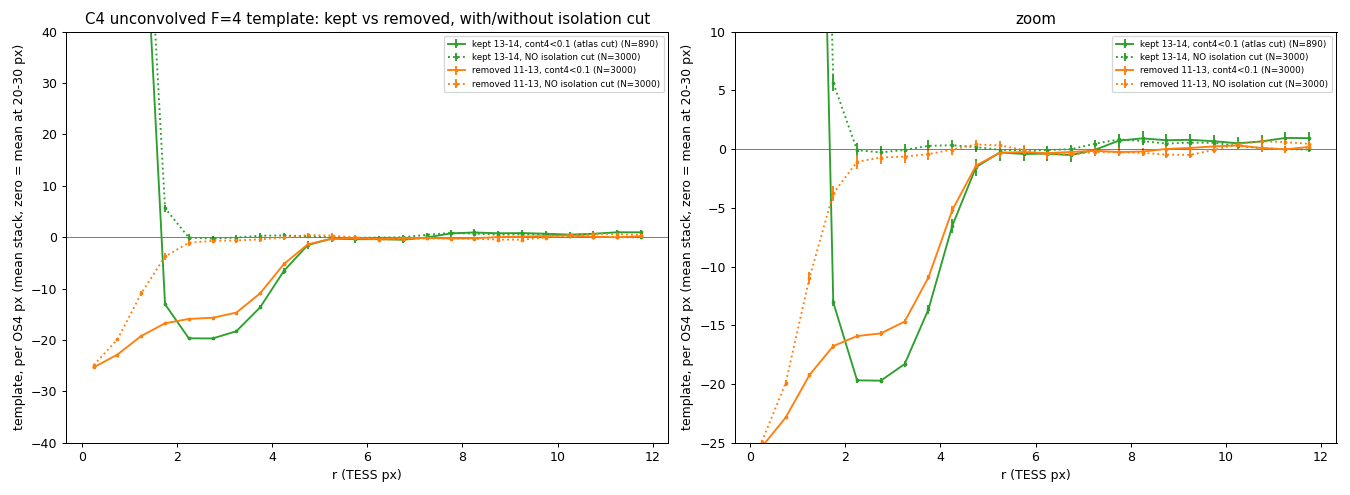
Kept T 13–14 stars, which are in the template, show a −19.7 moat at 2–4 px when the atlas cut cont4 < 0.1 is applied, and none without it (−0.08 ± 0.62).
For removed stars without the cut, the deficit is −24.9 at the core and −11.0 at 1.25 px, i.e. the template is empty there. It is down to −1.1 at 2.25 px and ≈0 beyond, the same as in PS1.
Size of the real deficit in hp_c, mean stack of all removed stars minus control, with no isolation cut:
| T 8–10 | T 10–11 | T 11–12 | T 12–13 | |
|---|---|---|---|---|
| C4 core (e-/s) | −7.9 | −7.7 | −7.2 | −6.1 |
| C4 missing flux, r<3 px (e-/s) | −110 ± 7 (0.42 %) | −72 ± 6 (0.84 %) | −66 ± 6 (1.9 %) | −44 ± 6 (3.2 %) |
| F2 missing flux, r<3 px (e-/s) | −71 ± 8 (0.27 %) | −65 ± 11 (0.74 %) | −30 ± 7 (0.85 %) | −17 ± 6 (1.2 %) |
Percentages are of the median star flux, taking T = 10 as 15000 e-/s. The deficit is gone by 2–3 px. In e-/s it is larger for brighter stars, which have bigger footprints, but smaller as a fraction of their flux.
Consequences.
- For hp_d: each removed star gets back the faint-source light that lay under its own footprint, +0.3 to +3 % of its flux. The percentage grows for fainter stars.
- For my atlas (bug, found 10-01): the relative isolation cut cont4 < 0.1 depletes neighbour light within about 4 px, in the FFI as well as the template. Because the cut is relative to the target's flux, it is stricter for faint targets. That imprints a magnitude-dependent moat on raw-FFI stacks, which biases brightness trends. It also explains the steeper-than-1/f T-slope and the 2–5 px part of the published hp_d − raw bump. The fix is a magnitude-independent, absolute neighbour-light cut, or a correction measured from the template. Brightness results are on hold until this is done.
What the model needs (preliminary)
- Needed: a radial colour shift linear in u, and a round colour-width term linear in u.
- Not needed at this precision: colour-dependent elongation, a colour × brightness term.
- Still open: the brightness width term; how $a$ and $w$ depend on $\rho$; how much of this the A3 model already contains (next: subtract A3's own colour response star by star).
Main estimator gate (V1) running on Condor
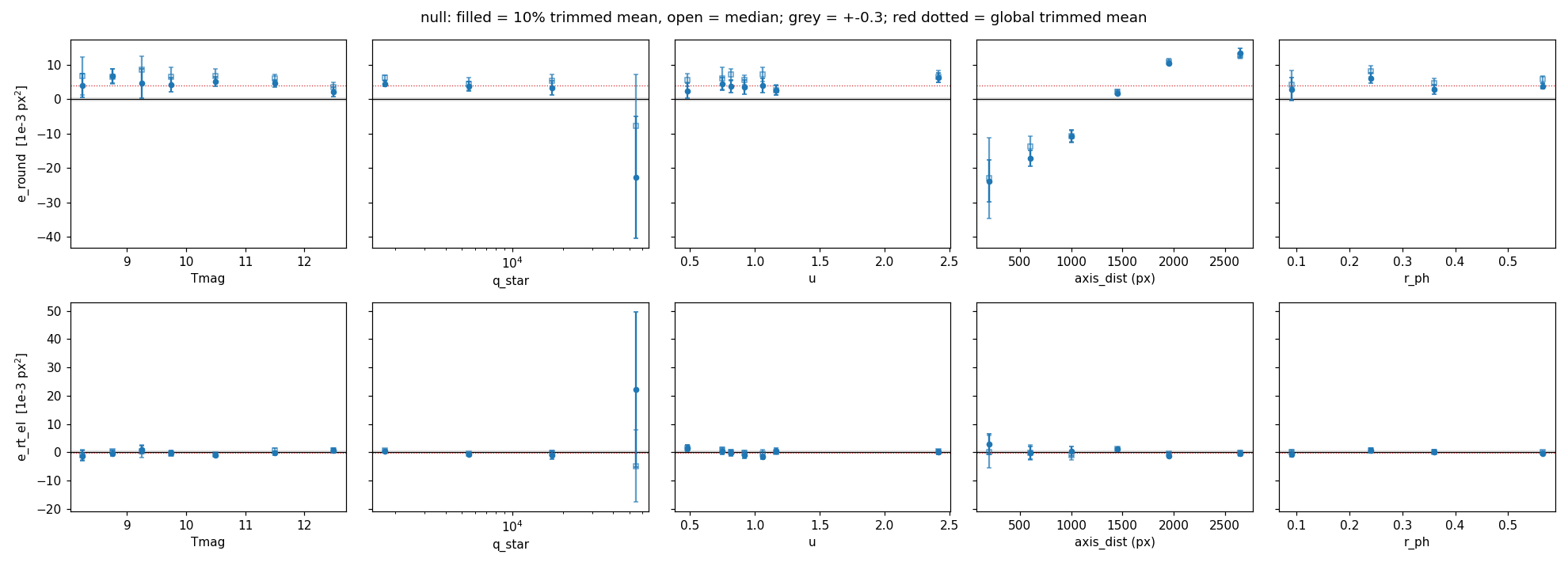
The cross-fitted Anderson–King estimator (adapted from bfwidth_20260929) measures blur covariance directly and can reach the brightness law, but its first small test runs showed two spurious trends: bright stars appearing broader (−2.0 ± 0.4e-3 px² per 1e4 e⁻, larger than the effect sought) and a width error that follows distance from the axis.
Astrometry: C1 header WCS
Bugs found and fixed
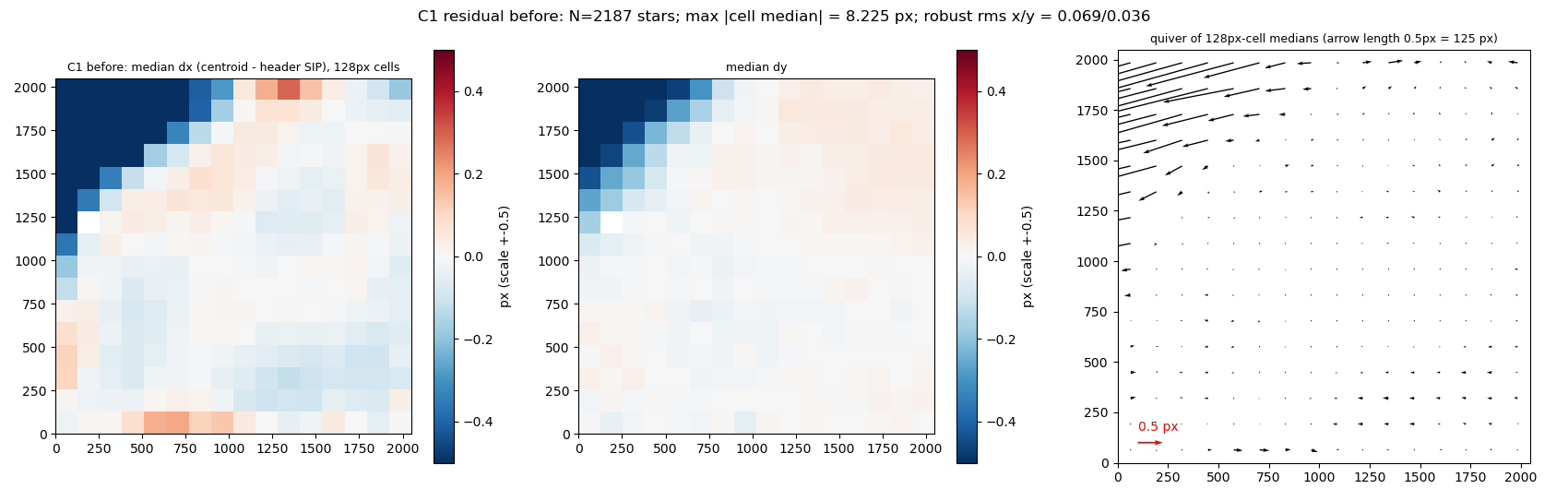
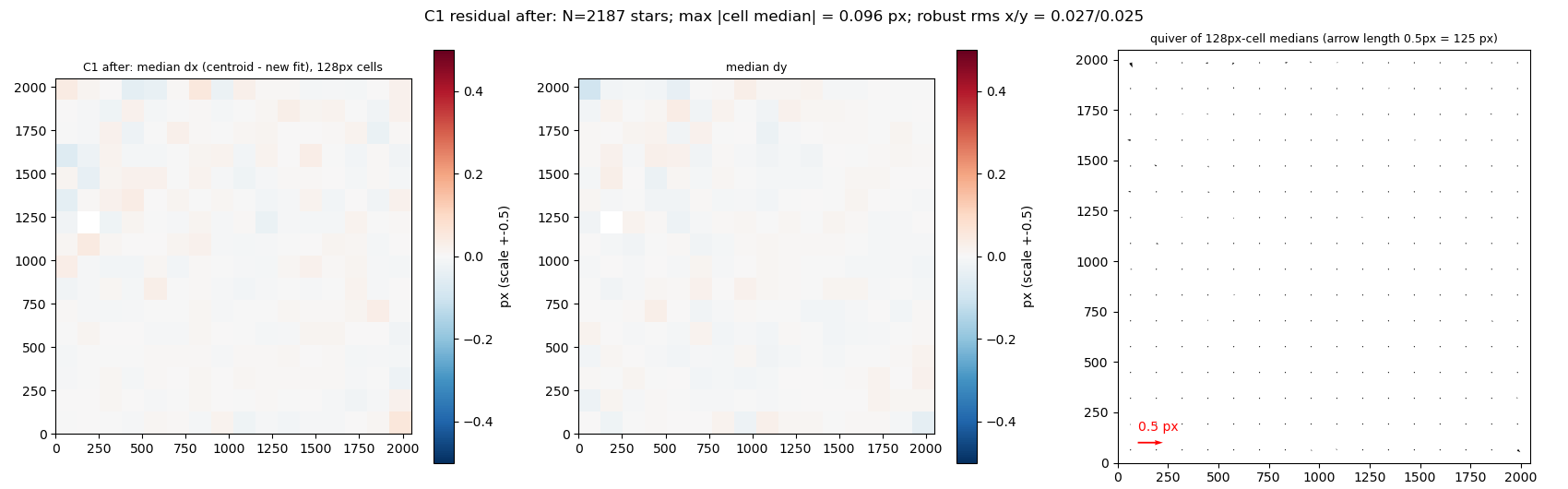
- C1 header WCS wrong by up to 12 px near the optical-axis corner (SPOC SIP solution). Fixed with the per-frame refit above.
- Isolation cut kept only 2–10 % of stars (counting any neighbour brighter than T+5 penalises faint targets). Replaced by neighbour light within 4 px < 10 %.
- hp_d mask rule would have masked 74 % of pixels (bit 32 is hotpants' input mask, including the bright-star disks). Only bit 0x8000 is masked now.
- Synthetic-PSF pixel integration 1 % wrong with the midpoint rule. Switched to Gauss–Legendre (3e-14).
- One near-zero-flux star destabilised the stack bootstrap. Added a 0.3-mag flux-outlier cut.
- The raw-vs-hp_d stack was not paired. Three problems:
- The raw stack did not get the hp_d 0x8000 mask. This contributed 14–24 % of the published Δround.
- hp_d was normalised by its own flux, which the template hole inflates. That normalisation alone made the core "deficit".
- Each image had its own plane-fit pixel set. That choice moves Δround by −19e-3 px².
Open: (1) The V1 gate is being scored. (2) The template removes the faint-source light under each removed star's footprint; this is for the paper pipeline. (3) The atlas isolation cut is relative to the target's flux and so depends on magnitude; it must be replaced before any brightness result.