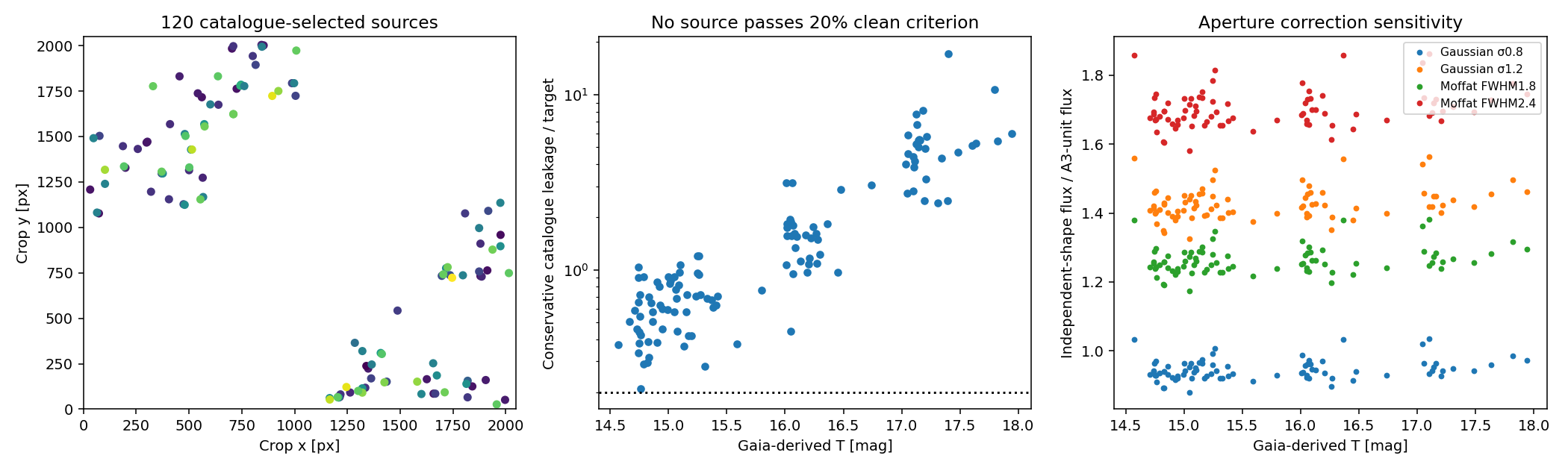
Conclusion: a concrete weak-prior scenario is now available; a clean or fixed-flux calibration is not established. This bounded pilot measures raw C4 image fluxes for independently catalogue-selected faint sources, quantifies aperture/annulus/profile sensitivity and provides a frozen image-unit prior recipe plus common pixel exclusions. It permits conditional model tests without treating an absolute-calibration gate as a prohibition on all experiments. The T17–18 deficit must not be adopted as a physical magnitude correction.
All work is confined to this directory. Production data, peer experiments, templates and jobs were read-only. No new catalogue query, ePSF training or production change occurred. Canvas.
Existing Gaia caches explicitly have no magnitude cut. After exact-ID deduplication and the C4 footprint transform they contain 1,005,744 sources, including604,791 with Gaia-derived T≥18. The complete-CCD pixel-to-sky roundtrip passes for every retained source (maximum0.000193arcsec); no divergent WCS solution leaked into the detector sample. Gaia2016 positions are propagated with recorded proper motion to FFI midpoint2020.23463. Candidates with missing proper motion are excluded; missing-motion neighbours remain in the isolation catalogue with zero-motion approximation and flags. The raw full-FFI crop is x[44,2092),y[0,2048); all quoted detector coordinates are crop-local.
The archived330,459 unique Gaia–PS1 associations provide93,324 potential T13–18 sources passing conservative unsaturated band limits r≥15,i≥15,z≥14,y≥13. Before measuring images, we required unique best+primary measurements,≥5 detections, finite positive formal errors below0.1mag in riz and0.2mag in y, and the already archived F1 PS1 reference-bad-bit policy. PS1 rows came from frozen source snapshots. Matching IDs are preserved as integers/strings, never floating point.
No source passes the predeclared clean criteria. Both strict and relaxed summed-neighbour-flux isolation within4/8pixels failed. A conservative analytic-Gaussian small-aperture absolute-leakage bound≤20% also had zero candidates. We retained this negative result. We then froze an explicitly conditional diagnostic population: at most five catalogue-ranked sources per magnitude×CCD-cell, ranked by predicted contamination, with no T<13 source within10pixels and the recorded preliminary crowding bounds. No measured flux, S/N, residual, chi-square or epoch consistency entered selection.
The resulting 120 sources cover six CCD patches and T14–18,30 per integer-magnitude bin. 82 pass the fixed physical-mask and aperture/annulus geometry:22,26,20,14 in the four bins. Their actual T range is14.572–17.943. Thus T13–14 and part of T14–15 are unmeasured. The cohort is the least contaminated available rank, not clean calibrators. Survey-incomplete companions and PS1-only objects remain unbounded.
Raw FFI: /astro/armin/koji/syndiff/dev_runs/paper_dataset_20261001/data_root/s0023/c4/k2/ffi/tess2020087042920-s0023-4-2-0177-s_ffic.fits.fz. Physical mask: /astro/armin/koji/syndiff/dev_runs/paper_dataset_20261001/C4/lane_f1/lane/shared_mask.fits.fz. Raw image pixels and their error plane are in electron/s. The new F4 template does not enter these raw-aperture measurements.
Only the faint-catalogue mask bit32 is ignored; bright-catalogue, saturation-cross, strap, edge, PS1, TNS and asteroid bits are excluded. Primary radius is1.5pixels, with8–12pixel annulus. The annulus excludes1.5pixel circles around Gaia neighbours brighter than targetT+2. Required usable area is≥98% in the aperture and≥25% in the annulus. Failures and signed fluxes remain in the delivered files.
For source $i$ and pixel $p$,
$$A_i=\sum_p w_{ip}D_p,\qquad R_i=\sum_p w_{ip}P_{ip},\qquad f_i=A_i/R_i.$$
Here $D_p$ is the raw pixel rate in electron/s, $w_{ip}$ is the dimensionless fixed aperture-minus-annulus weight including physical/source masks and effective areas, $P_{ip}$ is the exact archived A3 pixel response per amplitude, $A_i$ is net aperture rate in electron/s, $R_i$ is the dimensionless response of the same complete aperture/annulus operator, and $f_i$ is the conditional A3-amplitude-equivalent rate in electron/s. We do not renormalize the profile over visible pixels.
The exact native15pixel renderer is symmetrically zero-padded for extraction. Its finite represented support is explicit. A preflight caught and fixed a helper error: simply requesting n_pix=21 from an unchanged63×63 grid leaves the native band origin at pixel7, rather than centring it at10. This affected only preliminary extension-helper products, which were regenerated before interpretation; no production/model fit changed. The final model origin, source IDs and aperture centring are checked. Fitted A3 WCS and explicit chromatic shifts are frozen. PS1 effective wavelength is mapped through the archived C4 colour map; D13 flux weights do not silently redefine the A3 colour label.
The exact conditional statistical covariance is
$$C_{ij}=\sum_p\frac{w_{ip}w_{jp}\sigma_p^2}{R_iR_j},$$
where $C_{ij}$ is covariance between inferred amplitudes in squared electron/s, and $\sigma_p$ is the supplied FFI pixel error in electron/s. Shared global pixels are retained; the propagated diagonal matches each aperture error. The82 supported measurements form60 pixel-overlap components, with maximum absolute off-diagonal correlation0.027. Unknown background/profile/catalogue covariance is not included. Spatial-patch bootstrap intervals below describe sensitivity across six heterogeneous patches, not guaranteed confidence intervals.
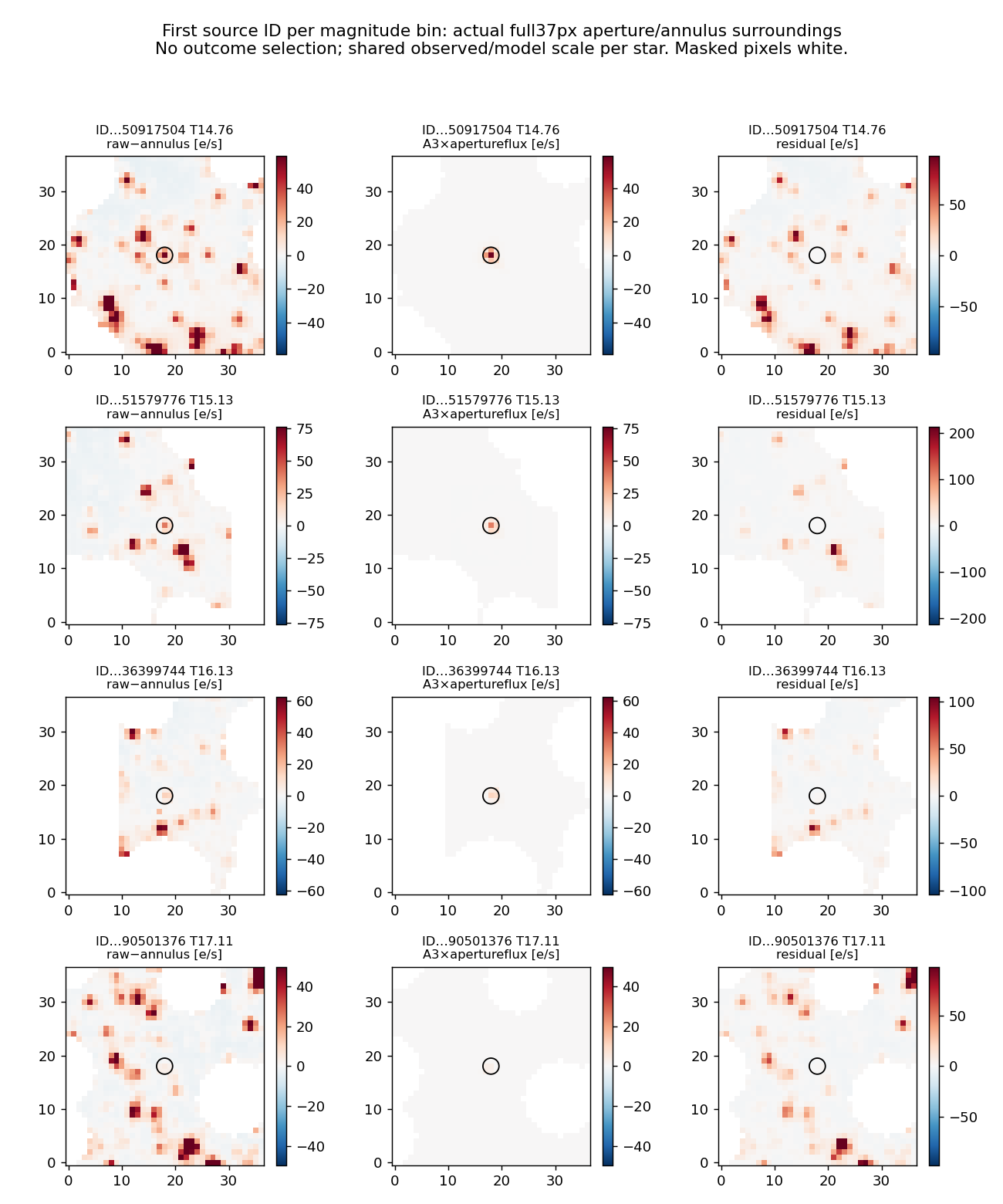
The first exact source ID in each magnitude bin is displayed, without outcome selection. Faint stars sit among substantial other light. The displayed model is the target's A3 response times the aperture amplitude; it intentionally does not pretend to model surrounding stars.
Let
$$q_i=\sum_b v_b10^{-0.4m_{ib}},\qquad \mu_i=S q_i\exp[\beta(c_i-0.5\,{\rm mag})].$$
Here $b$ indexes r,i,z,y; $v_b=(0.254,0.4368,0.1654,0.1438)$ are exact D13 weights; $m_{ib}$ are PS1 AB stack magnitudes; $q_i$ is dimensionless; $c_i=r_i-z_i$ is PS1 colour in magnitudes; $S$ is the fitted image-rate scale in electron/s; $\beta$ is the fitted colour coefficient per magnitude; and $\mu_i$ is the conditional predicted image amplitude in electron/s. Each detector patch is predicted using only the other patches. All four measured magnitude bins remain in training; none is removed because its flux outcome disagrees.
The full-sample descriptive fit gives S=1.9231×10^8 electron/s, β=−0.09968 per magnitude. The six leave-patch scales span1.8976–1.9662×10^8, conditional on this estimator and colour family. A simpler constant-scale control gives S=1.9387×10^8 electron/s. These ranges omit shared systematic errors. Both are much lower than the old bright-calibrator legacy-weight scale; this is not evidence that one universal absolute zero point has been established.
| Gaia-derived T | N | Held-out median error | Patch-bootstrap sensitivity interval | Empirical central68% individual-error interval | ±100% scenario coverage |
|---|---|---|---|---|---|
| 14–15 | 22 | +5.9% | −0.9% to +10.9% | −3.0% to +14.1% | 22/22 |
| 15–16 | 26 | +1.4% | −1.9% to +4.4% | −9.1% to +14.7% | 26/26 |
| 16–17 | 20 | +7.4% | −10.0% to +28.4% | −15.7% to +37.4% | 20/20 |
| 17–18 | 14 | −51.2% | −65.6% to −16.0% | −95.0% to −16.3% | 12/14 |
The interval labels matter: the central68% entries are descriptive quantiles of held-out individual errors, not Gaussian standard deviations or physical prior probabilities. Two negative primary fluxes atT17–18 remain. Scenario widths of50%,100%,200% cover respectively71/82,80/82,82/82 measurements after formal error is added; this is an empirical stress test in a selected population.
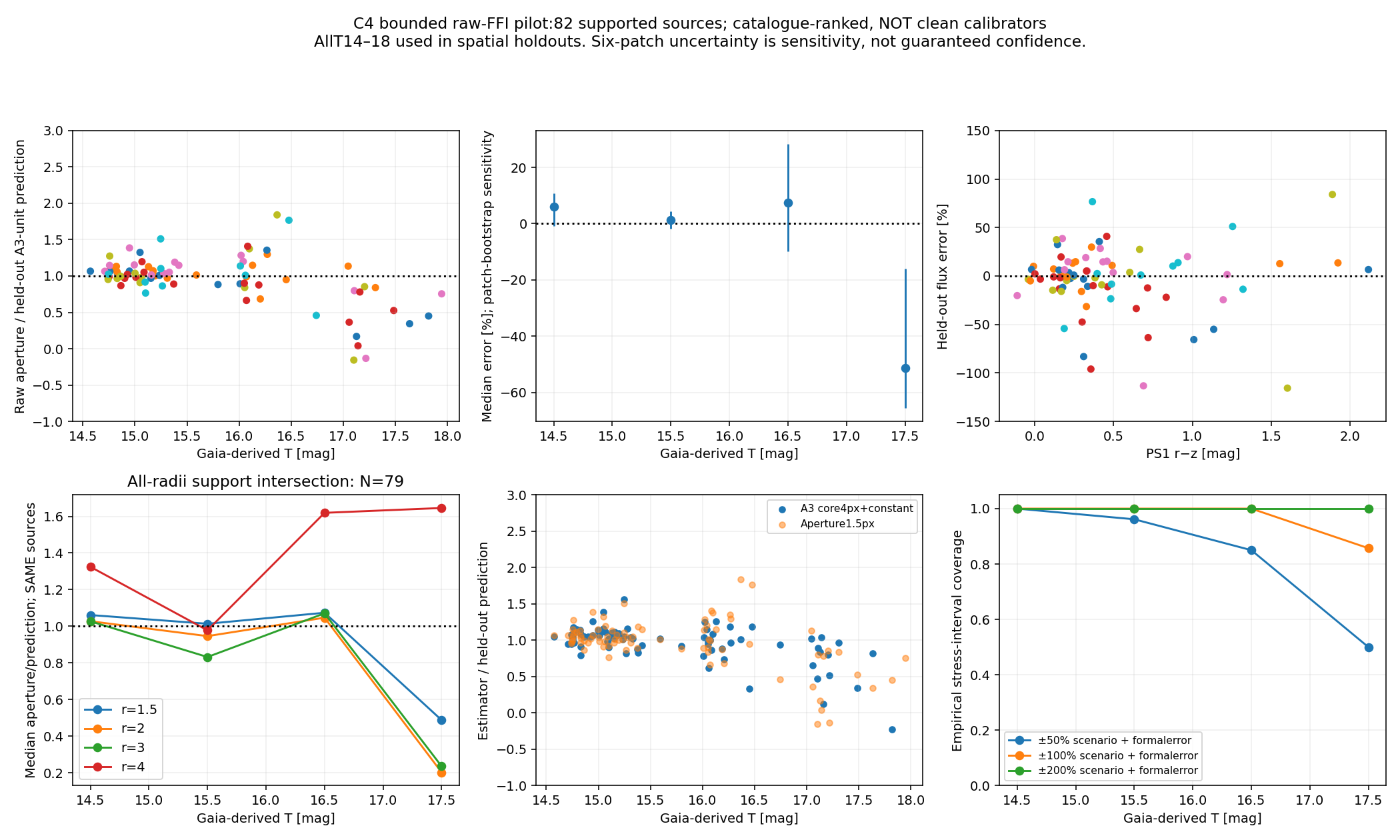
The lower-left comparison uses the same79 sources valid at all four radii. Increasing to radius4 changes median ratios materially, particularly in faint bins, showing surrounding-light sensitivity. With exactly matched source pairs, moving the source-masked annulus from8–12 to12–16pixels changes median measured flux by about−3%,−3%,−11%,−22% of the held-out prediction across the four bins; the last comparison has only six stars. Omitting annulus source masks produces much larger negative shifts. The A3 core4pixel-plus-constant fit is an estimator control on the same raw data, not independent profile truth.
Independent Gaussian/Moffat profile-family conversions of the same aperture measurement have median flux ratios to the A3 conversion of0.94,1.42,1.26,1.69. These are deliberately broad shape stresses, not evidence that those profiles are correct or an exhaustive physical bound. Pixel-centre sampling in these analytic controls is another approximation. Neither profile-family sensitivity nor large-aperture crowding supports a narrow physical prior.
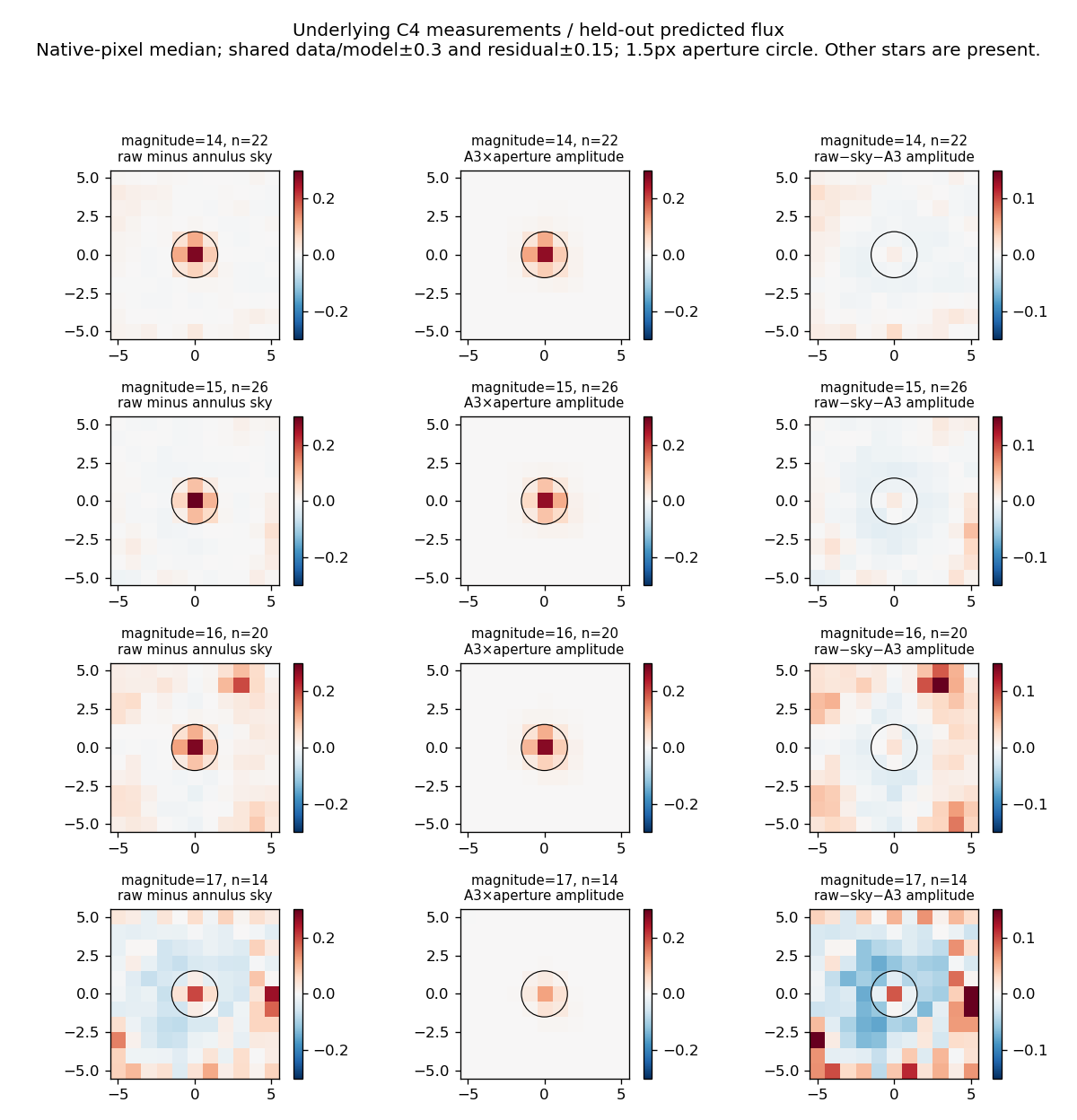
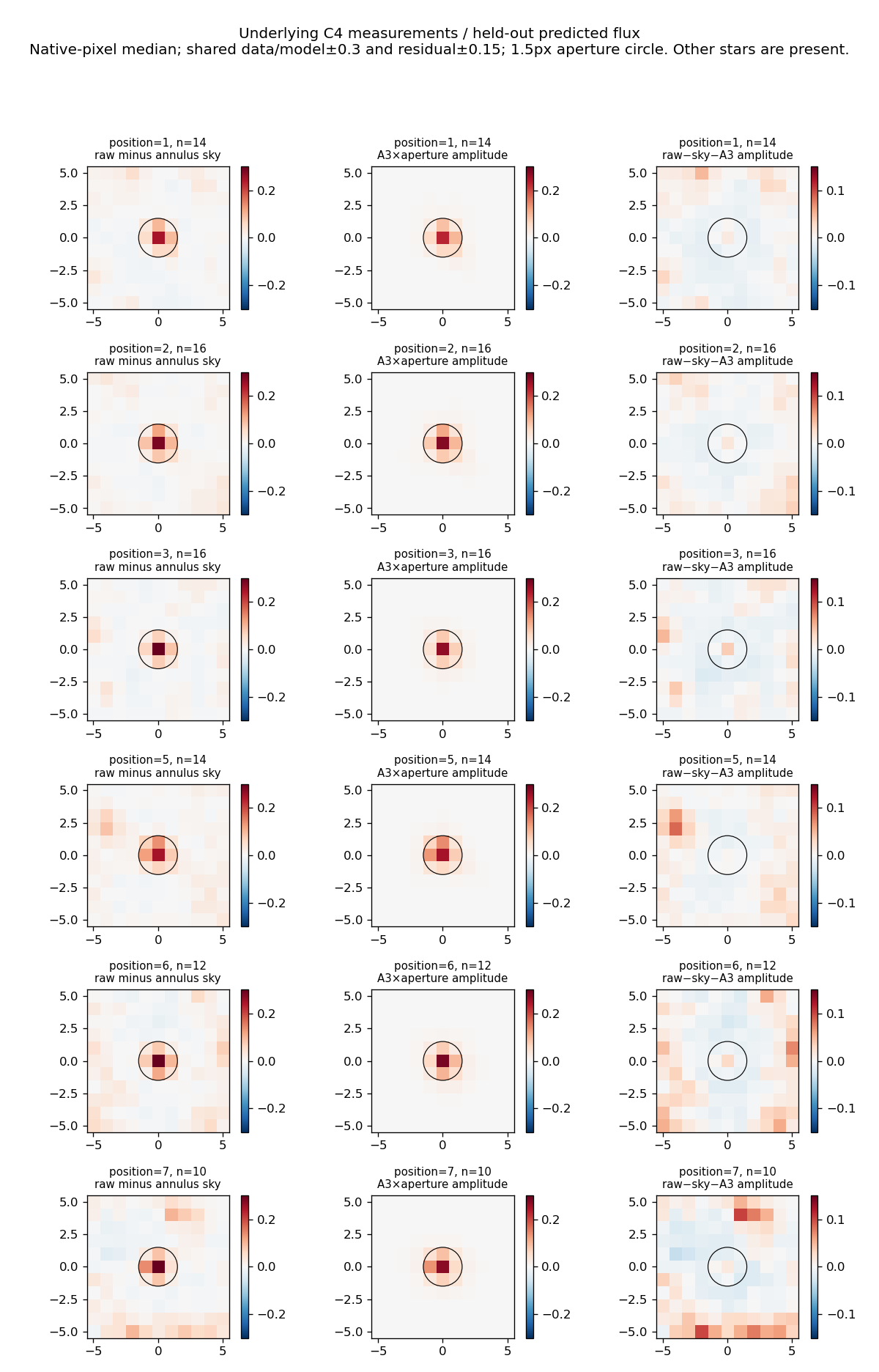
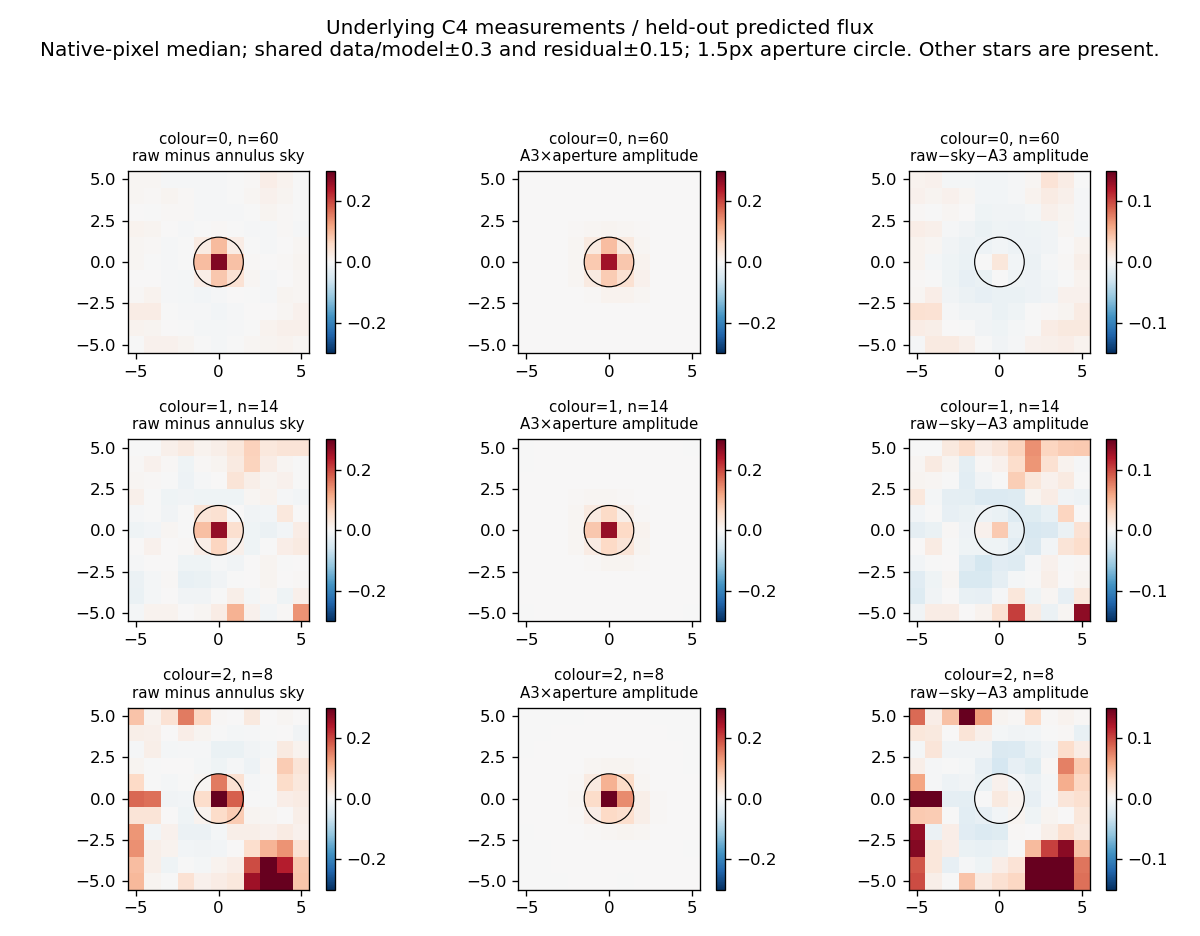
The stacked T17–18 measurements show a depressed surrounding background and remaining neighbouring light. The cause cannot be uniquely assigned to flux calibration, PSF shape, crowding or annulus subtraction. Accordingly, do not apply the observed faint-bin deficit as a magnitude correction.
conditional_prior_recipe.json and conditional_old_catalogue_priors.csv provide a reproducible alternative to fixed amplitudes:
To prevent preprocessing leakage, calibration_exclusion_mask.npy excludes the complete37×37 boxes of all120 calibration targets, including failed measurements:125,483 crop-local pixels. Apply this common exclusion to every model arm and evaluation support, or re-estimate calibration entirely within each fold. Holding out stars from profile training alone is insufficient when their calibration aperture/annulus pixels overlap scored data. The catalogue-source veto is also provided.
Activate syndiff. Preparation sources are prepare.py and select_secondary.py; the original clean selection correctly returned zero. The latter records the conditional rank fallback and freezes its IDs before measurement. Run render_profiles.py, measure.py, analyze.py, final_checks.py, final_figure.py, prepare_priors.py, and publish_extension.py in that order. Principal provenance is in gaia_cache_manifest.json, SELECTION_FROZEN.json, coordinate_roundtrip.json, profile_recipe.json, measurement_contract.json and the final owned manifest. All six figures were inspected. No data went into Git, and no shared products were edited.
Final conclusion: C4 image-unit weak-prior scenarios are now concrete and can be tested on matched, leakage-controlled support. The measured calibration population is small, selected, crowded and profile-dependent, with noT13–14 support and substantialT17–18 estimator bias. It does not authorize fixed neighbour amplitudes or a paper claim of physically corrected faint light. This distinction allows model tests to proceed while preserving the scientific acceptance boundary.