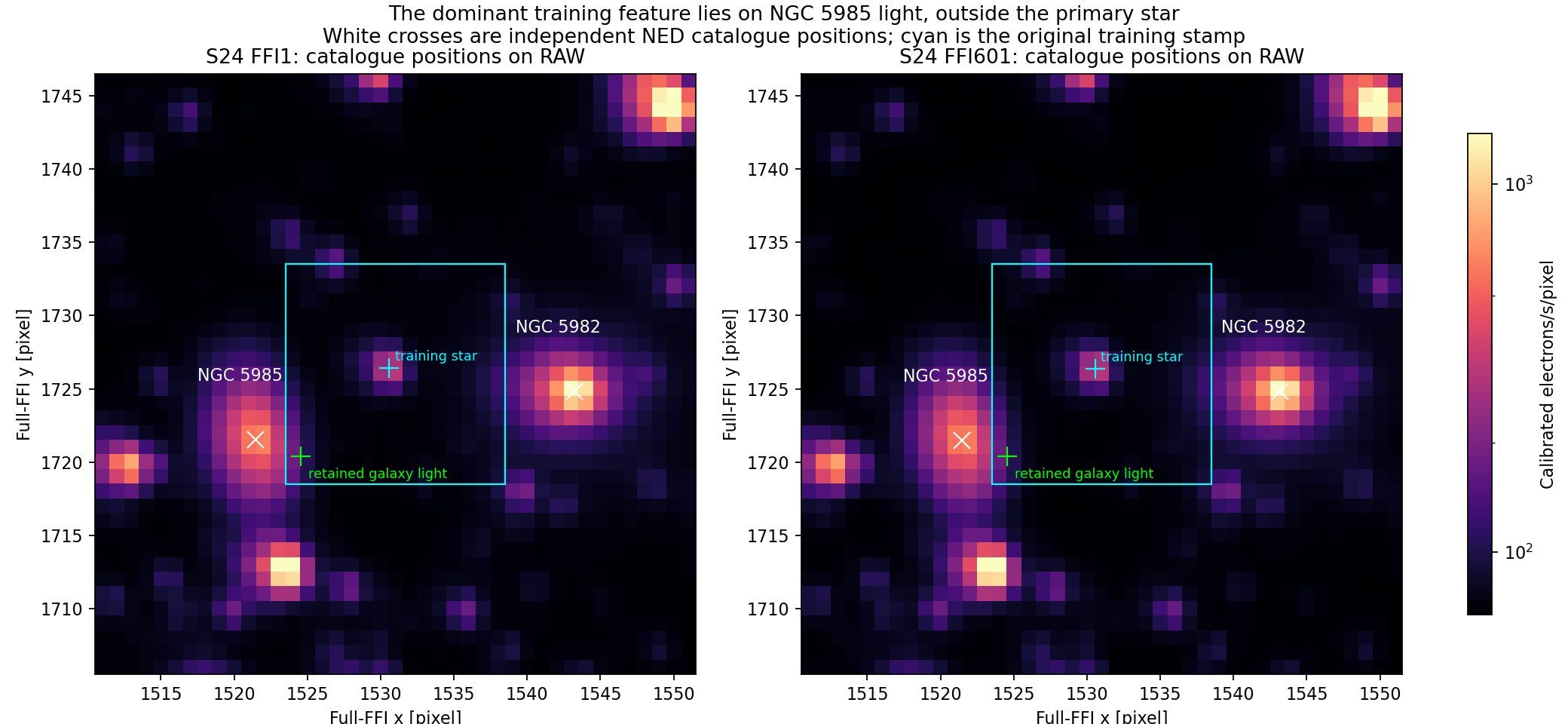
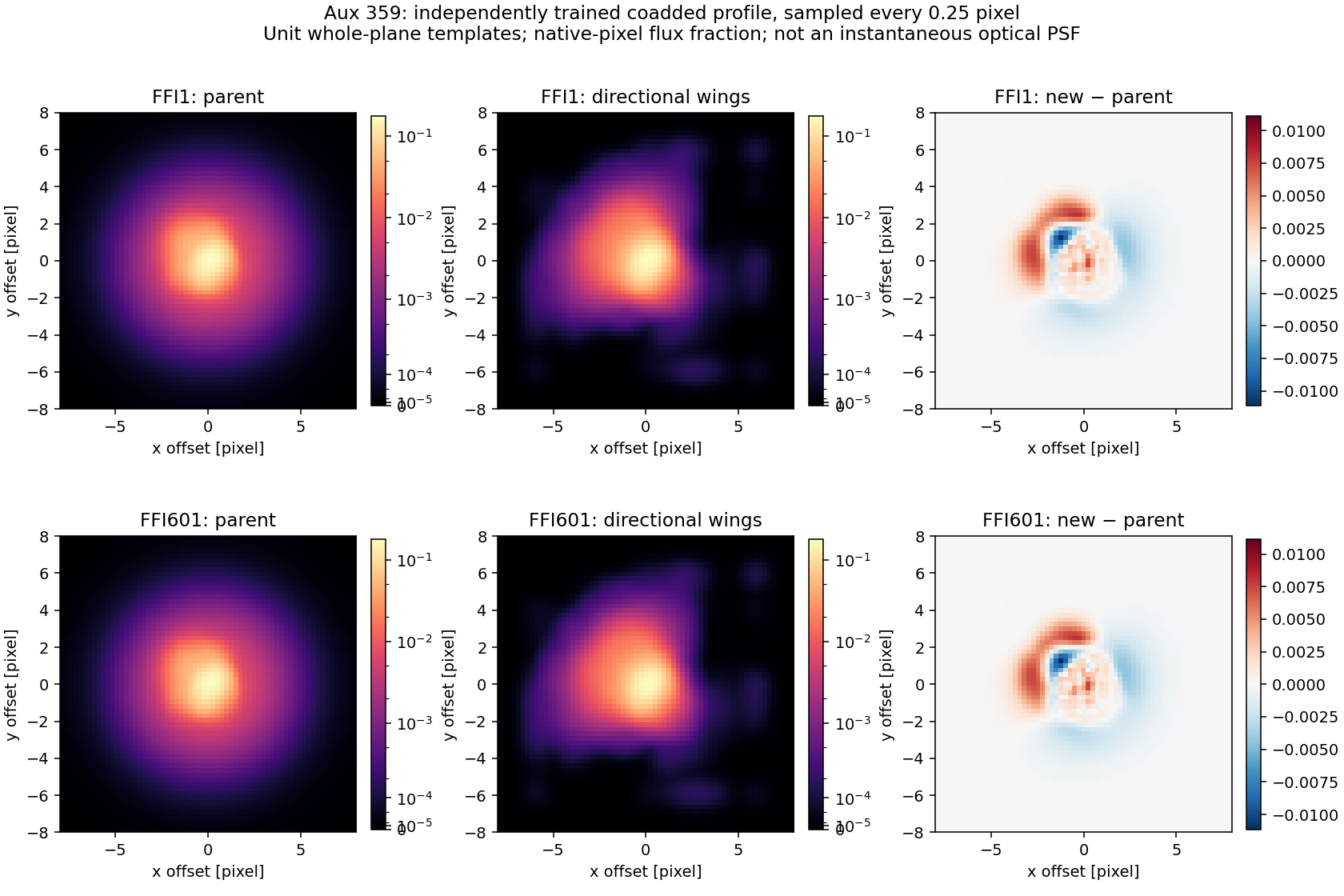
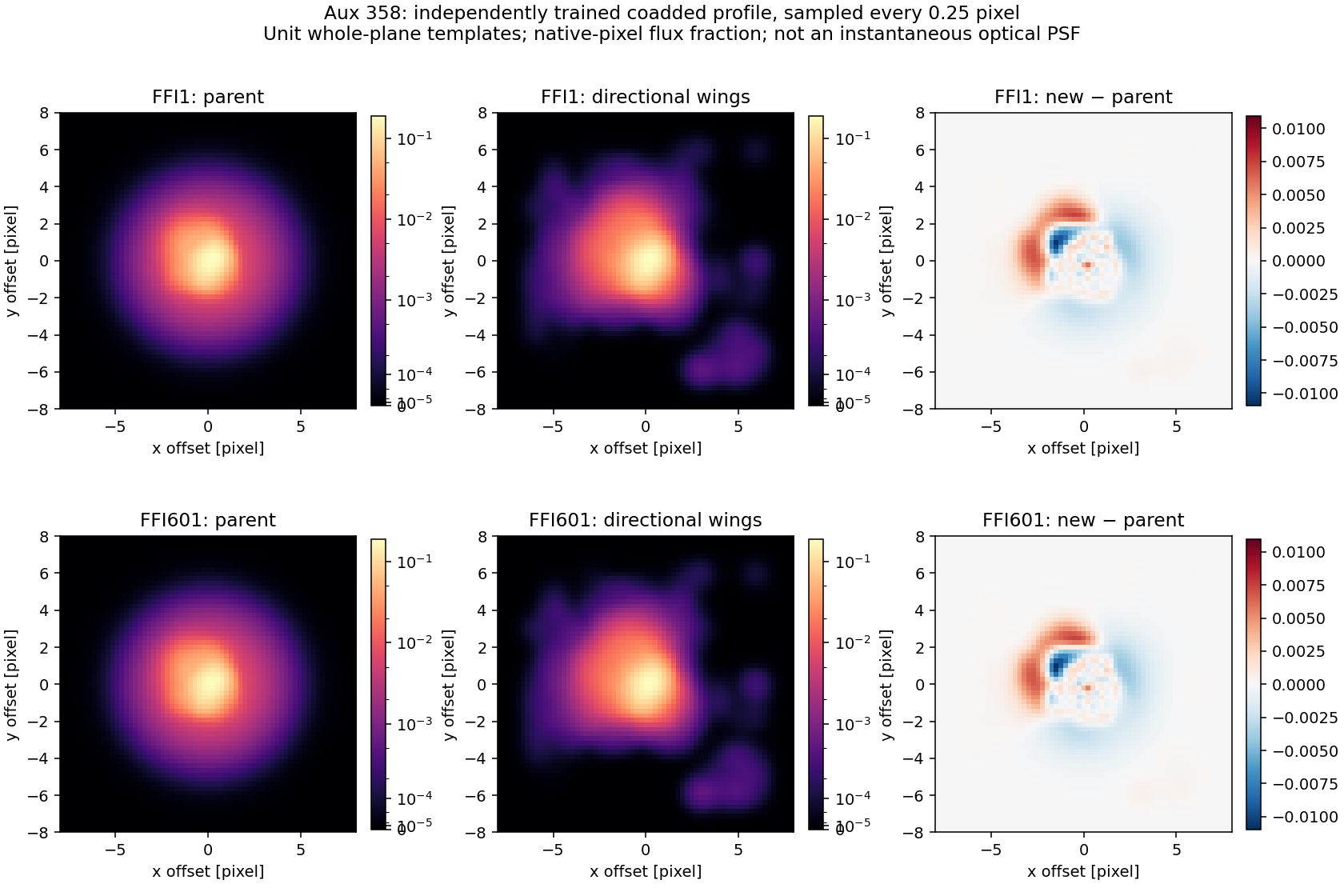
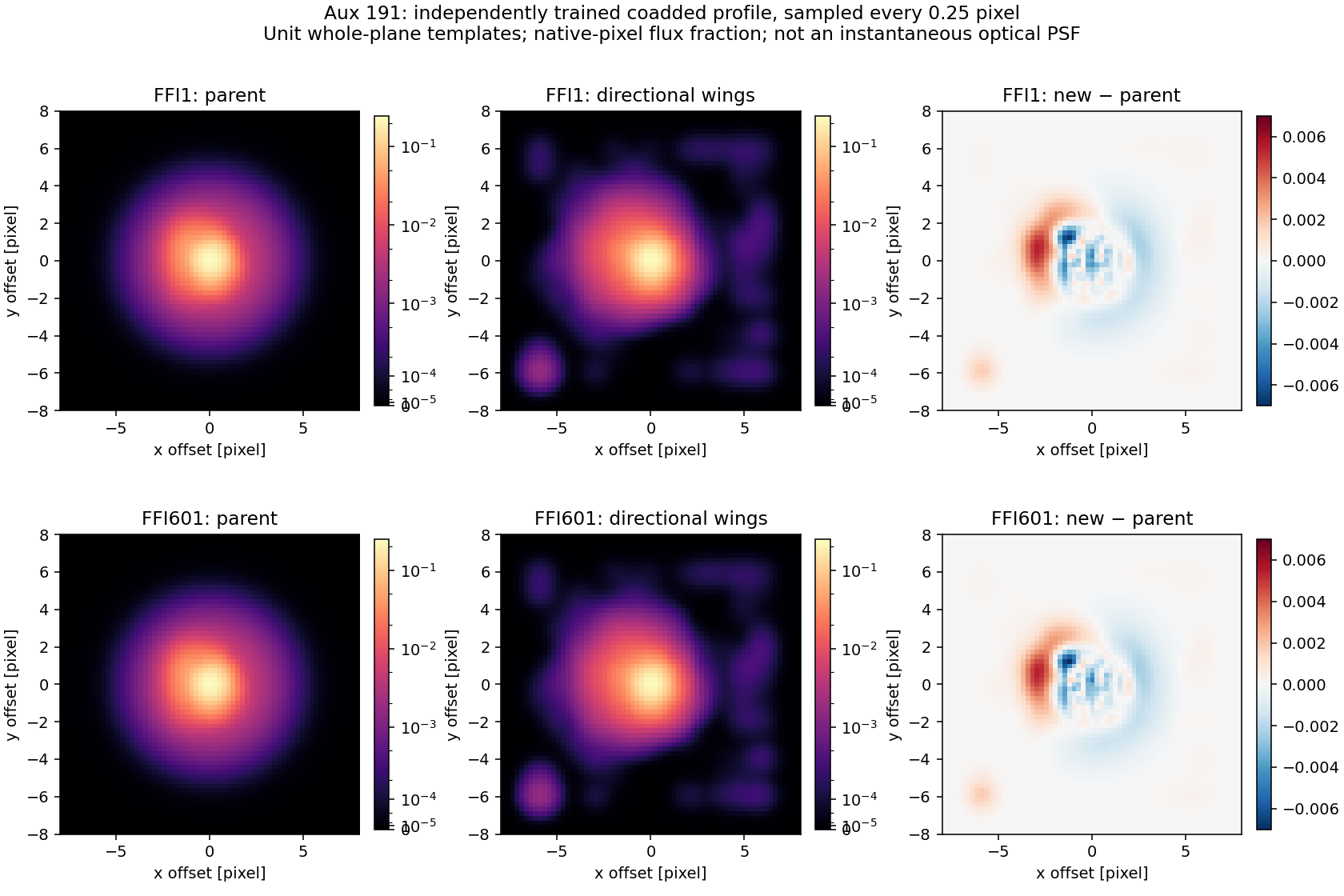
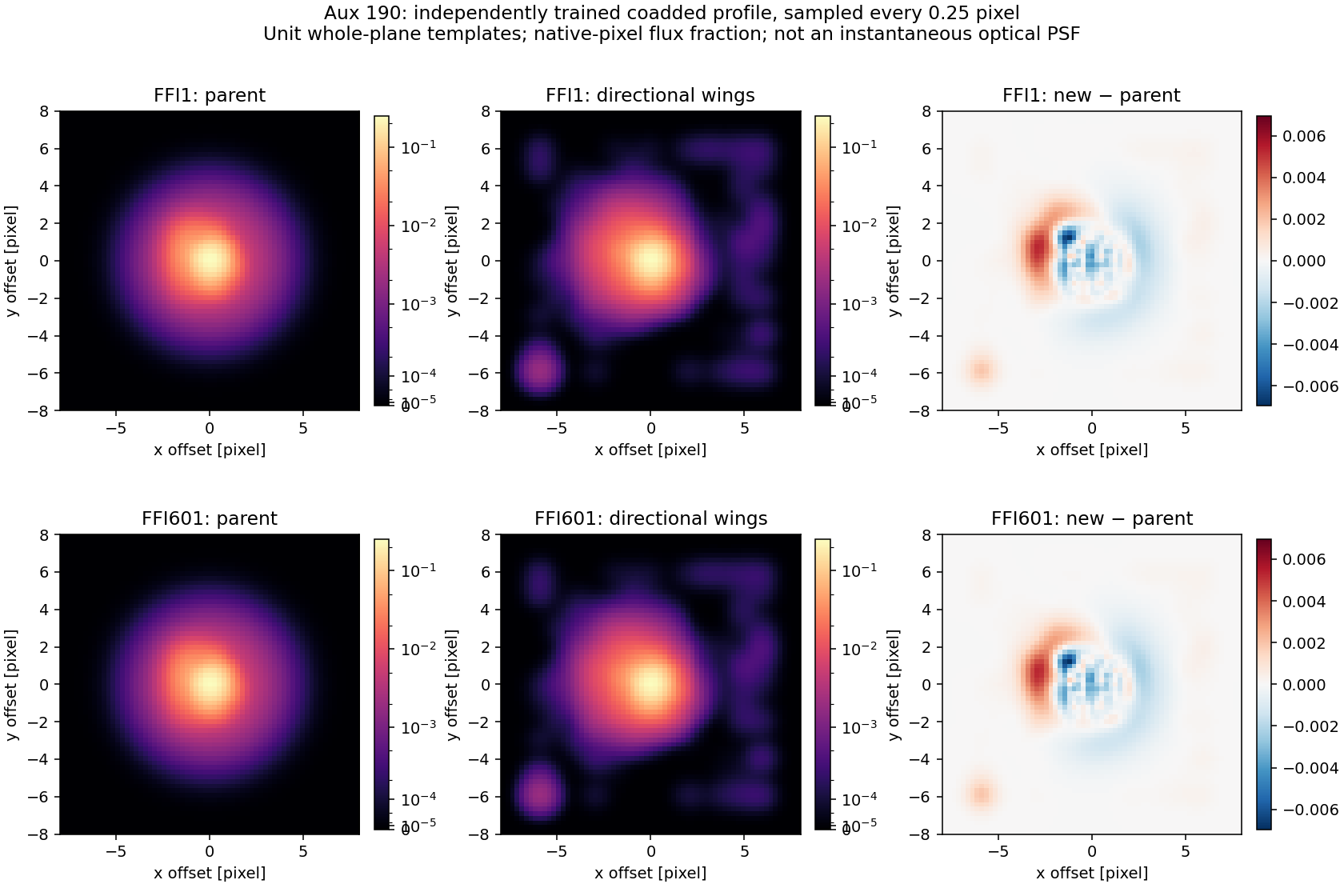
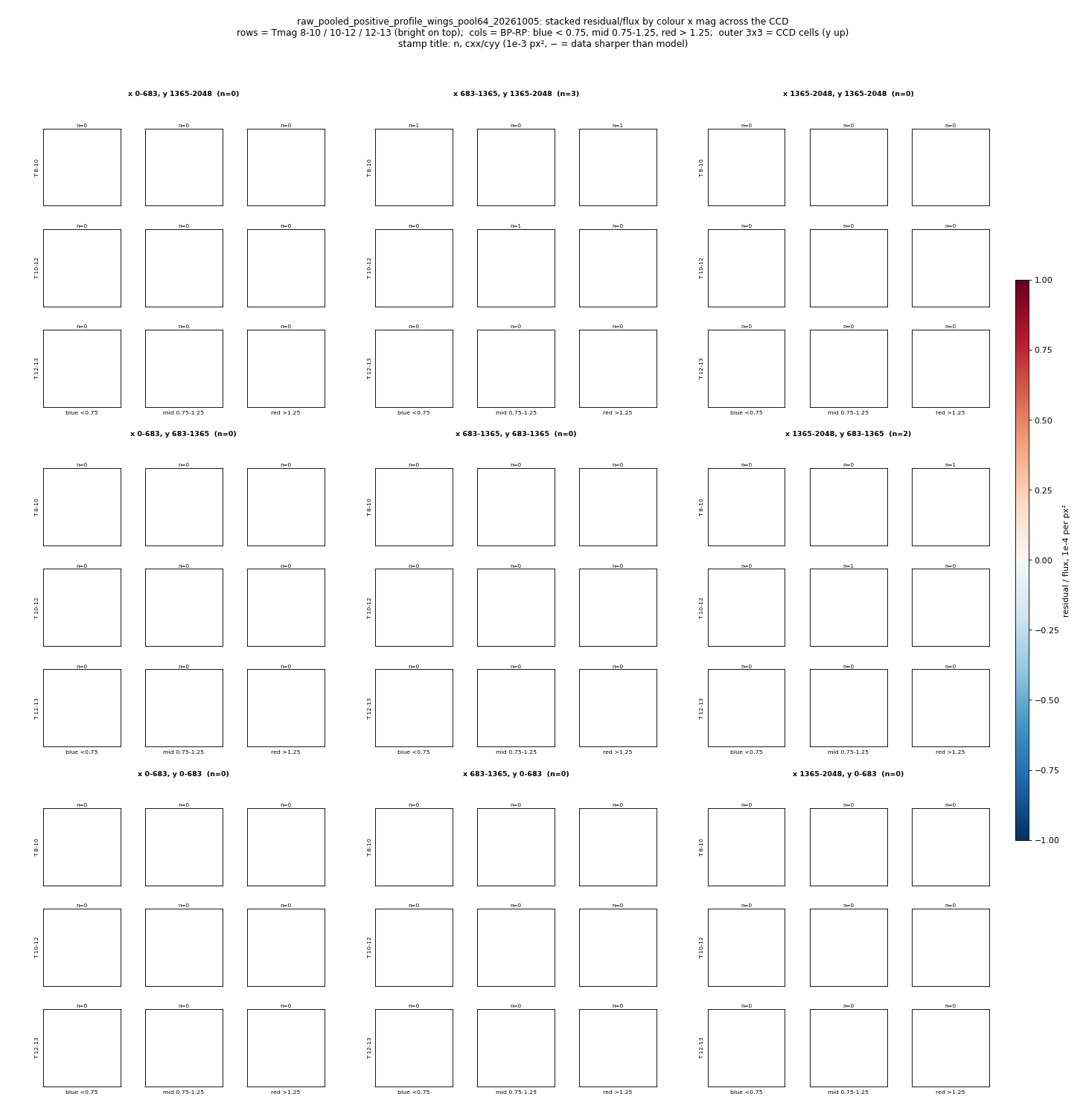
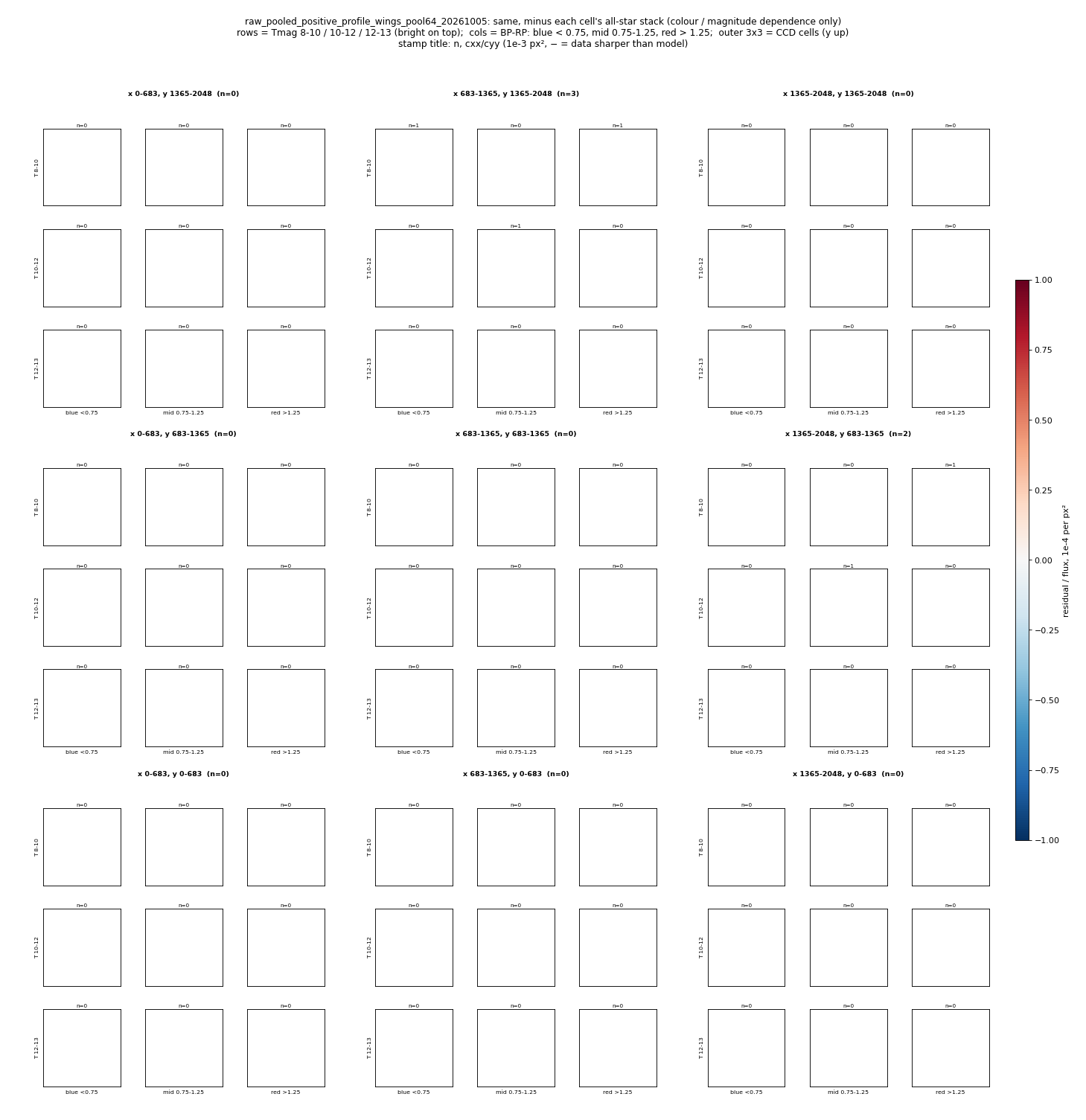
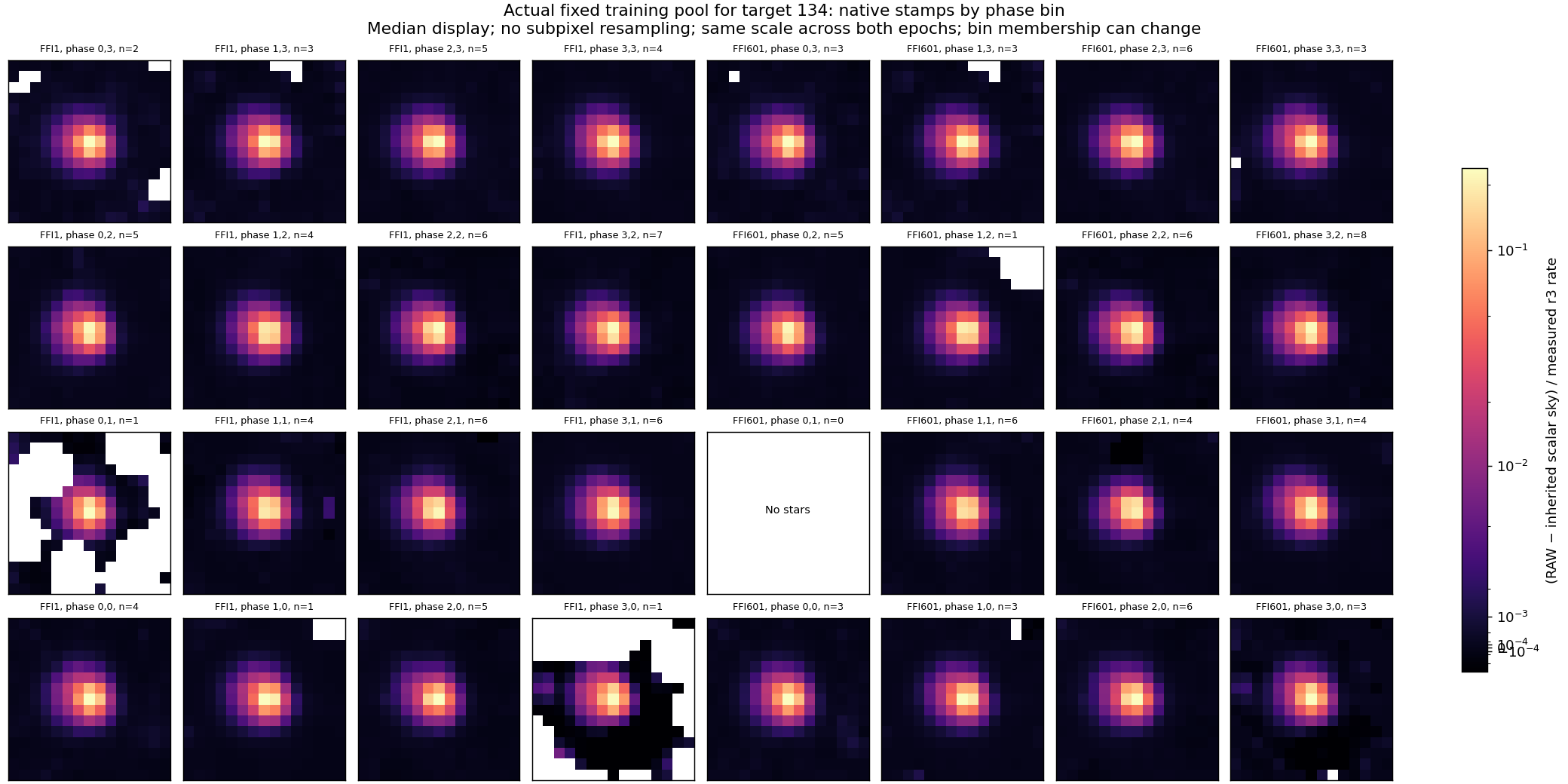
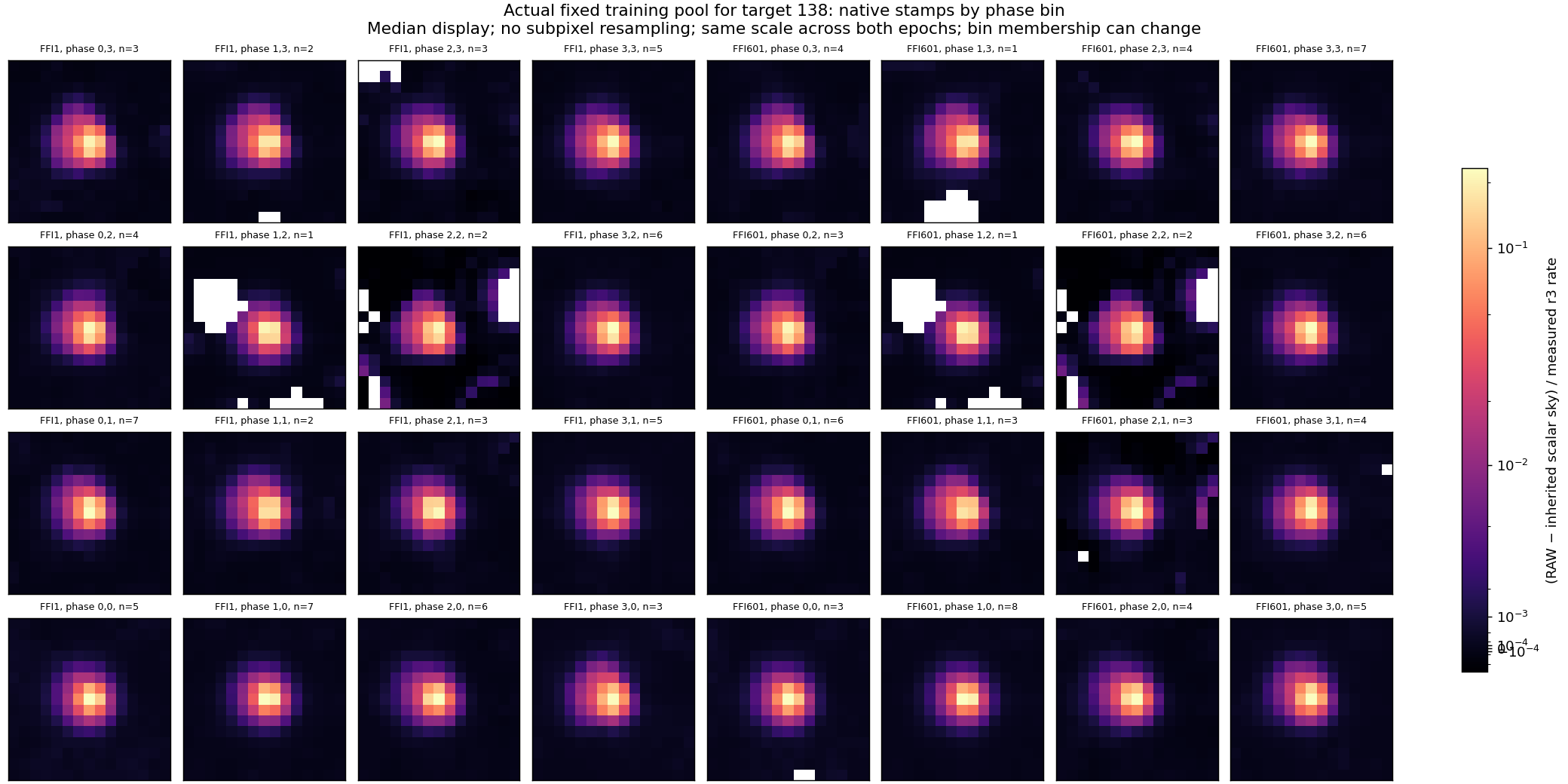
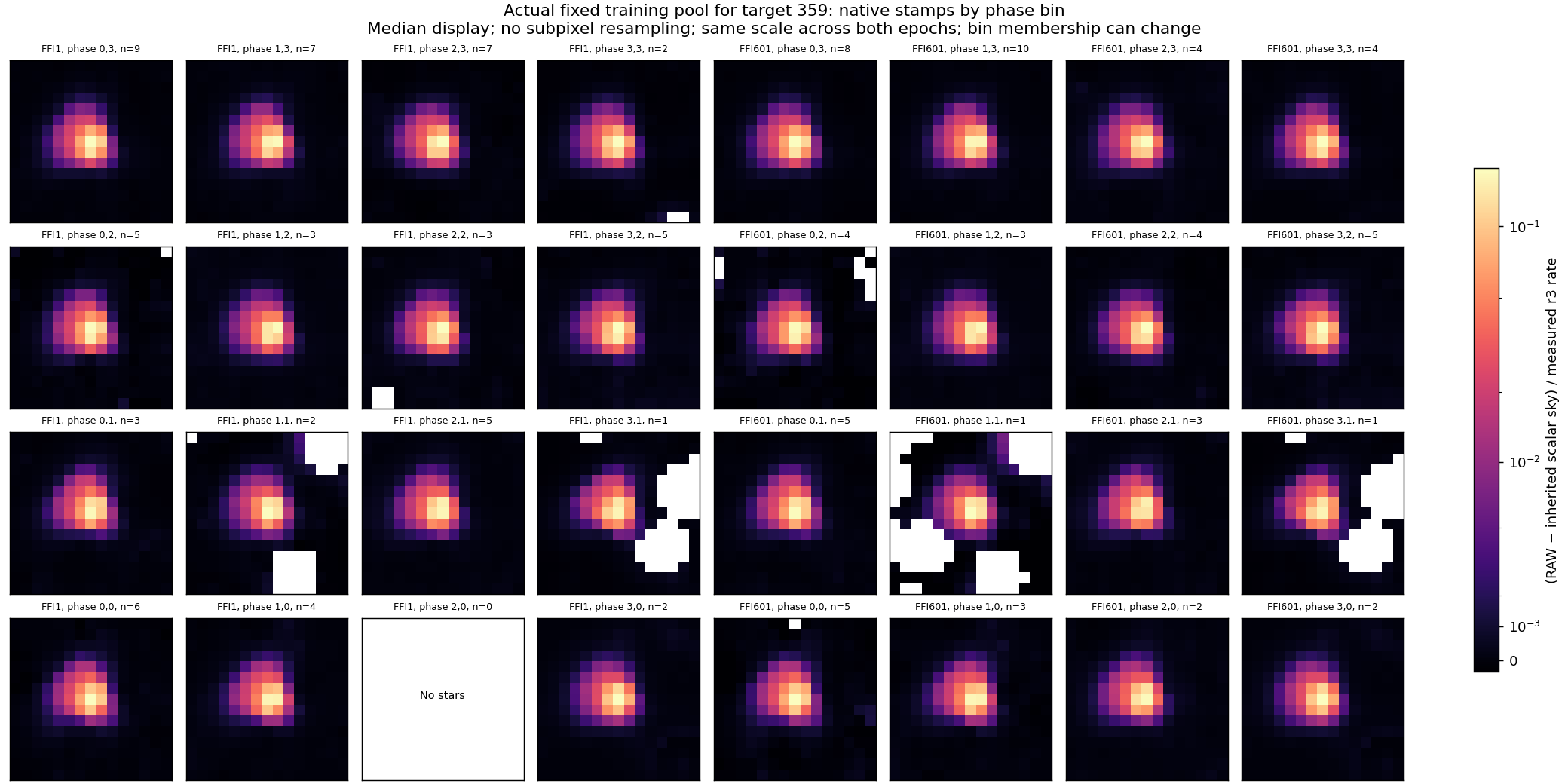
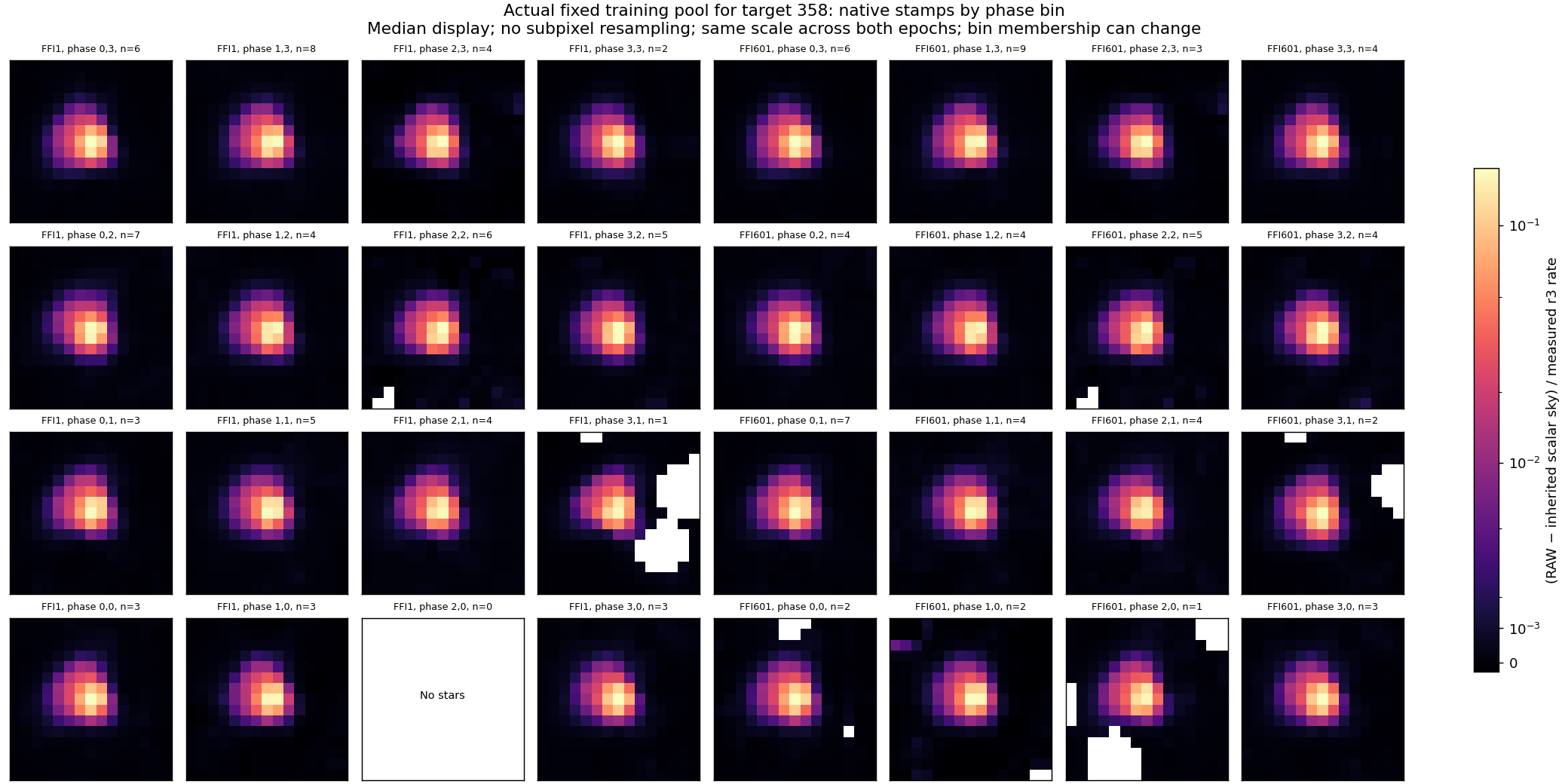
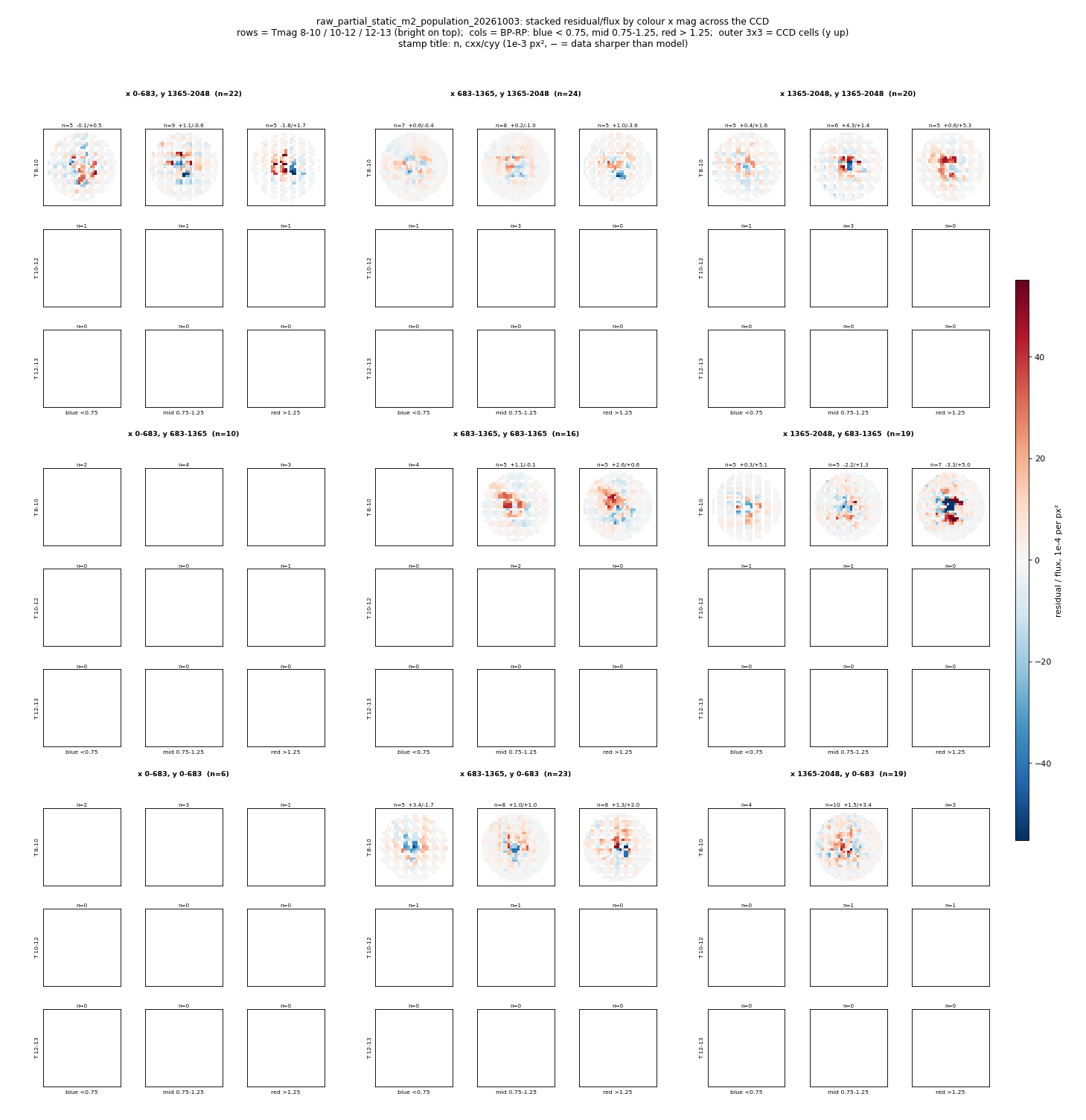
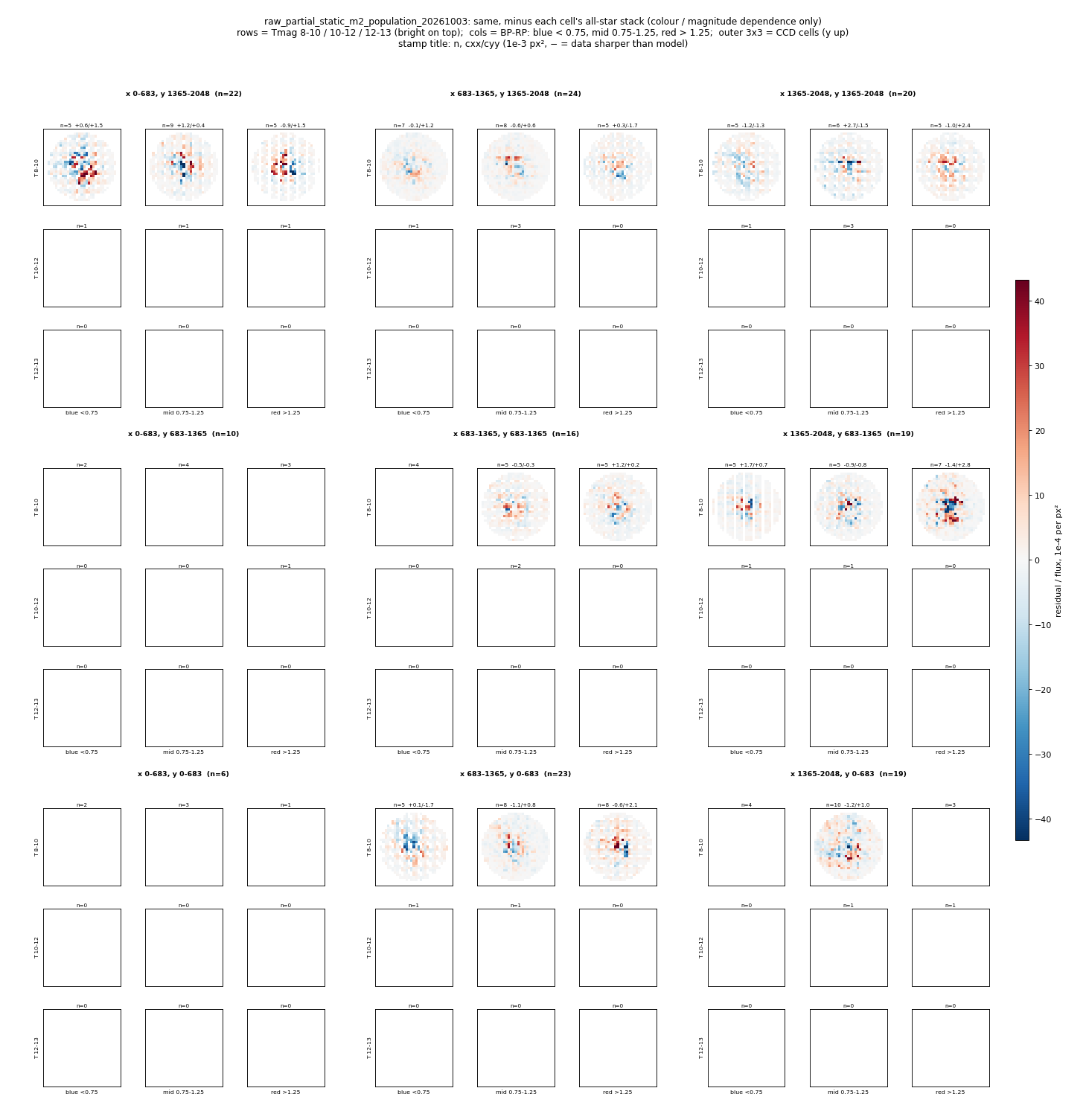
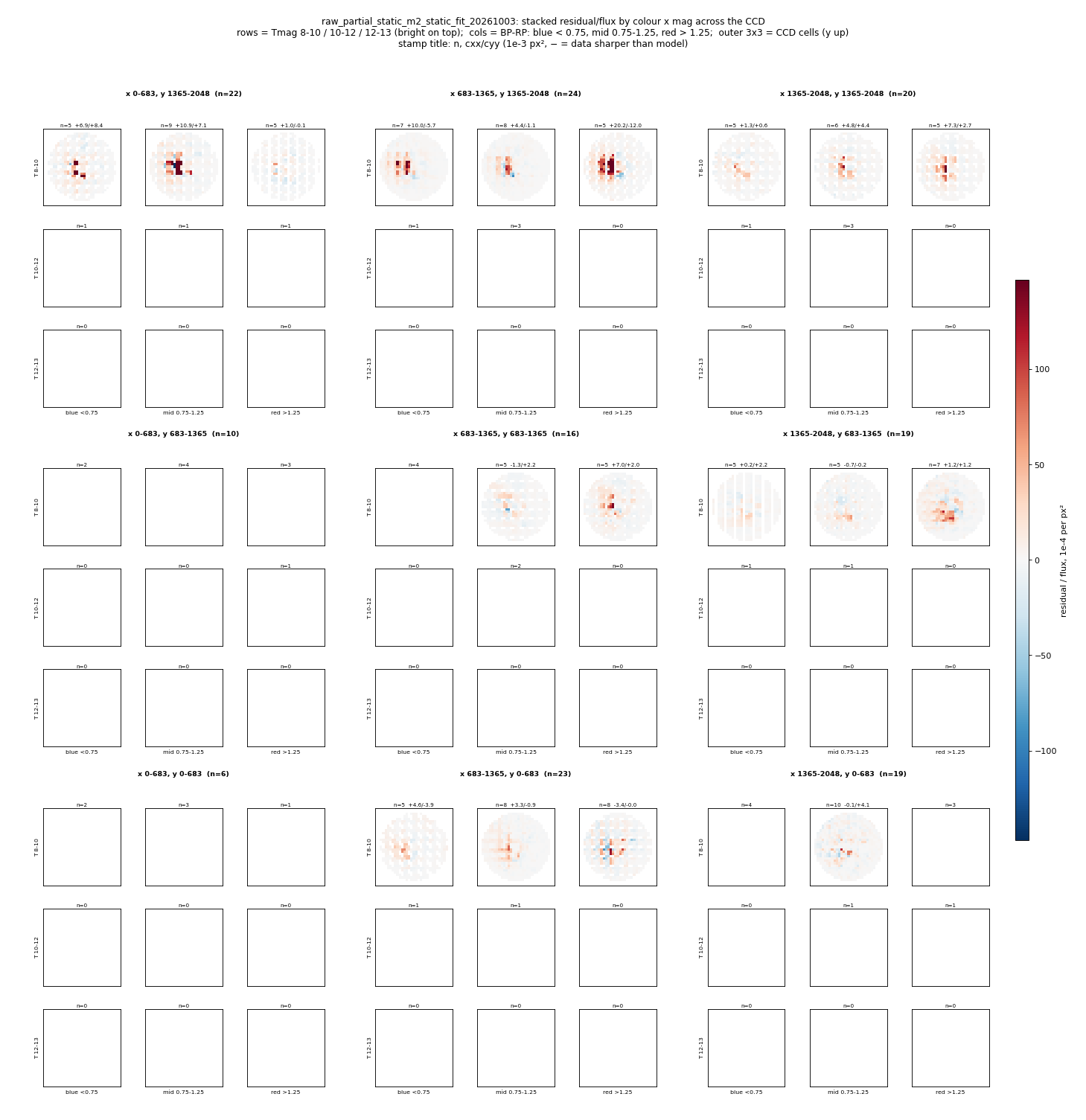
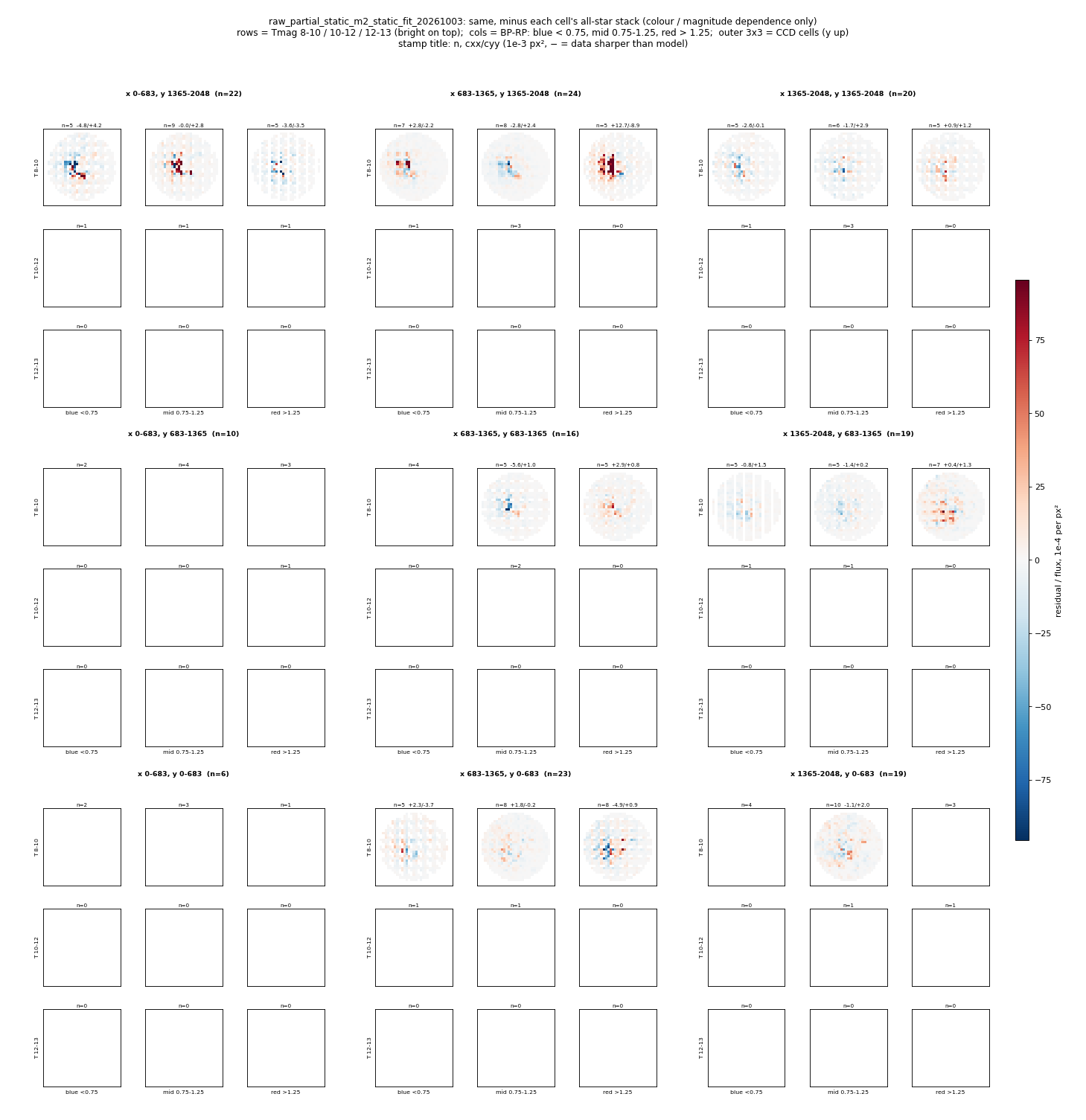
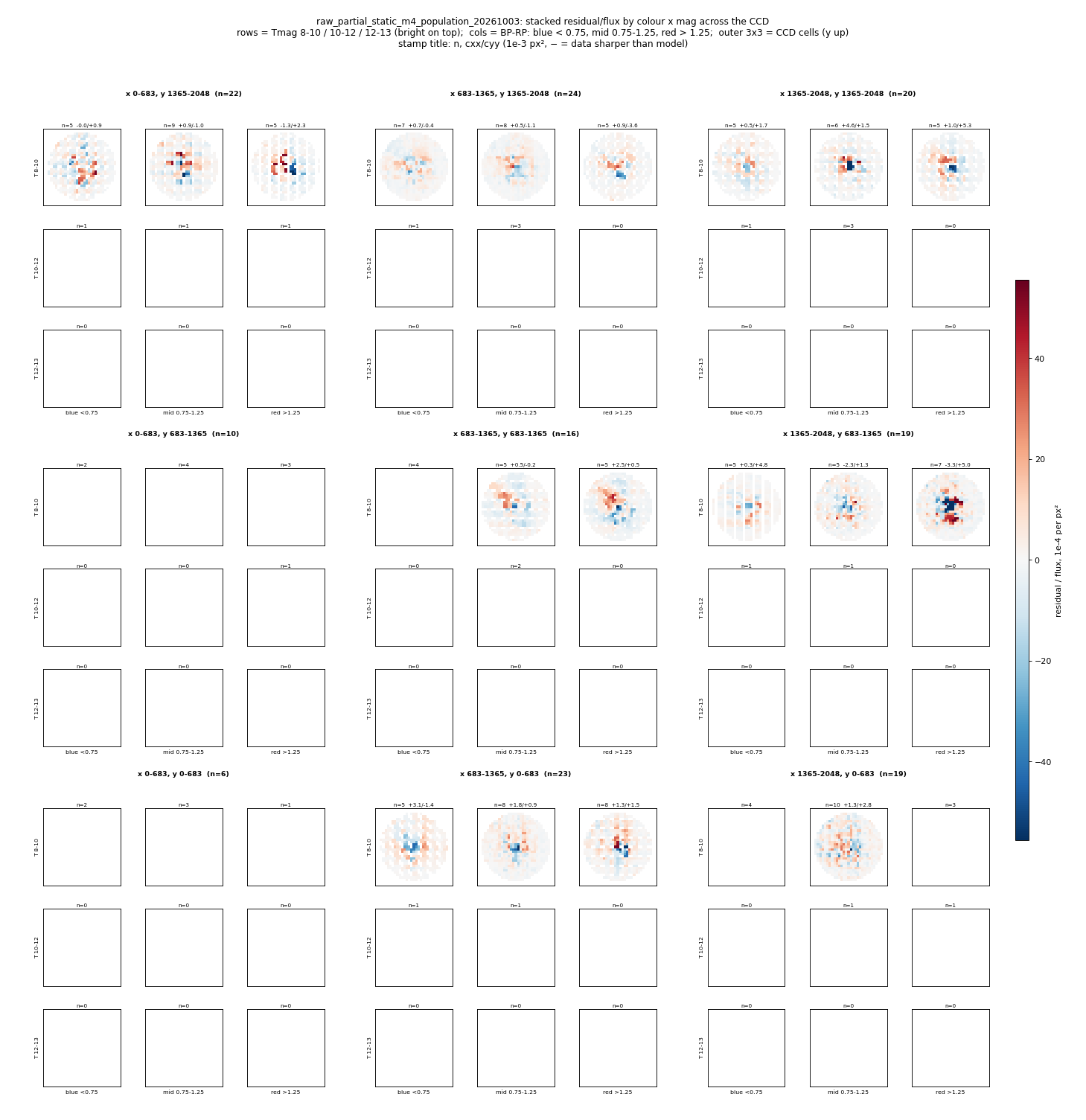
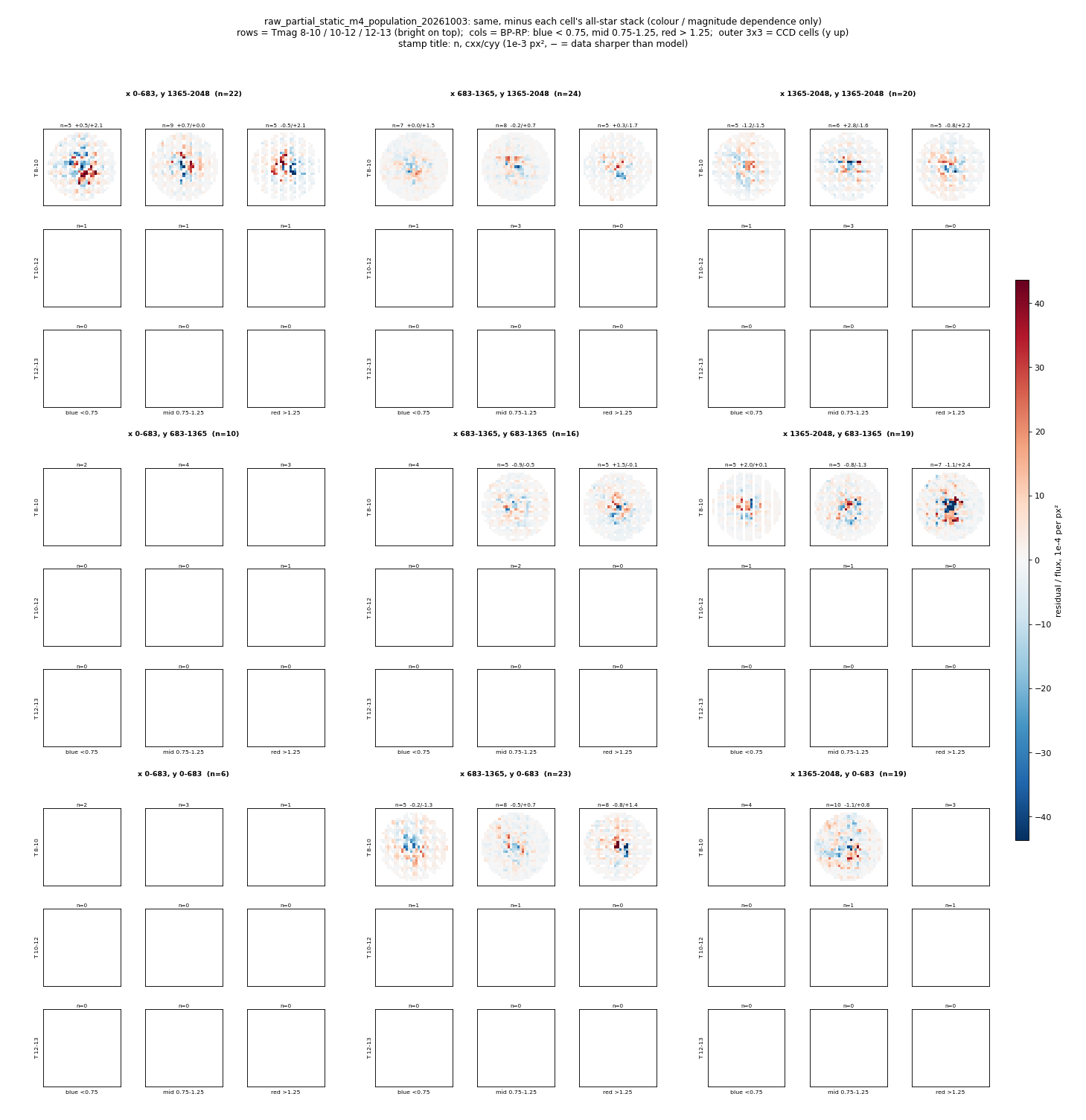
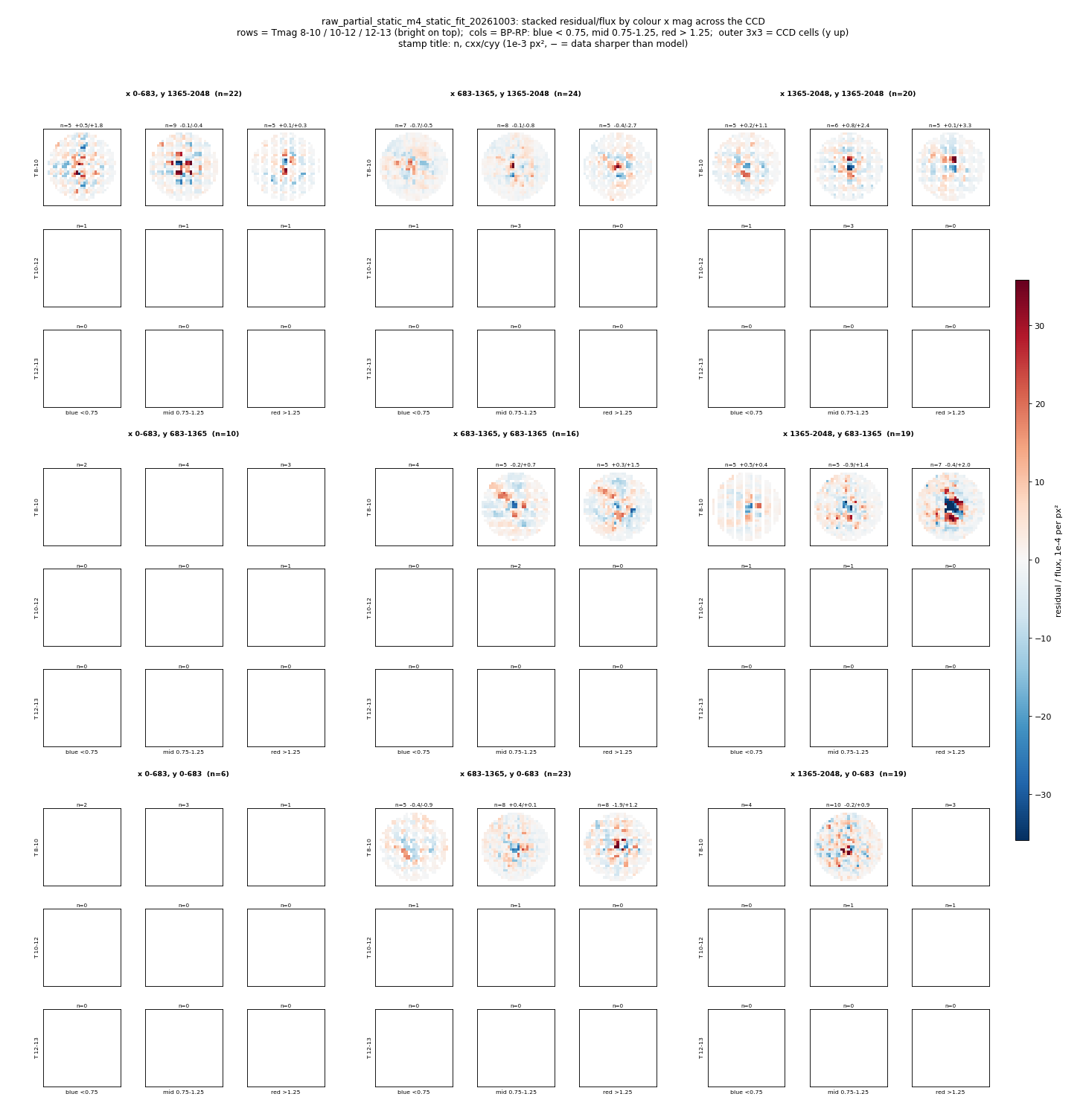
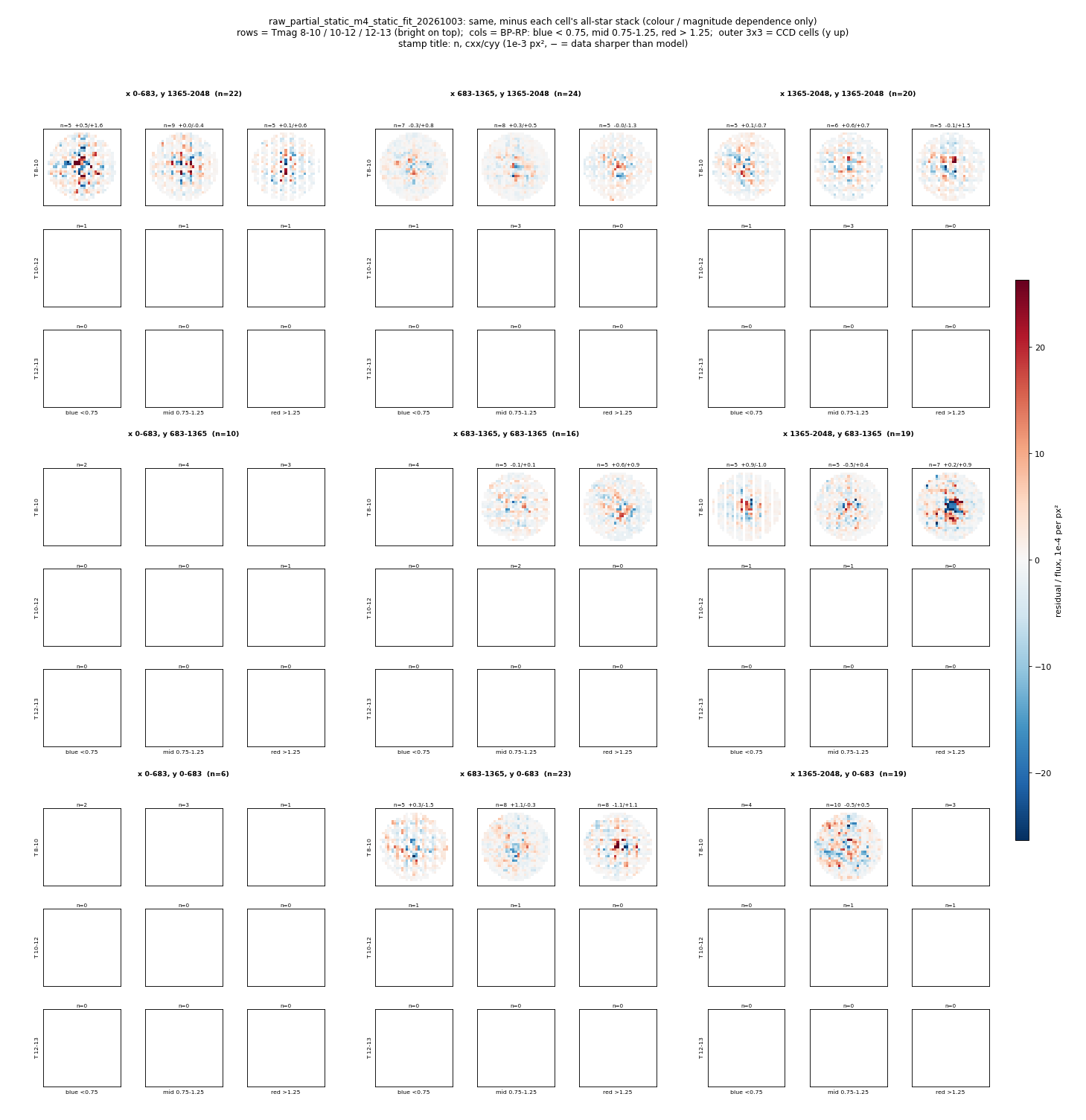
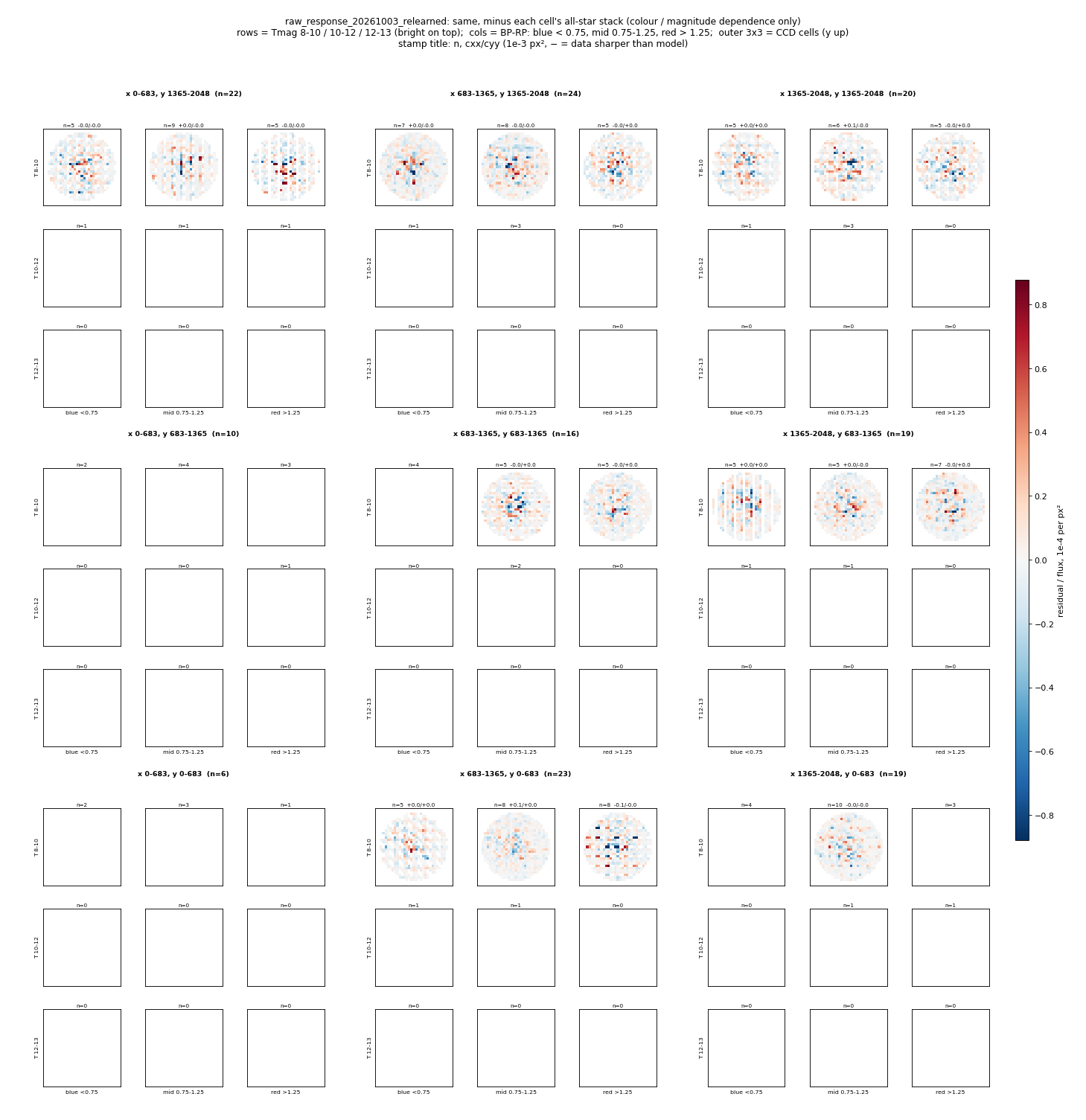
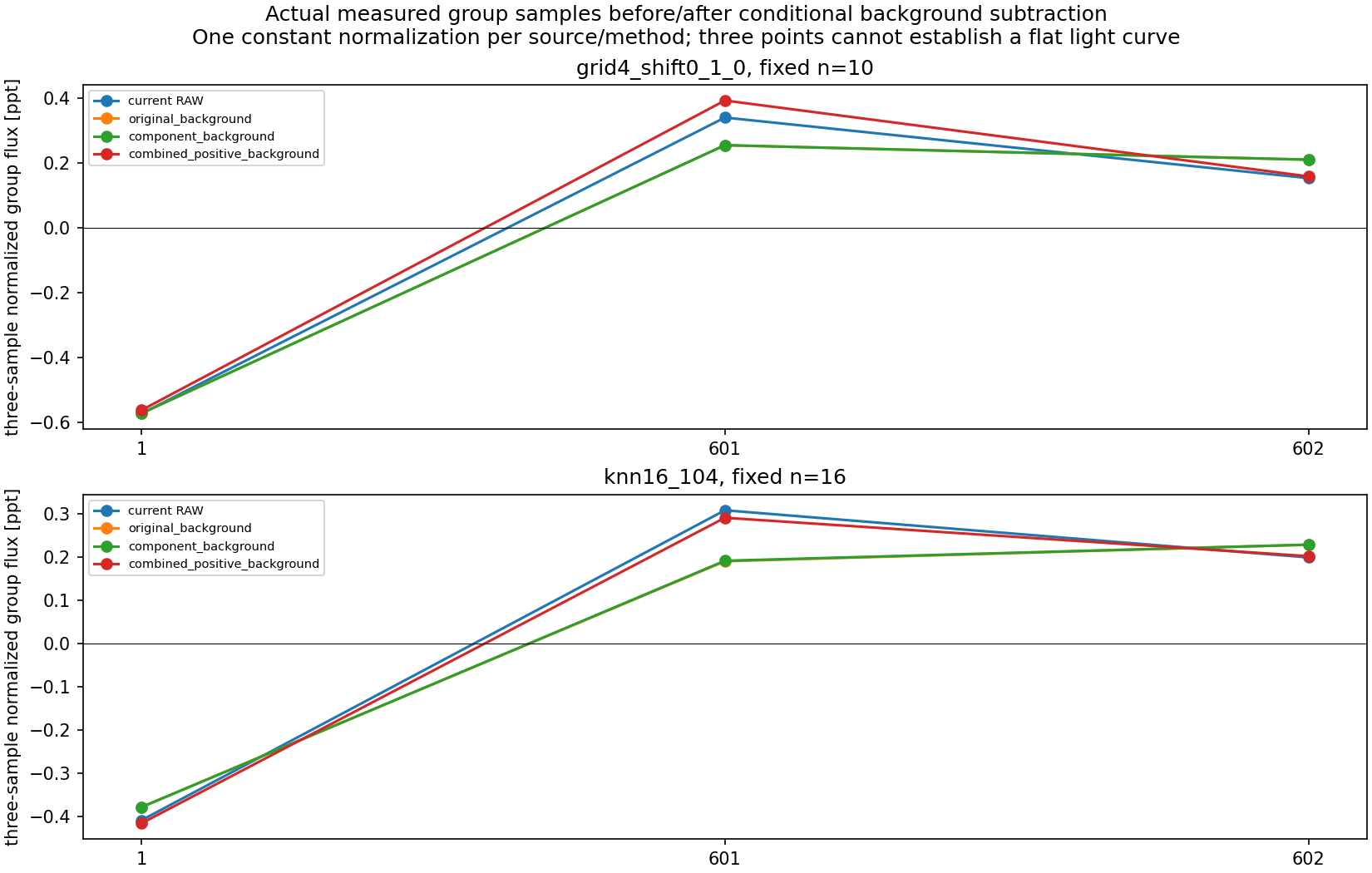
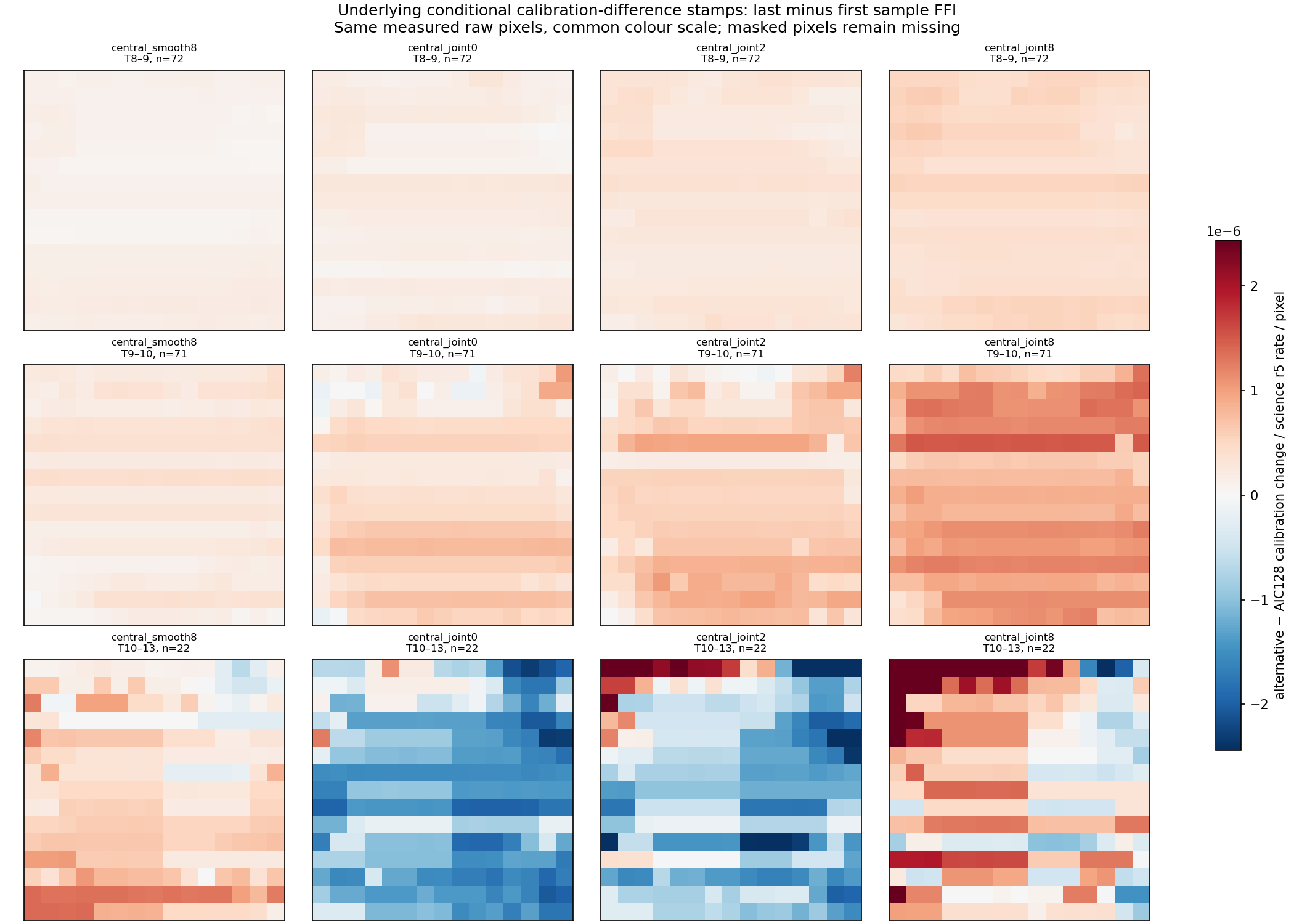
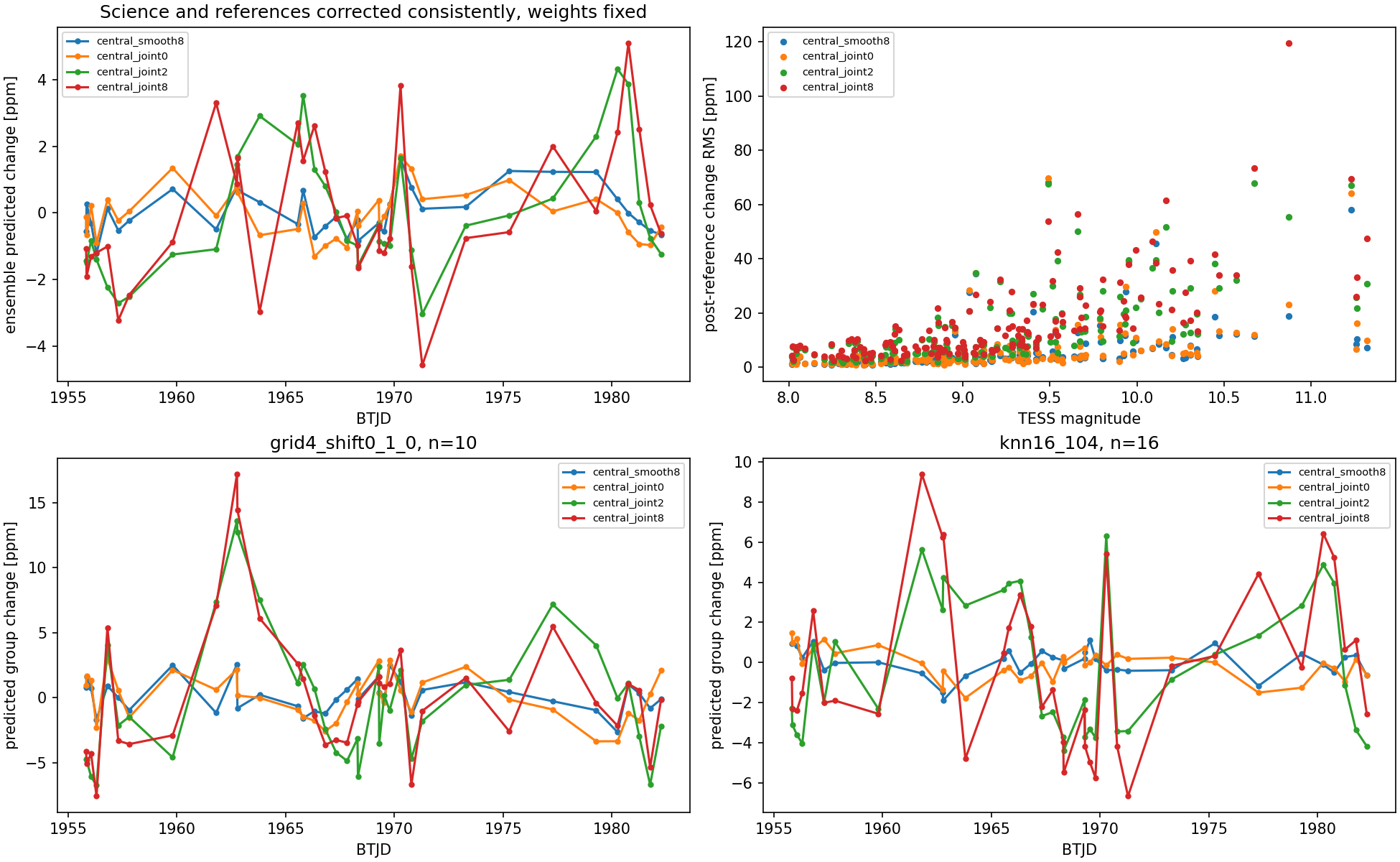
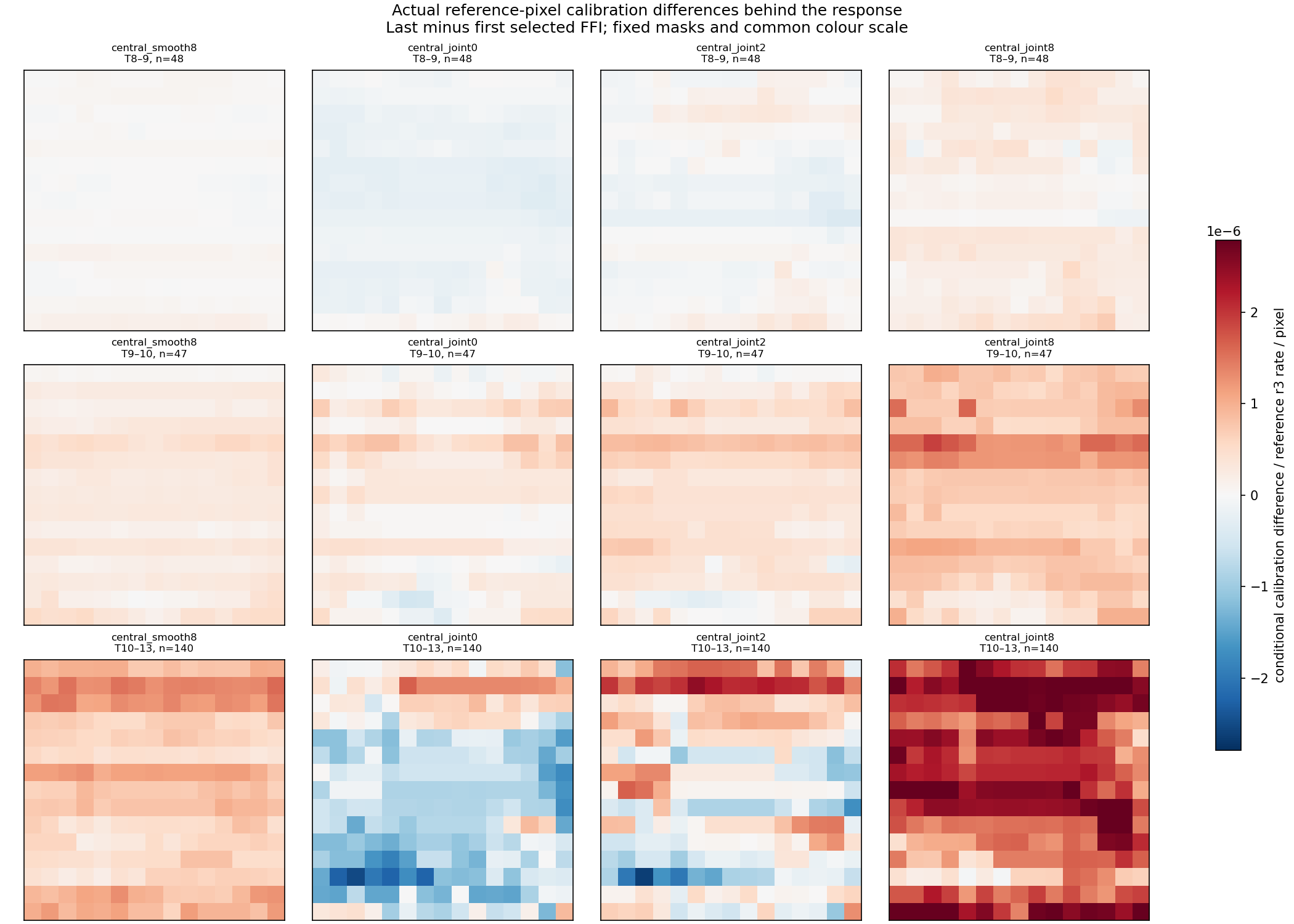
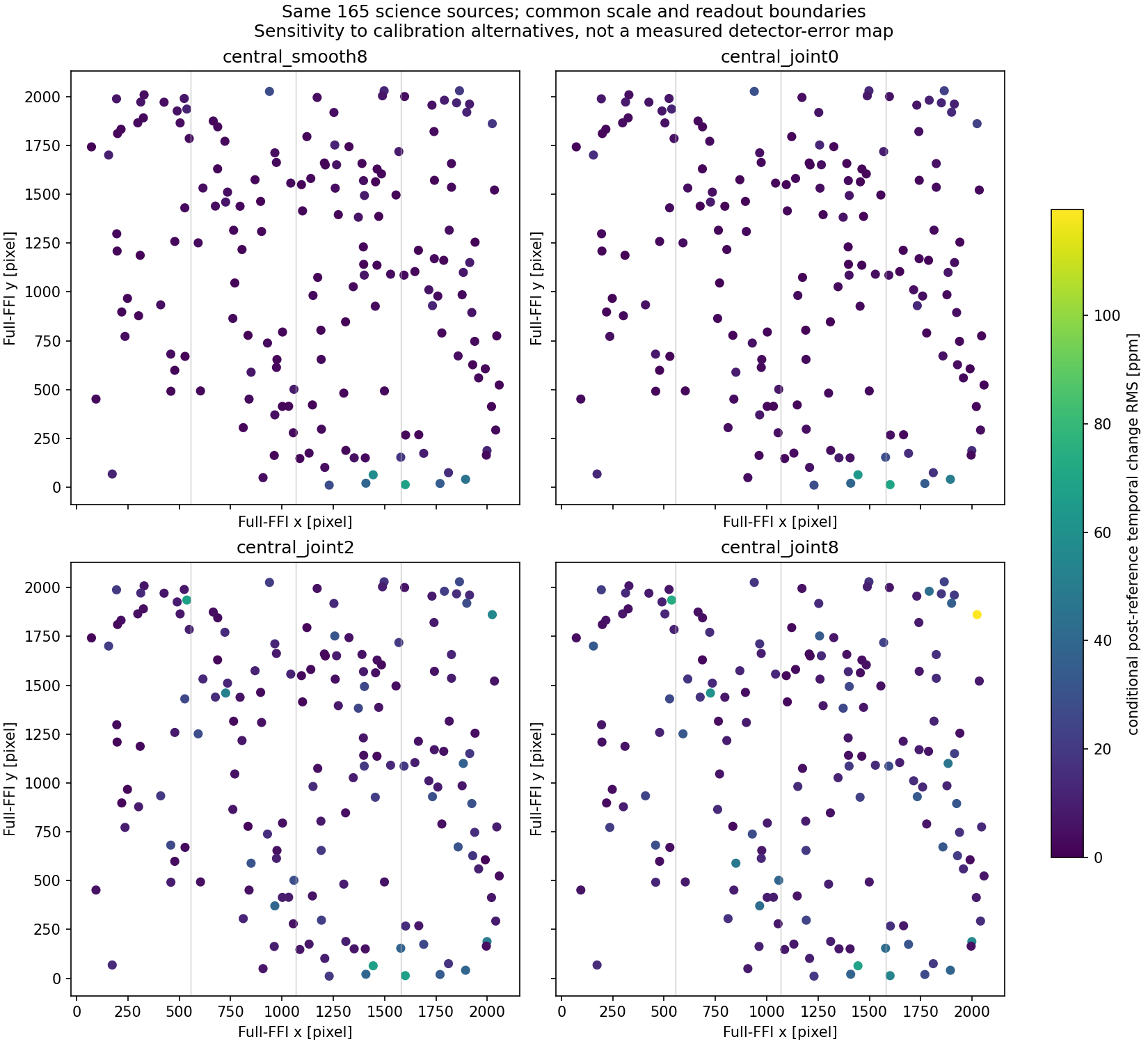
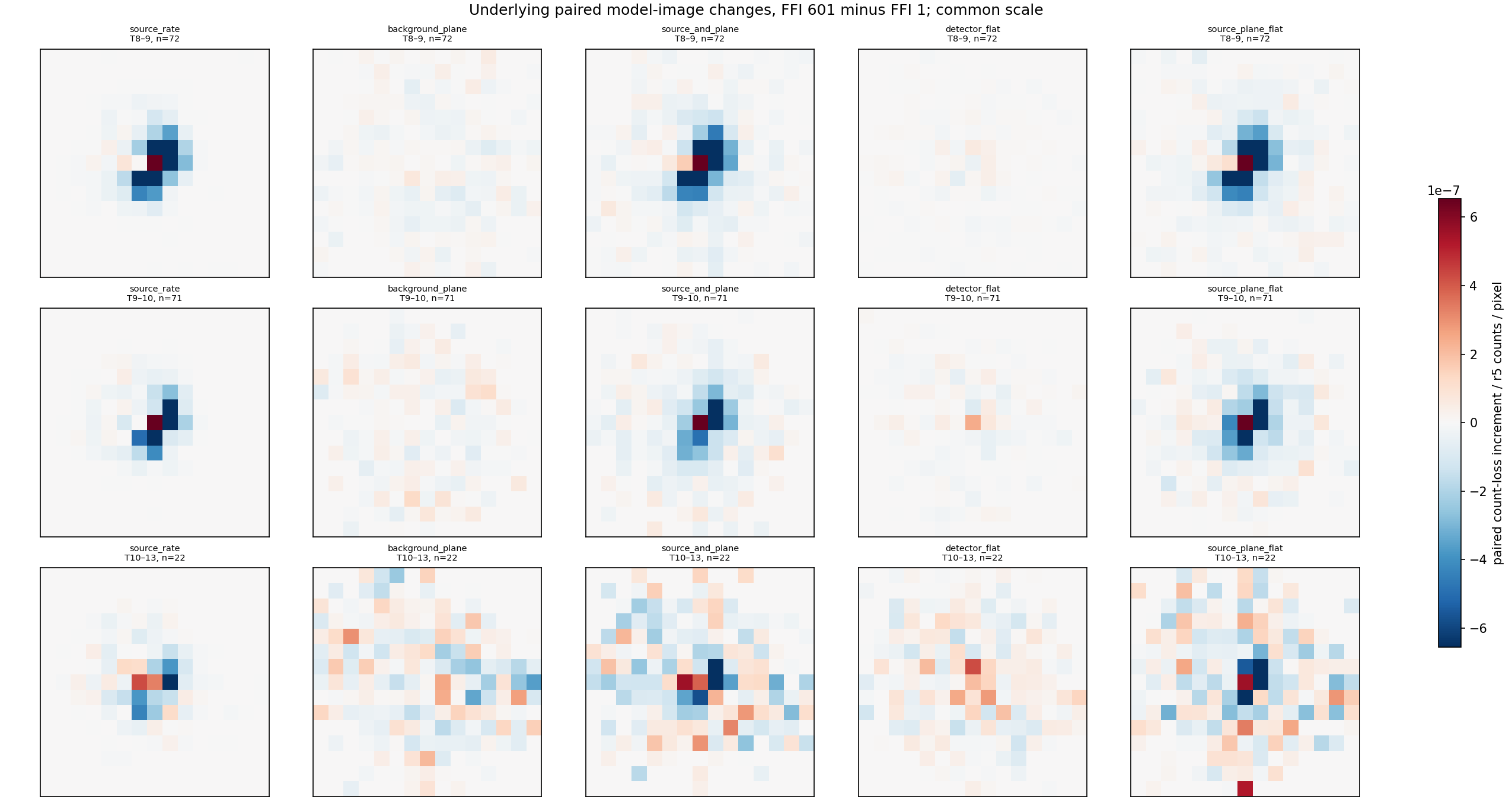
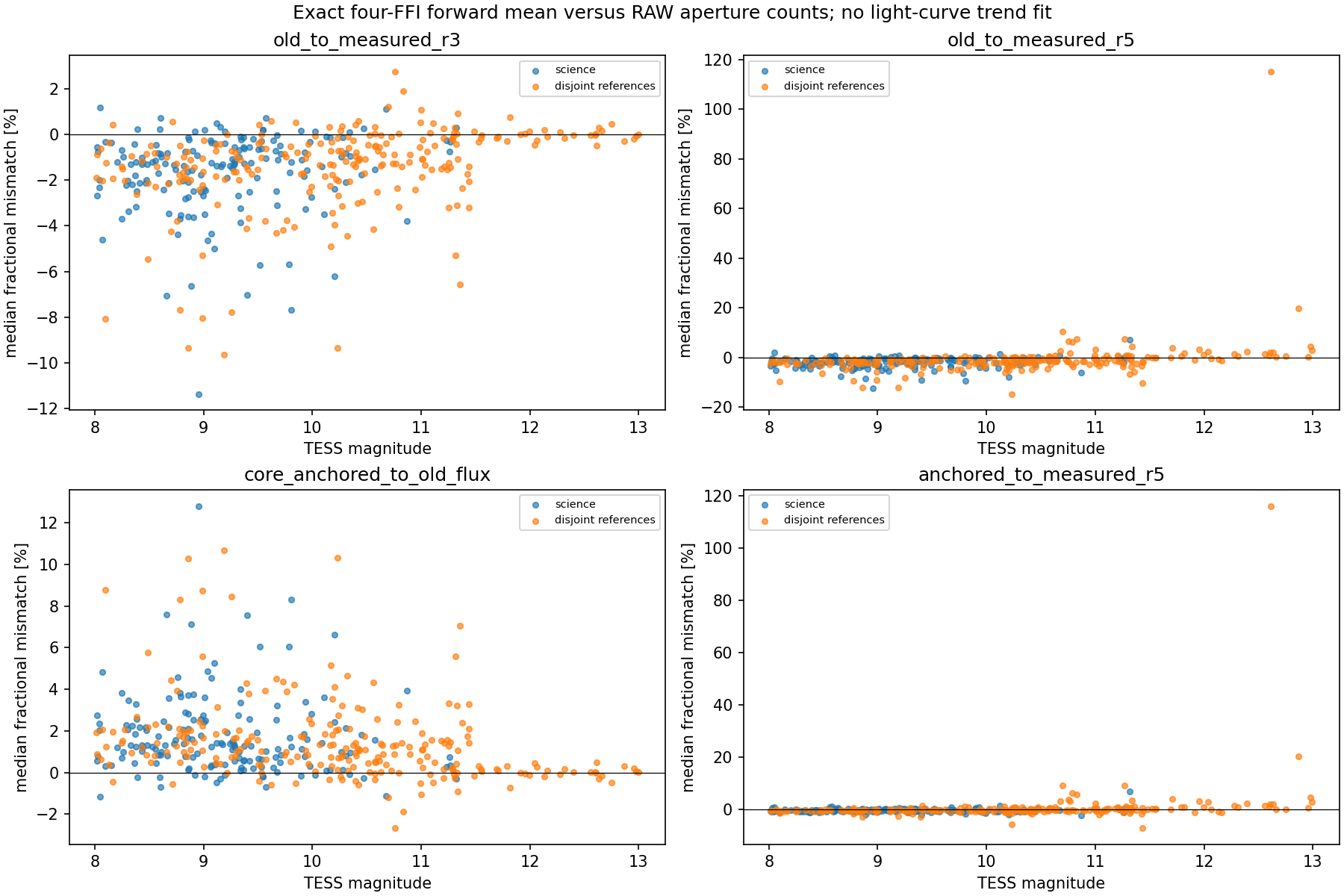
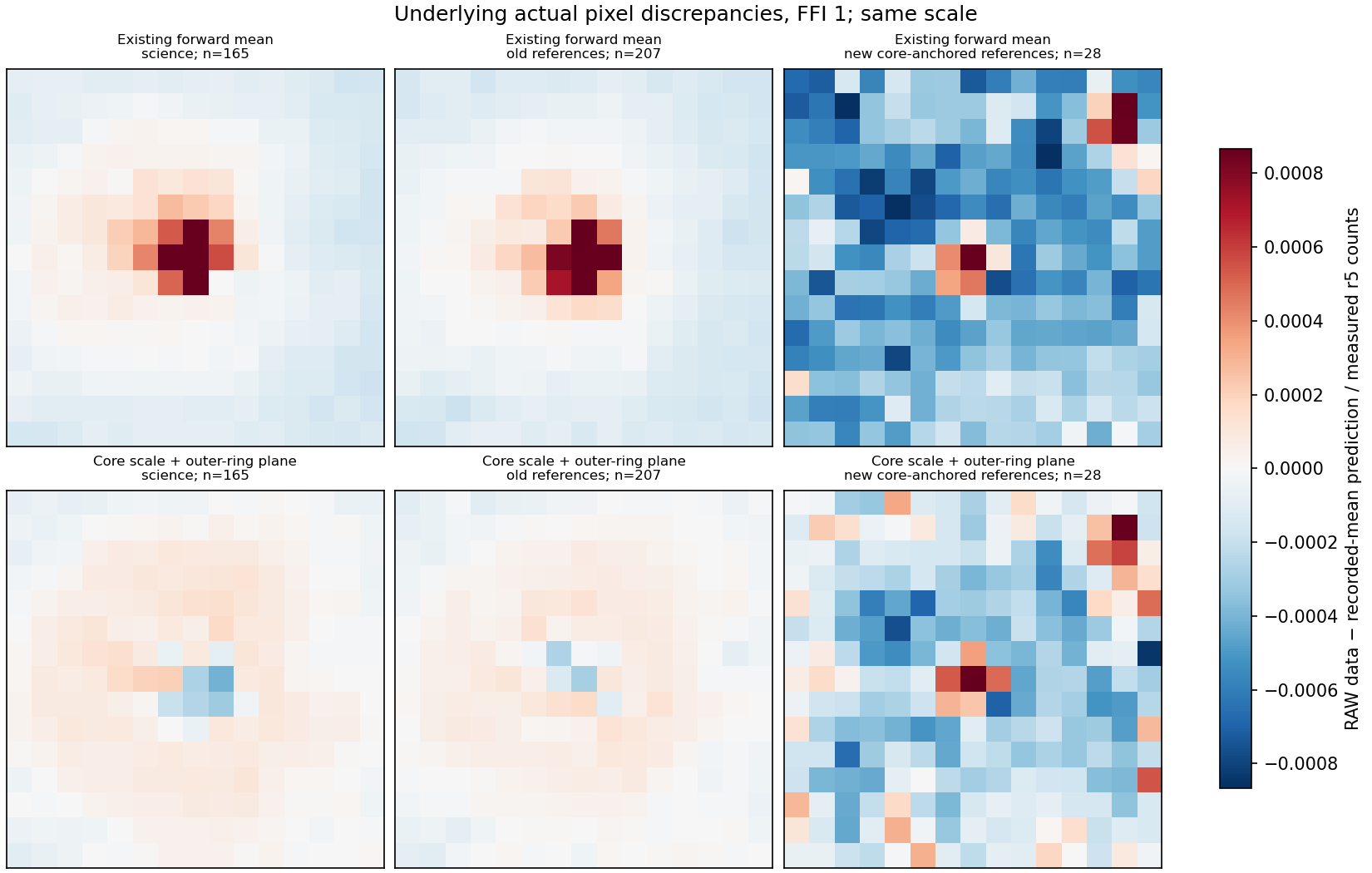
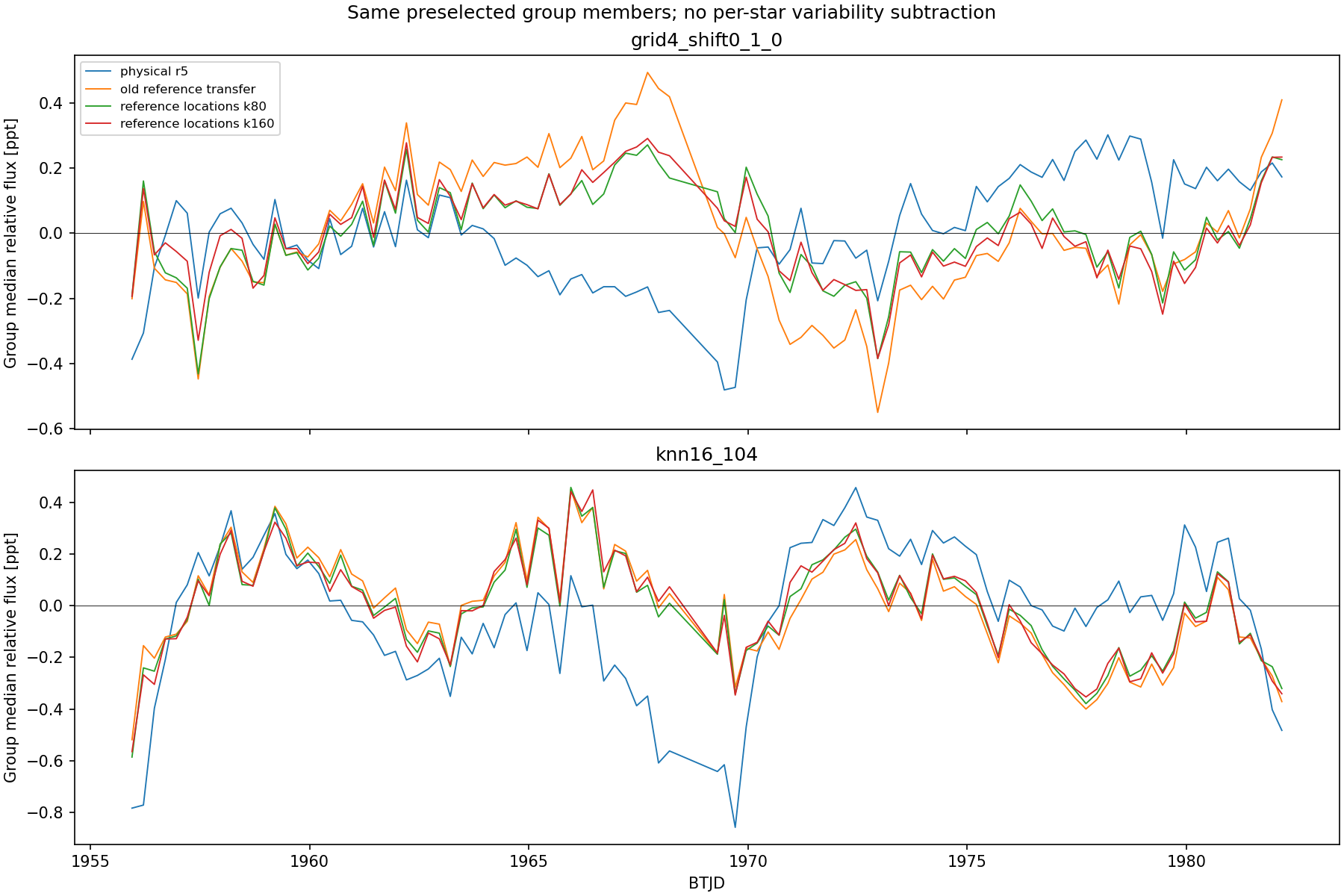
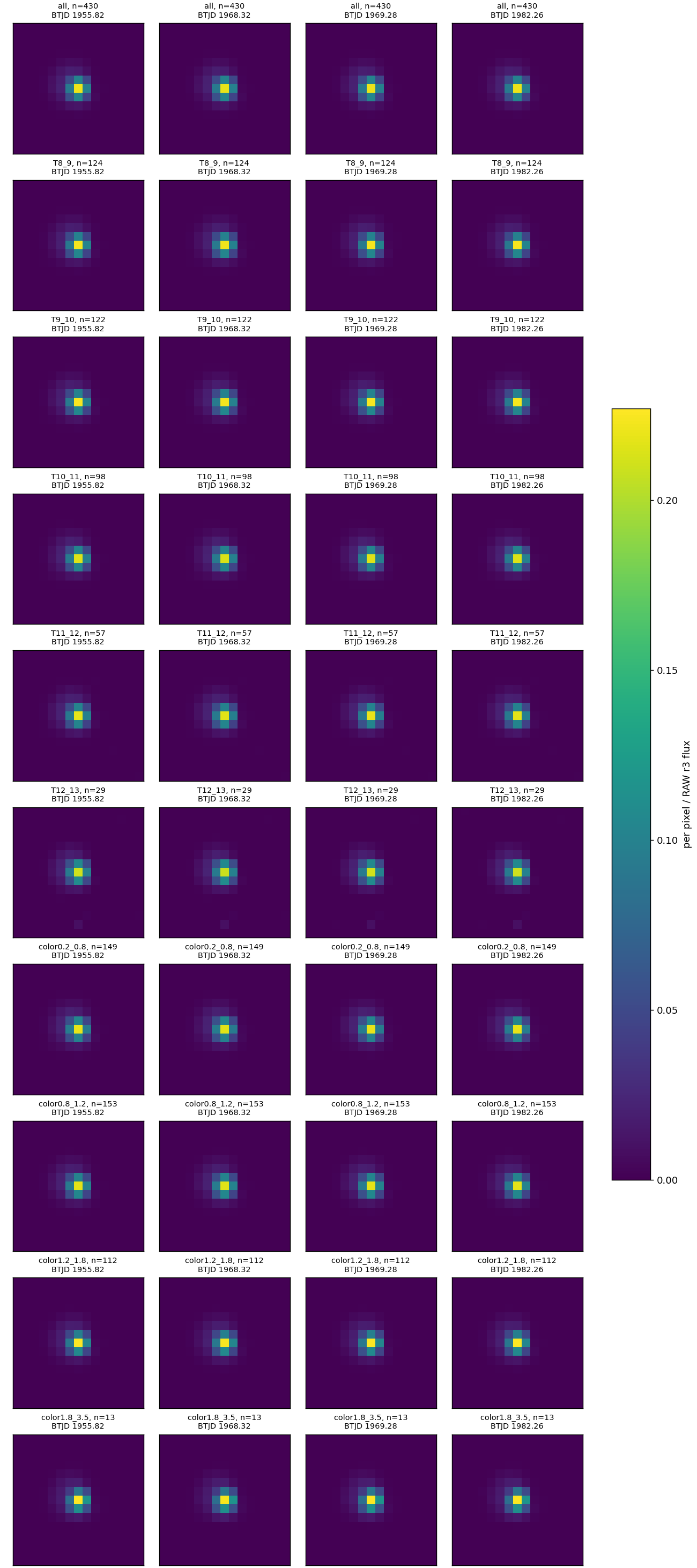
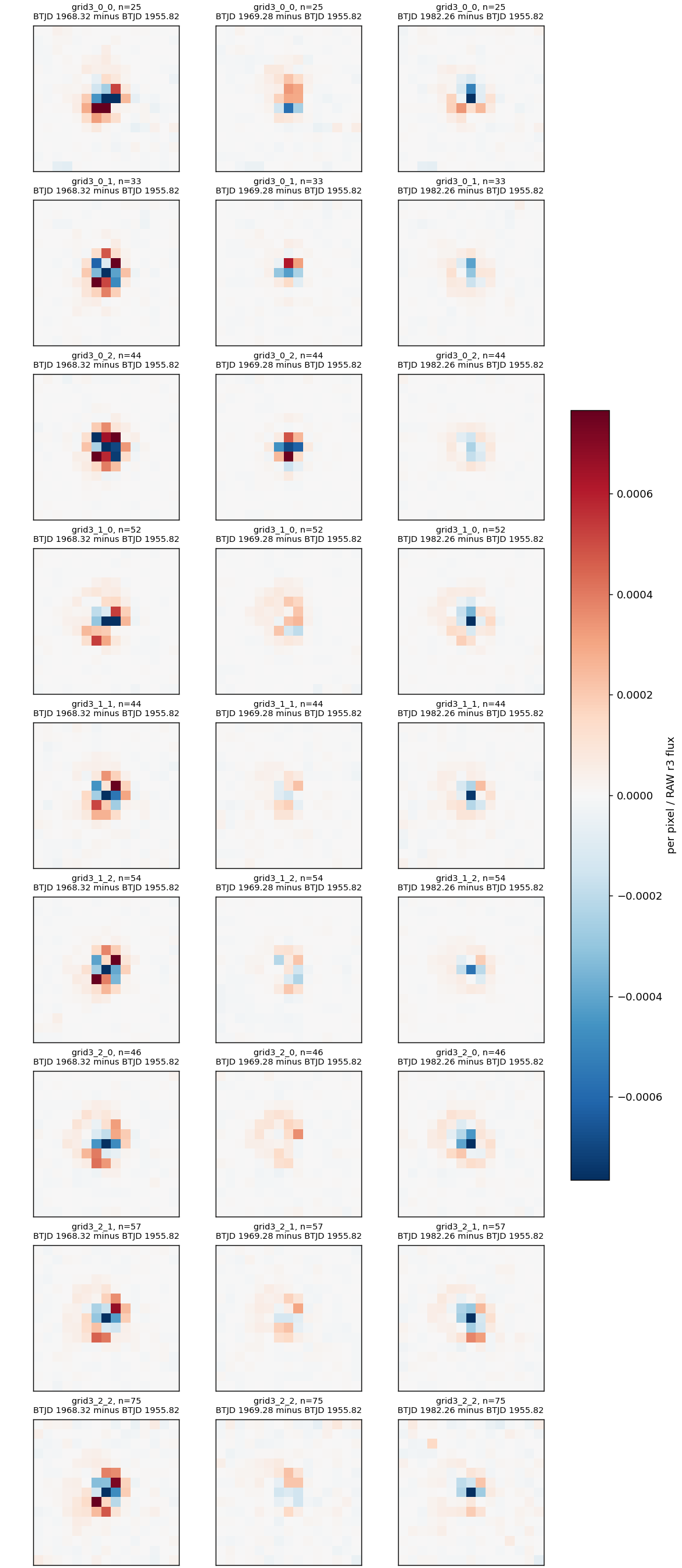
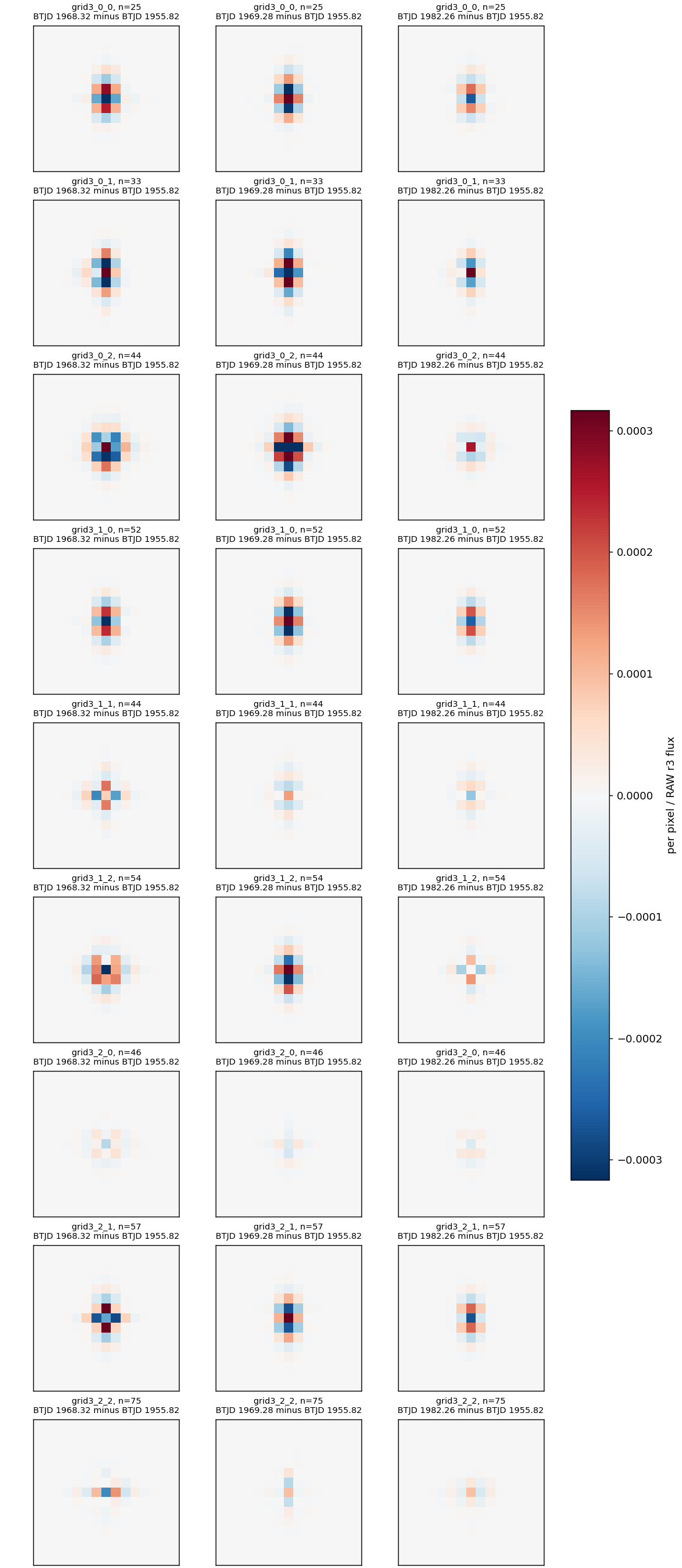
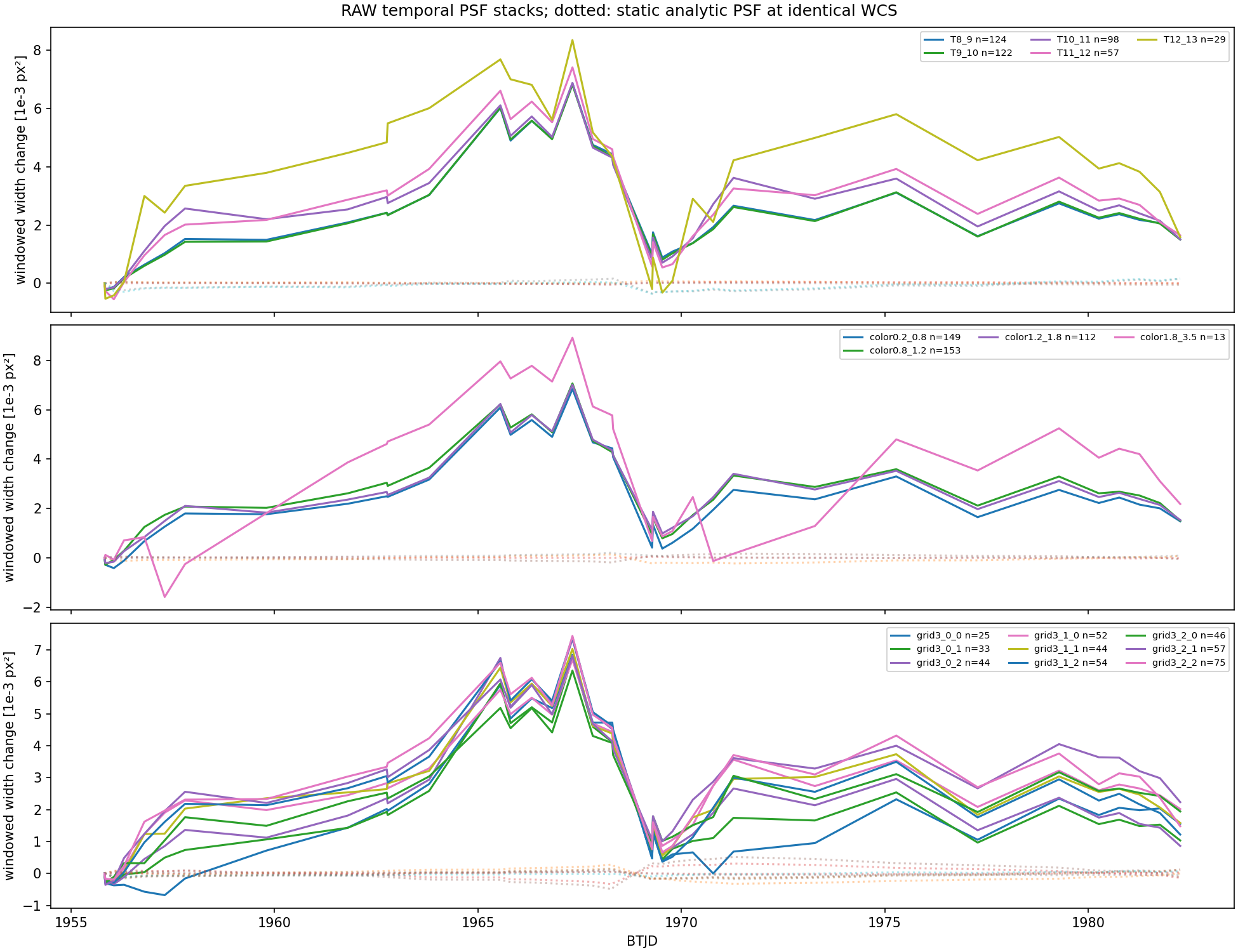
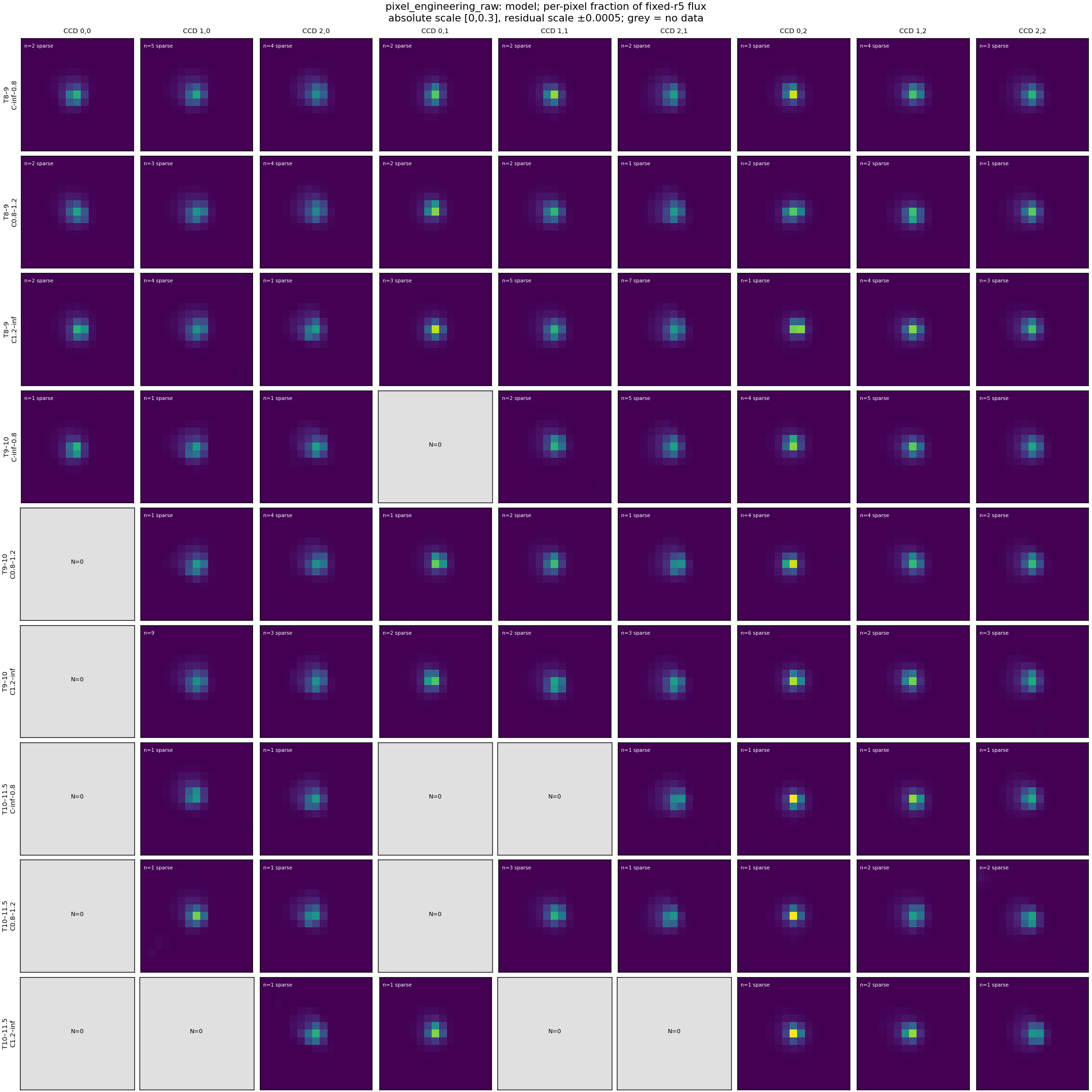
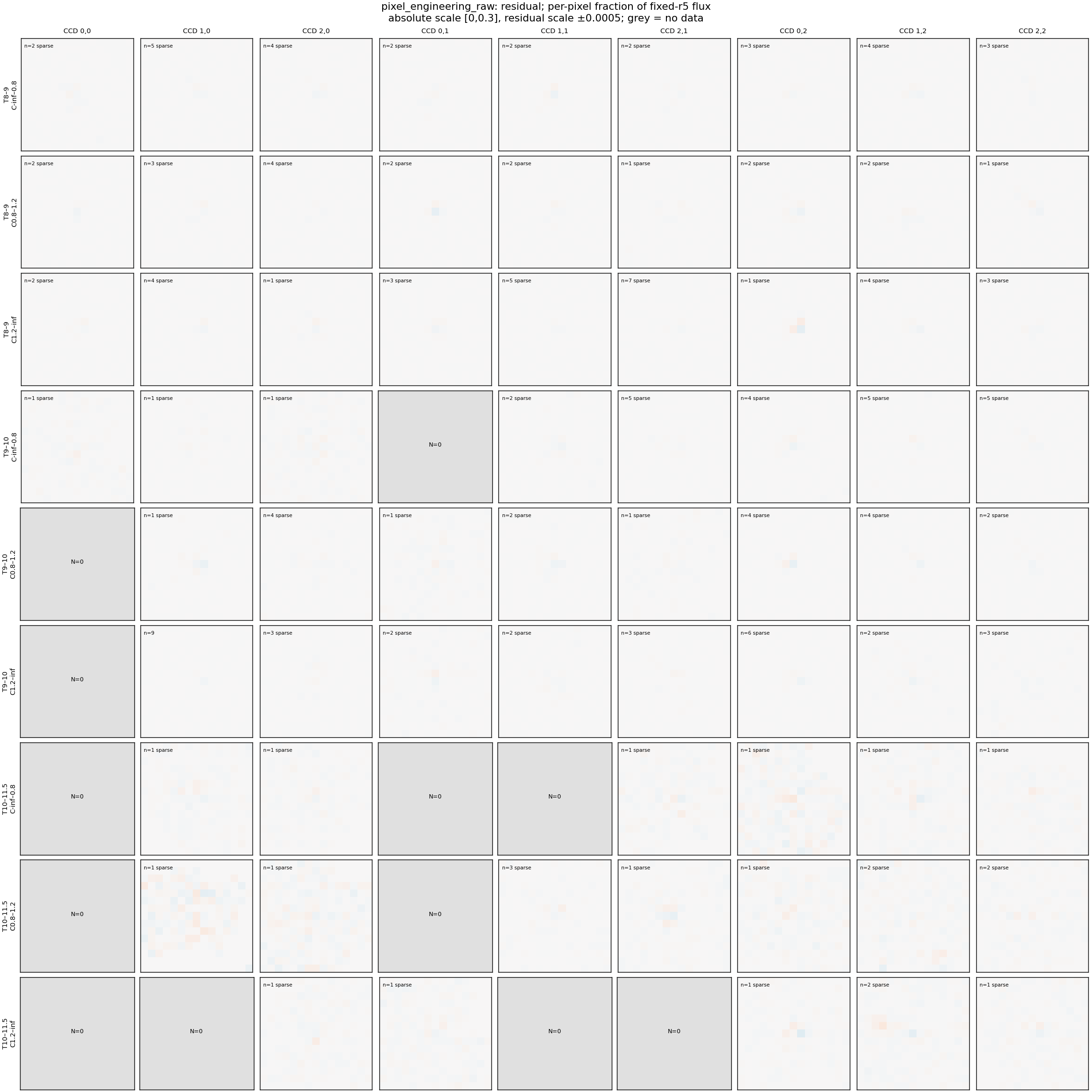
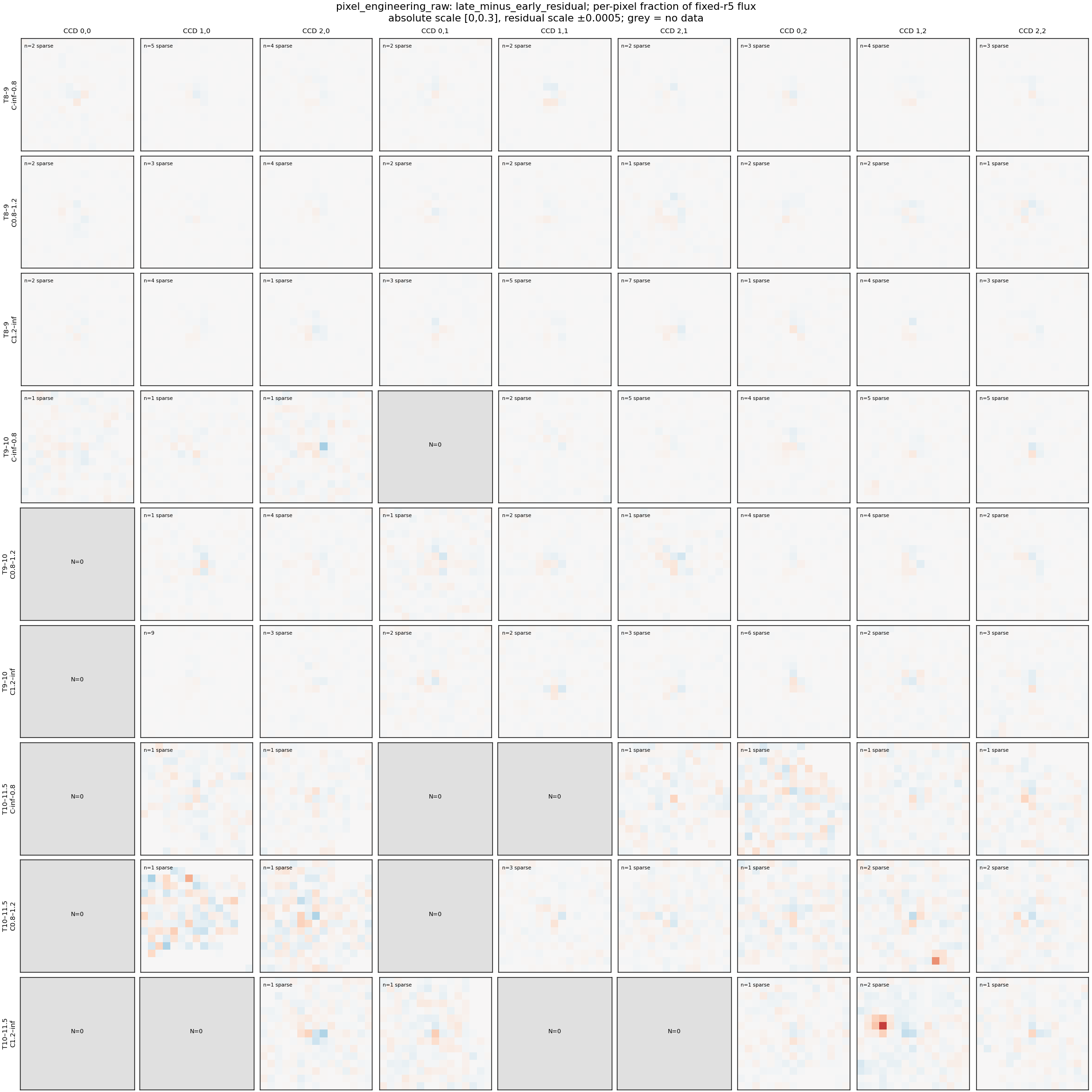
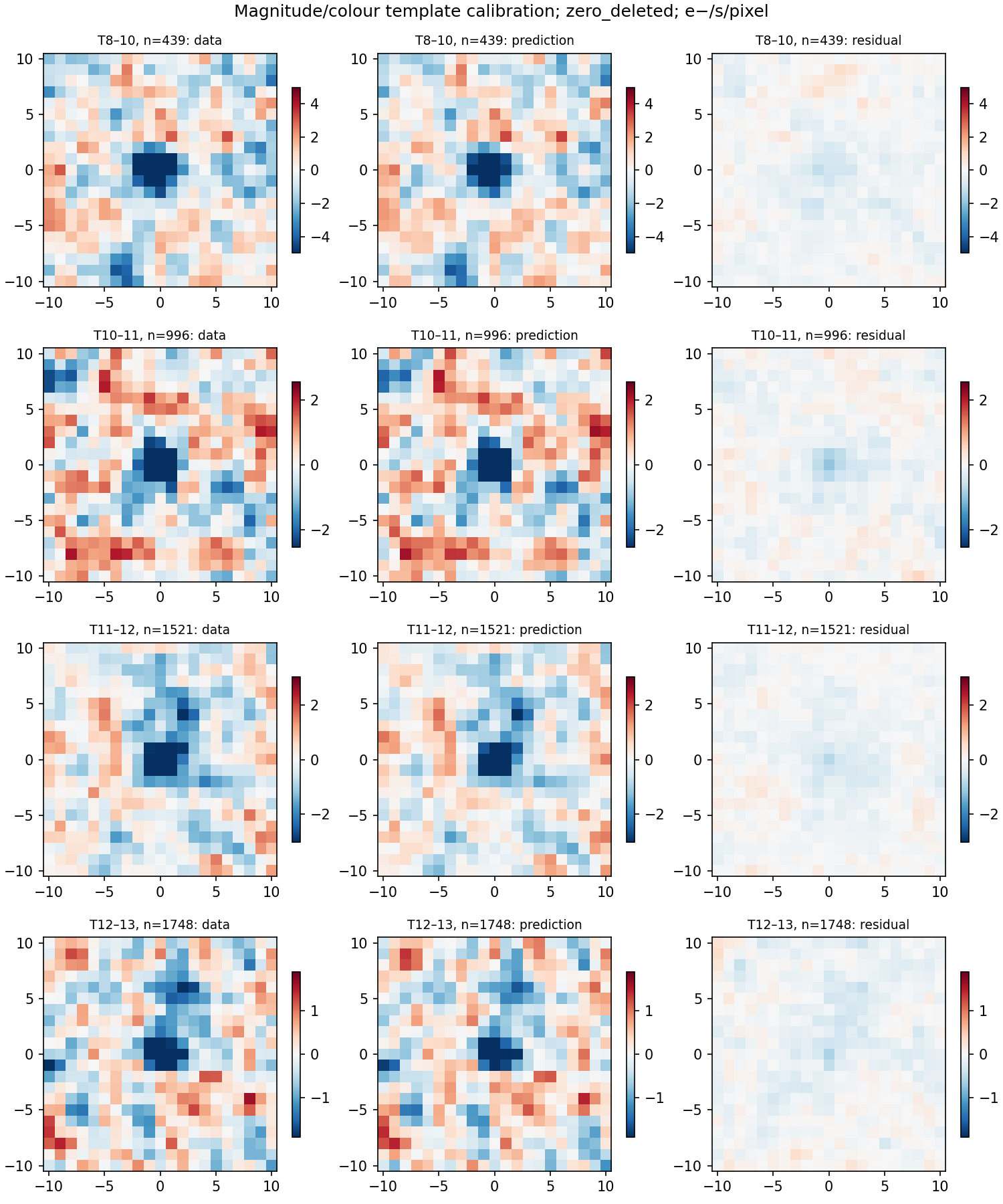
2026-10-05: galaxy light can enter the learned stellar PSF
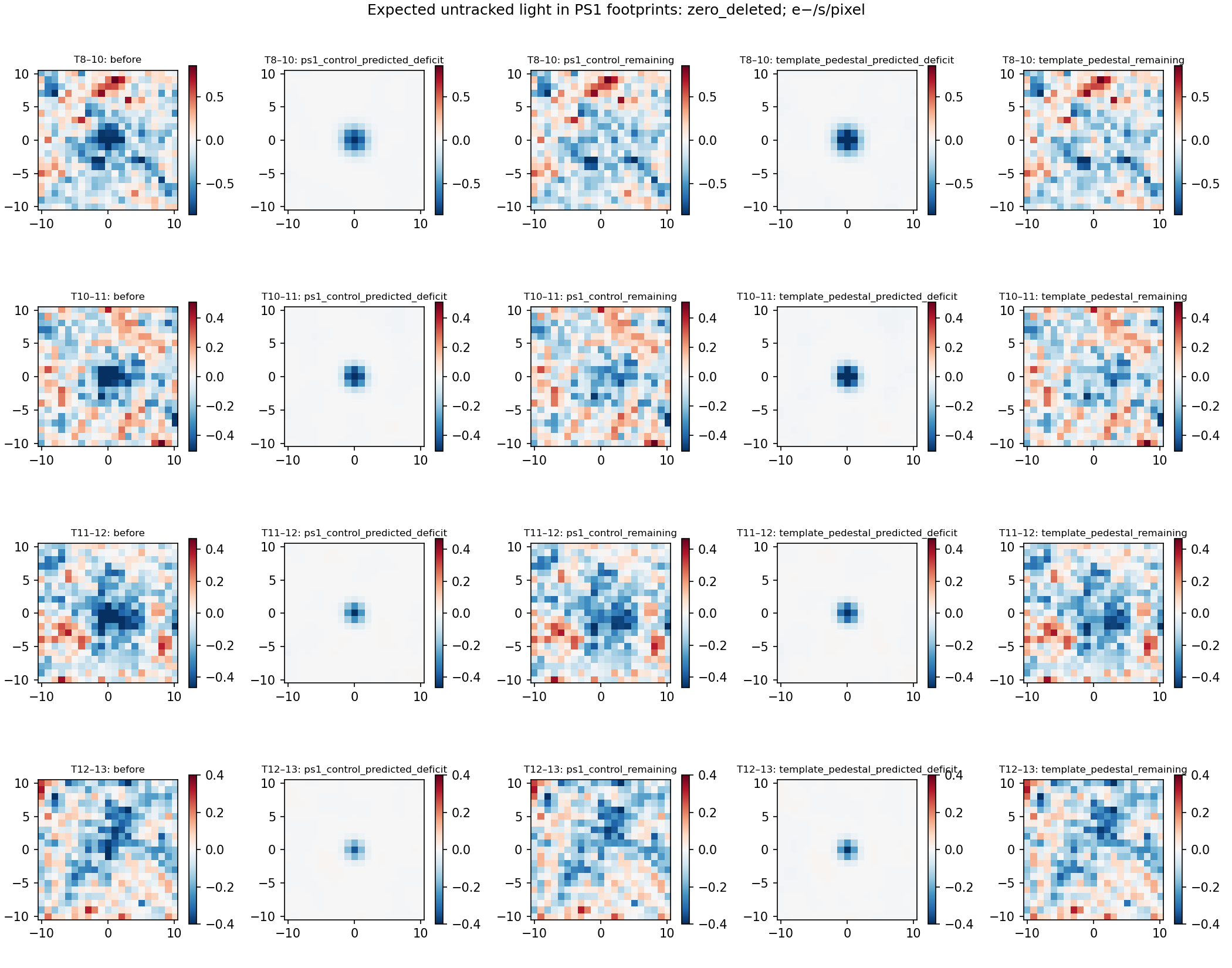
The full light-curve goal remains unmet. These are actual RAW training and held-pixel tests. More profile flexibility improves some pixel predictions but does not establish accurate source fluxes. A specific outer component is traced to extended galaxy light in a training stamp; a controlled training repair has been launched and is not yet assessed in this section.
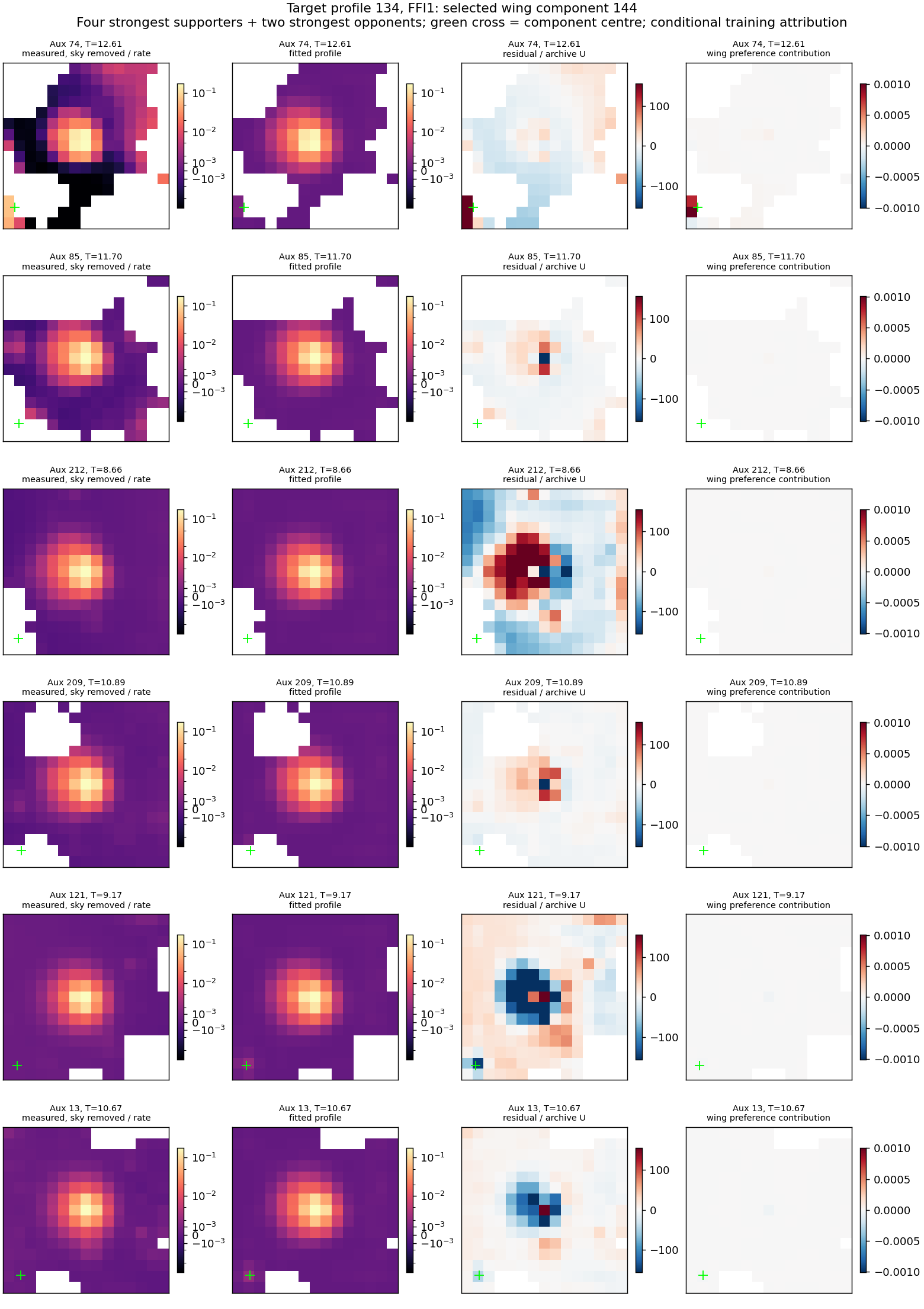
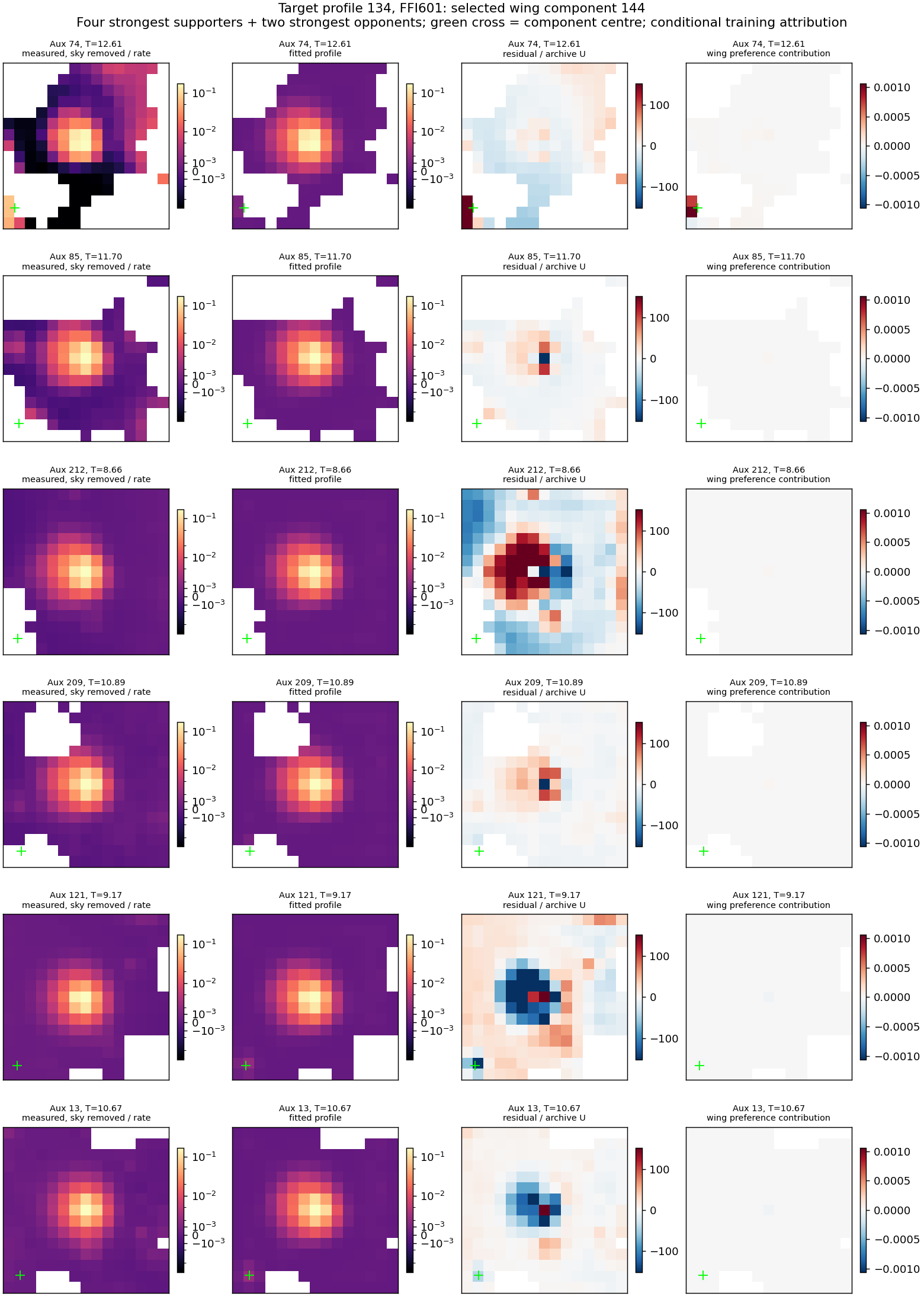
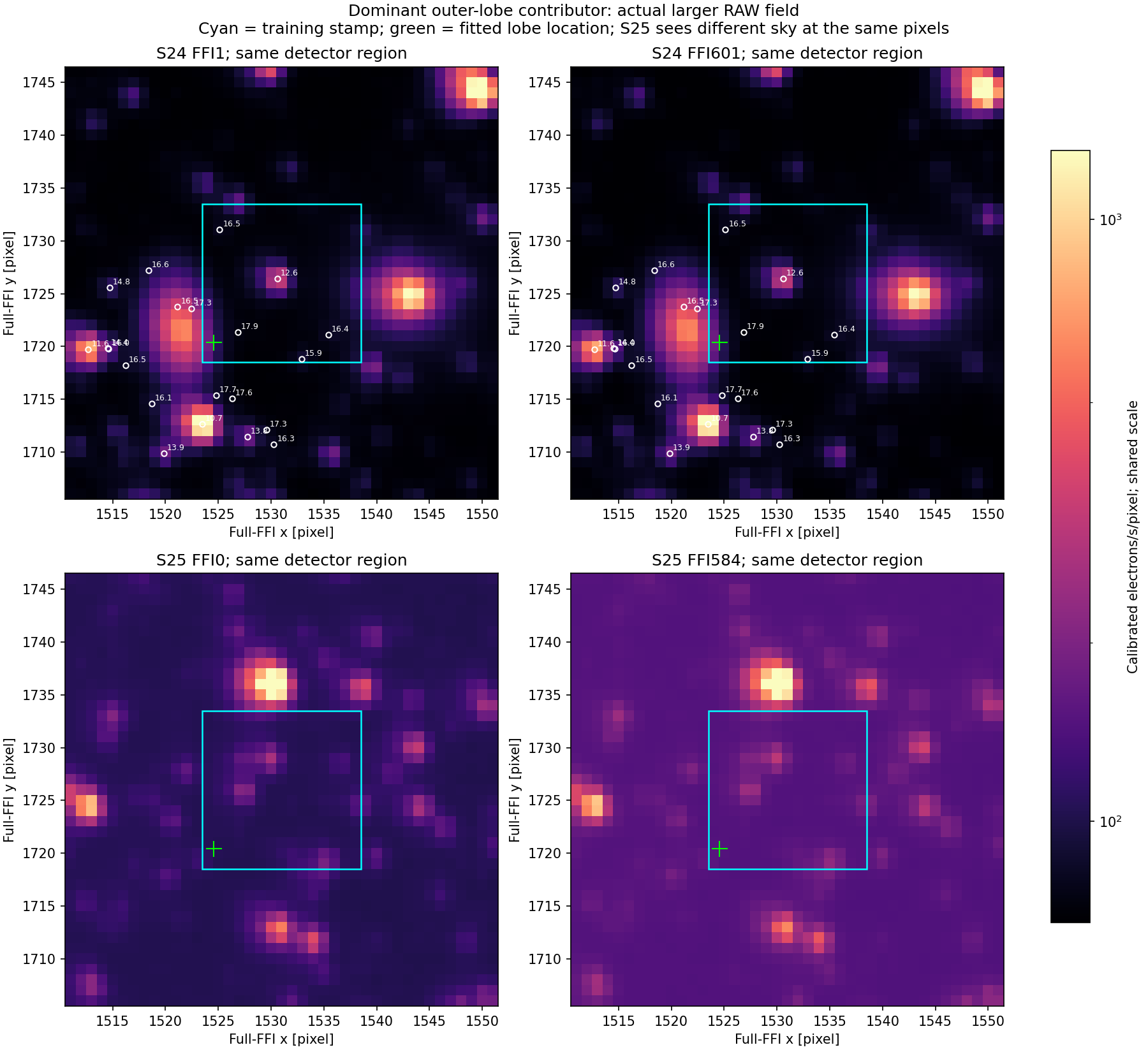
The dominant training source is auxiliary 74 (Gaia 1602991234929899008, Tmag 12.614). Retained pixels lie on NGC 5985 light. Independent positions from the NASA/IPAC NED05D table project onto the two extended objects. The live NED API attempt timed out; the record explicitly uses the table transcription. This is image-resolution association, not precision astrometry.
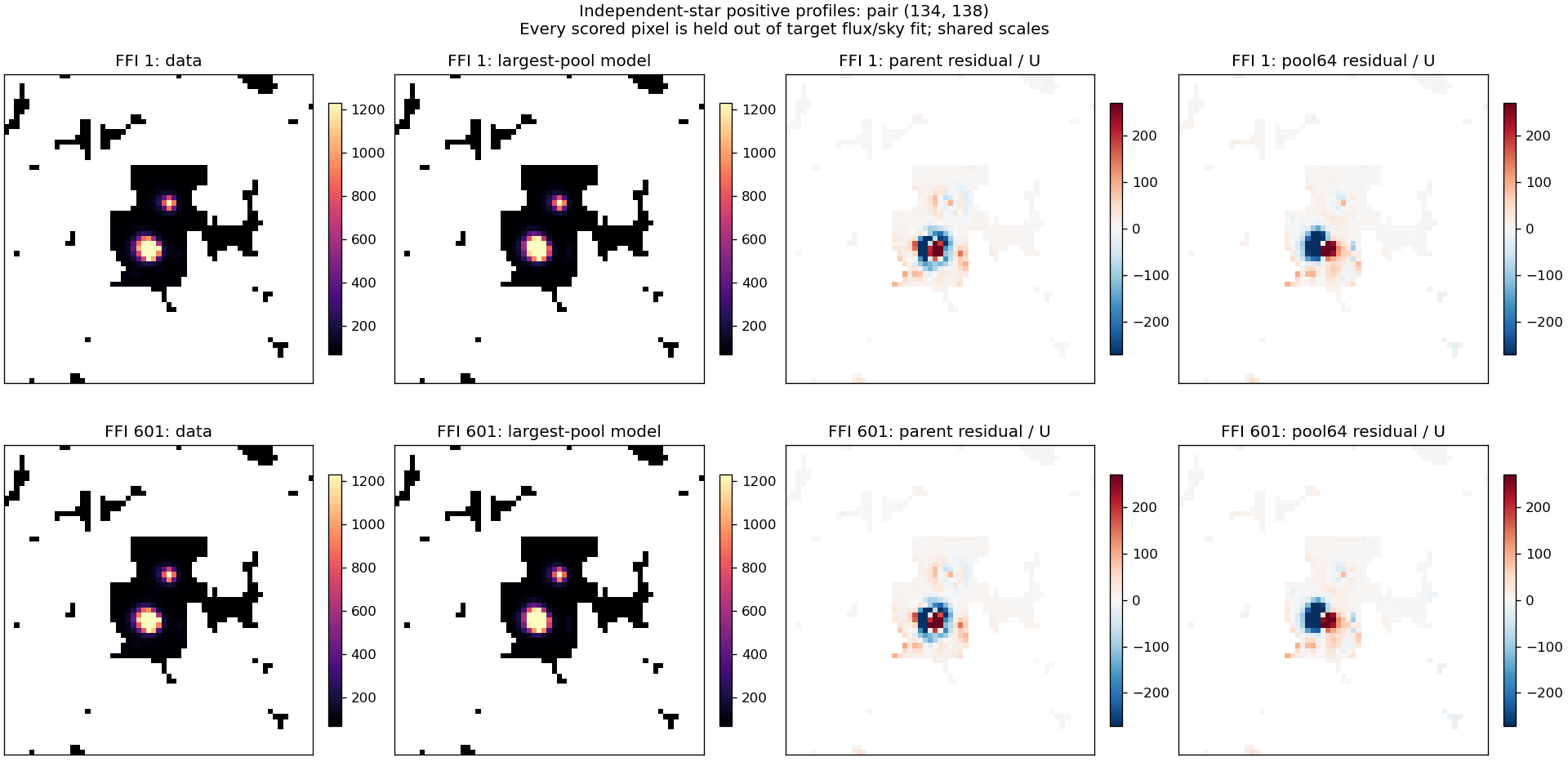
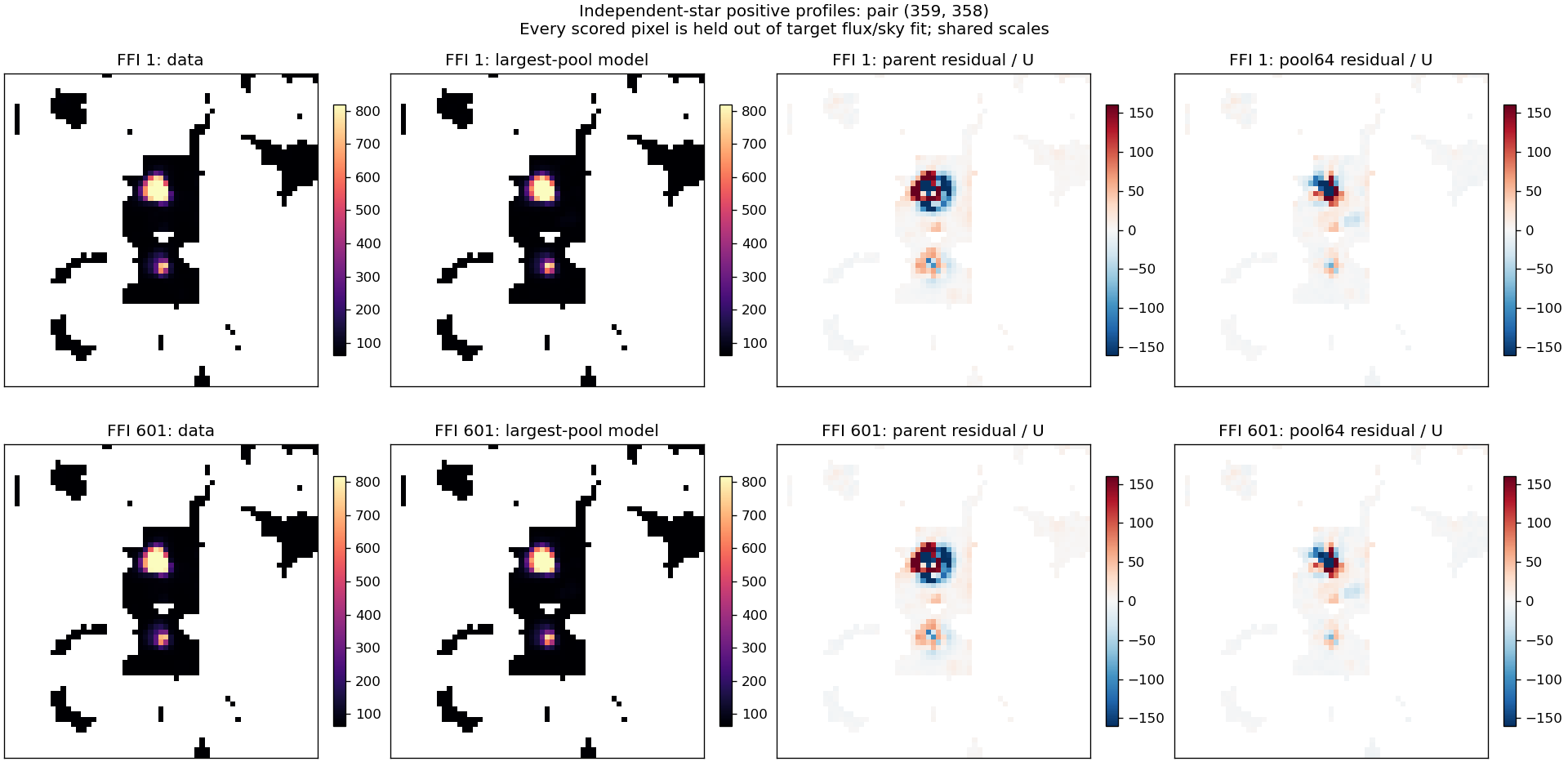
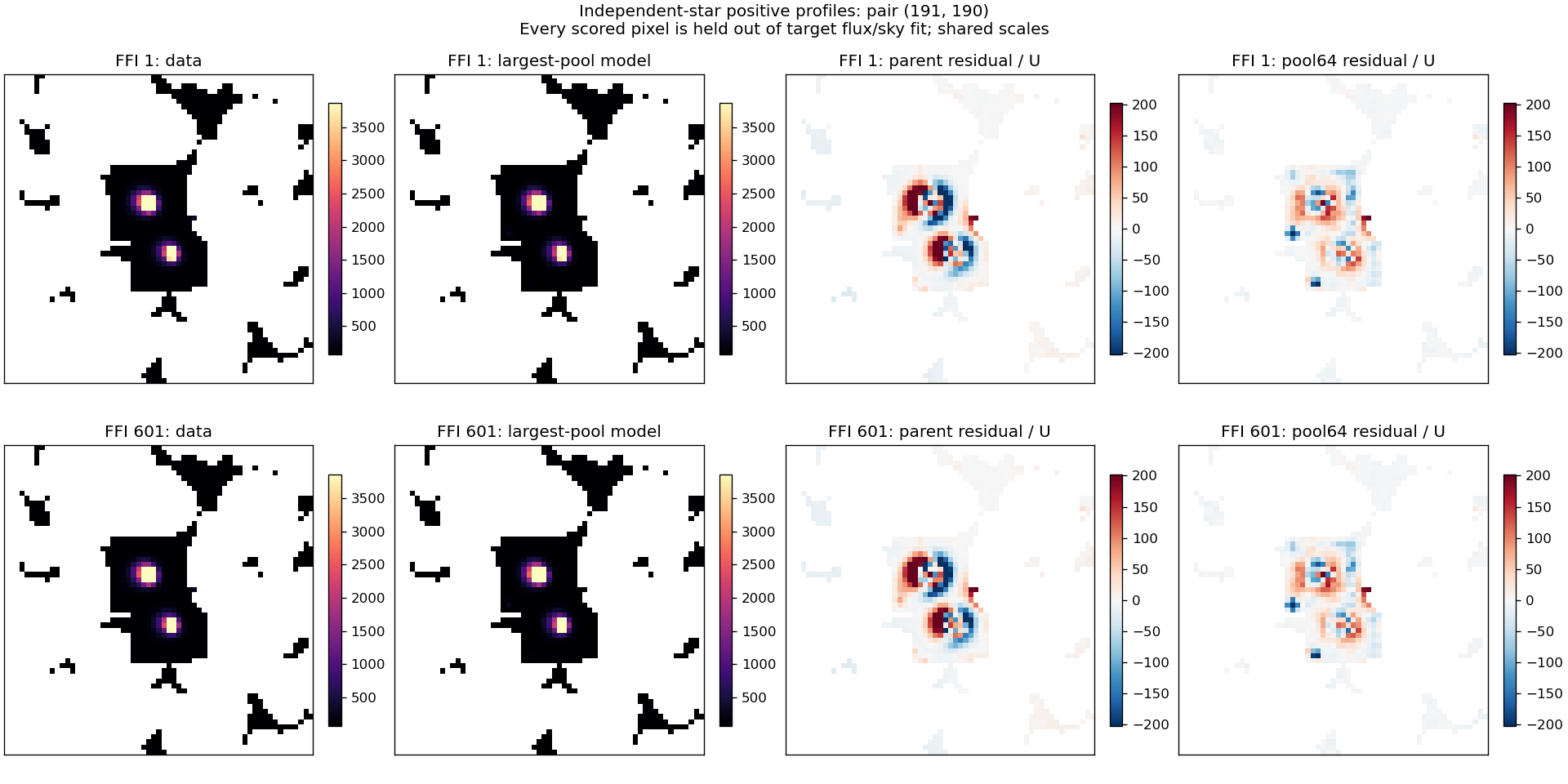
Controlled positive-profile comparison
The 144-component fine-core model is nested within a 304-component model adding directional wings. Both are positive, pixel-integrated Gaussian mixtures normalized over the whole plane. Training uses the same independent 64-star pools, target/overlap exclusions, WCS, sky response and regularization convention. All six targets remain, including the red cases with colour/spatial extrapolation. Source amplitudes and sky remain free; no time-flatness criterion enters the fit.
Here s is a training star and p a native pixel; D is calibrated rate in electrons/second/pixel and F0 its historical positive source rate in electrons/second. P is the fitted unit-total-flux pixel fraction; a is a free dimensionless source amplitude. Q is the inherited dimensionless background response, B the constant and two normalized coordinate-plane terms, and b their fitted coefficients in normalized-image units. The objective uses inherited radial shape weights and a fixed coefficient ridge; held target scores use archived pixel uncertainty. This is a coadded profile model, not a validated instantaneous optical PSF.
Pair
Parent native RMS
Directional-wing native RMS
134 / 138
122.61
125.95
359 / 358
94.21
69.18
191 / 190
115.33
67.14
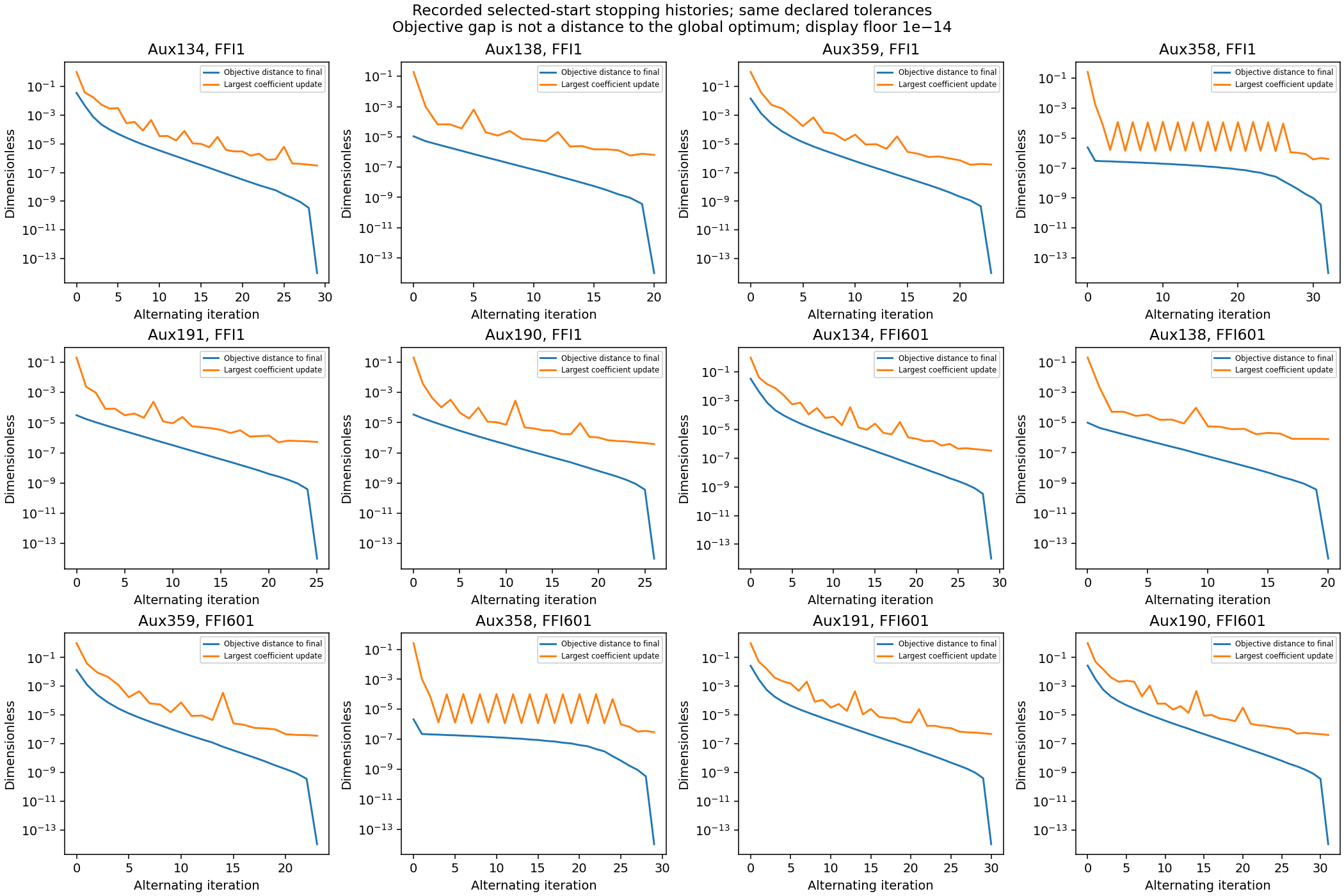
Each entry is the median of two epochs and two held-pixel halves, in archived-uncertainty units. These are large remaining discrepancies, not a Poisson-limit result. All 12 fits and both starts reach the unchanged stopping criterion; maximum coefficient differences between starts reach 0.0202, so convergence does not prove uniqueness. Parent held predictions replay numerically.
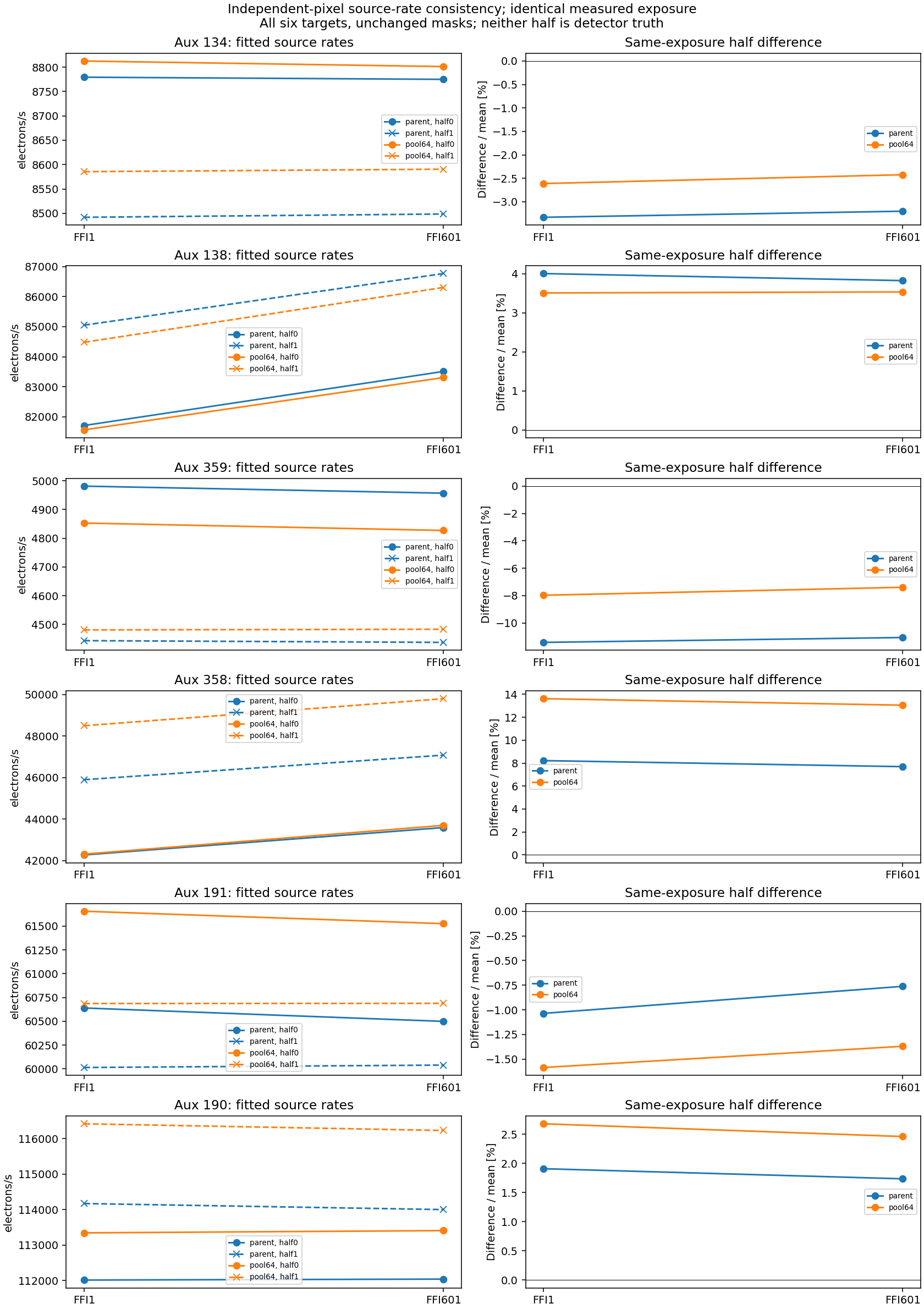
Same-exposure flux estimates still disagree. For source 358 the half difference grows from 8.22/7.69% to 13.61/13.05% at FFIs 1/601 despite the pair's lower pixel RMS. No new photometry or count-loss correction is adopted.
Conditional training attribution
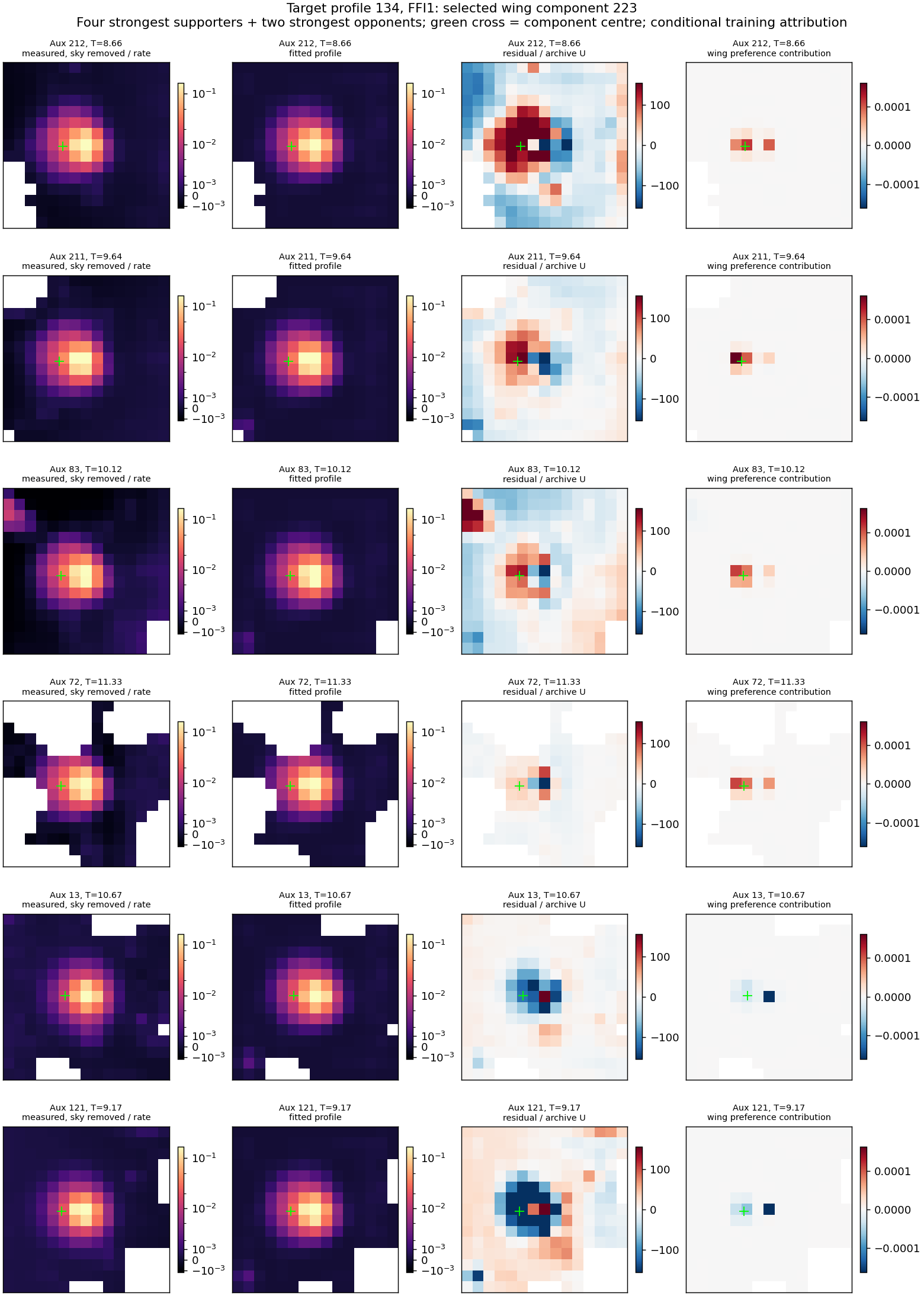
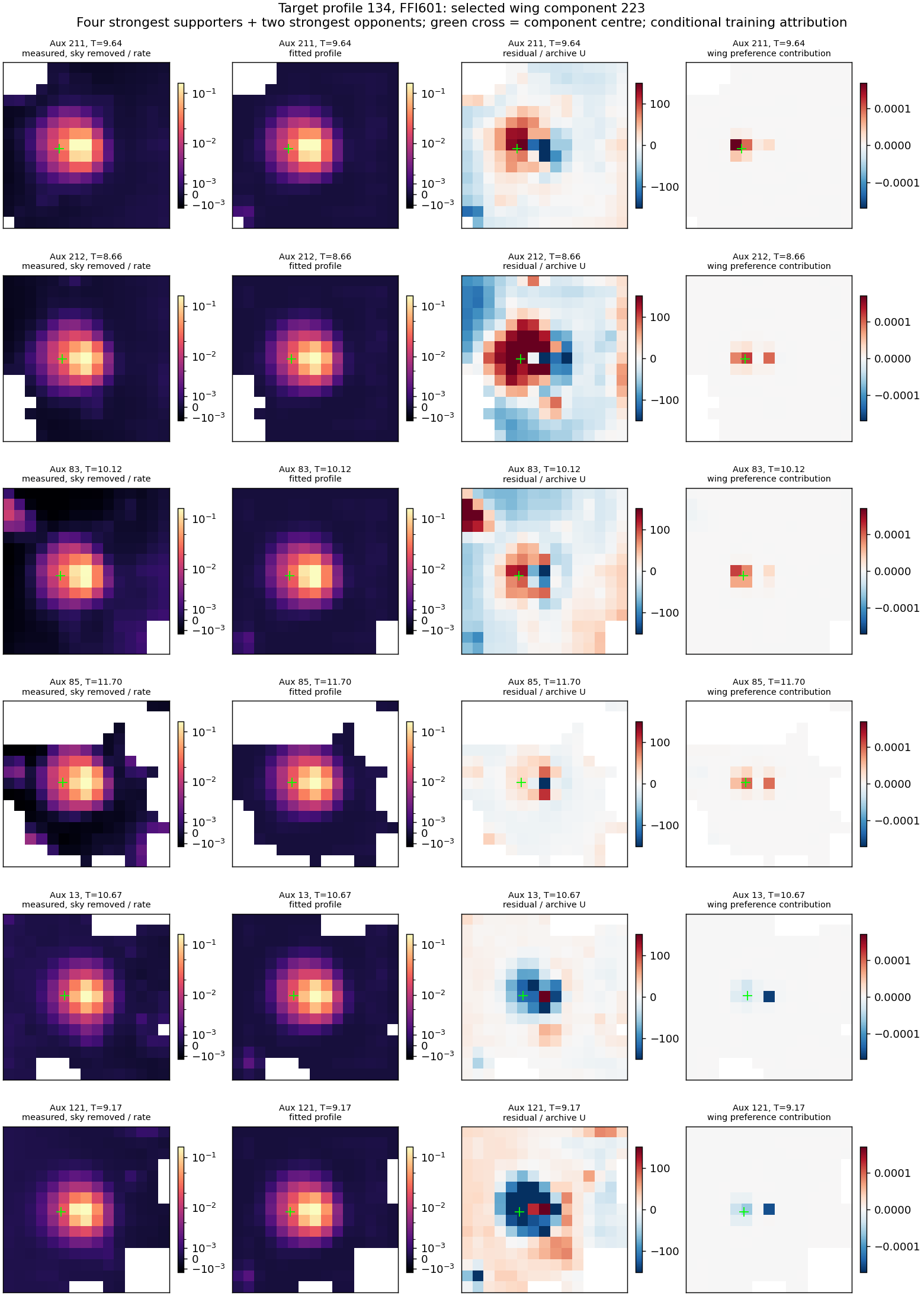
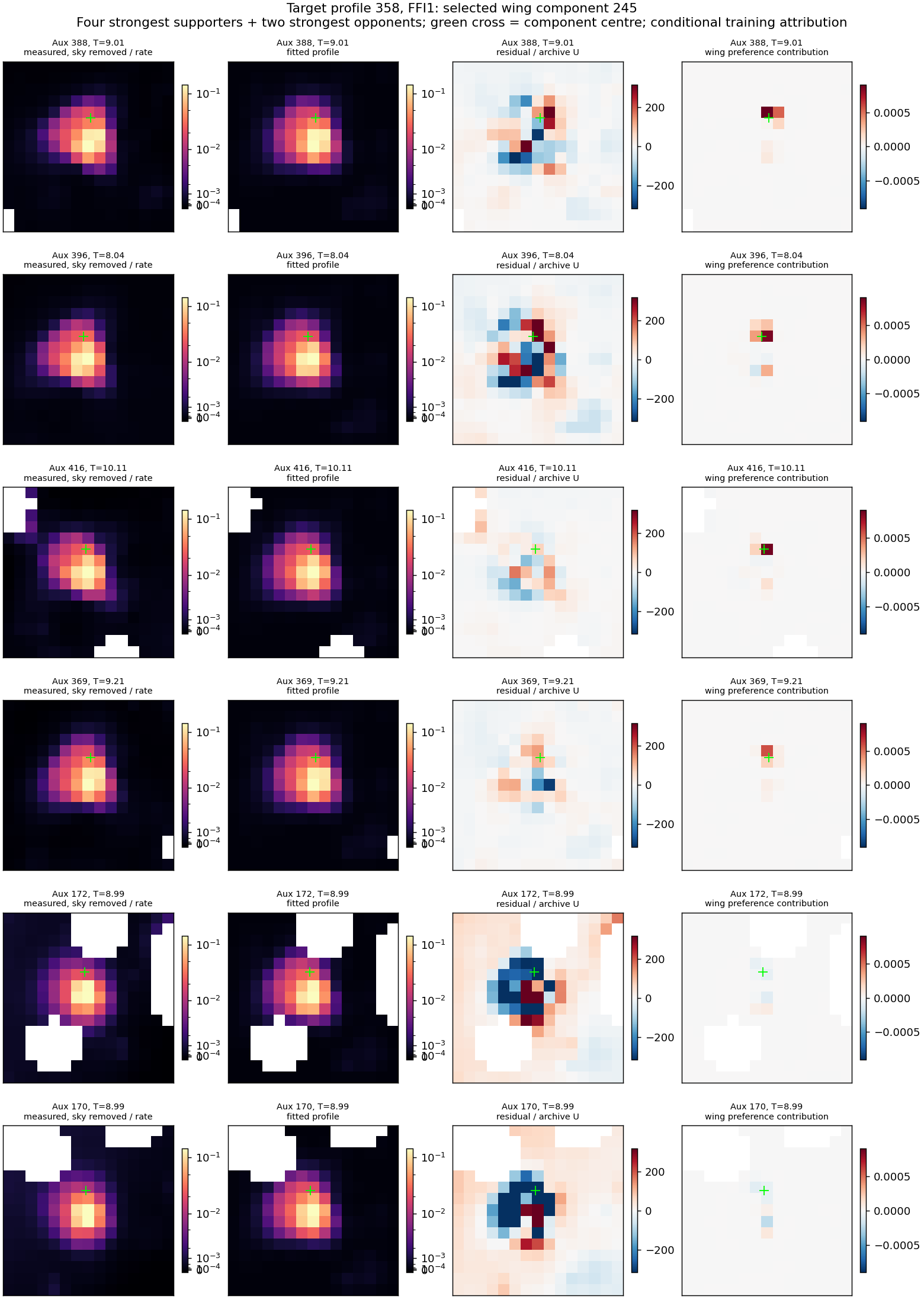
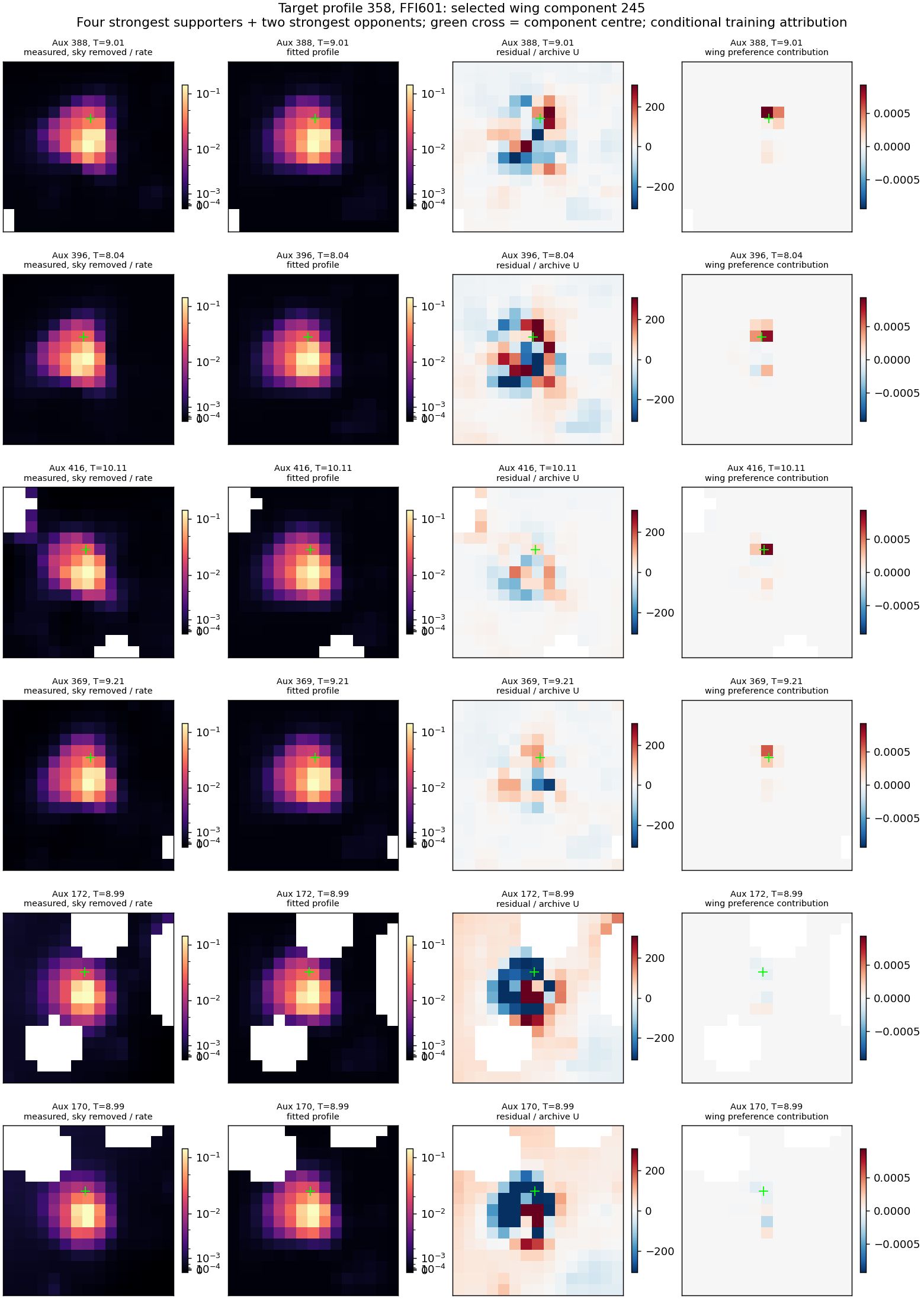
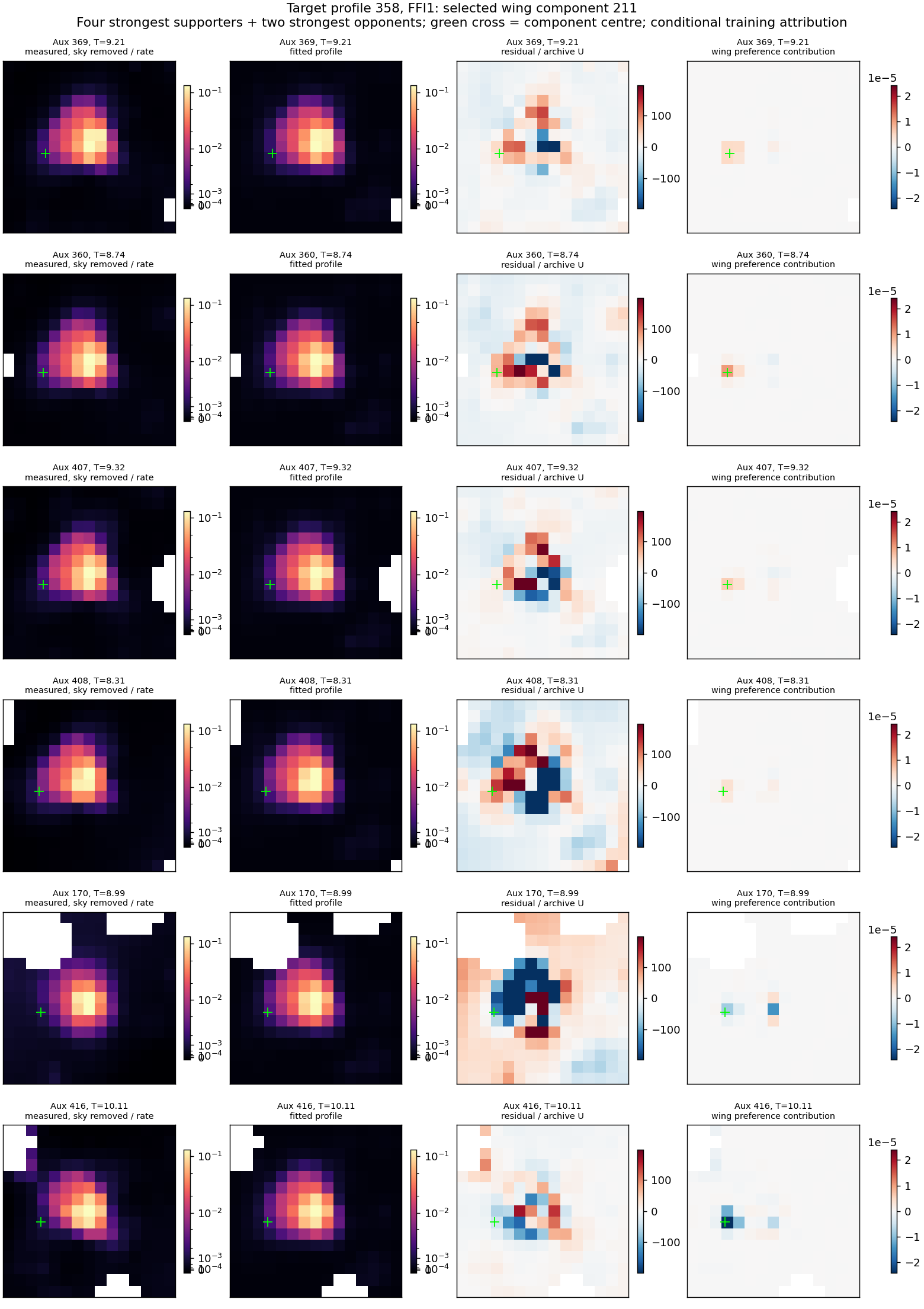
Remove a selected added Gaussian component, transfer its mass to an active core component, and refit only each training star's amplitude/sky. The weighted increase in squared residuals measures preference for that component. Fractions use the sum of positive preferences as denominator; negative contributions are retained separately. This is in-sample attribution, not an independent significance or automatic source rejection.
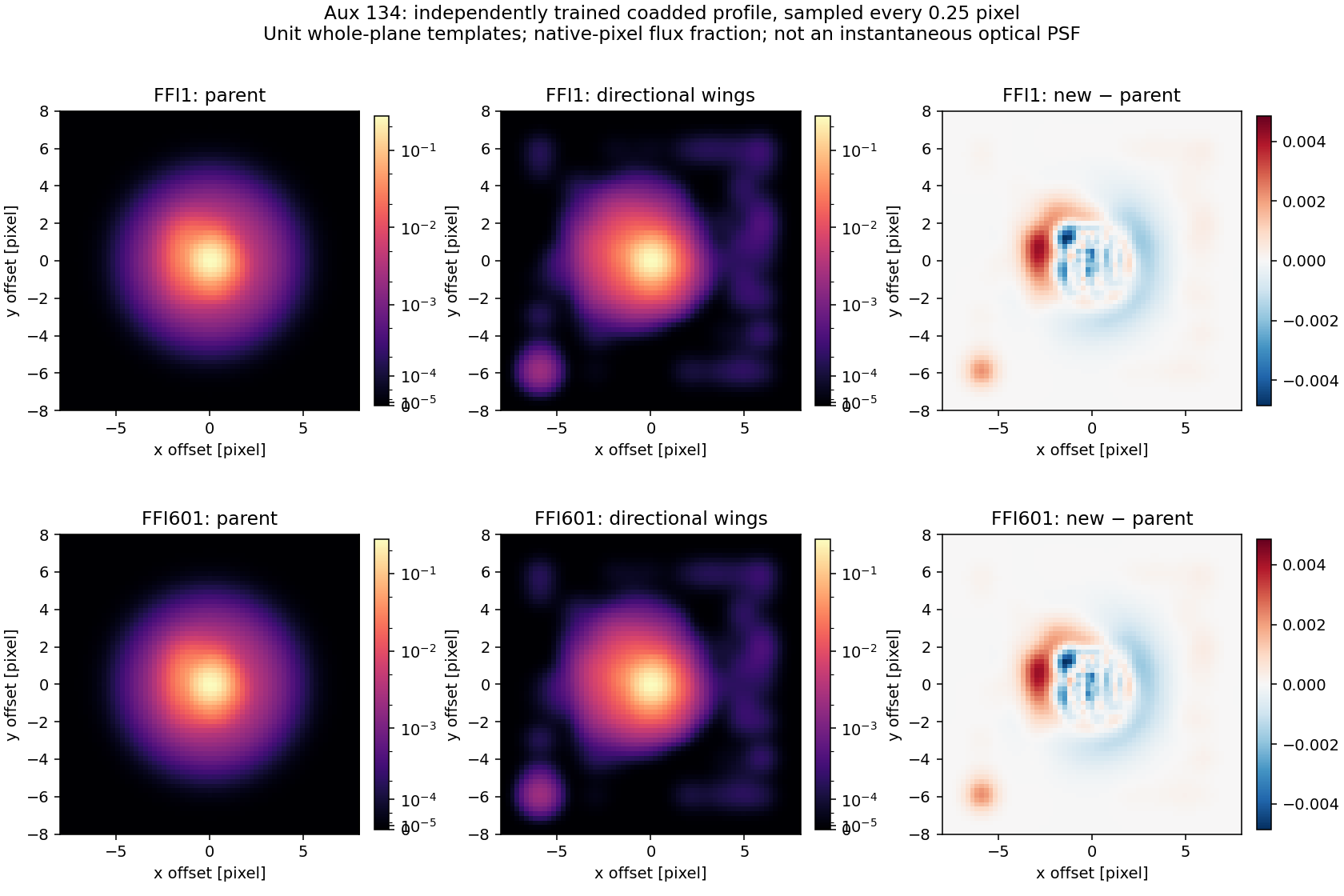
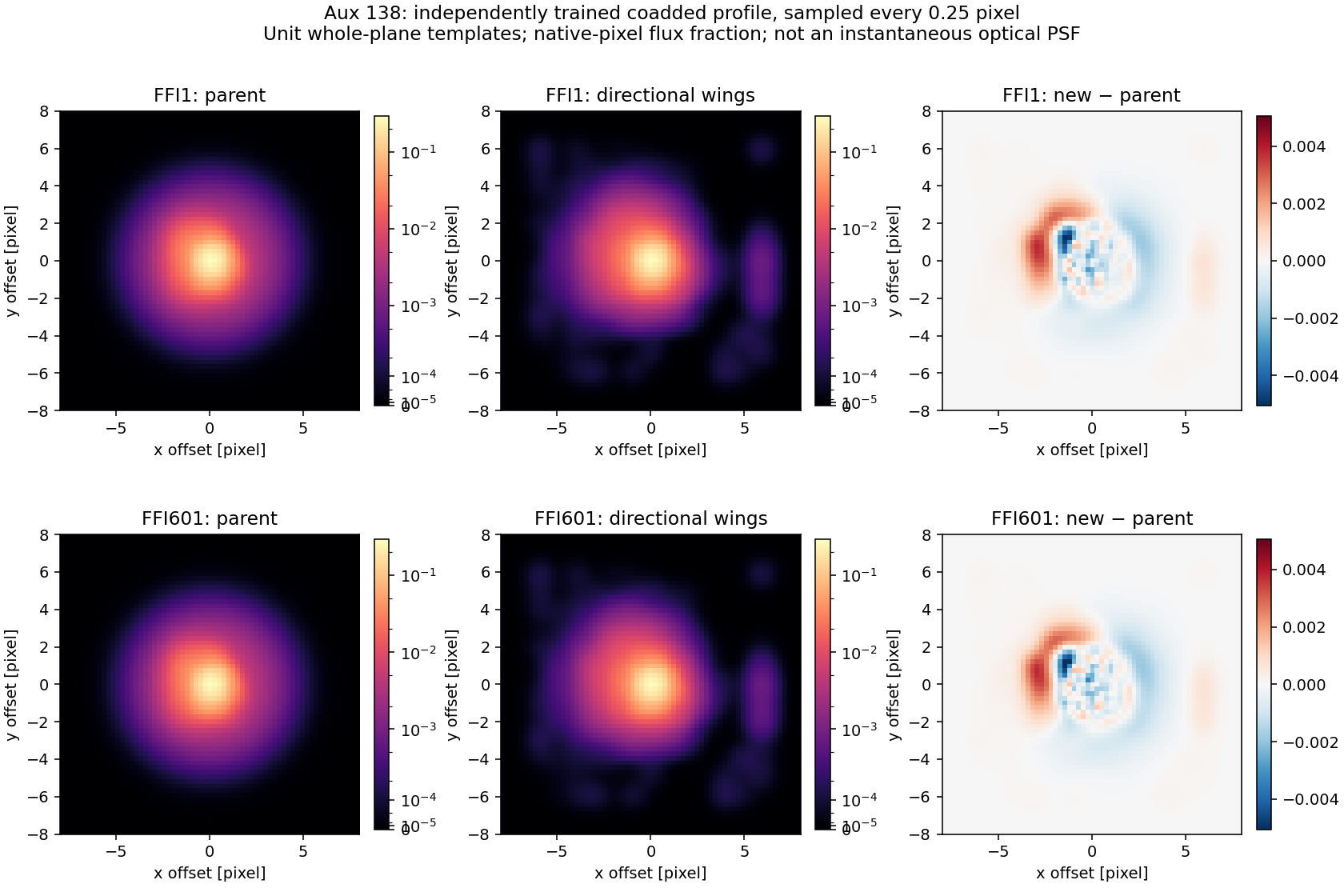
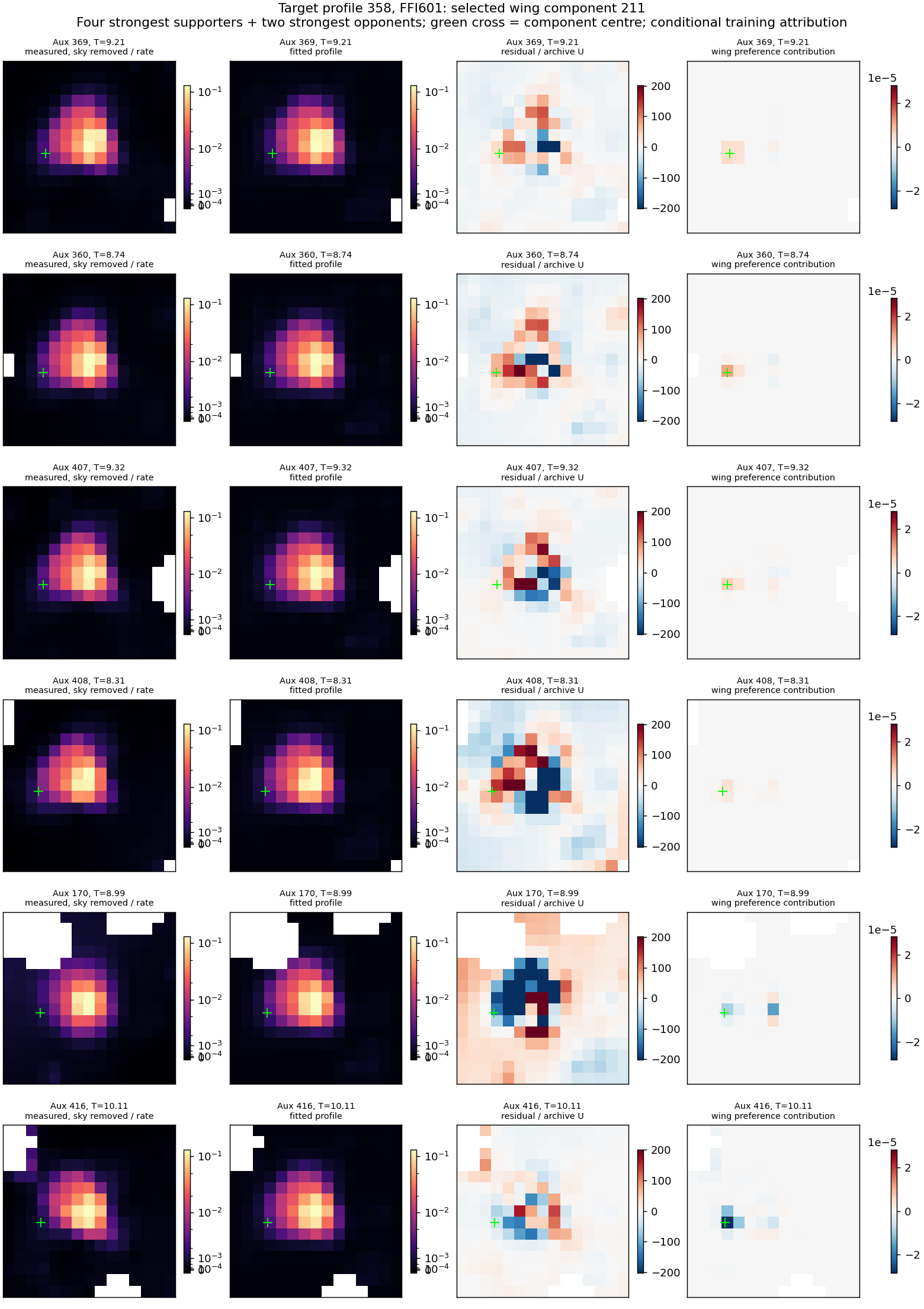
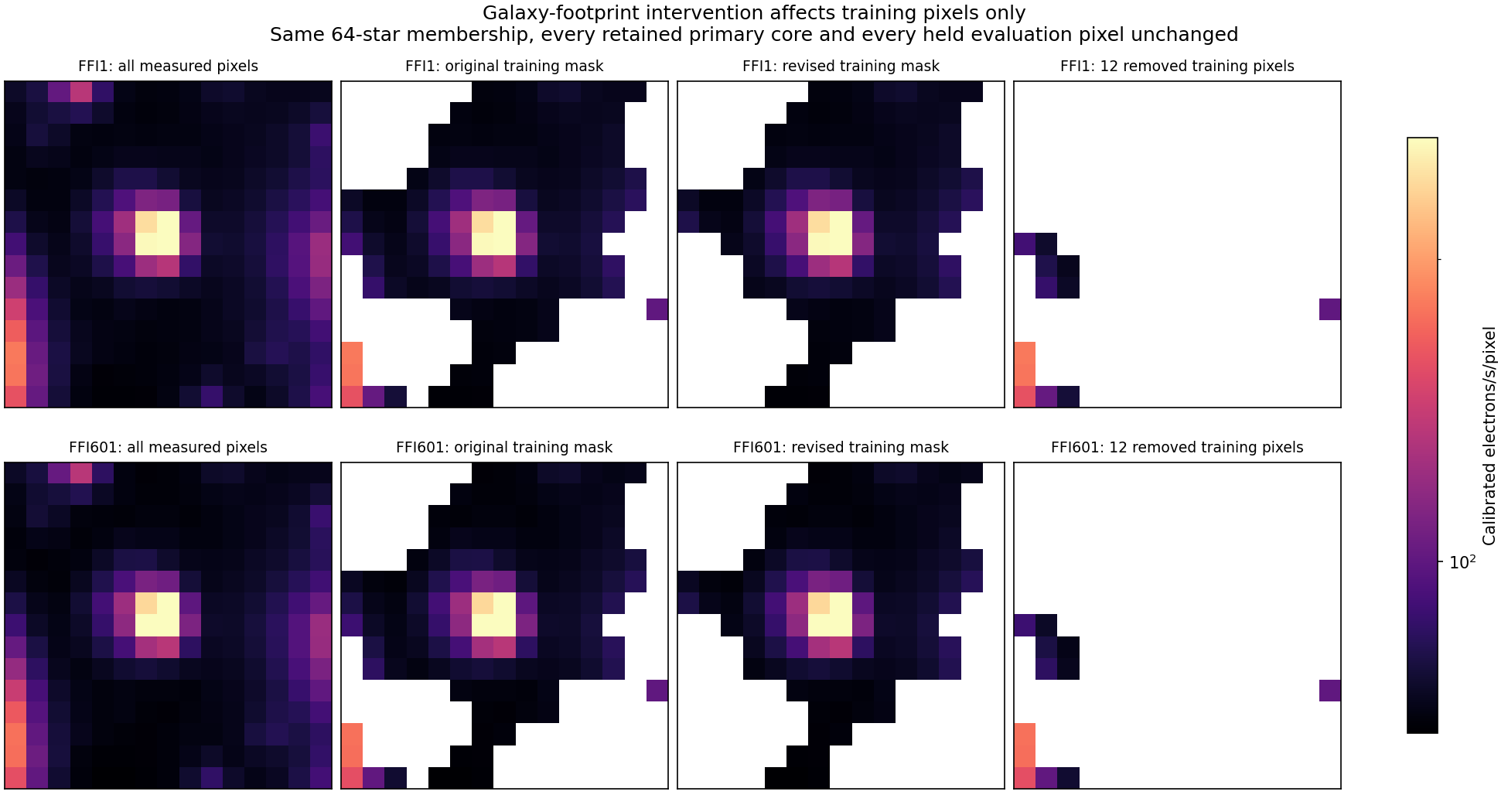
The largest new inner shoulders are supported by many stars. In contrast, the outer component at (−6,−6) pixels in profile 134 receives 87.97/88.27% of its positive preference from source 74 at the two epochs. That source has only 1.56% kernel weight. Its retained galaxy pixels explain this specific learned feature. The outer component selected in profile 358 is not dominated by a single star.
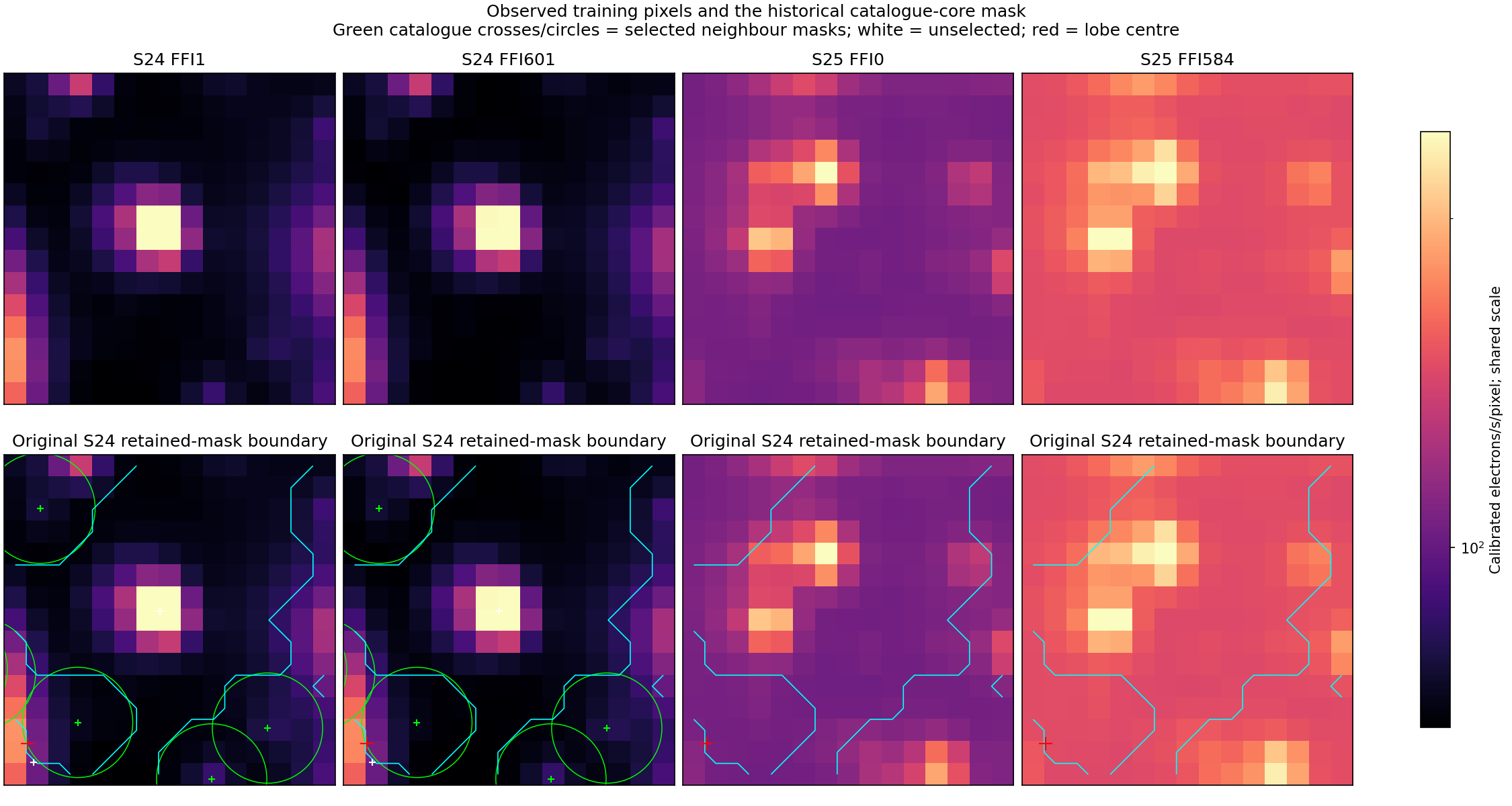
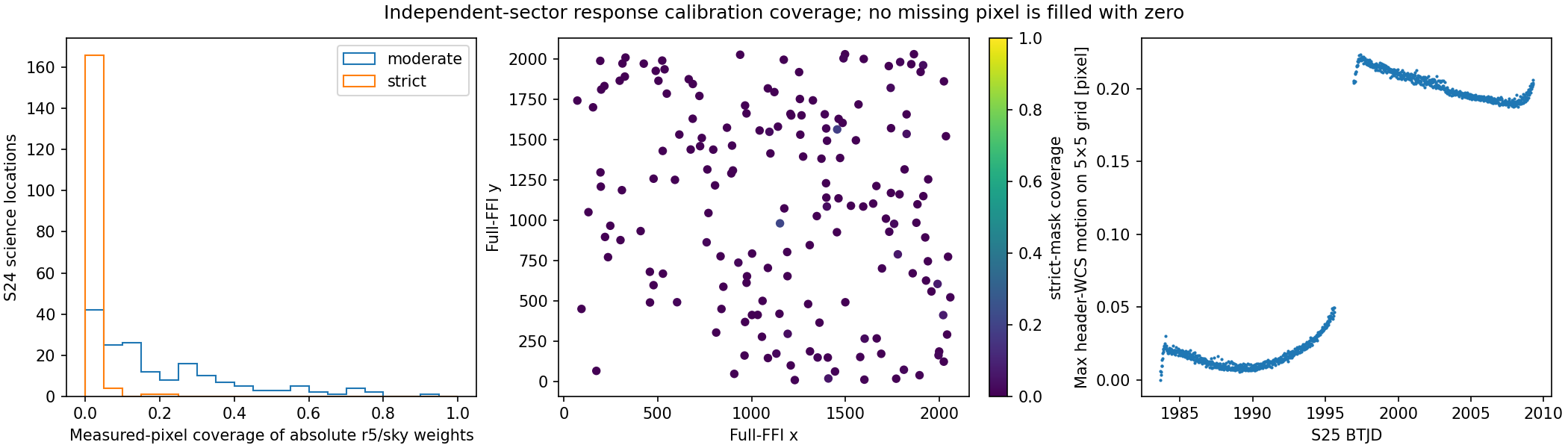
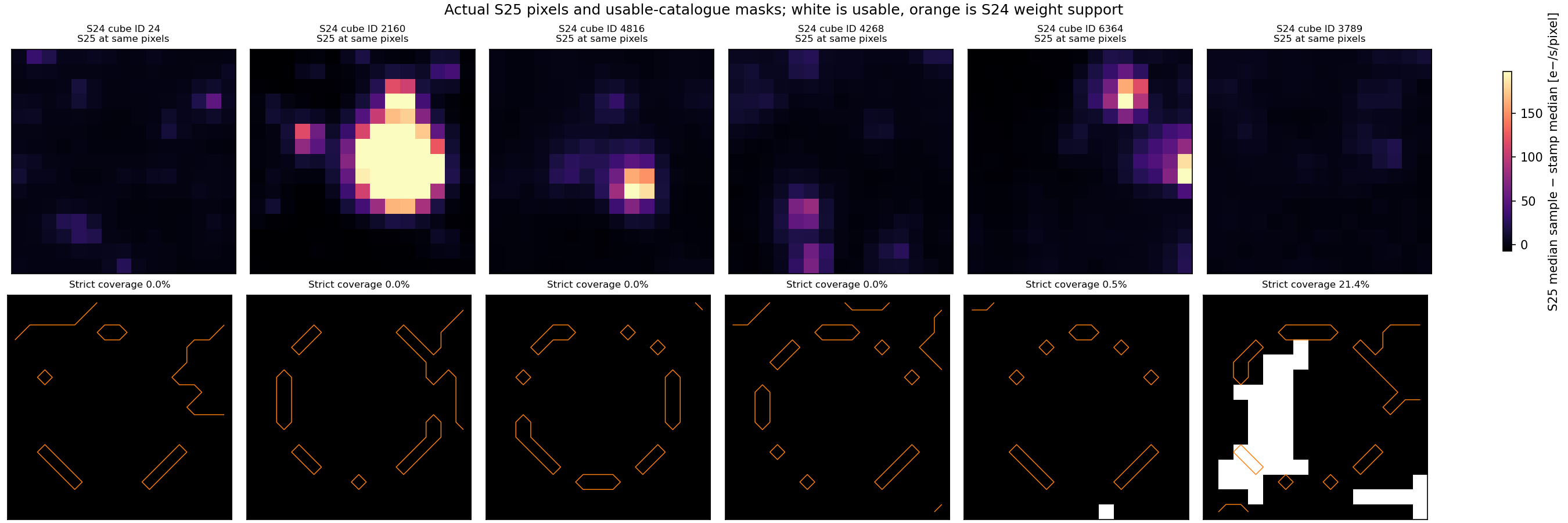
The historical catalogue-core masks replay on retained pixels. They exclude selected radius-2.5 neighbour cores but do not model extended galaxy light. Direct S24/S25 images match cached stamps exactly. Different sky at the same S25 pixels does not reproduce the same feature; this context is not an independent calibration test.
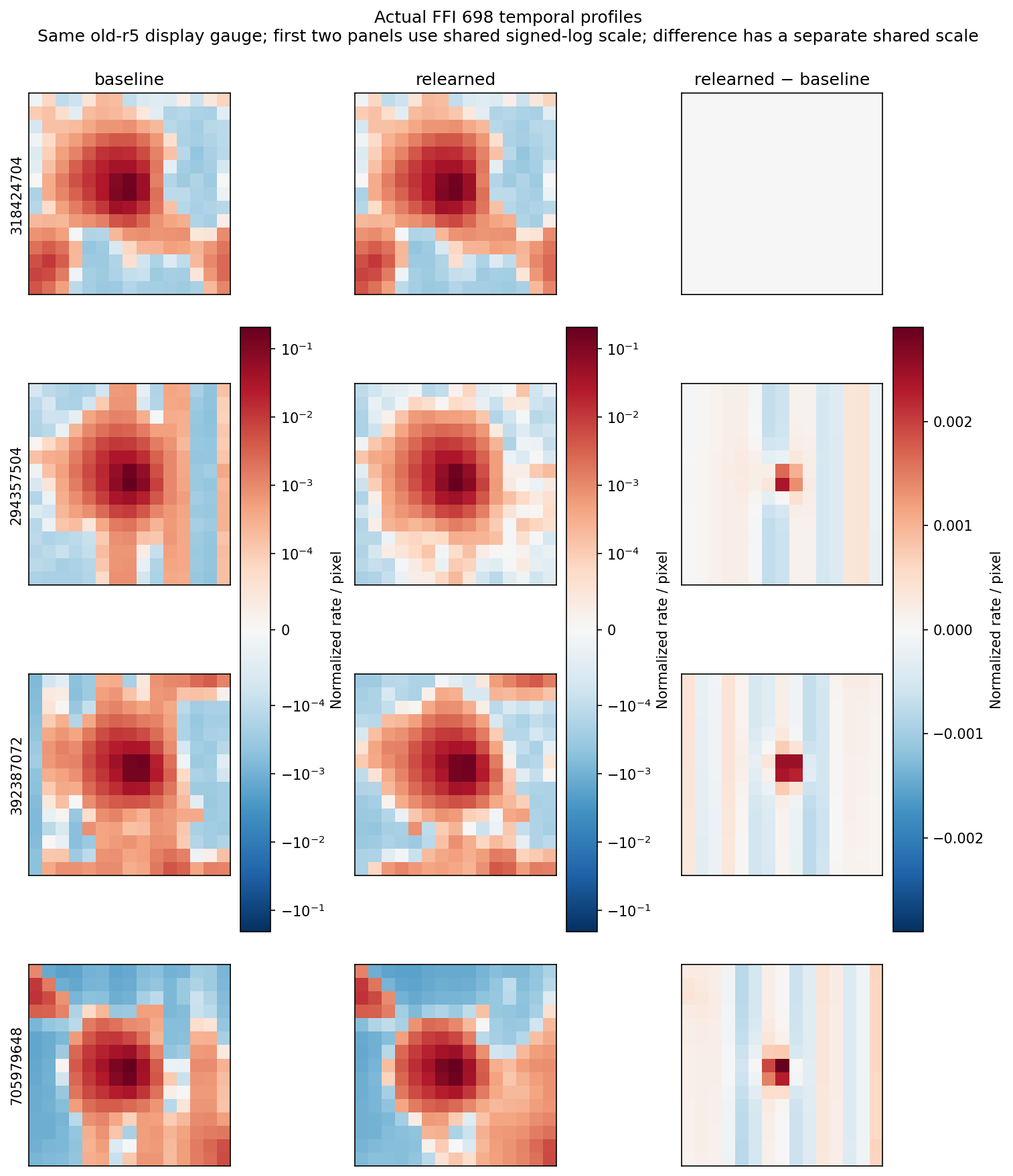
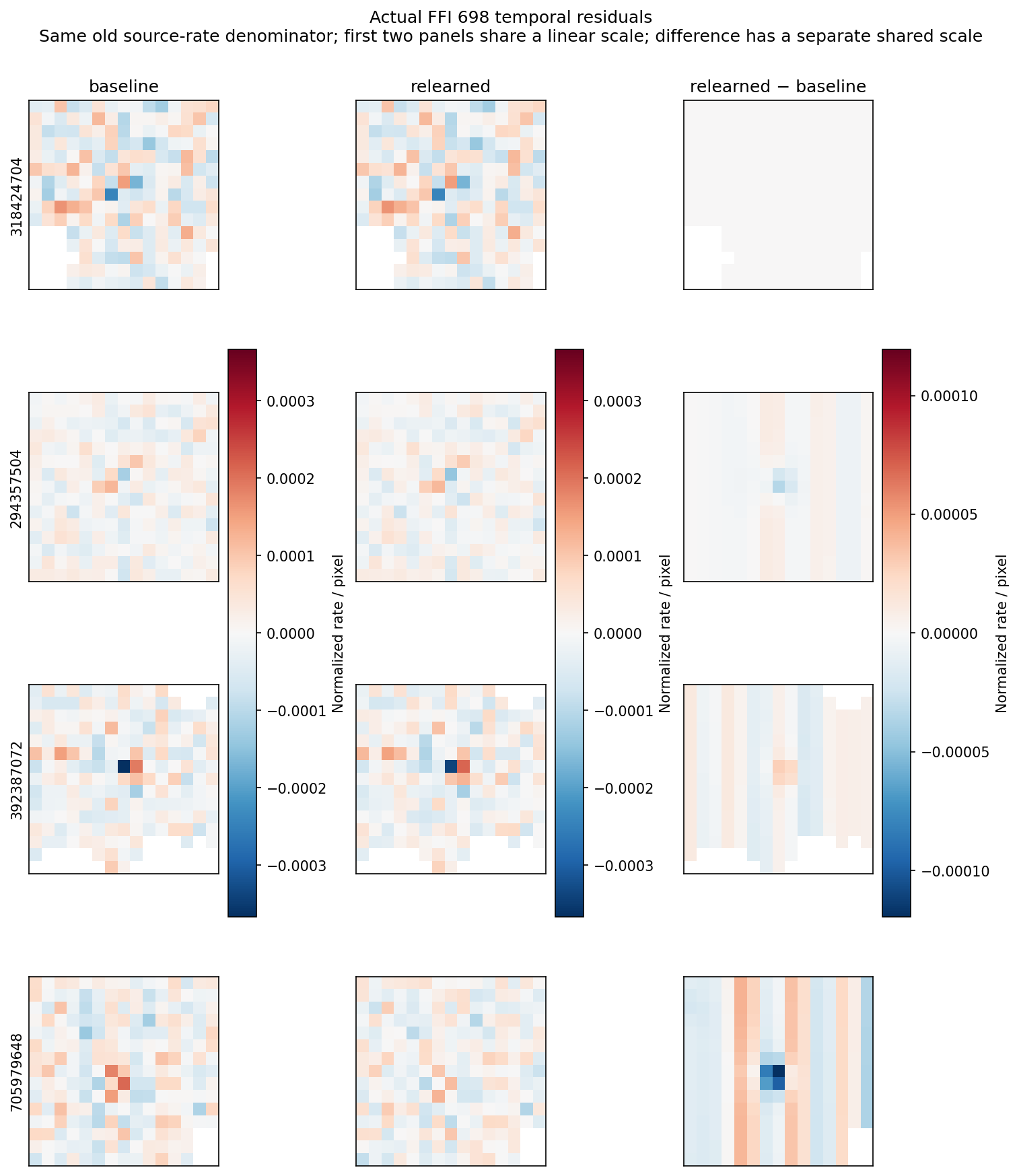
All measured pixels, residuals, profiles, flux checks, convergence, contributor images and canonical gridsPair 134/138 actual pixels and residualsPair 359/358 actual pixels and residualsPair 191/190 actual pixels and residualsSaved selected-start convergence historiesAll source rates and same-exposure discrepanciesProfiles for 134Profiles for 138Profiles for 359Profiles for 358Profiles for 191Profiles for 190134 inner shoulder, FFI1134 inner shoulder, FFI601358 inner shoulder, FFI1358 inner shoulder, FFI601134 outer lobe, FFI1134 outer lobe, FFI601358 outer component, FFI1358 outer component, FFI601Independent galaxy positions on actual RAW imagesLarger S24/S25 detector contextActual point-source masks and retained lightParent canonical gridParent relative gridDirectional-wing canonical gridDirectional-wing relative grid
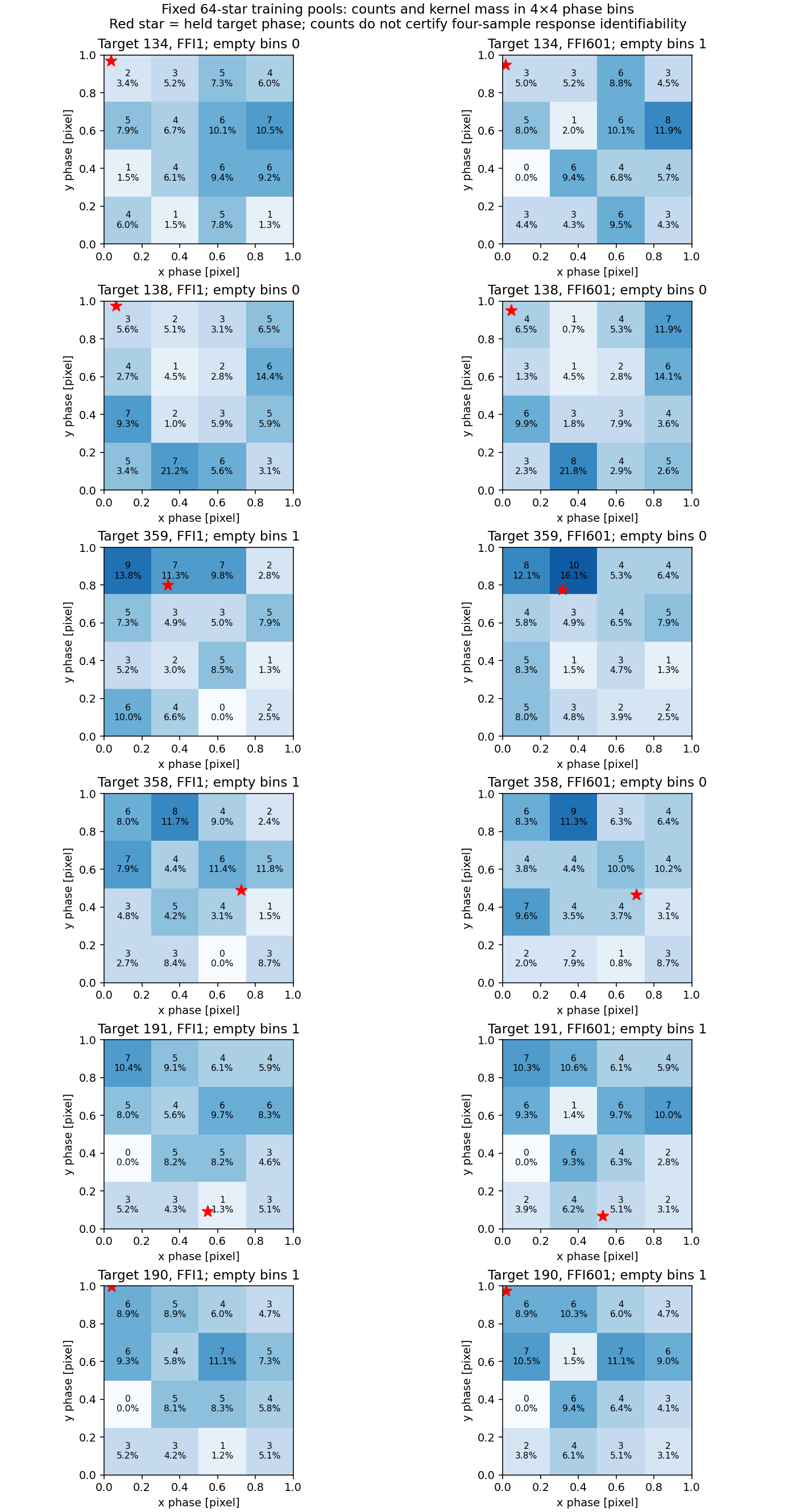
What phase information is actually available?
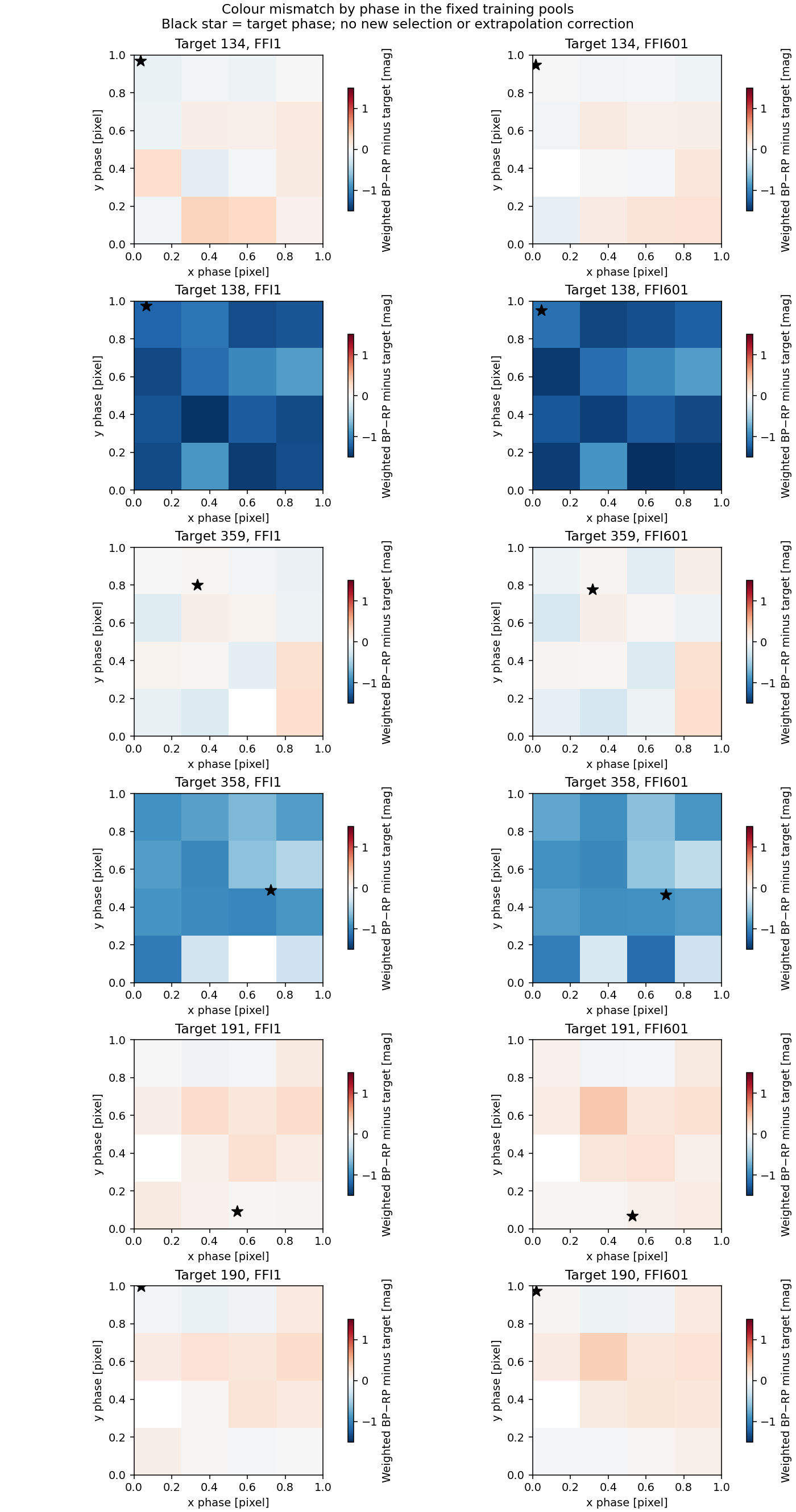
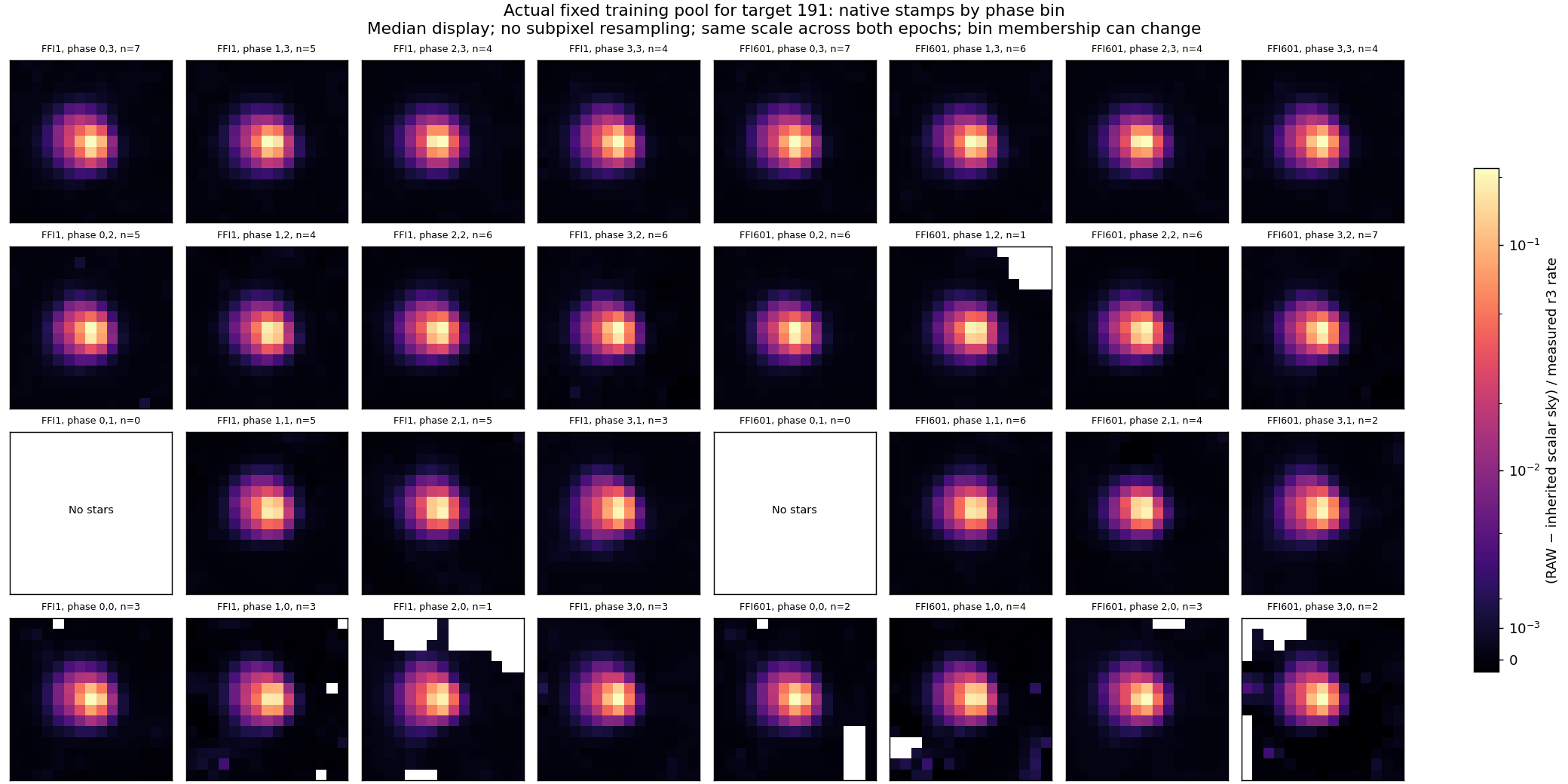
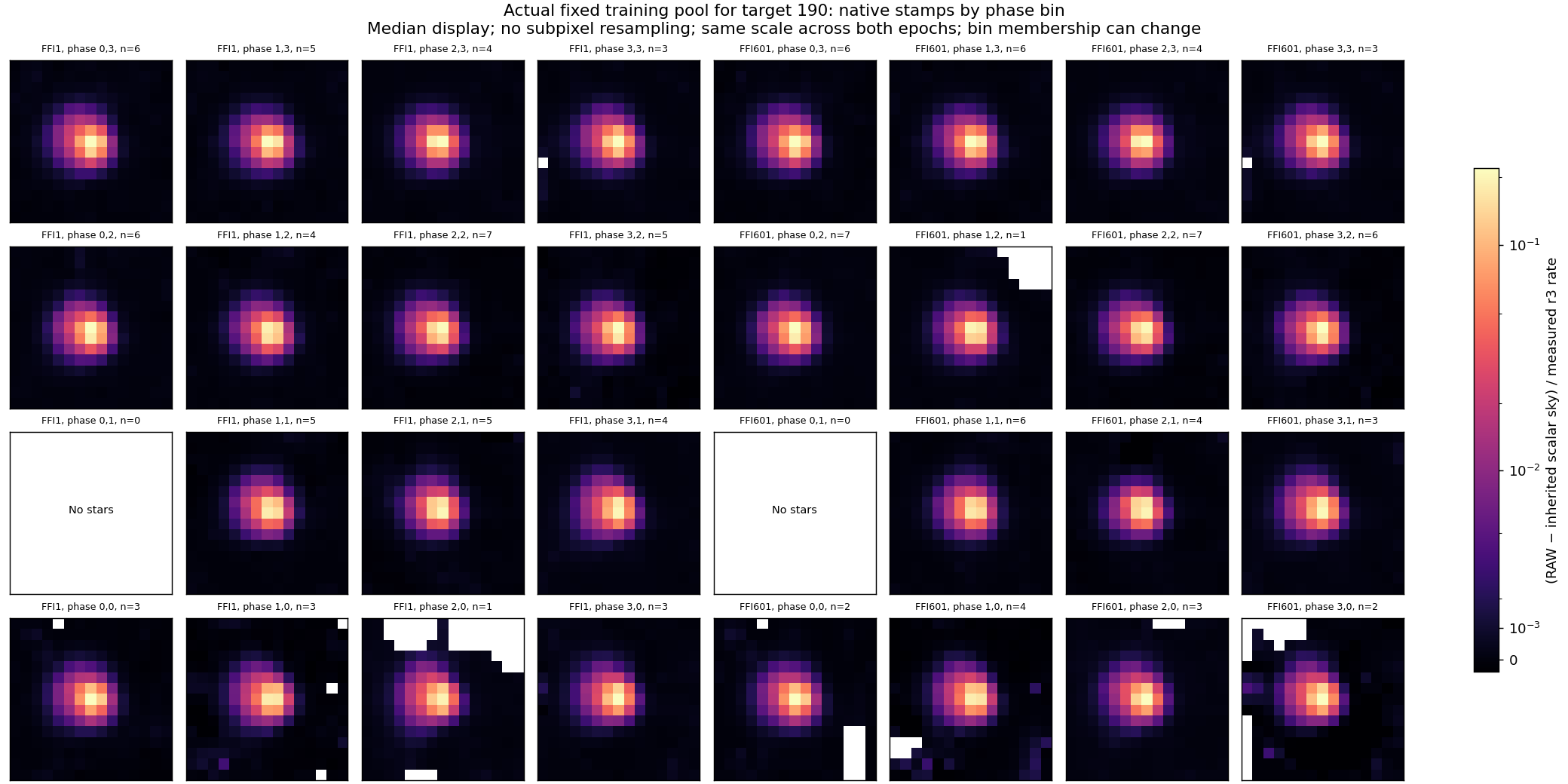
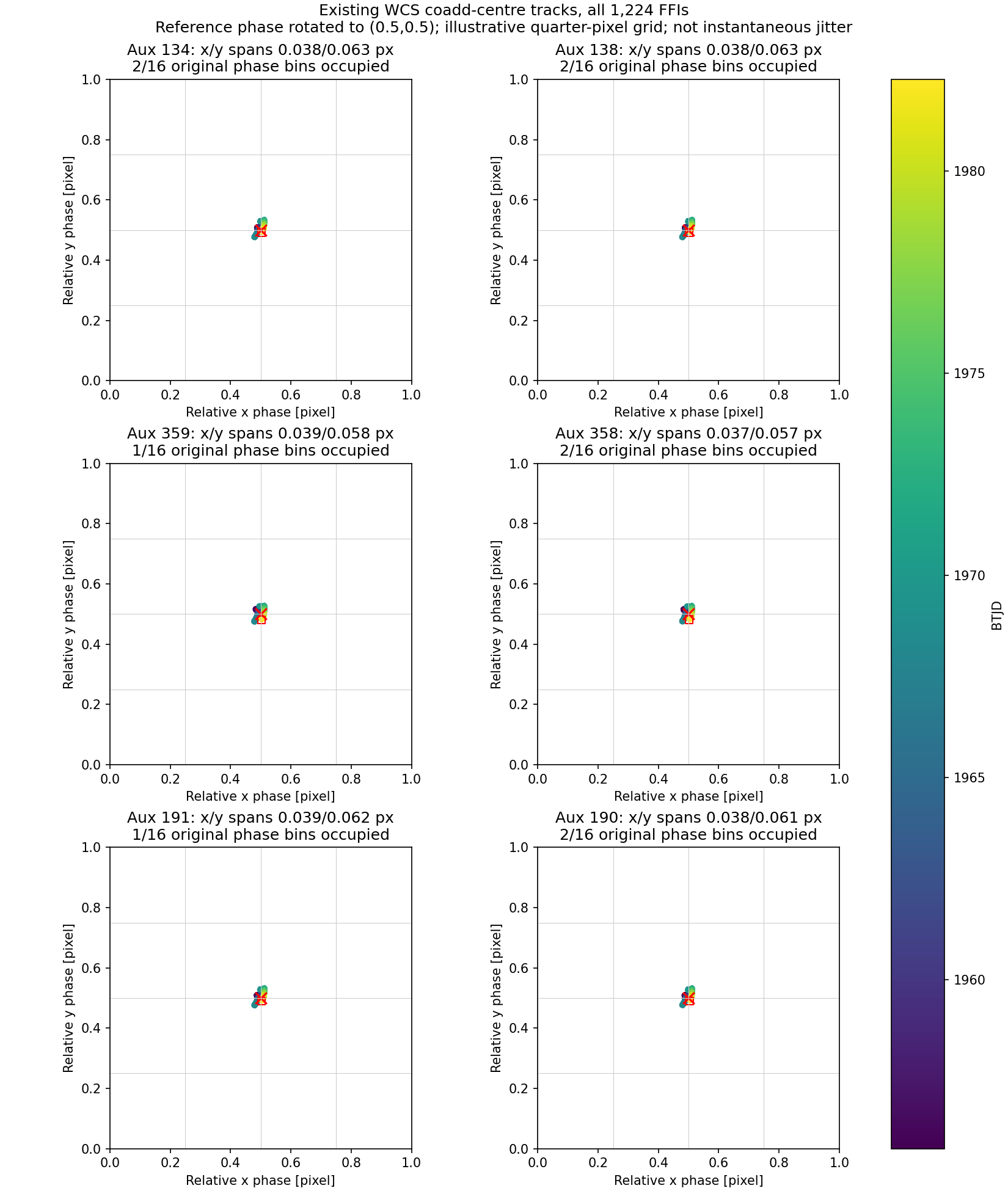
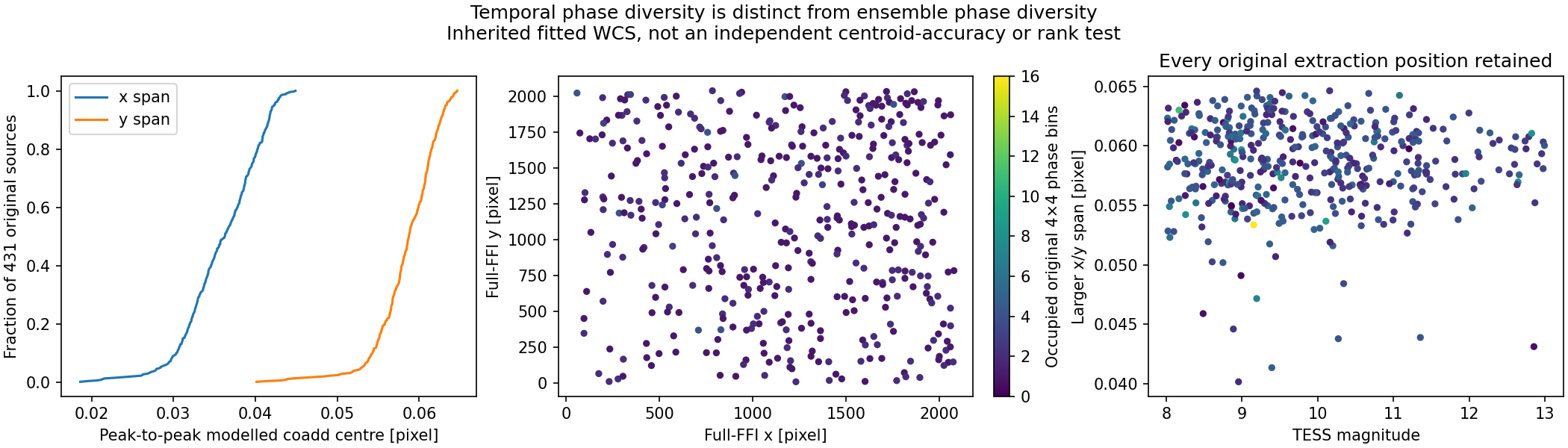
The same 64-star pools occupy 15 or 16 of 16 quarter-pixel phase bins, sometimes with only one source in a bin. Their colour mismatch remains substantial for red targets 138 and 358. Repeated exposures of individual sources provide much less mean-position diversity: across all 431 original extraction positions and 1,224 FFIs, median x/y spans are 0.0363/0.0587 pixel. These are inherited WCS-predicted coadd centres, not new centroid-accuracy measurements or instantaneous jitter tracks. Neither phase counts nor these spans prove full response identifiability.
Actual native training stamps, phase/colour support and full-cadence centre tracksActual phase-bin counts, kernel mass and target phaseTraining-minus-target colour by phaseMeasured training stamps for target 134Measured training stamps for target 138Measured training stamps for target 359Measured training stamps for target 358Measured training stamps for target 191Measured training stamps for target 190Individual modelled centre tracks through every exposureComplete population coverage by position and magnitude
Repair under test
A radius-six diagnostic footprint around the two tabulated galaxy centres removes 12 training pixels in source 74. It preserves every training source, every retained radius-two core at both epochs and every held evaluation pixel. Only the three affected pools are refitted; identical unaffected pools reuse their parent coefficients explicitly. The ridge strength is held fixed. This intervention is not yet an adopted mask or a demonstrated light-curve improvement.
Conclusion: this identifies a real training-contamination mechanism and a concrete repair test. Colour/spatial/brightness transfer, extended-scene modeling, instantaneous response, calibration/WCS uncertainty and the complete stellar light curves still require validation.
2026-10-05: count-loss response needs subpixel information
The real light curves are not certified instrument-free or photon-limited. These new tests separate mean-image errors, readout-response errors and missing subpixel information. The successful result below is conditional on exact synthetic response samples; it is not measured stellar photometry. Earlier sections below retain their historical checkpoint scope.
Observed-pixel mean anchoring does not fix the inherited response
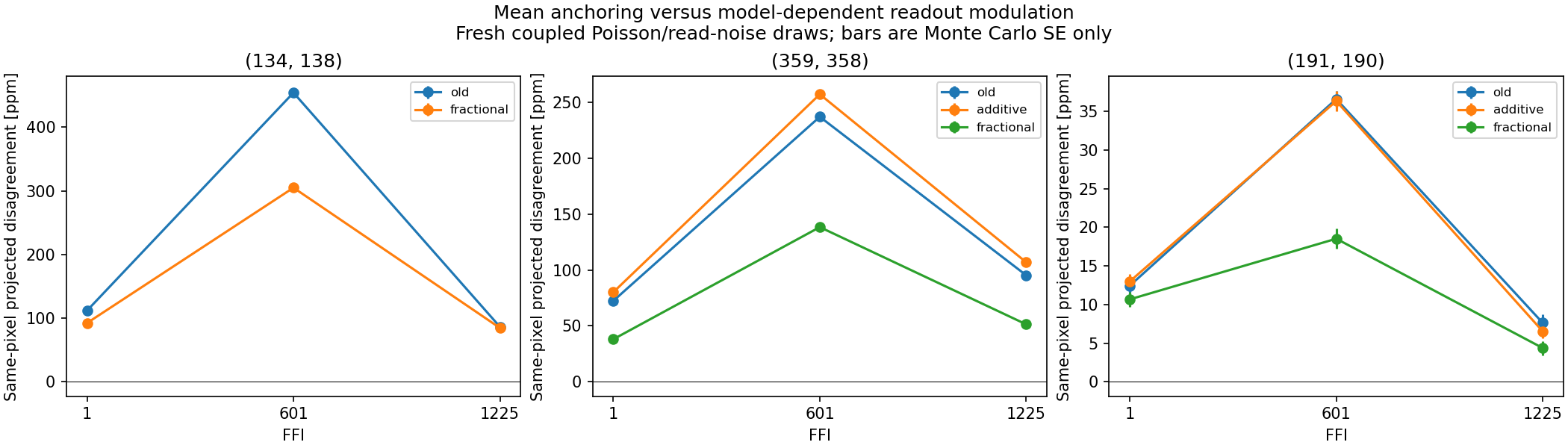
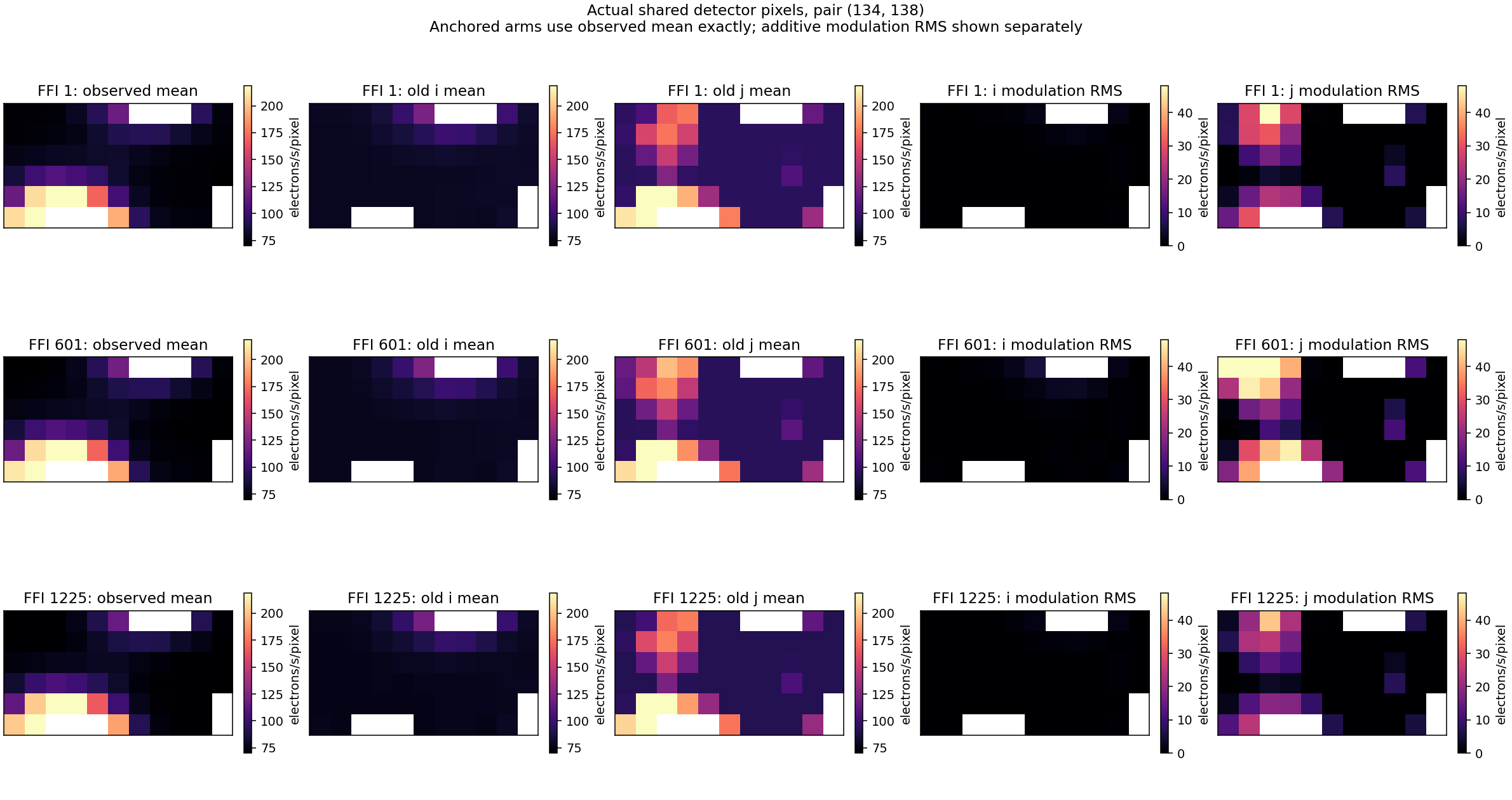
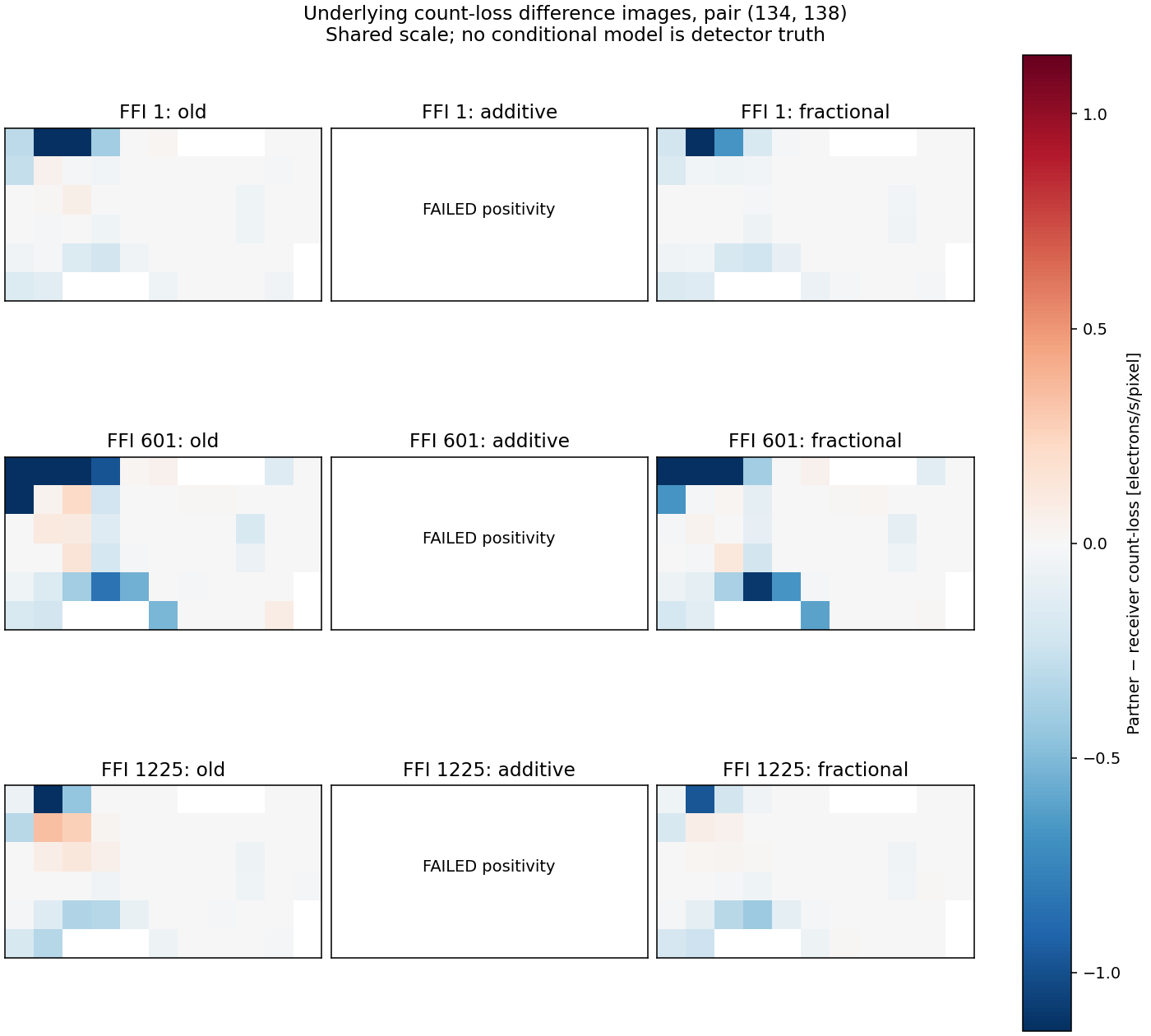
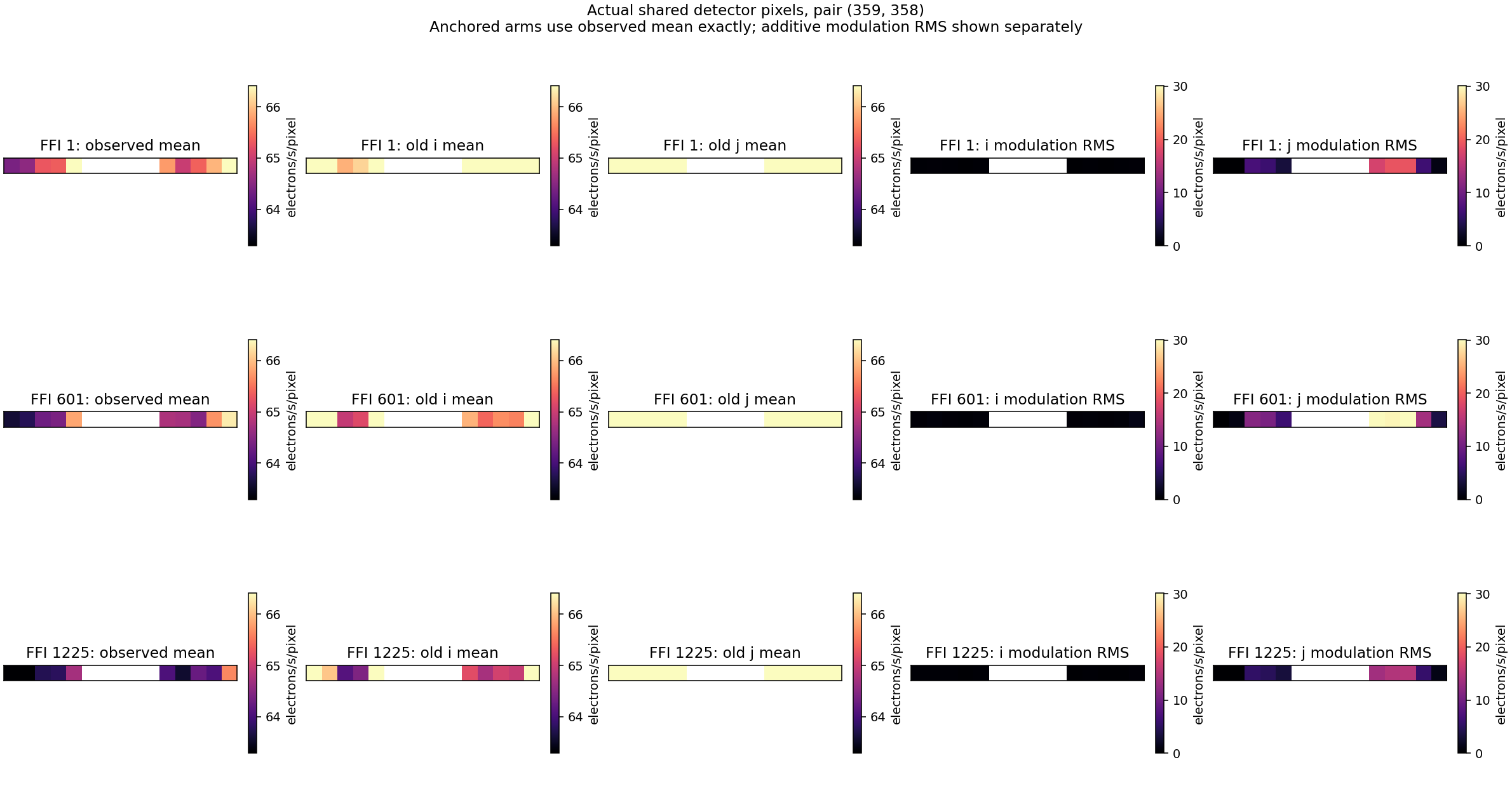
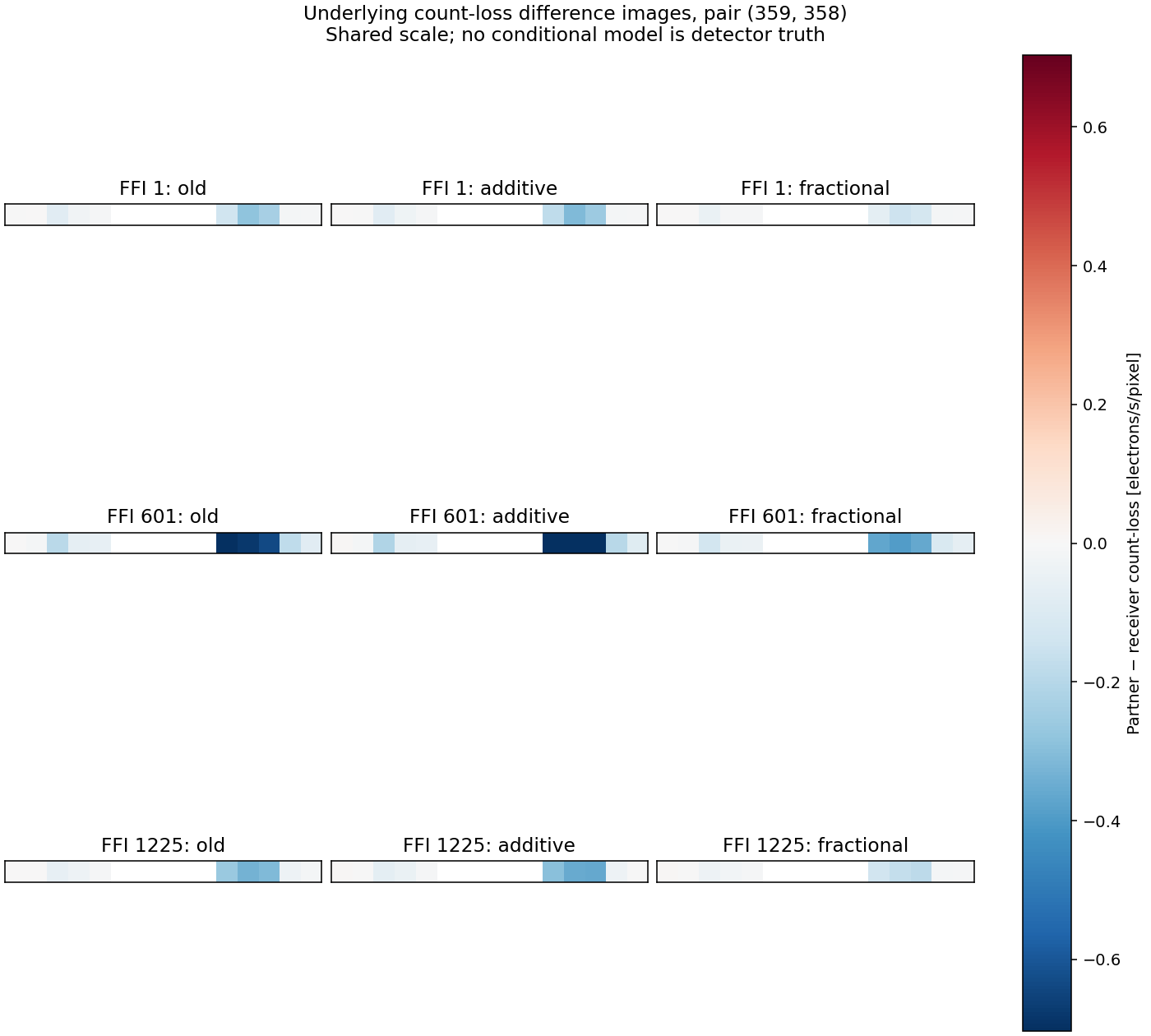
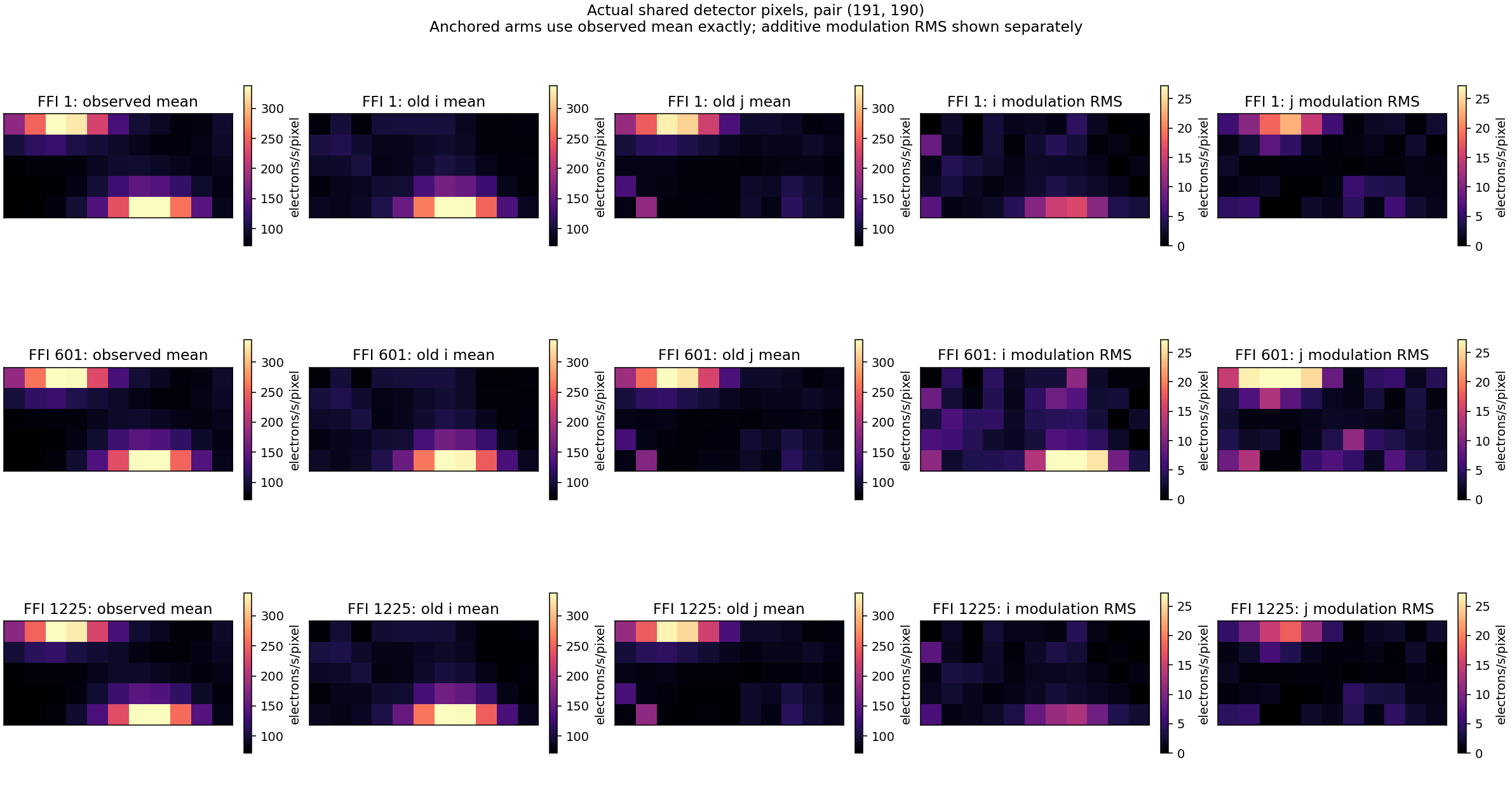
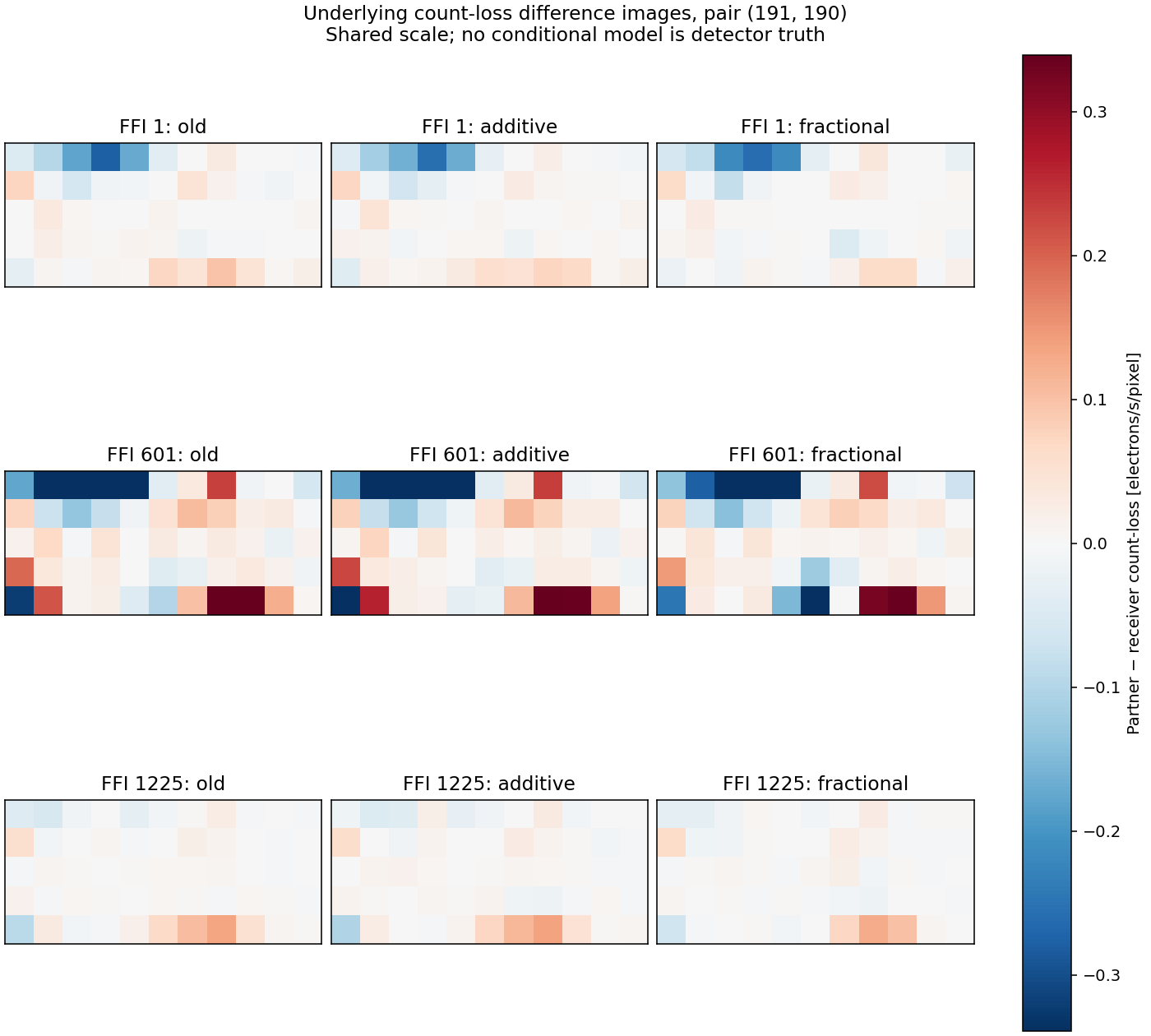
Three overlapping stamp pairs and FFIs 1, 601 and 1225 use identical measured detector pixels and unchanged aperture operators. Both descriptions receive the same pixel mean. Preserving absolute modulation produces negative photon rates in one pair; preserving fractional modulation reduces but does not remove disagreement. Failed arms are not clipped or rescued by dropping pixels.
Receiver / partner
Old contrast [ppm]
Absolute modulation [ppm]
Fractional modulation [ppm]
134 / 138
342.31 ± 4.10
Fails positivity
212.57 ± 3.89
359 / 358
164.52 ± 4.33
176.90 ± 3.49
100.24 ± 3.08
191 / 190
24.15 ± 1.40
23.34 ± 1.74
7.85 ± 1.68
The contrast is the FFI601-minus-FFI1 change in partner-minus-receiver projected count loss. Errors are Monte Carlo SE from 64 fresh paired draws, not detector/model uncertainty. Both descriptions remain conditional models. Shared masks contain 58, 10 and 55 pixels; the narrow strip in one image is the actual overlap.
All observed pixels, predicted readout modulation and loss-difference mapsAll three-epoch disagreementsPair 134/138: measured means and model modulationPair 134/138: correction differencesPair 359/358: measured means and model modulationPair 359/358: correction differencesPair 191/190: measured means and model modulationPair 191/190: correction differences
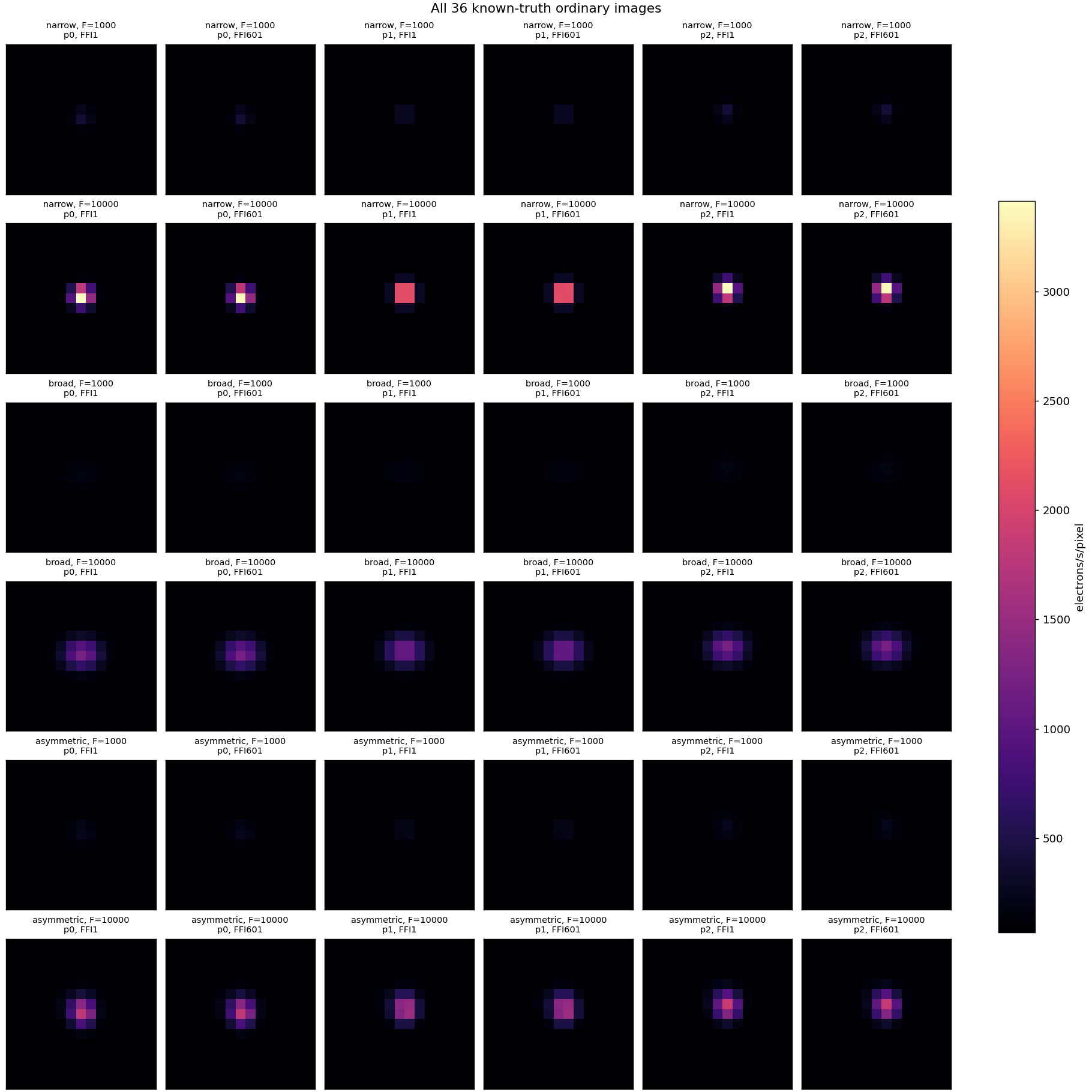
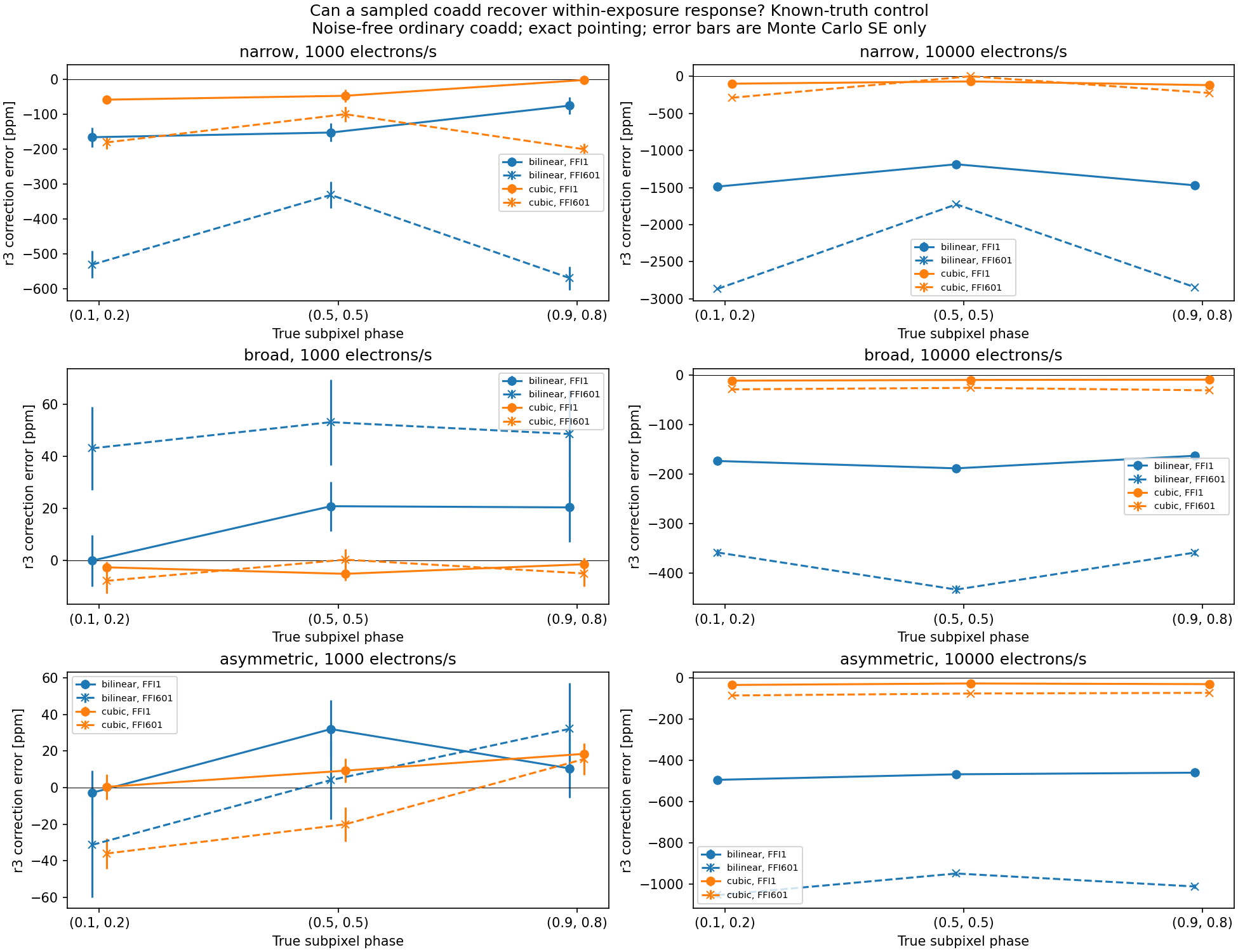
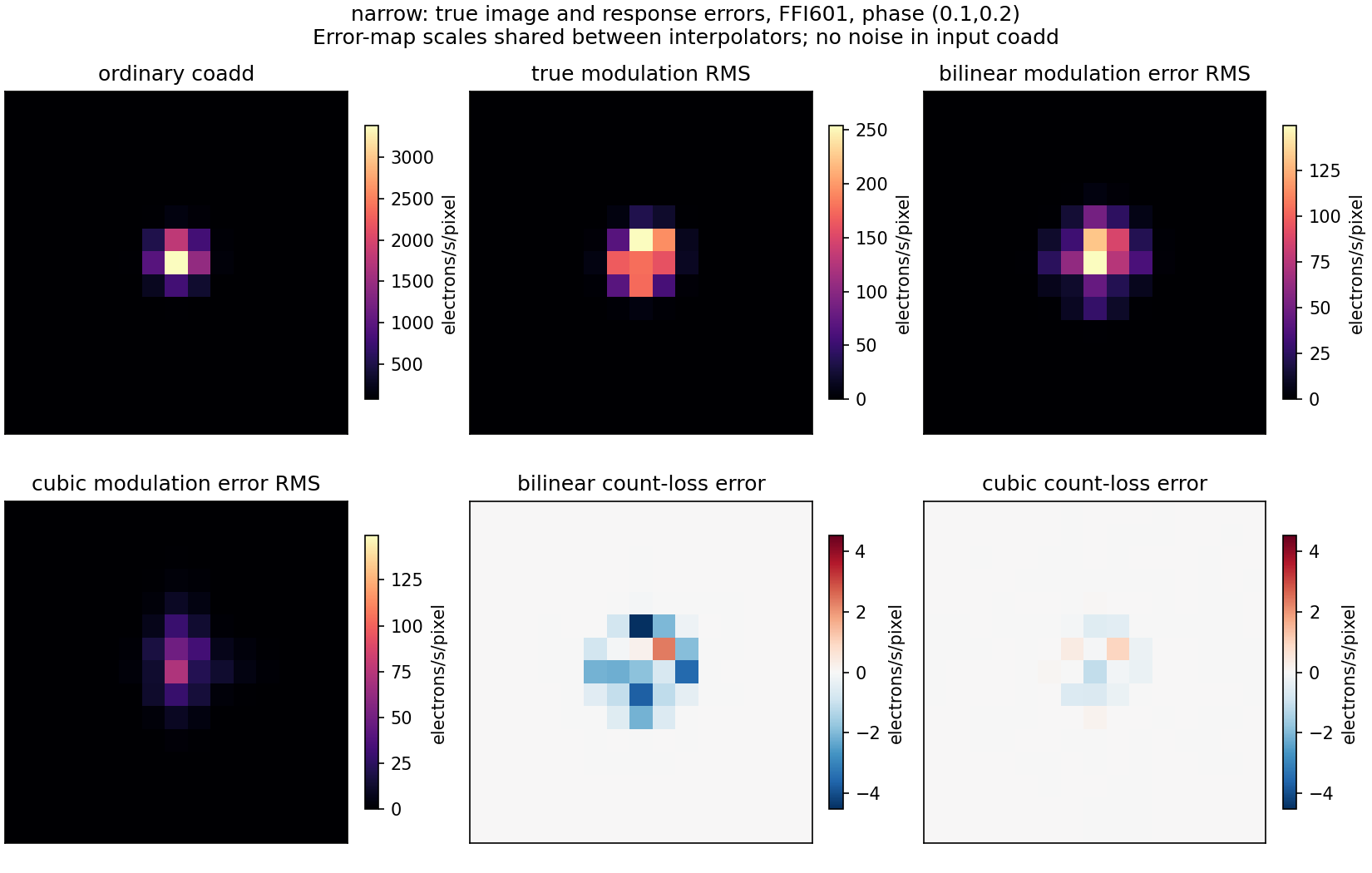
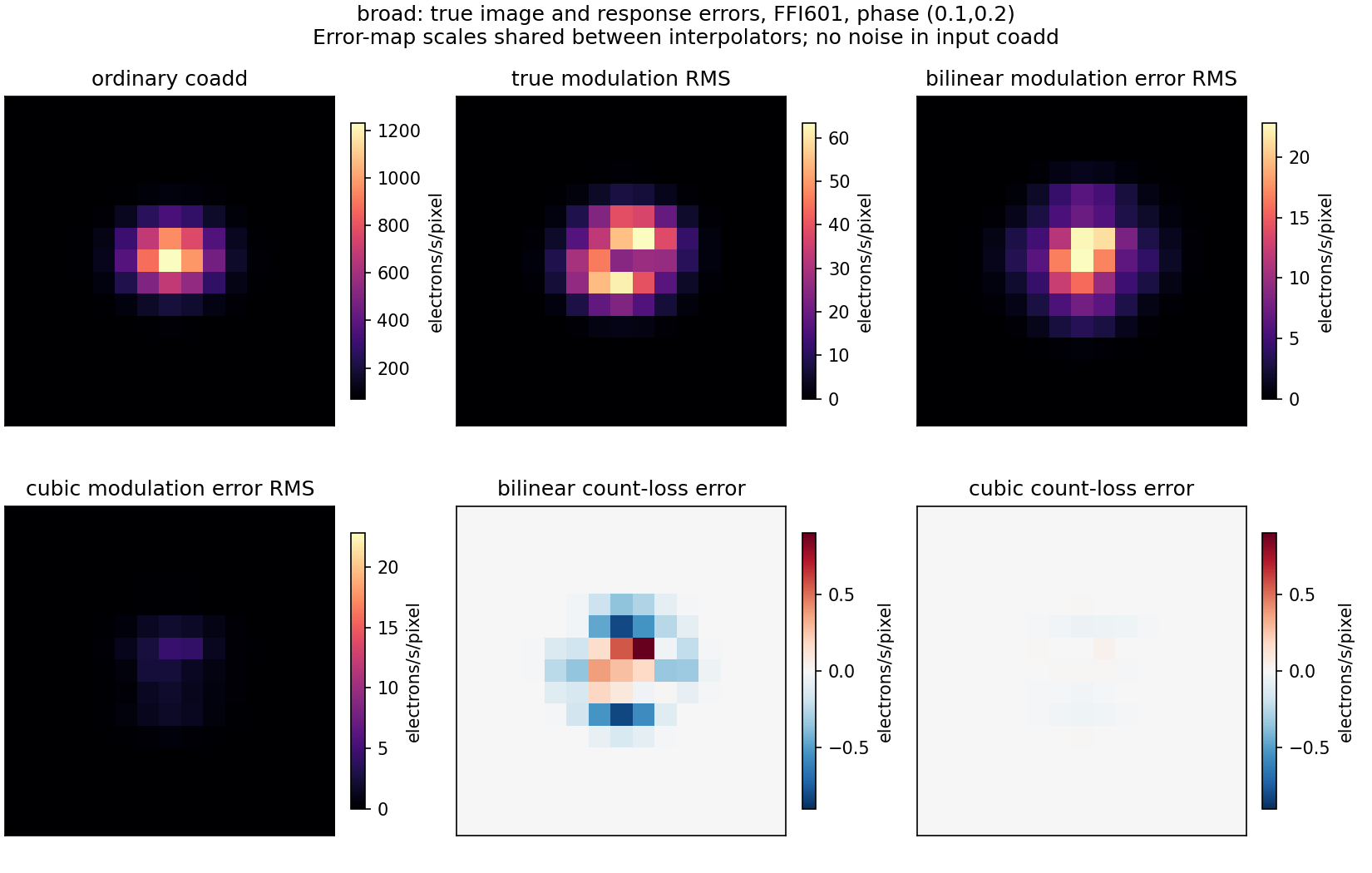
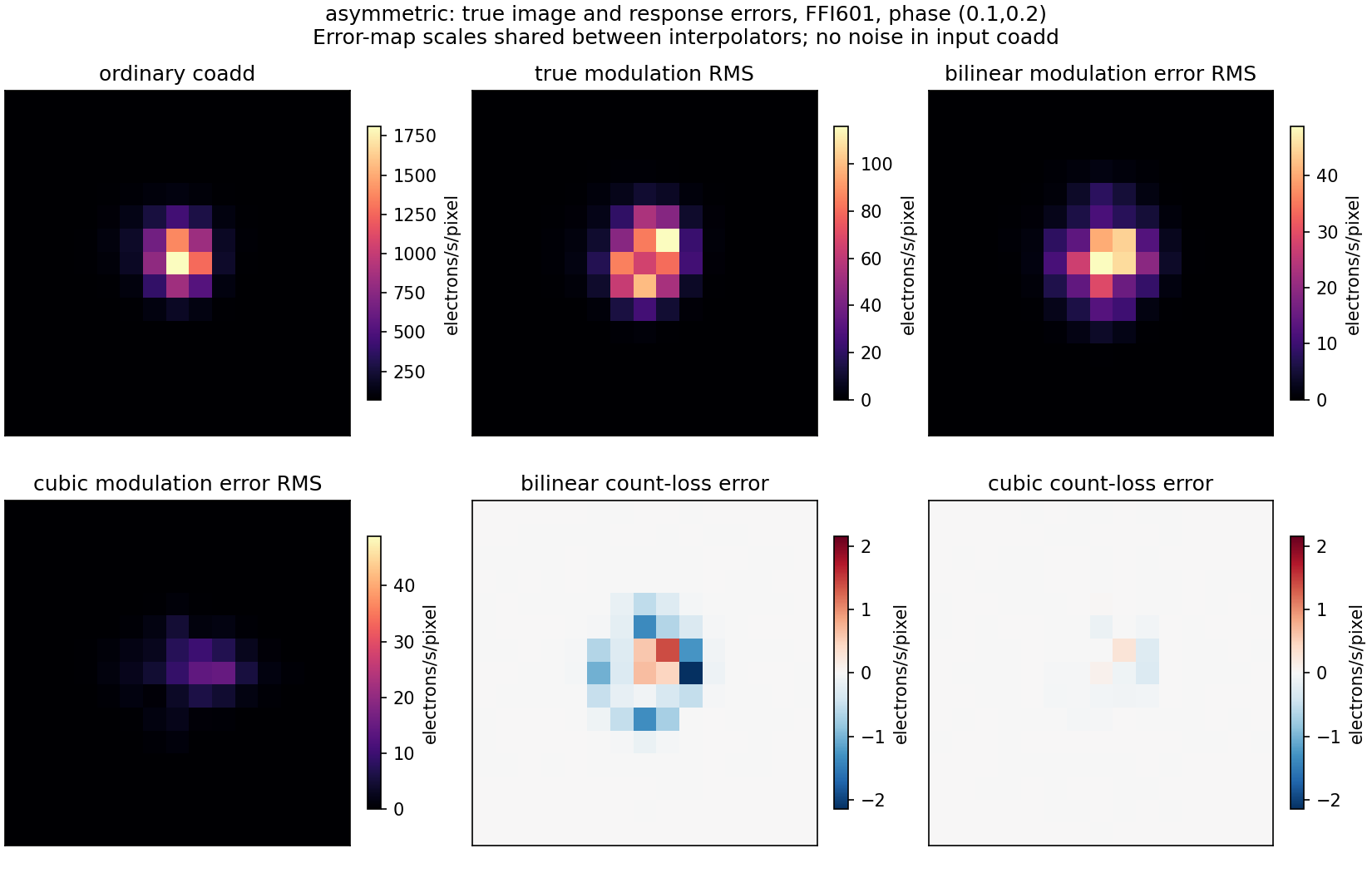
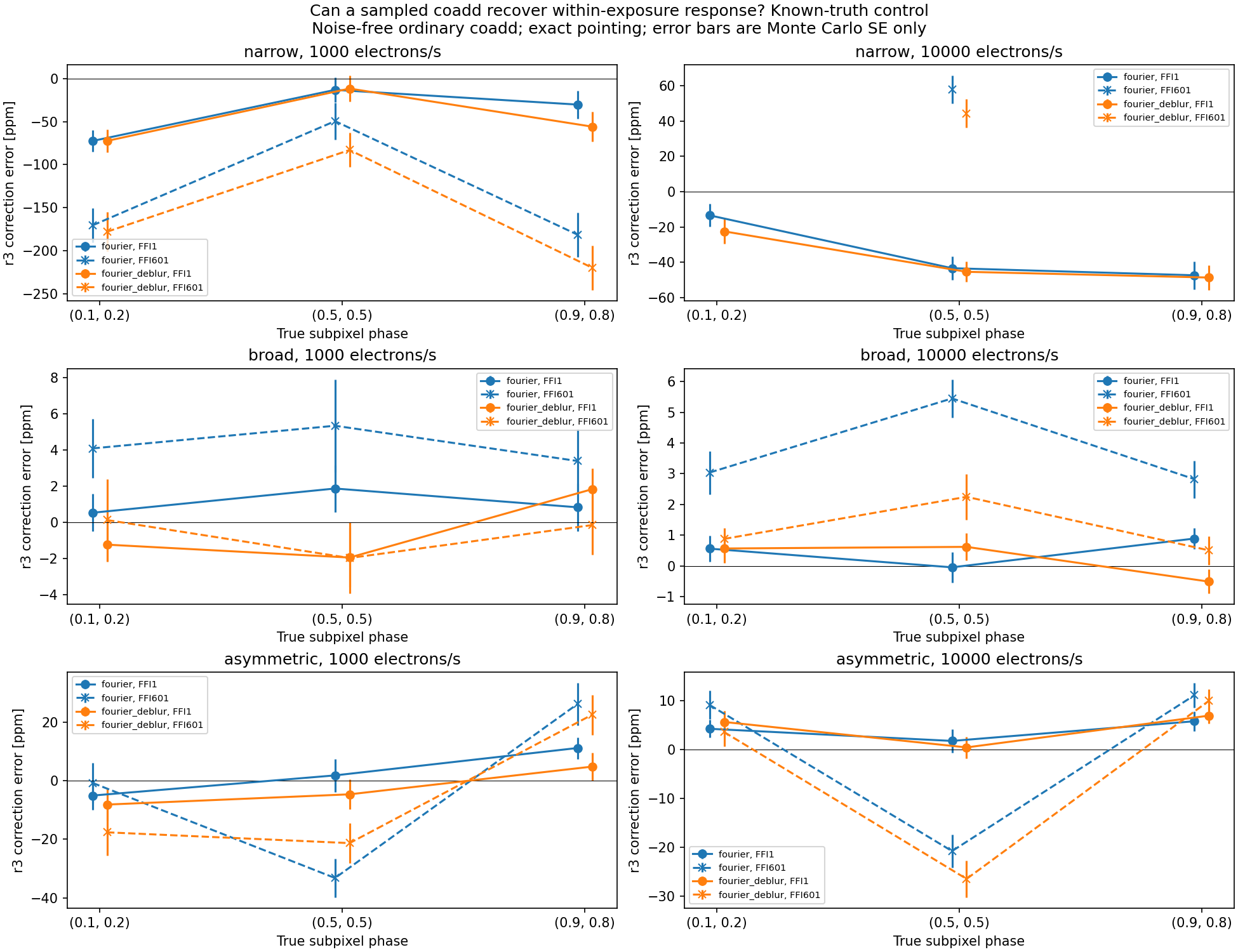
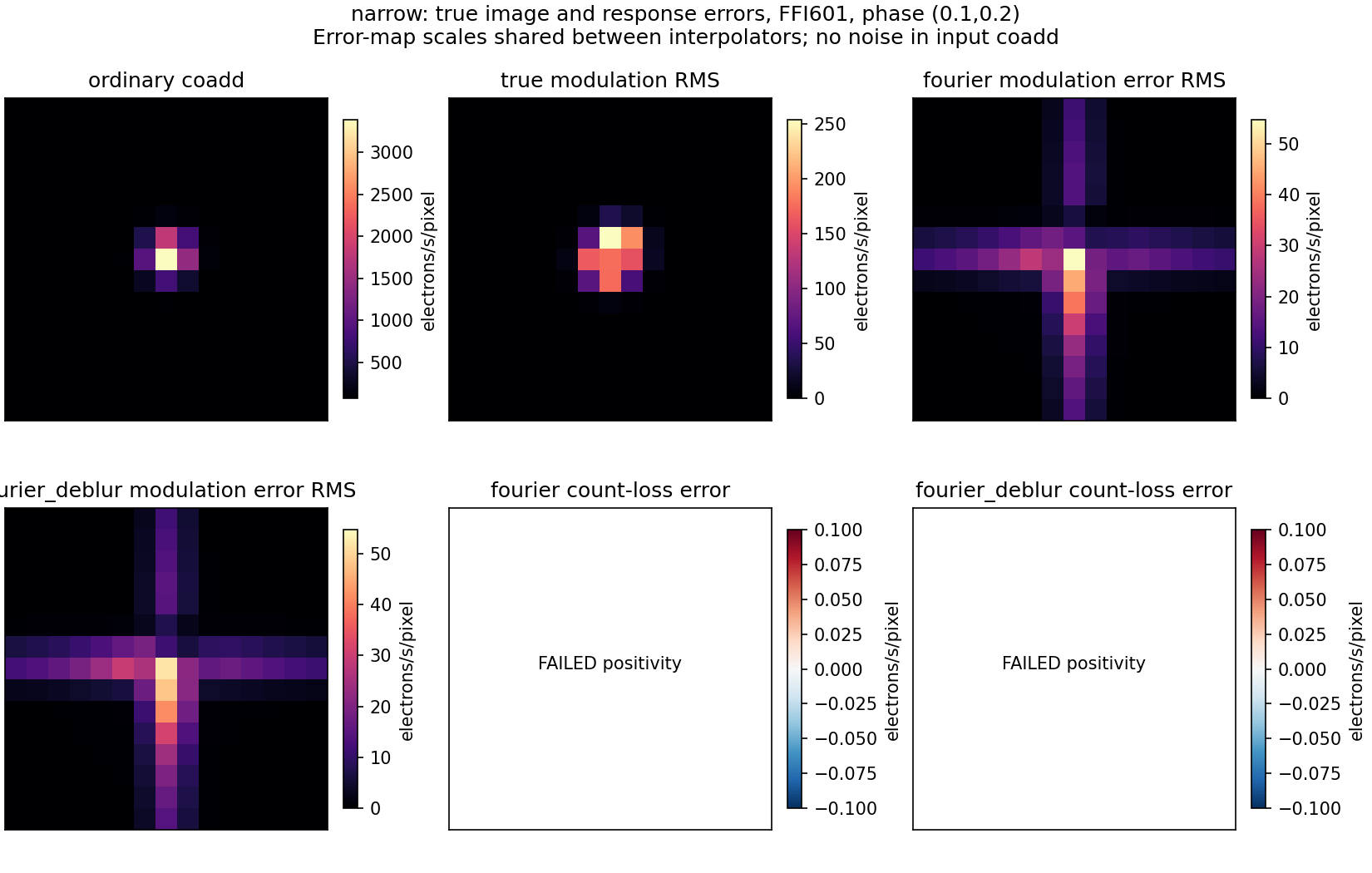
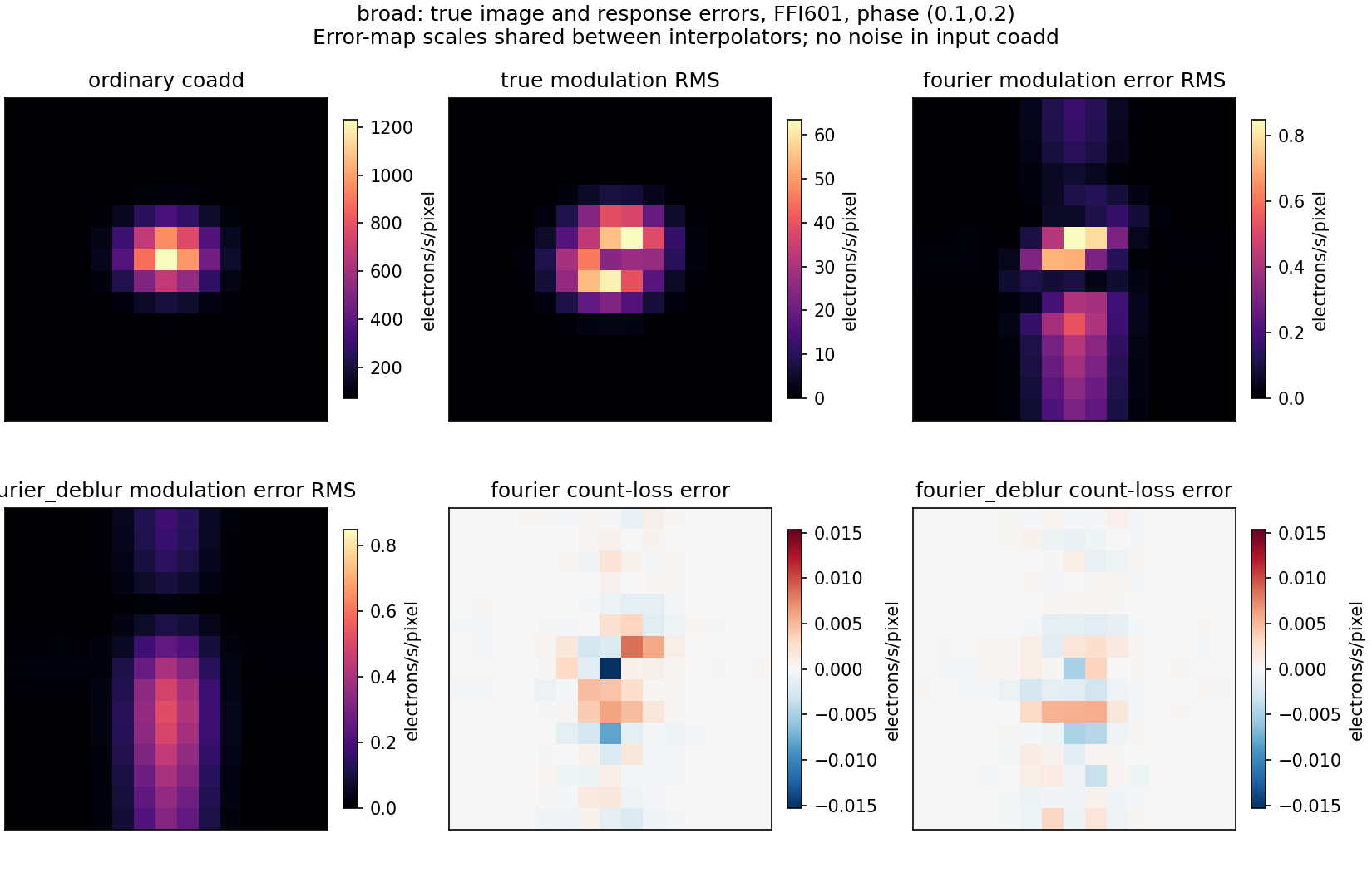
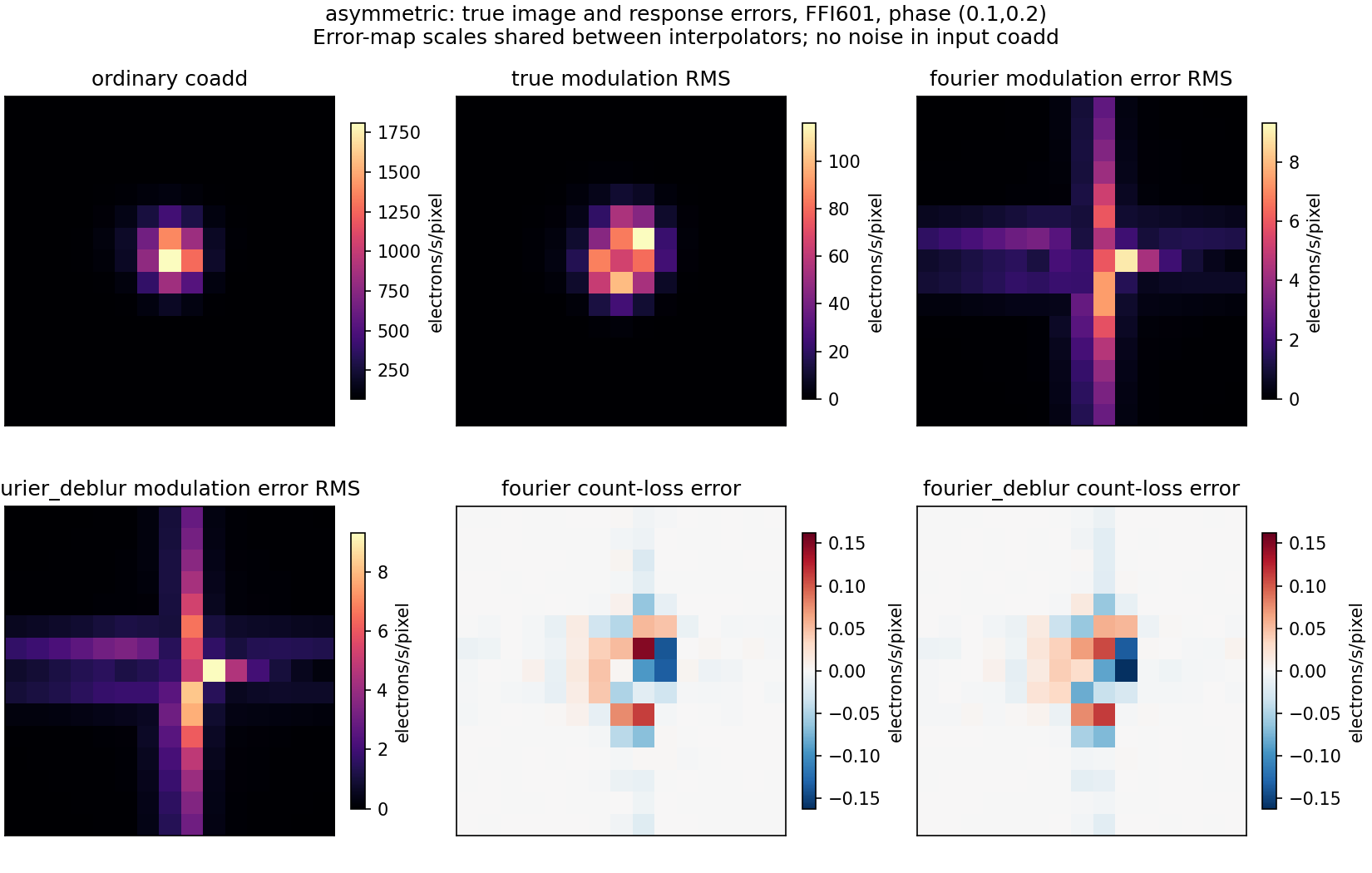
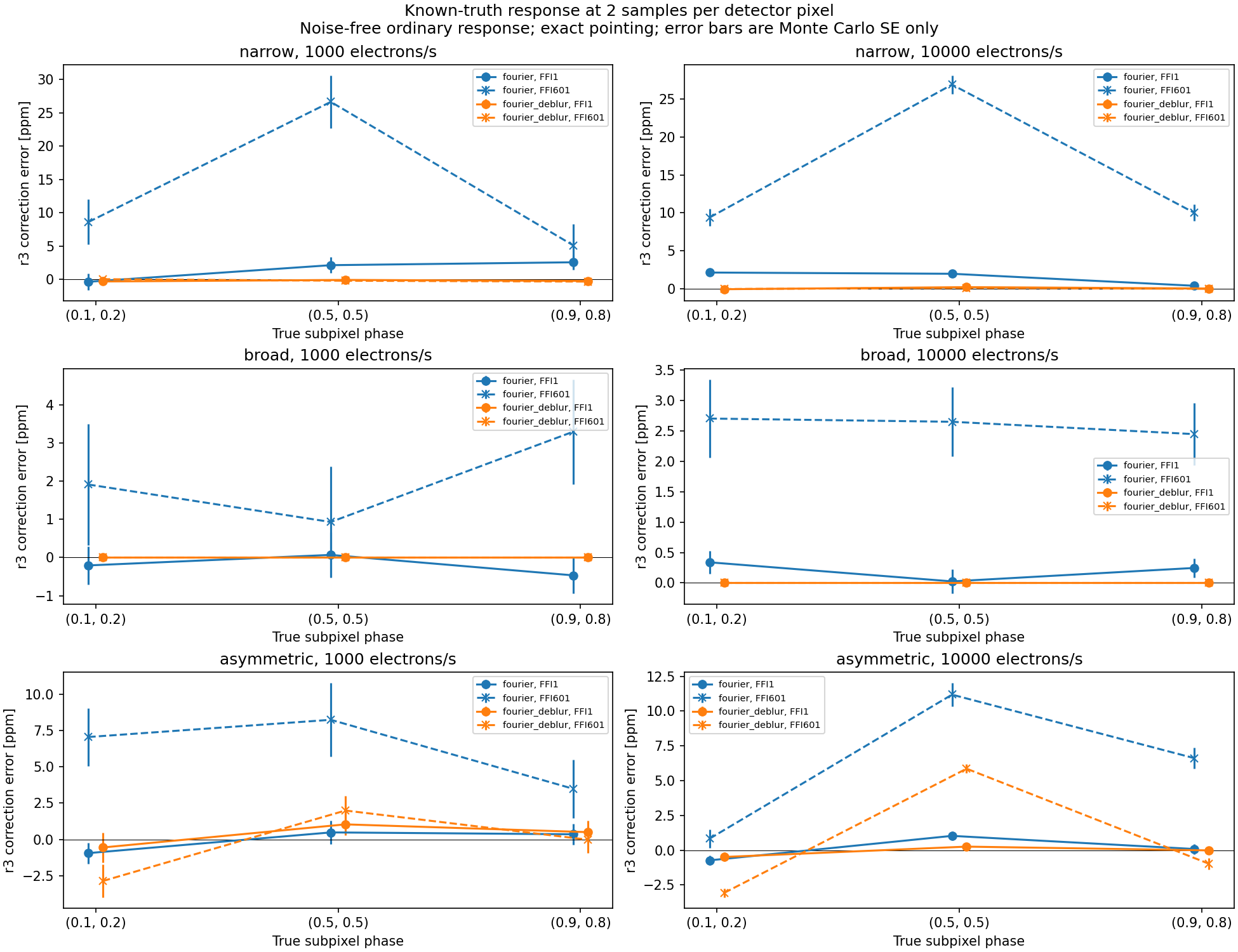
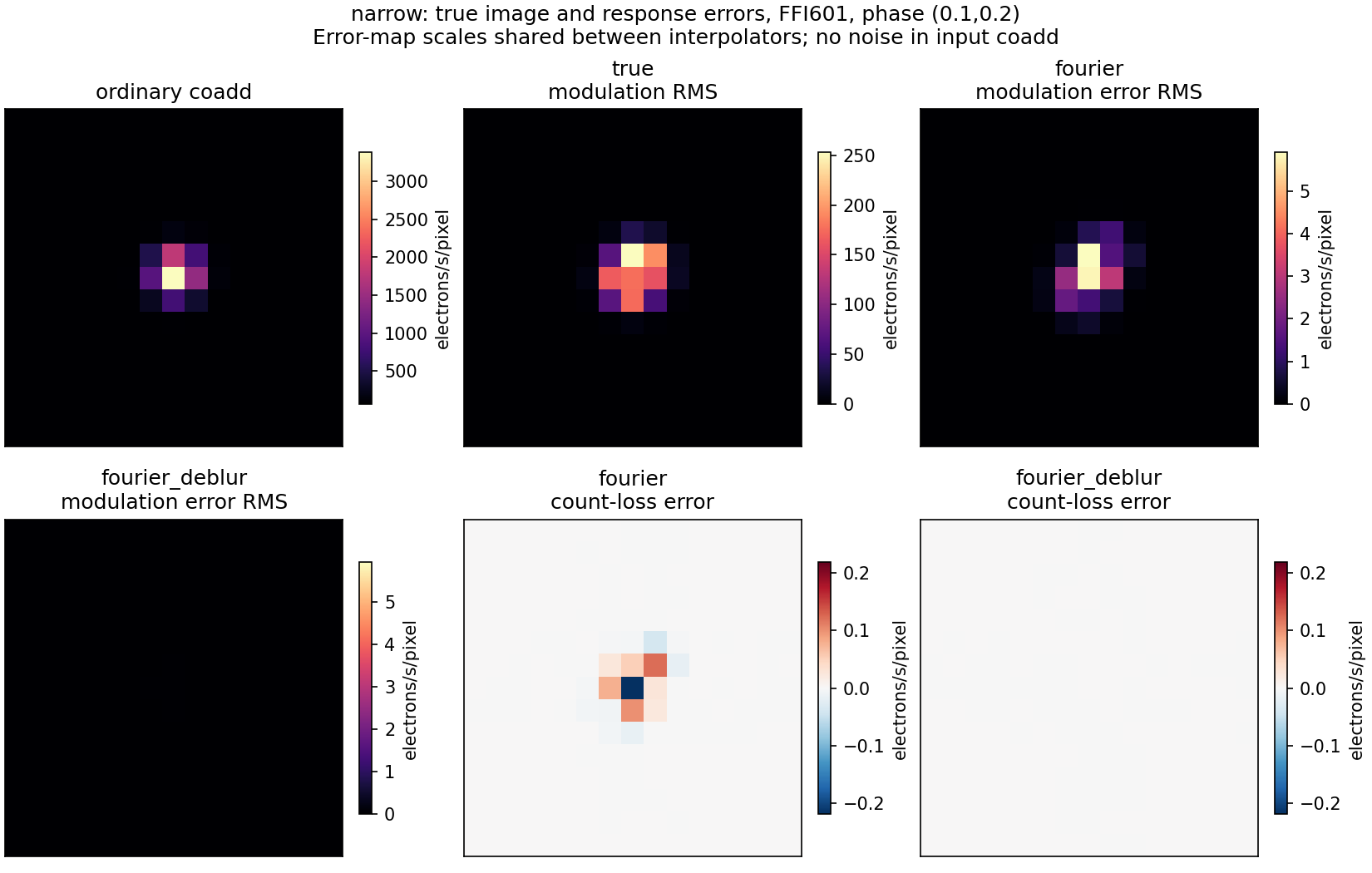
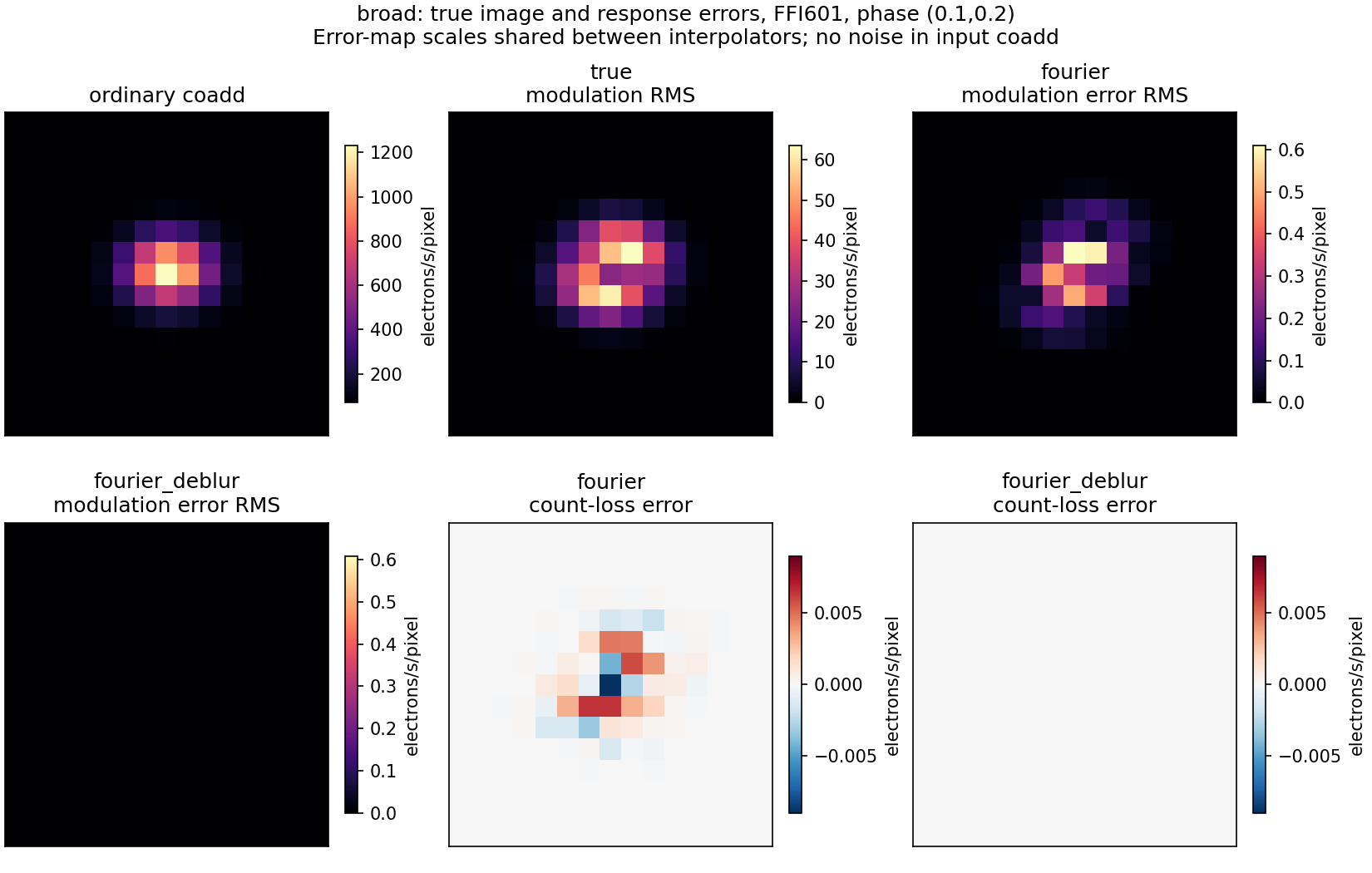
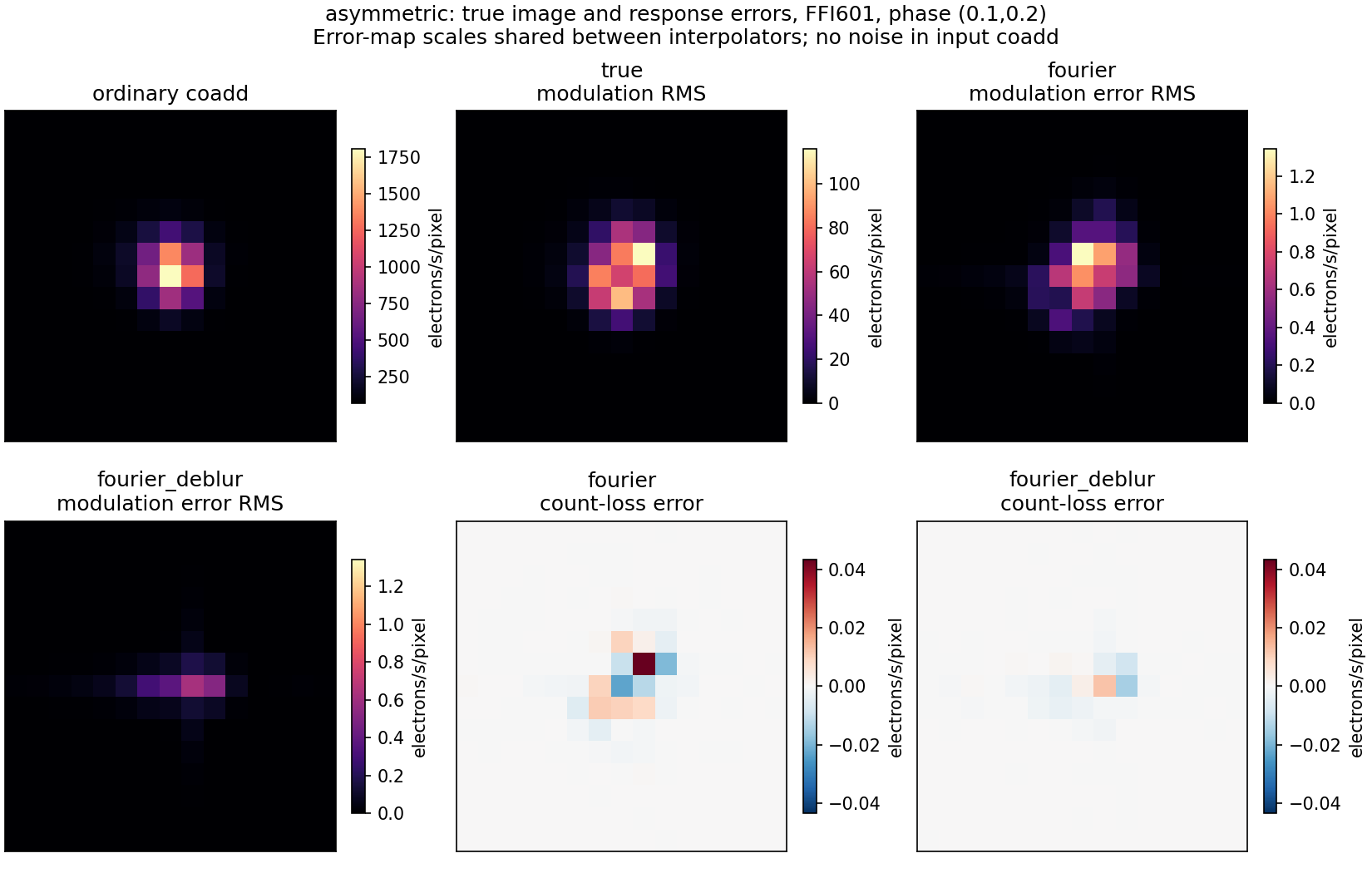
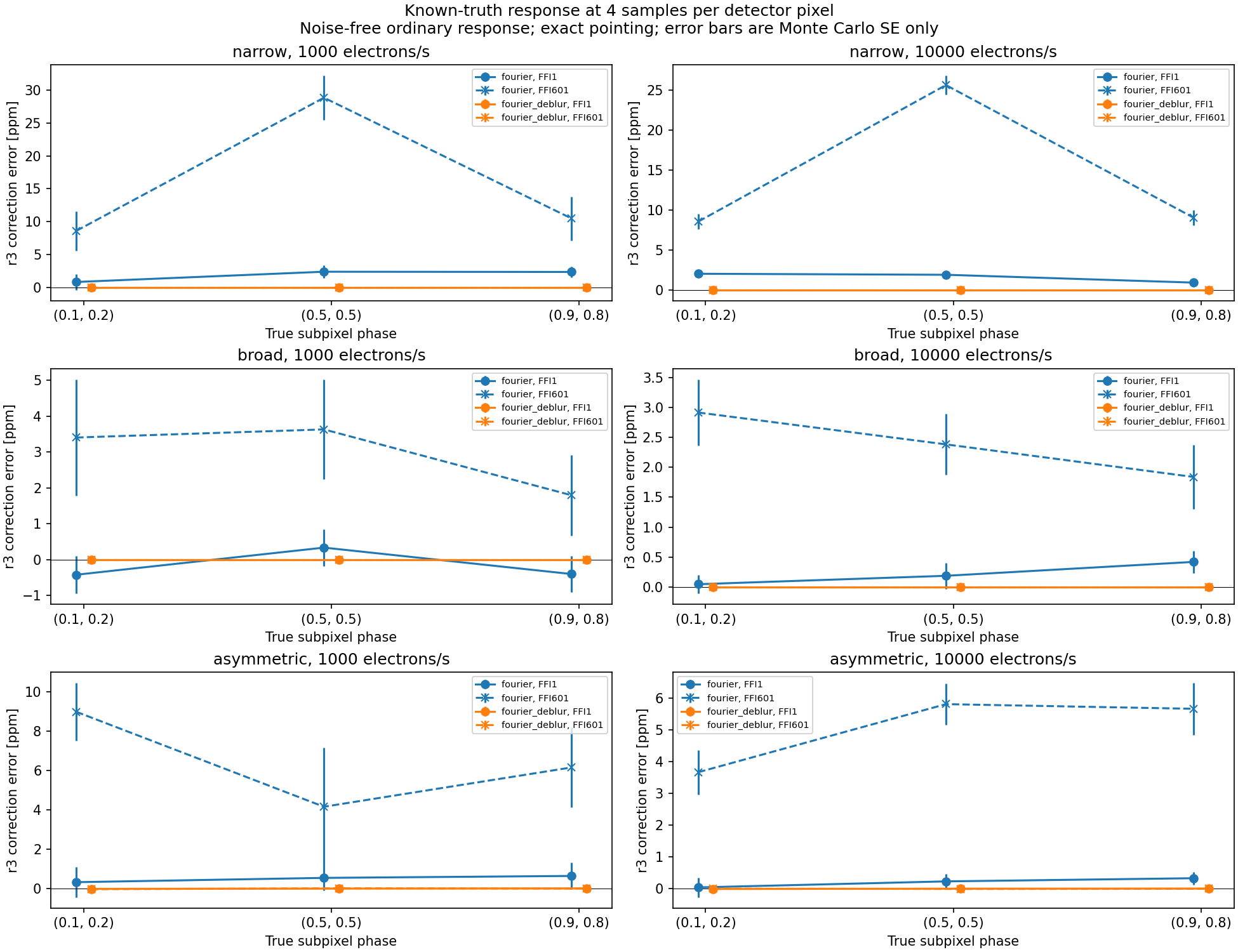
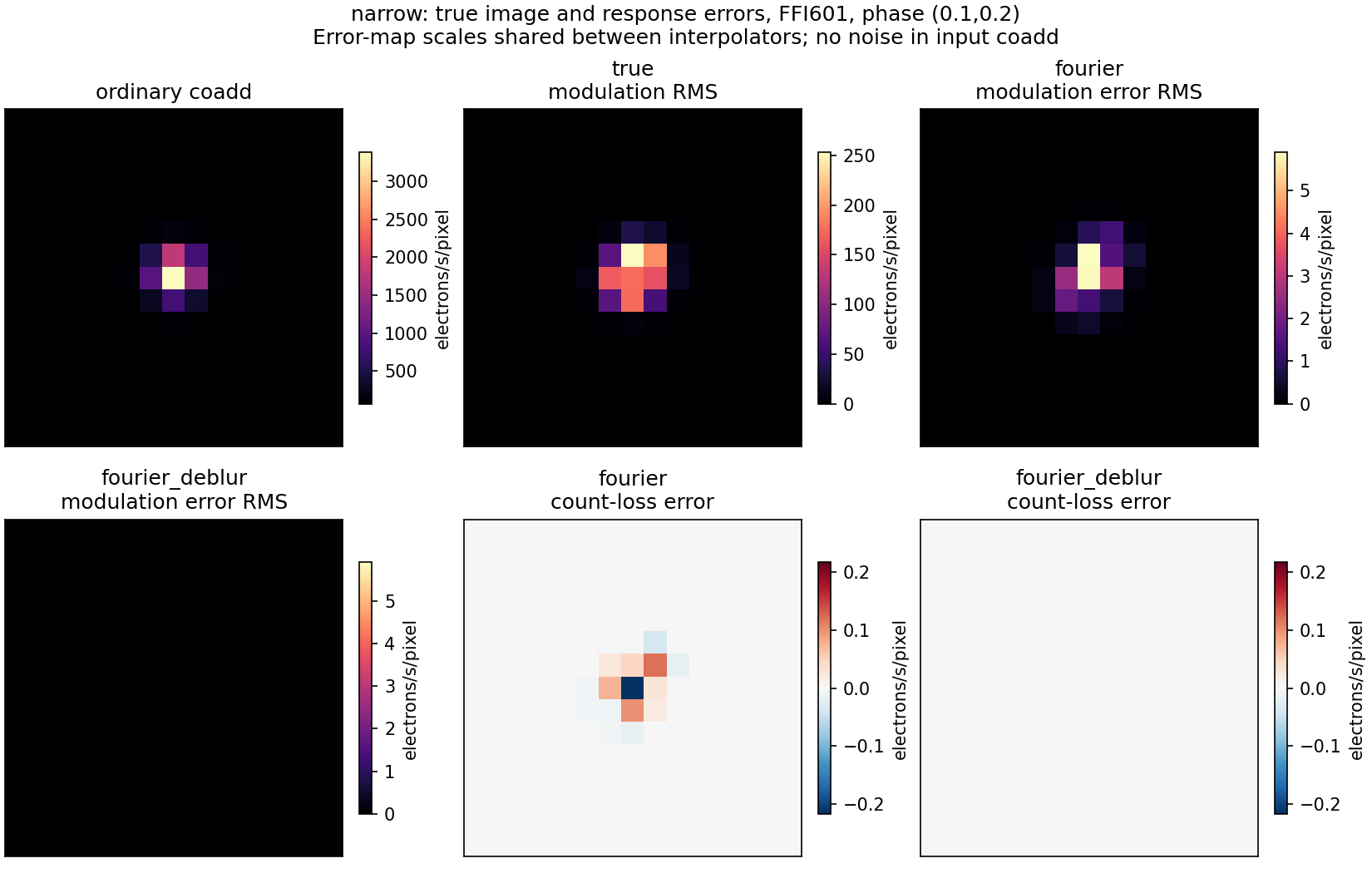
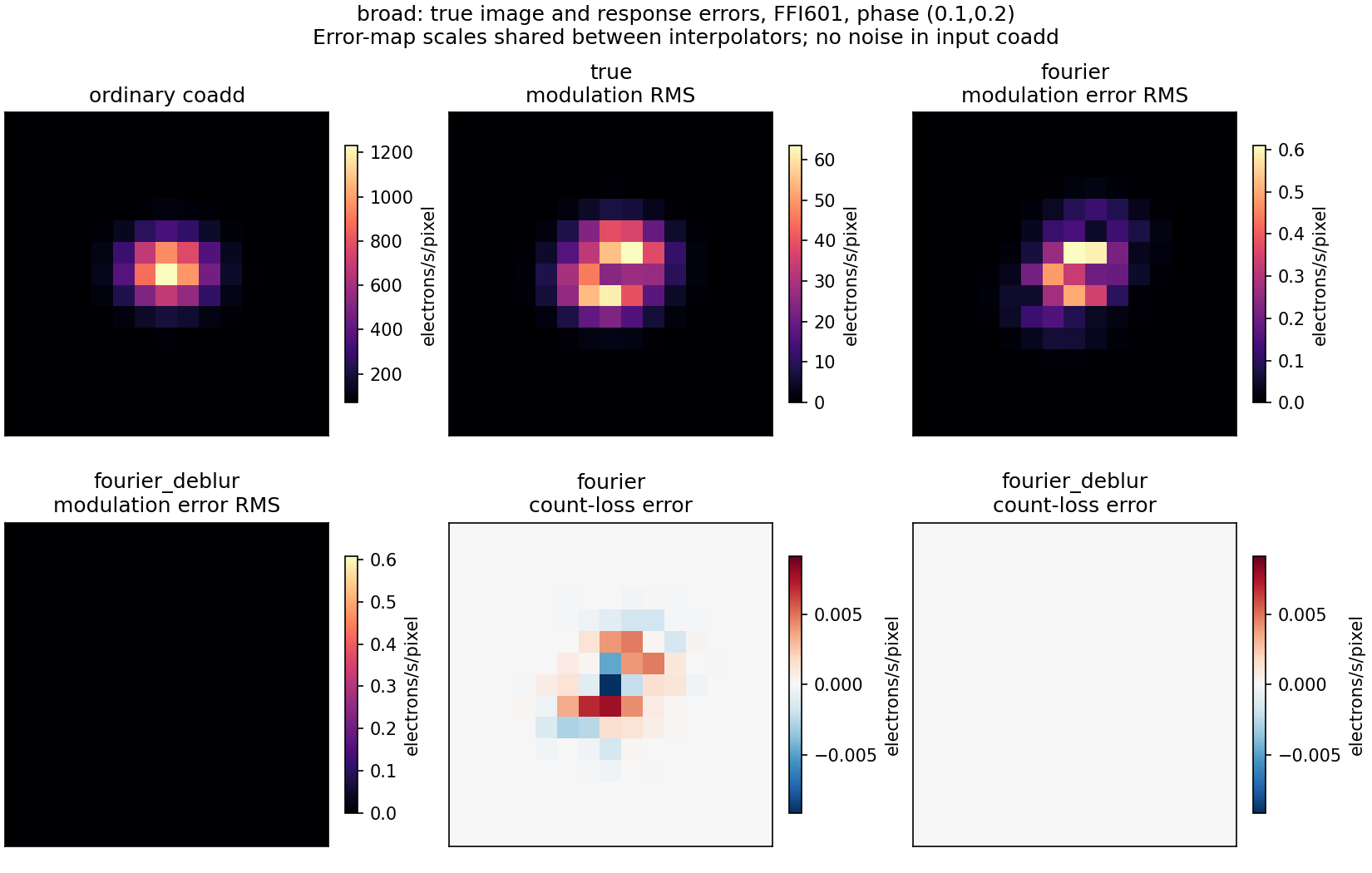
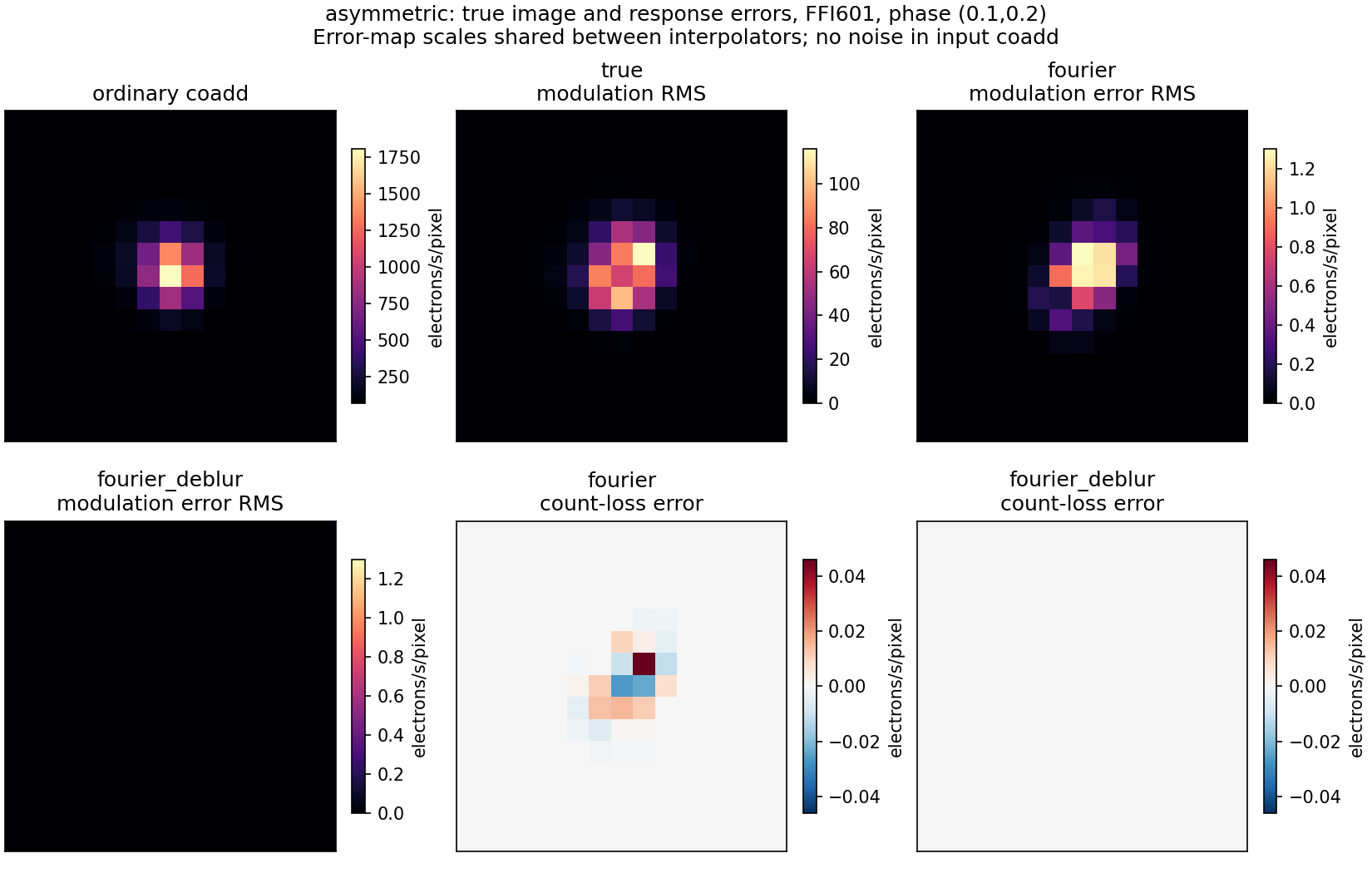
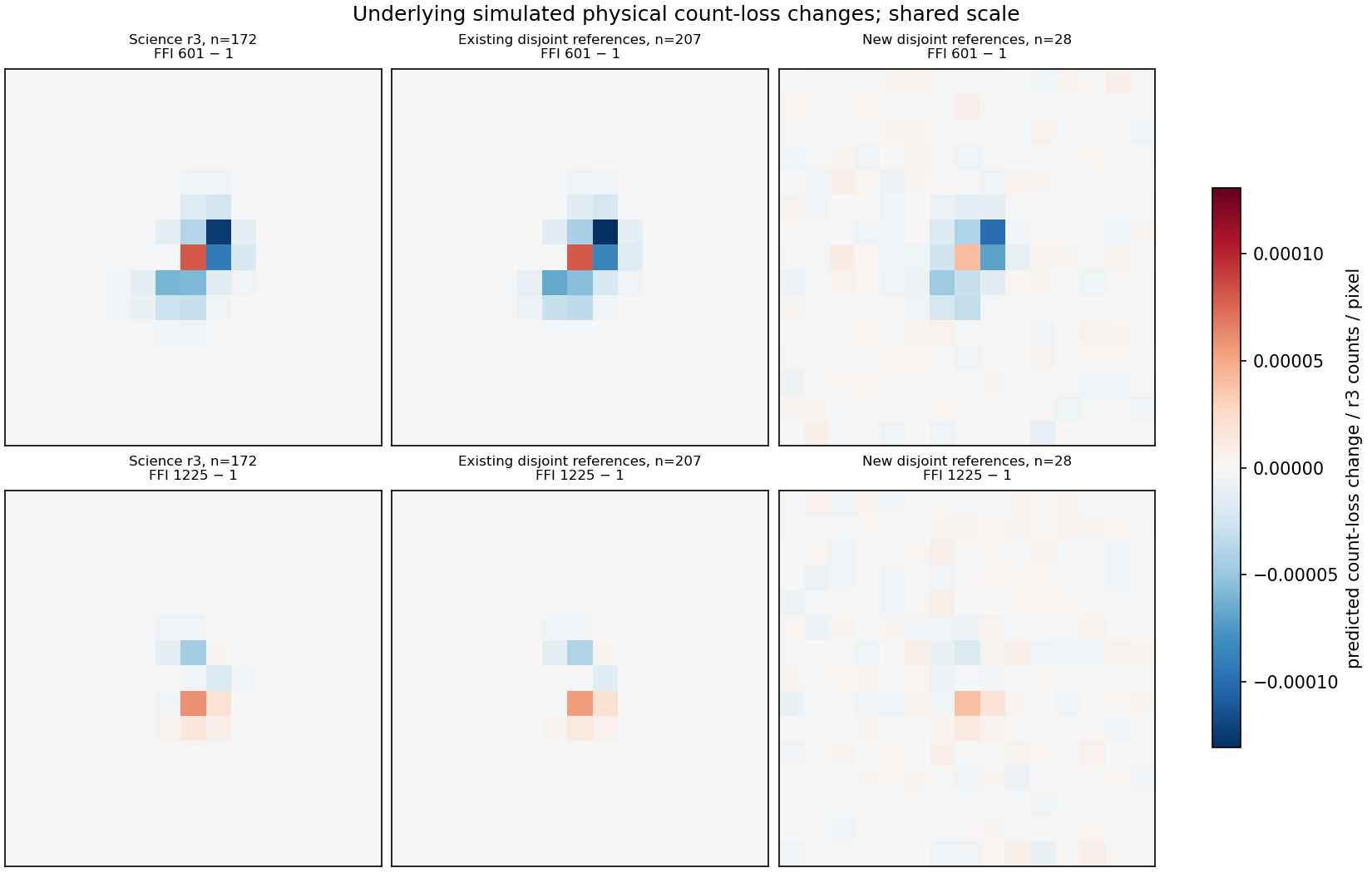
Thirty-six cases combine three exactly integrated Gaussian-mixture profiles, two source rates, three subpixel phases and two measured quaternion tracks. Every reconstruction receives a noise-free ordinary image and exact pointing. Fine-grid controls additionally receive exact unit-pixel responses at subpixel locations: information unavailable in a single FFI. Native coadd pixels match bitwise across all campaigns.
Method
Samples/pixel
Valid / total
Largest |MC r3 error| [ppm]
Largest conditional expected-bias bound [ppm]
bilinear
1
36/36
2865
1.004e+05
cubic
1
36/36
288.5
7.784e+04
fourier
1
34/36
181.4
6.042e+04
fourier_deblur
1
34/36
219.8
5.997e+04
fourier
2
36/36
26.92
3039
fourier_deblur
2
36/36
5.861
318.3
fourier
4
36/36
28.83
3047
fourier_deblur
4
36/36
0.02511
0.07439
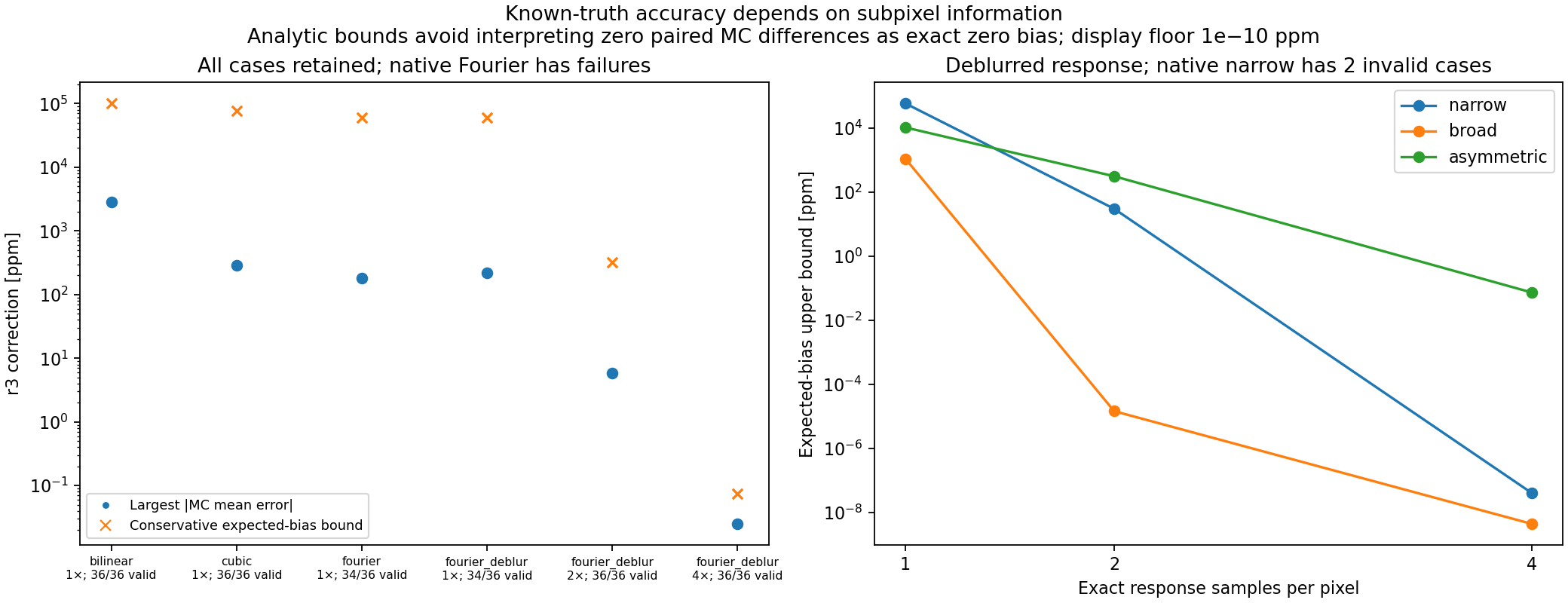
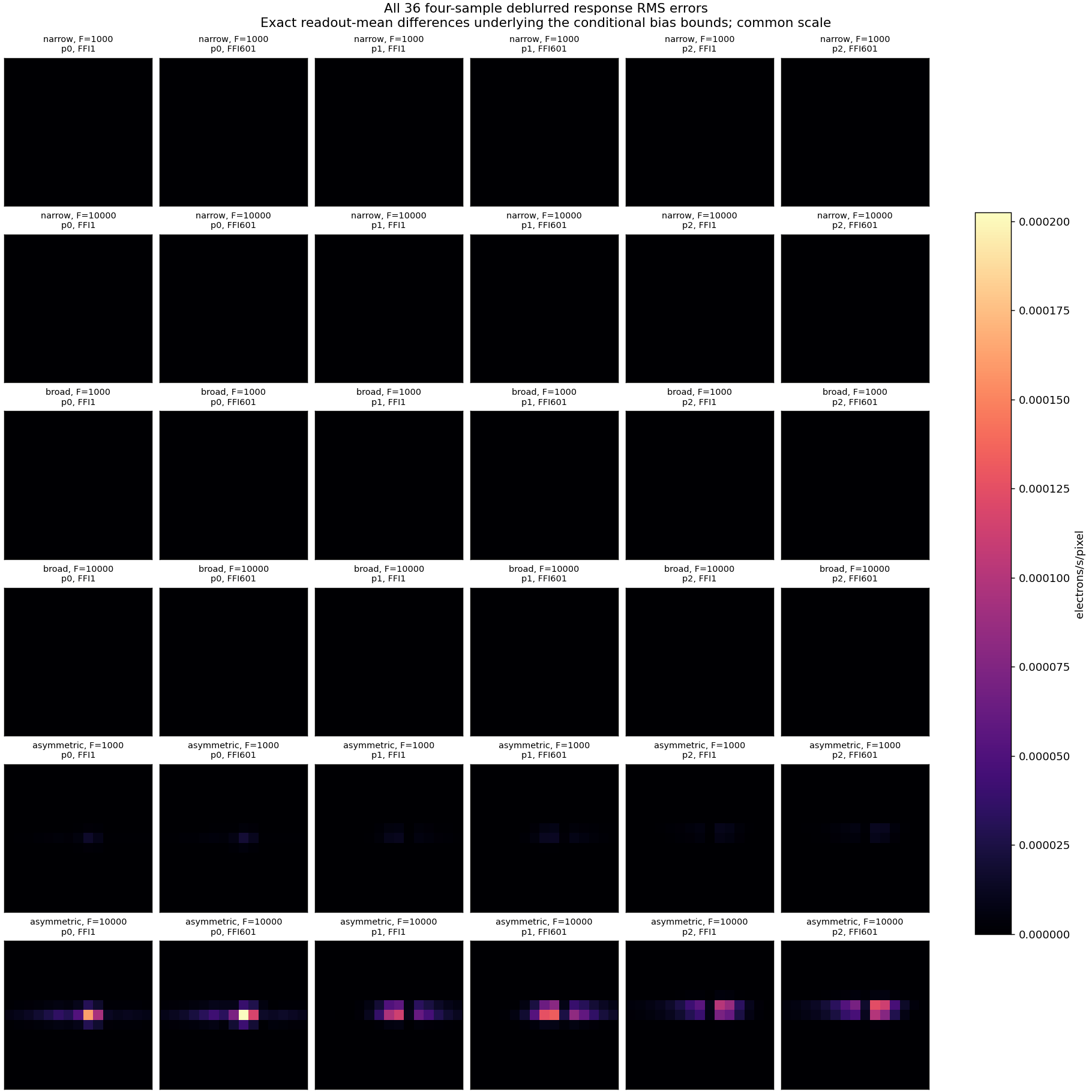
Invalid cases remain failures; the maxima for those methods cover only valid cases. Bilinear/cubic native-image interpolation is inaccurate. Native Fourier reconstruction still has narrow-profile errors and negative-rate cases. Fine sampling without removing jitter blur retains a response error. With both four-sample information and deblurring, all 36 cases remain positive; the expected-bias bounds are 0.0744 ppm for r3 and 0.0934 ppm for r5.
What the bound means
Here δ is reconstructed-minus-truth aperture count-loss in ppm; FA is exact source-only aperture rate in electrons/second; Wp is the dimensionless aperture/sky weight for detector pixel p; and Rp is the RMS over readouts of the photon-mean error expressed in electrons/second/pixel. All are known from the synthetic experiment. The min/max loss functional has count-wise Lipschitz constant 1/(900τ), with integration time τ=1.98 seconds. Monotone Poisson coupling and identical read noise yield the conservative expectation bound. Zero differences in finite simulations alone are not treated as zero bias.
All-case accuracy, truth images and exact response-error imagesAll methods and conditional expected-bias boundsAll 36 actual synthetic truth imagesEvery four-sample deblurred response-error image behind the boundsNative interpolation errorsNative narrow-profile pixelsNative broad-profile pixelsNative asymmetric-profile pixelsNative Fourier errorsNative Fourier narrow-profile pixelsNative Fourier broad-profile pixelsNative Fourier asymmetric-profile pixelsTwo-sample errorsTwo-sample narrow-profile pixelsTwo-sample broad-profile pixelsTwo-sample asymmetric-profile pixelsFour-sample errorsFour-sample narrow-profile pixelsFour-sample broad-profile pixelsFour-sample asymmetric-profile pixels
Eight focused tests pass. All completed campaigns and assessments have frozen local code, input conventions and exit records. The initial Fourier run failed because a generic helper rejected negative proposed rates; the retry reports those invalid cases explicitly. No rate clipping, population shrinkage or science-product replacement occurs.
Conclusion: the response correction is conditionally feasible with accurate subpixel information, while mean-only repair and simple native-image reconstruction fail. Next recover that information from native stellar/exposure samples with independent phase, spatial and colour validation; then repeat shared-pixel signal tests and full photometry/noise checks. Calibration, WCS and real astrophysical signal preservation remain open.
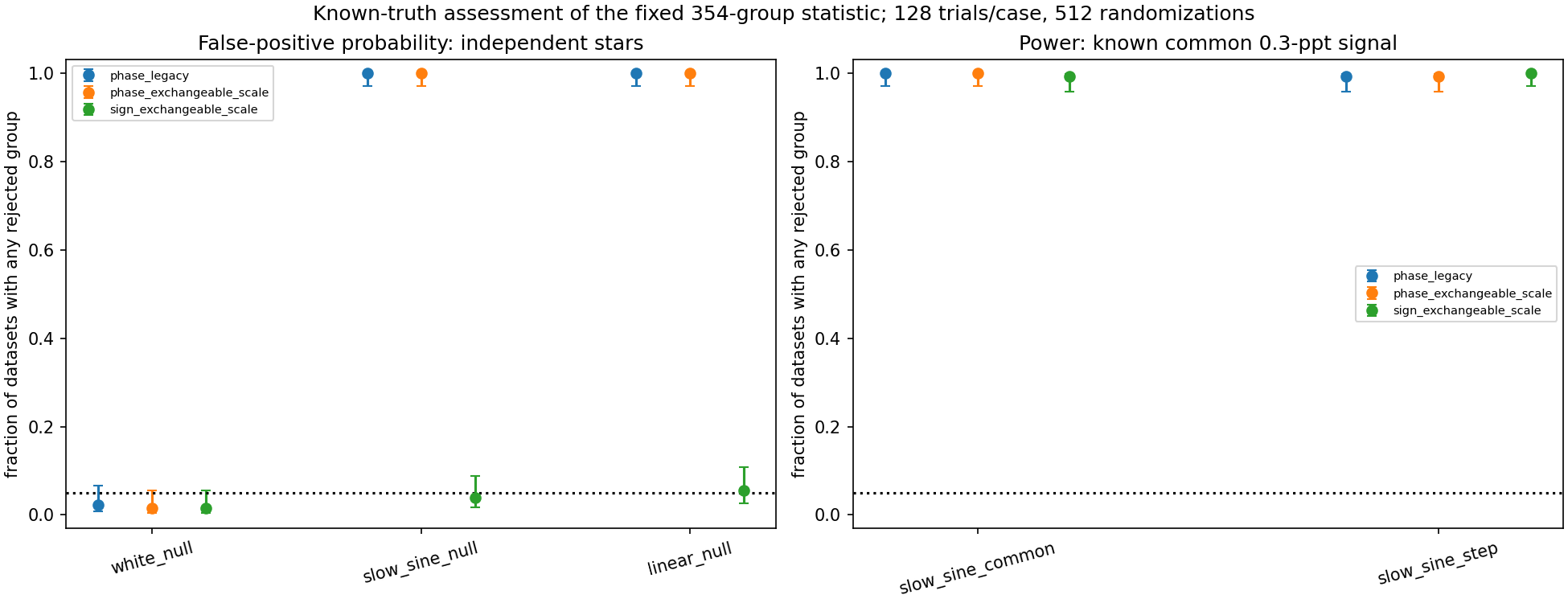
Investigation active: photon-limited, instrument-free photometry remains unproven. Known-truth tests expose a limitation of the phase-based audit. Physical validation, signal preservation and noise accounting remain required.
Neighbour-aware sky fixes the original signal failure, but broader wings still fail
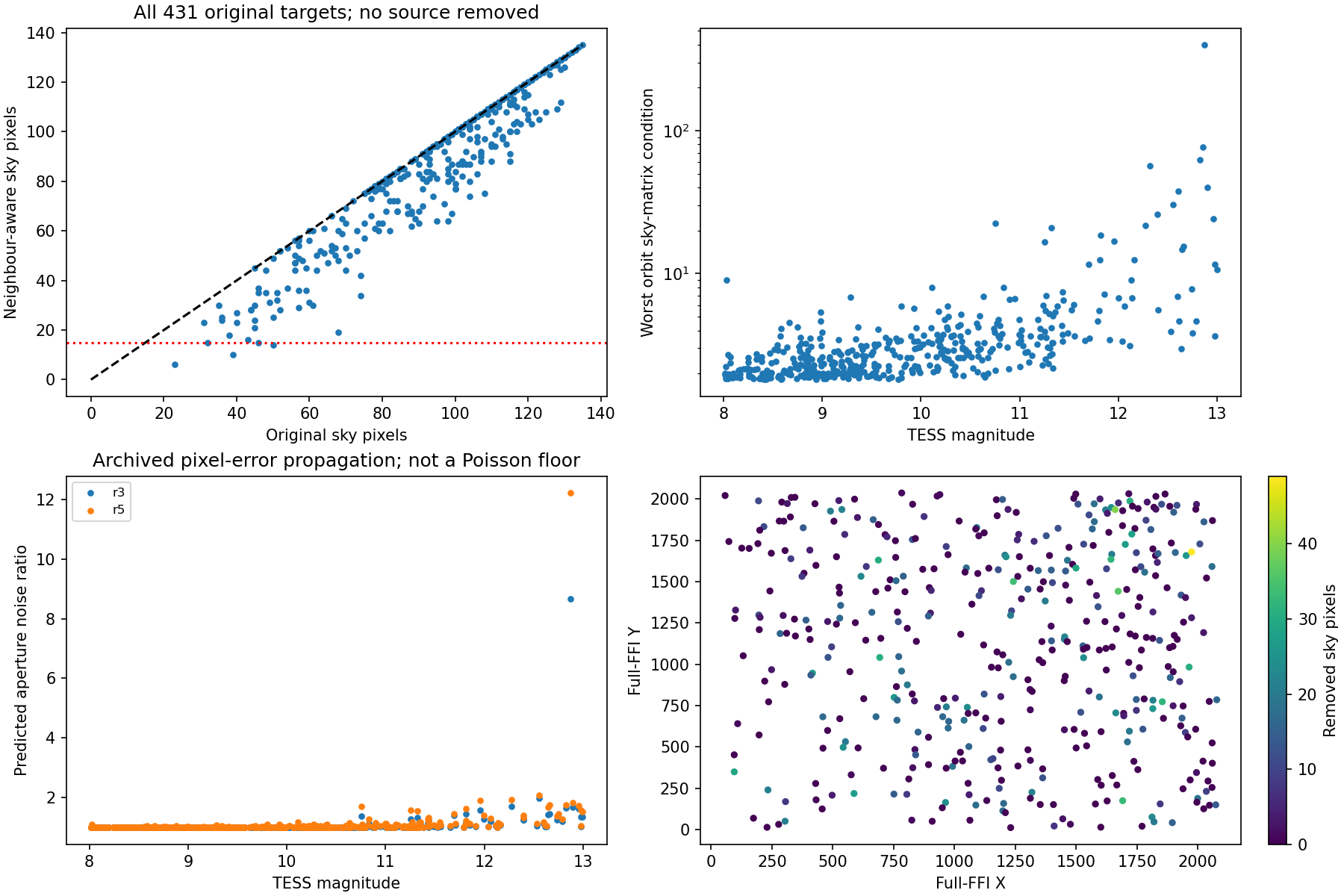
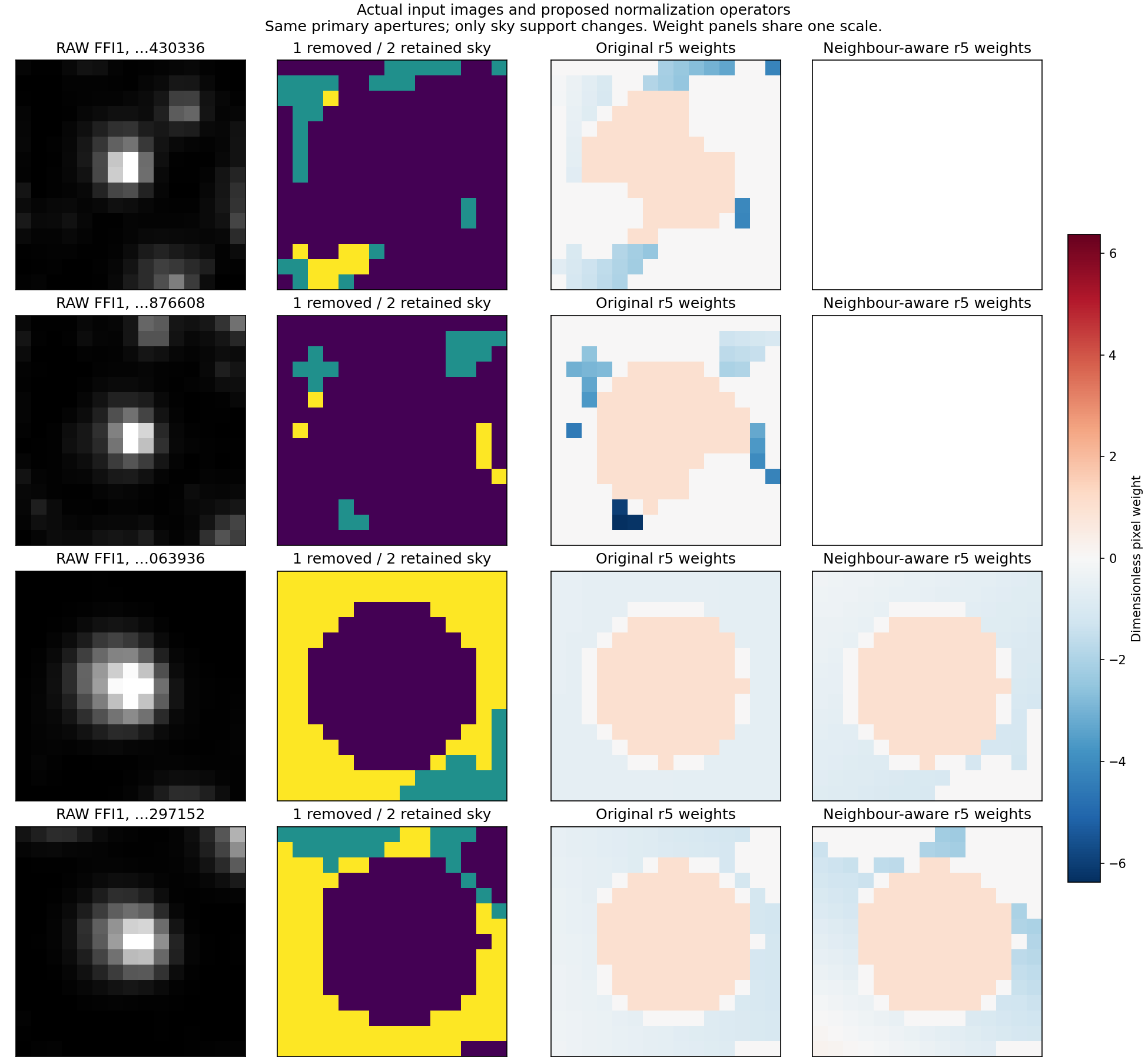
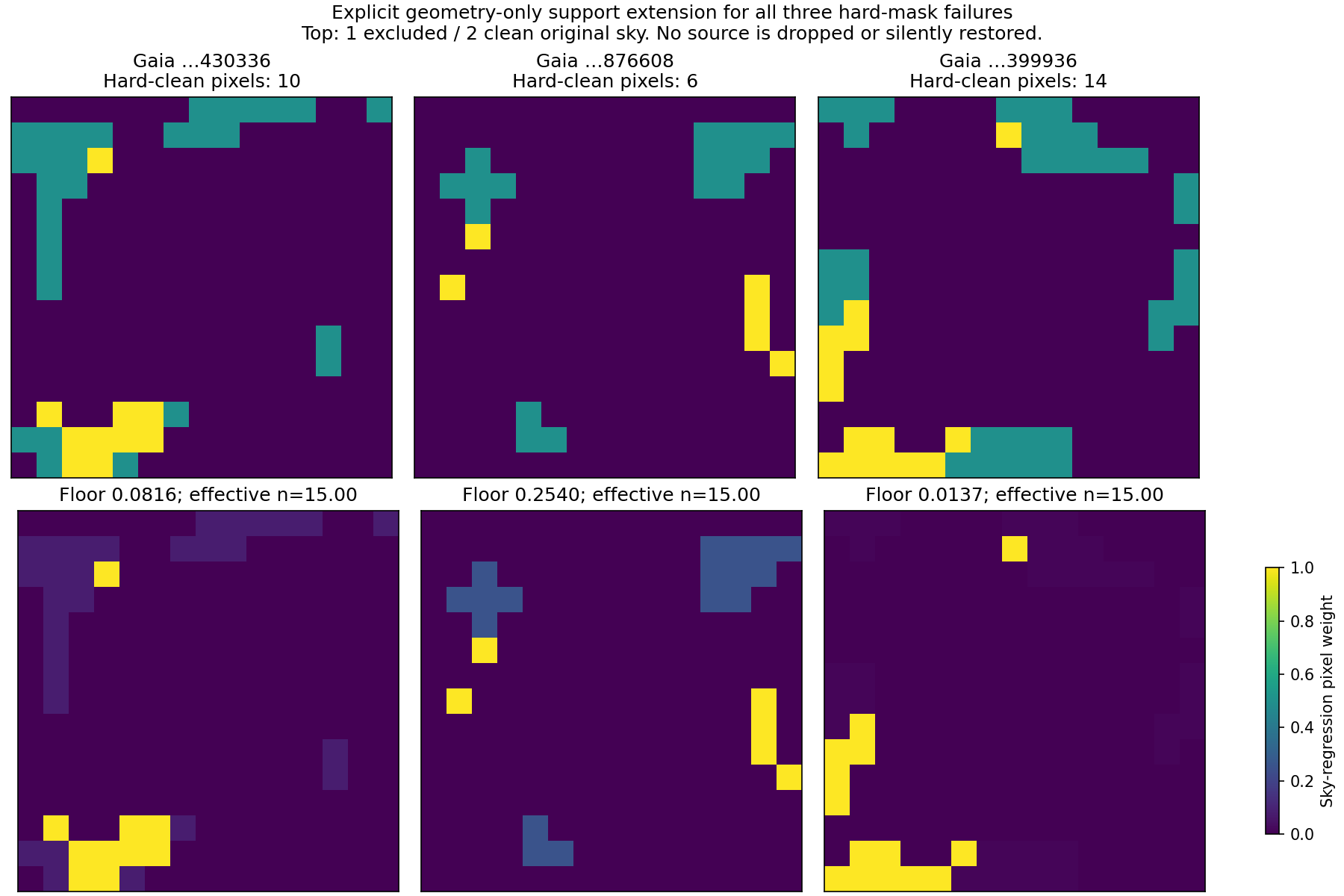
The primary recipe excludes sky pixels within 5 pixels of catalogue neighbours with flux ratio above 0.1, preserving every original source, primary aperture and stellar fit mask. It supports 428/431 targets; the three hard-mask failures remain recorded. A separate explicit geometry-only weight-floor extension retains an effective 15 sky pixels for those sources. No temporal flatness chooses the exclusions or floors.
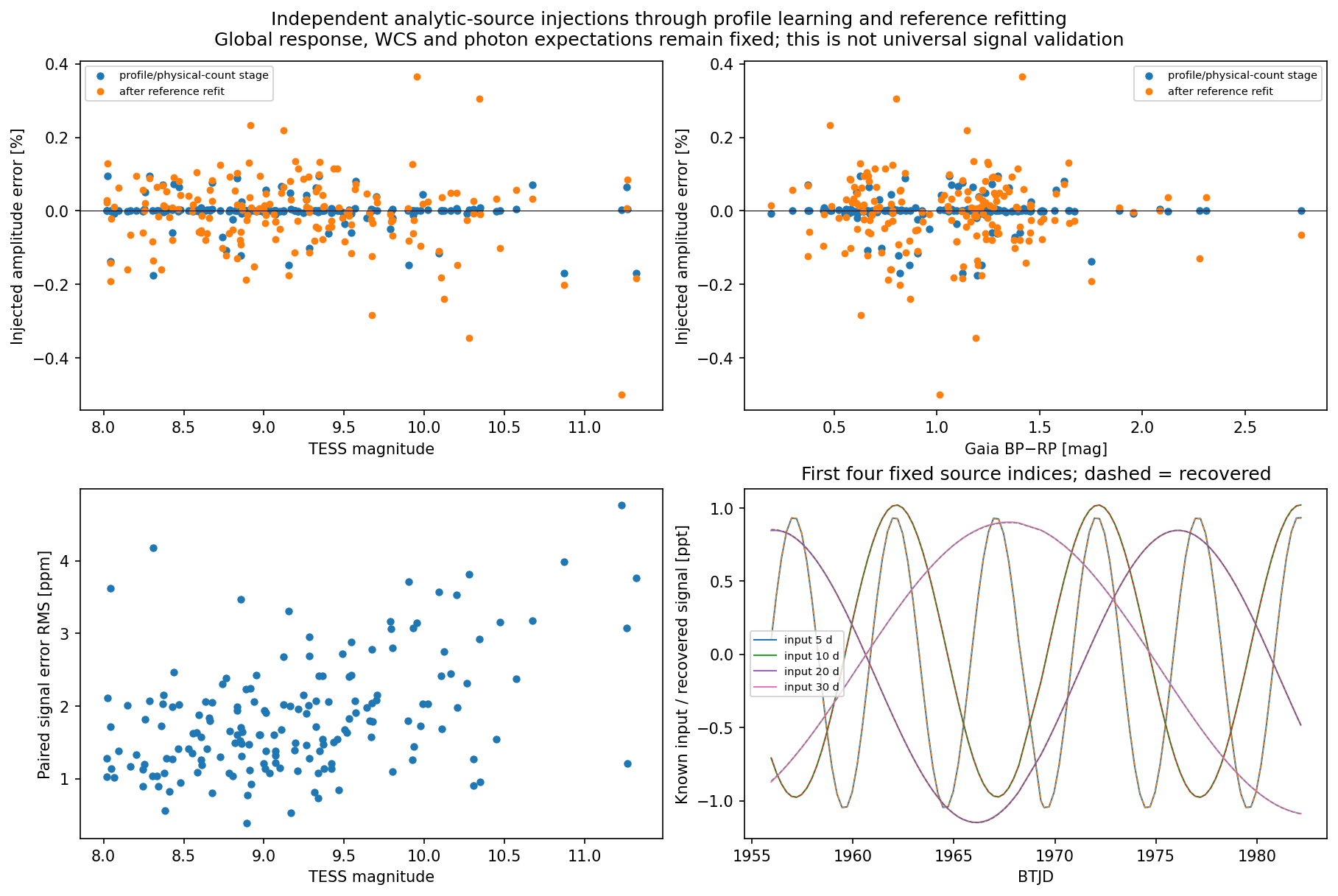
All 431 targets and 1,224 FFIs are remeasured. Physical pixel count loss is reprojected through each matching aperture; source profiles, aperture ratios and reference precision are refitted. A separately fixed broader Gaussian-mixture injection repeats the same absolute-detector source consistency checks. Old nominal/coupled controls and pilot/full overlaps replay exactly; five focused analytic/geometry tests pass.
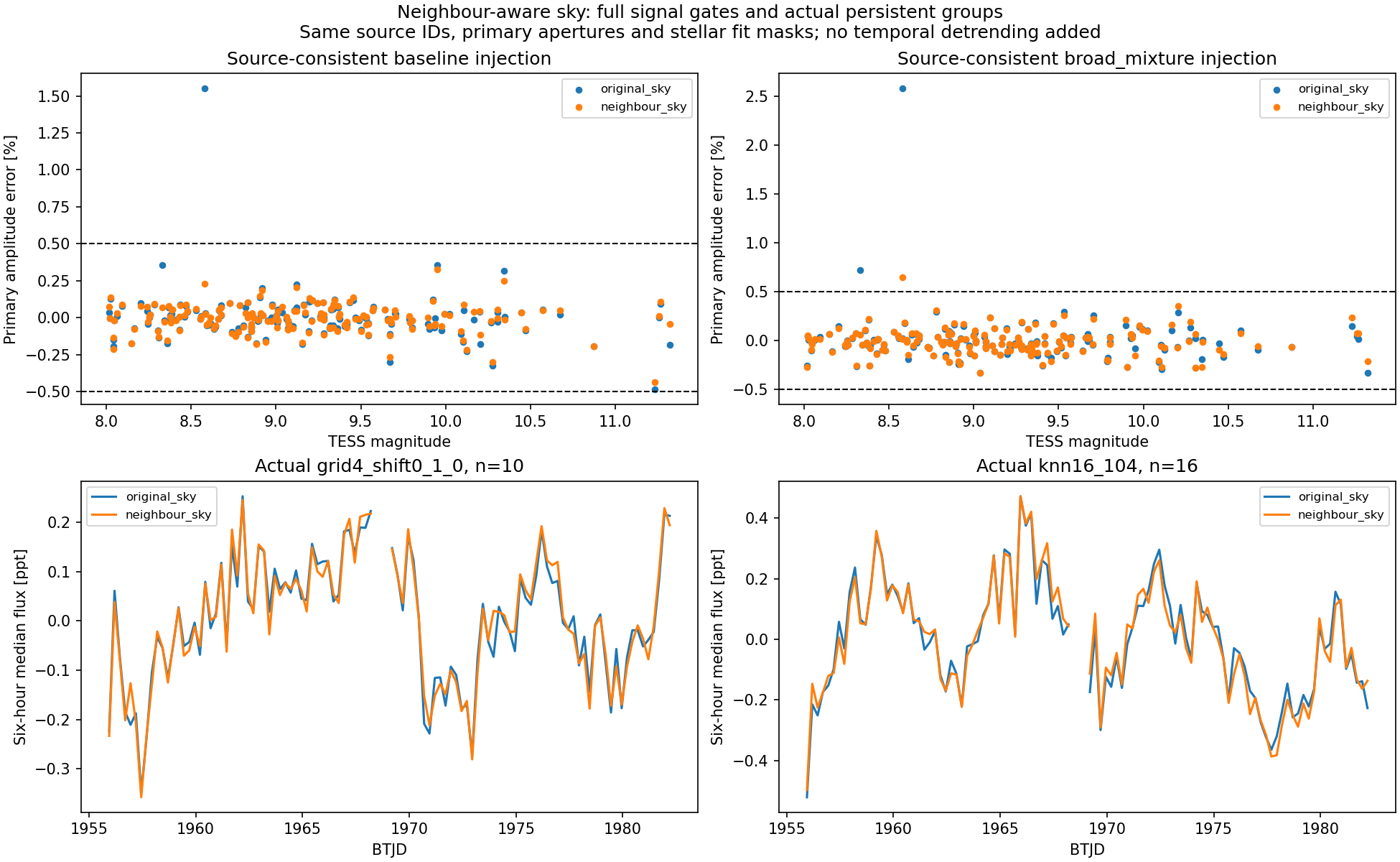
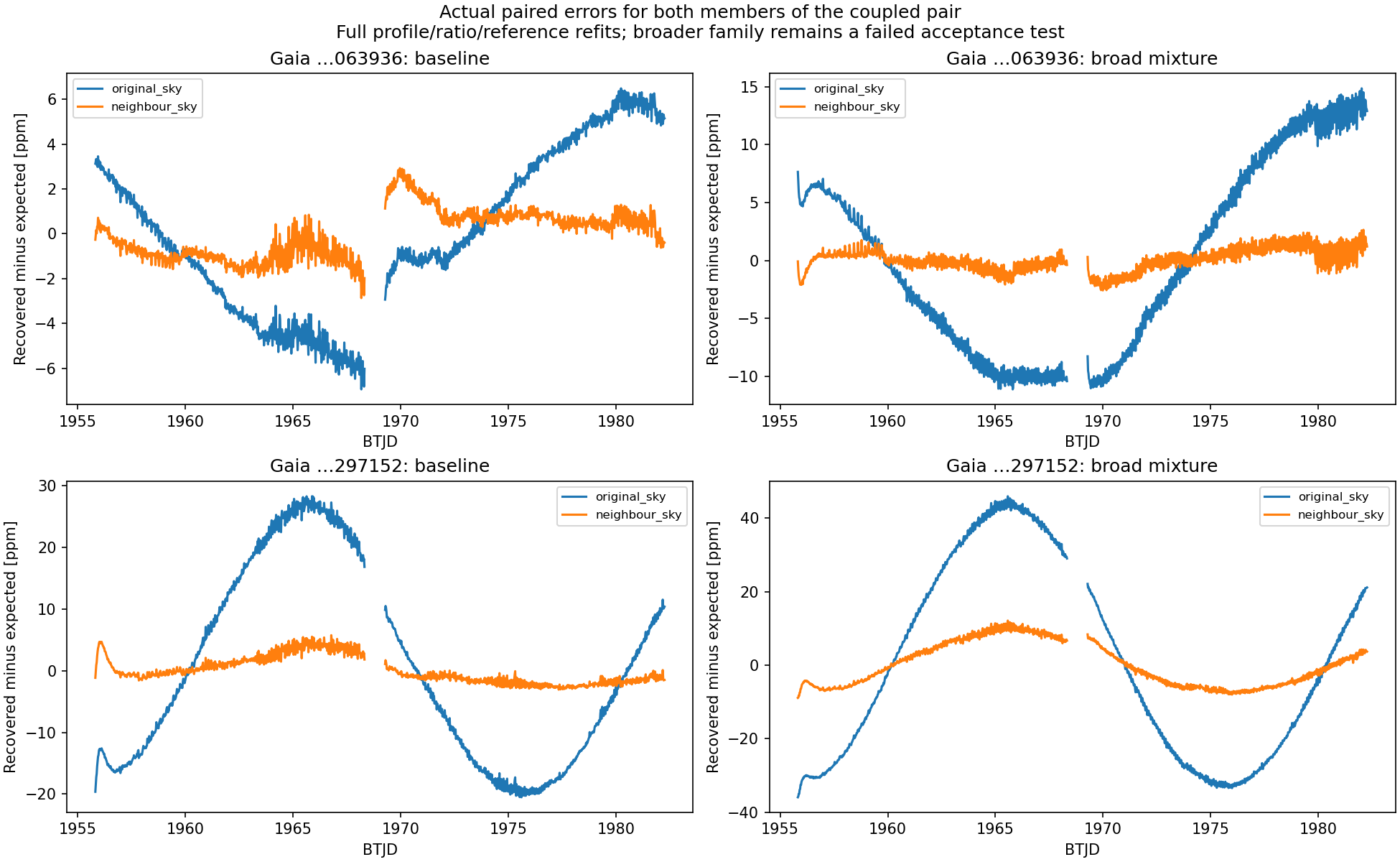
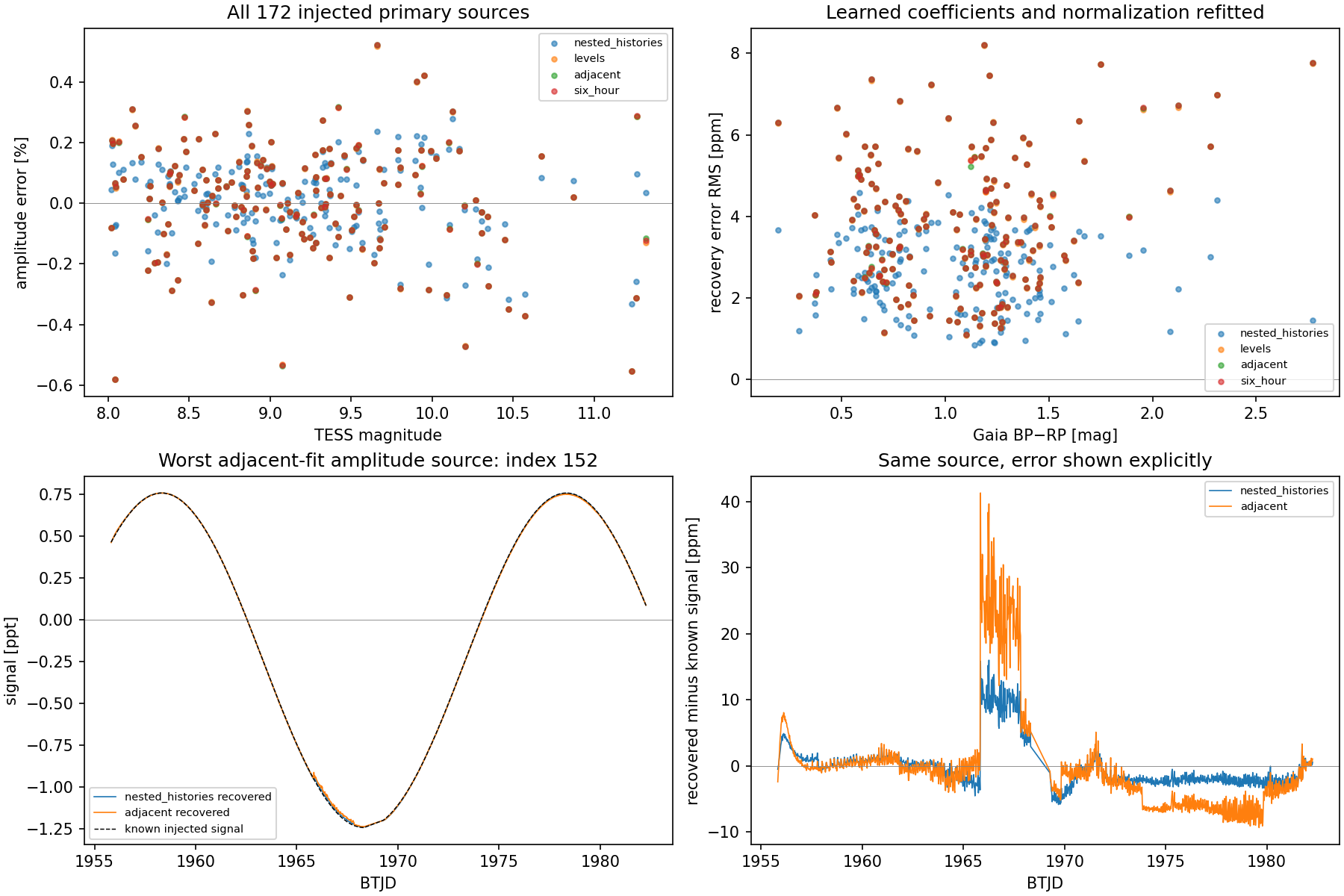
The original-family worst amplitude error falls 1.55152%→0.43669%, passing the unchanged 0.5% criterion across all 172 science stars. The broader family falls 2.57761%→0.64280%, but still fails for Gaia 1626038957153297152. That star remains included. The known normalization defect is reduced, not universally removed.
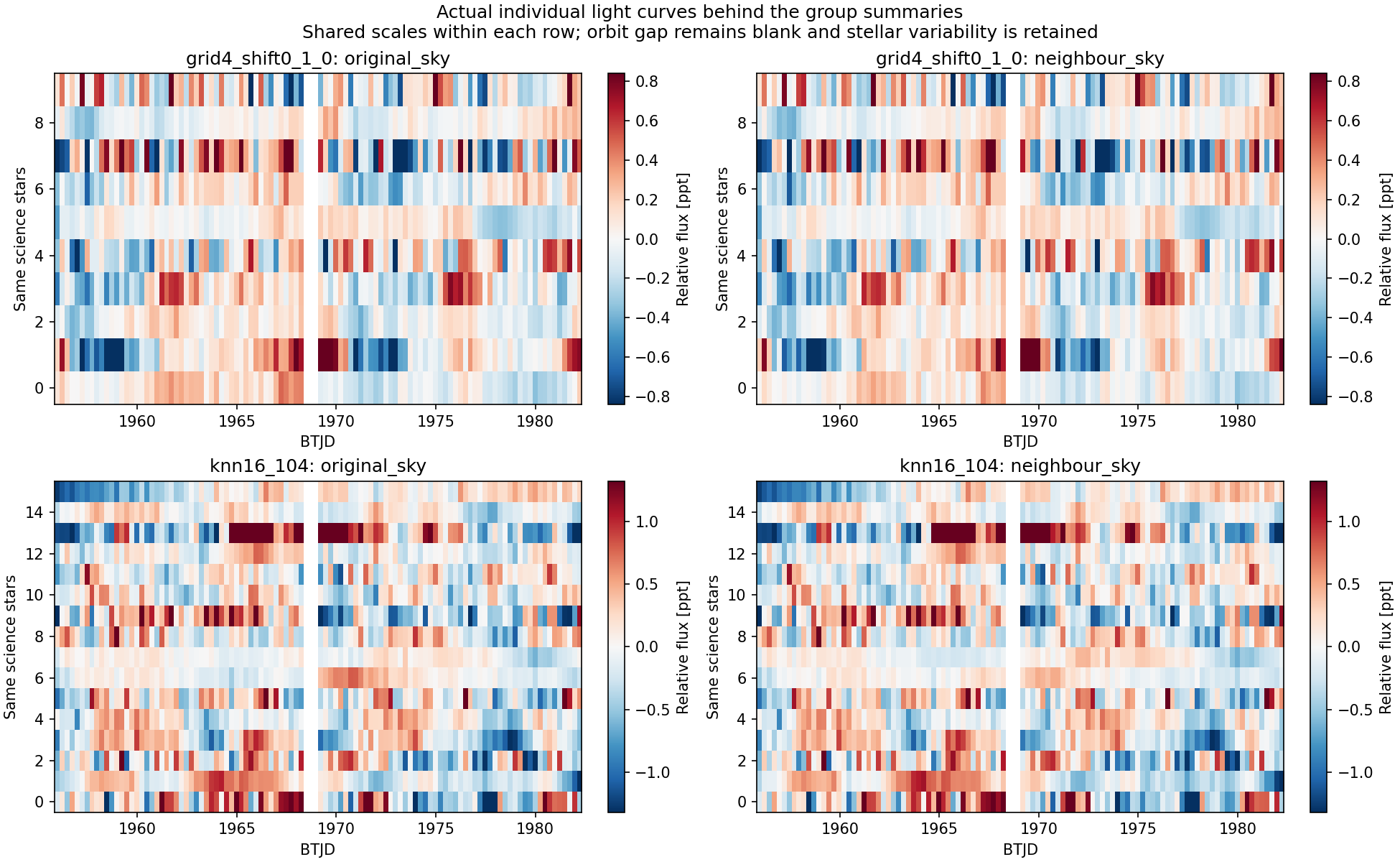
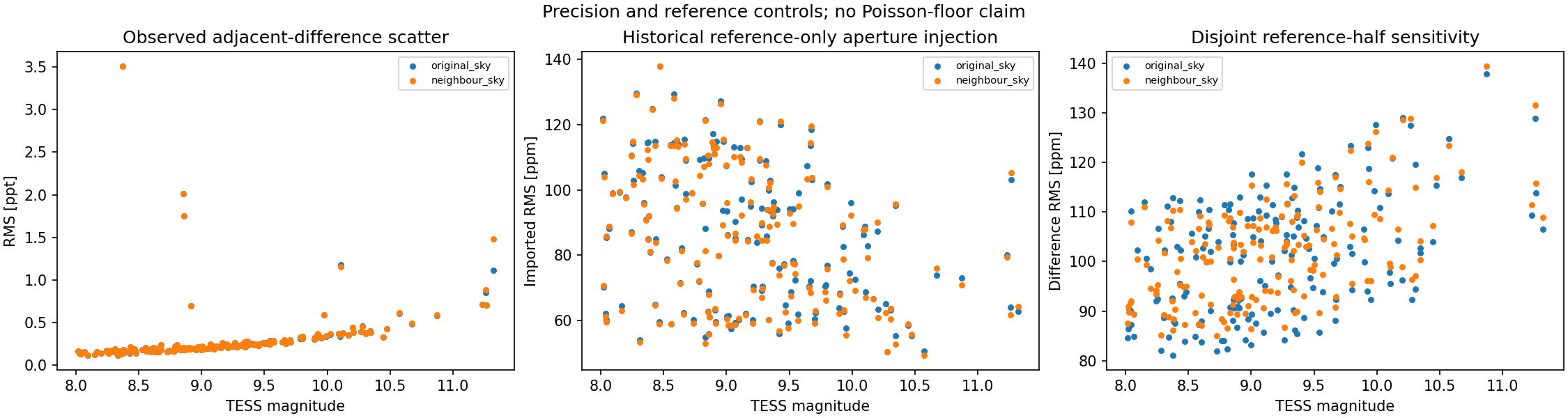
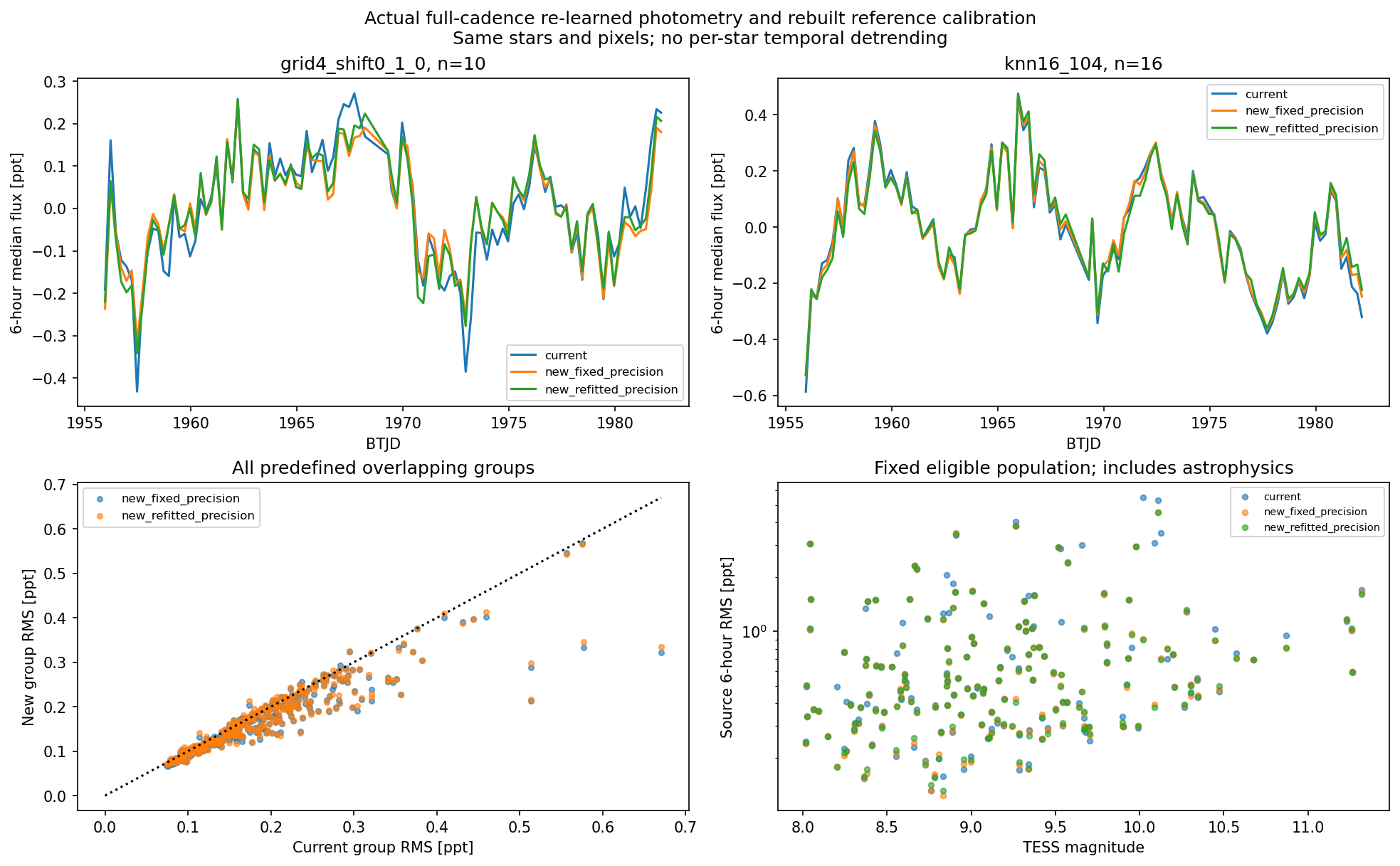
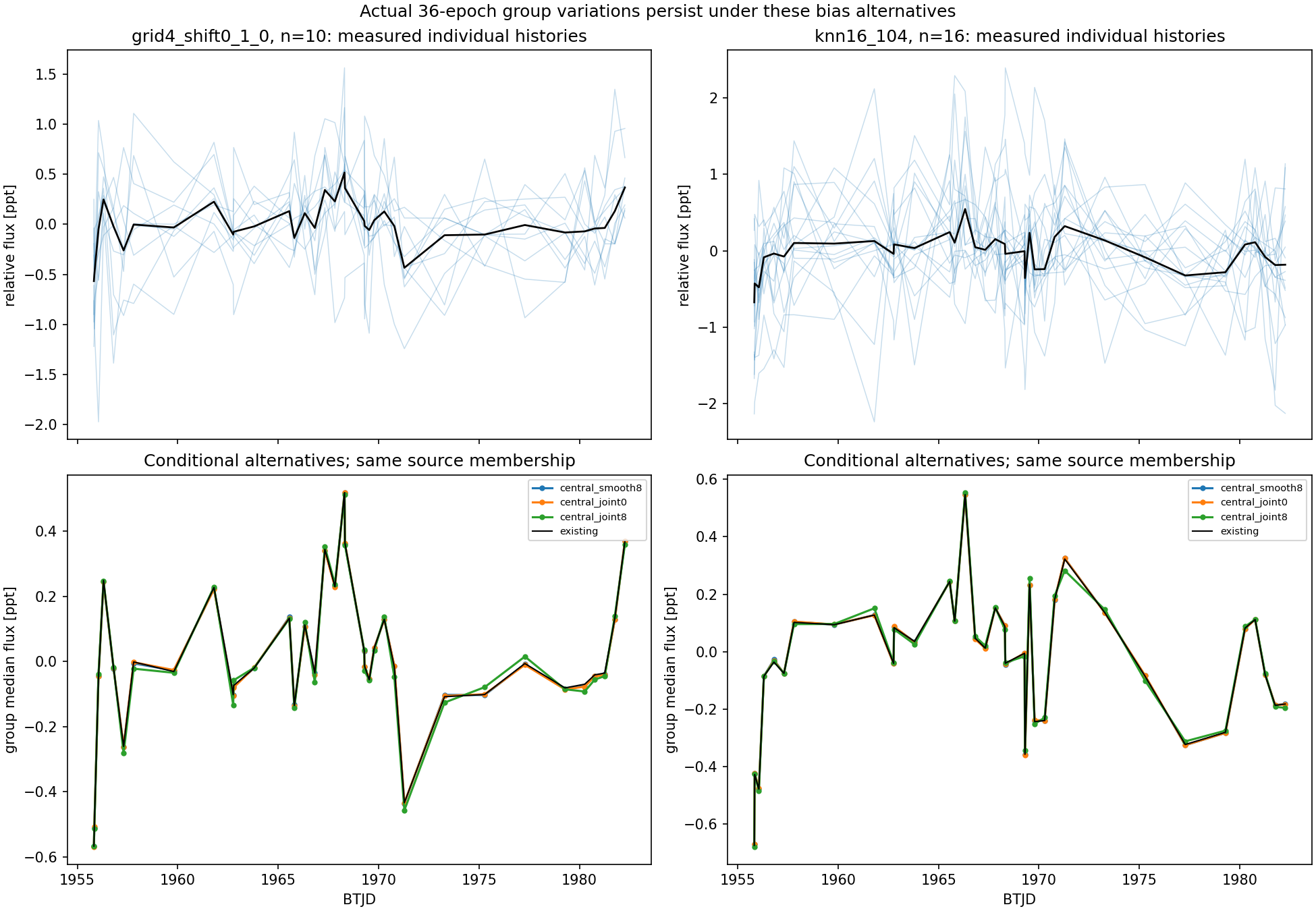
The ten-star and sixteen-star group RMS values change 0.12332→0.12510 and 0.18360→0.18626 ppt. Their histories persist. Median science six-hour RMS changes little and the high-scatter tail worsens; some references pay substantial aperture-noise costs. Archived-error propagation and aperture-level reference injections are conditional diagnostics, not Poisson or complete source-consistent reference validation.
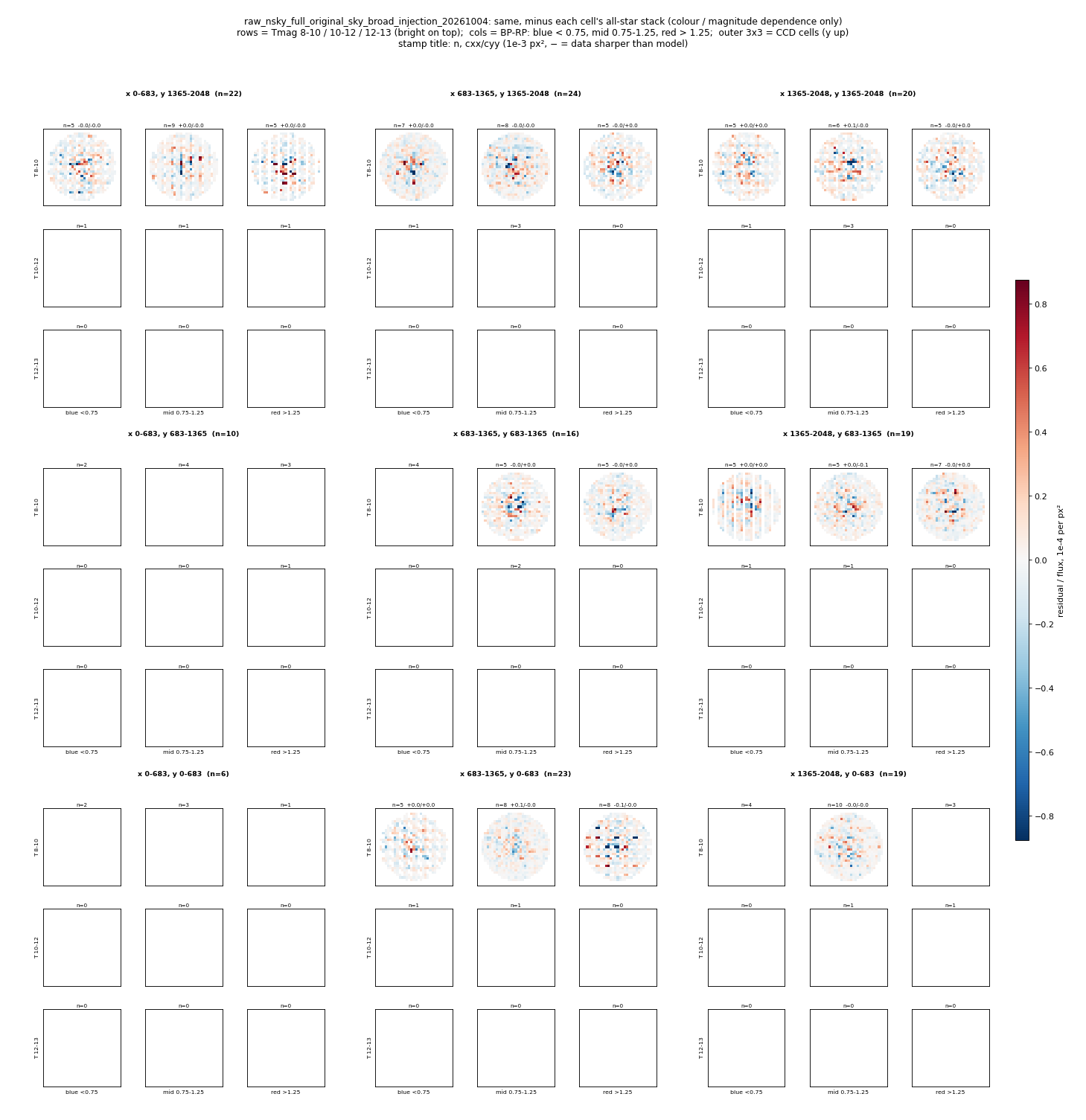
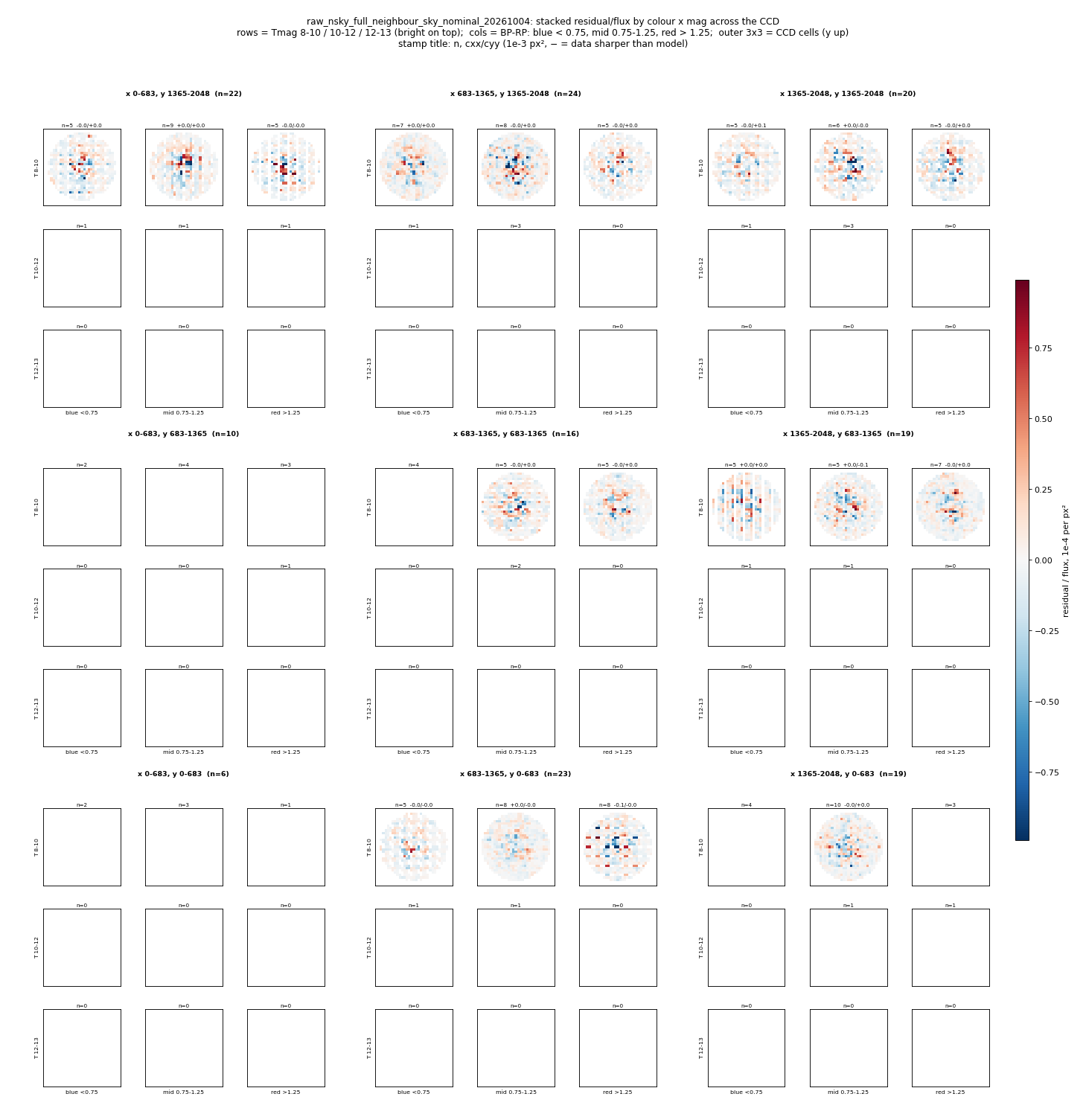
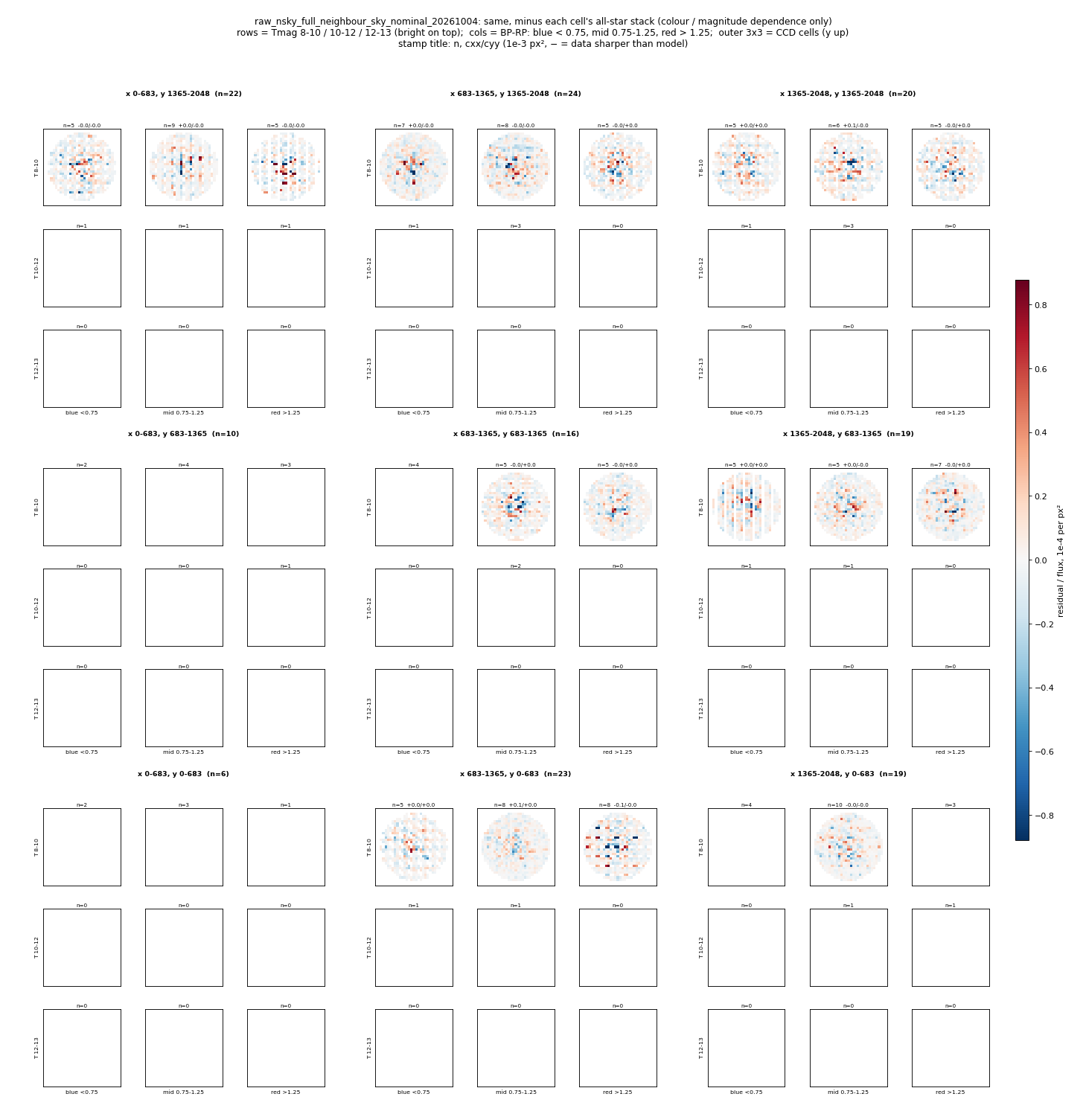
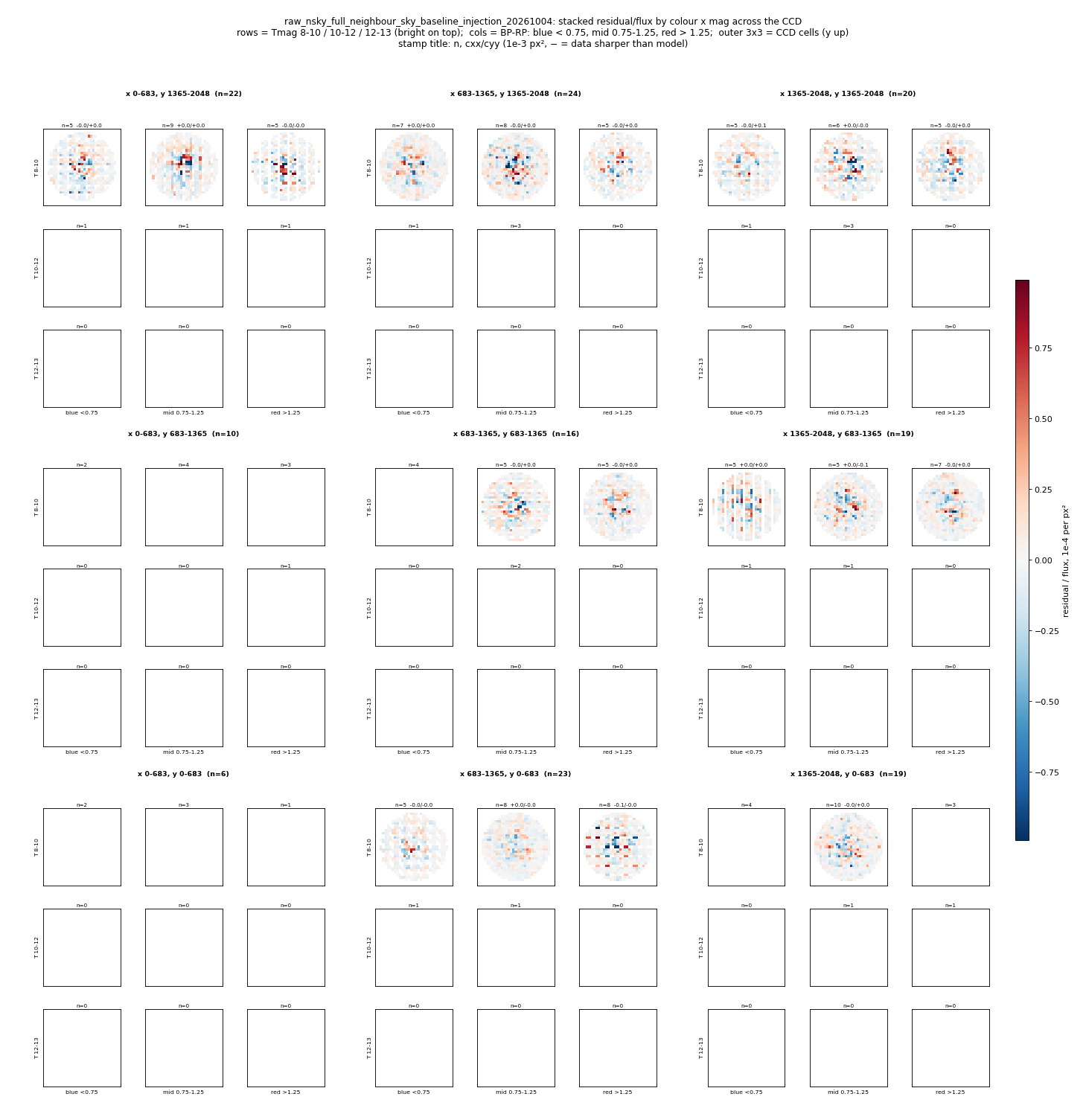
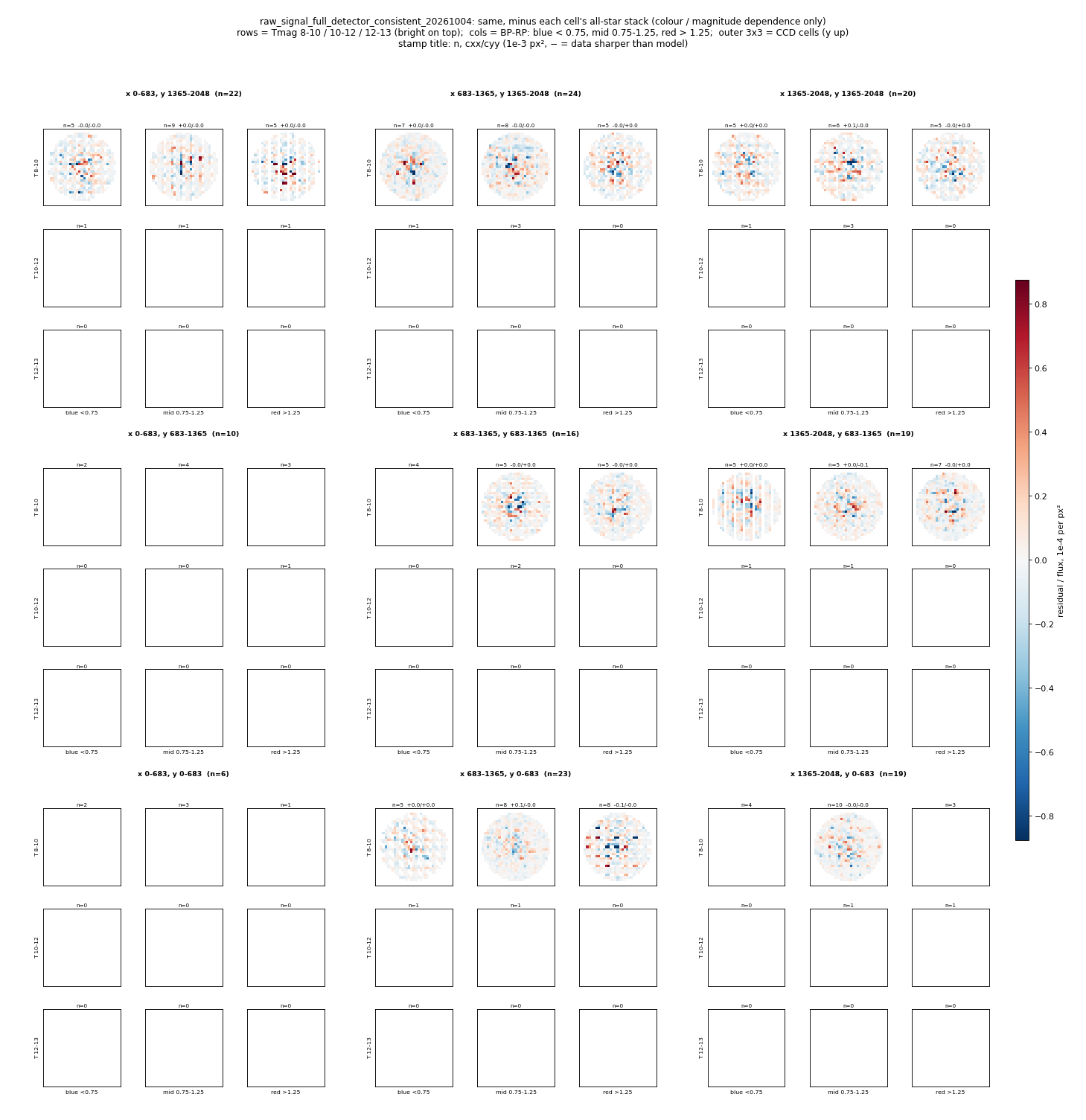
Required matched pilot/full residual grids: both sky operators and all three datasets
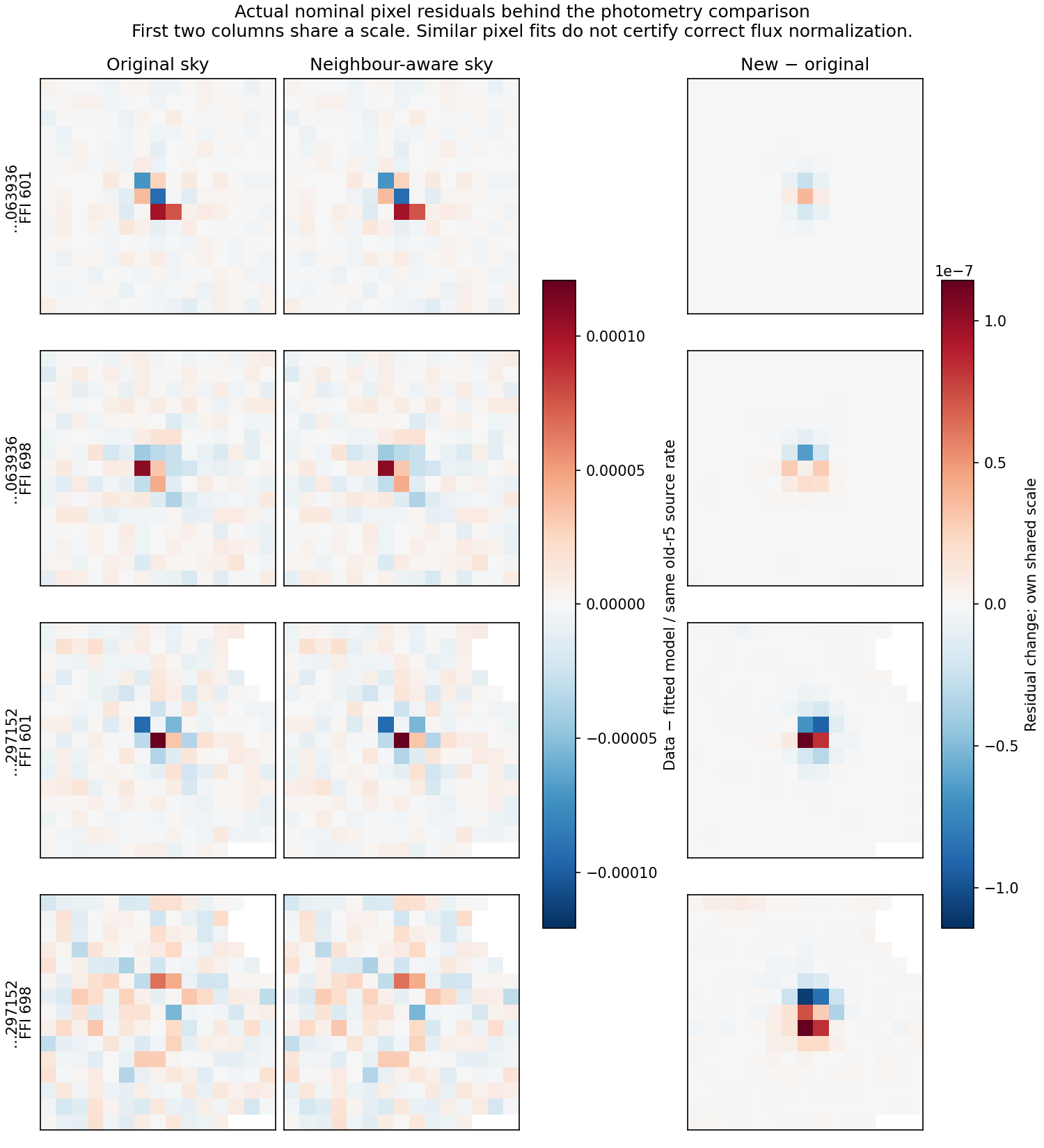
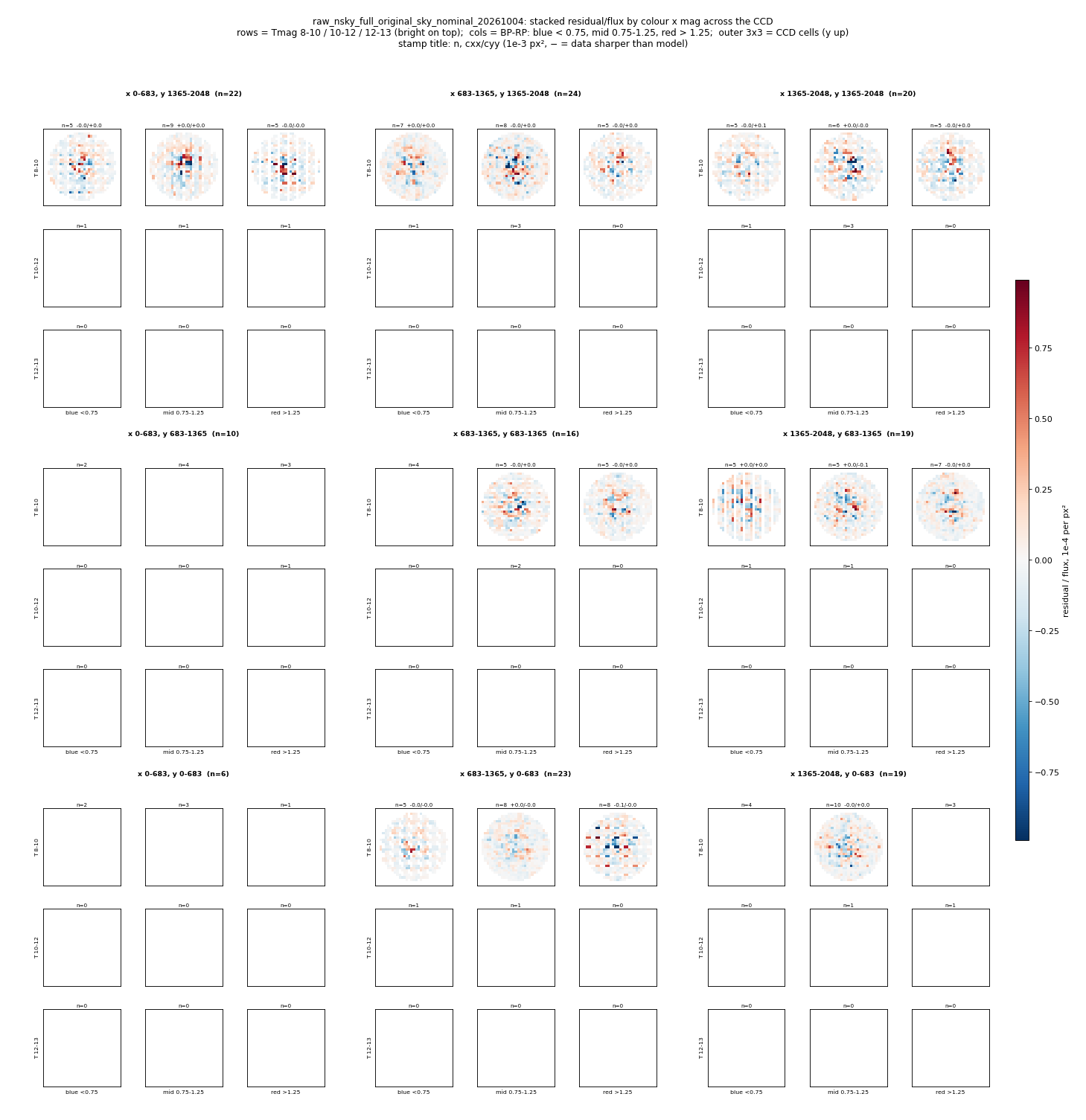
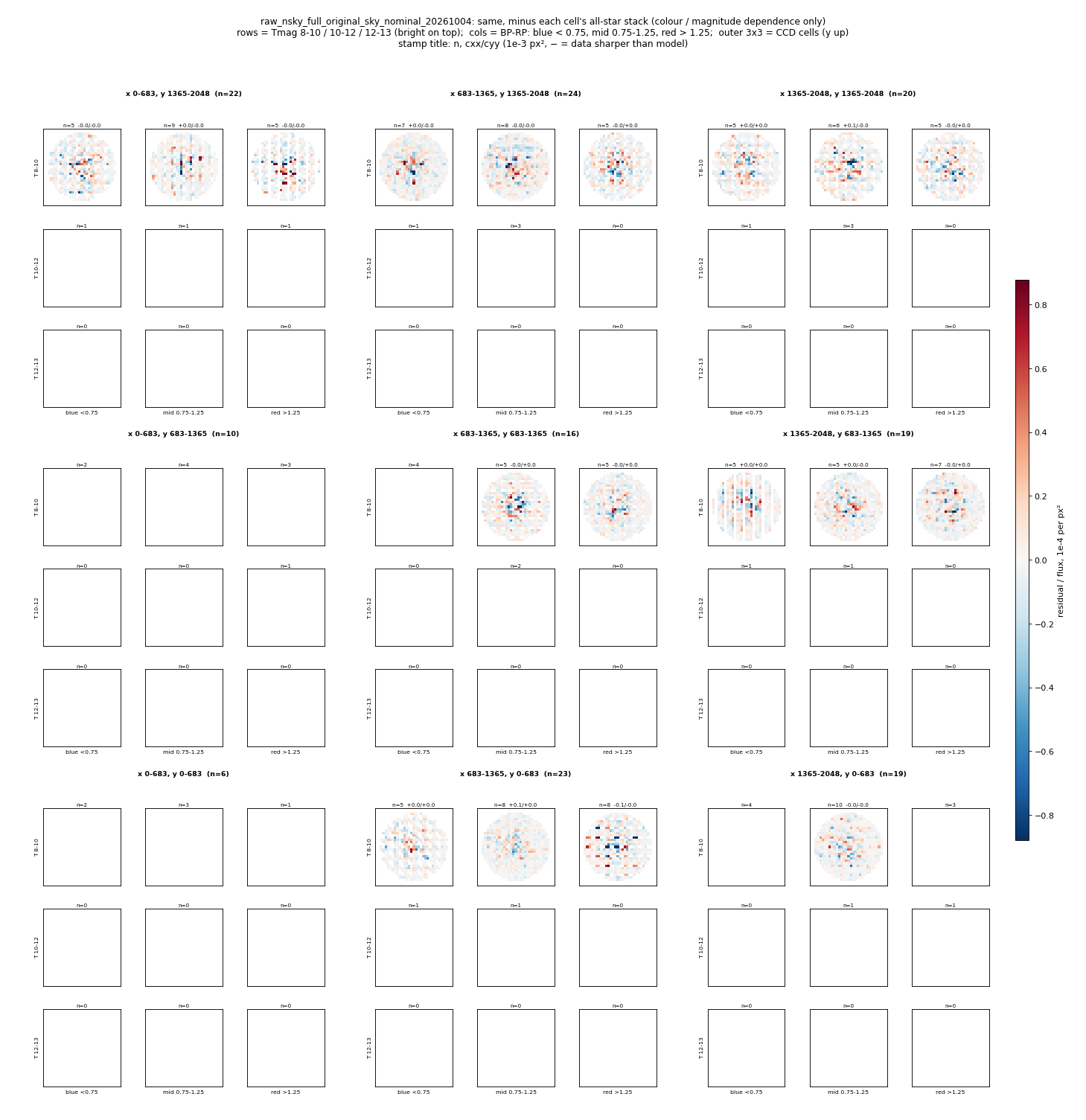
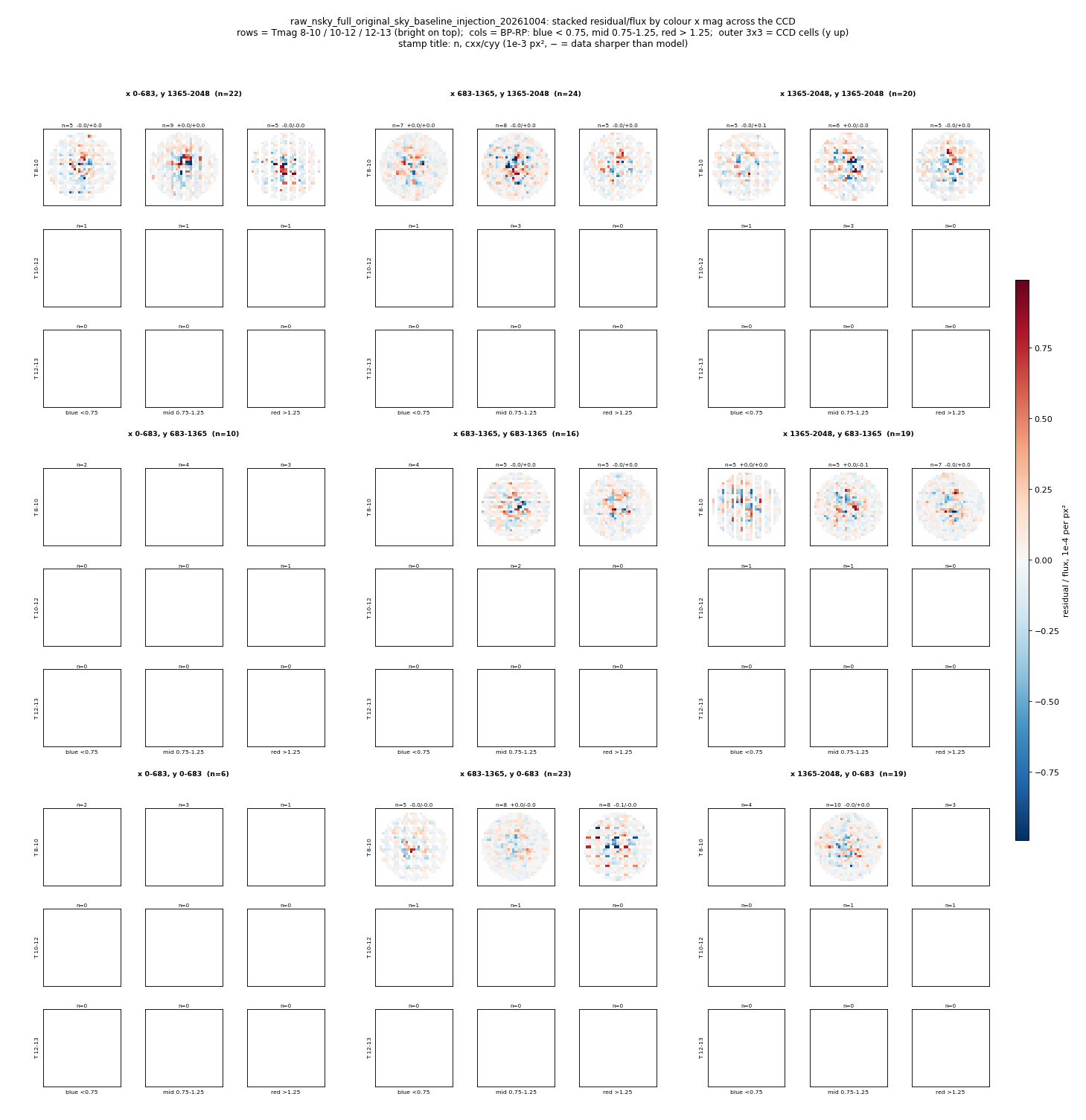
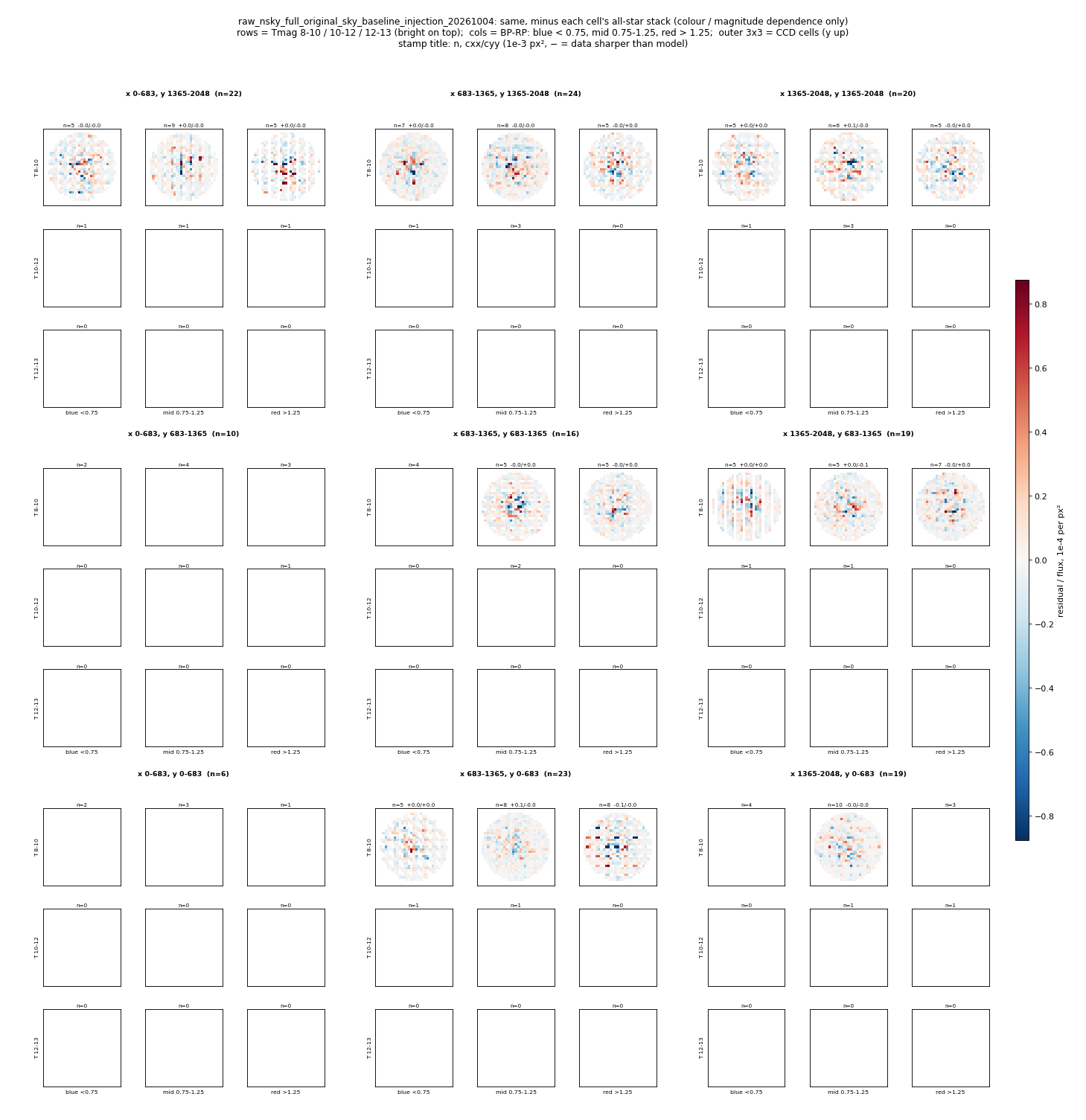
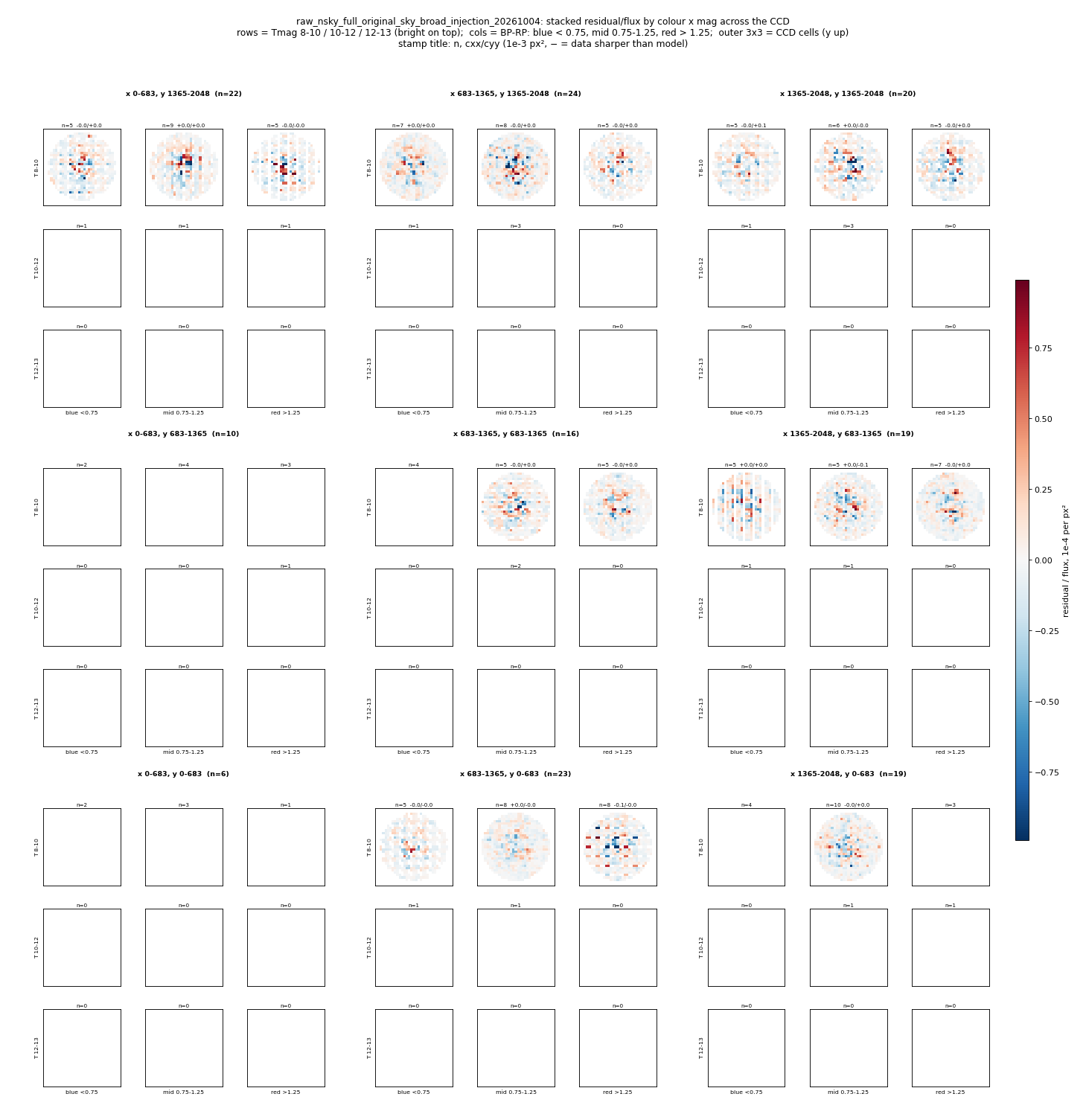
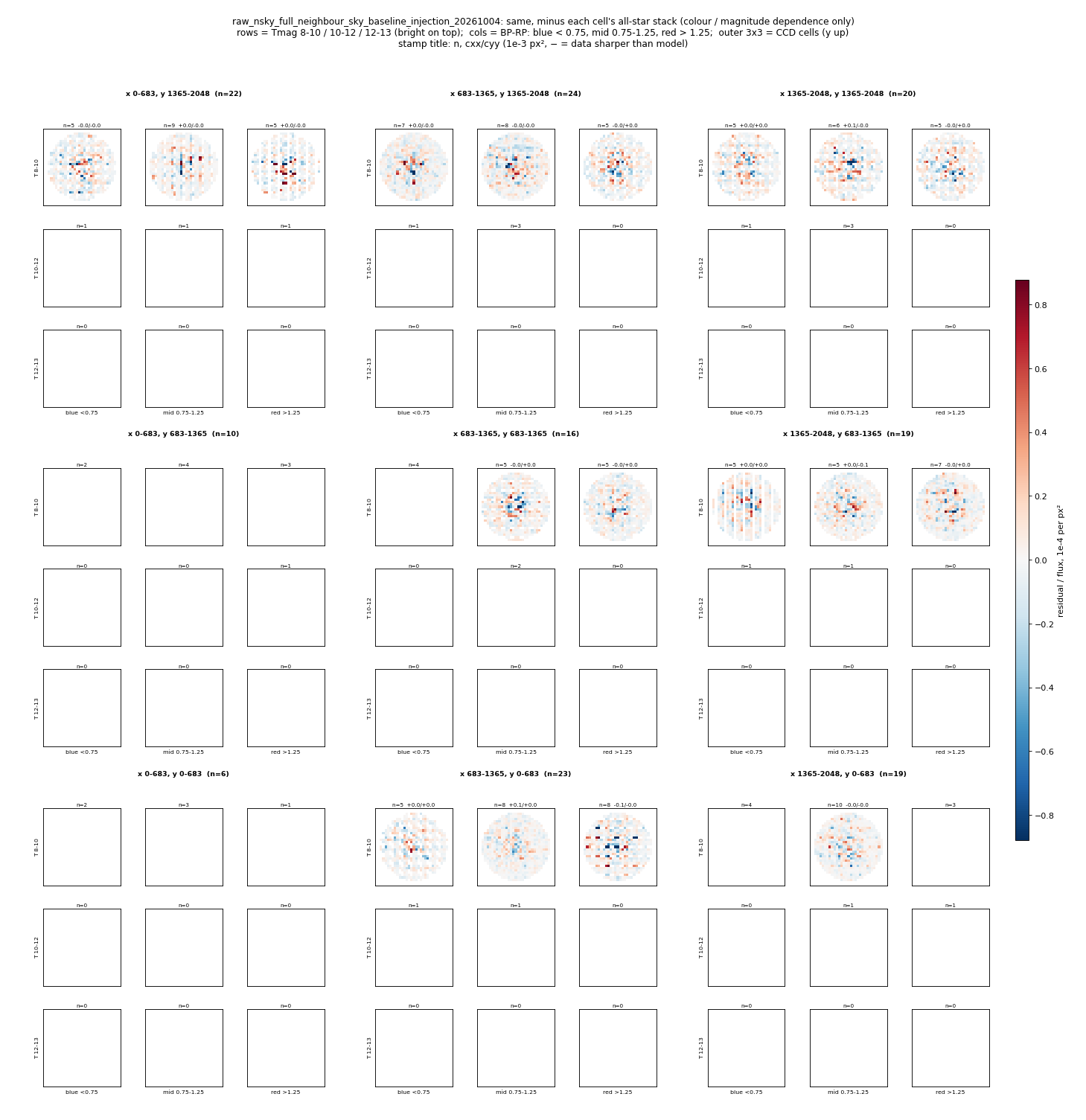
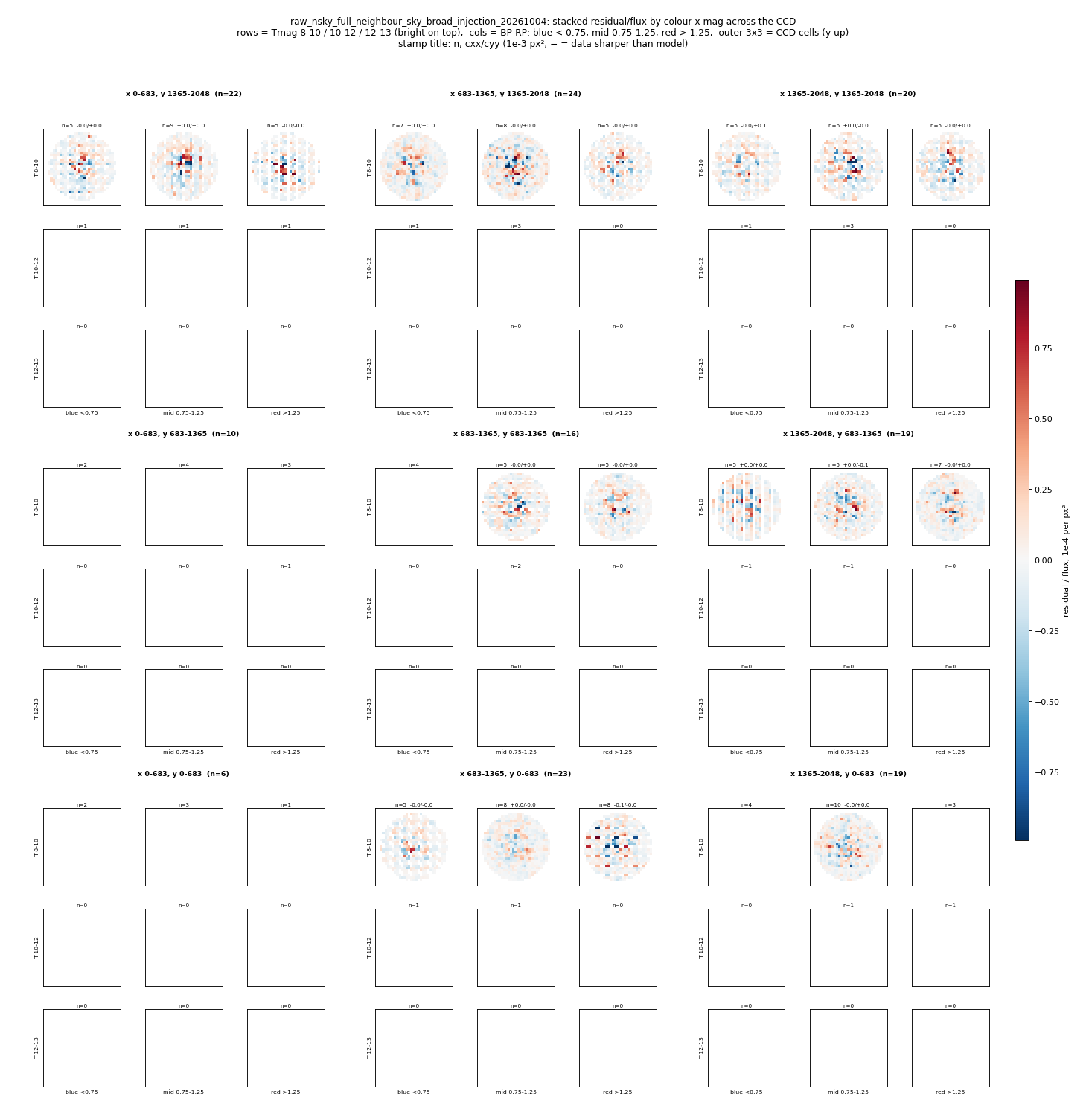
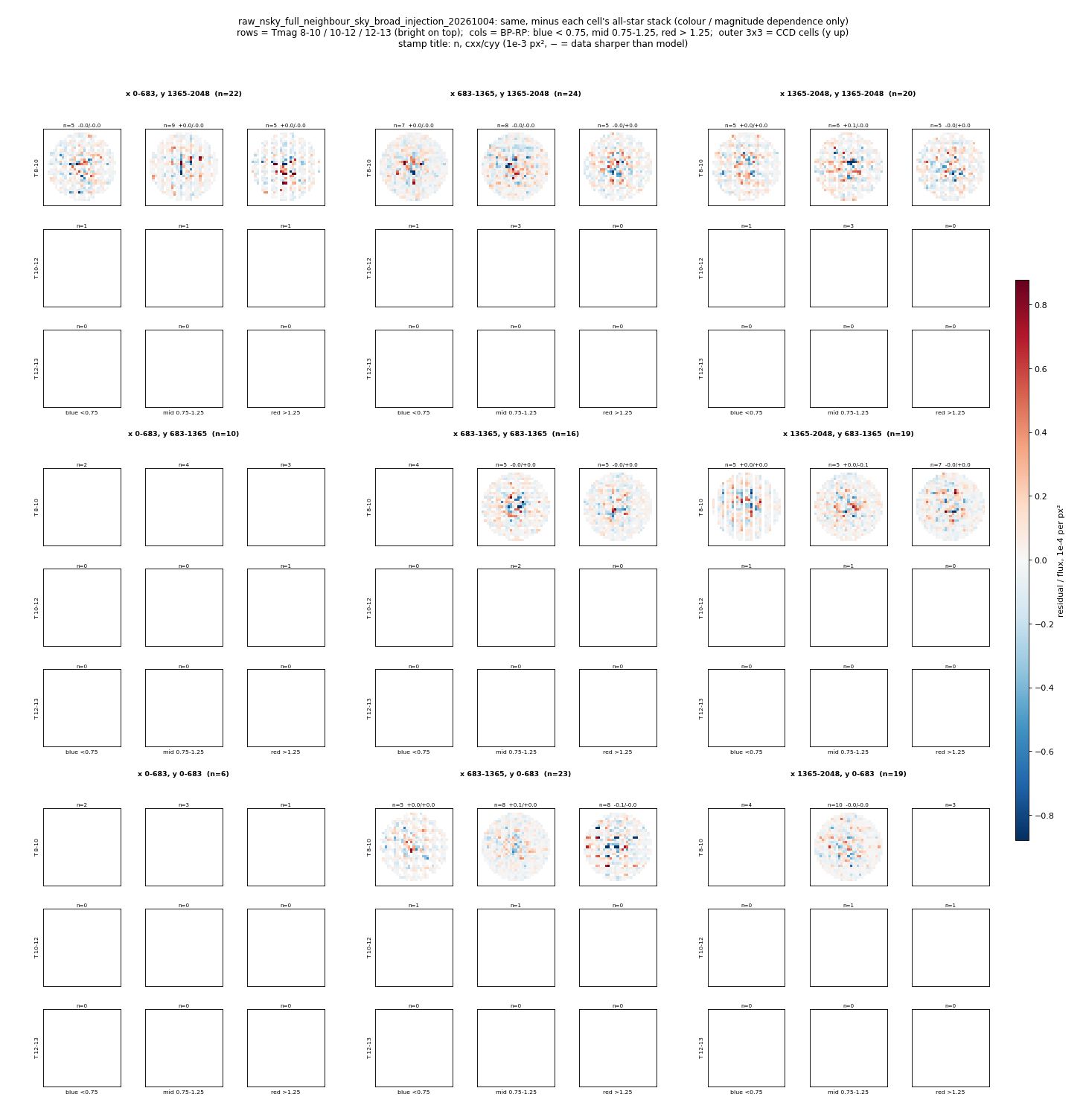
All 24 images inspected. Same original stellar evaluation pixels and old-r5 display denominators, four epoch snapshots. Pilot has five eligible inputs/four in canonical range, with no bin reaching MIN_N=5; full has 165 eligible inputs/159 in range. Automatic colour limits and cell-relative subtraction are not a common amplitude scale.
The shared residual gallery preserves prior entries and adds twelve matched labels. The external Artifact mirror was unavailable. Conclusion: this arm is not adopted: broader-profile signal preservation and persistent trends remain unresolved. Next test directional neighbour avoidance or nuisance-light modeling with explicit support/noise checks and independent profile controls. No star is dropped and no acceptance threshold relaxed. Complete recipe, equations, execution and evidence.
Source-consistent injection fails; leakage enters through sky-based normalization
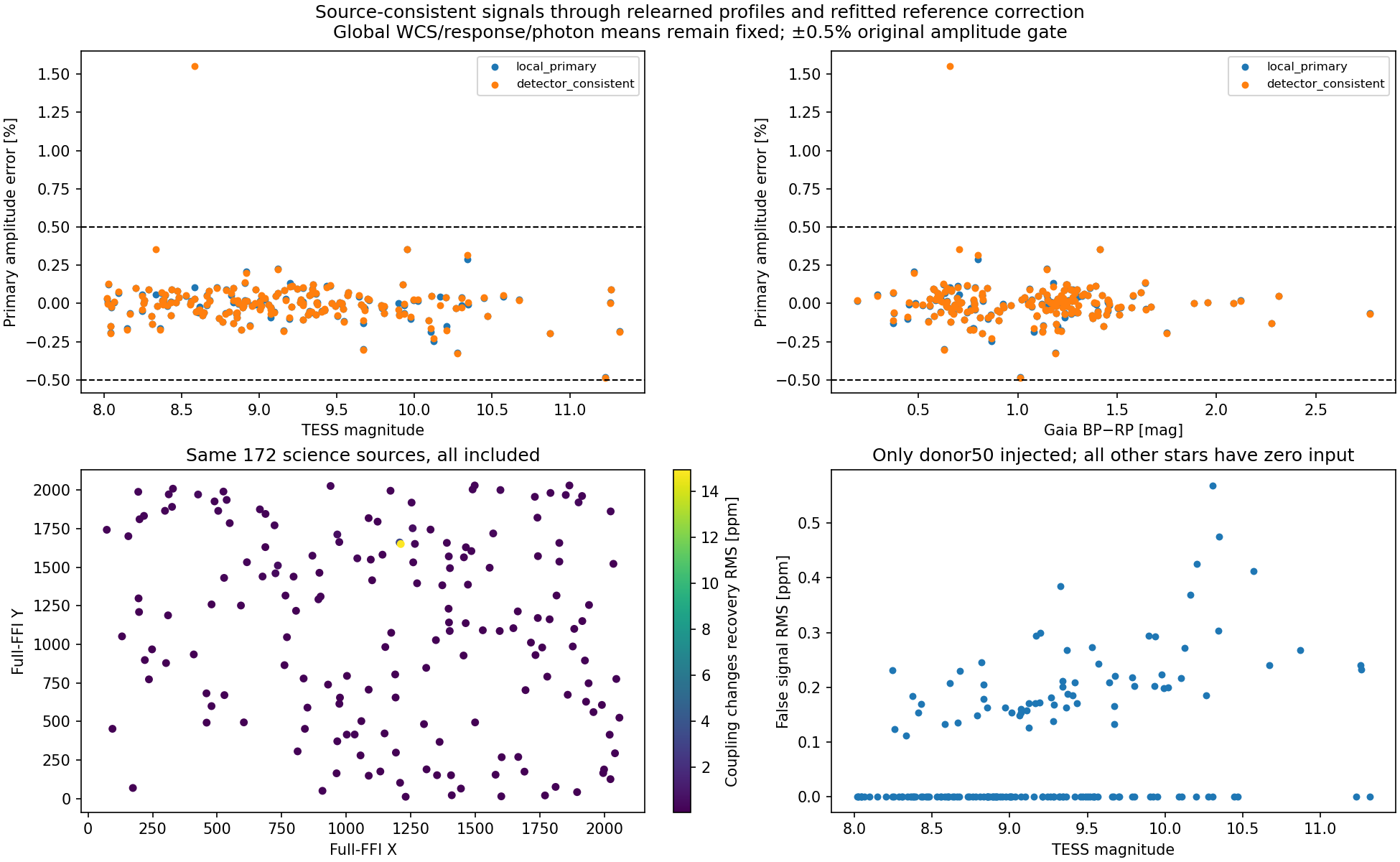
Each of the same 172 science sources is now injected once on the absolute detector grid and into every affected cutout on all 1,224 exposures. All 14 overlapping cutout pairs receive bitwise identical pixel additions. Analytic tail bounds replace catalogue-distance truncation. Nominal and old local-only fits replay; all source profiles, aperture ratios and reference precision are then refitted. Global WCS/response/photon means remain fixed.
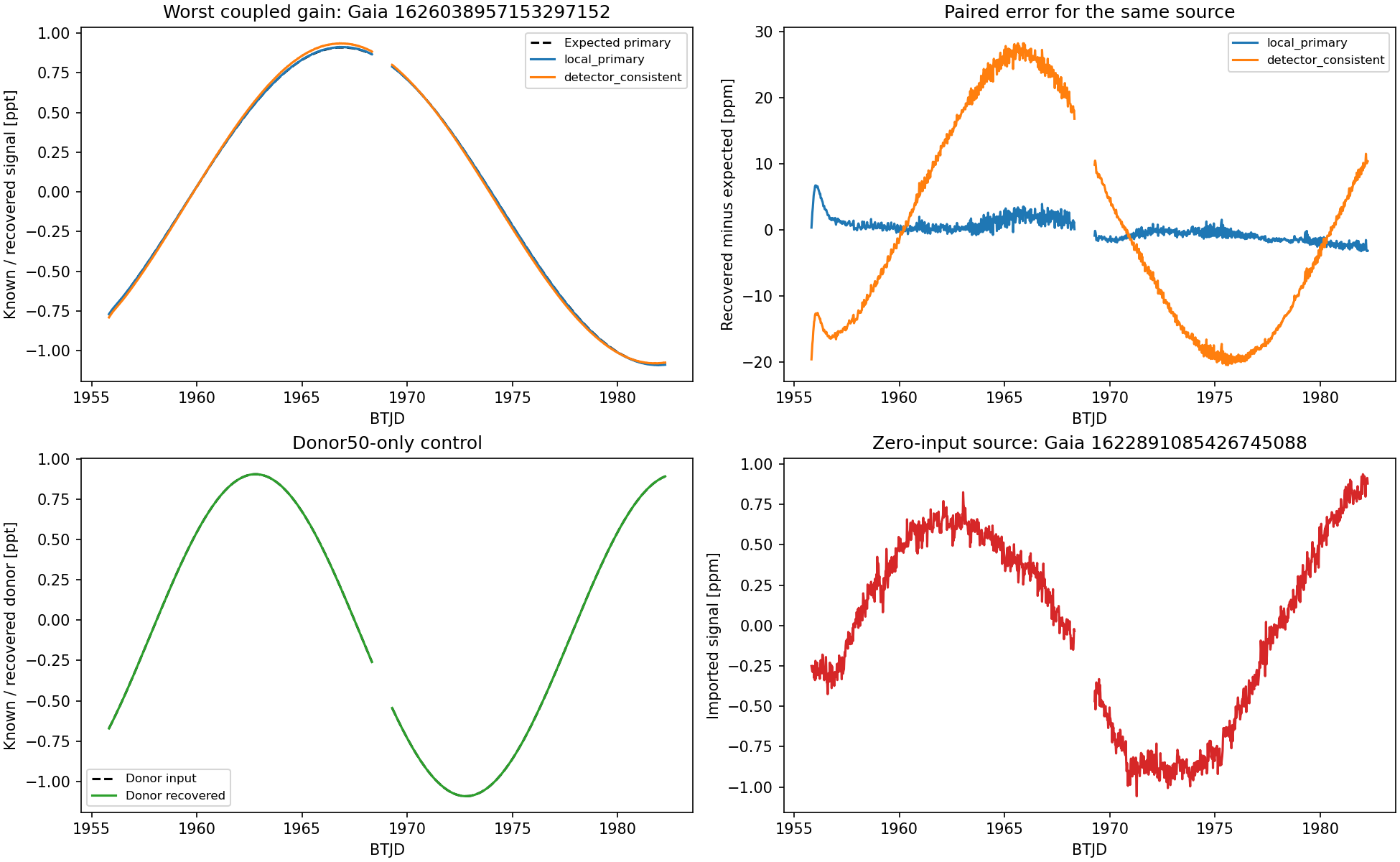
The worst amplitude error rises from 0.48120% to 1.55152%, failing the original 0.5% criterion for Gaia 1626038957153297152. Its nearby science source also affects the result. Median recovery error changes little, so a median-only check would miss this failure. The isolated reference-donor test produces at most 0.569-ppm RMS in other science stars for its 1-ppt input; it is not the main failure here.
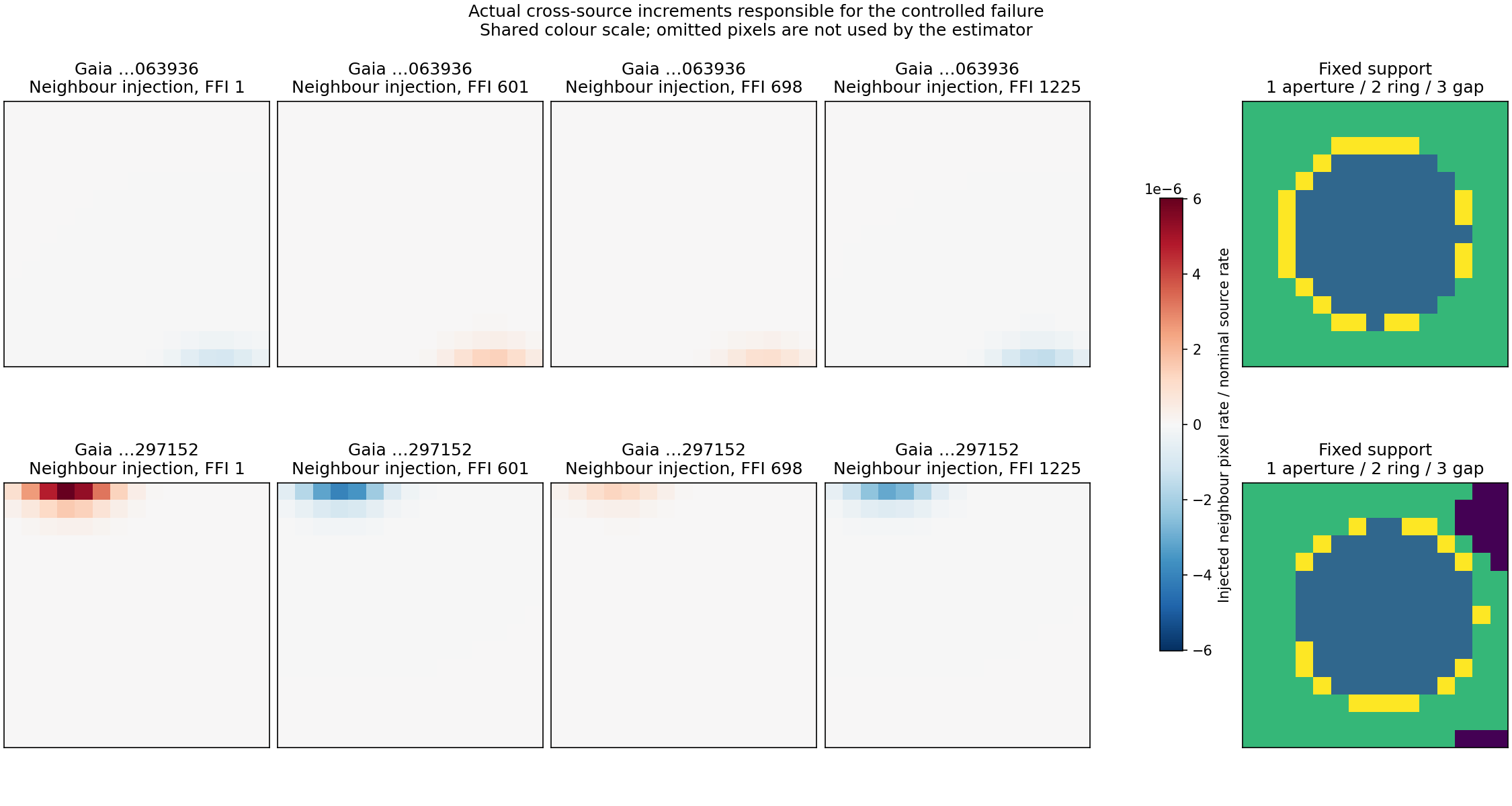
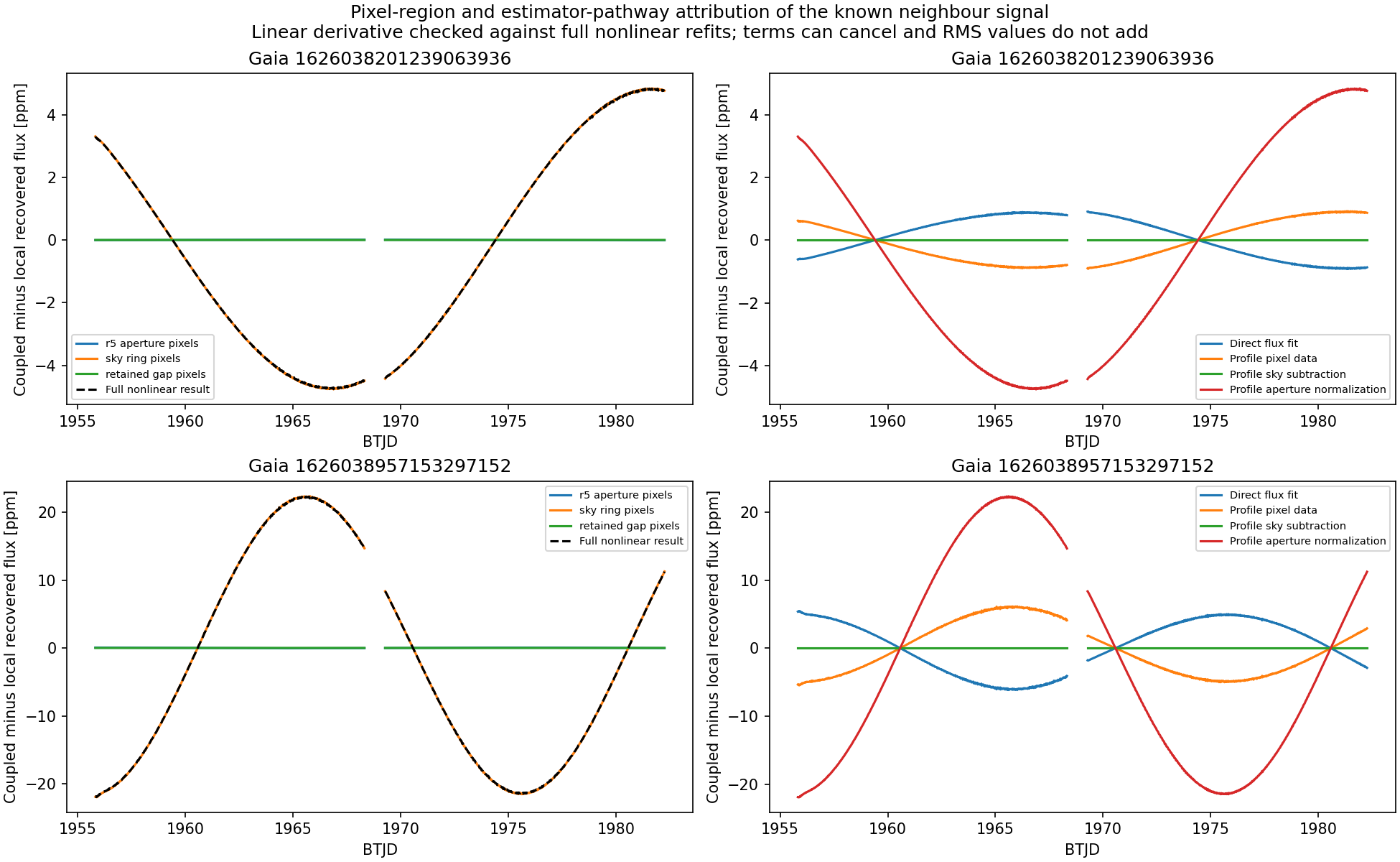
For the failing source, the nonlinear coupling has 14.8416-ppm RMS before reference calibration. Sky-ring pixels contribute 14.8763 ppm, while aperture pixels contribute only 0.03472 ppm and partly cancel. The dominant estimator pathway is the aperture normalization of the learned profile. The derivative matches full nonlinear refits within 3.91e-5 ppm for this perturbation; these are causal controlled-test results, not measured real-neighbour amplitudes.
Required matched pilot/full residual grids, all three signal arms
All twelve images inspected. Same masks, old-r5 normalization and FFIs 1/601/698/1225. Pilot has four eligible inputs (three in standard plotting range), so no bin reaches MIN_N=5; blank panels do not show successful fitting. Full grids have 165 eligible inputs, 159 in canonical range. Relative panels subtract the cell-wide stack; canonical scales vary by image. Compare the common-scale injected-pixel panels above for the actual failure.
The shared residual gallery preserves all prior entries and now contains six new labels. The unavailable external Artifact mirror was not republished. Conclusion: the current candidate fails the stronger signal-preservation test. Next protect sky-based normalization against neighbours and retest all original sources, real photometry, noise and shared trends. No science star is removed, no threshold relaxed, and no new correction adopted. Equations, input/support proof, validation, numerical results and next requirements.
Neighbour leakage exposes a source-consistency gap in signal validation
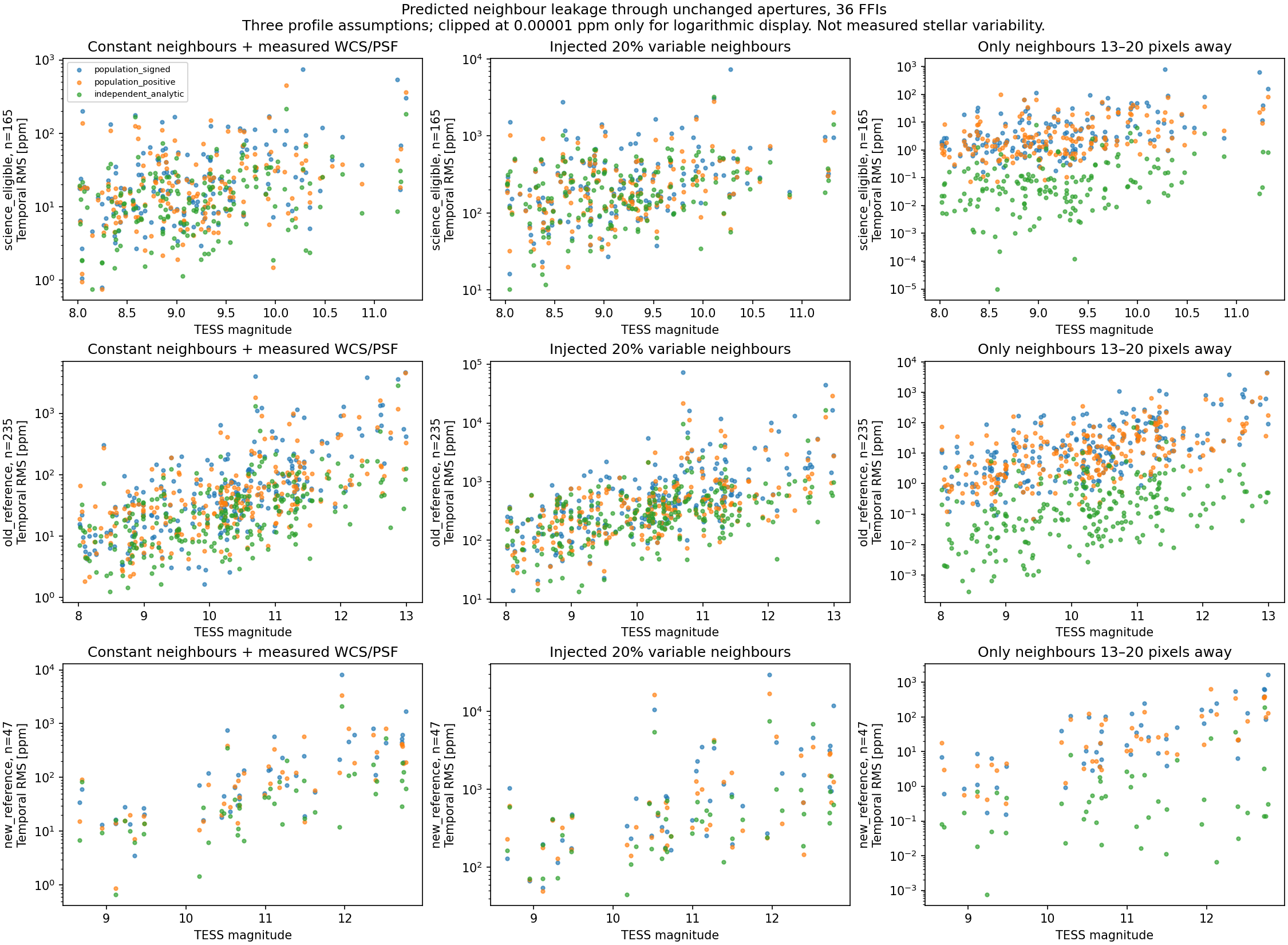
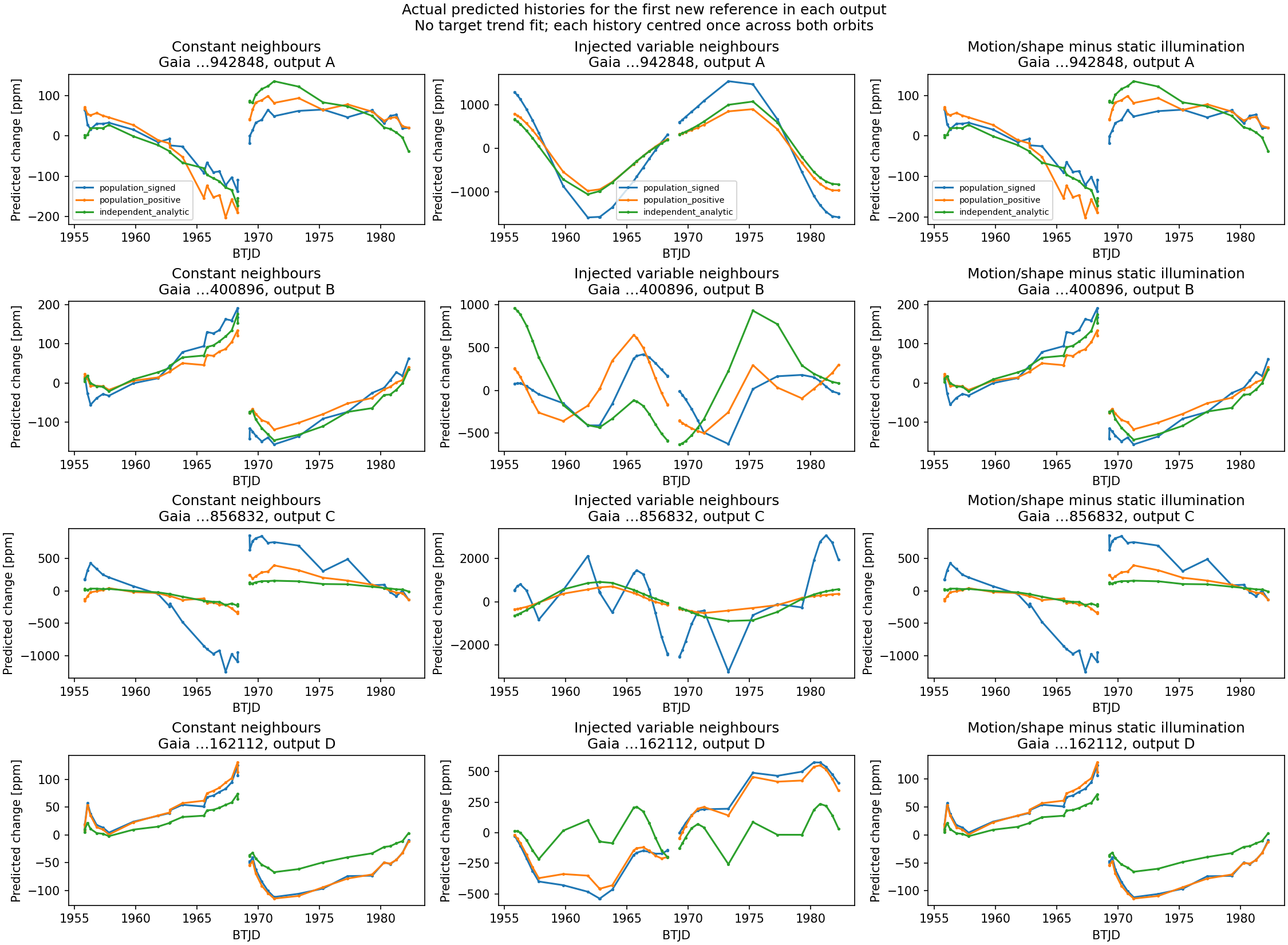
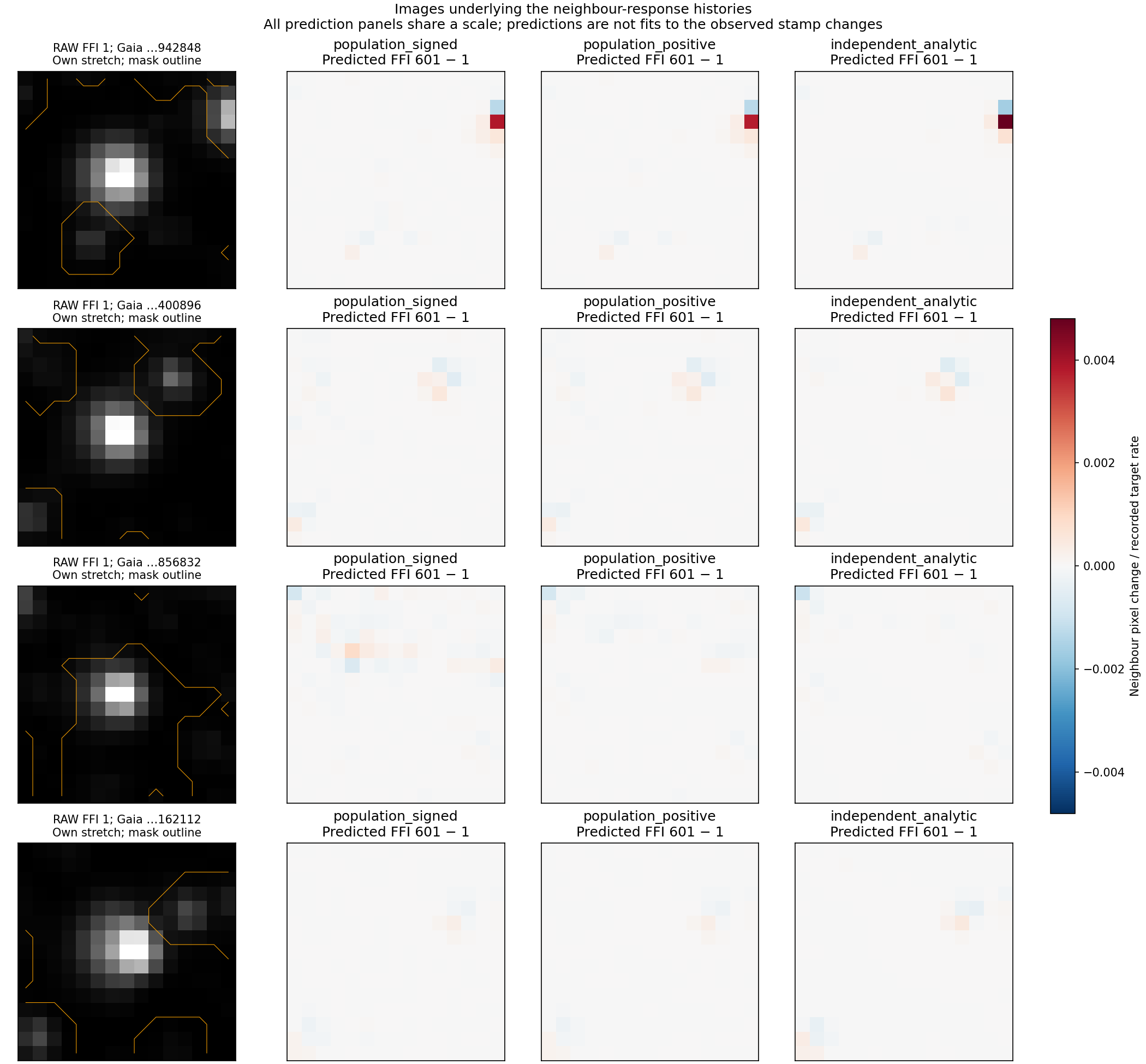
All 482 extraction targets and 36 selected FFIs are evaluated with their original masks/WCS. Constant and injected-variable neighbours within 20 pixels are propagated with signed population, positive-clipped population and independent analytic profiles. Each neighbour is normalized about its own centre, never on a truncated target cutout. Target coordinates/masks replay; all 16 pilot sources replay bitwise. The full Condor run and assessments completed successfully.
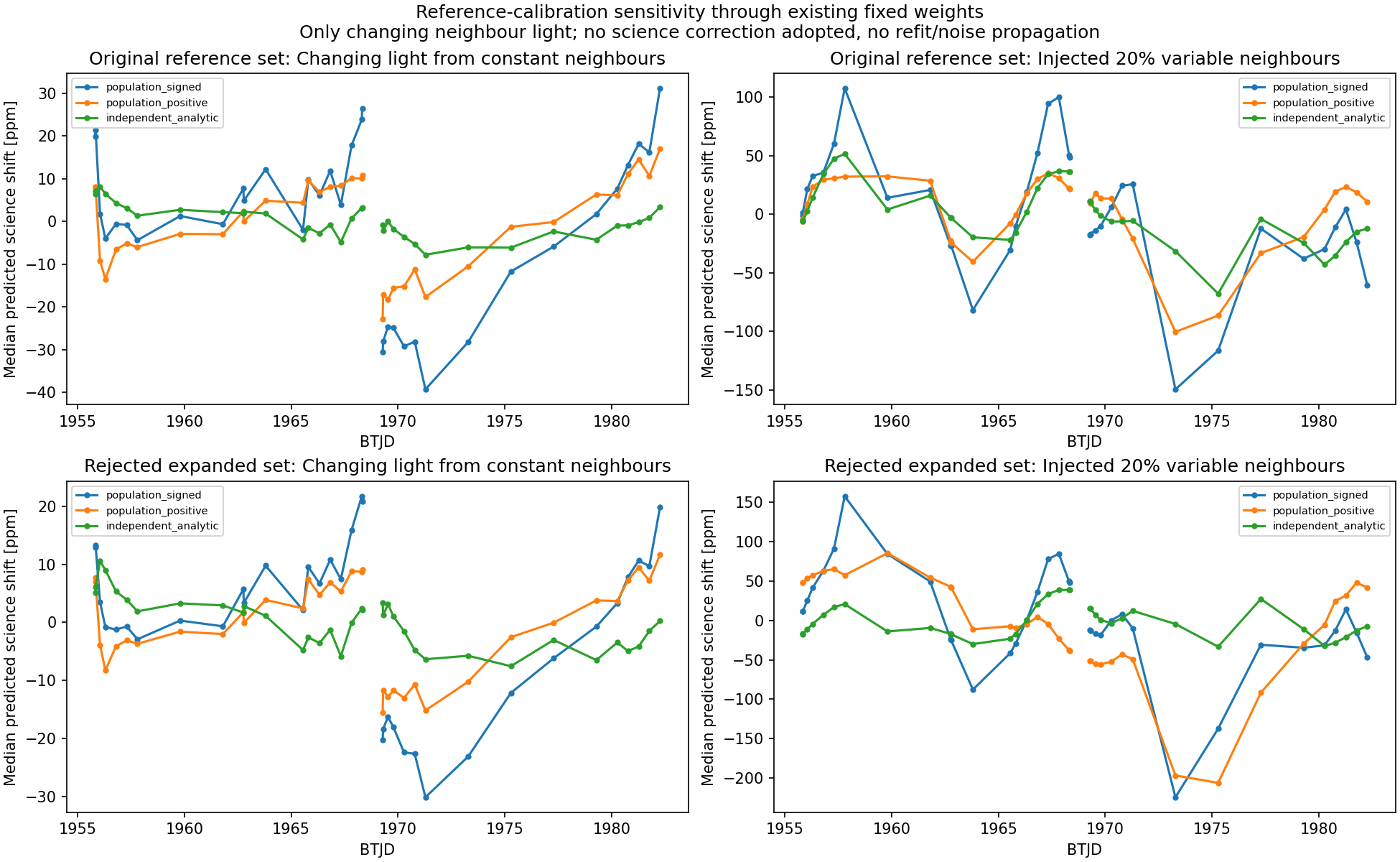
Constant-neighbour changes through the original reference ensemble yield median science sensitivity about 5–20 ppm depending on profile. A hypothetical 20% variable-neighbour population yields about 49–131 ppm. These are fixed-weight sensitivities, not observed contamination, fitted corrections or an end-to-end signal pass. Far-wing predictions disagree strongly, so no catalogue-driven subtraction is adopted.
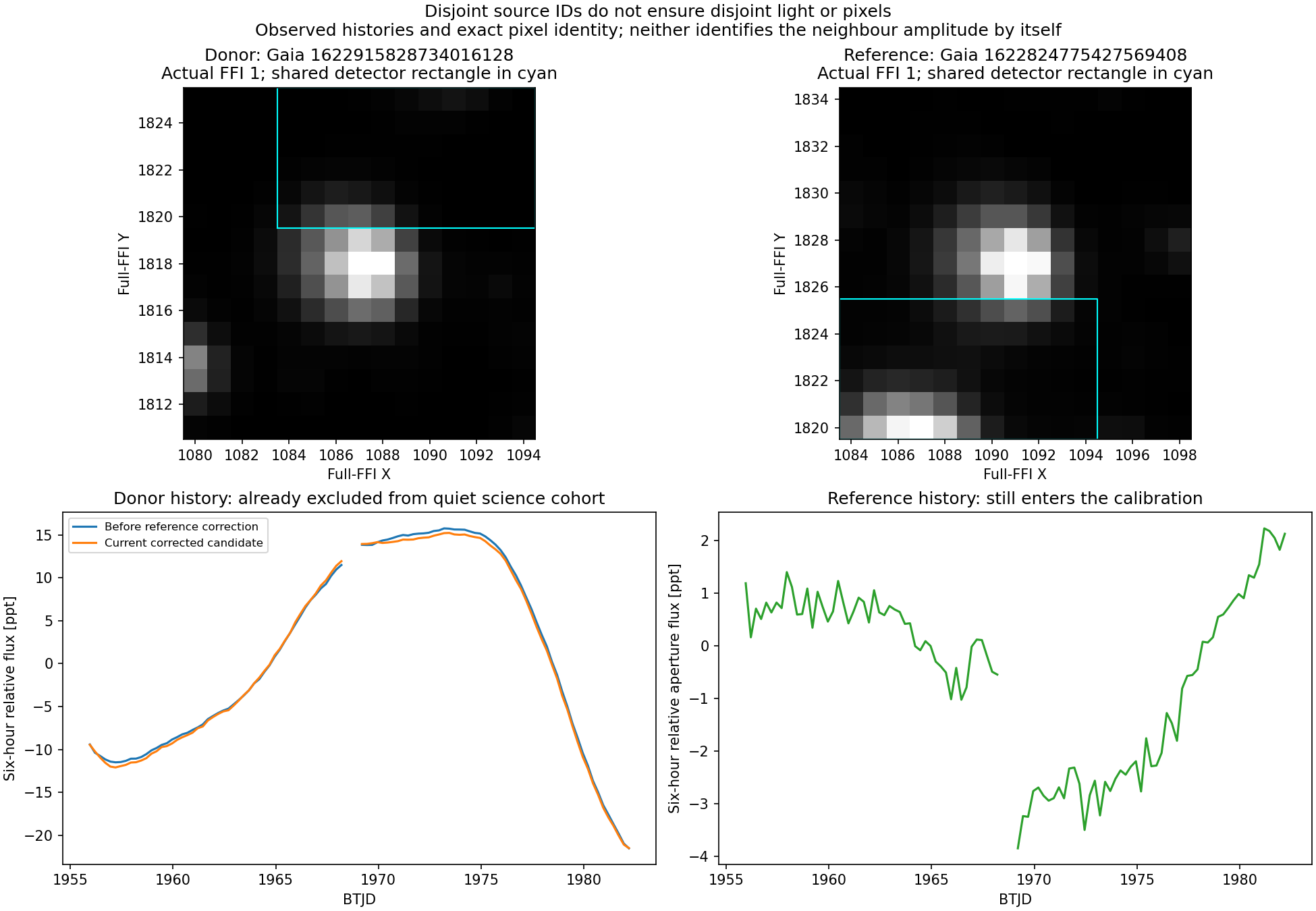
A concrete validation gap: different source IDs do not imply disjoint light or detector pixels. All three profile rankings select Gaia 1622915828734016128 as the strongest potential donor to the current reference calibration. It is already excluded from the quiet science cohort, but neighbouring reference 1622824775427569408 remains. Their cutouts share 66 detector pixels, 61 retained in the reference mask; the raw values match exactly across all 1,224 FFIs. The observed donor history varies substantially, but these facts alone do not identify its physical variability or the correct wing amplitude.
There are 16 science-to-reference links and four science-to-science links in the tested catalogue support. Code inspection confirms that earlier primary injections changed only each source's own science cutout; they did not add the same source to neighbouring reference cutouts. Their amplitude pass remains conditional on that narrower experiment. Conclusion: next insert each source with one absolute trajectory/profile into every illuminated cutout, verify identical additions on shared pixels, then relearn profiles and refit transport/reference precision. The current candidate is unchanged and the full photon-limit goal remains unmet. Equations, exact validation, measured/predicted distinctions and next requirements.
47 additional references: full-cadence test fails acceptance
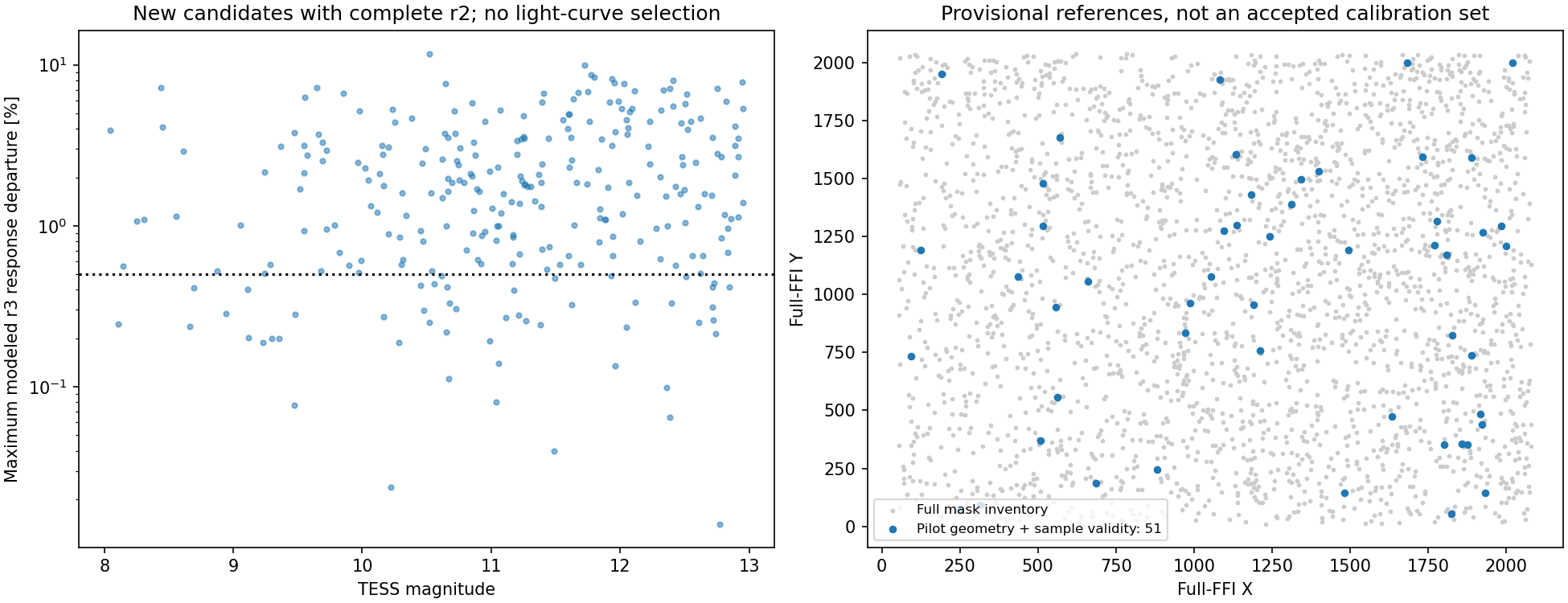
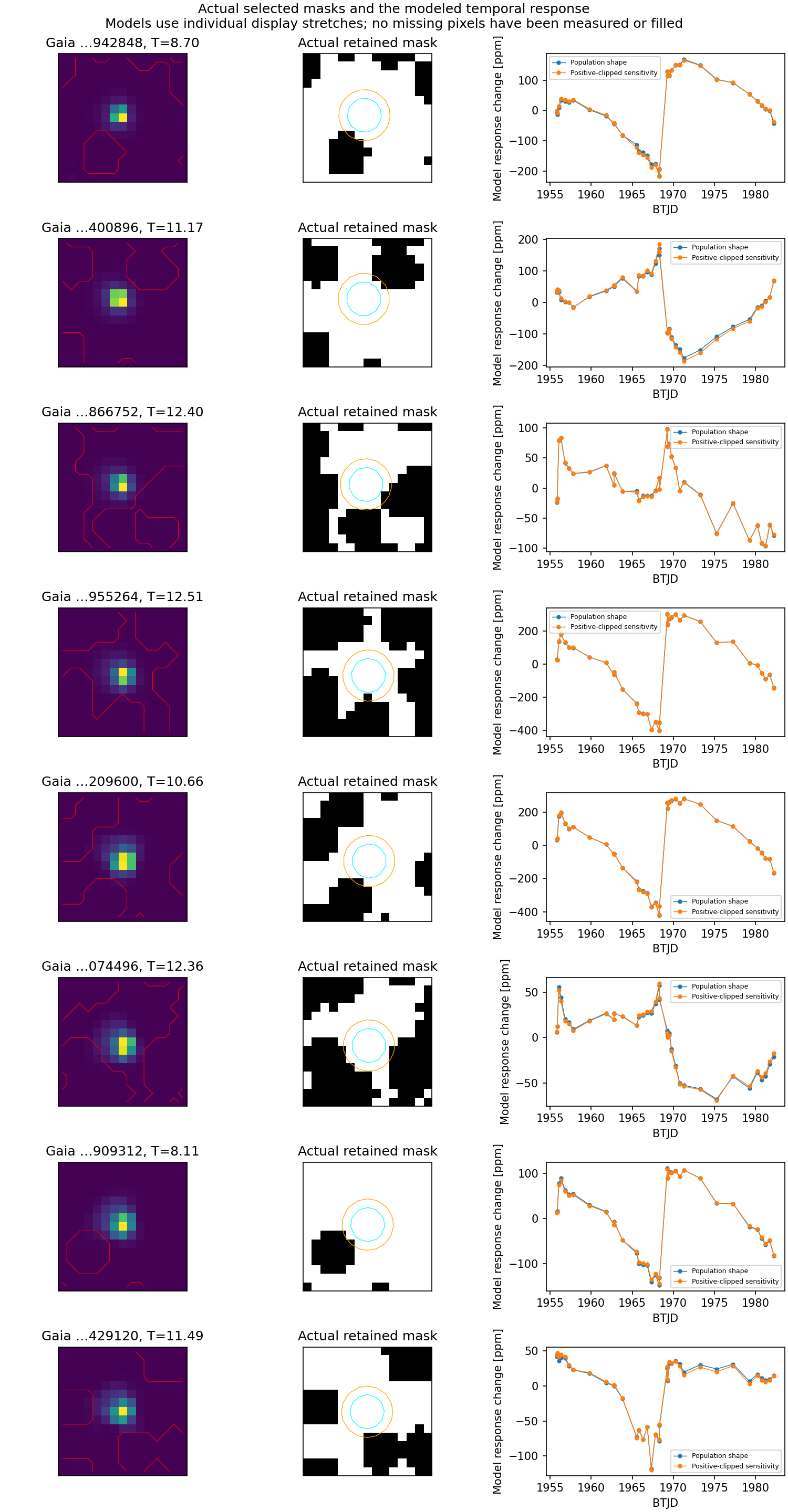
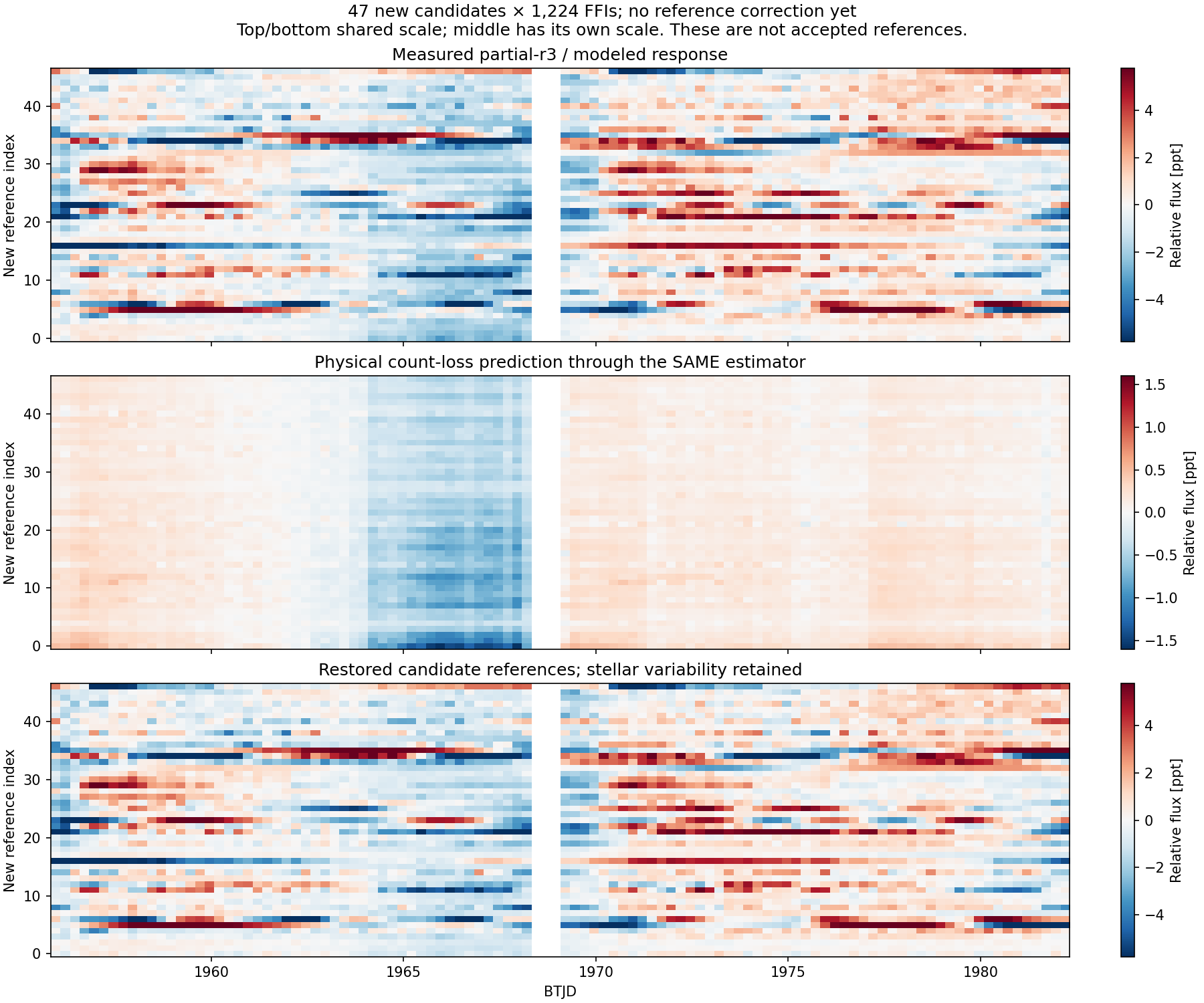
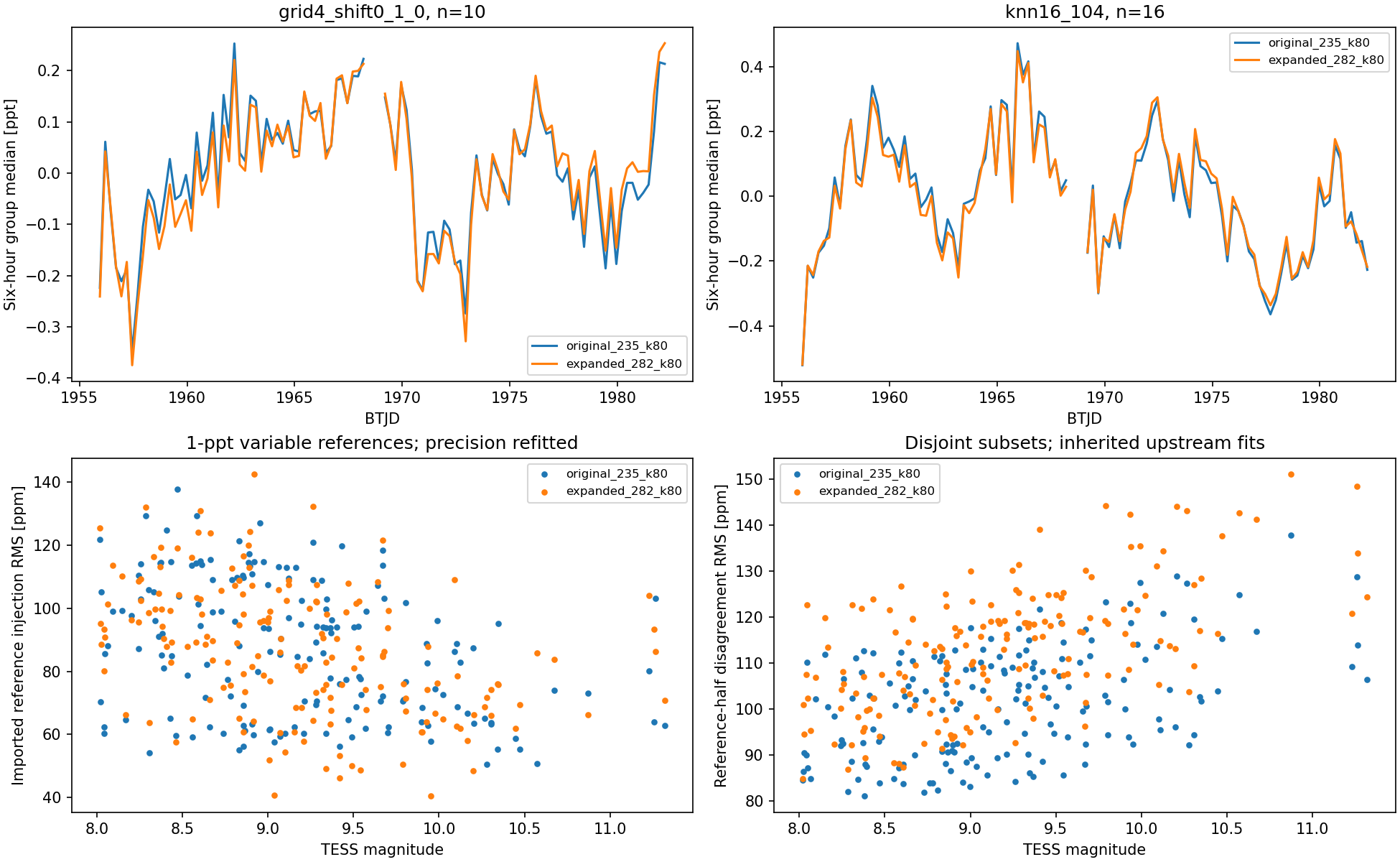
The original population PSF and temporal WCS/shape select 51 lightly masked candidates using a predeclared 0.005 response-departure limit, complete radius-2 support and pixel validity. All pass across 1,224 FFIs; the existing broad reference-only variability screen leaves 47. No science-light-curve flatness selects them. These extend the original 235 references to 282 in a diagnostic comparison; the accepted-development candidate is unchanged.
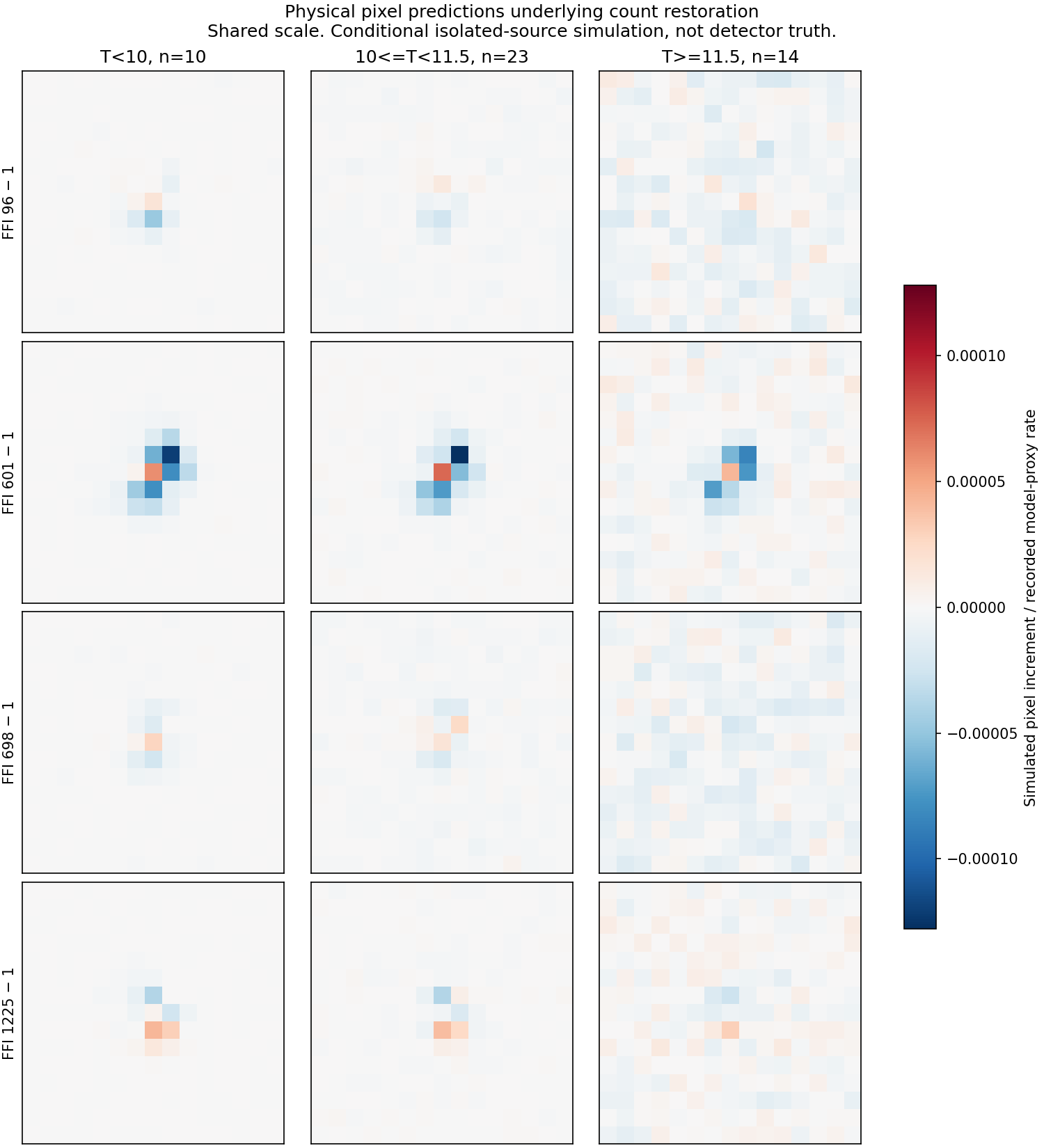
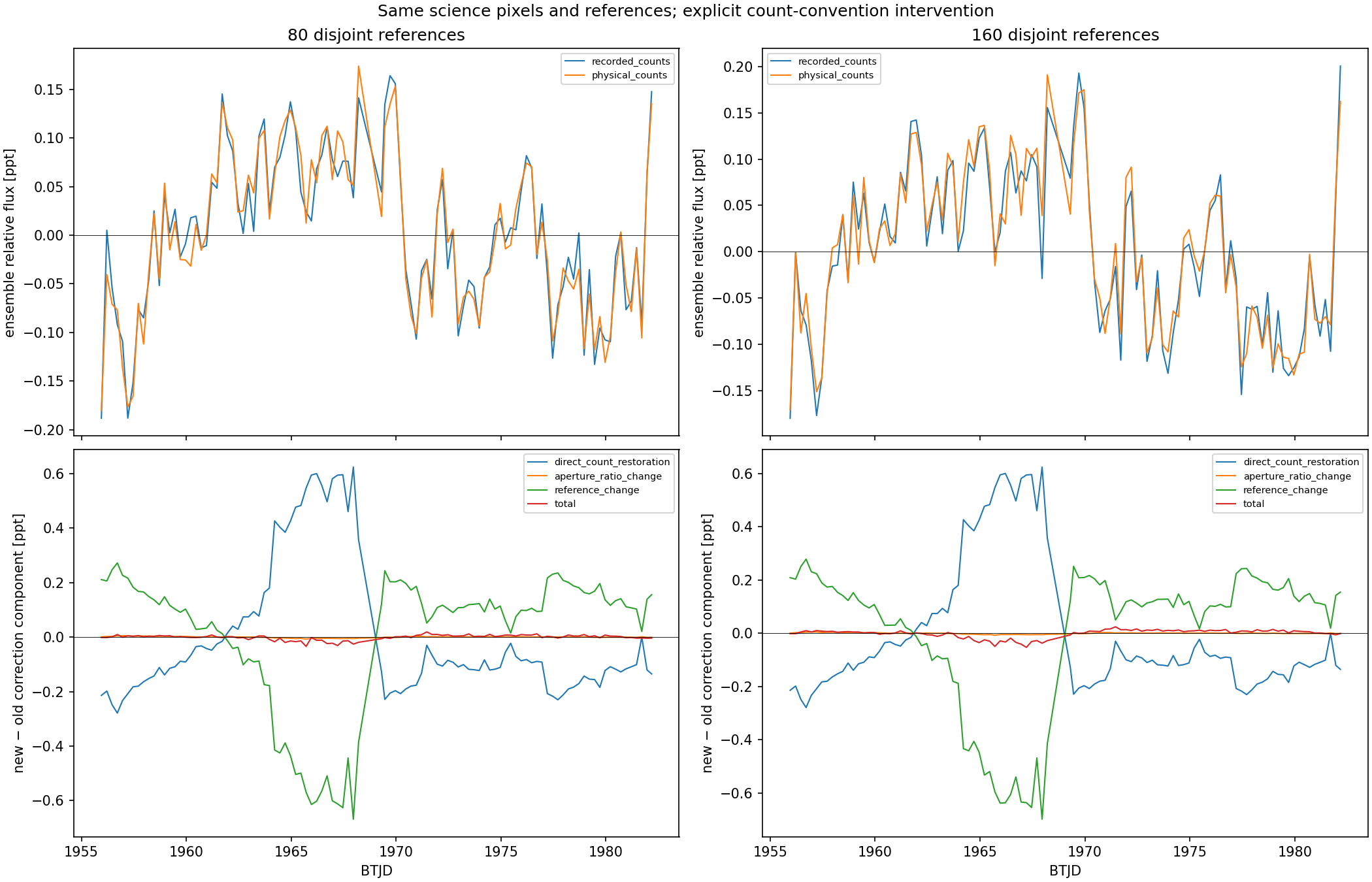
The matched physical campaign completed with exit 0; all six-epoch overlap pixel predictions replay bitwise. Correctly projecting count loss through the measured partial aperture and its model response reproduces old reference counts at floating-point precision. Substituting the hypothetical complete-aperture operator differs by median/p95 5.91/22.69 ppm over the new sources, so it is retained only as a sensitivity.
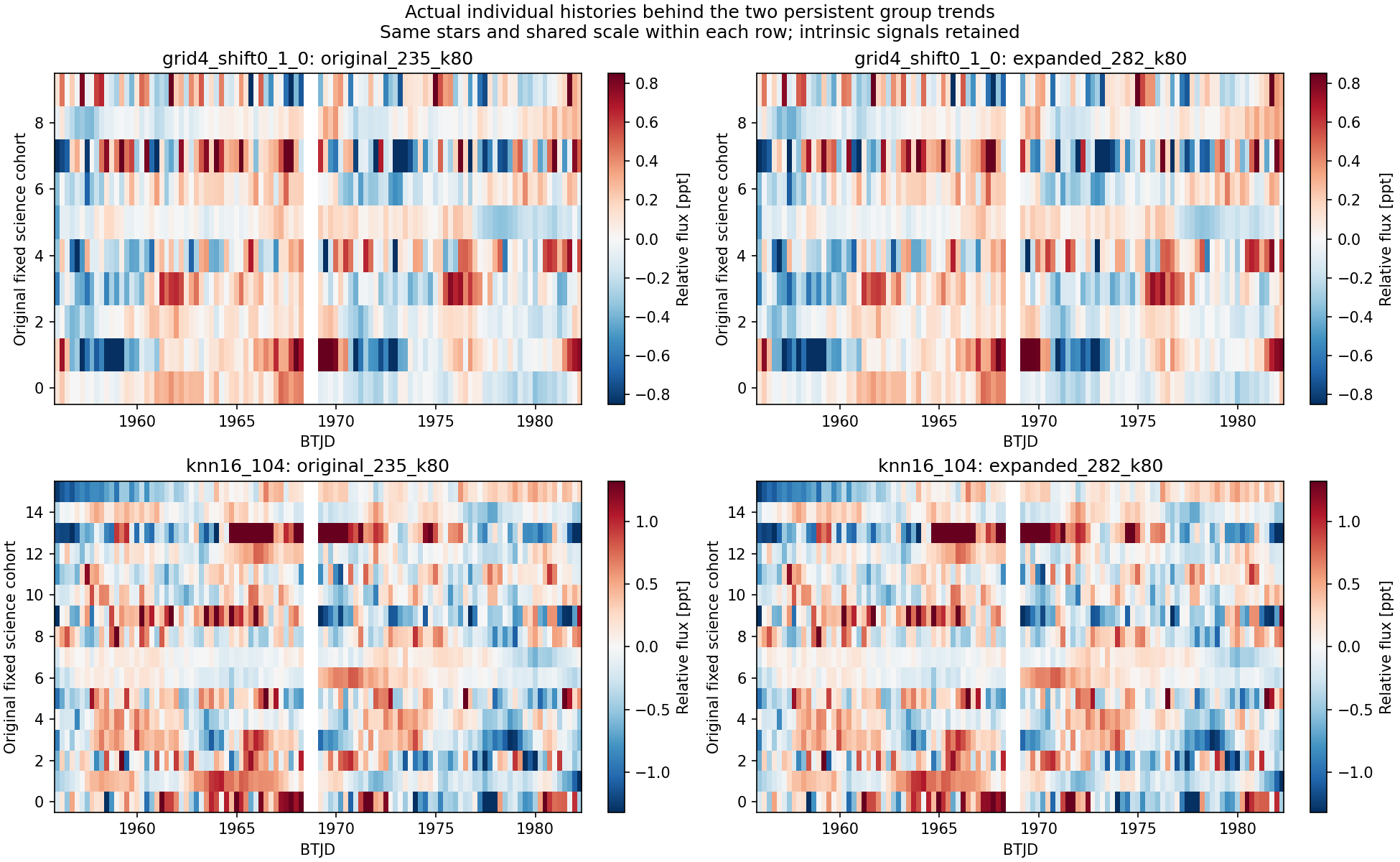
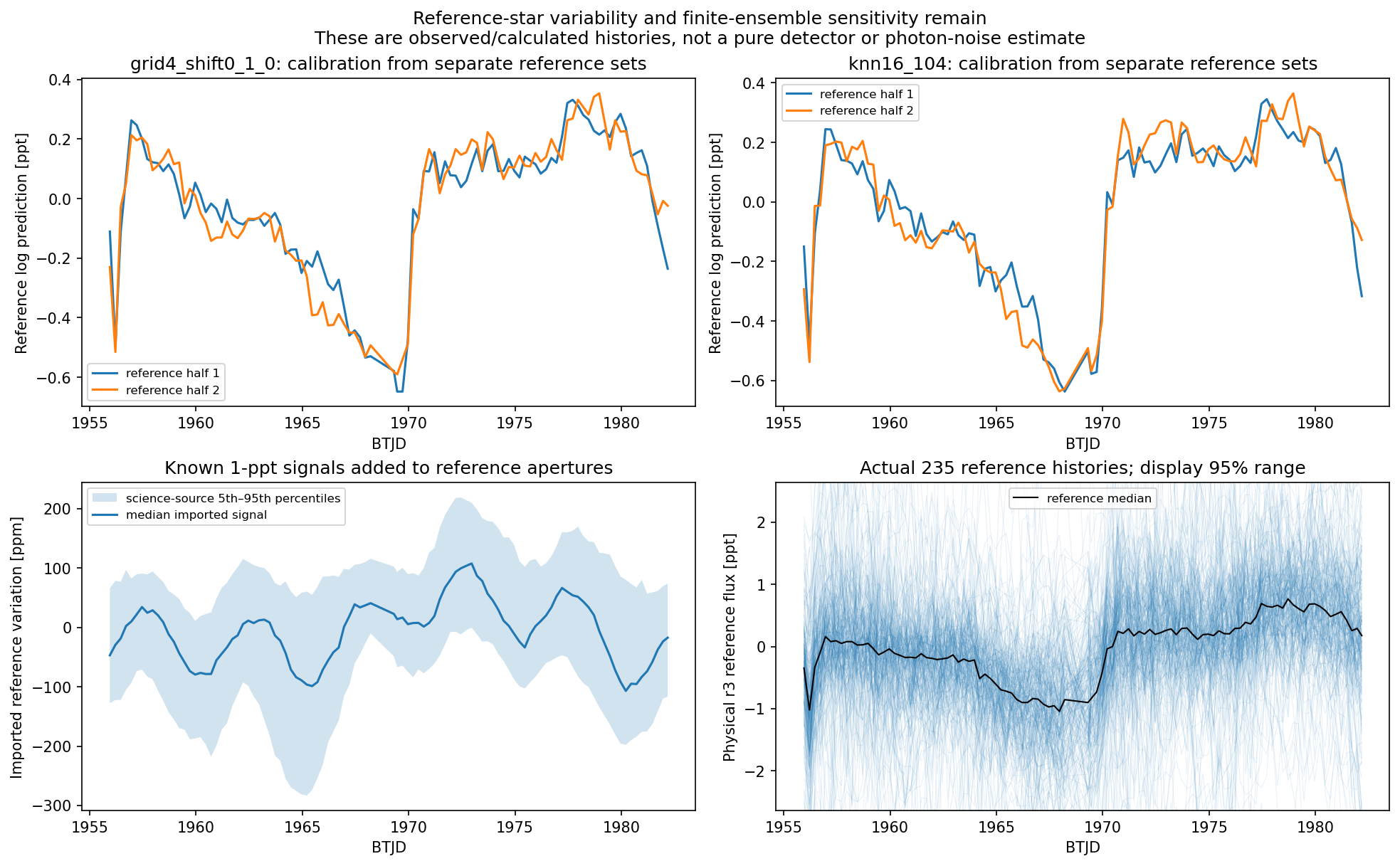
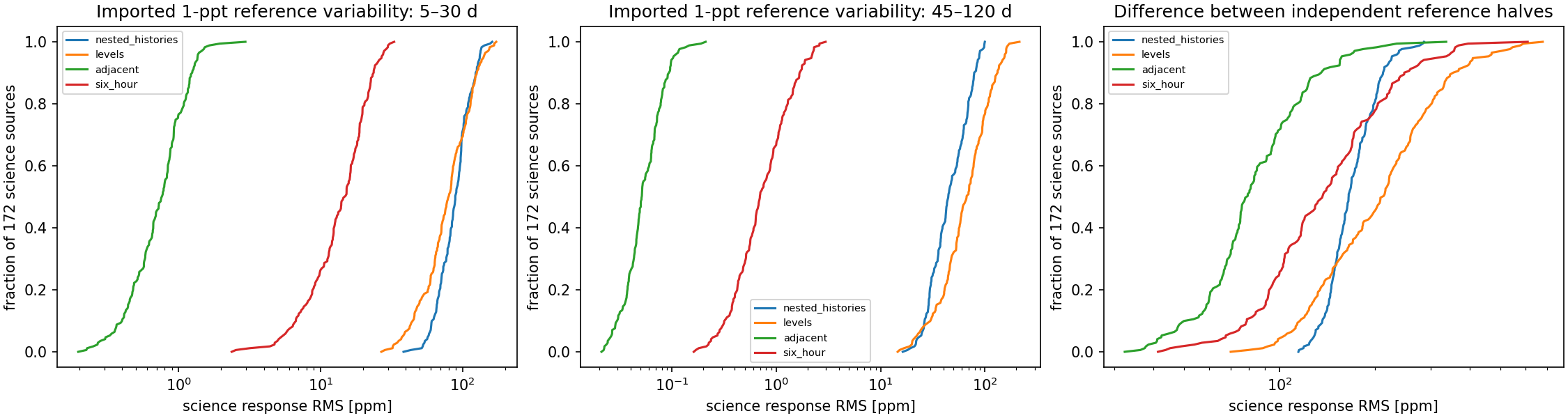
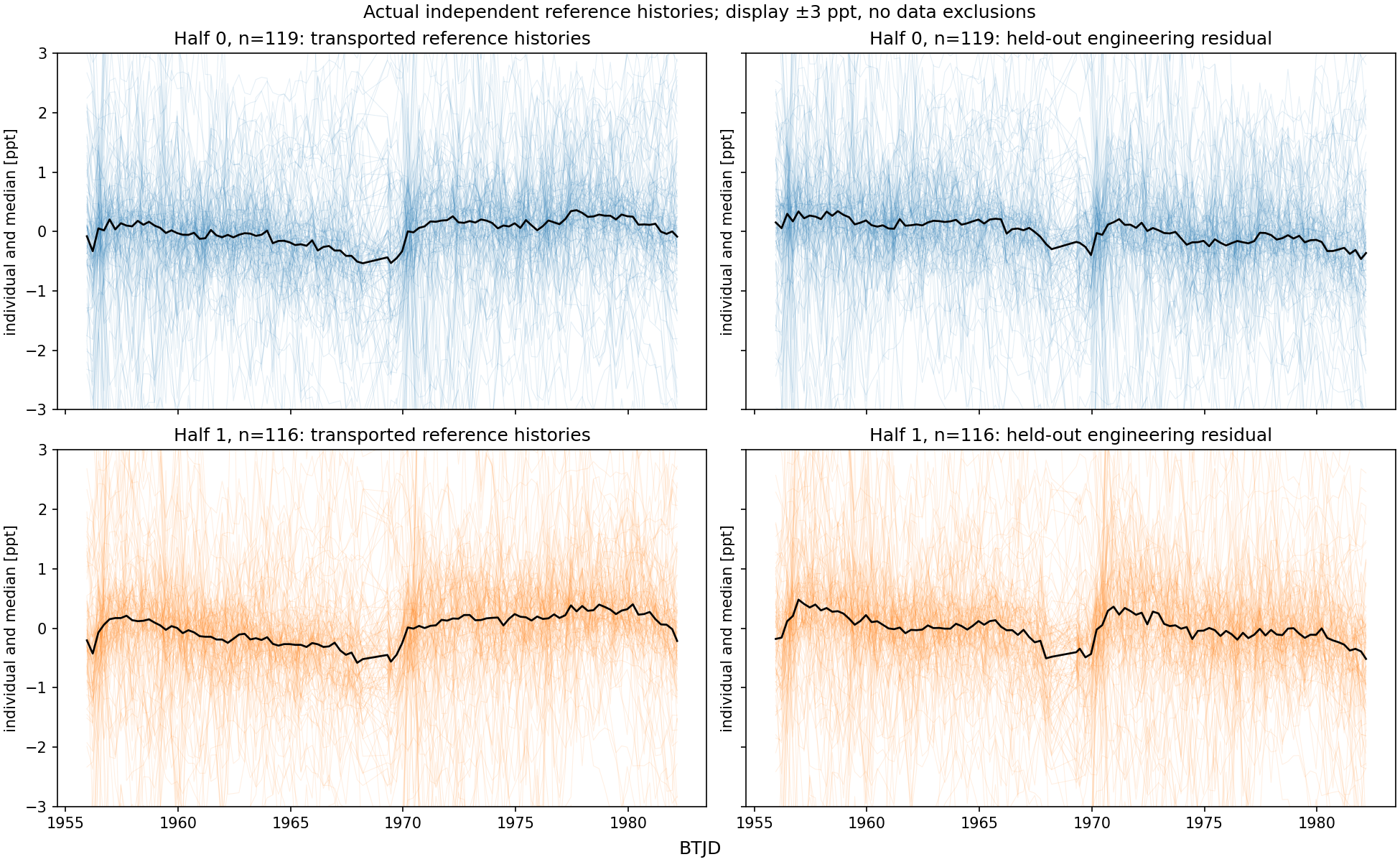
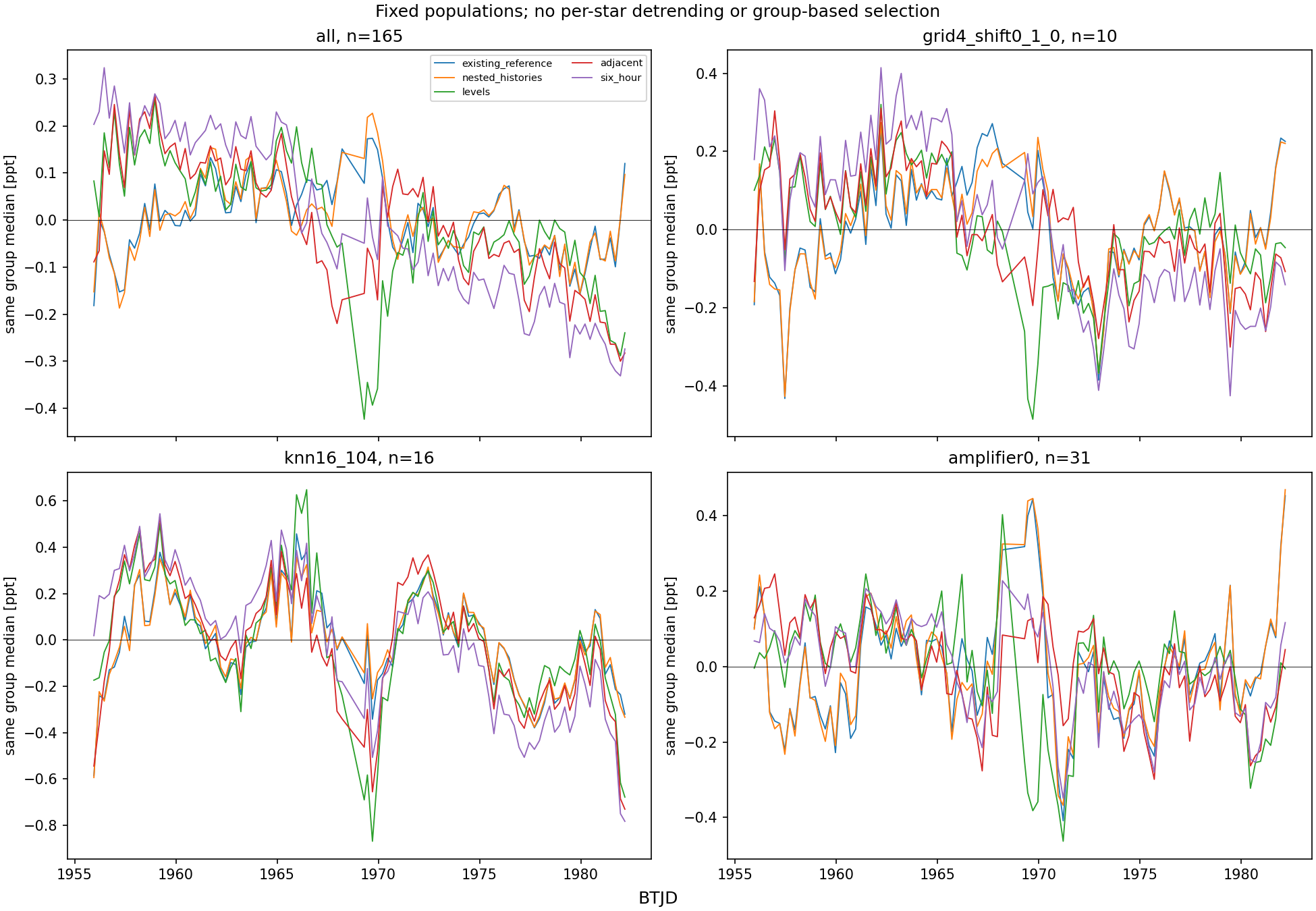
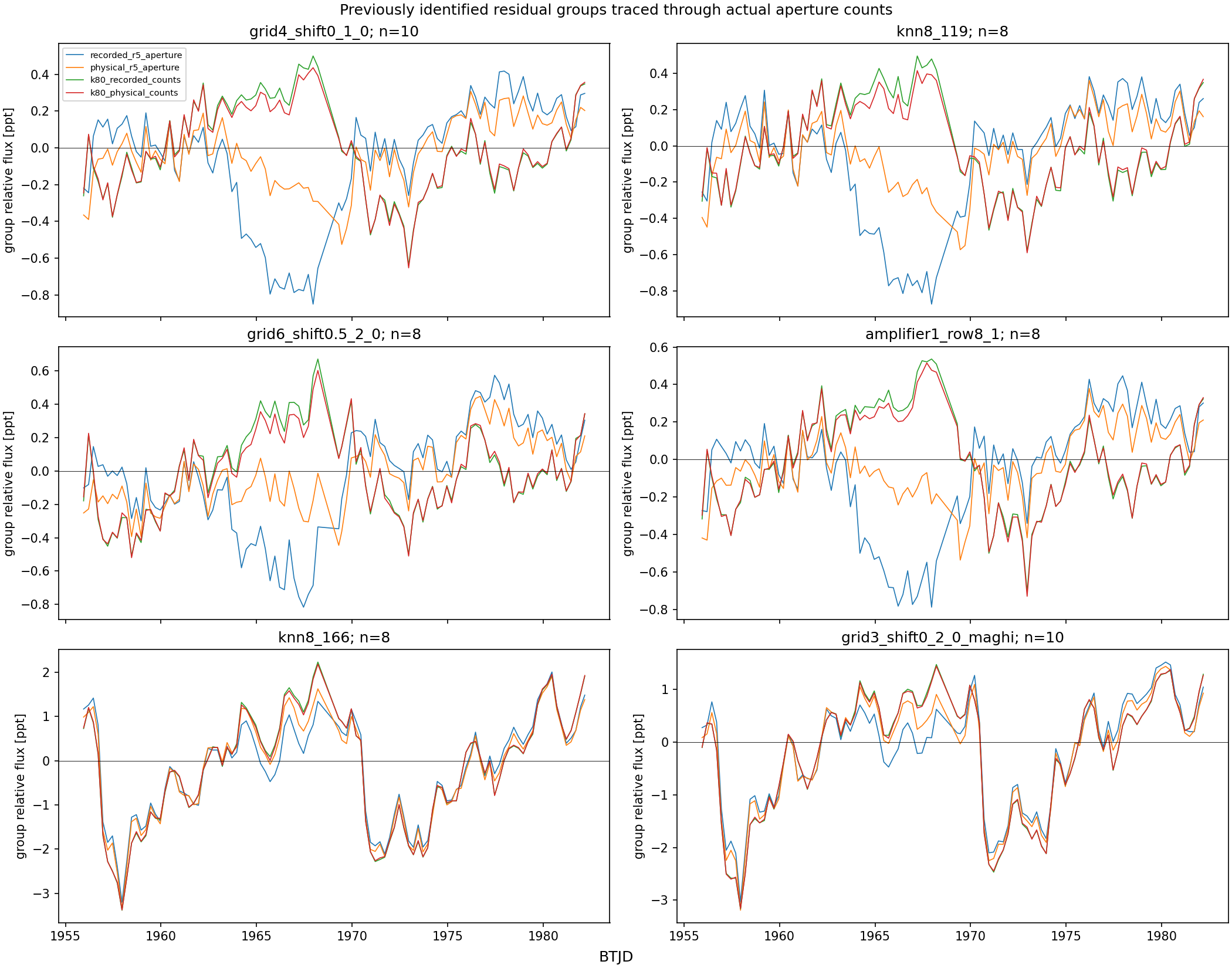
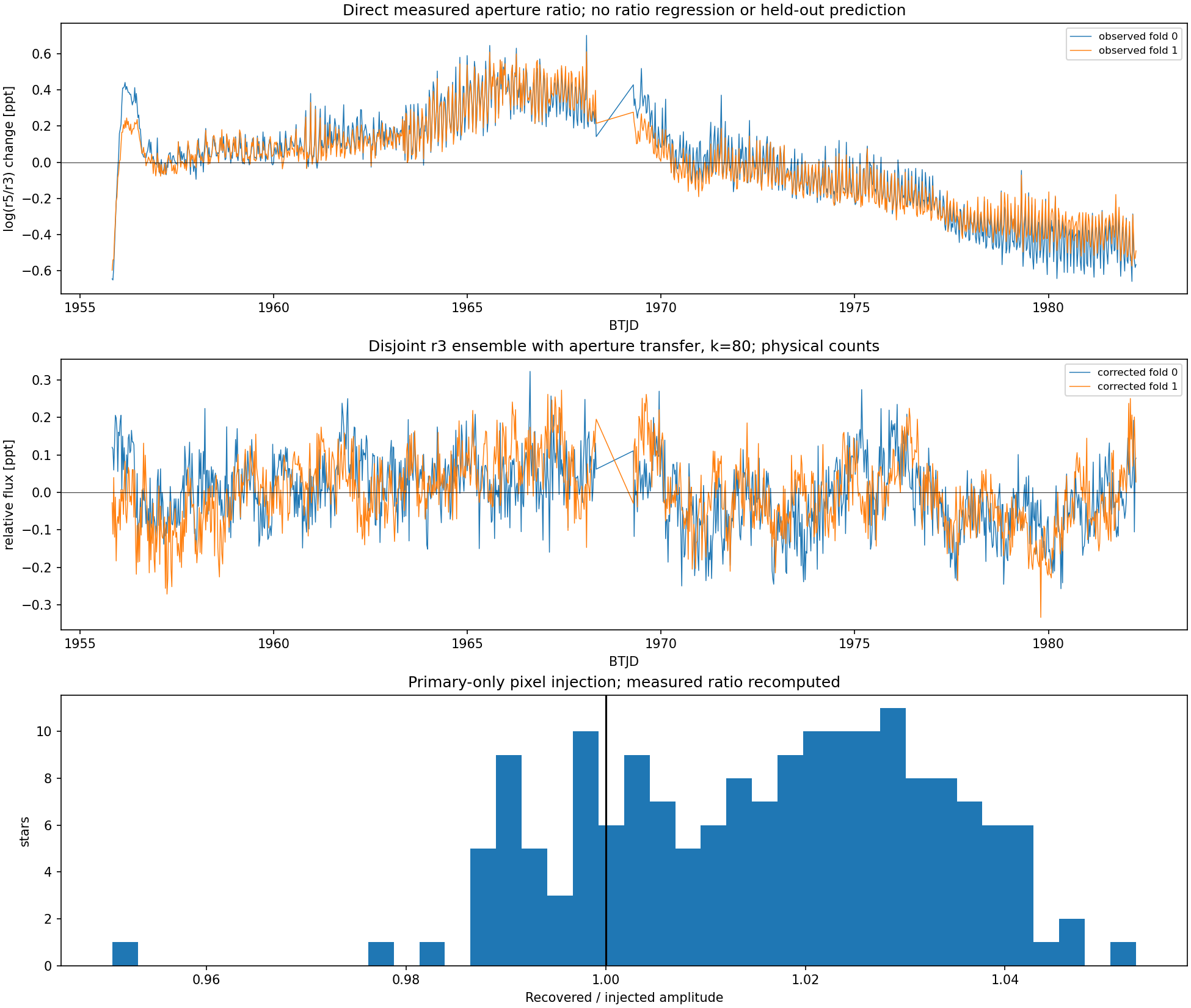
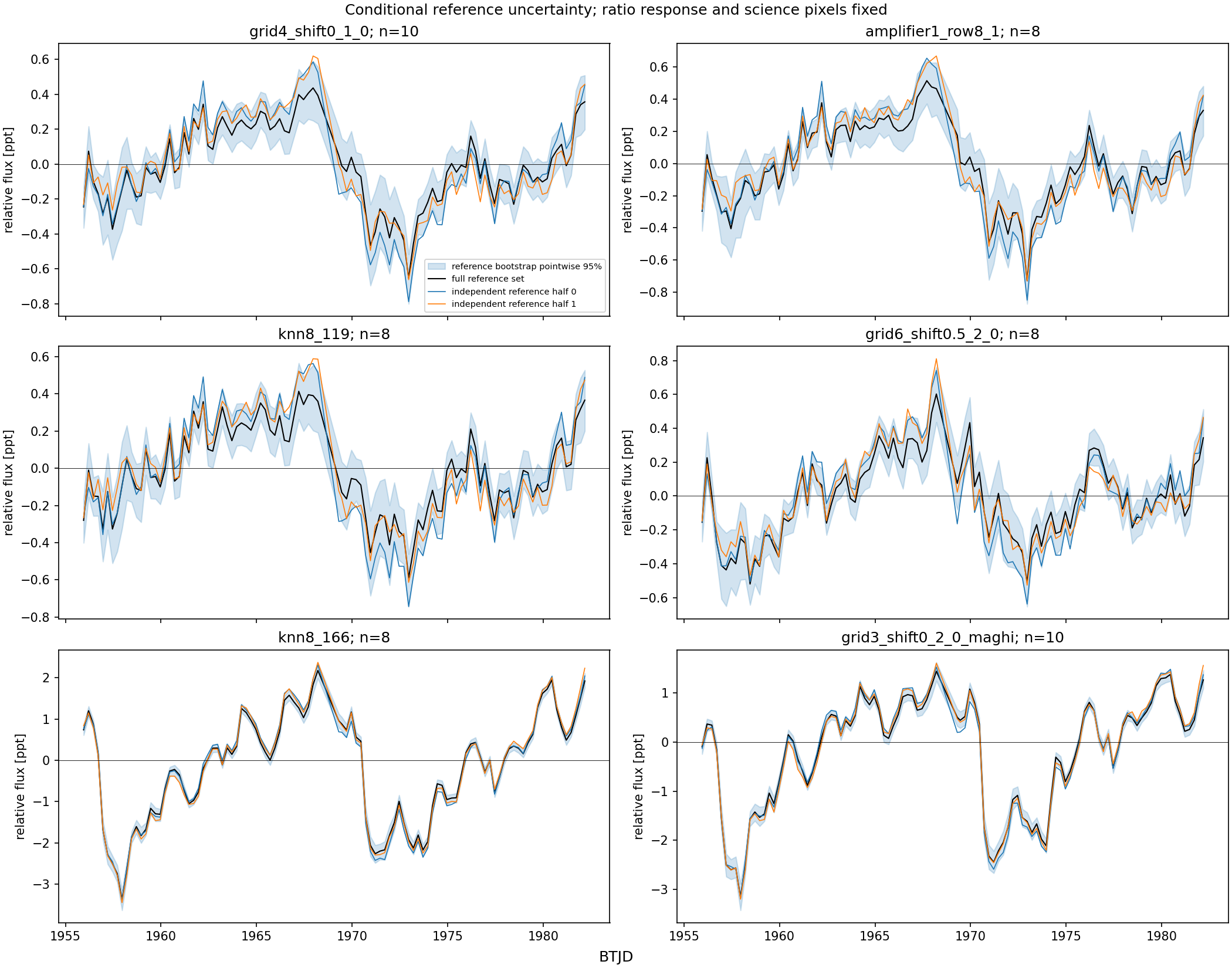
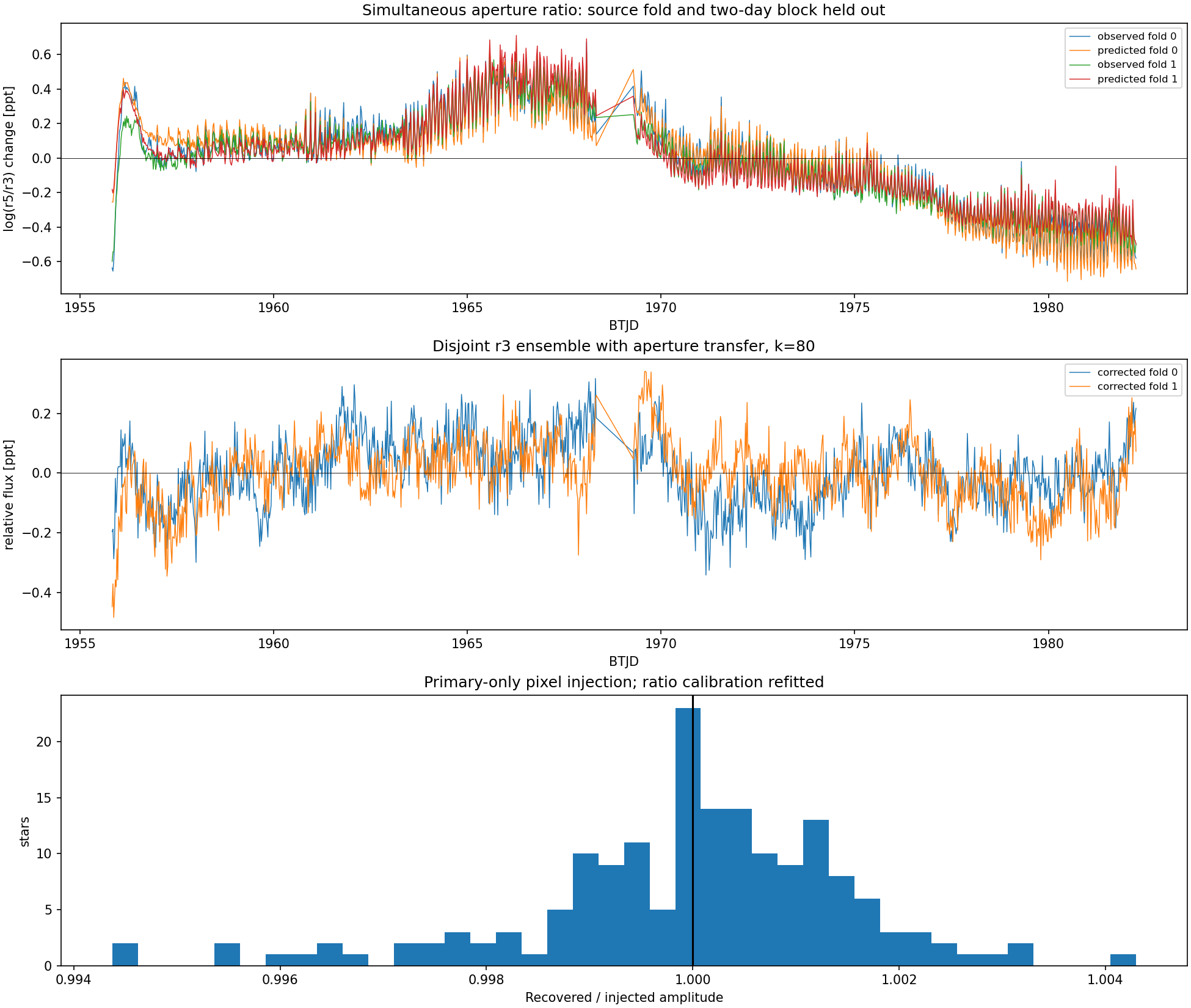
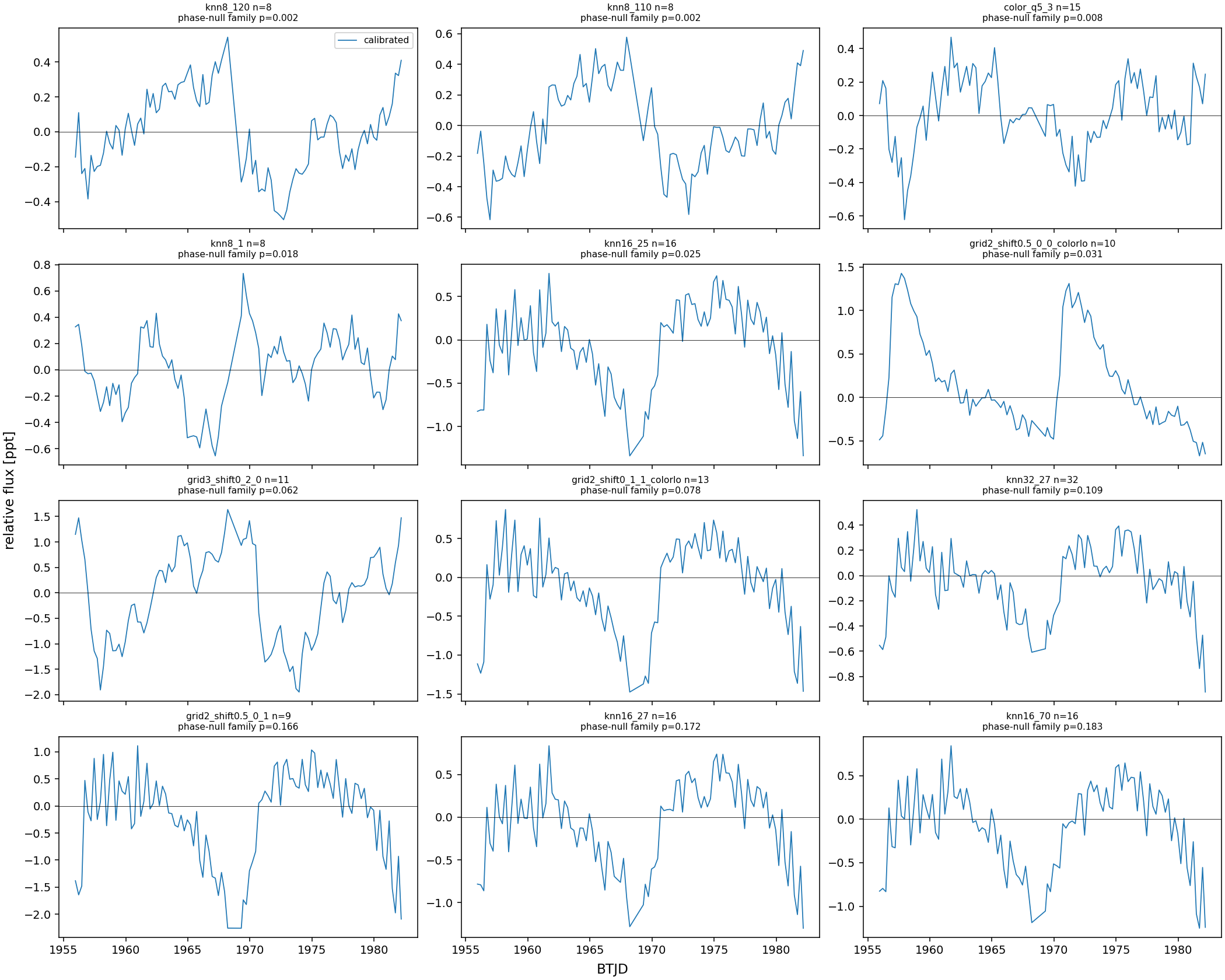
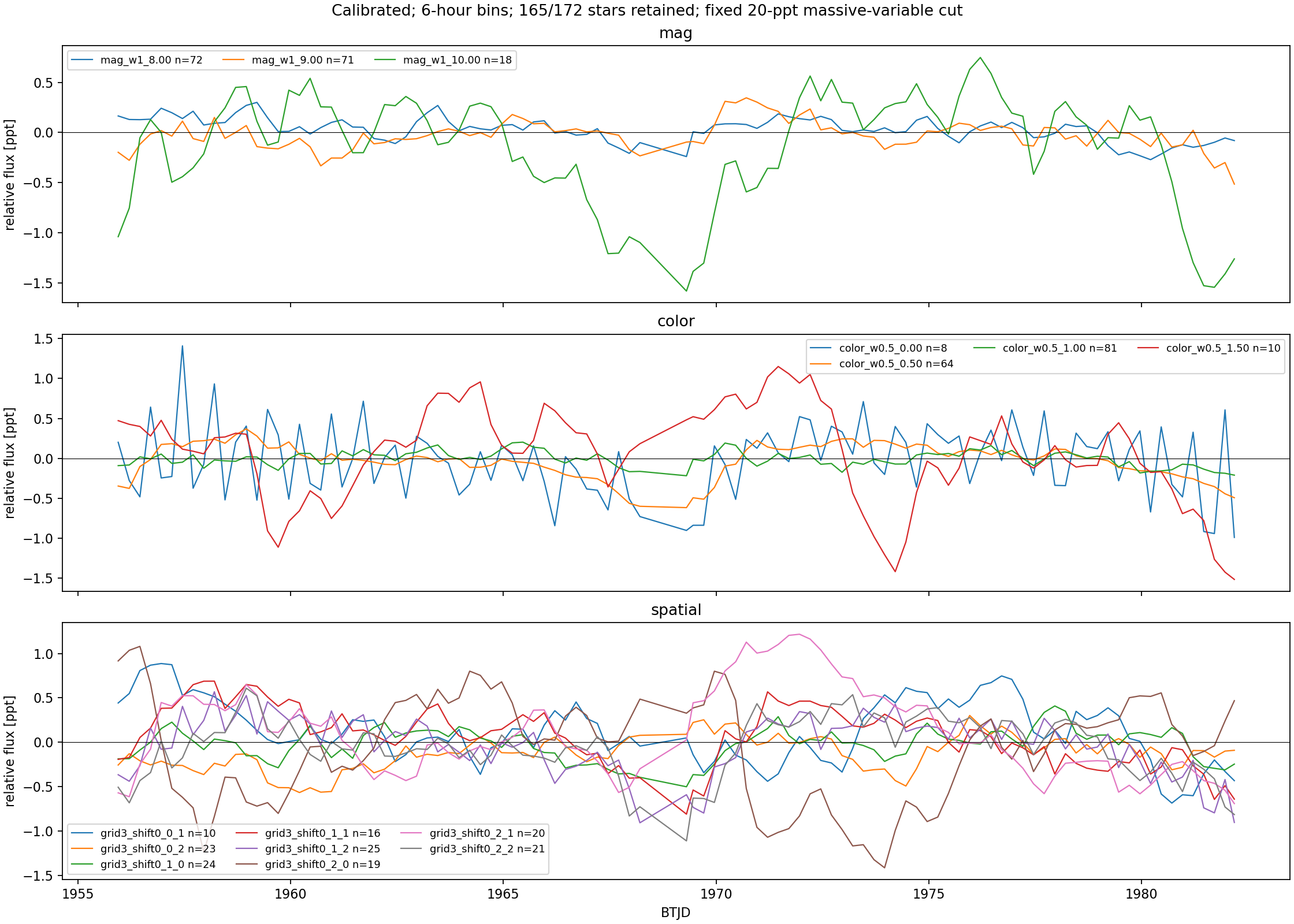
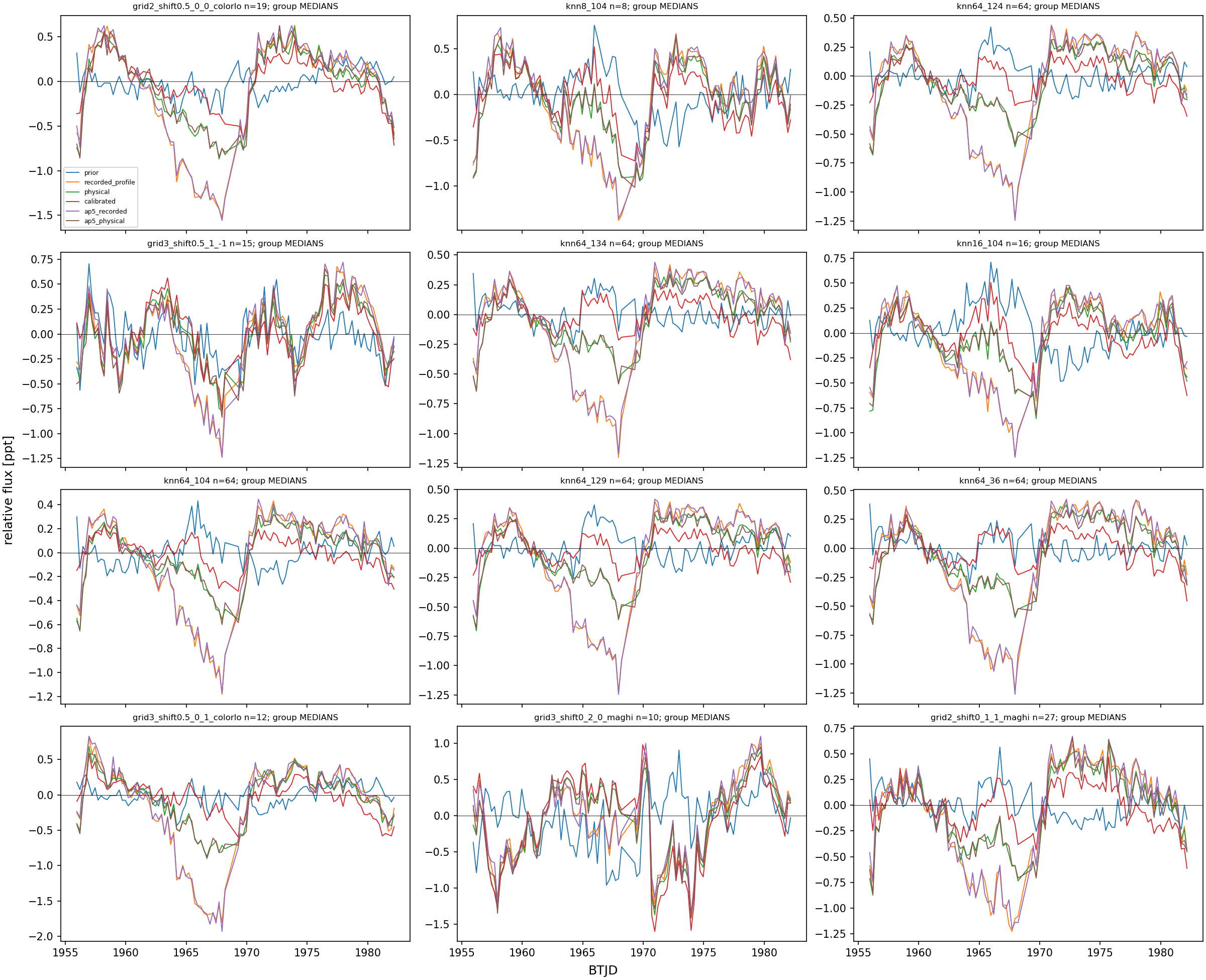
Keep all 172 science sources, 165 eligible stars, 354 groups, the existing ratio fits and k=80 rule. The ten-star group RMS changes 0.12332 to 0.12858 ppt, and the sixteen-star group 0.18360 to 0.17859 ppt. These small mixed changes do not remove the persistent histories. Reference-variable import and matched reference-half disagreement increase slightly. Intrinsic variability remains in these descriptive curves.
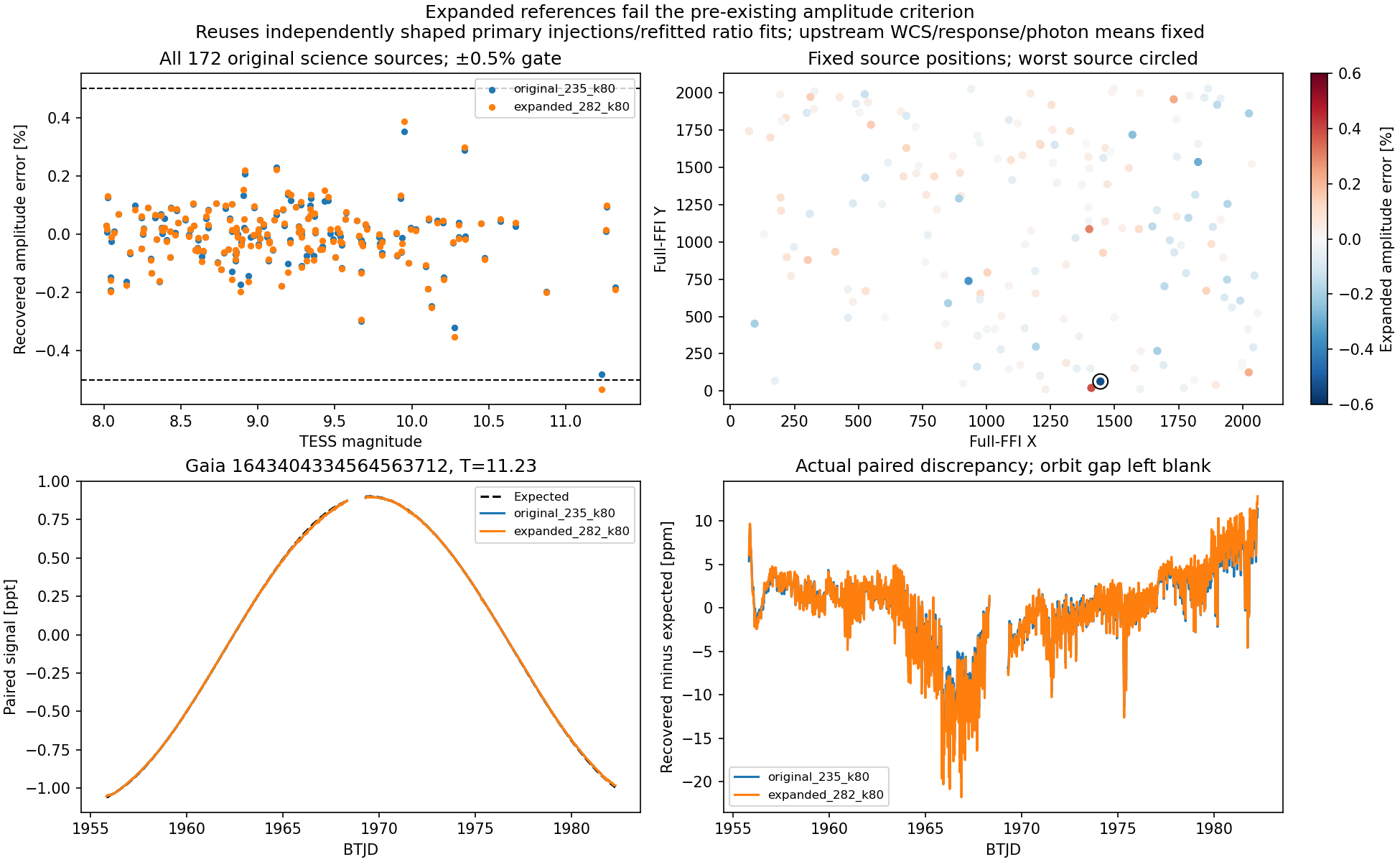
Worst primary amplitude error changes from 0.48120% to 0.53318%, failing the existing 0.5% gate for one source. The original baseline replays; primary profile/ratio injections are inherited from the exact paired science run, and reference precision is refitted. Global WCS/PSF/response/photon means remain conditional; precision uses full histories. Conclusion: the expansion is not adopted. Neighbour leakage, independent missing-profile validation and physical covariance remain before further expansion. Upstream calibration is not cleared and photon-noise dominance remains unproven. Estimator equations, complete evidence, exact jobs and next tests.
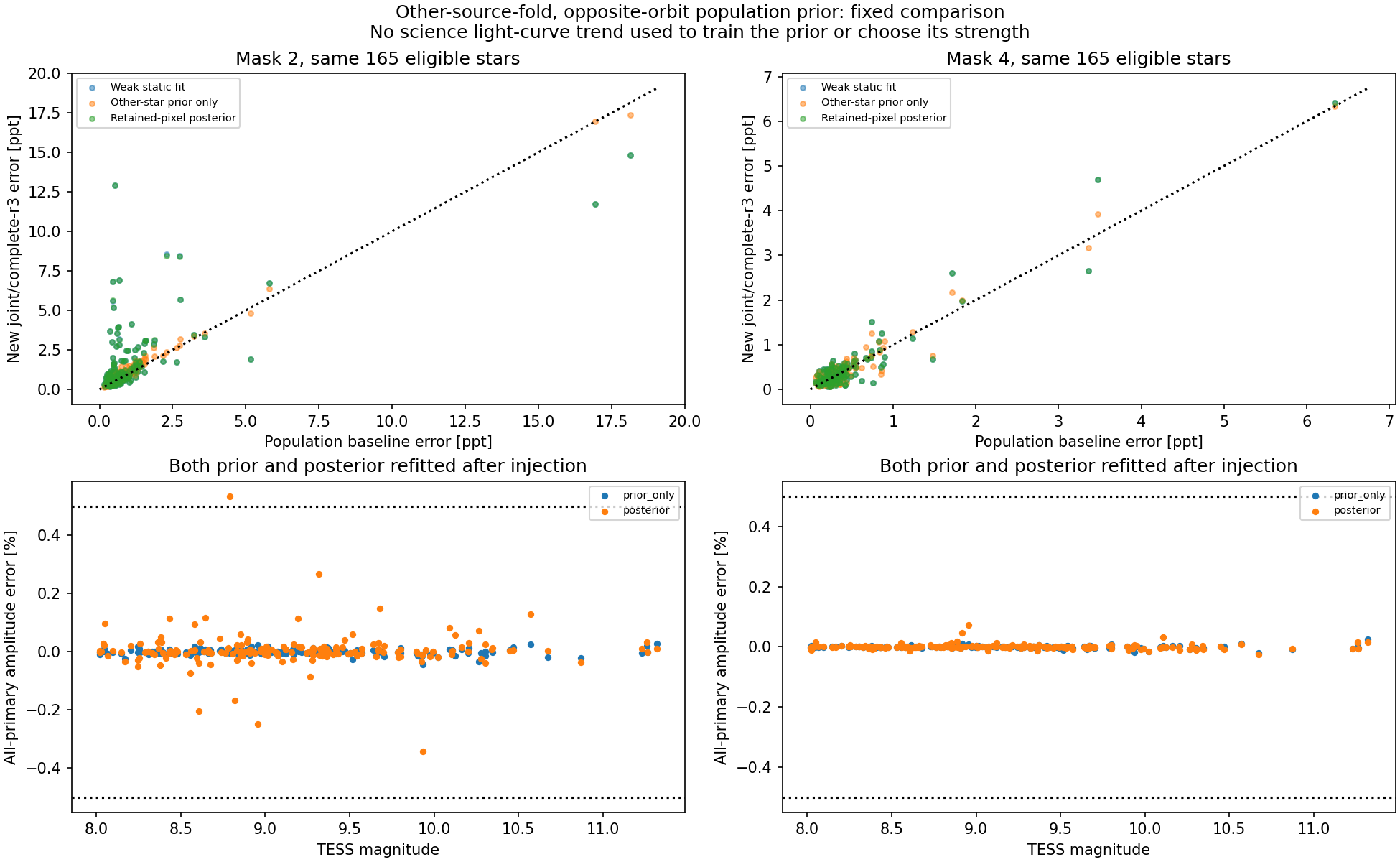
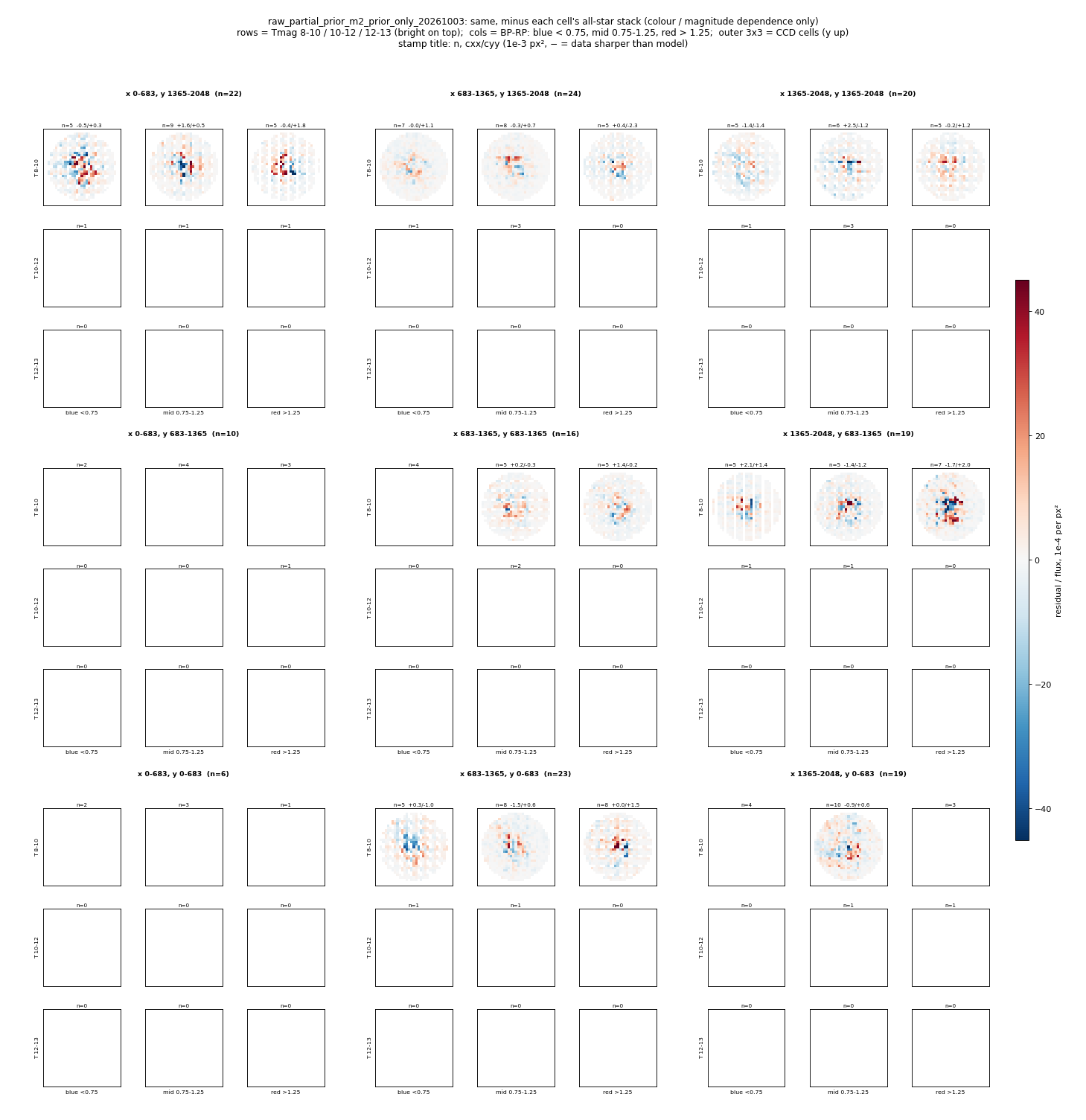
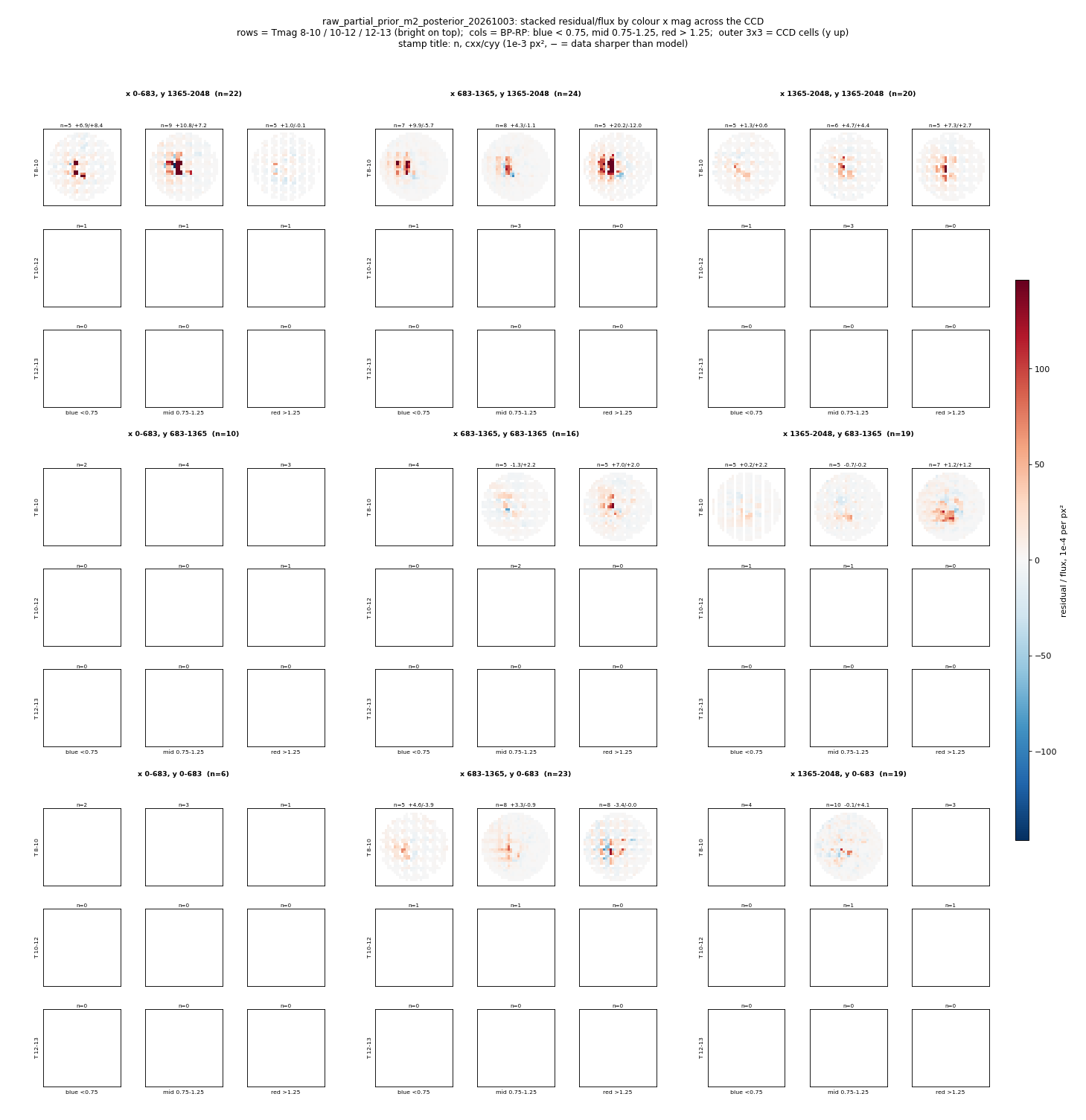
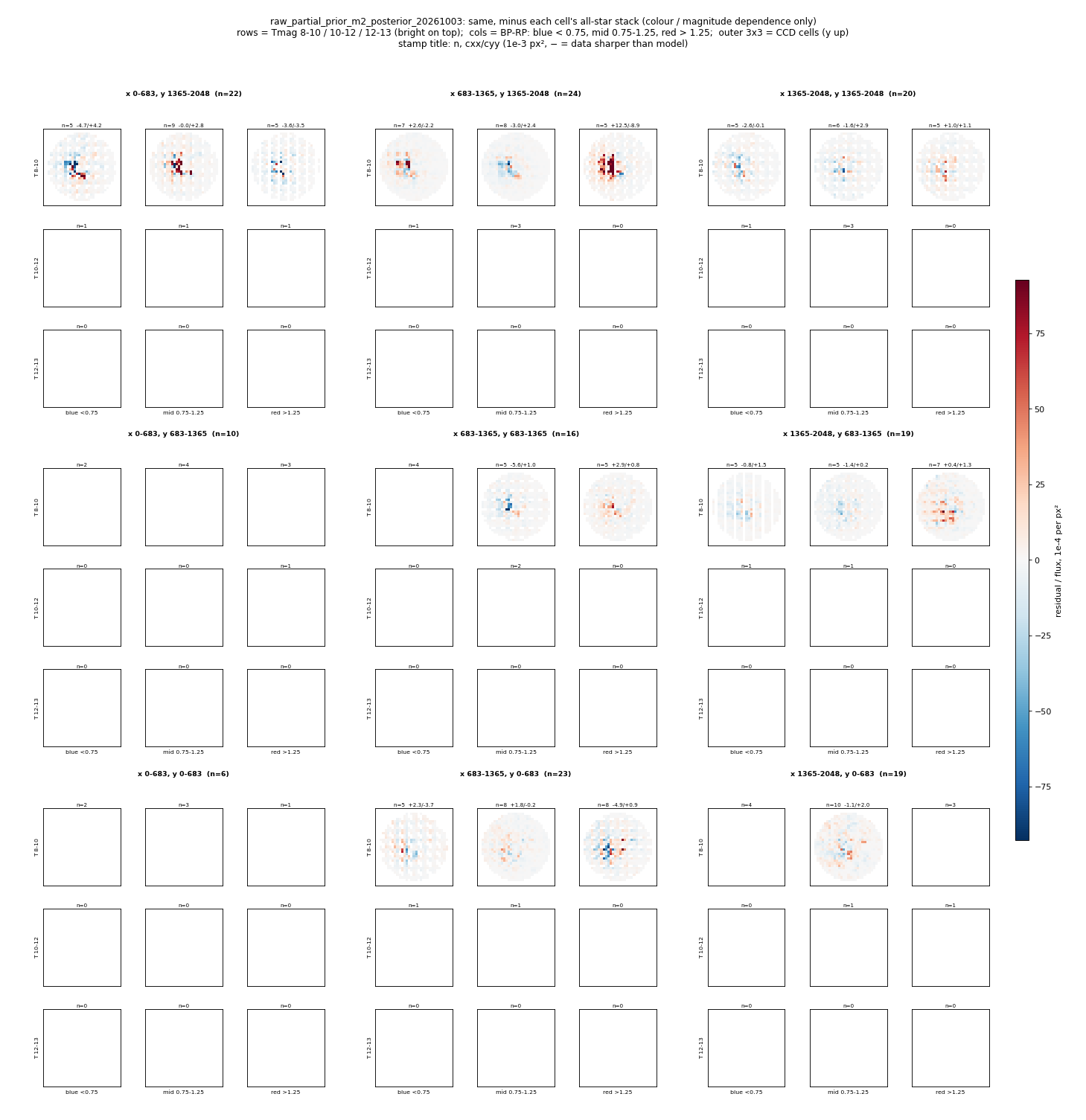
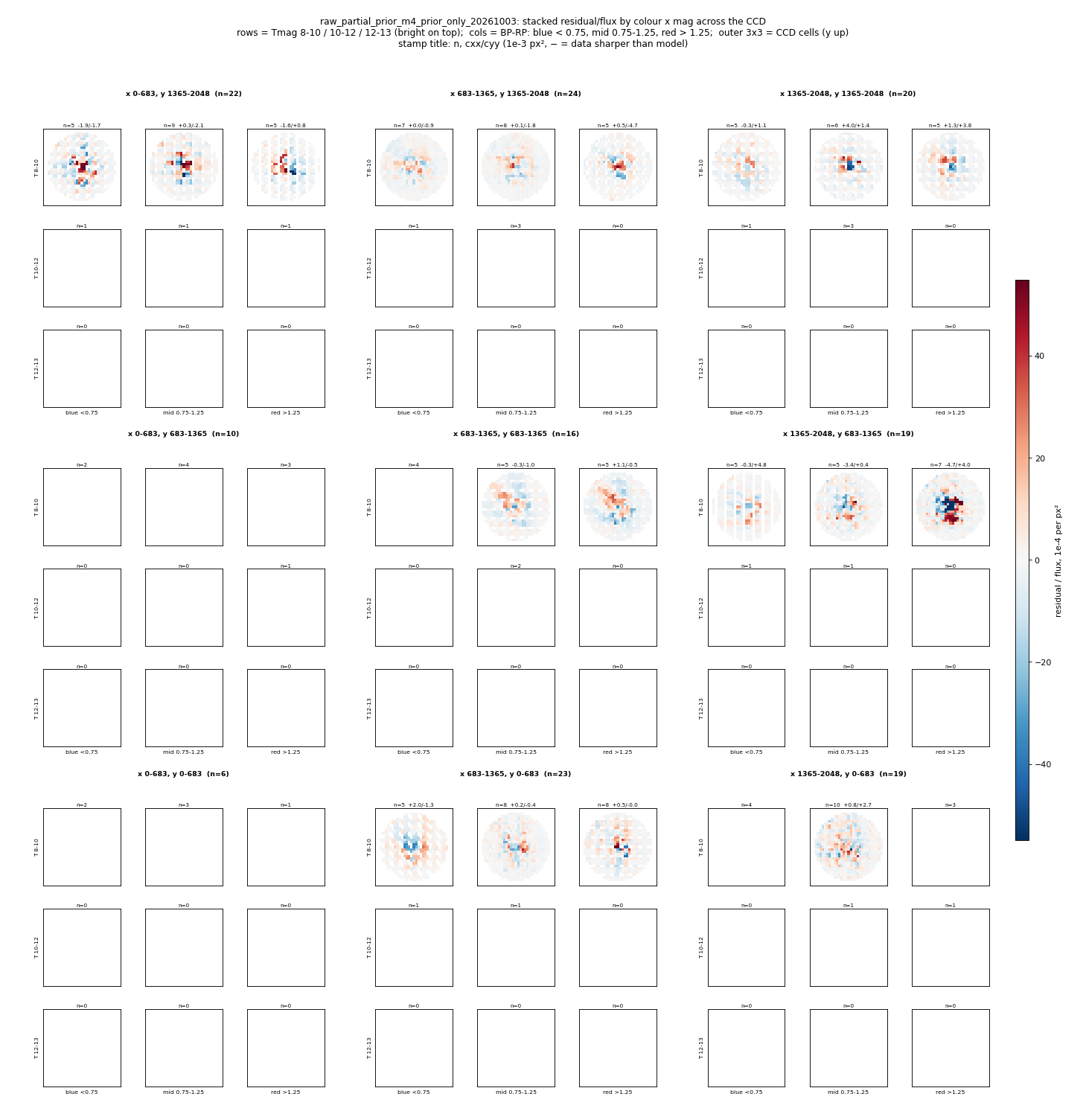
Other-star shape prior: signal stability without improved missing-light photometry
The static five-mode mean and covariance are now learned from fully observed eligible stars in the opposite source fold and opposite orbit. Every prior trainer uses the same target-fold population template and state convention, avoiding reverse-fold template leakage. Actual training IDs are verified: 89 or 76 stars per source fold. The prior uses fixed catalogue position, colour and brightness features; no target light-curve trend chooses its coefficients or strength.
All 660 prior fits and 2,064 target fits converge, with no prior bounds and twelve target bound-active fits. Target position replay is within 3.61e-13 pixel and baseline photometry replays exactly. Five unit tests, sixteen real exclusion checks and independent starts on four catalogue-spaced targets pass. These establish implementation and information flow, not a successful photometric correction.
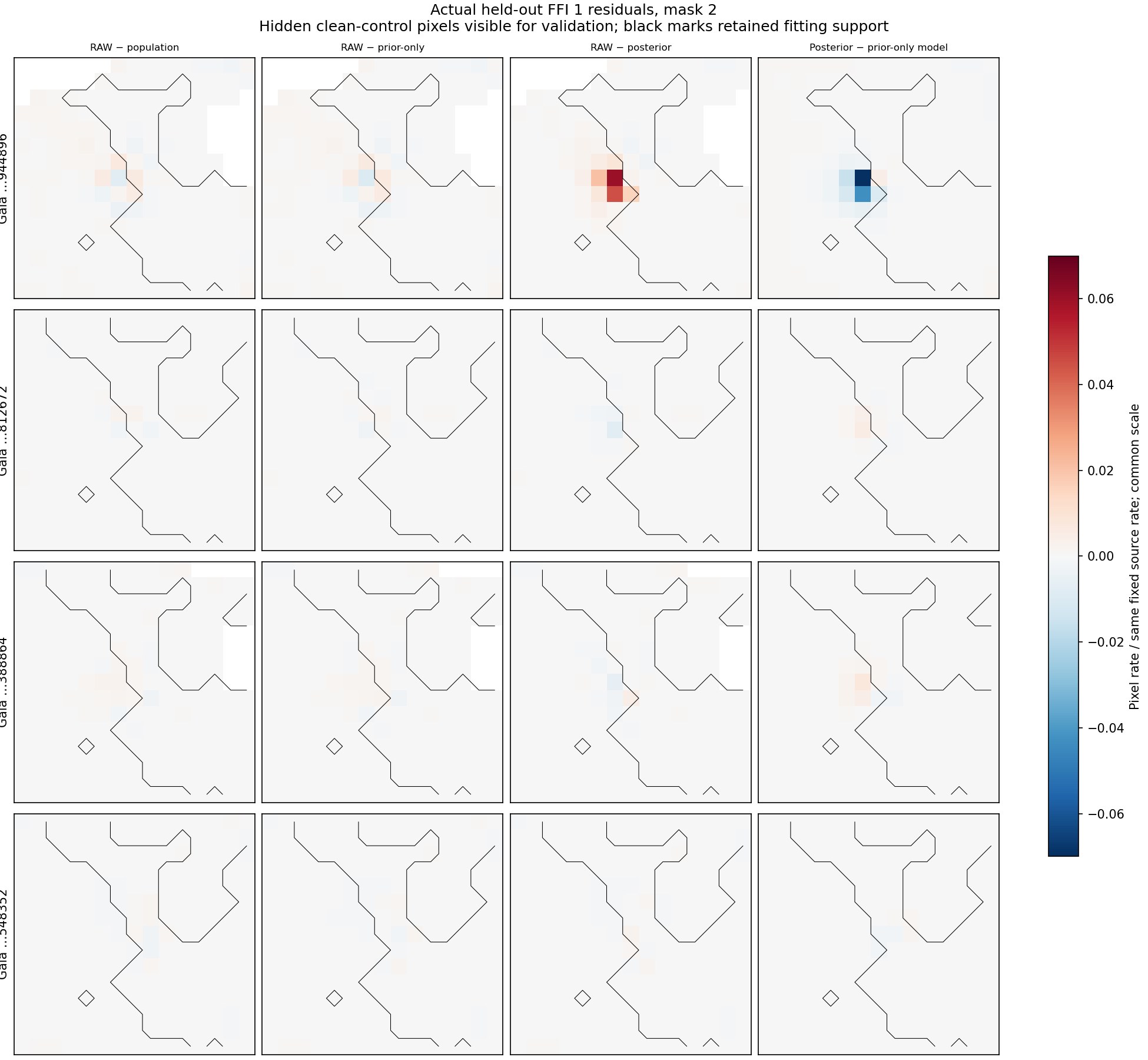
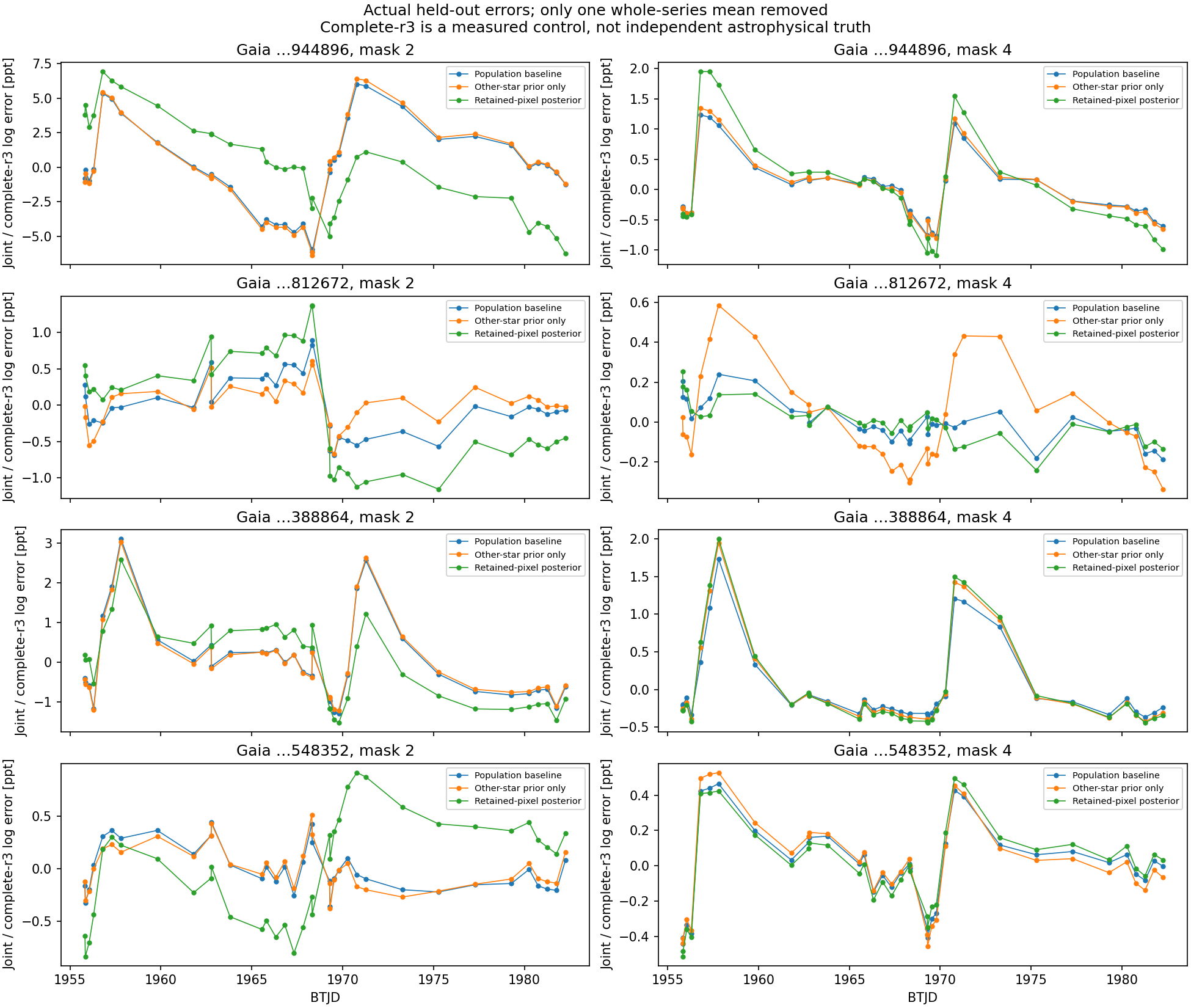
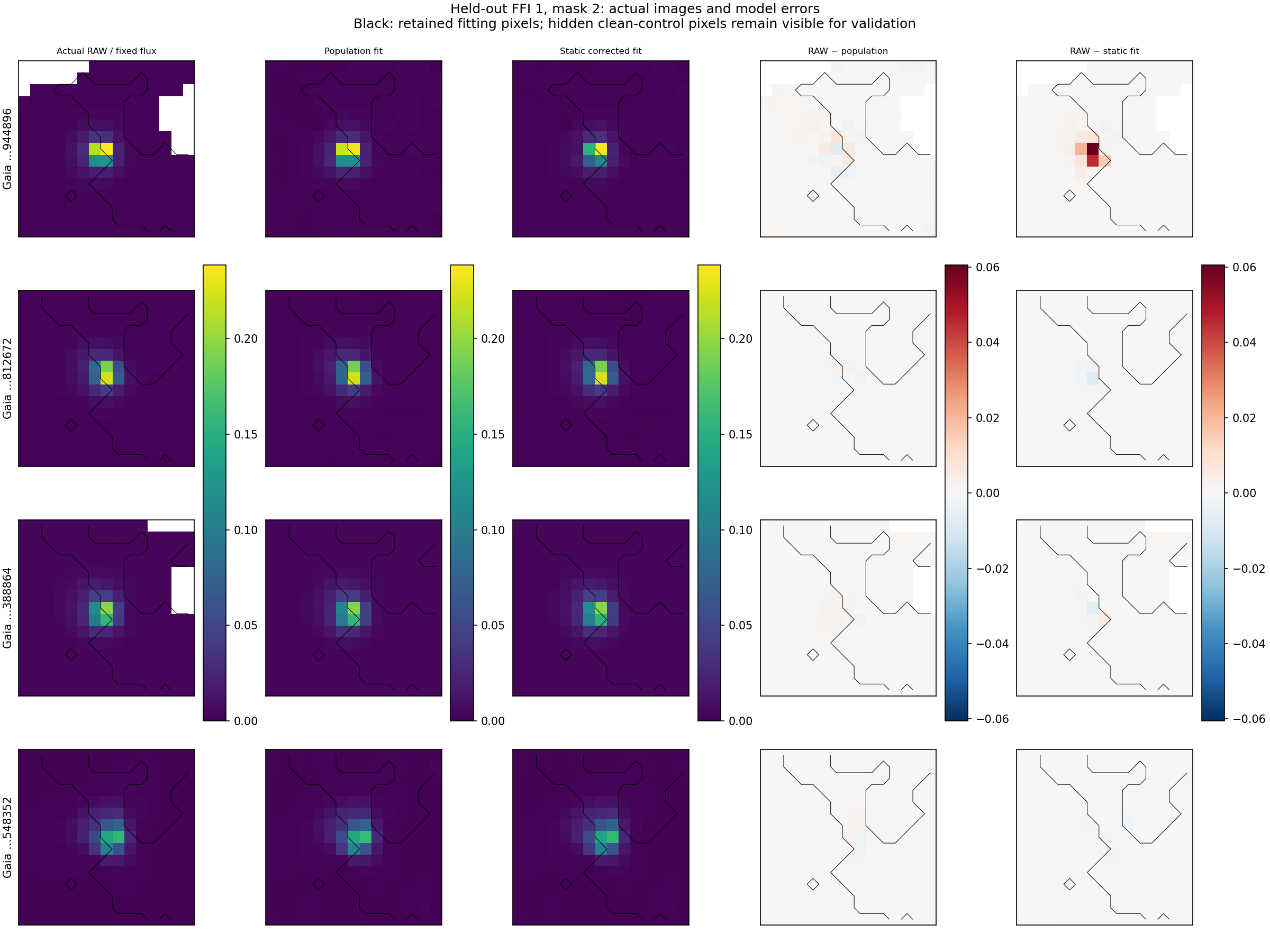
For mask 2, the original population joint-estimator error is median/p95 0.6343/2.5751 ppt. Prior-only gives 0.7743/2.6538 and posterior 0.8433/5.6674 ppt. Mask 4 likewise has no improvement: 0.2609/0.8764 baseline, 0.2685/1.0384 prior-only and 0.2732/1.0325 posterior. All use 165 eligible stars and the same measured complete-r3 control, not independent astrophysical truth. The aperture branch retains its one unsupported row per mask.
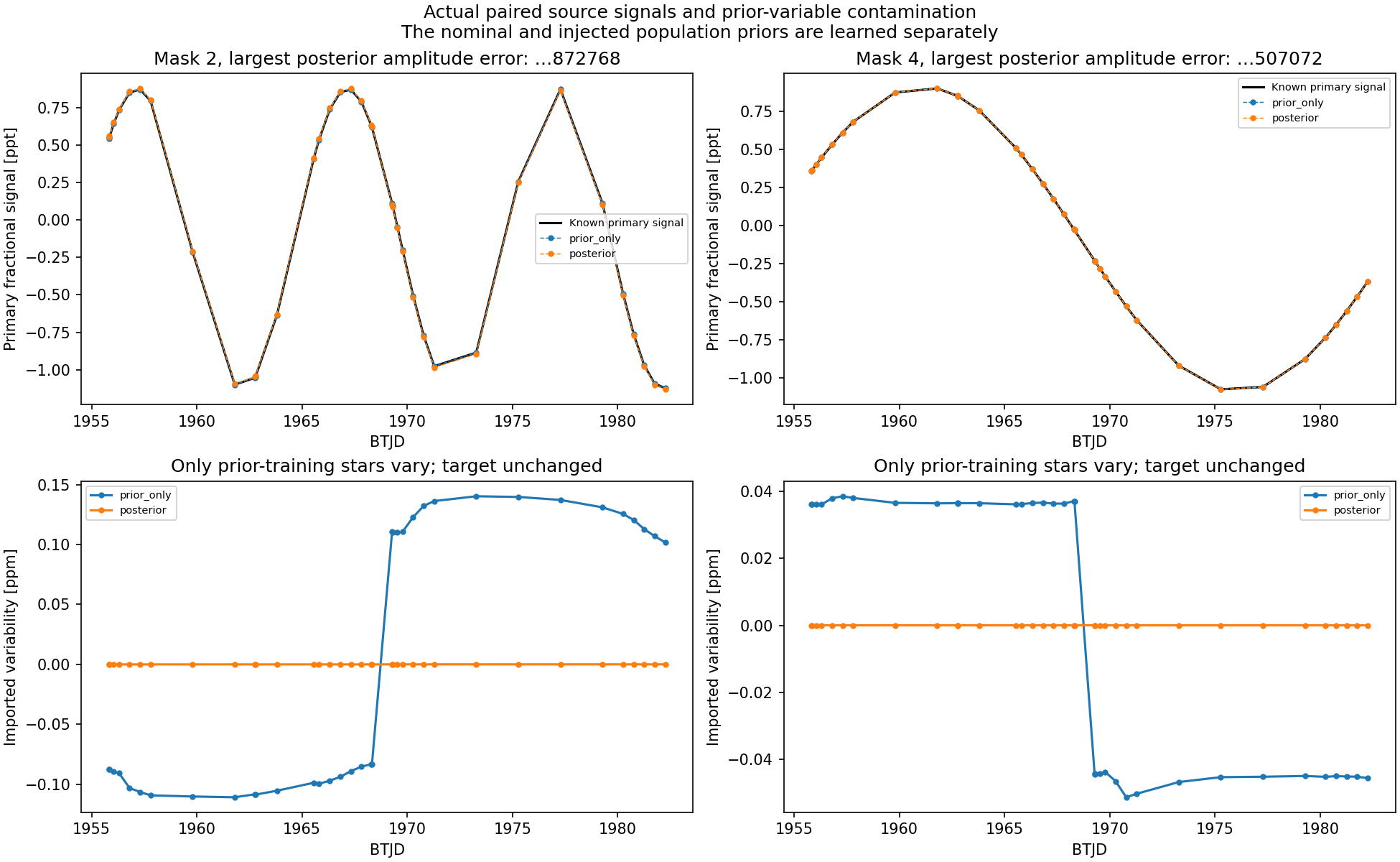
Both prior and posterior stages are refitted under the known signals. Prior-only worst primary amplitude errors are 0.04443%/0.02402% for masks 2/4; posterior errors are 0.53494%/0.07169%. The heavier posterior still fails the existing 0.5% criterion. Prior-only imported variability is median/p95 0.0603/0.1927 ppm for mask 2 under this specific injection, not a general noise-floor bound. Photometric error inputs are unchanged.
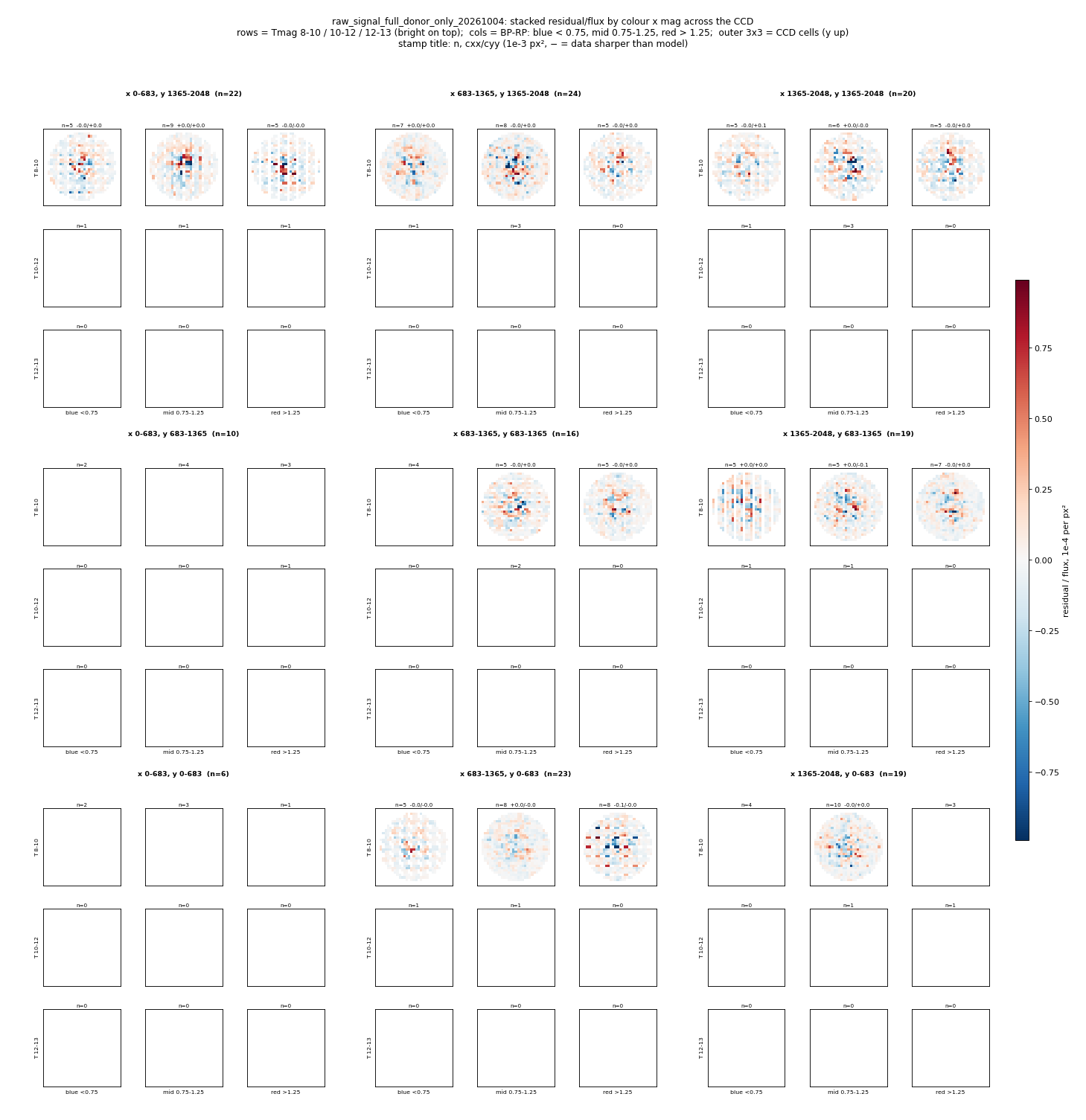
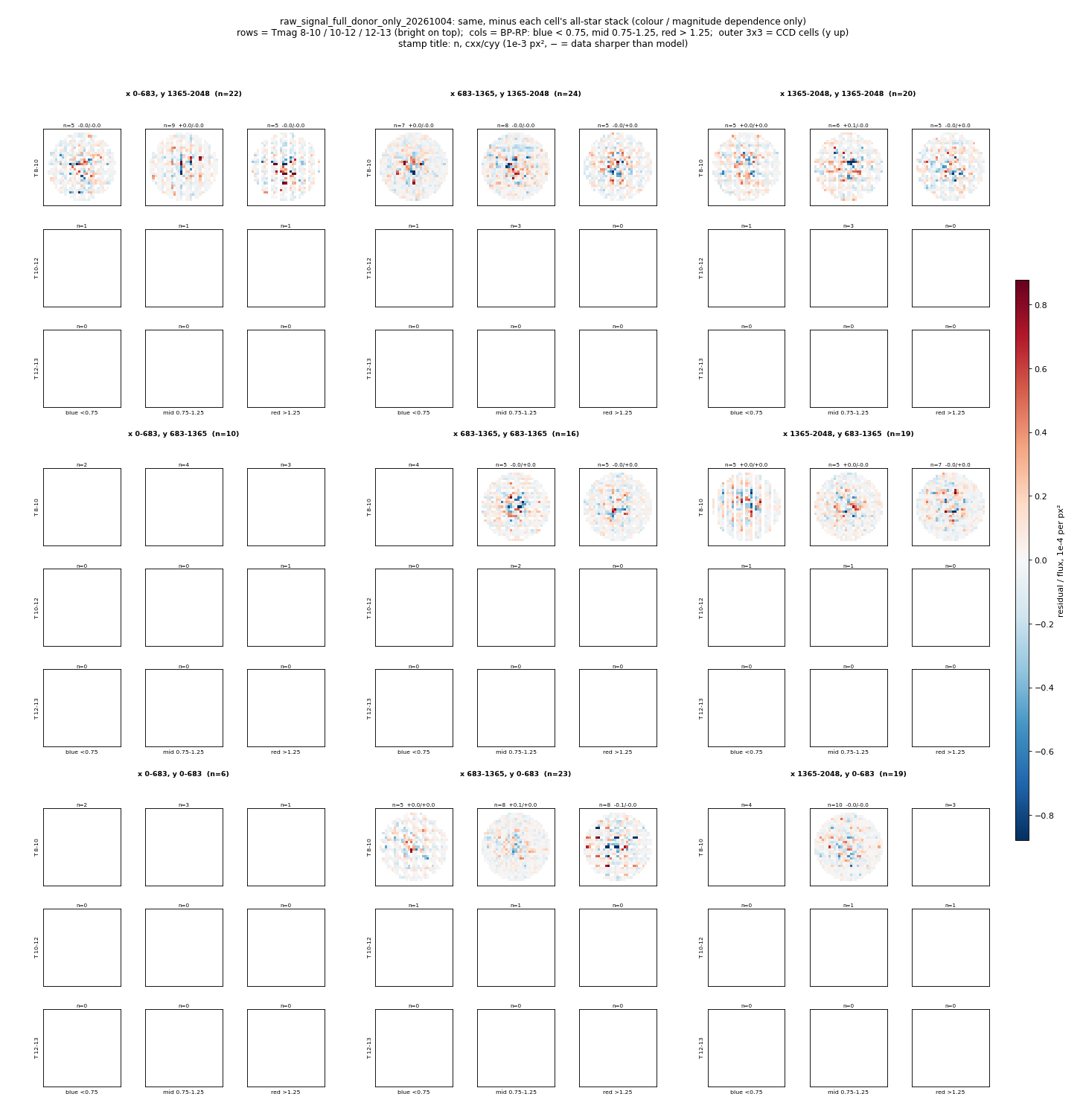
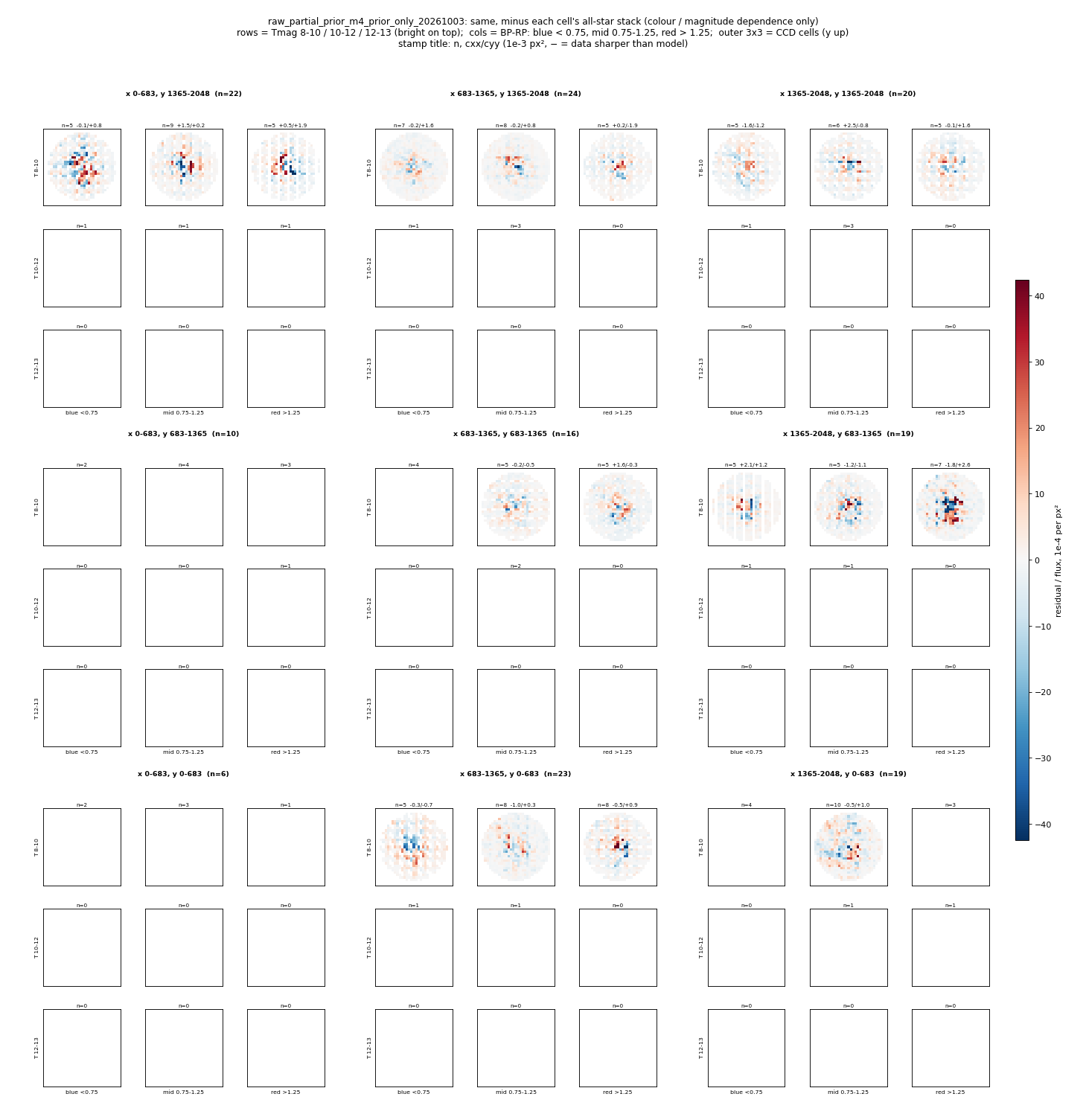
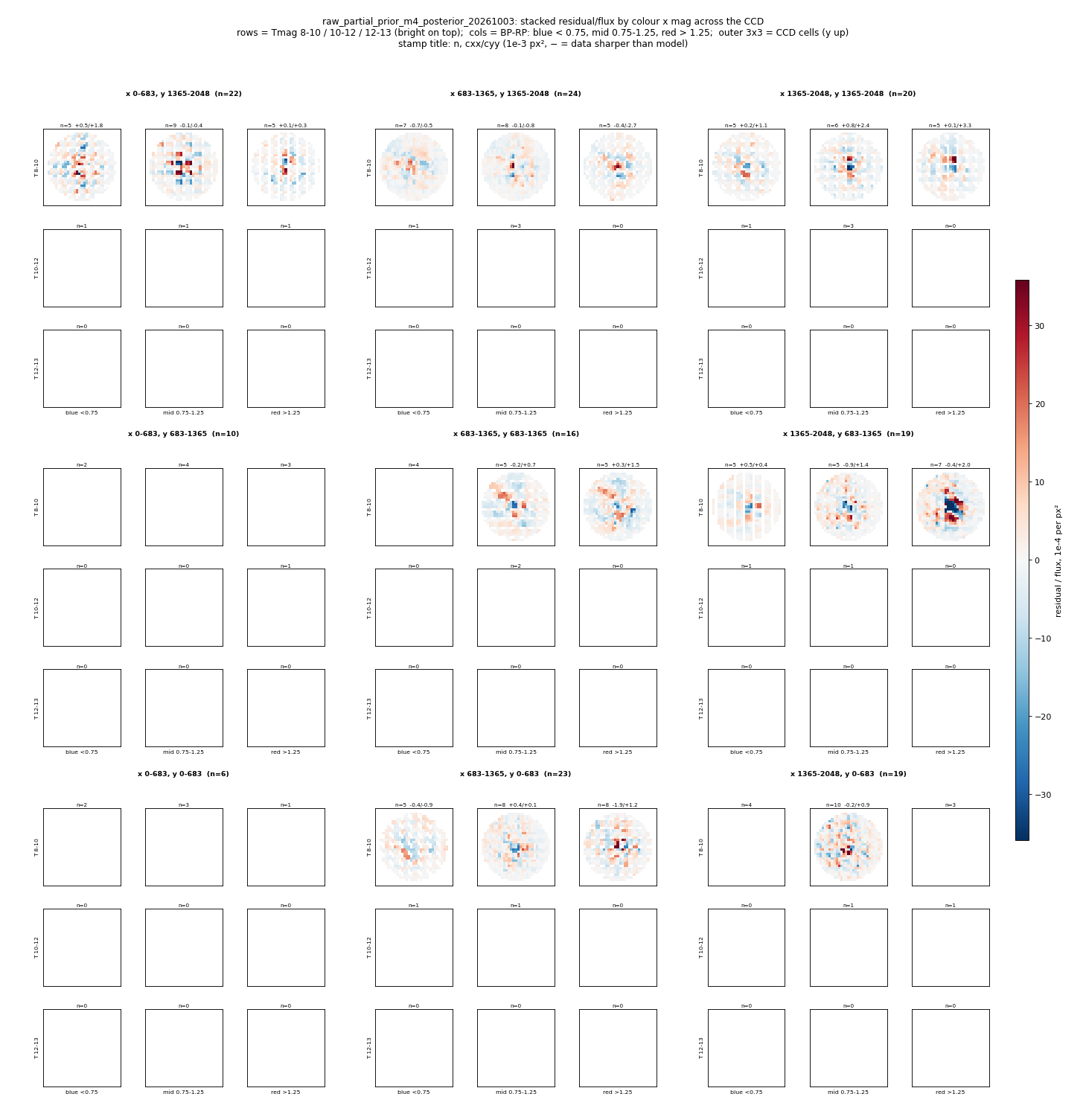
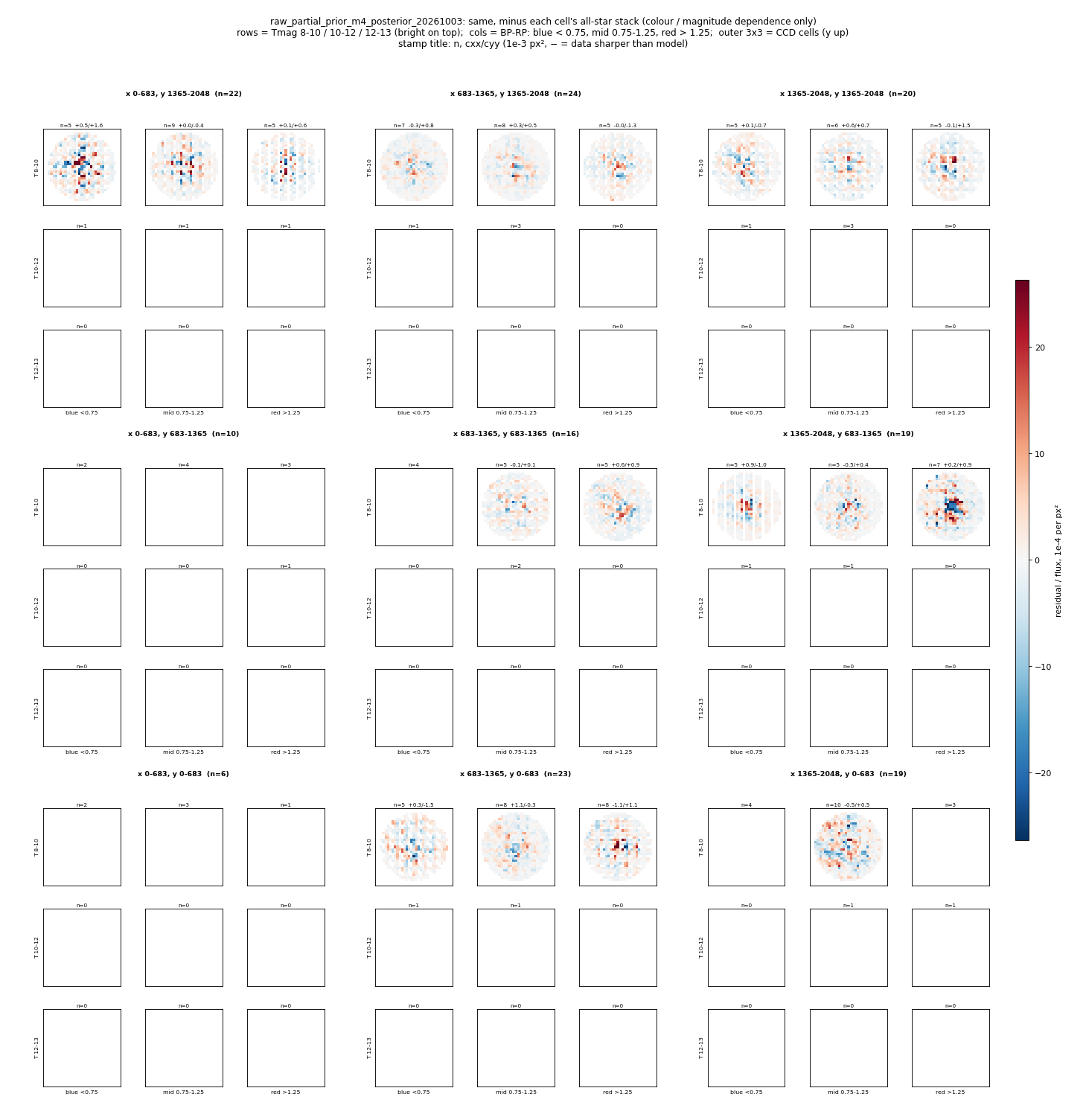
Required absolute and cell-relative residual grids for the two prior models
Same full clean evaluation support, snapshots and normalization as the paired population baselines in the preceding chapter. 165 inputs, 159 in the standard range; sparse bins and automatic per-image colour limits remain explicit. All eight images were inspected.
The shared residual gallery preserves all prior entries and includes the four new labels. The unavailable external Artifact mirror is not updated. Conclusion: neither arm improves the required photometry, so neither is adopted. This limits the tested static five-mode prior, not all population constraints. Next use the better-performing population baseline for a controlled lightly-masked reference expansion, while retaining heavily masked/crowded sources and richer temporal shape modeling in the full objective. Equations, exclusion proof, signal tests, numerical outcomes and scope.
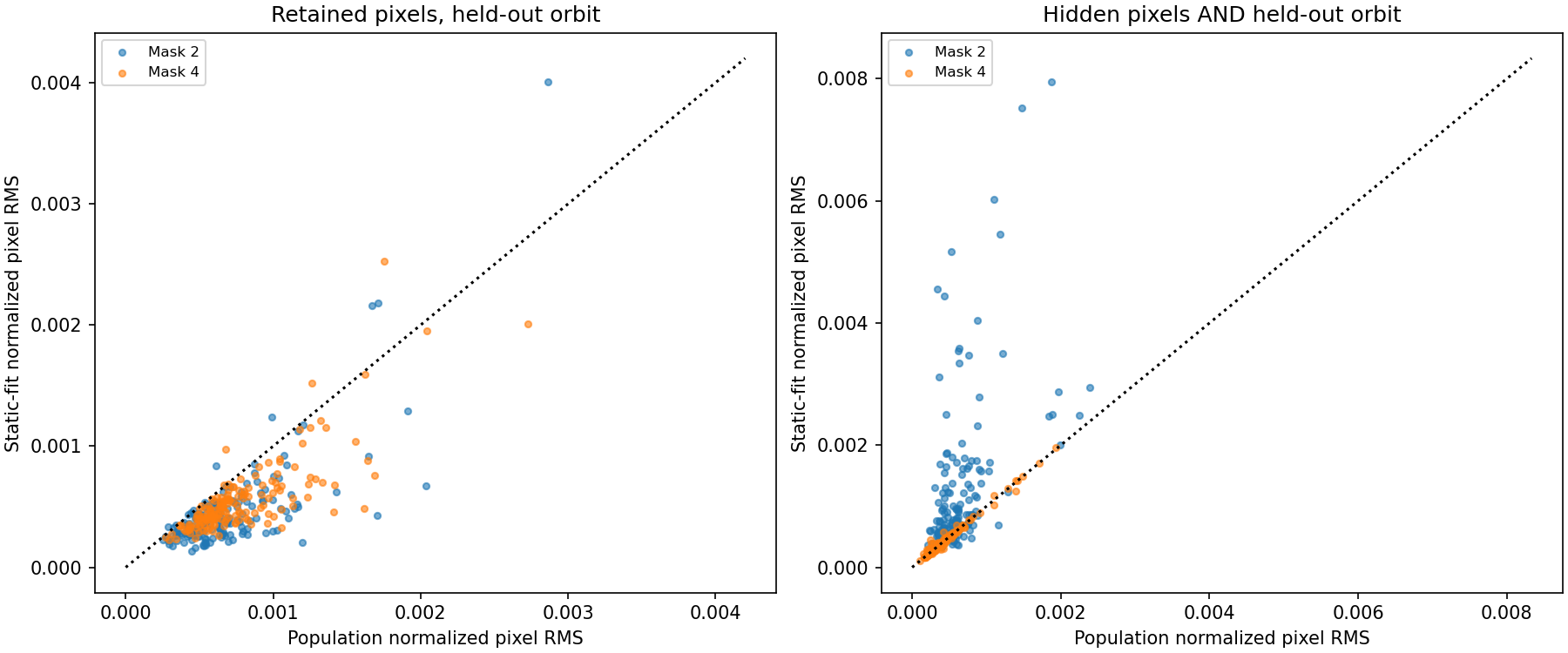
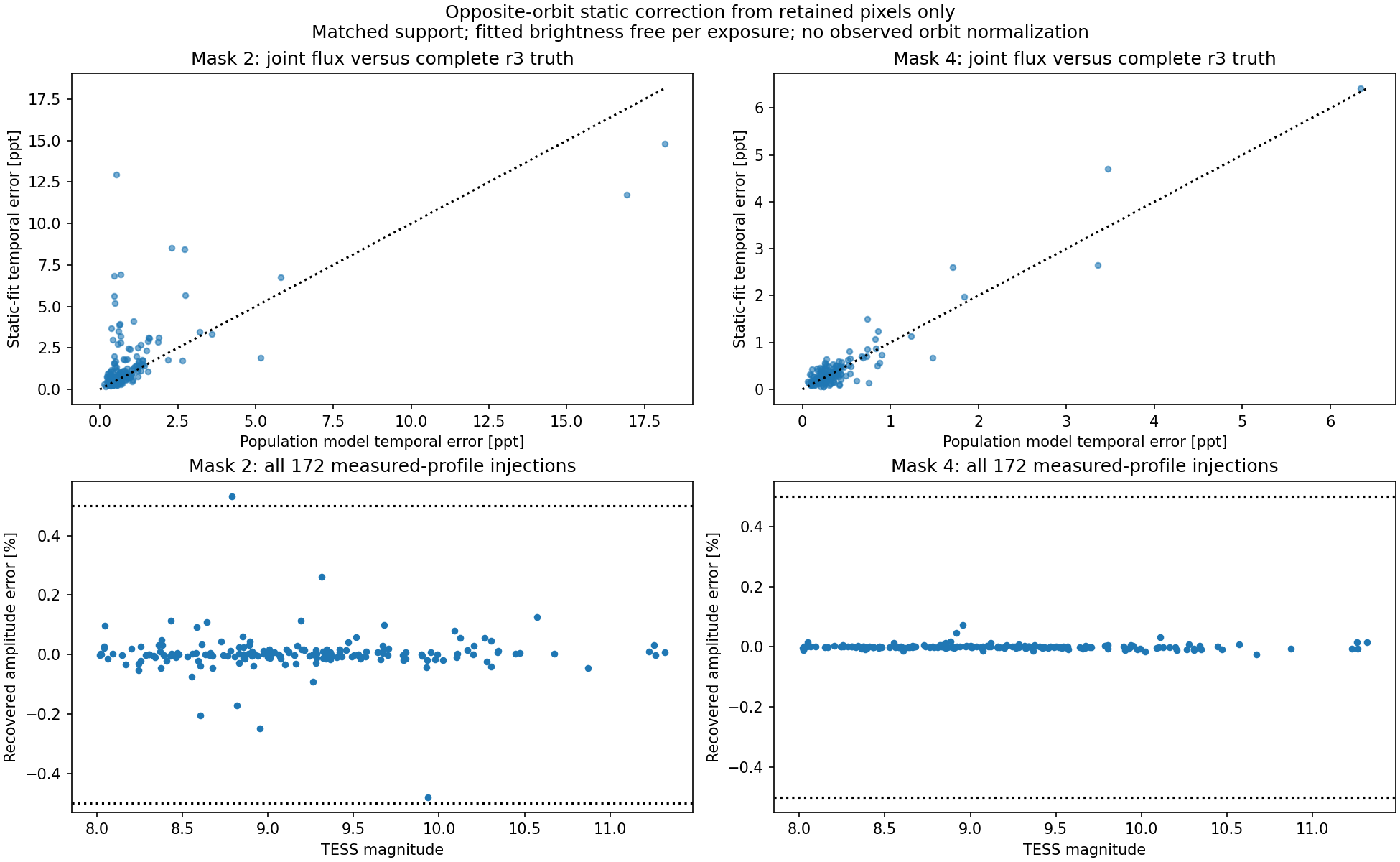
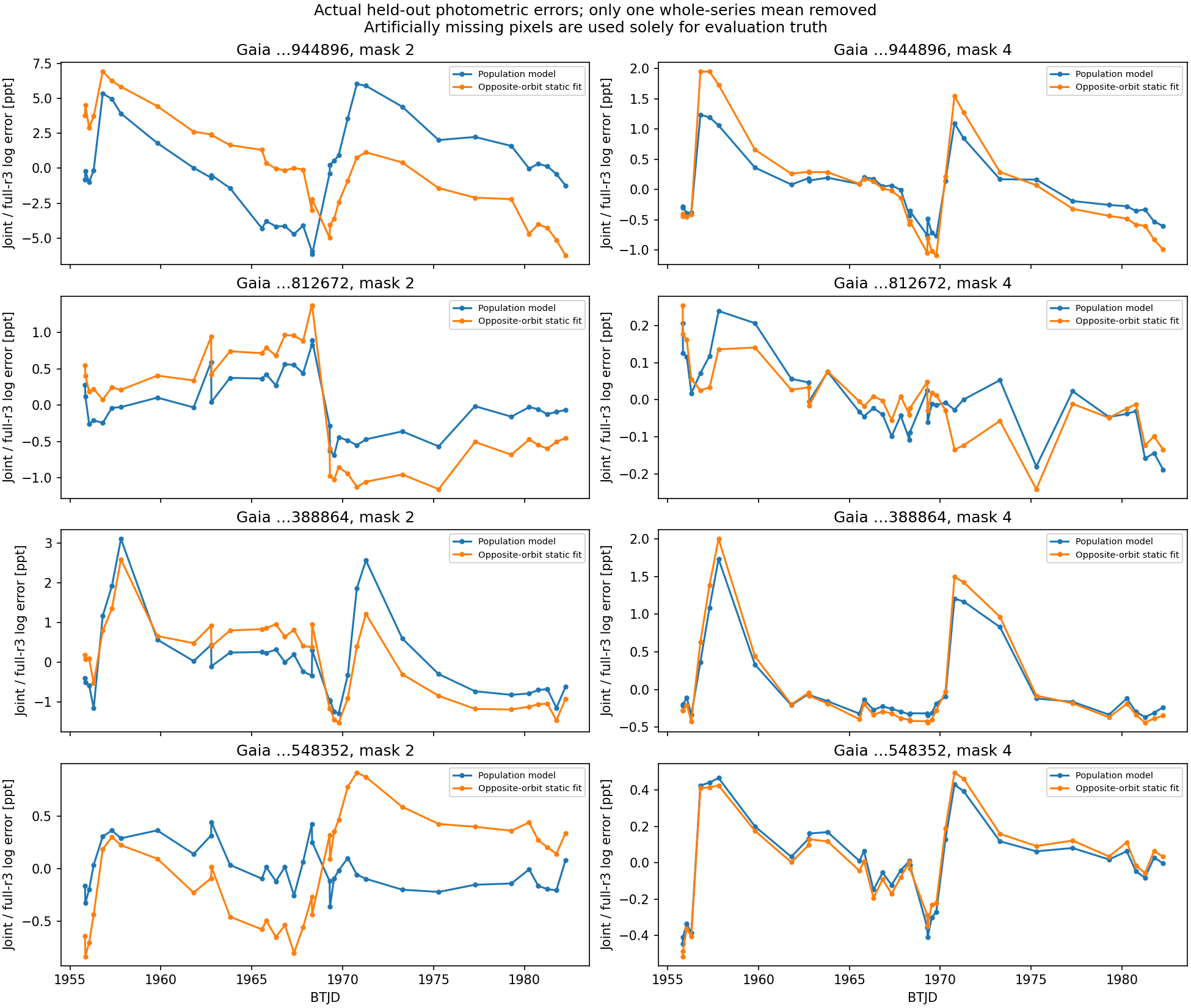
Five zero-sum static latent shape modes are fitted only to genuinely retained pixels on the opposite orbit, with flux and response-aware sky free in each exposure. All 172 controls and the original 36 FFIs remain. Hidden-pixel/held-epoch invariance, analytic derivatives and known-shape tests pass. Every one of 1,376 fits converges, with eight bound-active fits; independent starts agree on four catalogue-spaced sources. These are numerical checks, not scientific acceptance.
Several hidden cores become substantially worse even when retained-pixel residuals shrink. The initial ring-support gate remains failed for one eligible source per mask; aperture results cover 164/165 sources. A separate joint flux/sky estimator uses all retained pixels and covers all 165. It does not relax the ring-only aperture gate.
For mask 2, median/p95 aperture error worsens 0.4851/1.5230→0.7689/4.4528 ppt; joint-estimator error worsens 0.6343/2.5751→0.8482/5.6636 ppt. For mask 4, joint error changes 0.2609/0.8764→0.2732/1.0325 ppt. These are errors against the same observed complete-r3 control measurement, not independent astrophysical truth or the final science light-curve scatter.
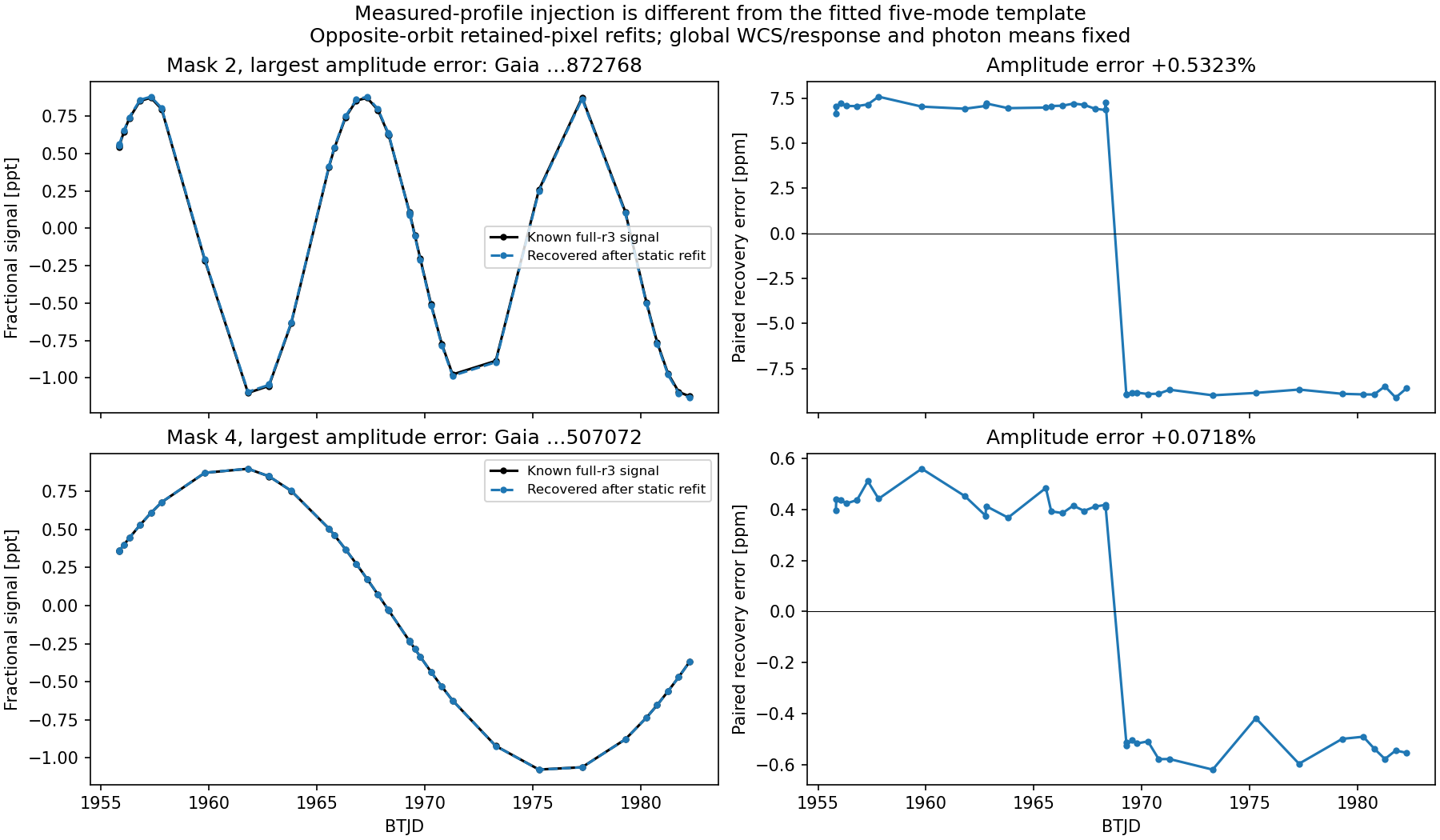
Worst joint-estimator primary amplitude errors are 0.5323% and 0.0718% for masks 2 and 4 across all 172 sources. Mask 2 fails the existing 0.5% criterion. The empirical full-support profile is used only to construct the injected signal, never to fit hidden pixels. Global WCS/response/photon expectations remain fixed.
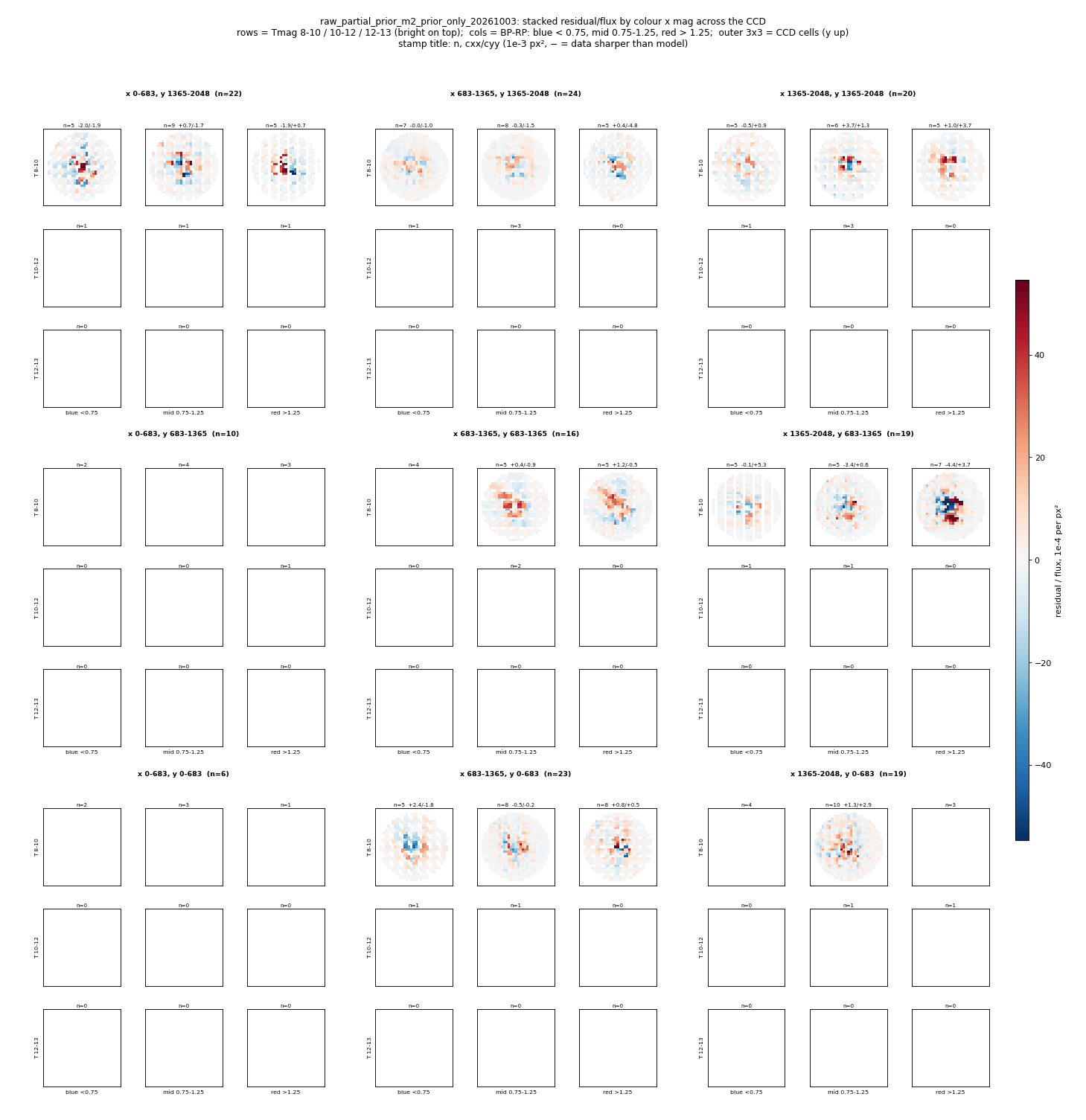
Required matched colour × Tmag × CCD residual grids: both masks and both recipes
All eight images were inspected. Full original clean masks evaluate both recipes, including hidden pixels. There are 165 inputs, 159 within standard magnitude/position range; empty bins are not evidence of a good model. The canonical renderer chooses automatic scales per image, so use the shared-scale pixel comparison above for amplitude comparisons. Relative grids subtract the cell-wide stack.
The existing shared gallery now includes these four labels while preserving all 119 prior entries. The unavailable external Artifact mirror was not republished. The first two execution attempts remain recorded as failed; the final run exactly replays all 94 and 172 saved source arrays respectively, with the support failures preserved.
Conclusion: this five-mode static correction is rejected as a replacement. It demonstrates why lower retained-pixel residuals cannot certify missing-light recovery. Next constrain hidden-profile predictions from independent fully observed sources and test normalization-dependent shape weighting, keeping source/time exclusions and astrophysical signals intact. No new references or production products are changed. Equations, convergence and leakage checks, complete outcomes and remaining work.
Broader reference support: missing-light accuracy is the next gate
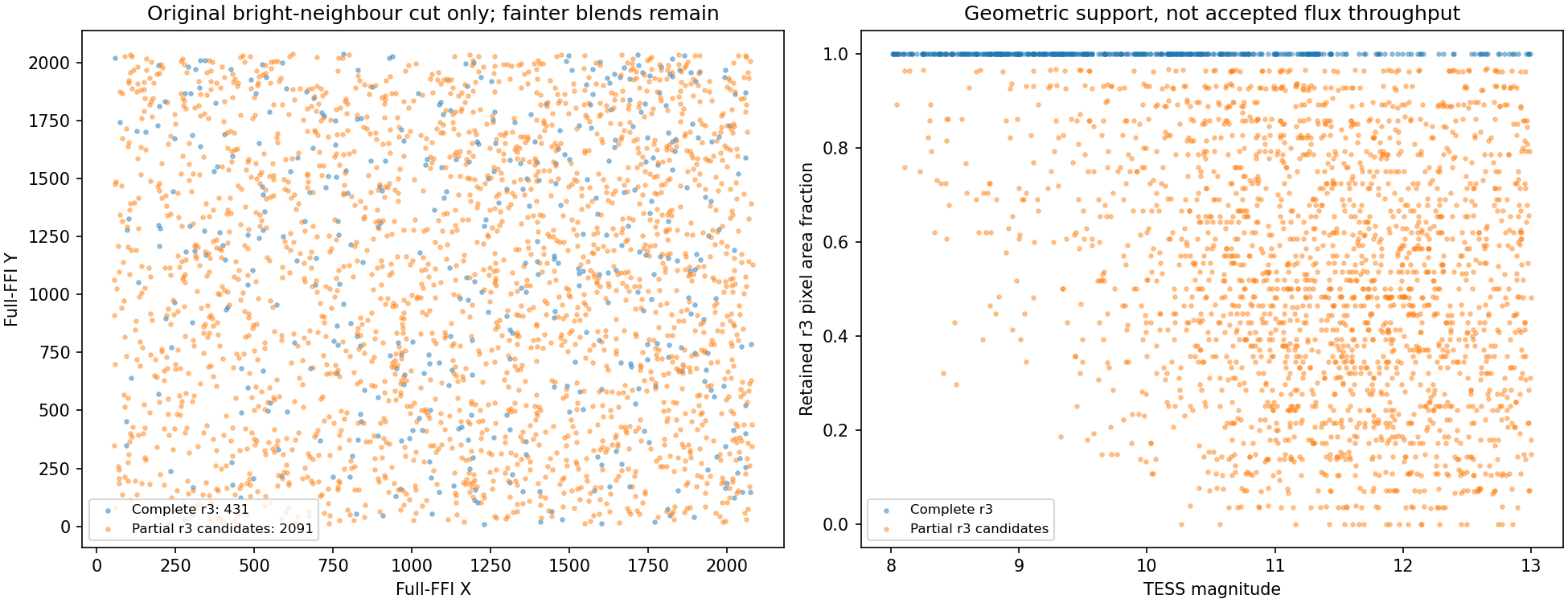
An explicit inventory-only loader option preserves all existing defaults, catalogue cuts and masks while exposing incomplete cores. It finds 2,522 geometrically supported candidates: the existing 431 complete-r3 sources replay exactly, plus 2,091 partial-r3 candidates. These are not accepted new references. The bright-neighbour catalogue cut ignores neighbours fainter than T=13; actual masks include them.
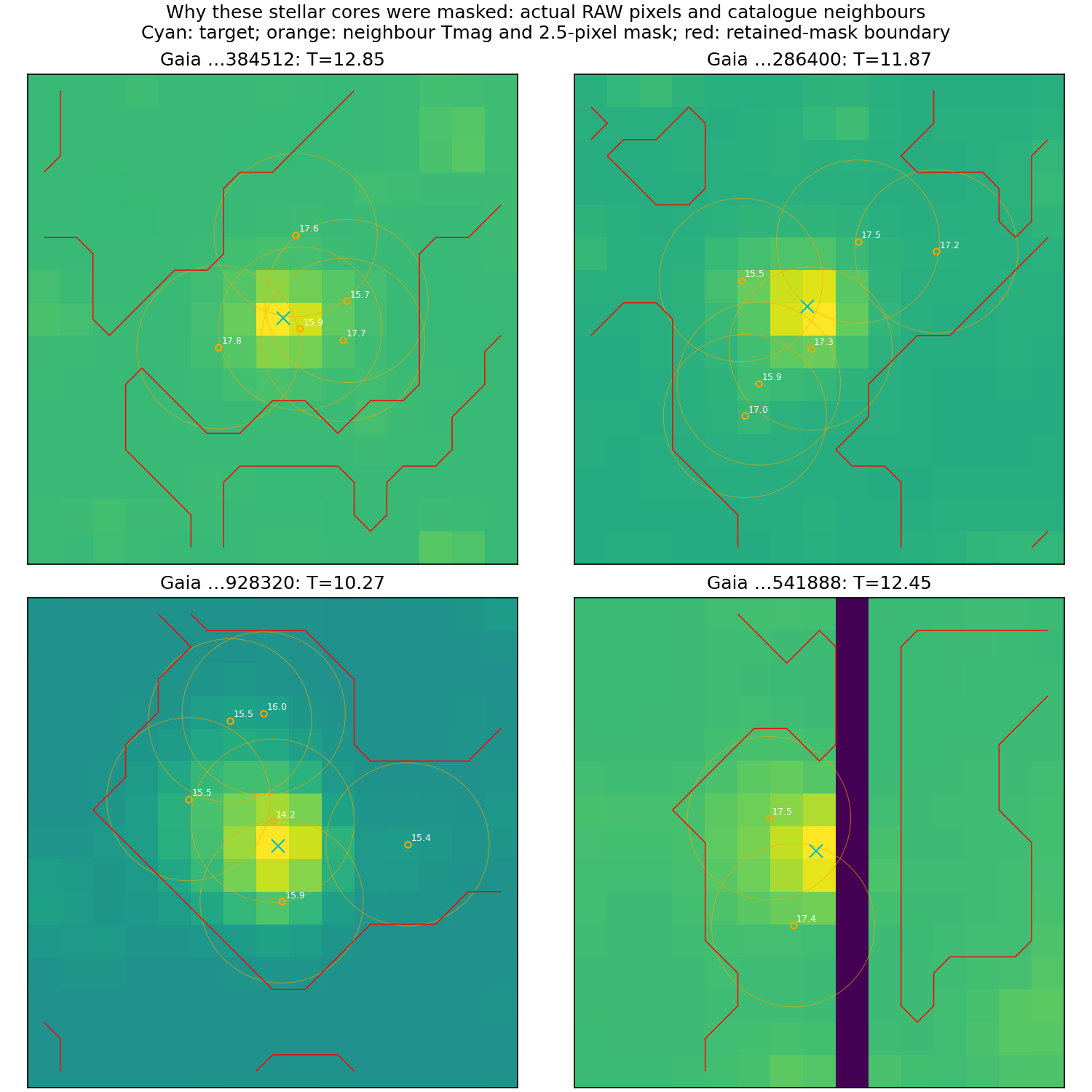
Four zero-core examples have real catalogue neighbours inside the mask radii. A source passing the old bright-neighbour cut is not necessarily isolated from fainter blends. Catalogue flux ratios are not measured aperture contamination; the exclusions cannot simply be removed.
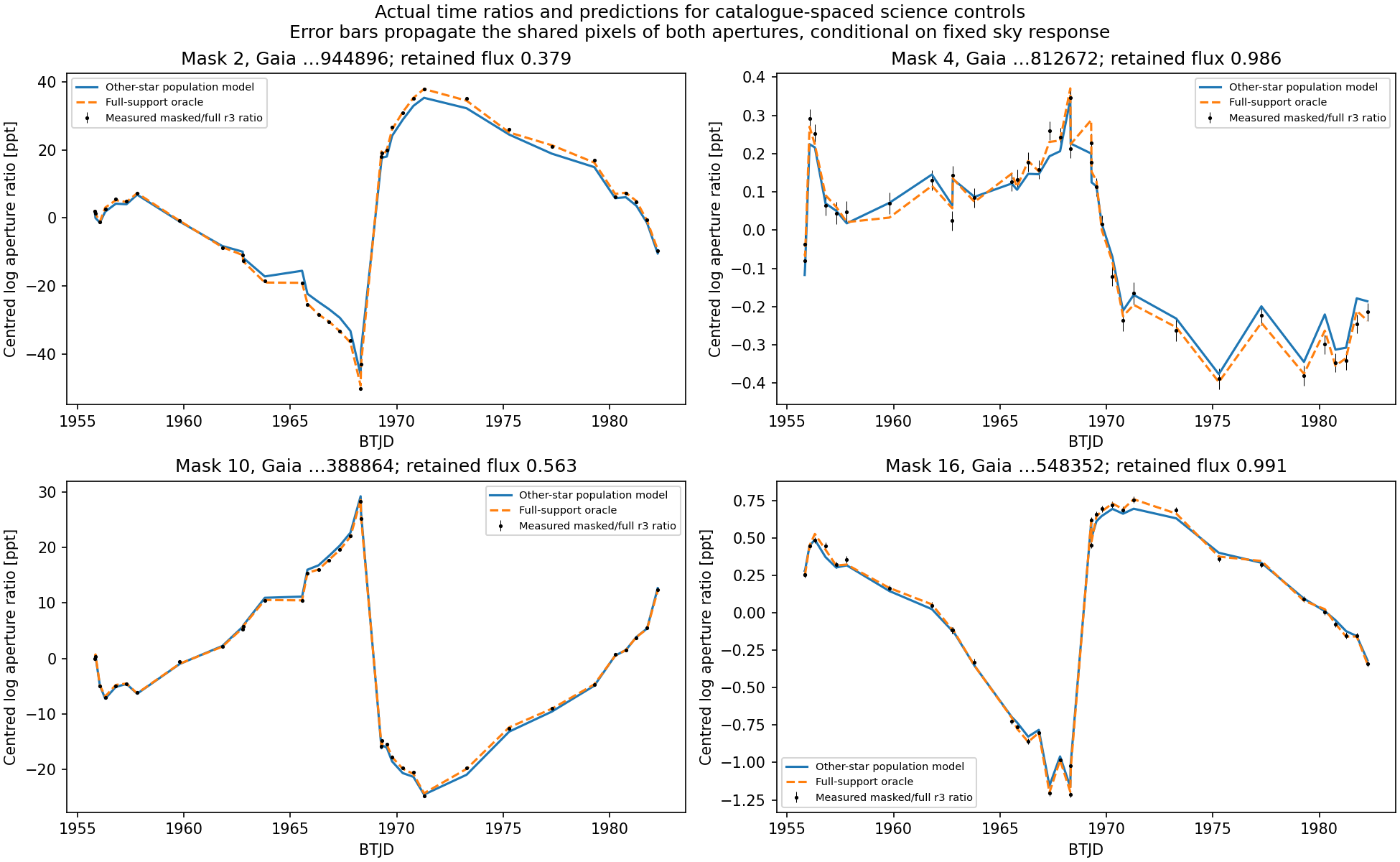
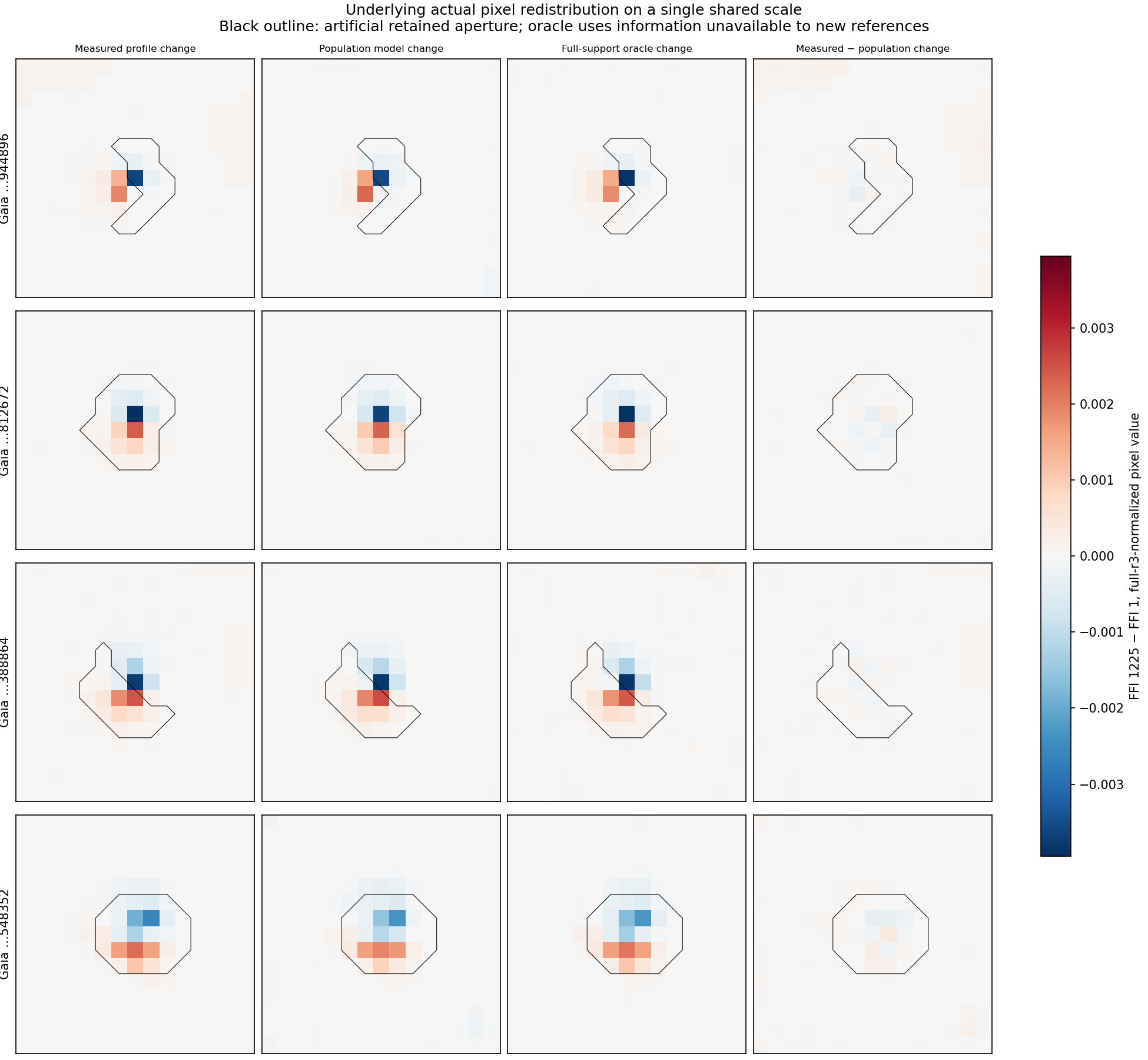
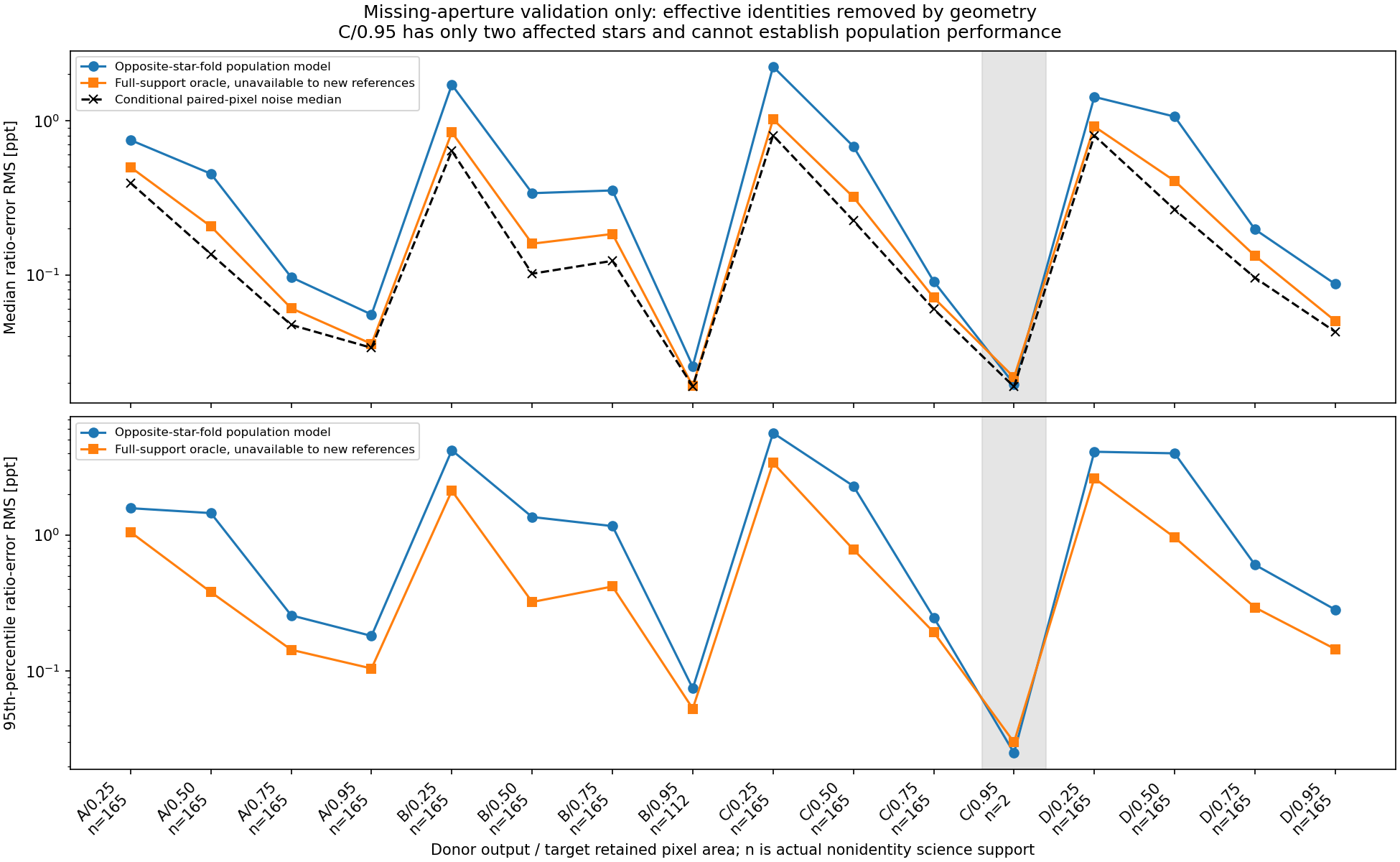
Sixteen real mask patterns, chosen by geometry before examining histories, plus an identity control are applied to all 172 existing clean science stars on the original 36 FFIs. The unchanged 165 eligible subset is scored. Existing opposite-source-fold population PSFs use measured WCS and blur/focus fields; no temporal ratio coefficient is fitted. A full-support empirical source profile is an explicitly nondeployable oracle because its missing pixels would be unavailable for the new references.
The population model improves 99.71% of 2,424 genuinely nonidentity star/mask comparisons. For two half-area patterns, median uncorrected ratio RMS 9.674/18.470 ppt falls to 0.452/0.679 ppt. Most motion-induced aperture variation is predicted, but the remaining error matters. Severe patterns retaining median flux fractions 0.058–0.180 leave residuals 0.746–2.232 ppt; lightly affected patterns can reach tens of ppm but do not establish blanket acceptance.
Transferred detector-pixel masks sometimes become identities at another subpixel centre: 53/165 cases for B/0.95 and 163/165 for C/0.95. They are explicitly separated from missing-light validation; C/0.95 has only two affected stars. Conditional error bars do not include learned-profile/WCS/shared-CAL covariance and are not a certified photon floor.
Conclusion: temporal PSF/WCS modeling removes most artificial-mask variation, but missing-light and real-neighbour errors still gate broader reference photometry. No new references or correction are adopted. Next validate a profile/neighbour model using genuinely available pixels while retaining the full fainter/crowded-star objective. Equations, fixed support, exact controls, source provenance and next requirements.
Reference mixing across readout boundaries: real transfer weakness, no general cure
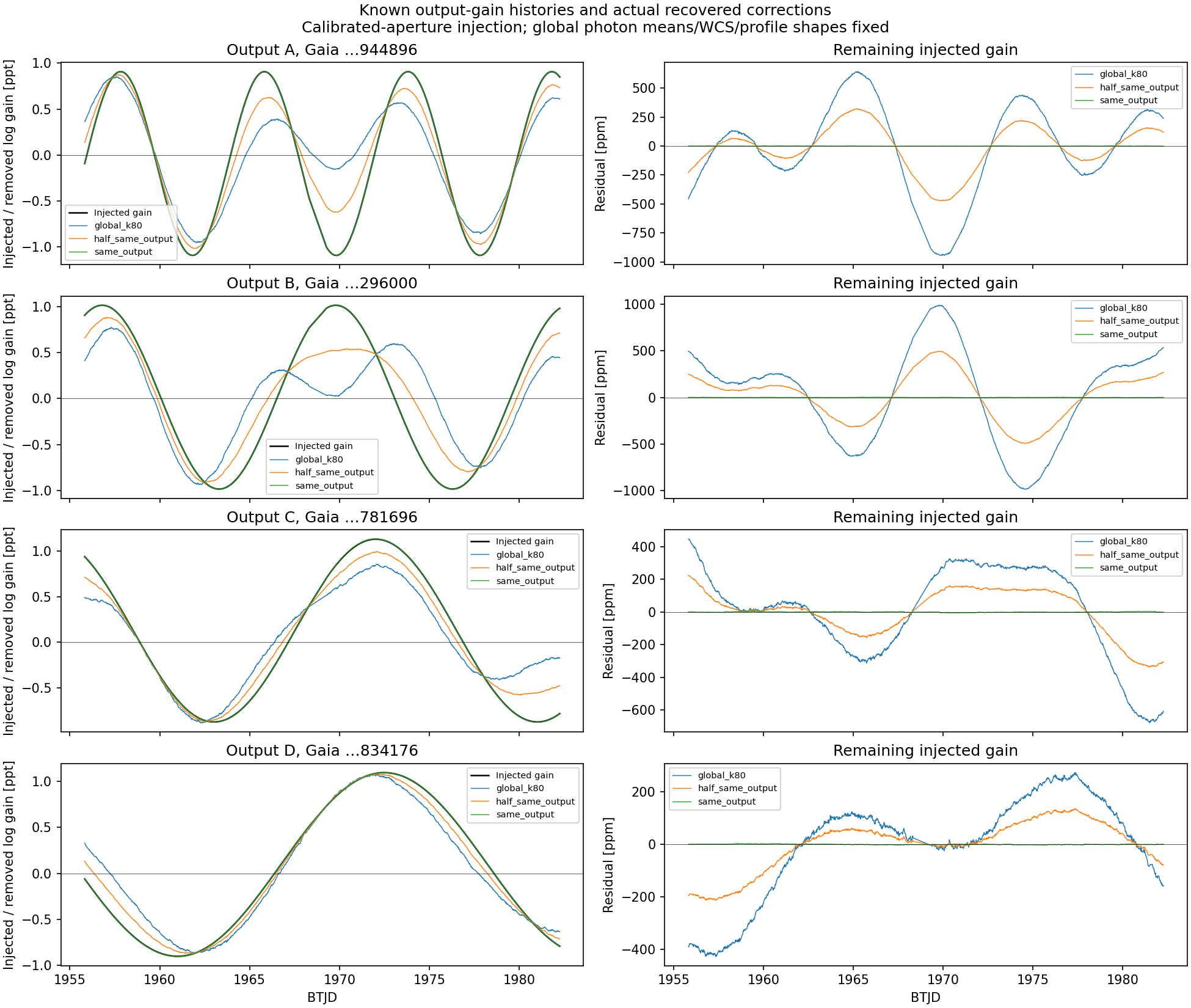
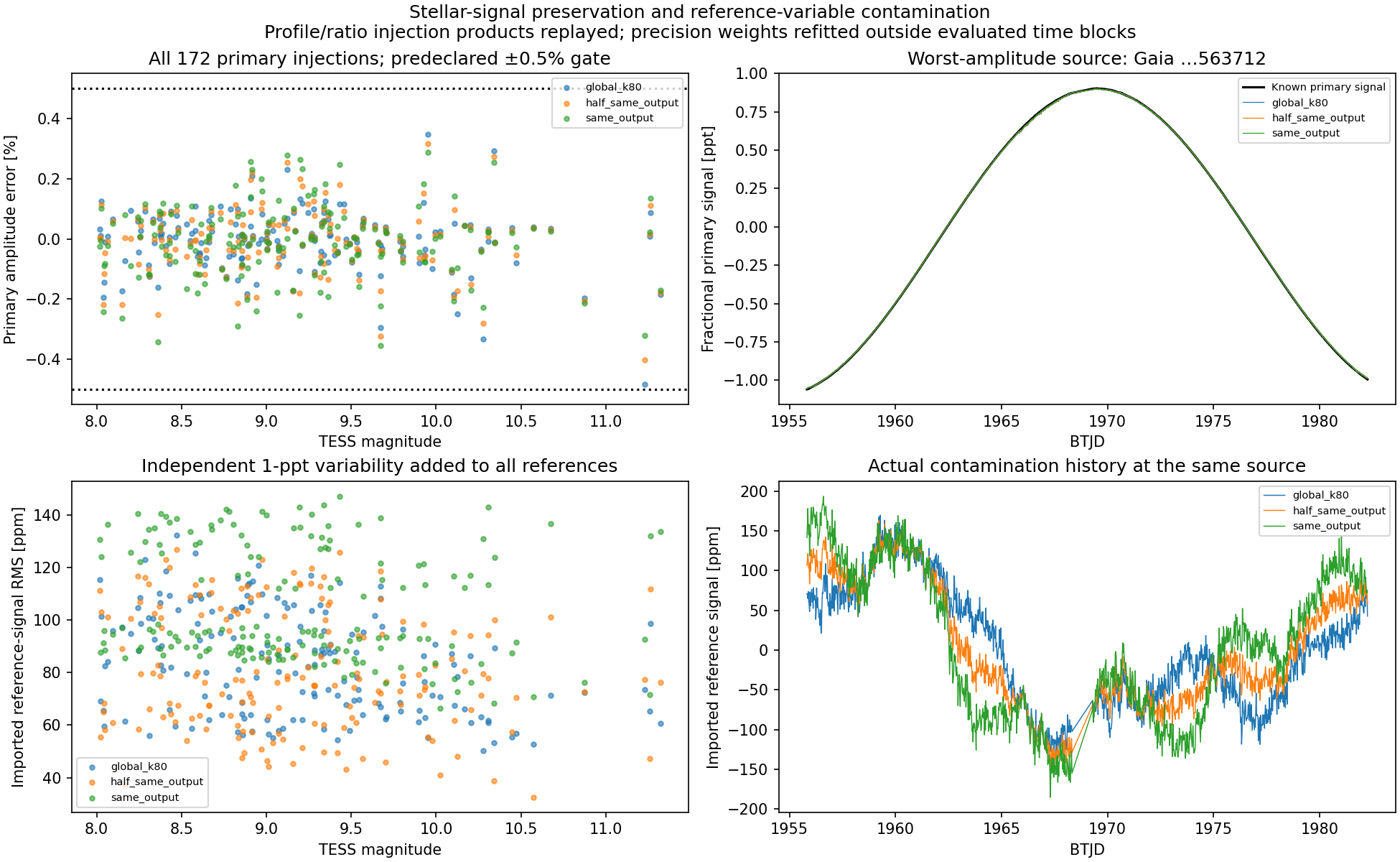
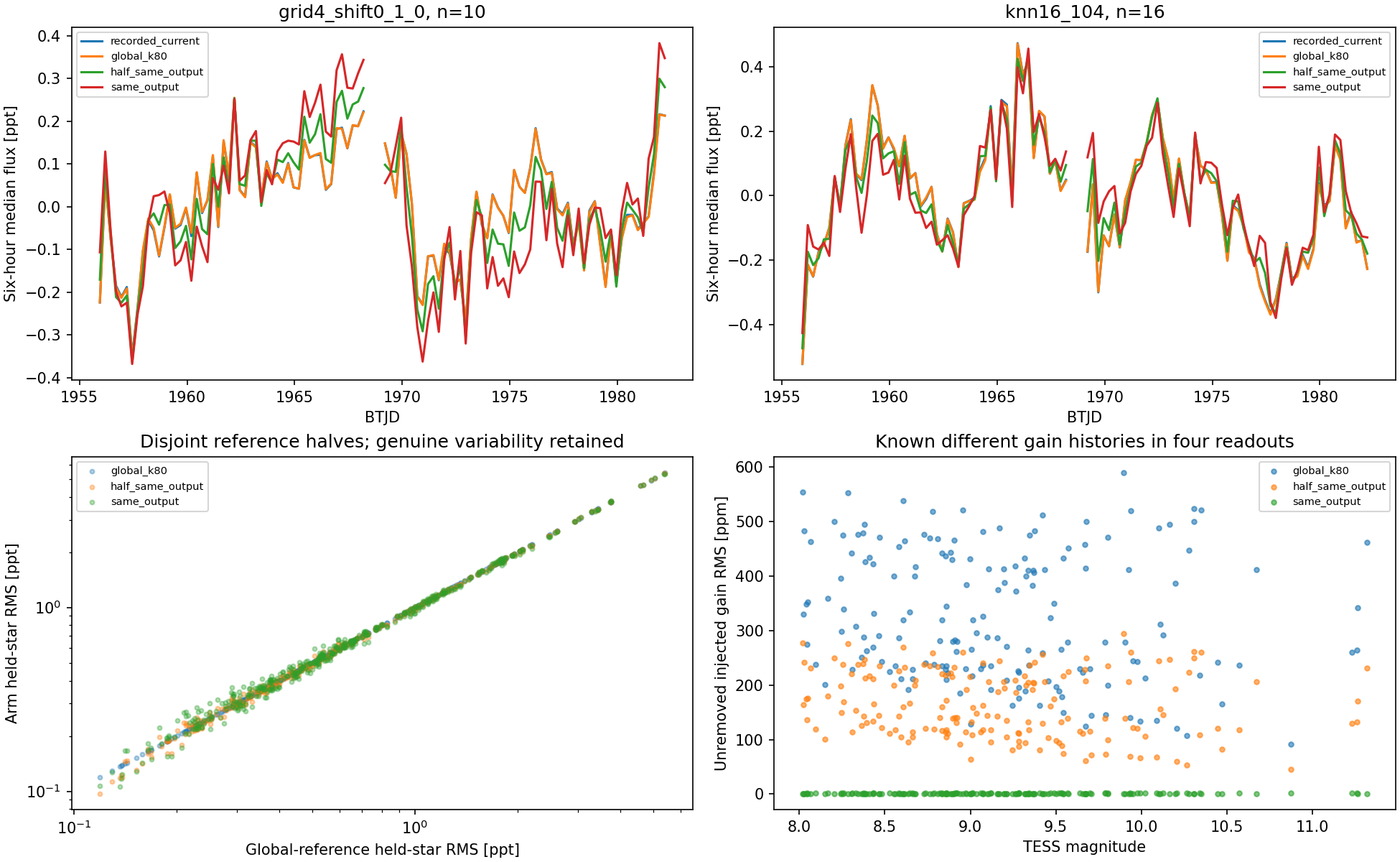
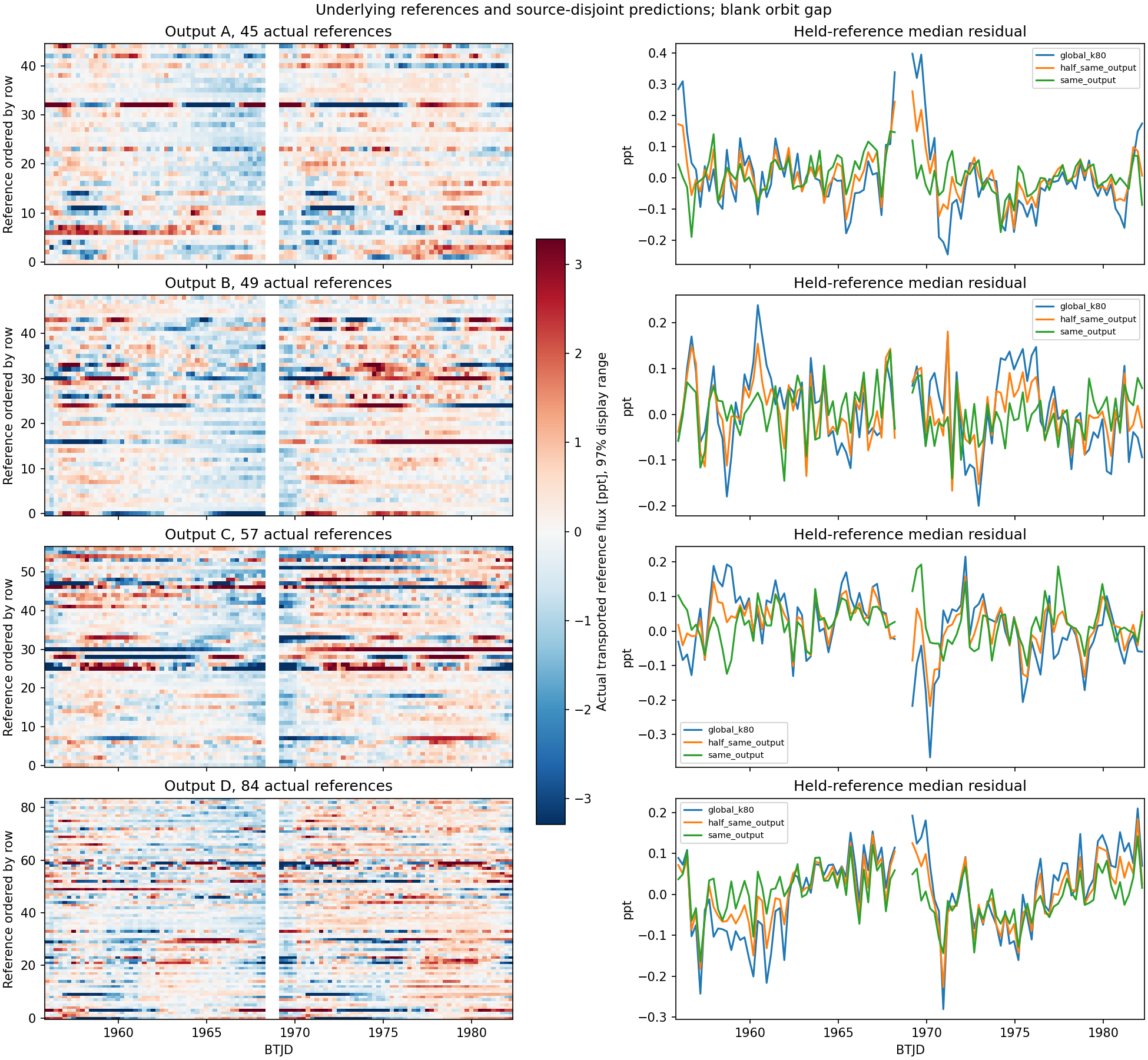
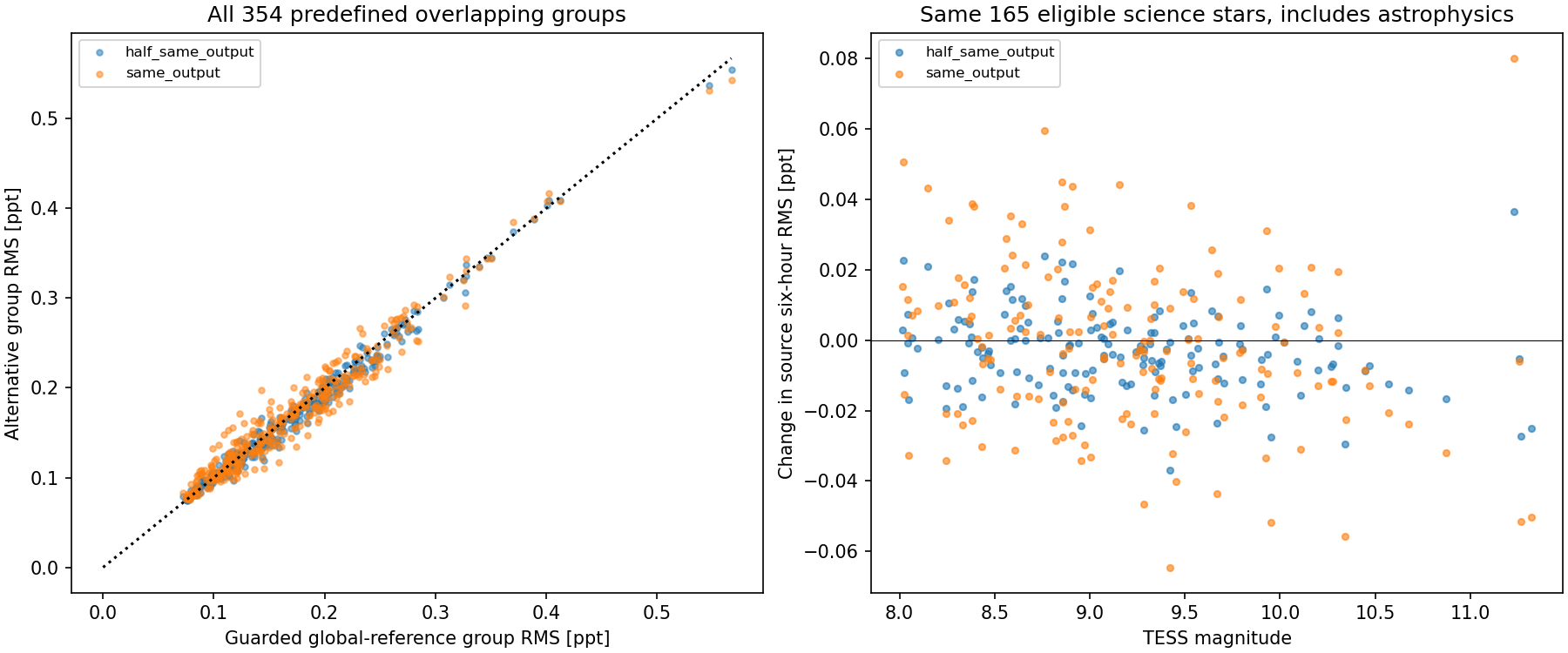
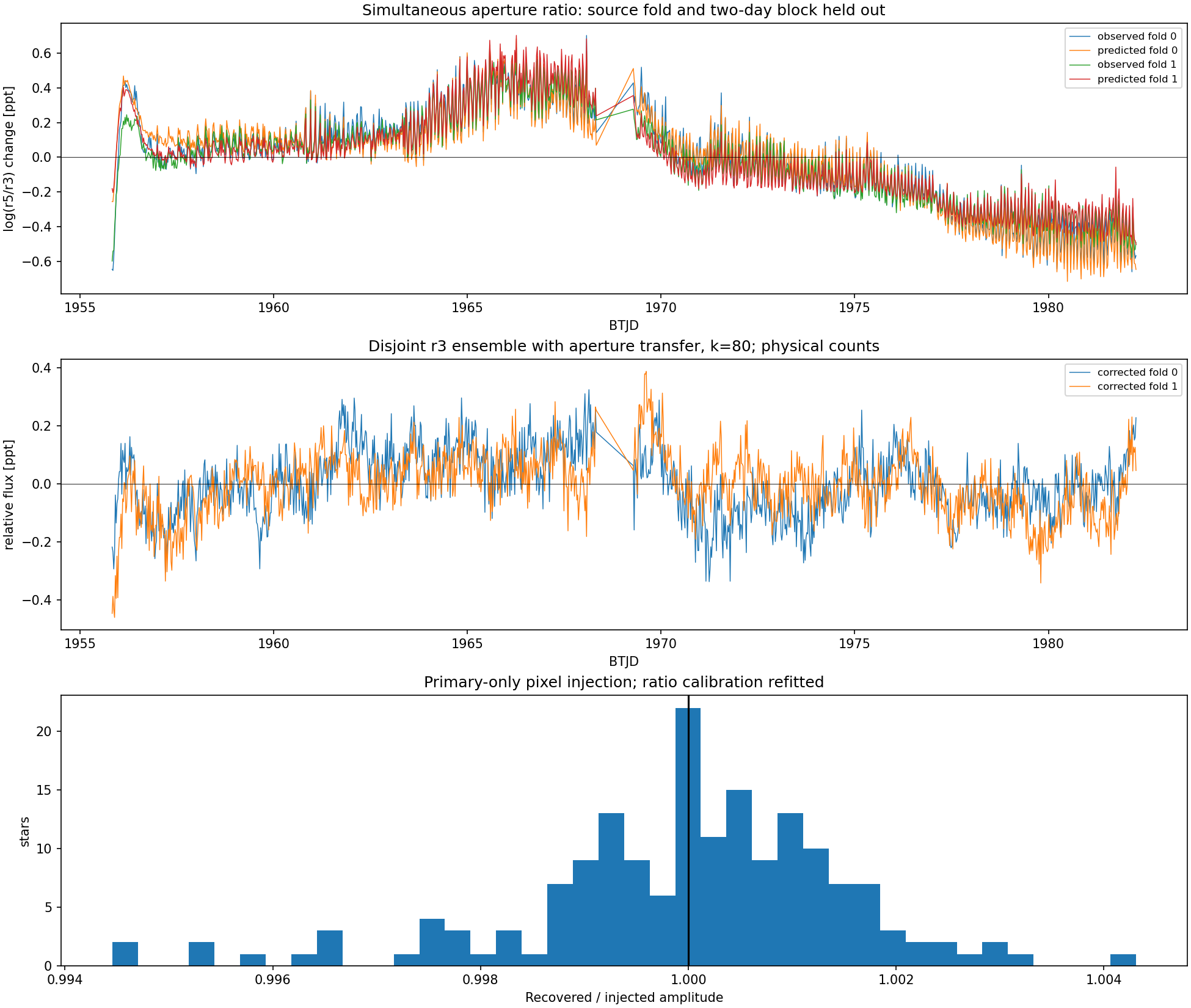
Three predeclared arms retain the same 172 science sources (165 eligible), 235 disjoint references and 1,224 FFIs: global k80, a fixed half same-output mixture, and same-output-only references. Output A/B/C/D has 45/49/57/84 references. Precision training excludes the evaluated two-day block and uses that exact outer source-fold/block ratio coefficient. Full-history constant normalizations and upstream WCS/profile/response models remain fixed.
A known 1-ppt output-specific gain leaves median/p95 residual 302.69/514.50 ppm with global references, 150.95/257.17 ppm with the mixture and 1.09/1.80 ppm with same-output references. This is calibrated-aperture transfer, not a physical detector injection. The existing mixed-output correction is therefore not validated removal of arbitrary readout-specific gain changes.
All three pass the predeclared 0.5% primary amplitude gate (worst errors 0.4821/0.4016/0.3540%). Reference-variable injection has median/p95 contamination 83.61/114.49, 77.56/116.53 and 94.81/140.32 ppm. Same-output calibration imports more variability from its smaller reference ensemble.
On actual data, the 10-star group RMS worsens from 0.12342 to 0.17116 ppt while the 16-star group changes 0.18378 to 0.16119 ppt; these include astrophysics. Source and held-reference median scatter has no general improvement. Reciprocal reference-half medians can partly cancel algebraically and are not a detector-truth test.
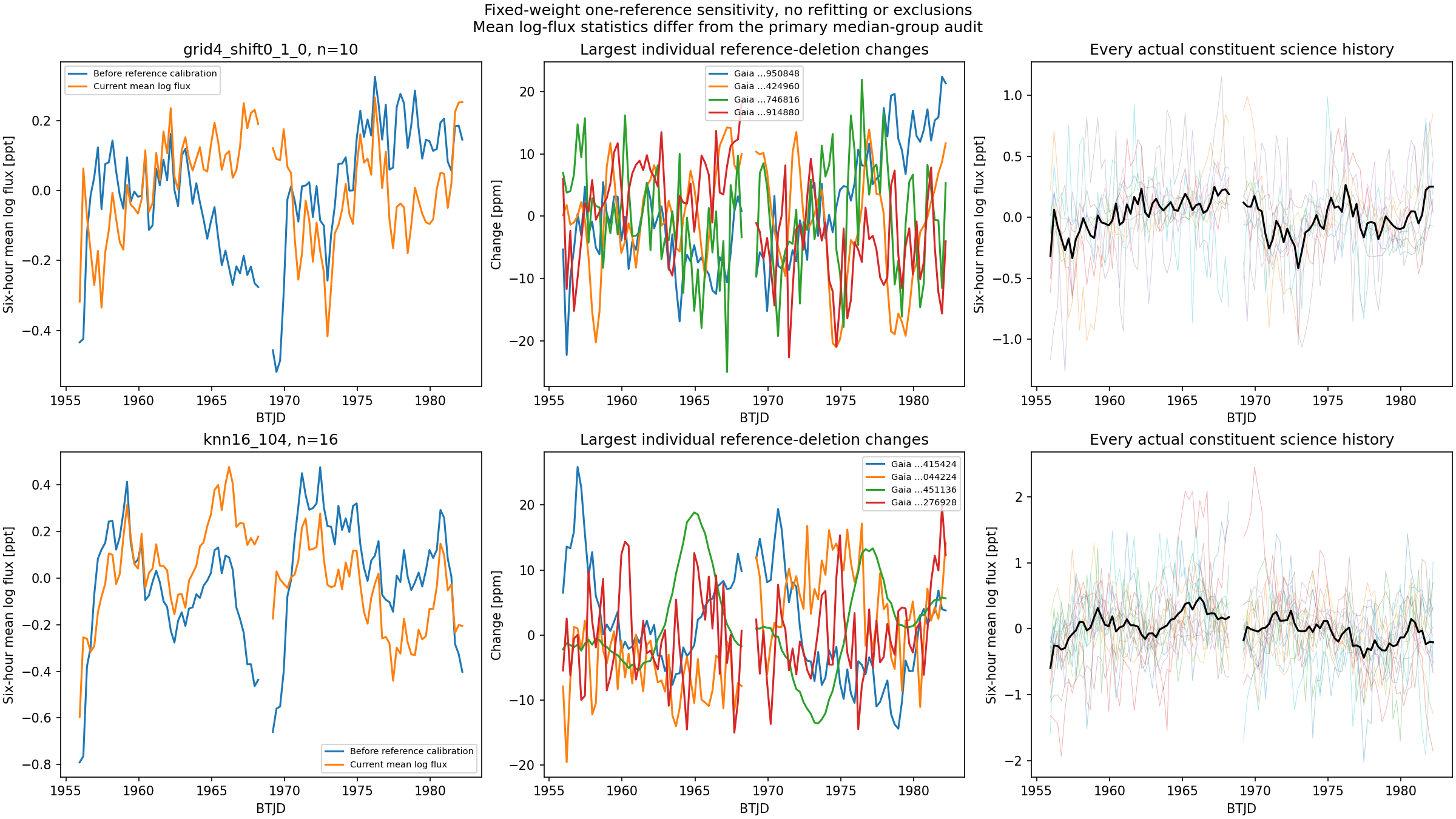
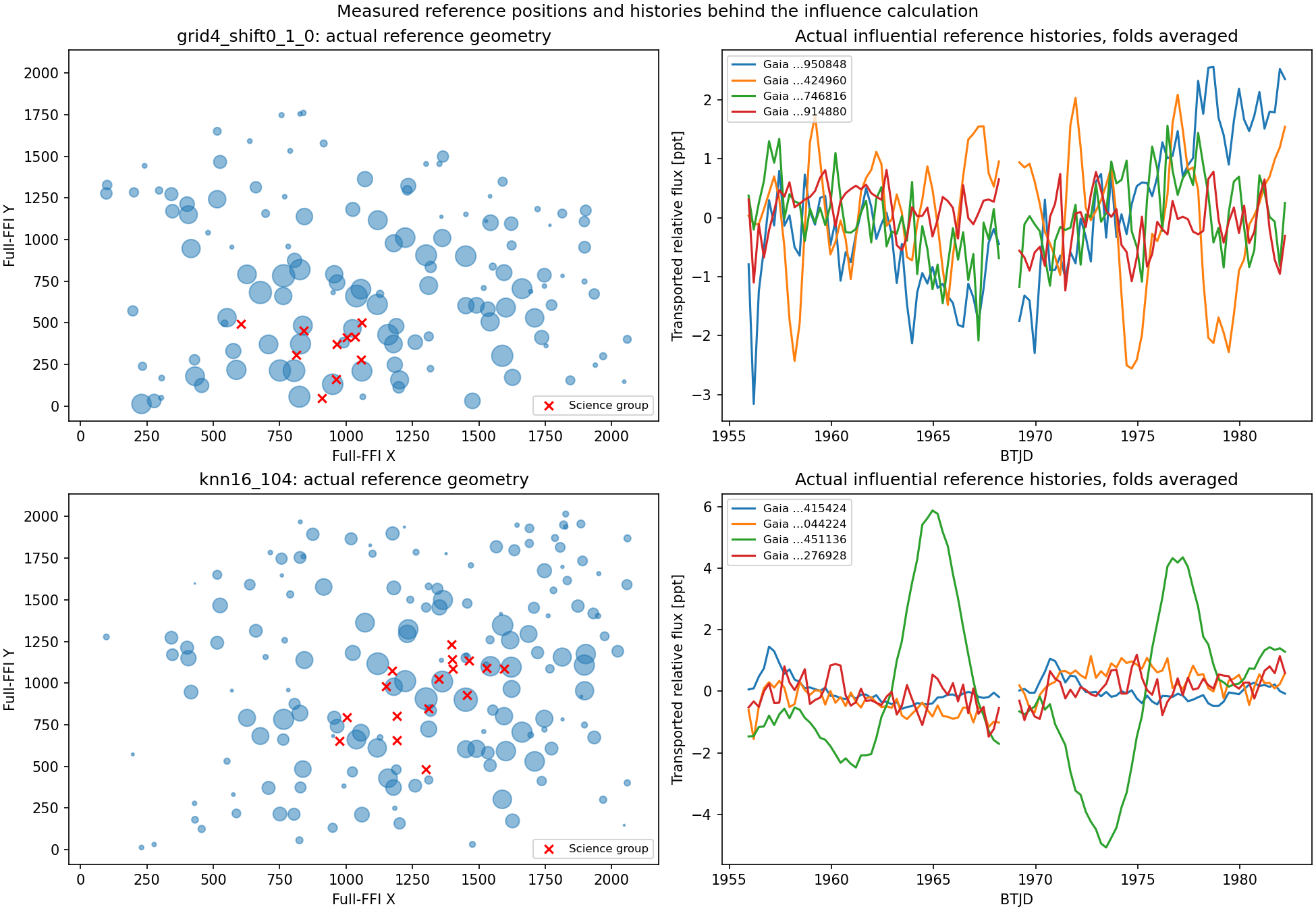
One-reference deletion does not explain the persistent groups
With all other weights fixed apart from normalization, the largest individual reference-deletion effects are 9.02 and 8.10 ppm, versus current mean-log group RMS 142.65 and 199.00 ppm. Mean-log statistics here are distinct from the primary median-group audit. No references are removed. Collective reference signals and weight-refit effects remain possible.
Conclusion: readout boundaries matter for calibration transfer, but this restriction alone is not the missing correction. No alternative is promoted. Broader validated reference coverage and the remaining spatial/colour/background/PSF effects are still required. Equations, exact holdouts, signal controls, limitations and all evidence.
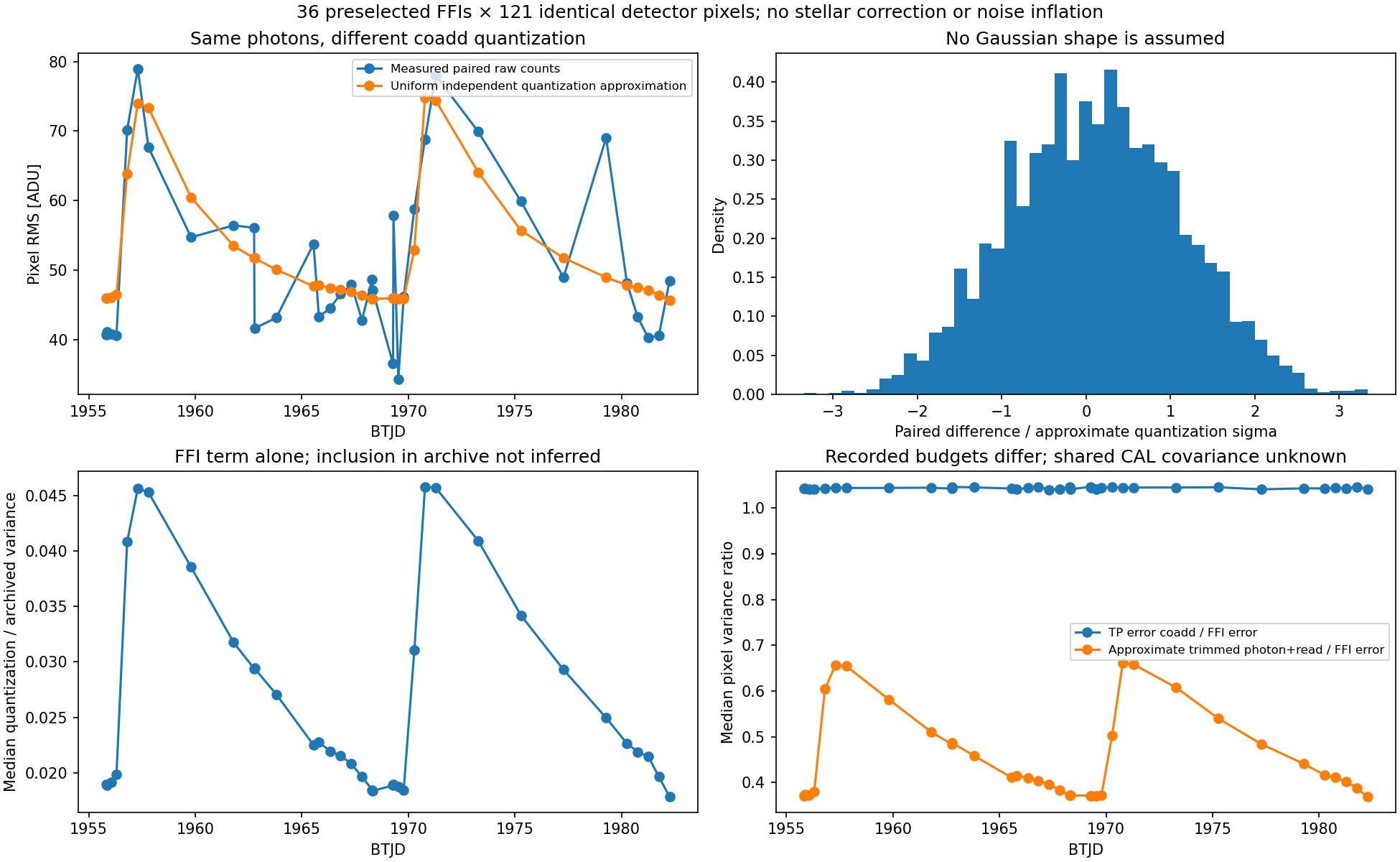
Coadd quantization: paired raw mismatch largely accounted for
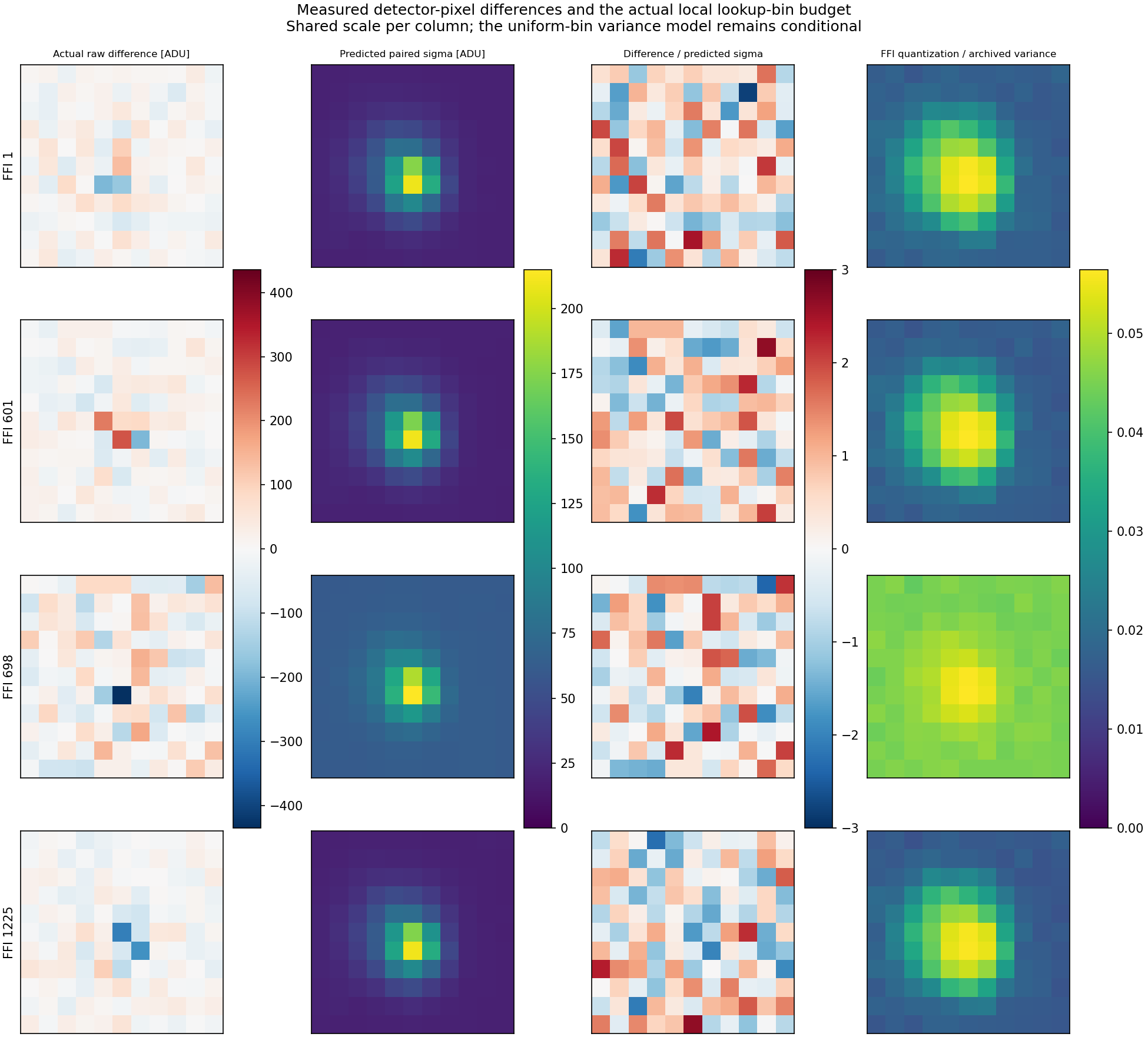
All tested raw counts lie exactly on the official TP and FFI reconstruction tables. On the fixed pilot's 36 FFIs × 121 identical pixels, all 4,356 paired differences are inside the nearest-cell allowed bounds. Independent uniform-cell moments predict the scatter closely (standardized RMS 1.02255), while a small signed offset remains.
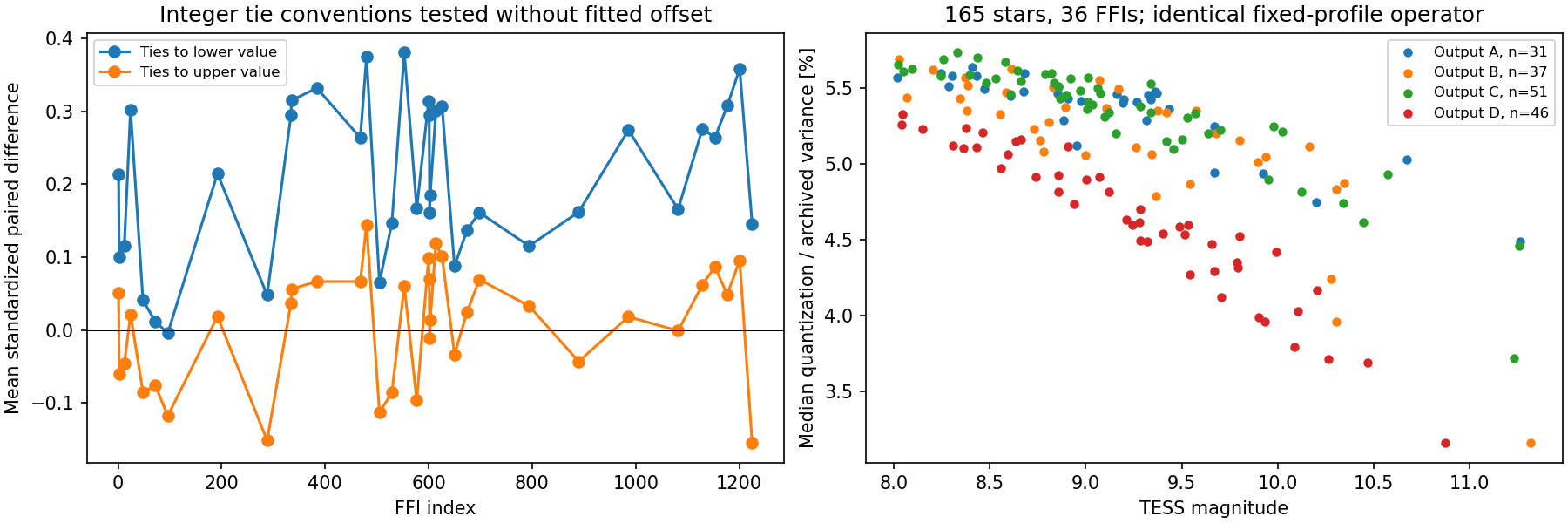
Integer cells with exact ties assigned upward predict a +3.11490-ADU average paired offset without fitting a parameter, leaving standardized mean 0.00789 and RMS 1.00971. Lower ties leave mean 0.20562. An independent nearest-distance encoder verifies both moment formulas on 66 synthetic integer inputs. Agreement supports a rounding convention; it does not prove flight software or calibration truth.
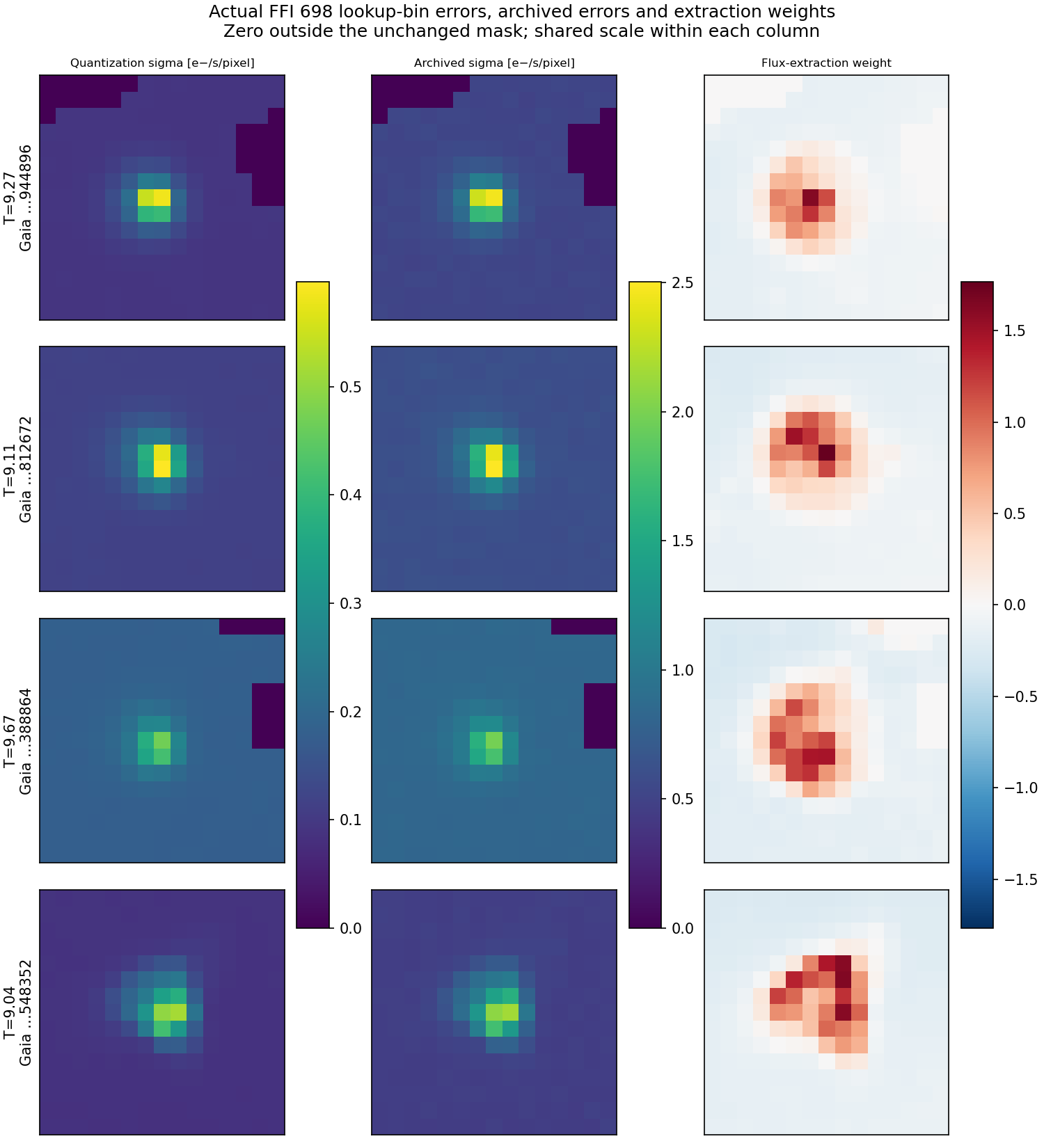
The unchanged 165 eligible stars on 36 FFIs have median fixed-profile quantization variance 5.248% of their propagated archived variance; the largest source/exposure ratio is 5.742%. Even if wholly missing and independent, the largest direct RMS increase would be 2.83%. Flux and archived-variance replay agree within 3.67e-8 and 6.47e-8 fraction. Learned profiles, WCS/global response and reference covariance are separate terms.
Archived inclusion remains unresolved. Later release notes explicitly changed propagation of static bias uncertainty; it must not be treated as independent noise on every exposure. Nothing is added to the noise floor and no light curve is changed. Conclusion: compression plausibly explains this raw-product mismatch but cannot supply a large missing direct-noise term under the tested estimator. Long trends and the full photon-limited goal remain unresolved. Exact equations, validation, source limitations, all figures and execution record.
Calibration scope and the current CCD-wide check
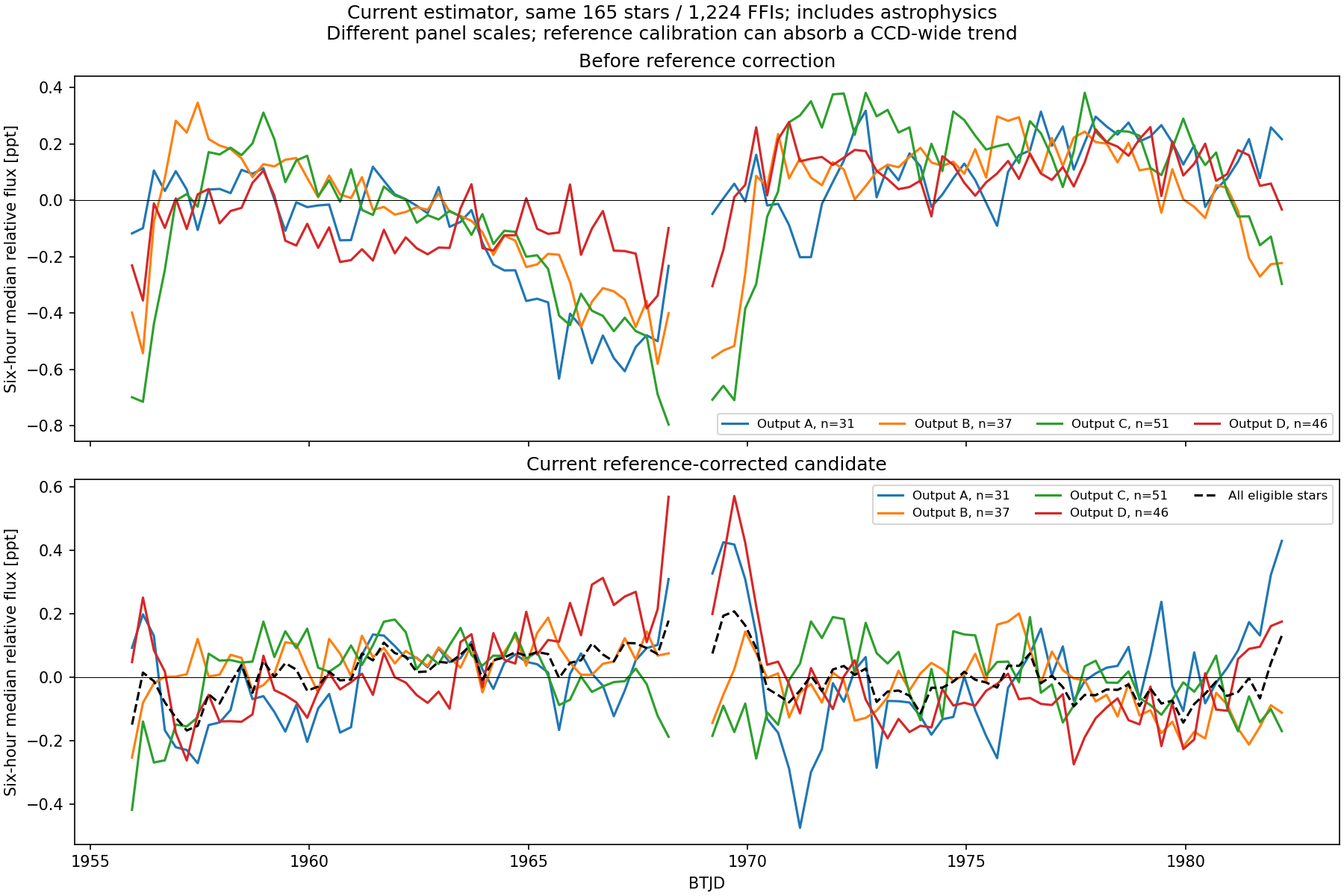
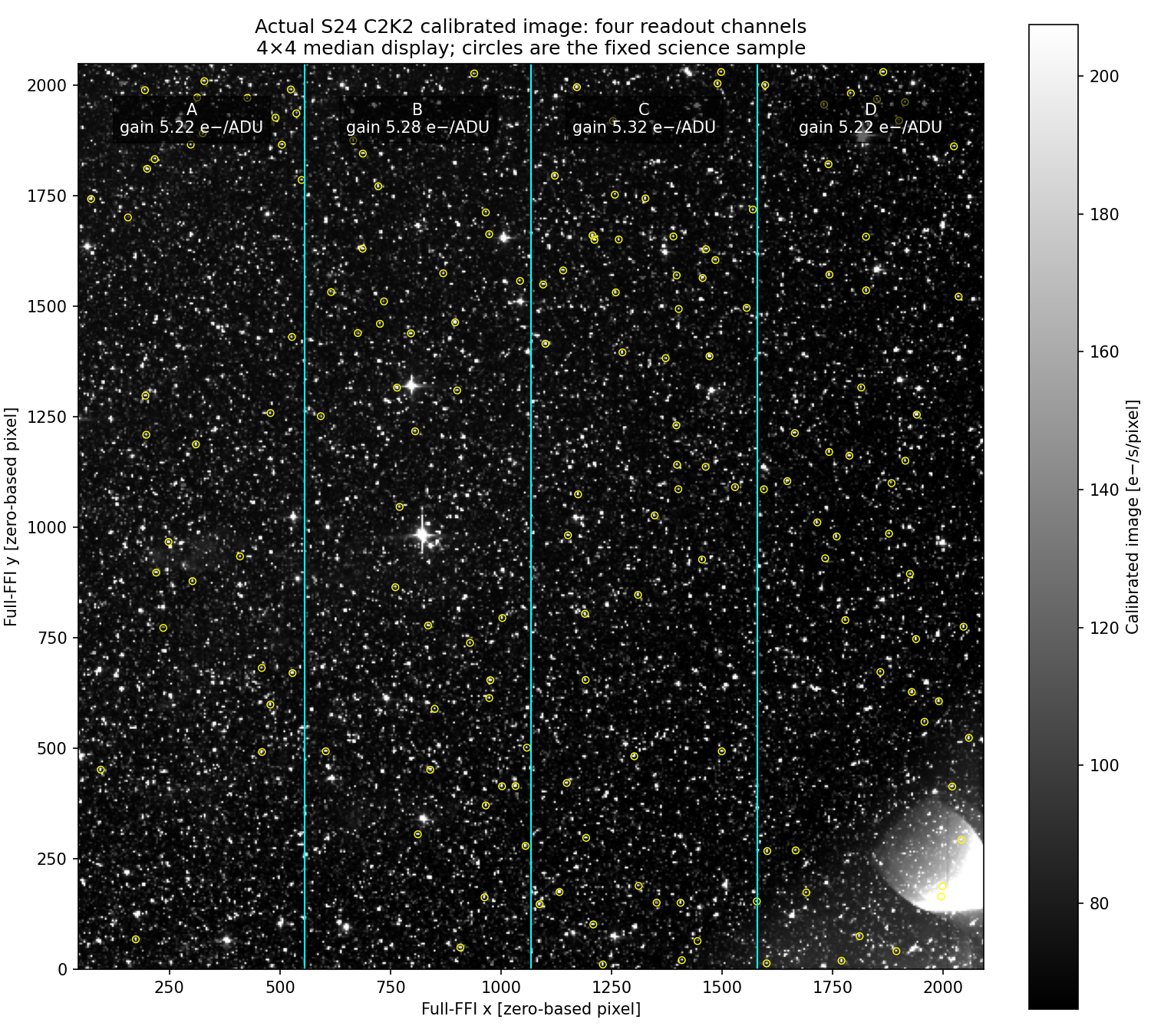
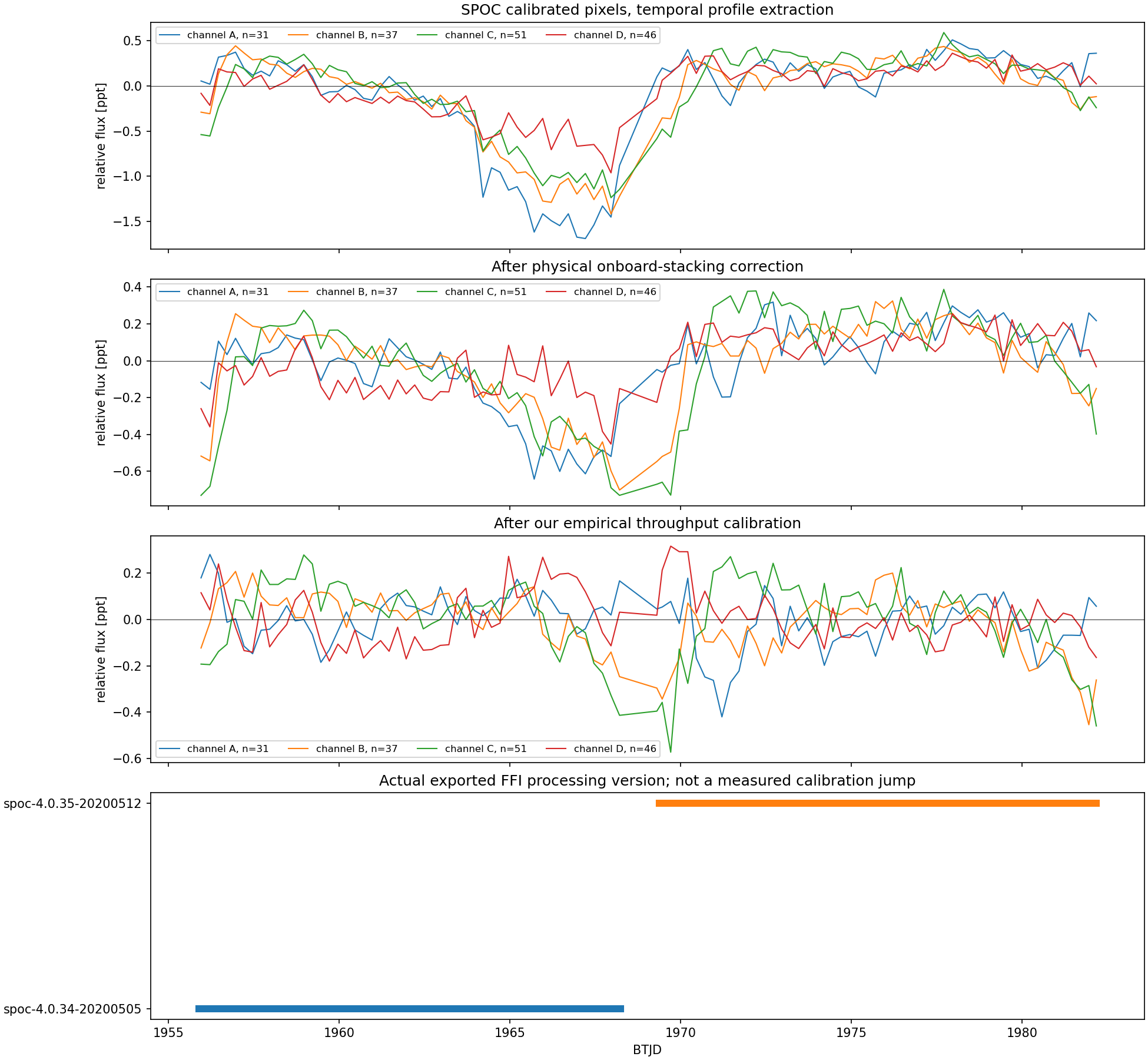
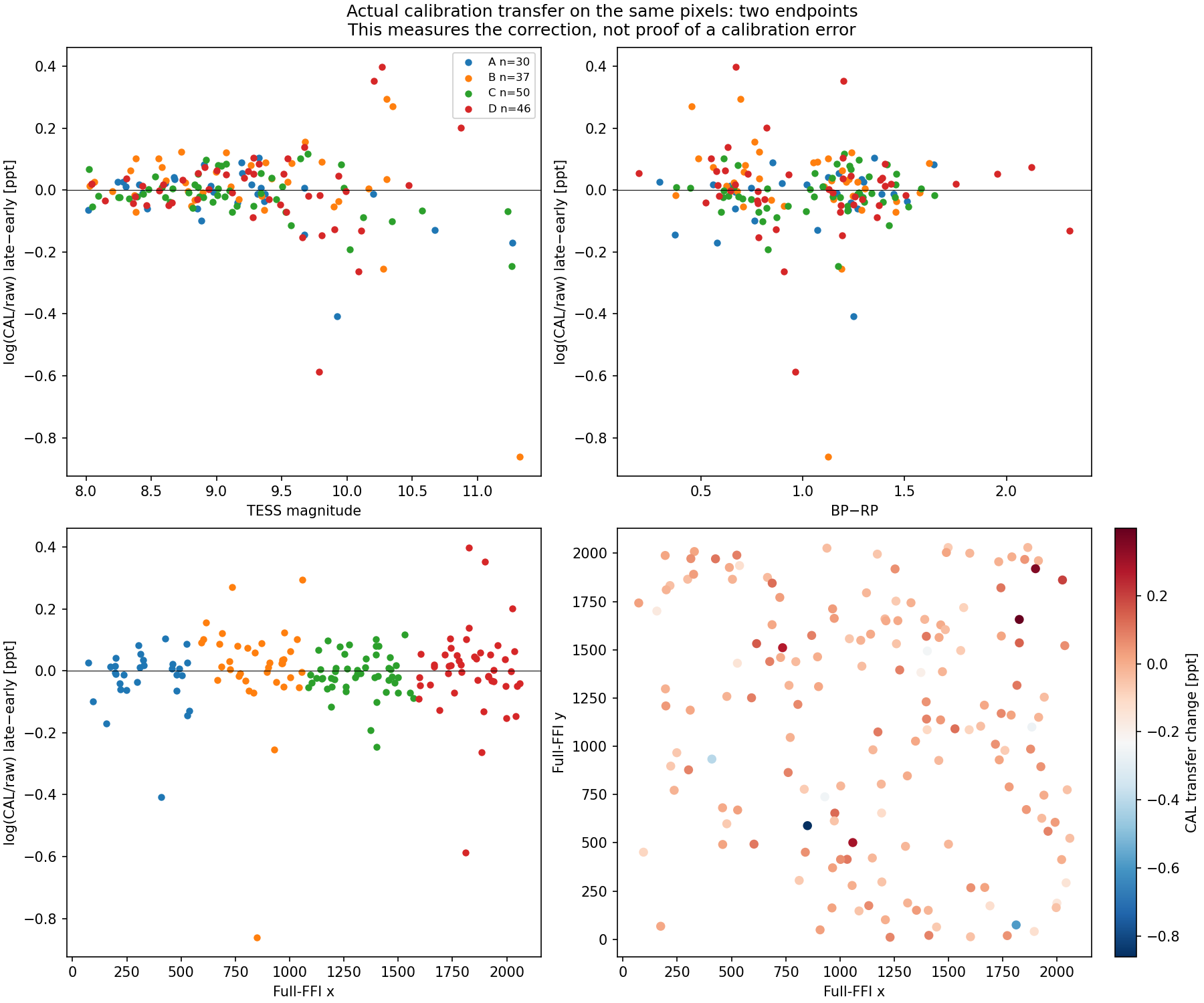
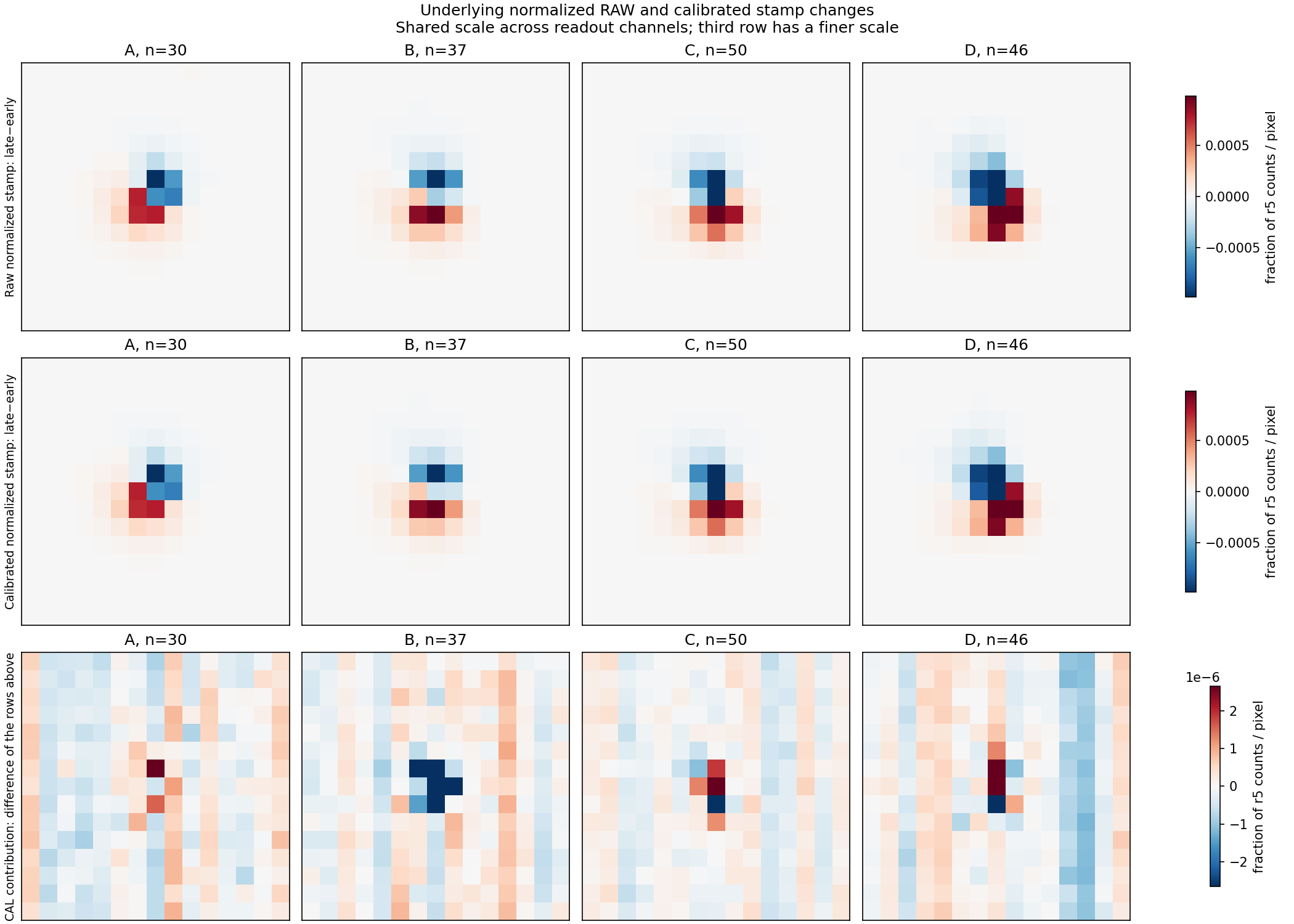
Our unsubtracted RAW inputs are SPOC-calibrated _ffic pixels. Calibration is not one scalar per CCD: it uses a two-dimensional bias map, exposure-dependent row bias, four output gain/nonlinearity responses, column smear and a pixel flat. The later reference-star correction is a separate stage and can absorb a CCD-wide instrumental drift. A small corrected ensemble trend cannot certify stable gain.
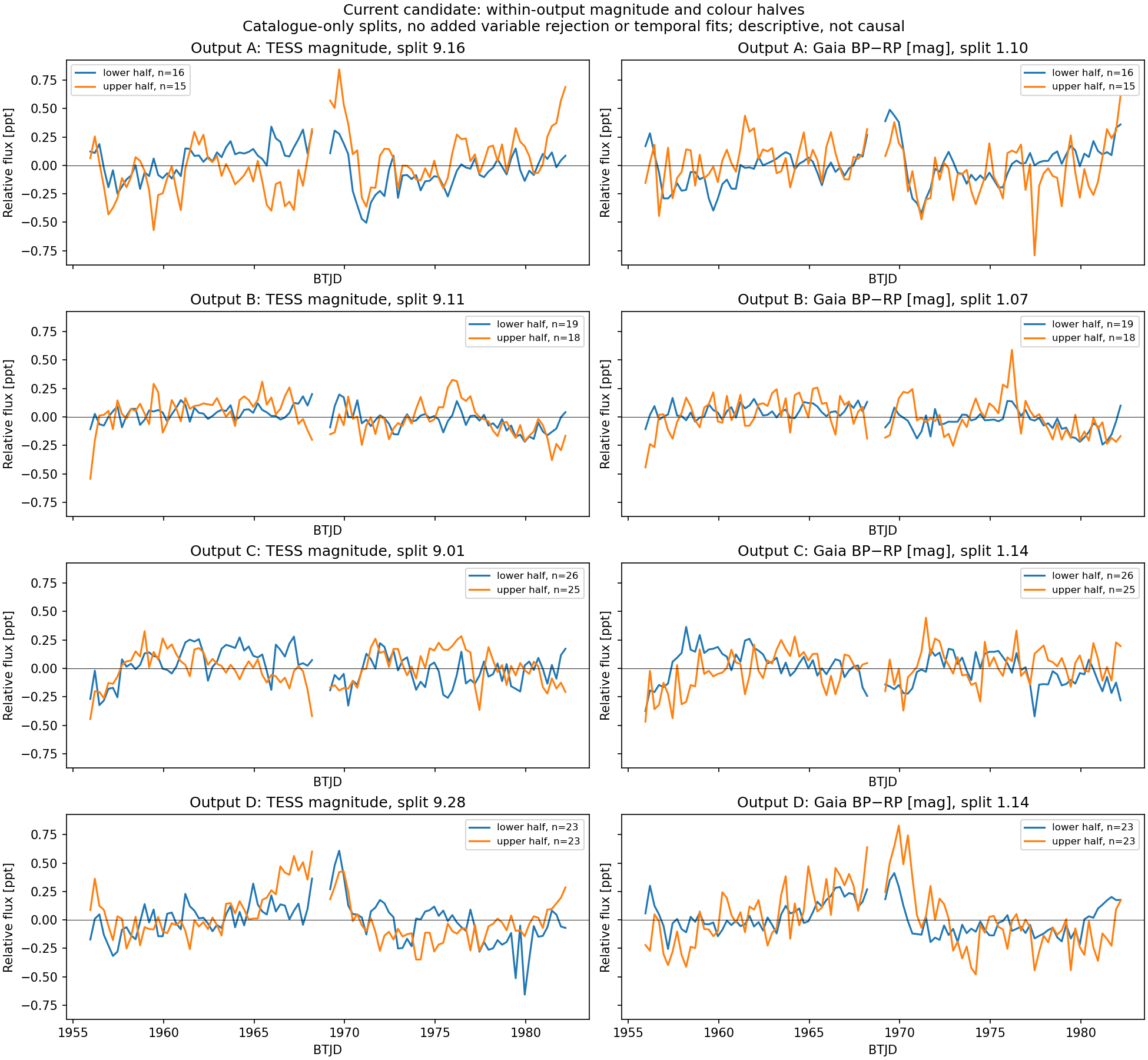
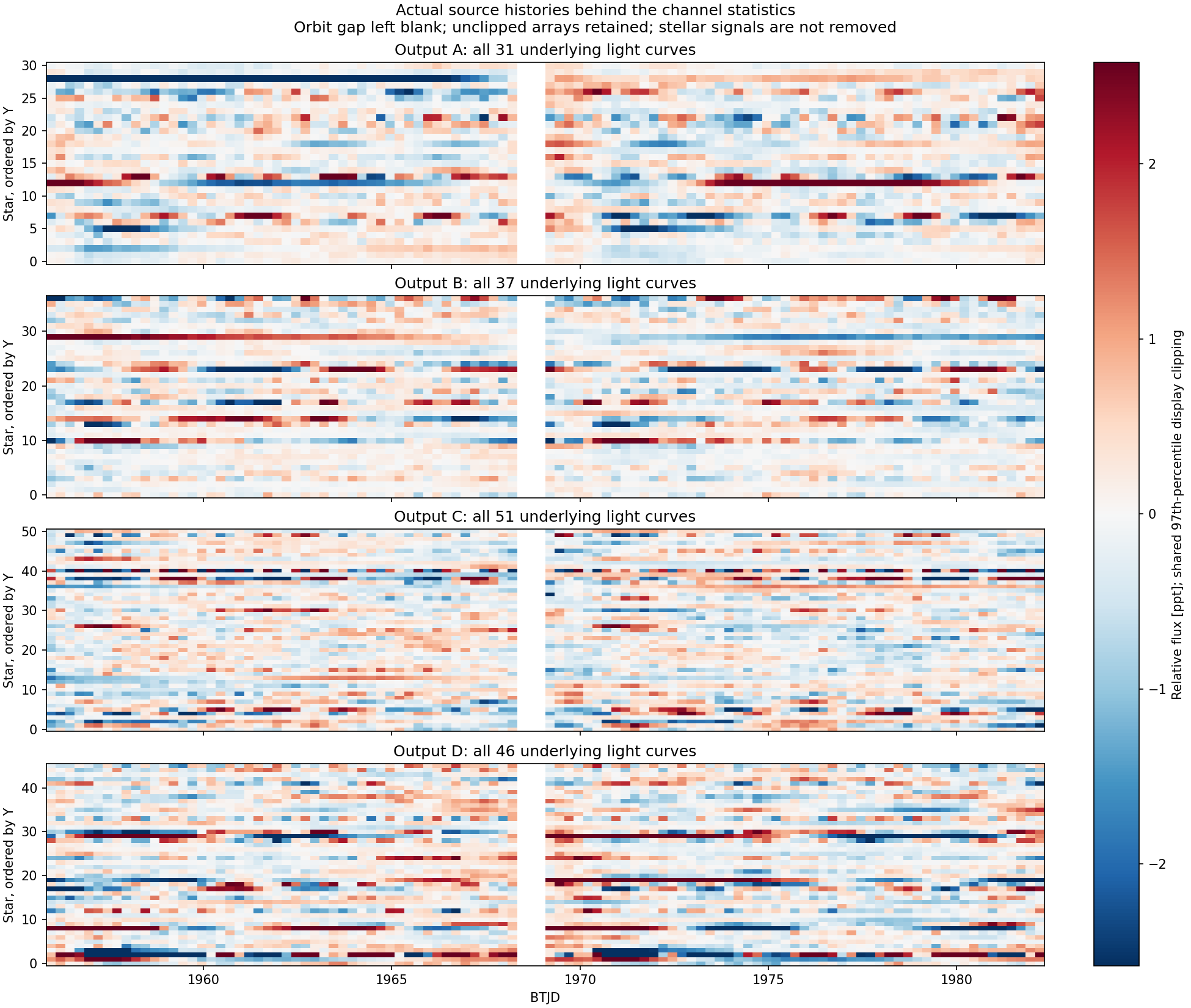
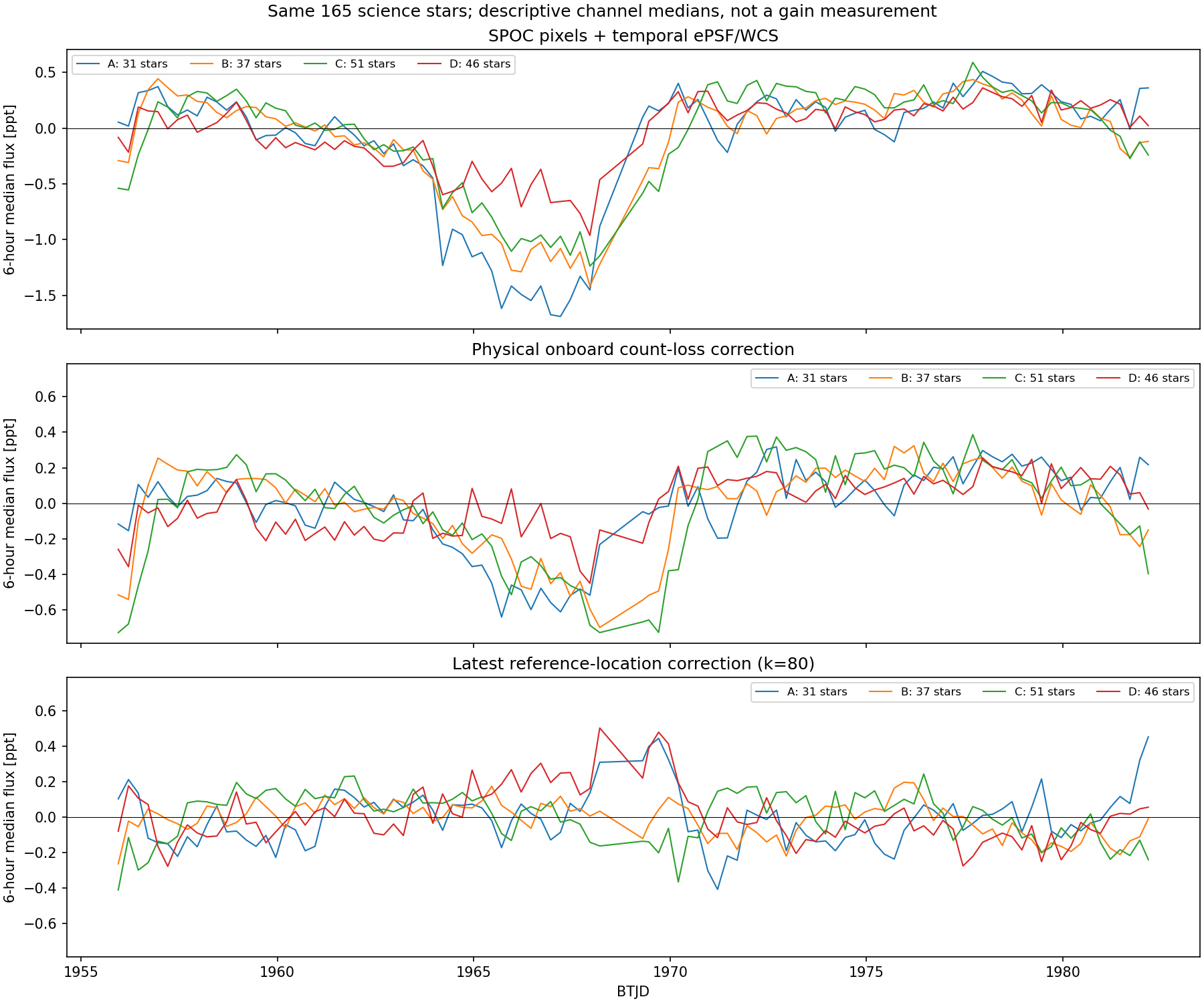
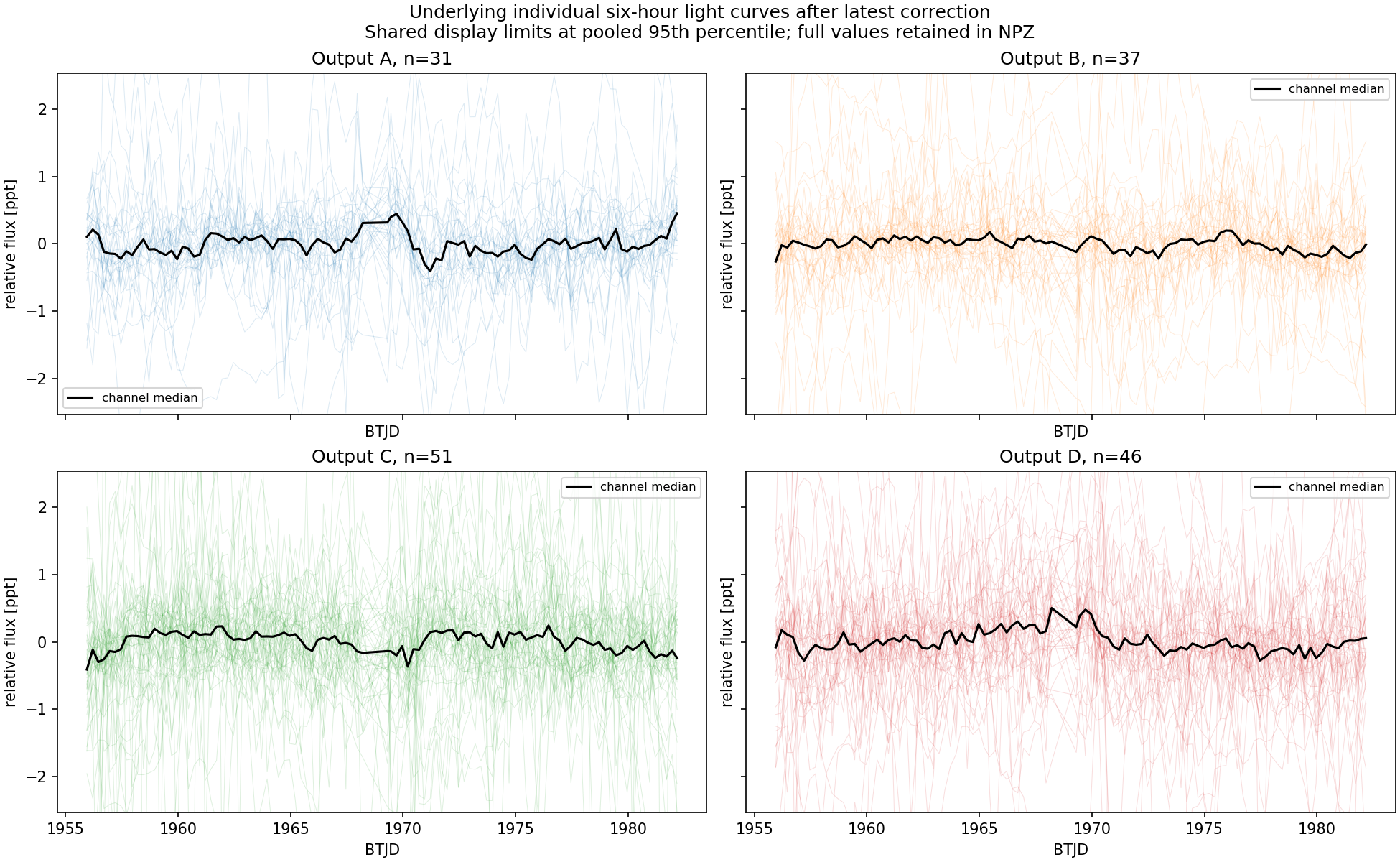
All 1,224 original FFIs and the same 165 eligible stars are retained. Current six-hour channel-median RMS is A/B/C/D = 159.61/96.18/117.19/161.38 ppm, with 31/37/51/46 stars; the full-cohort median is 74.26 ppm. These descriptive values include astrophysics and shared-reference effects, not an identified calibration error or instrumental significance.
Identical TP/FFI pixels isolate the large pilot discrepancy
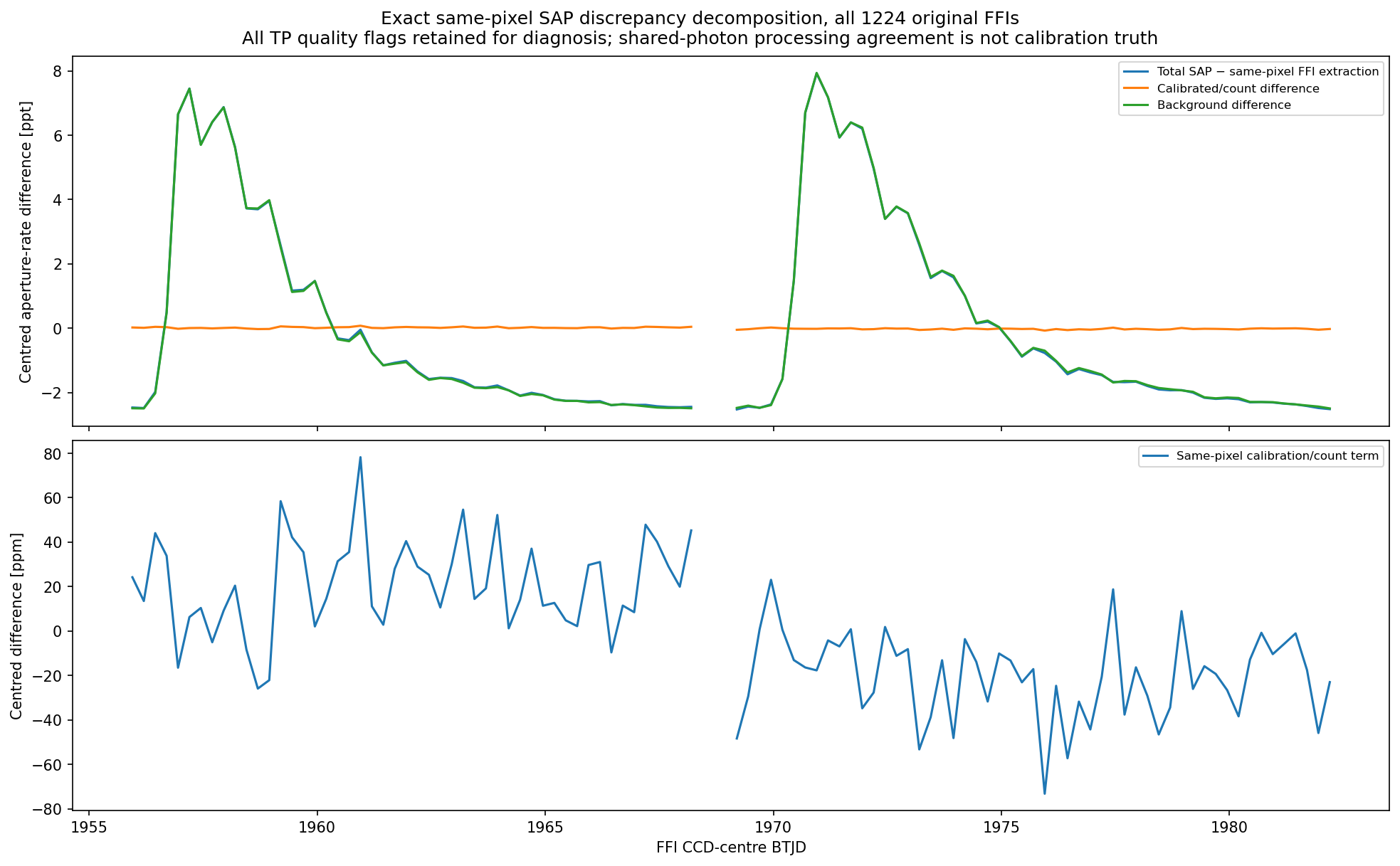
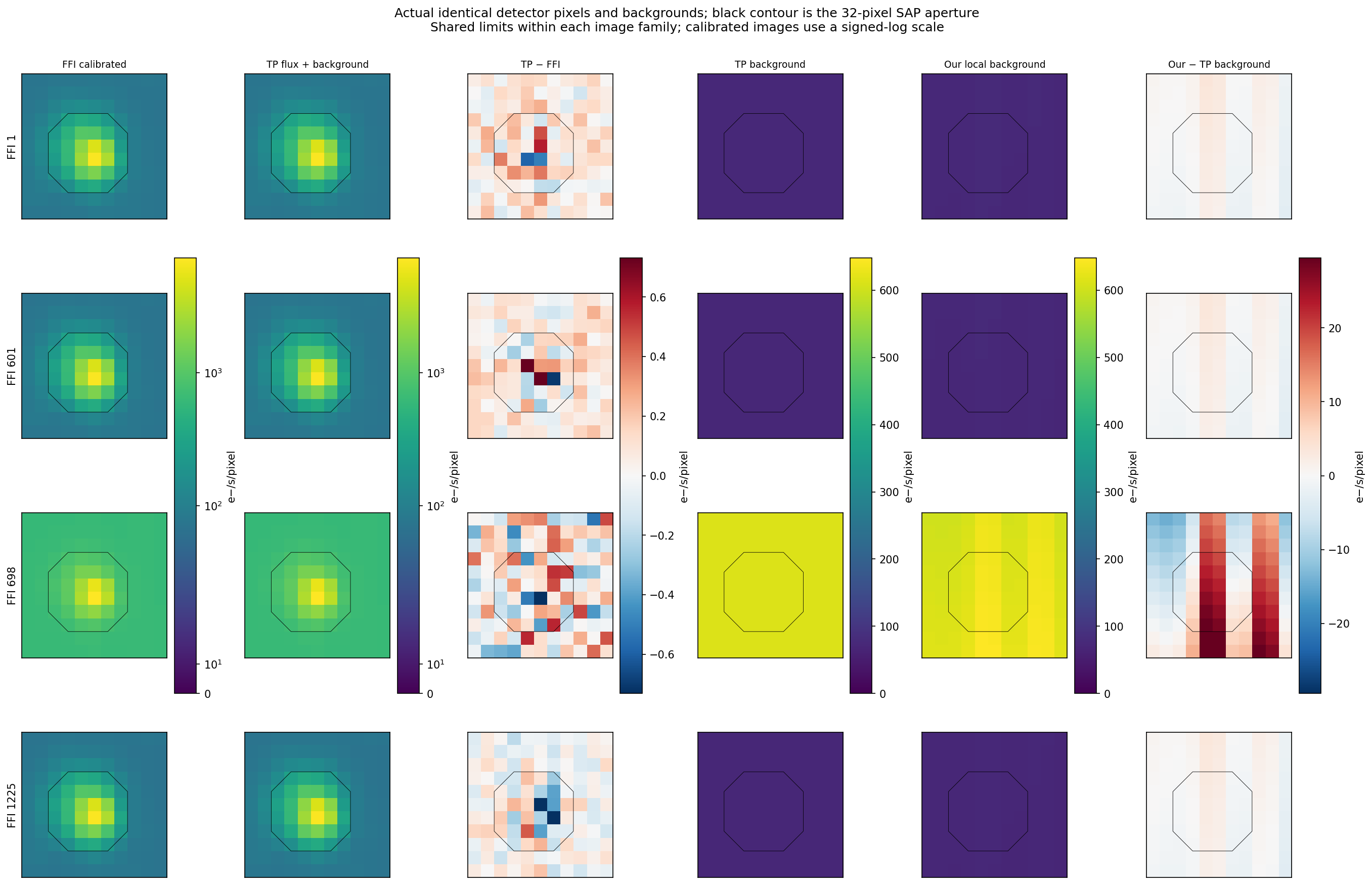
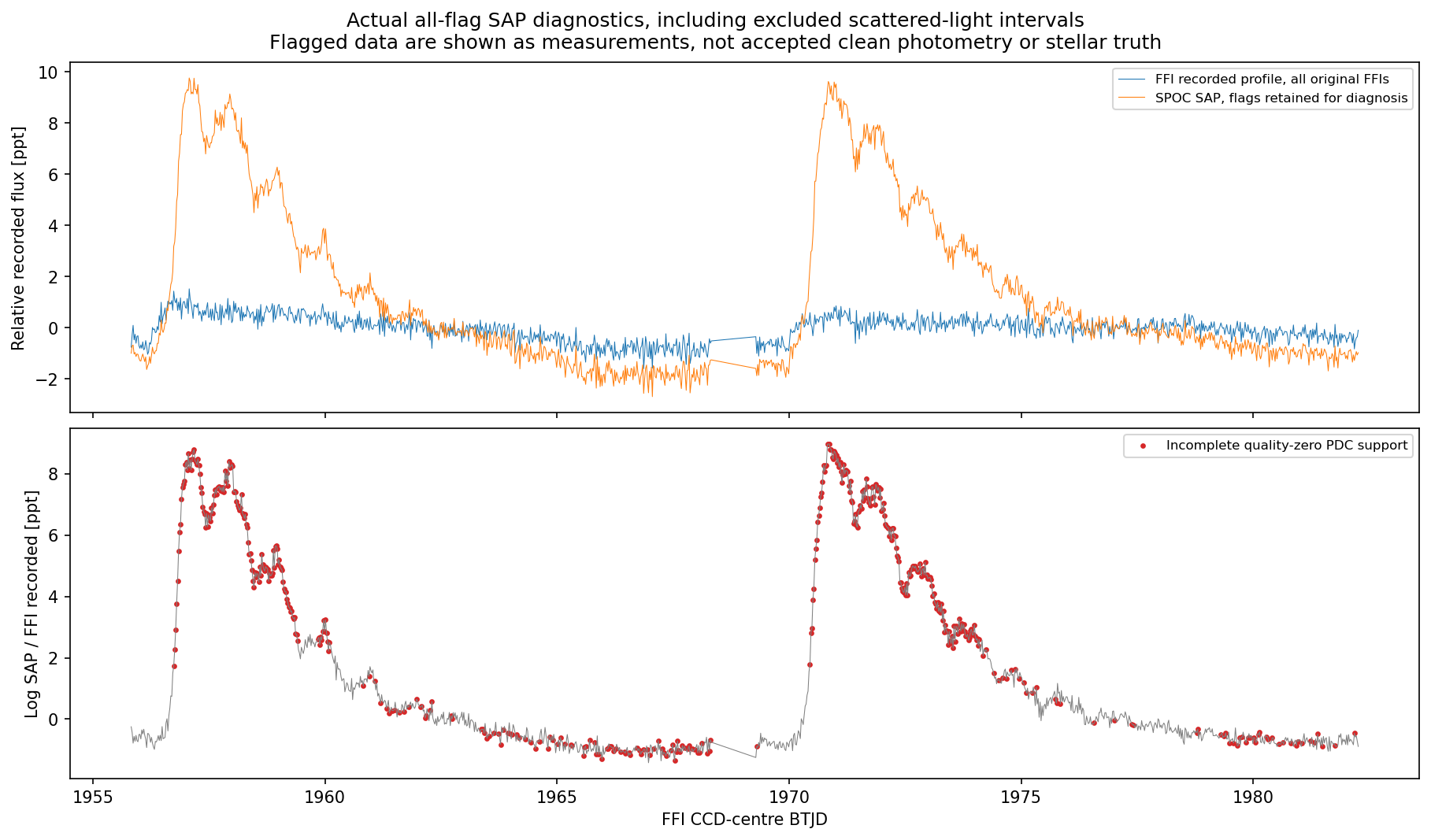
TIC 198208038 uses exactly the same 32 detector pixels and 15 two-minute samples per original FFI. SAP replay, geometry controls, integration timing and direct FITS-to-cube checks pass. All TP flags are retained only for processing diagnosis; the earlier clean-PDC coverage gate remains failed.
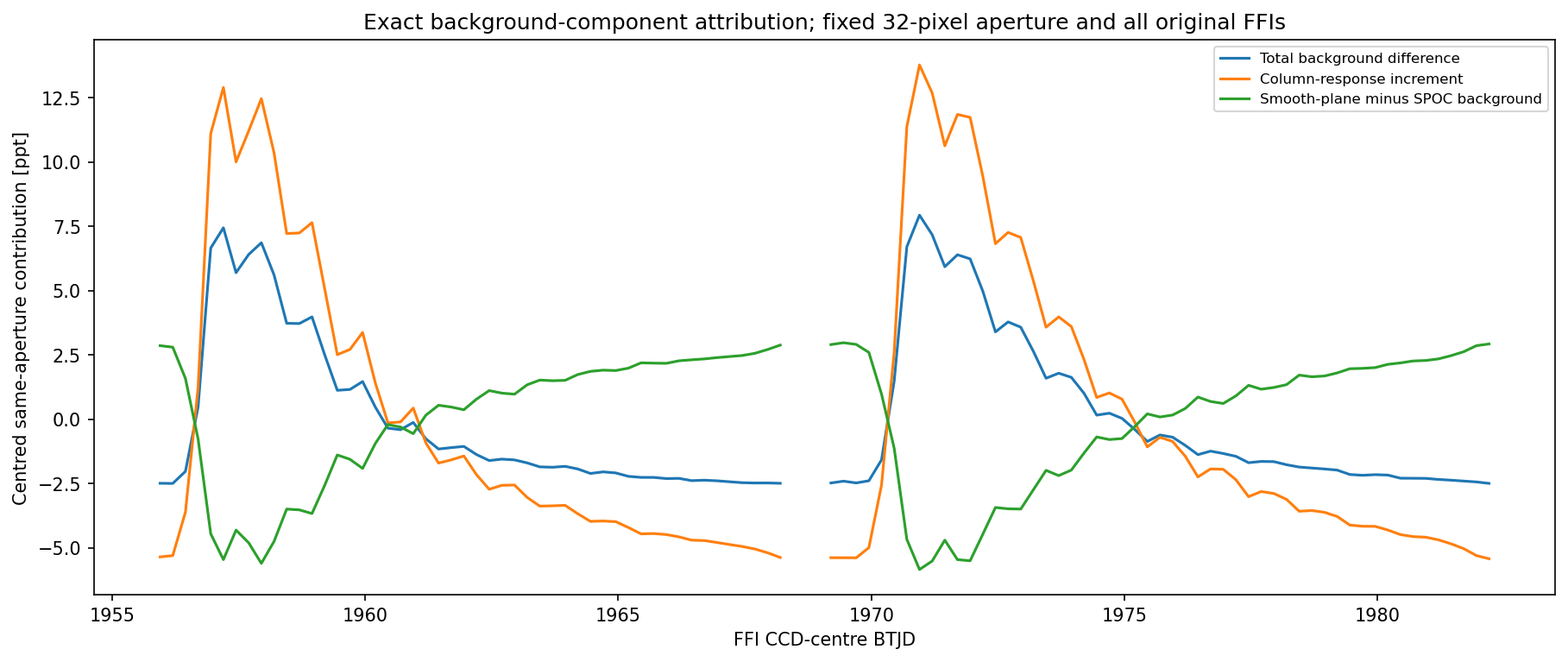
The six-hour total discrepancy is 2.99072 ppt RMS; calibrated/count differences contribute 0.02875 ppt and background differences 2.99426 ppt. These correlated components do not add in quadrature. This is a matched-aperture reduction comparison, not the RMS of the final calibrated candidate. Shared calibration errors cancel, and neither background is independent sky truth.
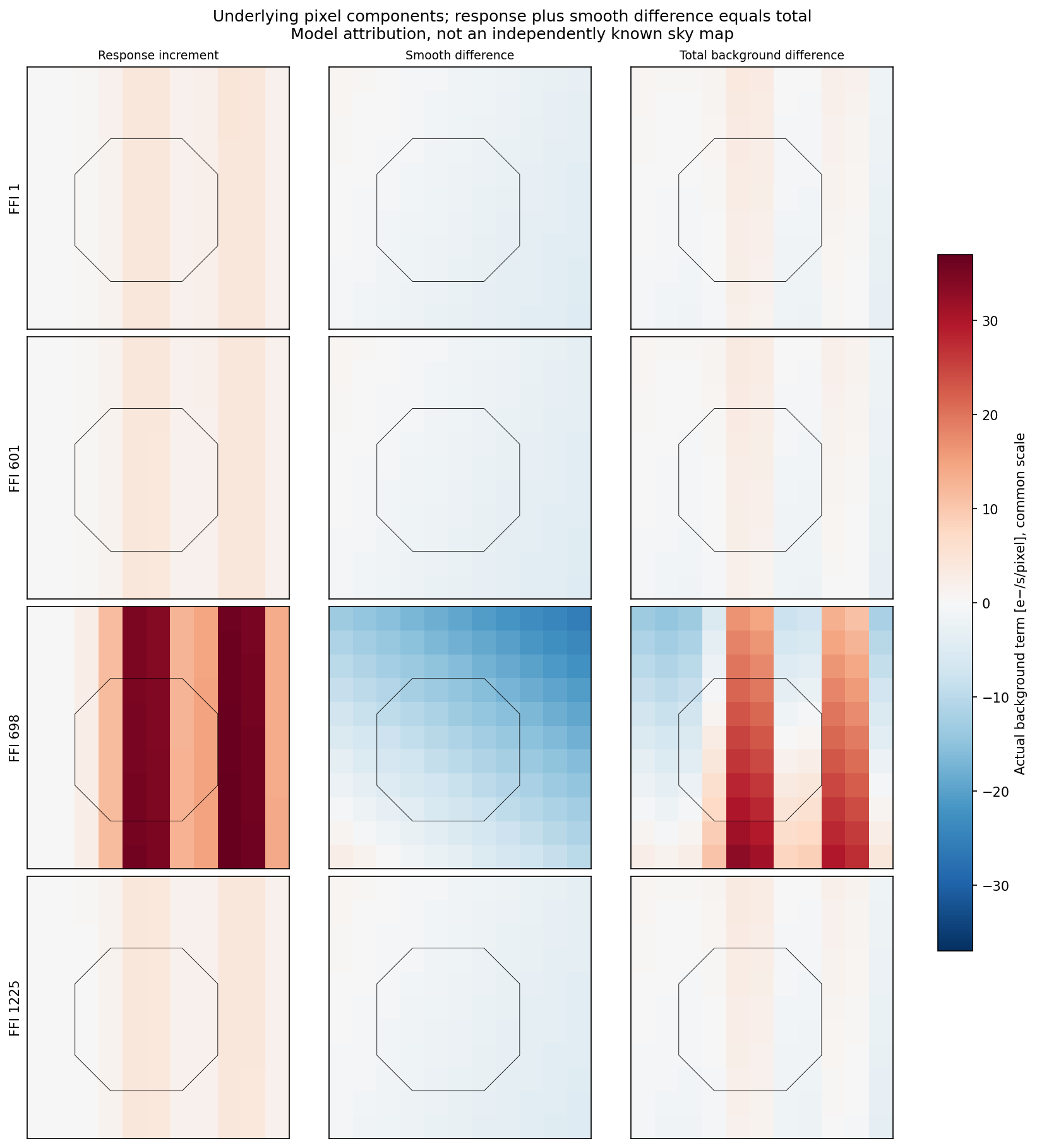
The column-response increment and smooth-plane mismatch partly cancel (six-hour RMS 5.55953 and 2.58897 ppt). This attributes a difference within the fitted model; it does not establish the true background below the star.
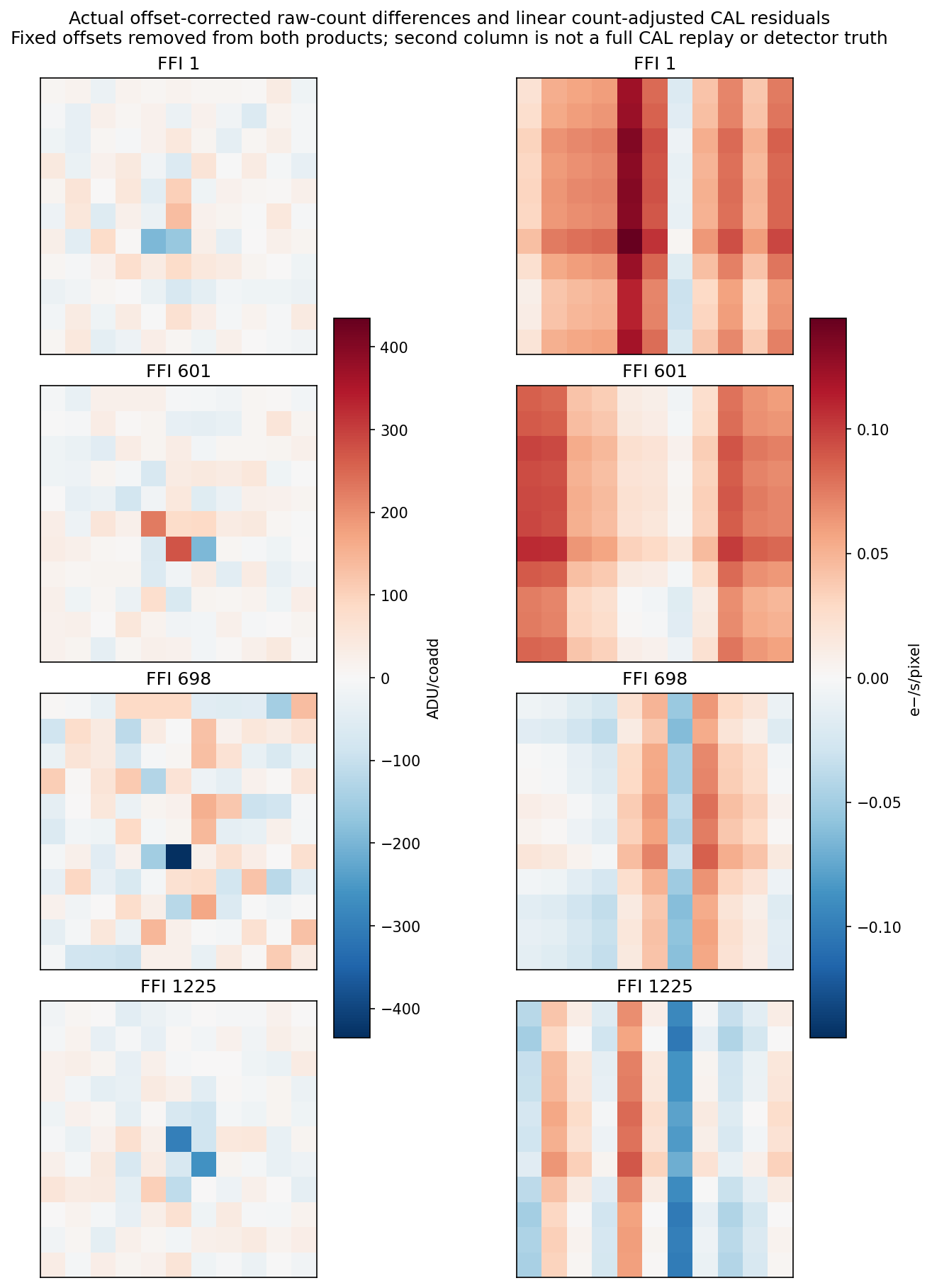
The 36 raw counterparts require separate FXDOFF removal: FFI and summed TP offsets differ by 209,900 ADU. After removal the median raw difference RMS is 48.00 ADU; first-order gain/exposure/flat adjustment leaves 0.04891 e−/s/pixel median calibrated disagreement, with column structure. Nonlinearity, calibration order and requantization remain separate tests.
Conclusion: structured calibration remains a live hypothesis. This single-source bridge identifies background treatment as the dominant large processing difference, while current channel histories retain differences. Neither one global factor nor calibration agreement establishes instrument-free photometry. Methods, equations, exact validation, failures, figures and pending tests.
Separate stellar-column response hypothesis
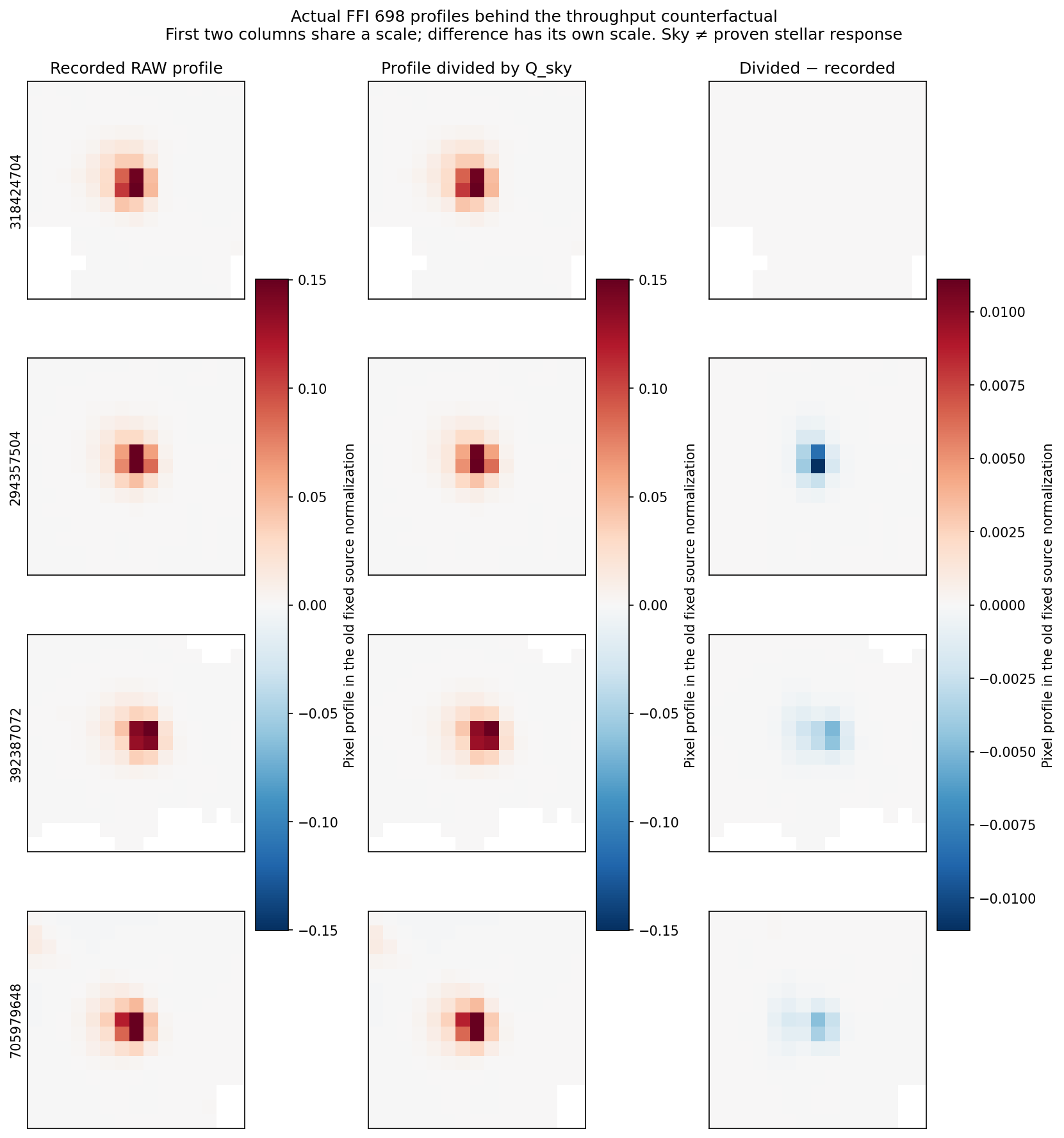
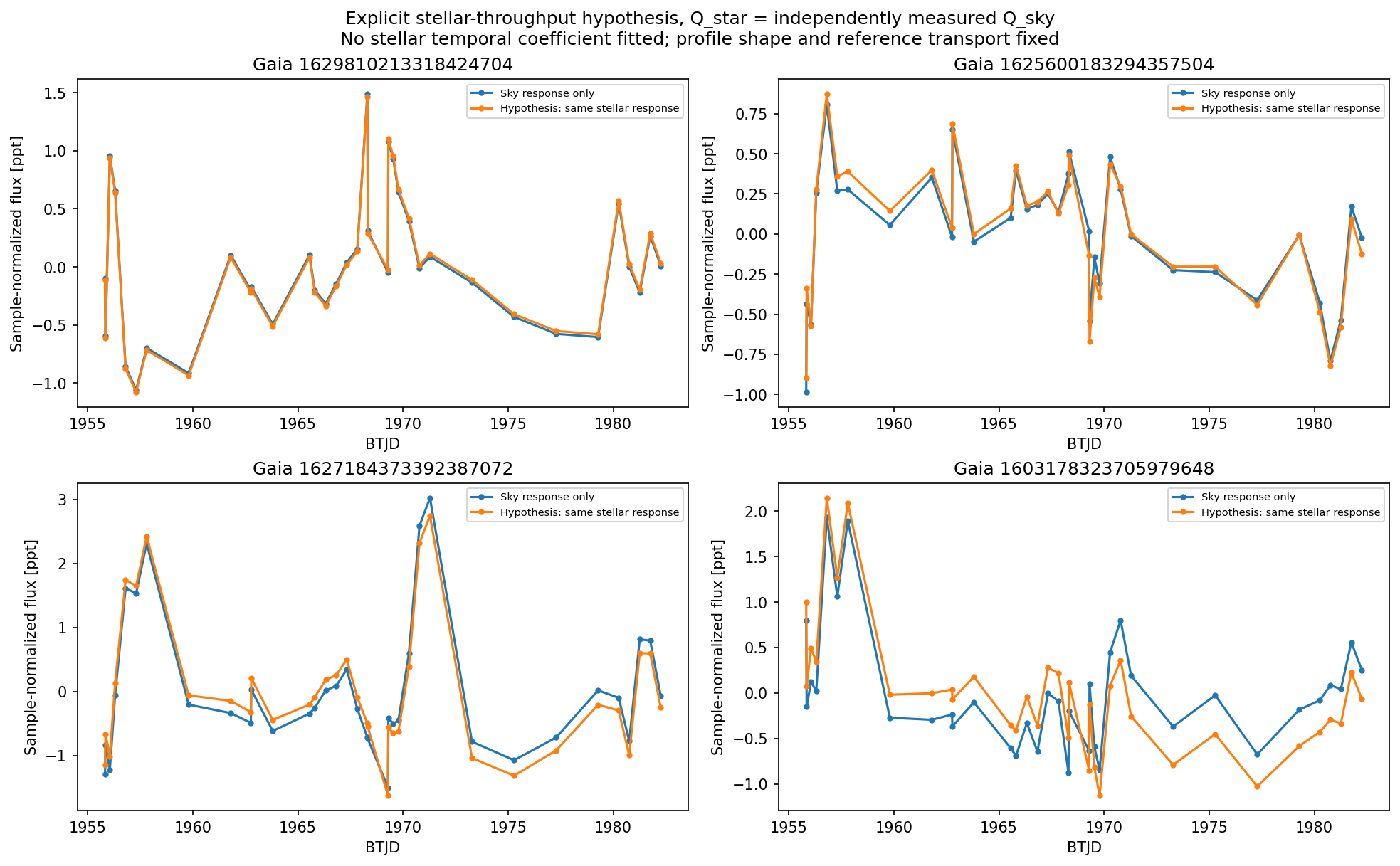
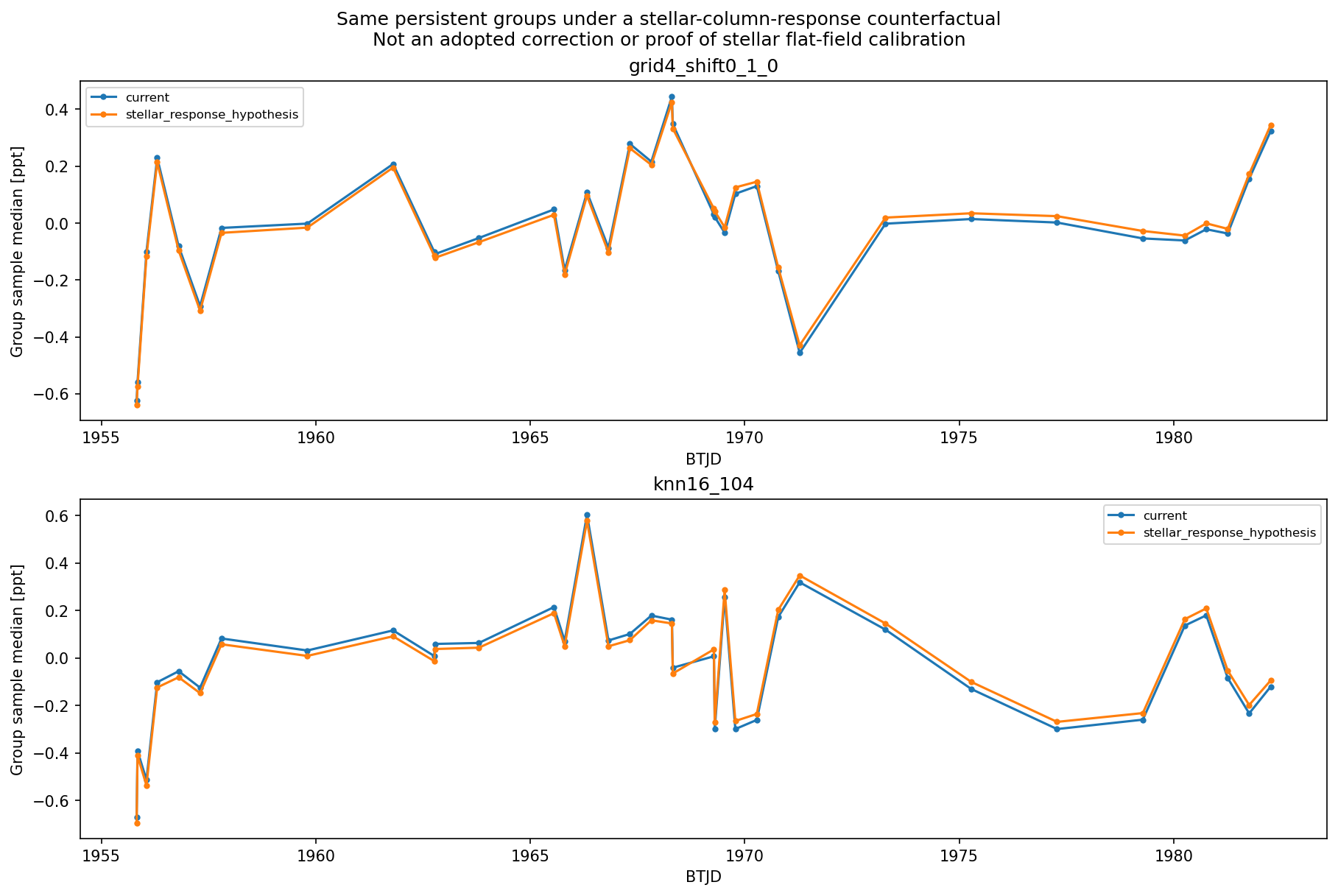
Enhanced column sensitivity can affect stellar throughput as a PSF moves/broadens, even after its excess sky is removed. A parameter-free counterfactual tests stellar response equal to the independently measured sky response, against unity stellar response. The same raw-space sky fit is retained; source aperture normalization and physical count-loss projection change consistently. No temporal coefficient is fitted to a source light curve.
The large excursions remain; the group sample RMS values change only 0.22461→0.22548 and 0.24430→0.24316 ppt. Conclusion: this simple stellar=sky response hypothesis is not the missing cure and is not adopted. It does not rule out colour-dependent or finer pixel response errors. Sky and stellar illumination may differ, and profile shapes/reference transport remain fixed in this pilot. Explicit aperture equation, scope and evidence.
Independent two-minute pilot: coverage and reduction differences matter
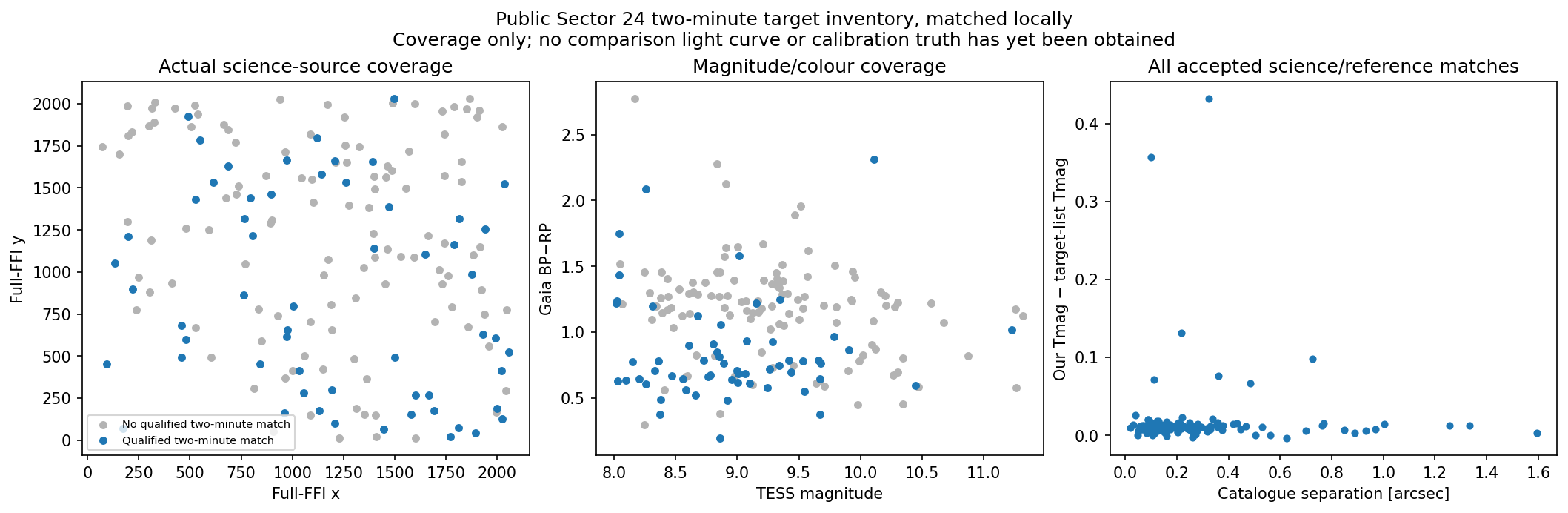
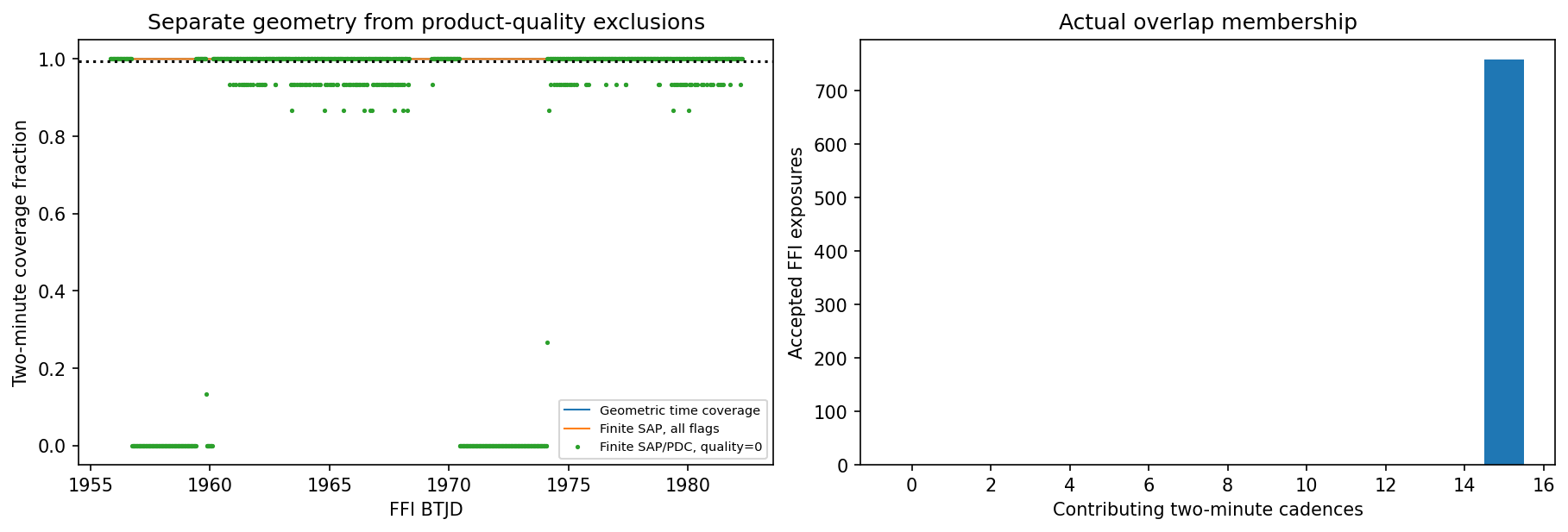
A local match to the official public Sector 24 target list identifies 58/172 science and 56/235 reference stars. Of the four diagnostic stars only Gaia 1625600183294357504 matches, TIC 198208038. The downloaded LC is DR35, spoc-4.0.36-20200520. Its 48/60 retained-readout header must not be treated as an untrimmed photon reference.
Spacecraft-time matching gives geometric and finite-SAP coverage for all 1,224 FFI exposures, but only 758 have complete finite quality-zero SAP/PDC coverage. The planned 70% comparison-coverage gate fails and remains failed. The diagnostic does not lower that gate or remove any FFI from our primary photometry. Flag 4096 excludes target-specific scattered-light cadences, including difficult orbit-edge intervals.
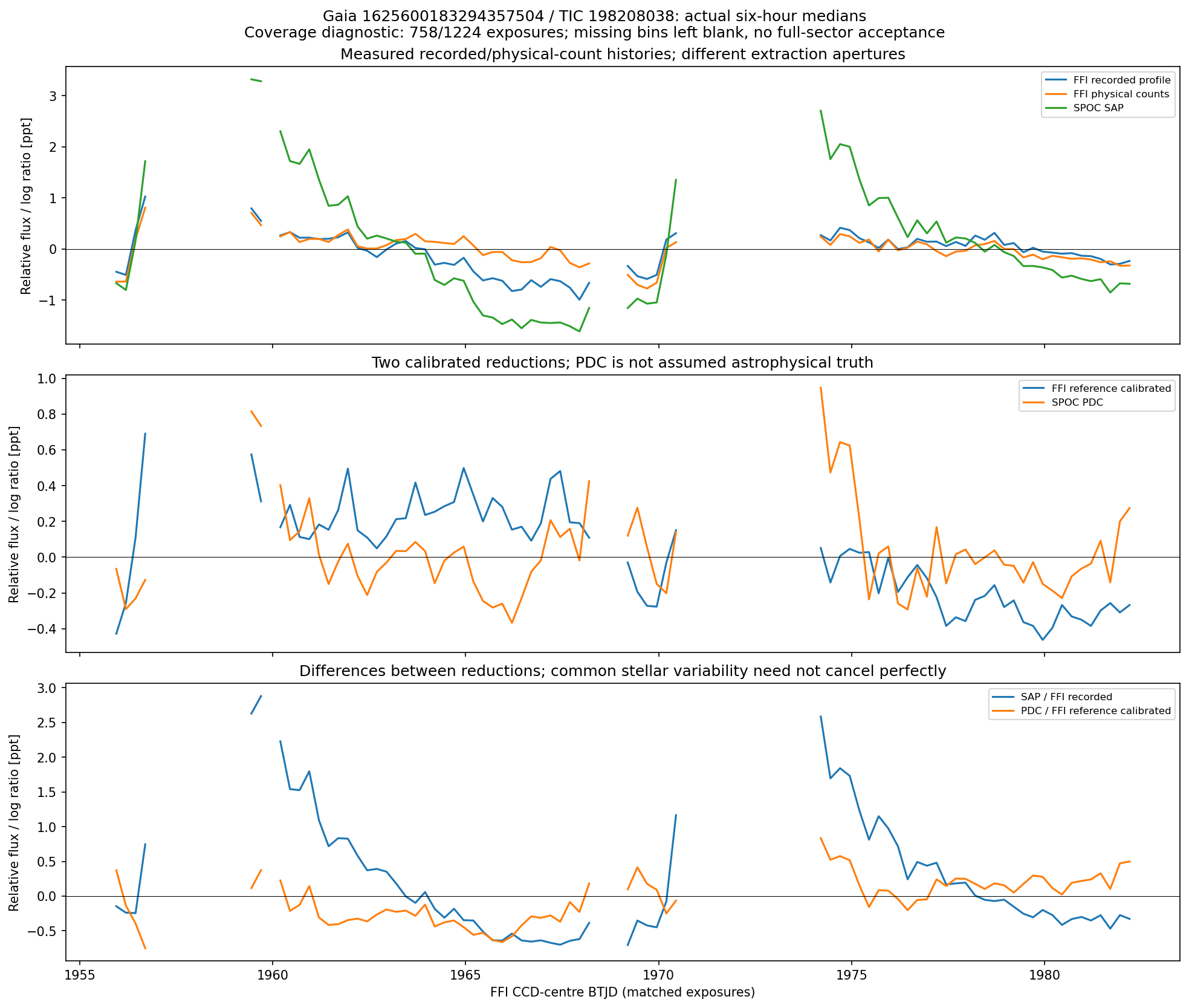
On the limited 78 populated six-hour bins, our calibrated RMS is 0.2762 ppt and PDC 0.2574 ppt, yet their correlation is only 0.185 and log-ratio RMS 0.3288 ppt. Similar scatter is not matching astrophysical variability. SAP has larger repeated orbit-linked excursions; different apertures, sky treatment, shared instrumental effects and PDC suppression remain confounded.
Conclusion: PDC cannot validate the missing difficult intervals or serve as ground truth here. The matching target-pixel file is downloaded for a same-pixel/aperture calibration comparison. No external light curve is adopted and the full instrument-free/photon-noise goal remains unmet. Source identity, official flag references, timing, failed gate and next test.
Covariance now recomputed for the latest repaired-profile generation
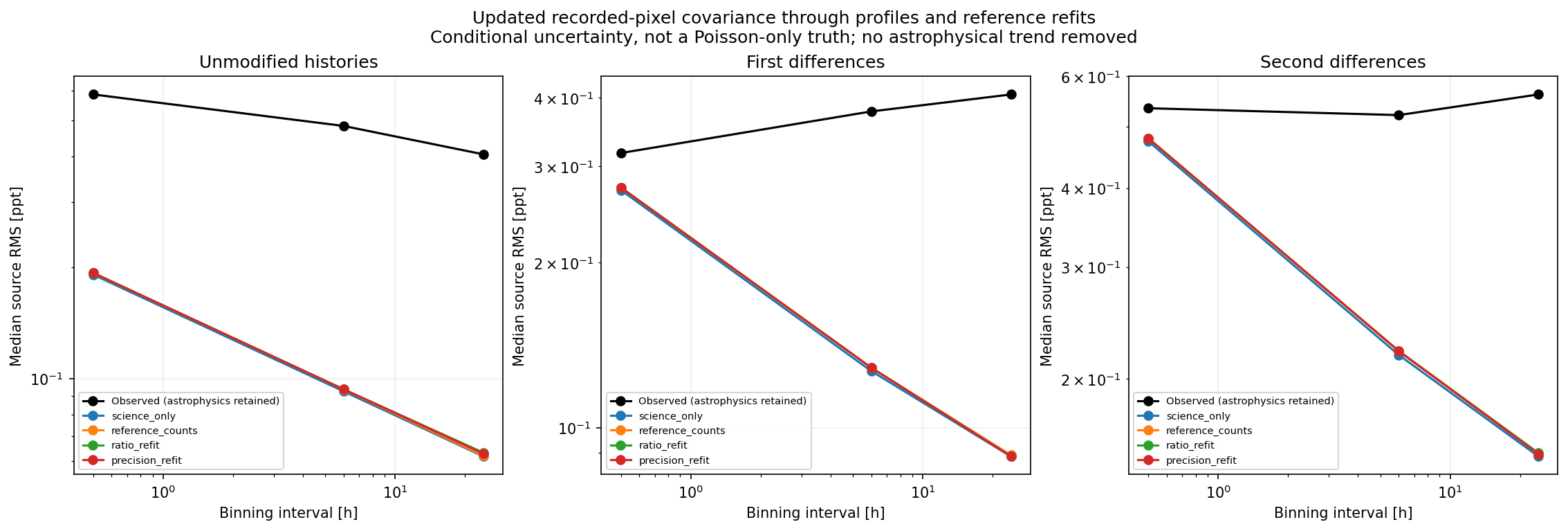
Sixty-four shared-pixel realizations repeat the current profile Jacobians and reference refits on all 172 science sources and 235 references. This uses the latest estimator rather than borrowing the previous denominator. Baselines replay; nonlinear central-difference checks pass. WCS/global response/physical photon means remain fixed, and the input is archived uncertainty.
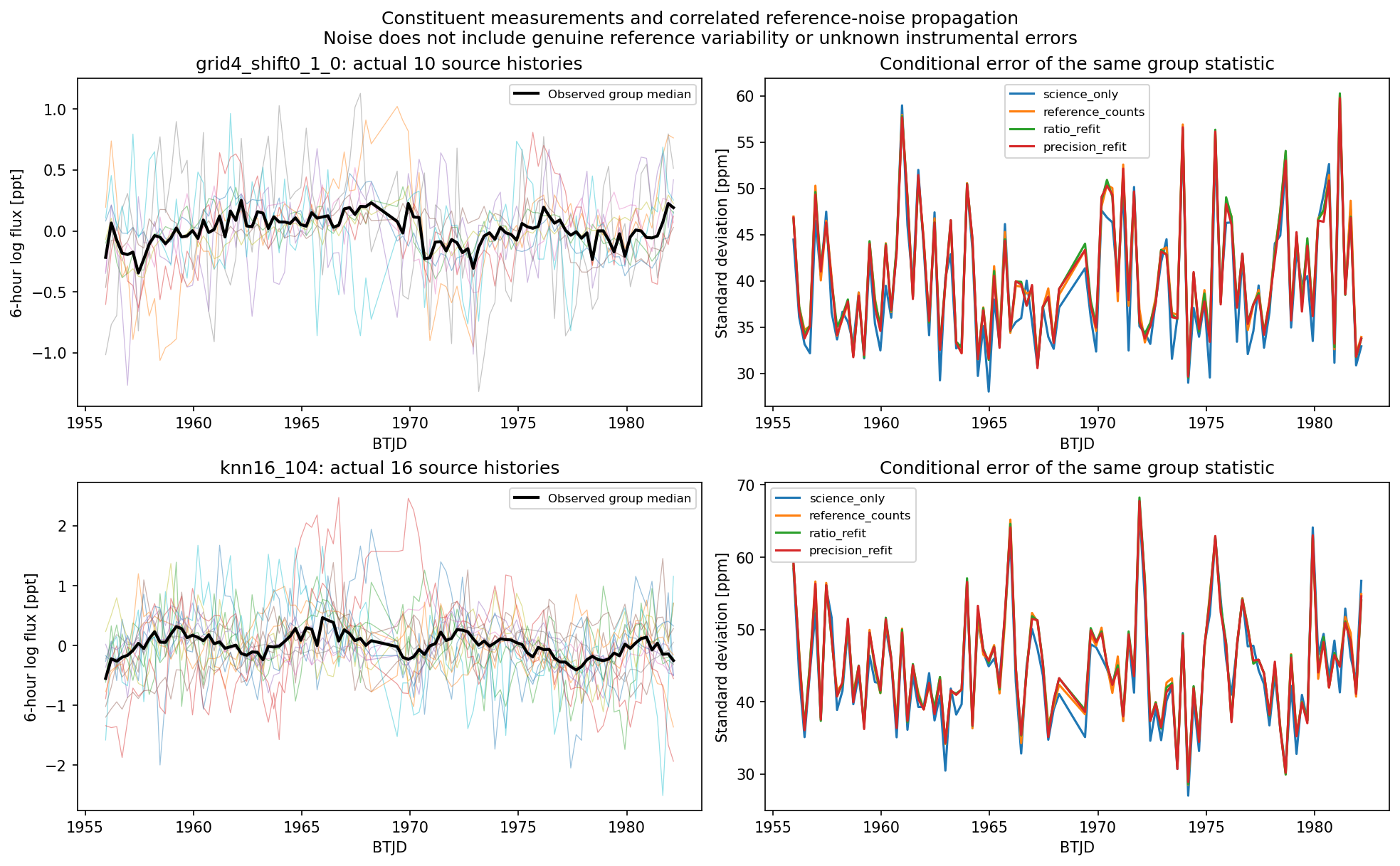
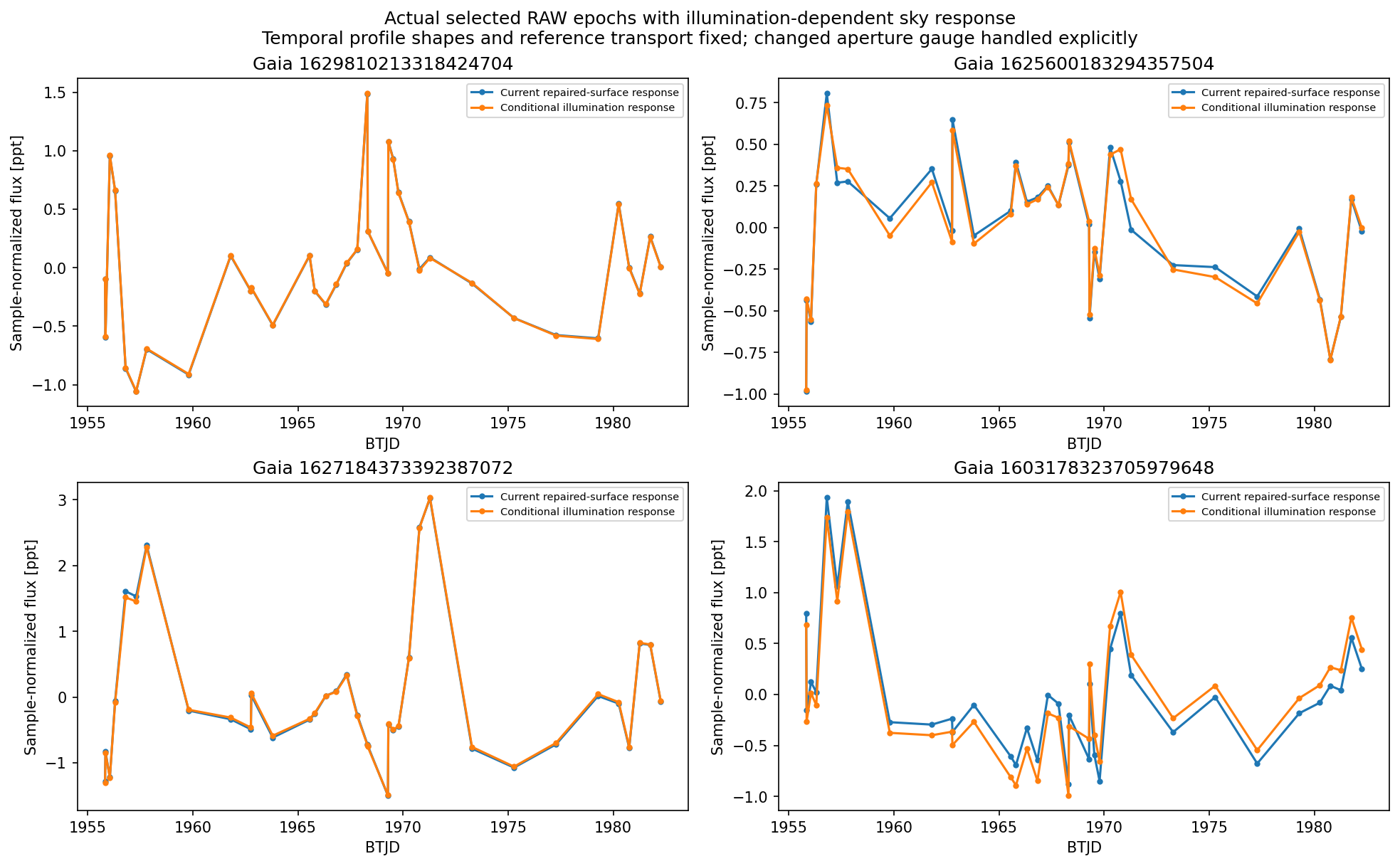
Median exposure RMS is 0.58734 versus conditional 0.19318 ppt; six-hour RMS is 0.48271 versus 0.09361 ppt. The preselected groups are 0.12532/0.18751 ppt versus conditional 0.04590/0.05200 ppt. Orbit-aligned log-flux bins differ slightly from the earlier fractional-flux audit. Conclusion: the remaining slow histories still exceed this conditional noise calculation, but astrophysical variability remains and this is not a pure photon-noise or instrumental-cause certificate.
Quadratic illumination response: small sky gain, no large photometric cure
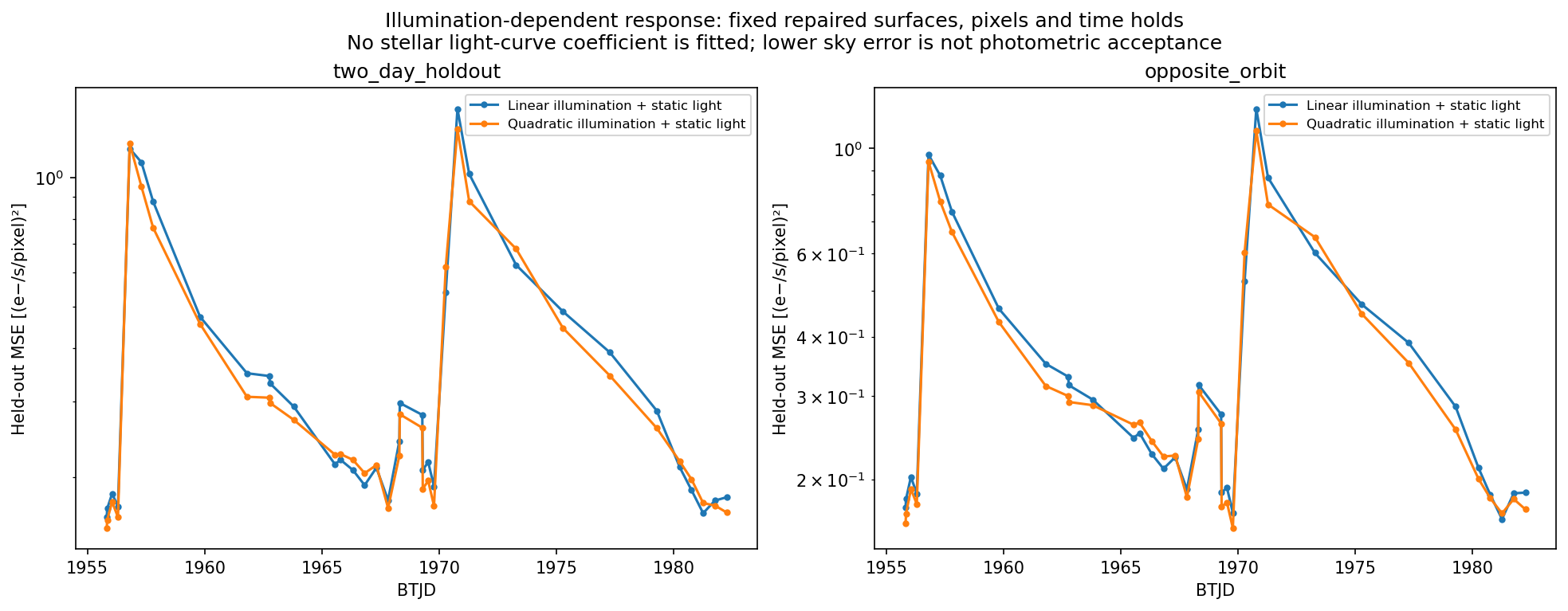
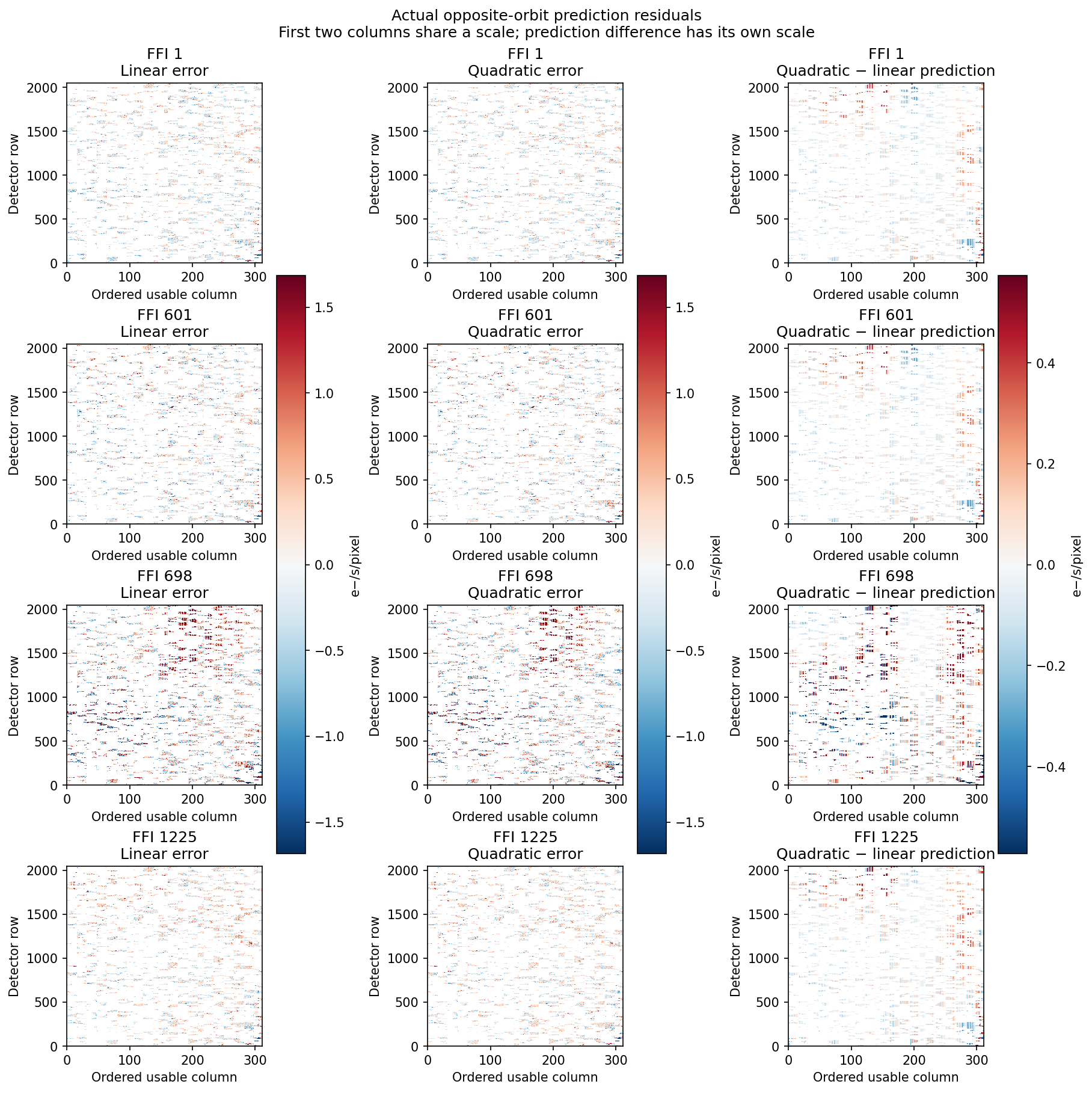
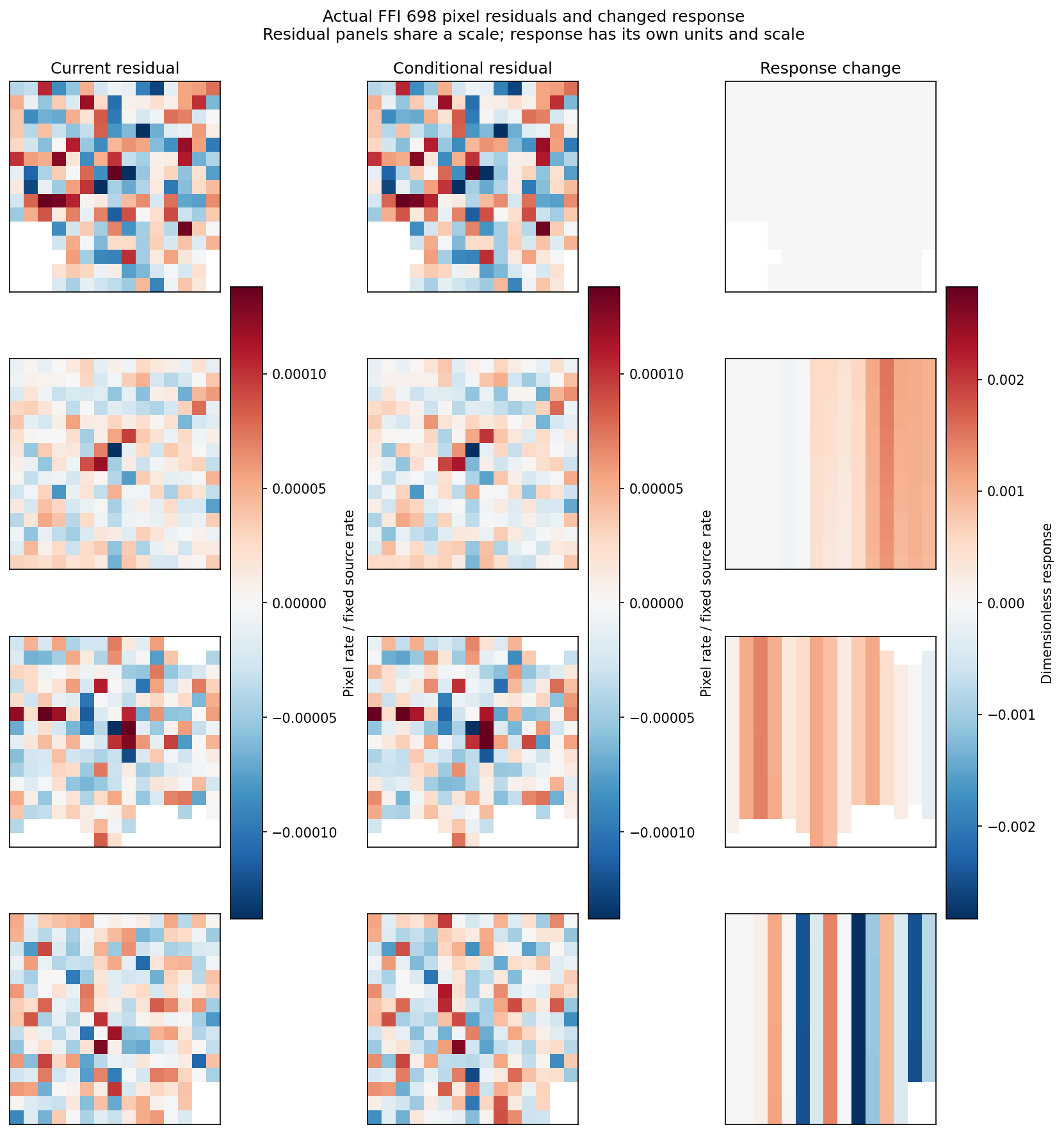
Add a quadratic-in-illumination term with quadratic row coefficients while profiling static pixel light. Training-only normalization, unchanged 36 epochs/312 columns/110,806 evaluated pixels, and identical two-day/opposite-orbit holds prevent choosing the response from stellar histories. Known-response, units, degeneracy, baseline-replay and held-out perturbation tests pass.
Held-out MSE changes 0.388226→0.367759 for two-day blocks and 0.364036→0.346882 for opposite-orbit transfer, about a five-percent gain. Units are (e−/s/pixel)². Positive responses and conditioning are checked; held-out illumination includes extrapolation, recorded by fold. This does not identify detector nonlinearity.
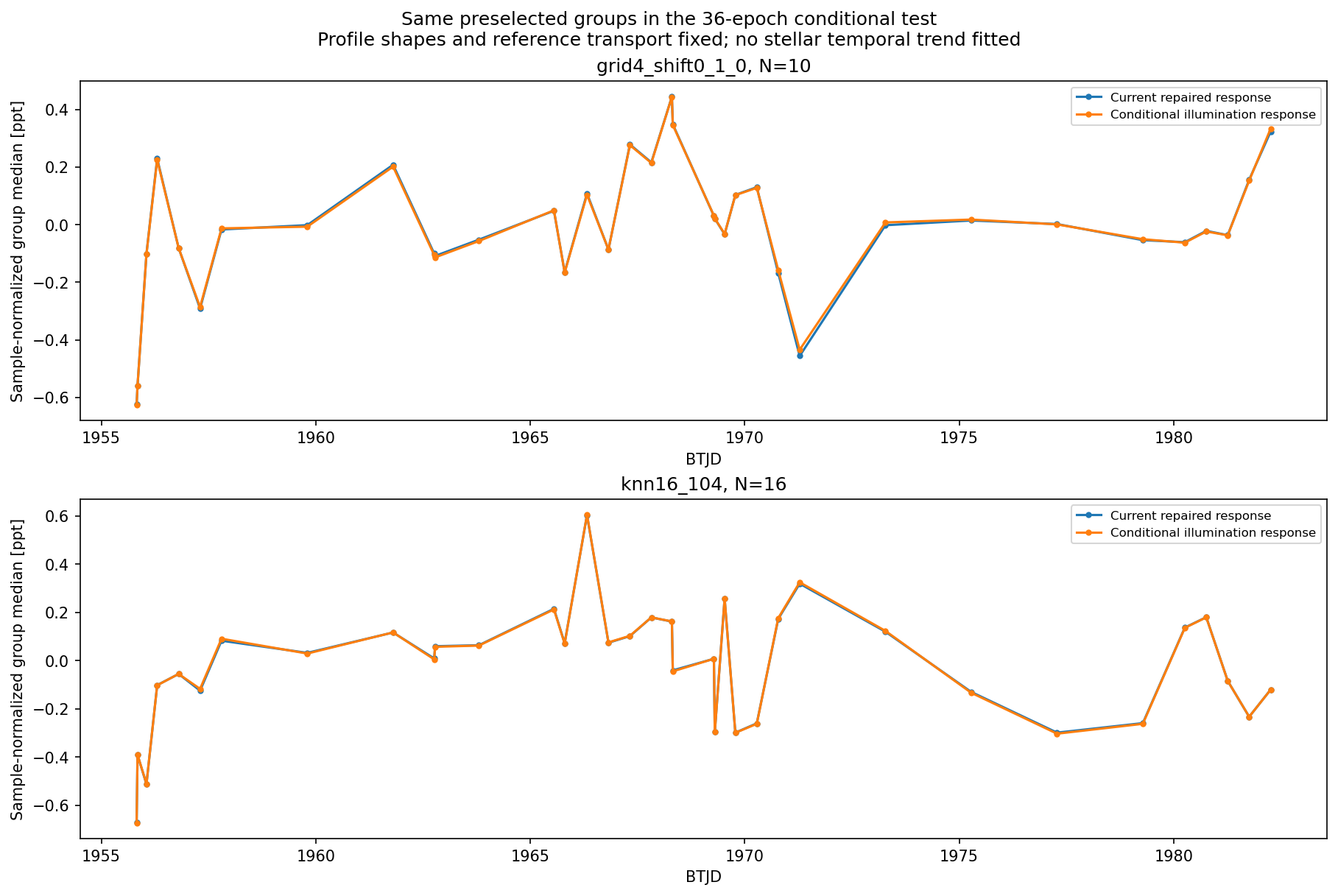
Changed aperture weights explicitly renormalize the frozen profile and reproject physical count loss. The two persistent groups remain essentially unchanged (sample RMS 0.22461→0.22311 and 0.24430→0.24511 ppt); large source excursions persist. These sample values are not six-hour full-cadence RMS. Profile shapes and reference transport/precision remain fixed.
Conclusion: this simple conditional illumination change does not explain the major remaining histories and is not adopted. Any epoch-dependent profile relearning requires explicit per-epoch aperture normalization and complete signal/covariance checks. Full method and negative result.
Fresh RAW versus hp_d centroid transfer
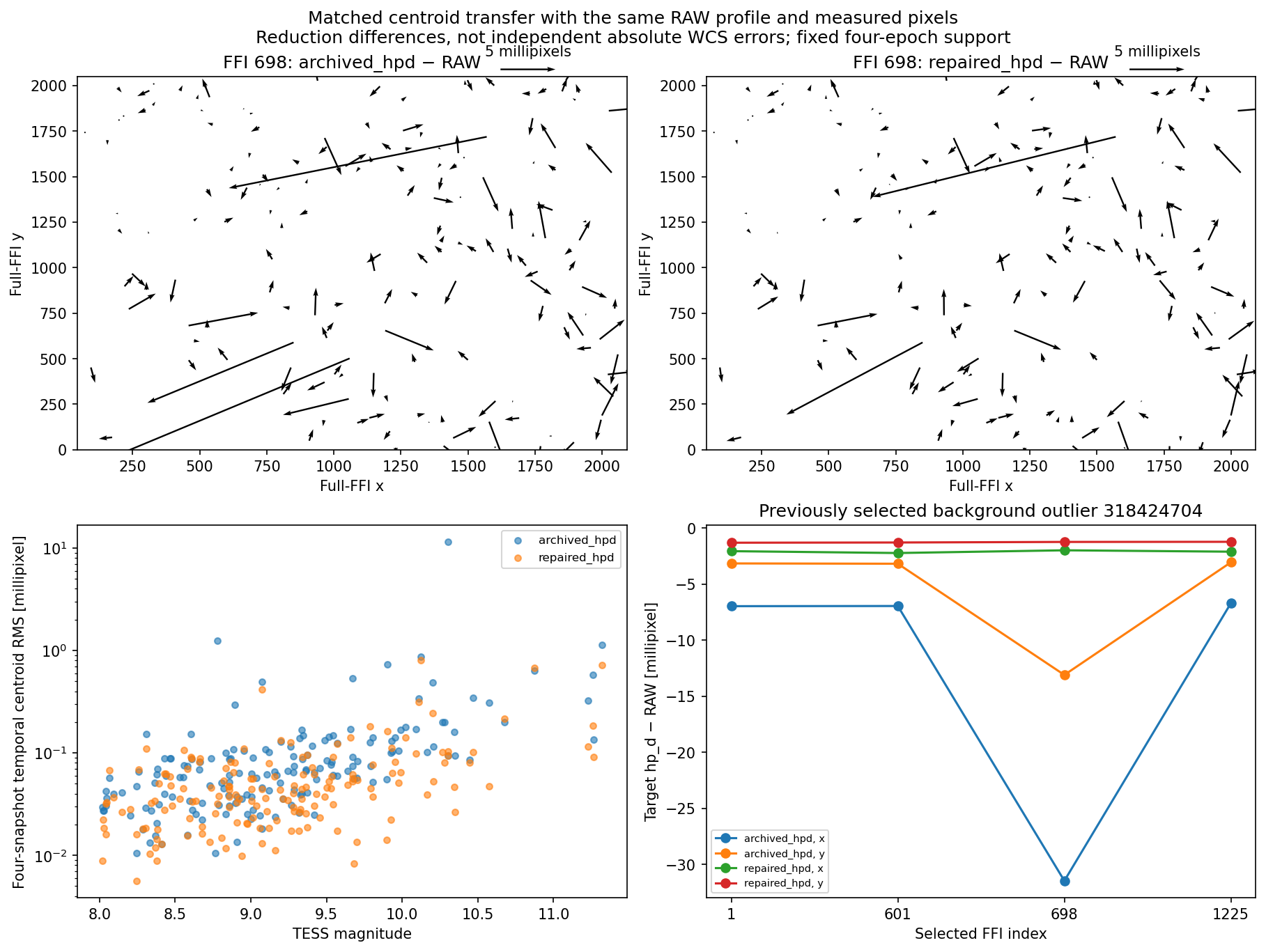
The same RAW-derived empirical profile, exact integrated translation increments and fixed measured pixels are fitted to RAW, archived hp_d and repaired hp_d at four verified epochs. All 2,064 fits converge; 164 of the original 165 eligible sources have complete nonfatal support. No WCS header or PSF training is changed.
At the known background outlier, FFI 698 hp_d−RAW displacement decreases from 34.09 to 2.33 millipixels; its four-snapshot temporal RMS decreases from 11.4966 to 0.0944 millipixels. Across the common eligible cohort, temporal RMS median/p95 decreases 0.0664/0.4951→0.0440/0.1791 millipixels. Most total offsets remain approximately static; median FFI 698 displacement is about one millipixel in both reductions.
Conclusion: the local background-induced position artifact is now measured and reduced. These shared-photon, same-profile differences are not absolute Gaia/WCS errors or independent per-exposure precision. Source/neighbor-shaped residuals remain in other hp_d stars, and opposite-fold spatial fits do not establish a replacement global WCS. Definitions, numerical controls, images and scope.
Repaired backgrounds carried through all 1,224 exposures
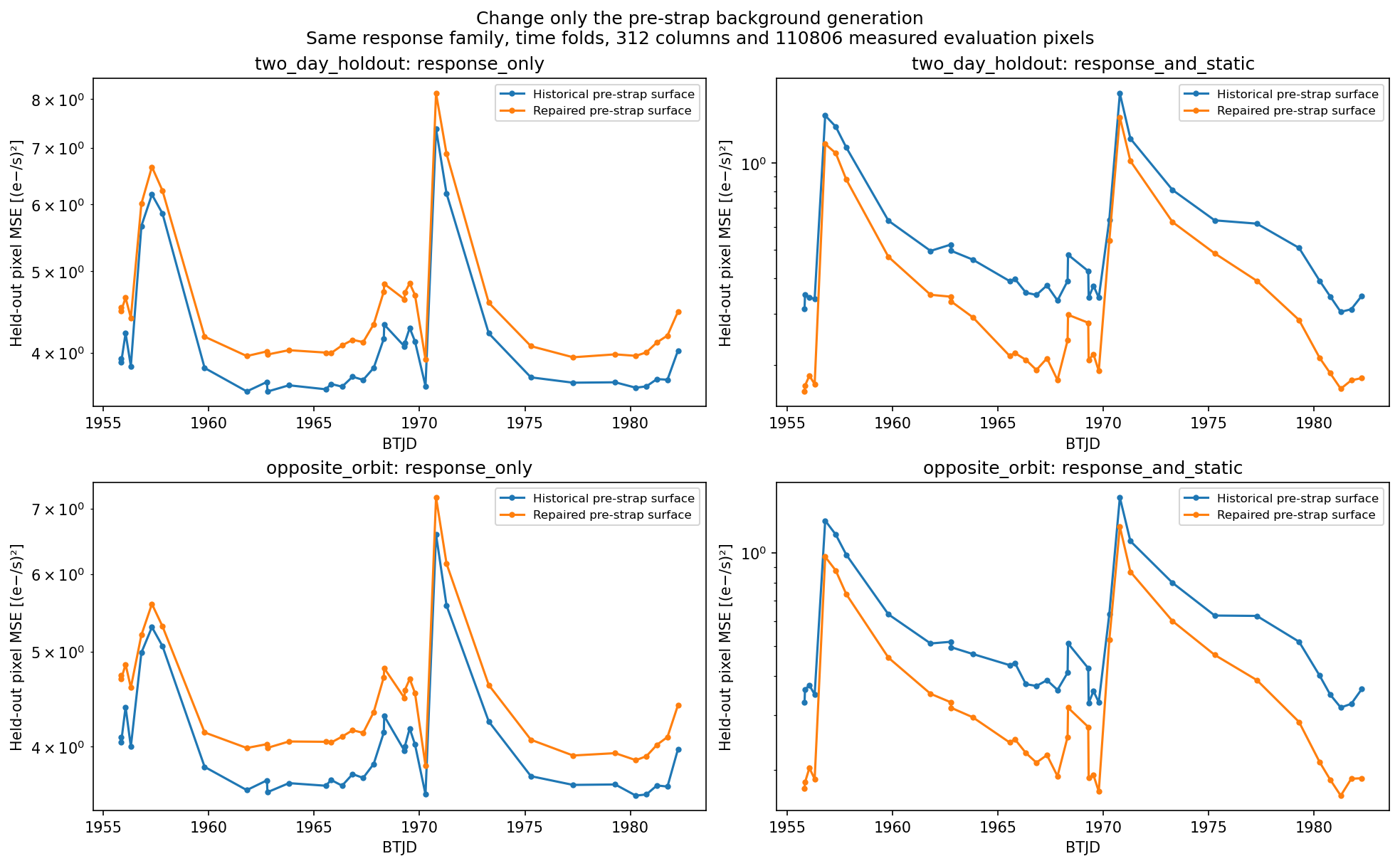
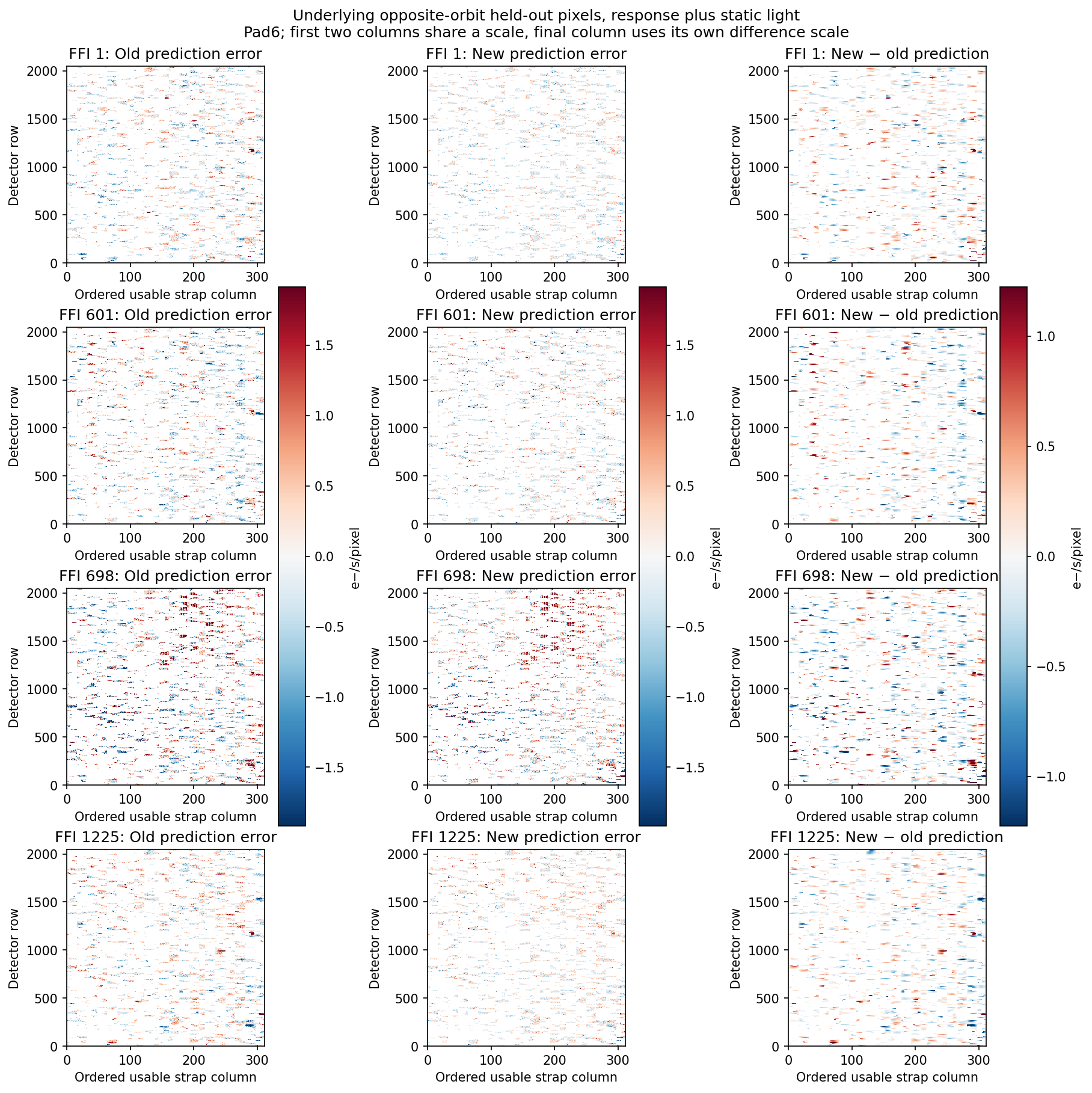
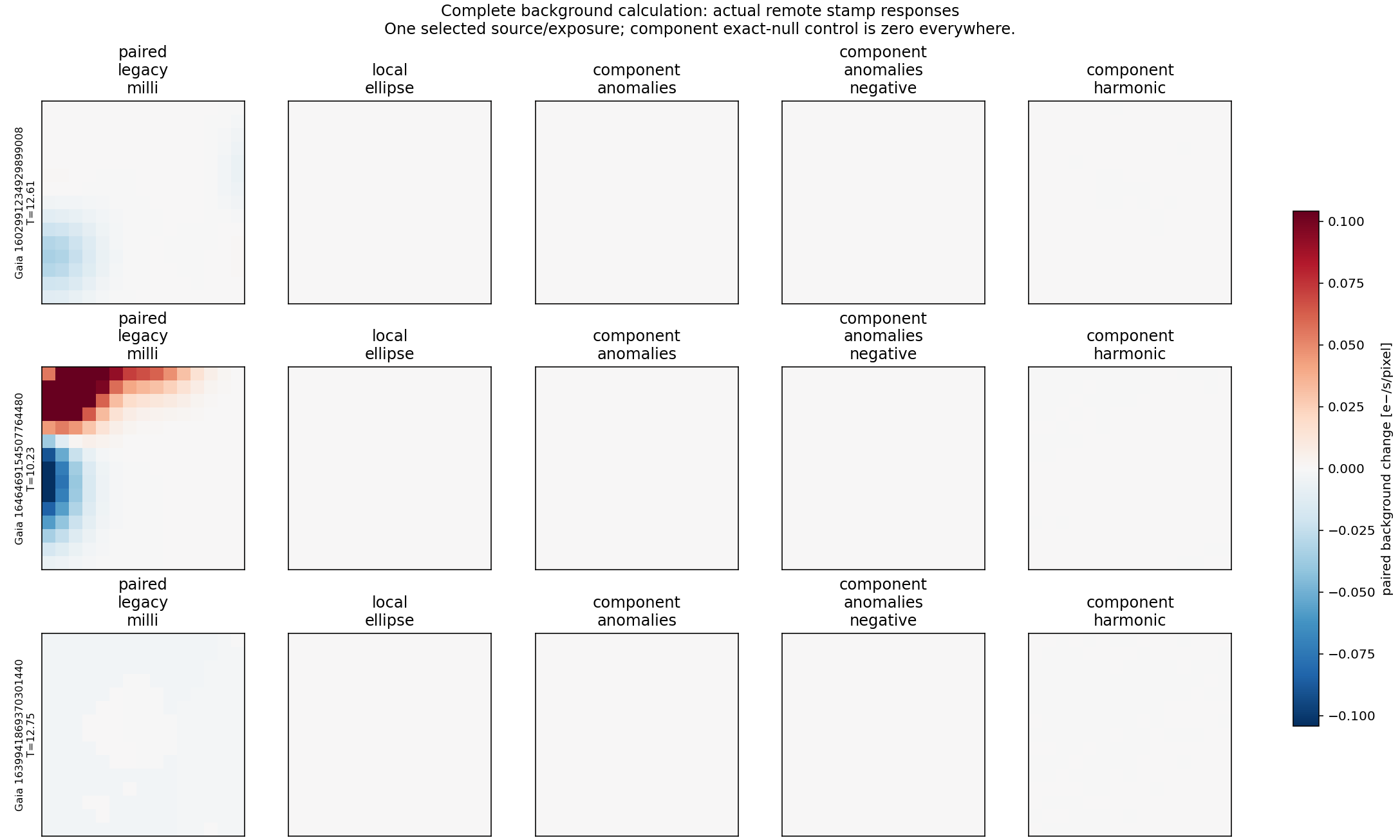
All 36 preselected backgrounds now use the tested component-anomaly, positive-RMS, harmonic-fill and known-column exclusions. Every original training/evaluation pixel is retained: 312 usable columns, 110,806 pad-6 pixels. The same held-out time blocks and opposite-orbit training are used. No stellar light-curve trend chooses the correction.
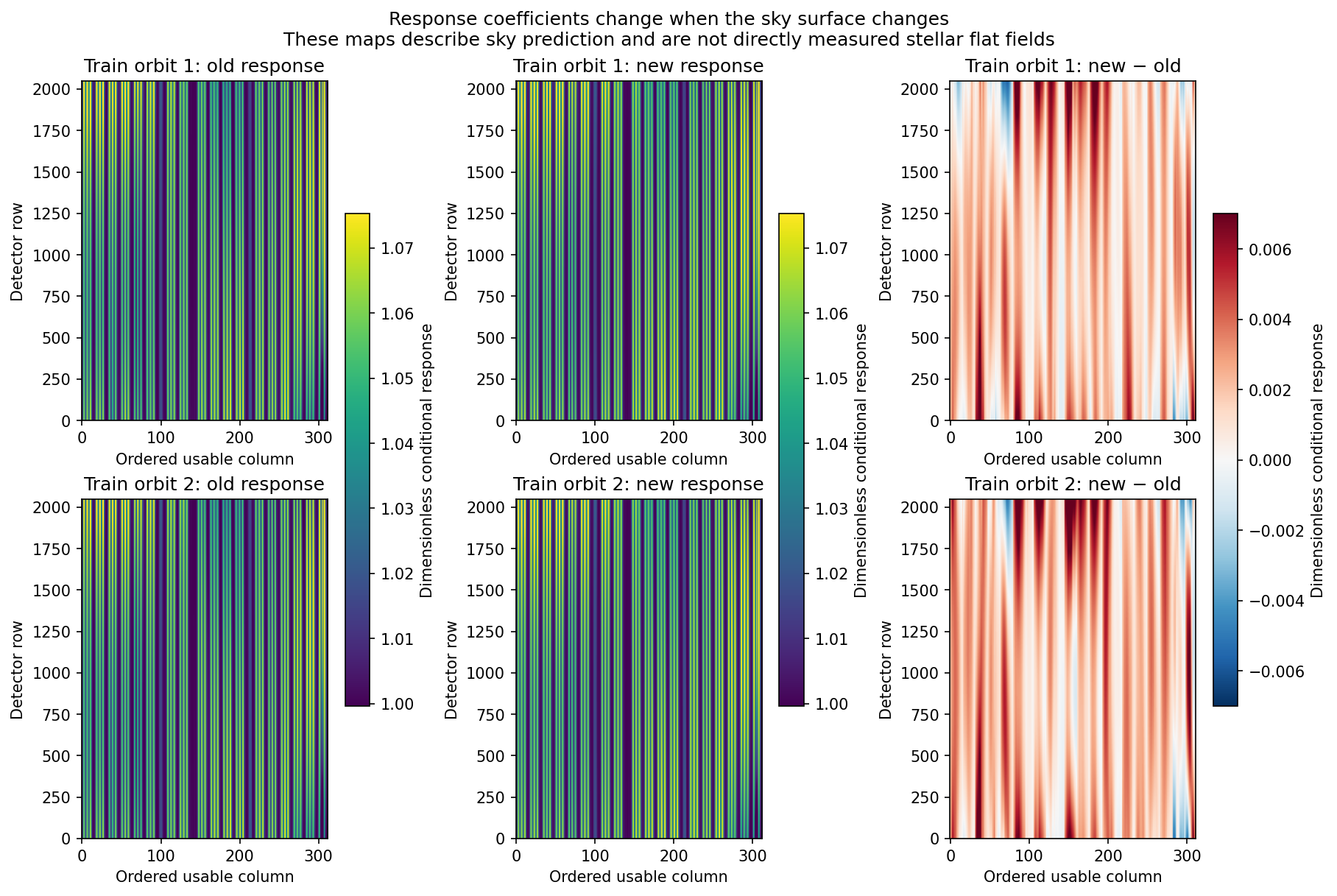
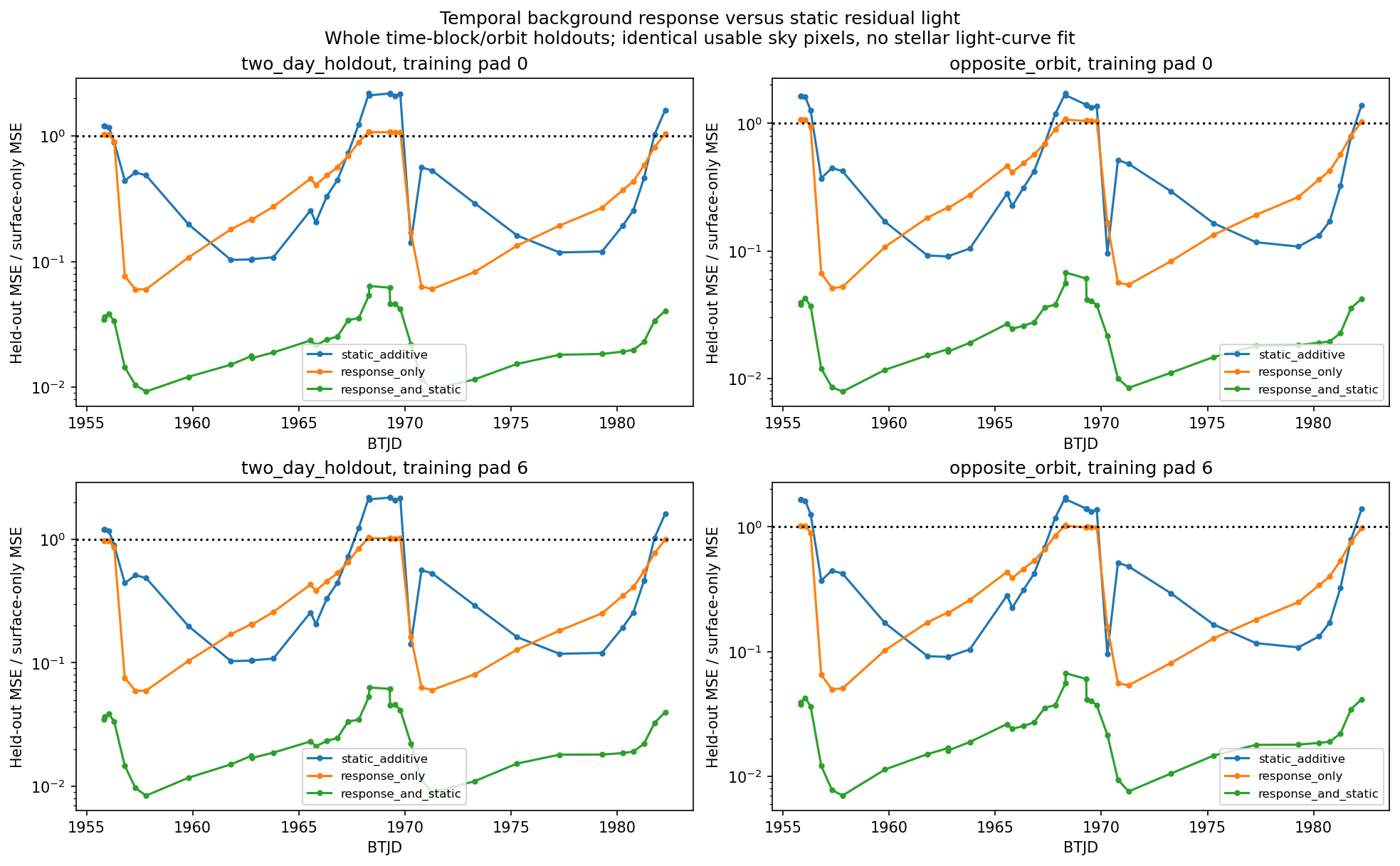
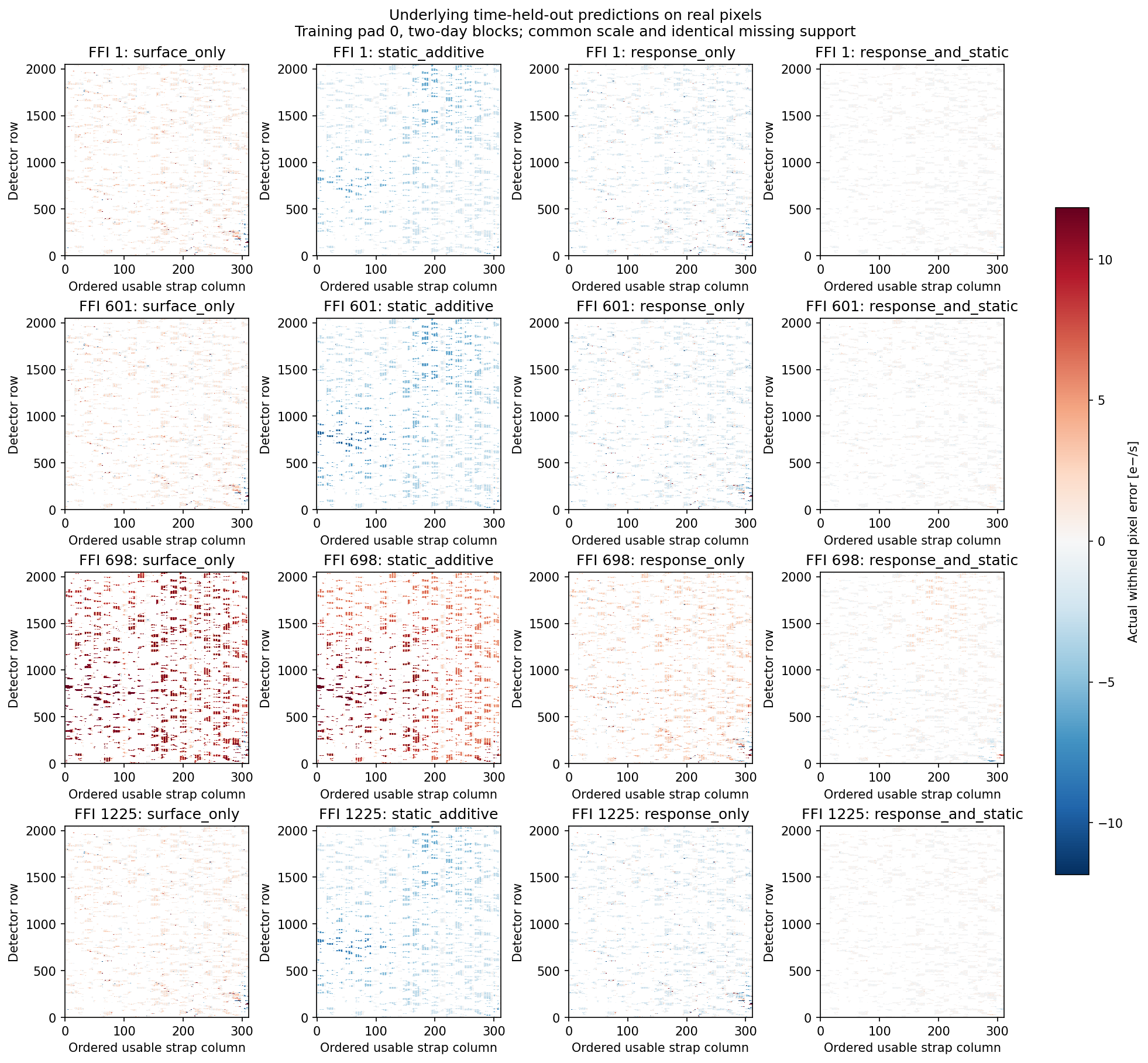
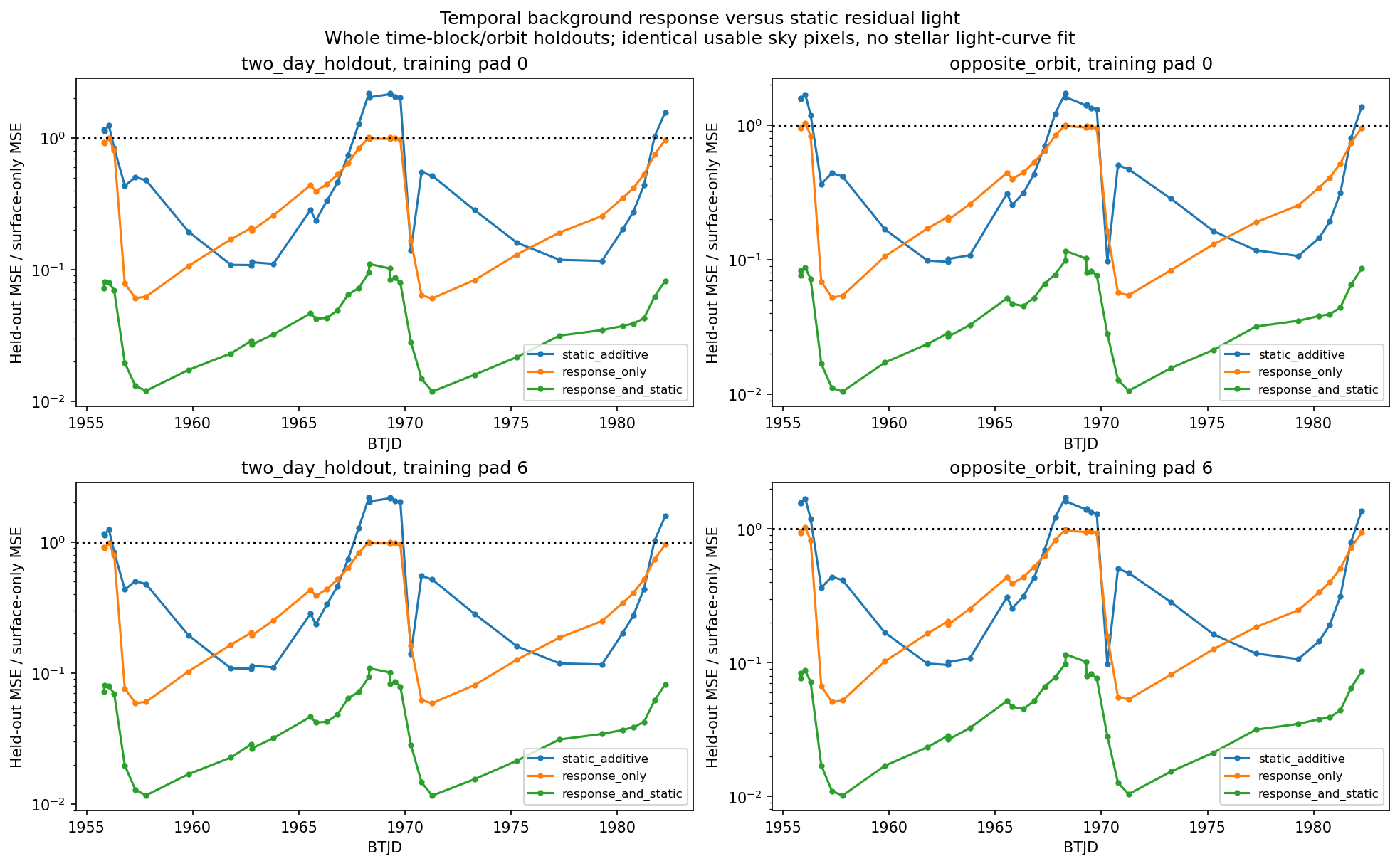
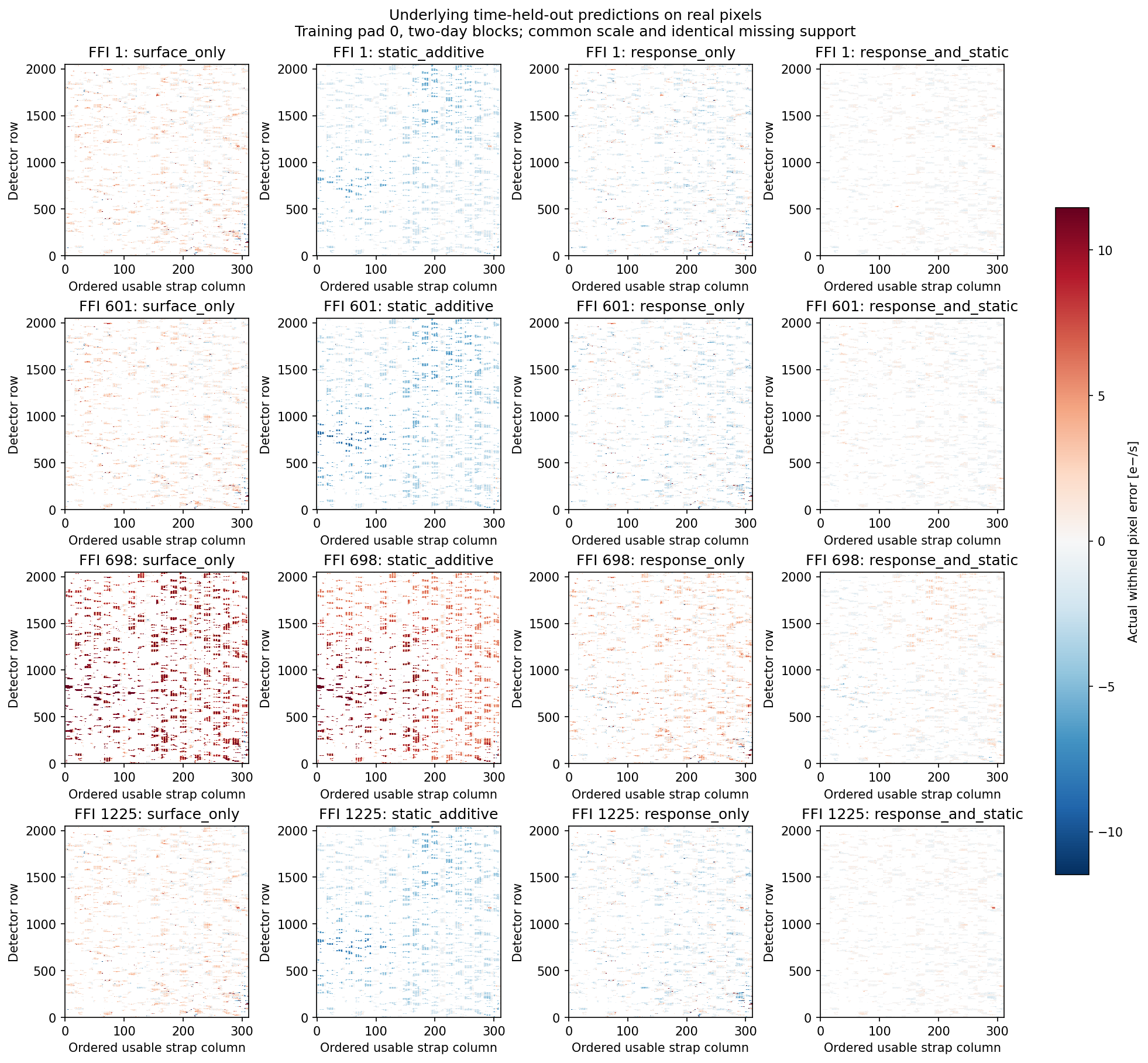
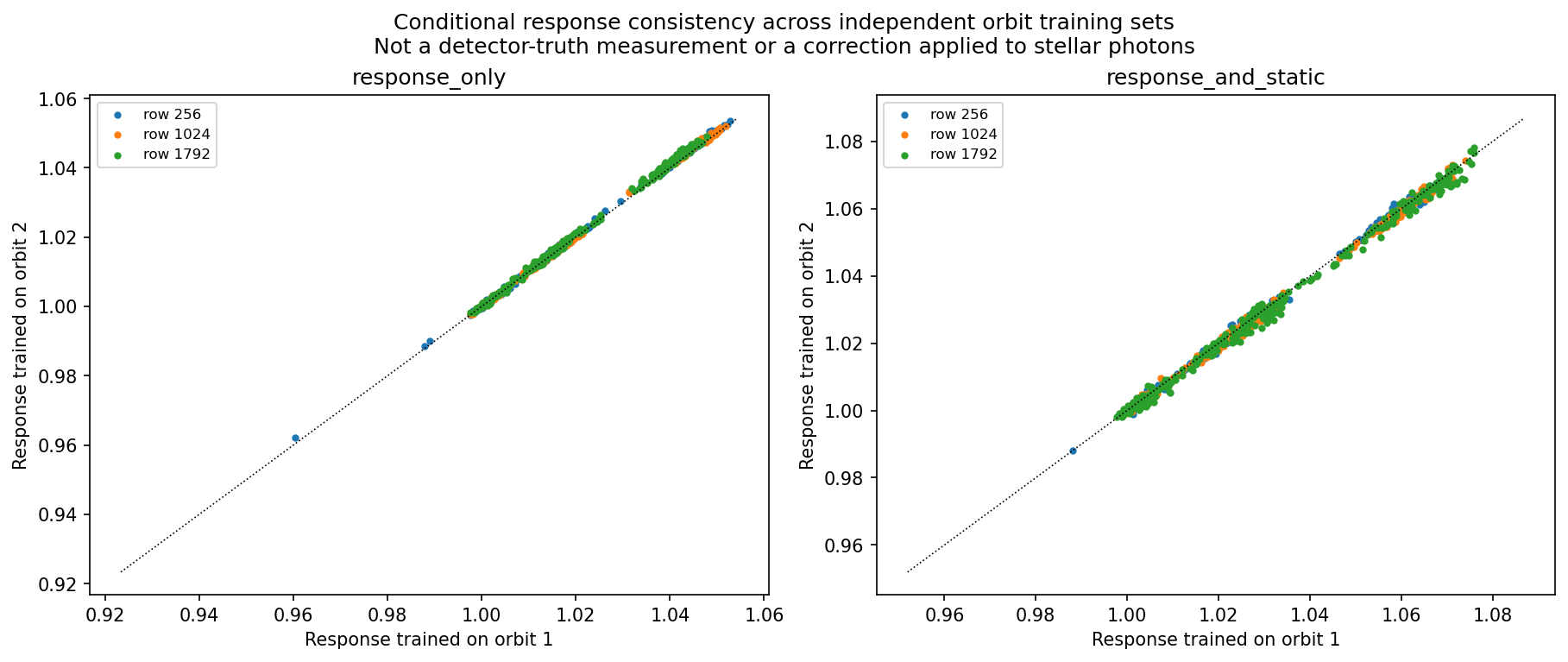
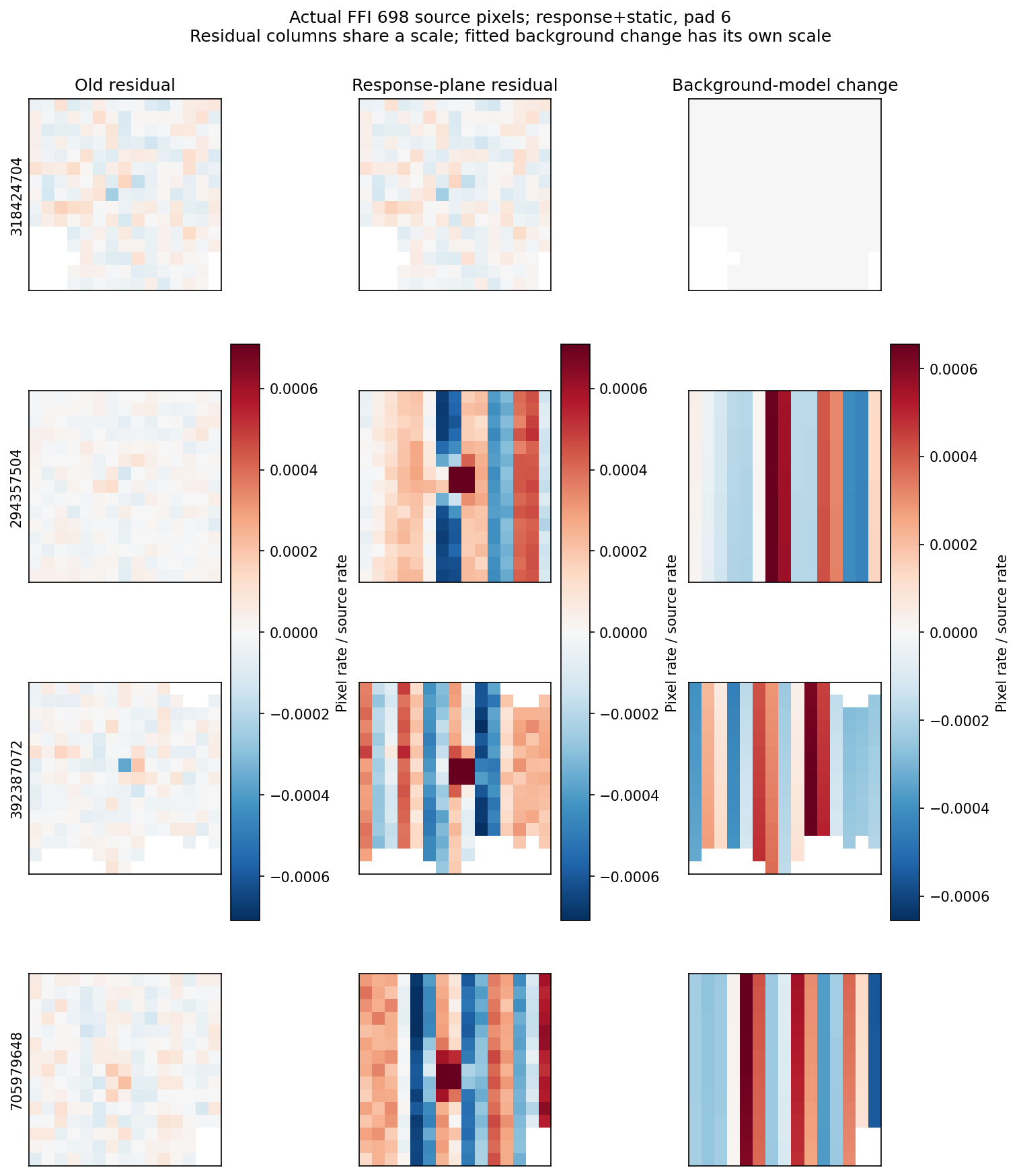
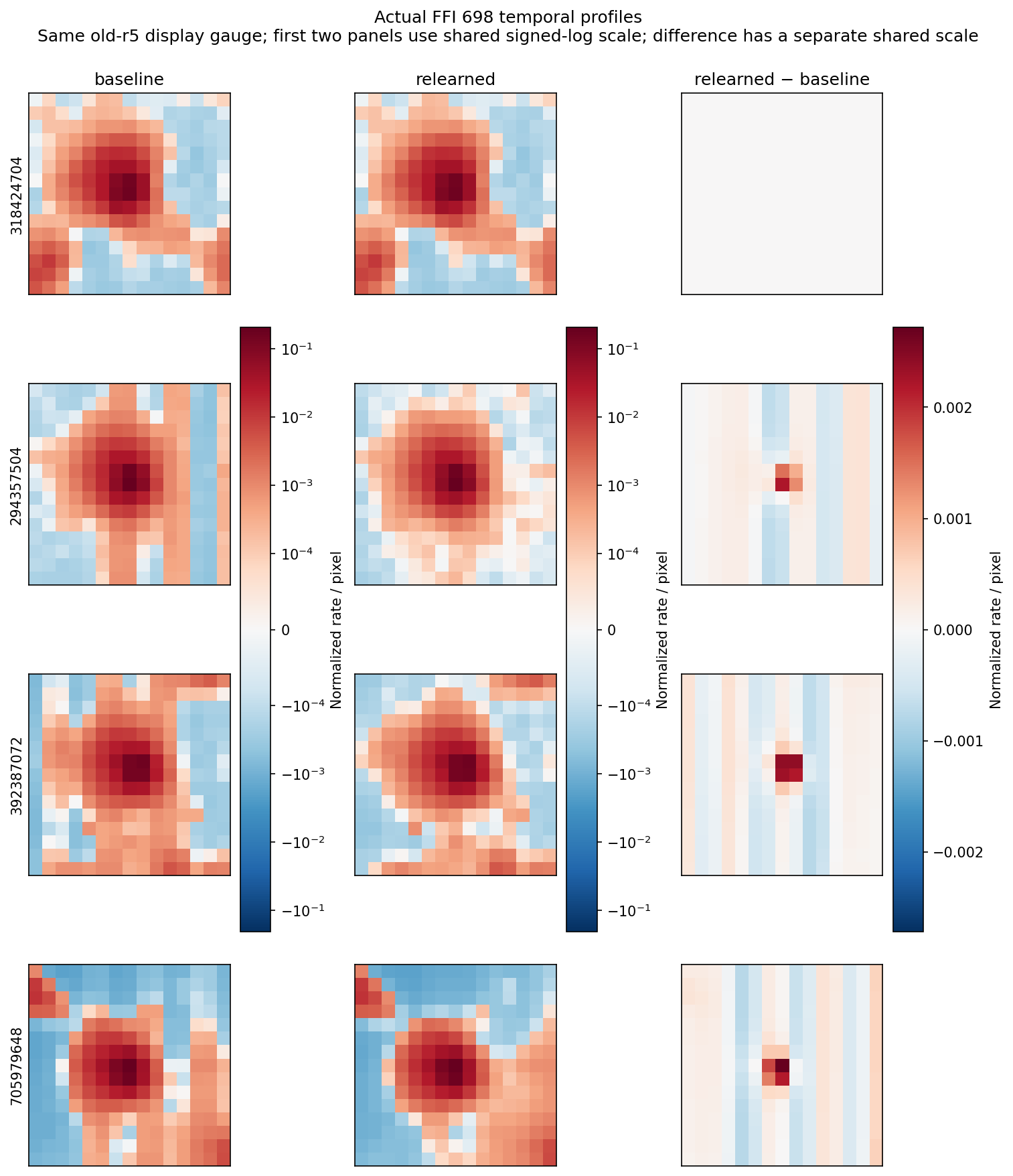
Response plus static residual light improves equal-epoch held-out MSE from 0.56458 to 0.38823 for two-day holds and 0.54821 to 0.36404 for opposite-orbit tests, about 31–34%. Units are (e−/s/pixel)². Surface-only and response-only controls worsen; the joint model matters. These prediction errors are not a photon floor or independent-pixel significance.
Individual model-validation plots and all paired background controls
The full 172-science/235-reference extraction is relearned with the new opposite-orbit response, matching r3/r5 weights and reprojected physical count loss. The global background defines response training; stellar counts retain their fitted response-weighted local sky. Original fluxes replay within 3.80e-13 fraction. Static residual light is not filled beneath stars; WCS and photon expectations remain fixed.
Compared with the preceding response-aware result, two diagnostic source RMS values decrease from 0.40577 to 0.26605 ppt and 0.69446 to 0.53982 ppt. The other two change 0.45800→0.45849 and 0.89582→0.87430 ppt. The full-cohort median-source RMS changes 0.49476→0.48799 ppt, while its median-history RMS changes 0.07282→0.07426 ppt. These include astrophysics.
The preselected group RMS values remain effectively unchanged, 0.12264→0.12332 and 0.18328→0.18360 ppt. The same two conditional sign-association flags remain. This repair does not explain their cause. Shared calibration and asymmetric astrophysics prevent treating those flags as pure instrumental significances.
Worst primary amplitude error is 0.4812% after reference refitting; paired signal-error median/p95 is 1.692/3.375 ppm. Reference-variable injection still imports 86.67/119.05 ppm, and reference halves differ 92.87/110.21 ppm RMS. Global response, WCS and physical photon means are fixed in these controls. The covariance chapter below applies to the preceding response generation and is not silently assigned to this changed estimator.
The inspected standard grids preserve the old normalization/binning and represent 159 of 165 eligible sources; sparse bins remain explicit. The new label is in the existing shared private gallery, preserving all 118 prior entries. Conclusion: this is a further partial correction for selected stars and a useful negative result for the persistent-group hypothesis. Instrument-free/photon-limited acceptance remains unmet. Next discriminate illumination-dependent response, fresh RAW/hp_d astrometry and reference-variable transfer, retaining broader-population and full physical noise requirements. Complete methods, results, jobs, validation and remaining work.
Updated covariance through response profiles and reference calibration
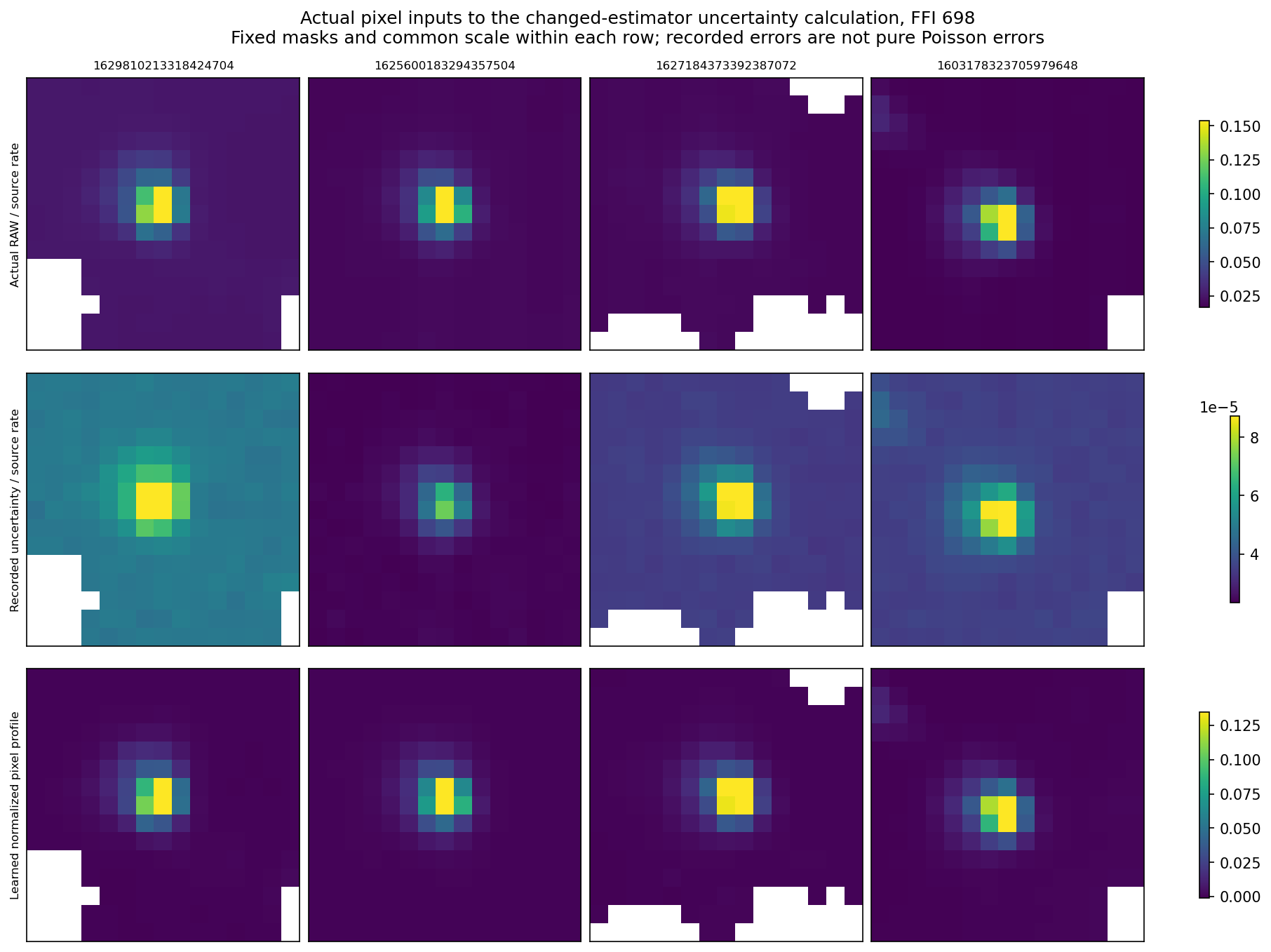
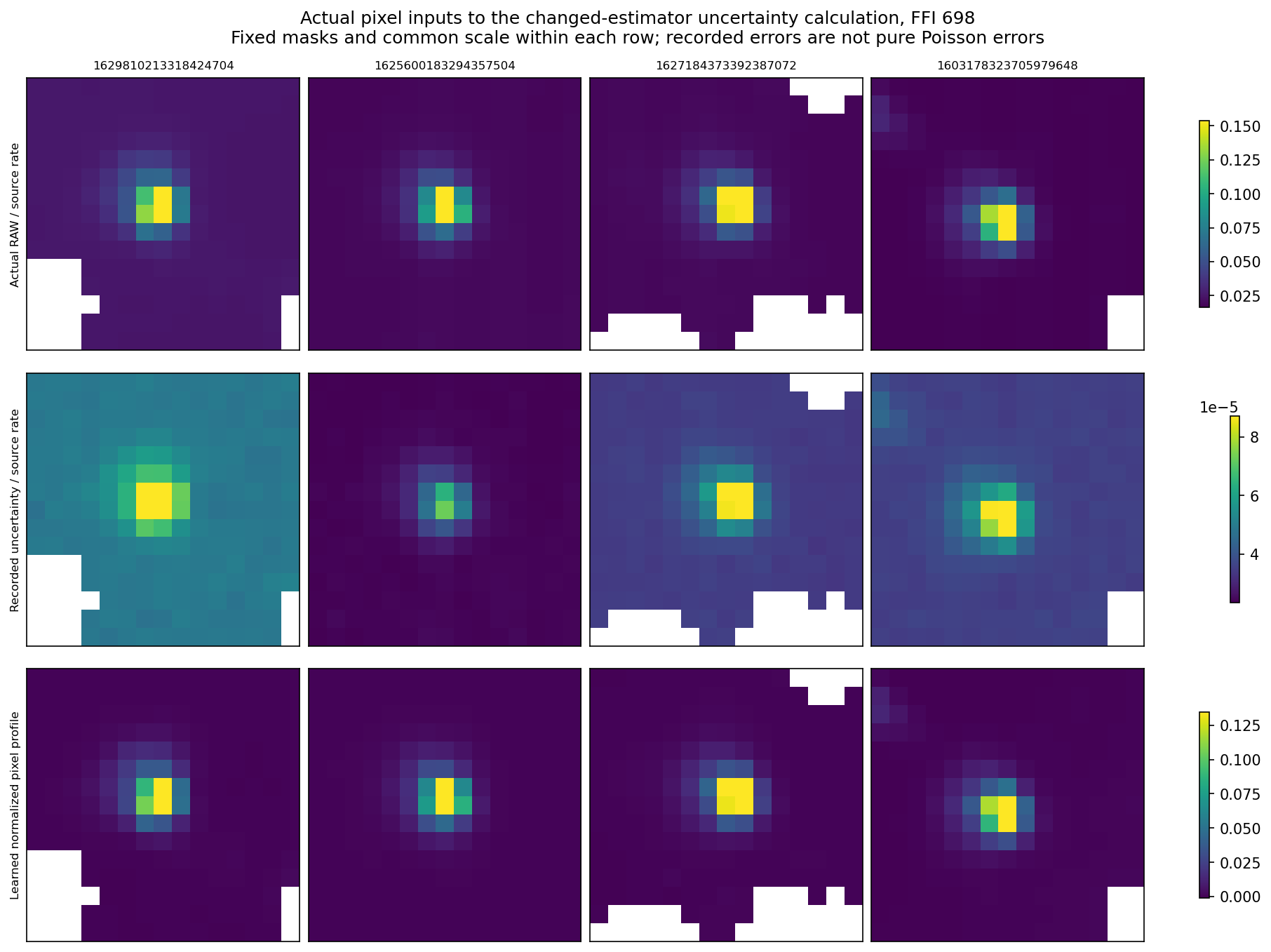
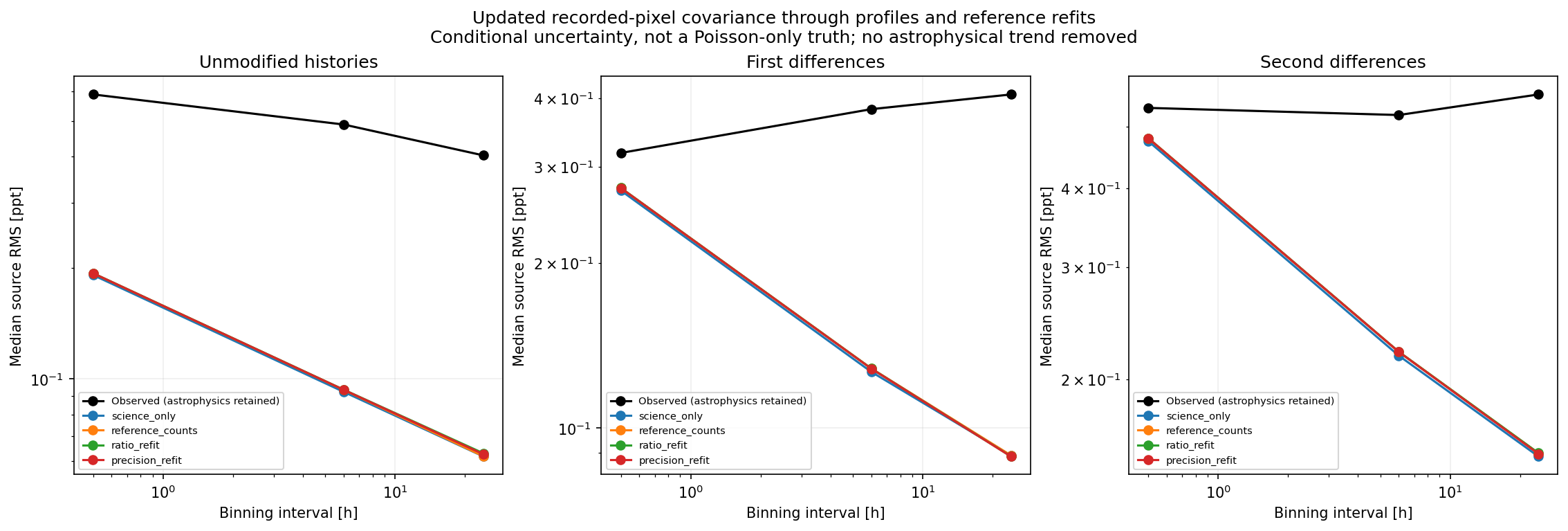
The changed estimator now propagates recorded pixel errors through response-weighted local sky, r5 normalization and learned temporal profiles. Absolute-detector-pixel random streams preserve overlapping stamps. Sixty-four realizations then refit aperture-ratio transport and reference precision with the same source/time exclusions. WCS, global response, explanatory features and physical count-loss means remain fixed. These are conditional archived uncertainties, not a pure Poisson noise budget.
Nonlinear central-difference checks validate the profile Jacobian; full flux replay differs by at most 1.54e-10 fraction. The first 32 draws of all eight pilot sources and the first four reference-refit draws match their full runs exactly. All 64 final draws are finite and complete. Source photometry uses the validated first-order propagation; the reference stage is refitted nonlinearly.
Across 165 eligible sources, median exposure RMS is 0.58984 ppt versus conditional 0.19317 ppt; six-hour RMS is 0.48900 versus 0.09346 ppt. Astrophysics remains. The median per-star first/second-difference ratios at exposure cadence are 1.103/1.065; they do not establish whiteness or a photon limit. This audit uses orbit-aligned log-flux median bins, so exact values differ slightly from the earlier globally aligned fractional-flux audit.
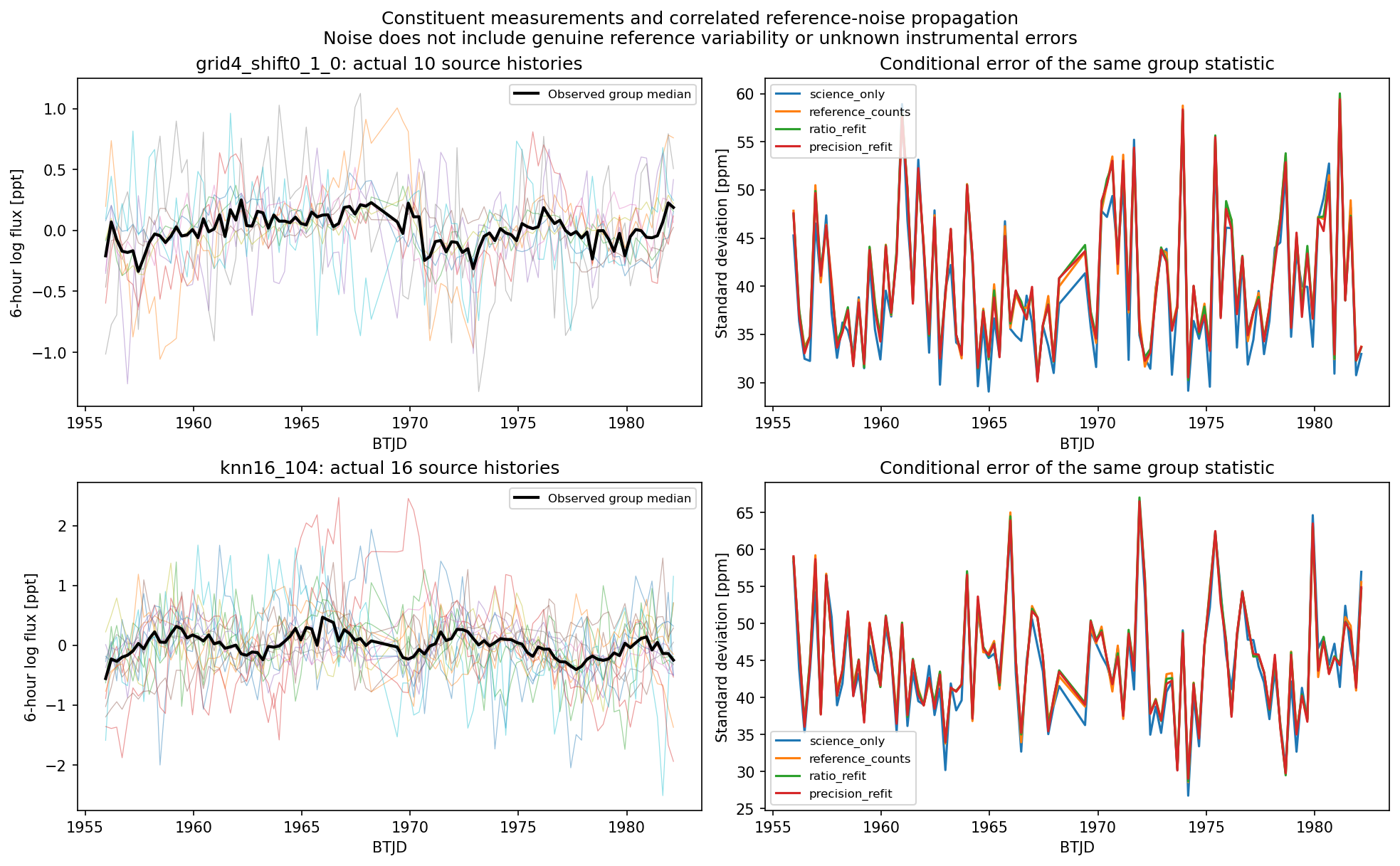
The preselected 10/16-star groups have measured six-hour RMS 0.12592/0.18717 ppt versus propagated 0.04626/0.05208 ppt (Monte Carlo SE about 0.00045/0.00046 ppt). Adding reference pixel noise and reference refits changes the science-only noise estimate modestly. Genuine reference variability and unknown calibration errors are separate terms.
Conclusion: missing conditional pixel/profile/reference covariance does not account for the slow histories on its own. This does not classify their excess as purely instrumental or certify photon-noise dominance. No light curve is changed or noise floor tuned to observed scatter. Equations, exact support, checks, operational limitations and remaining physical noise terms.
Calibration trace: actual virtual-row counts drive the defective column
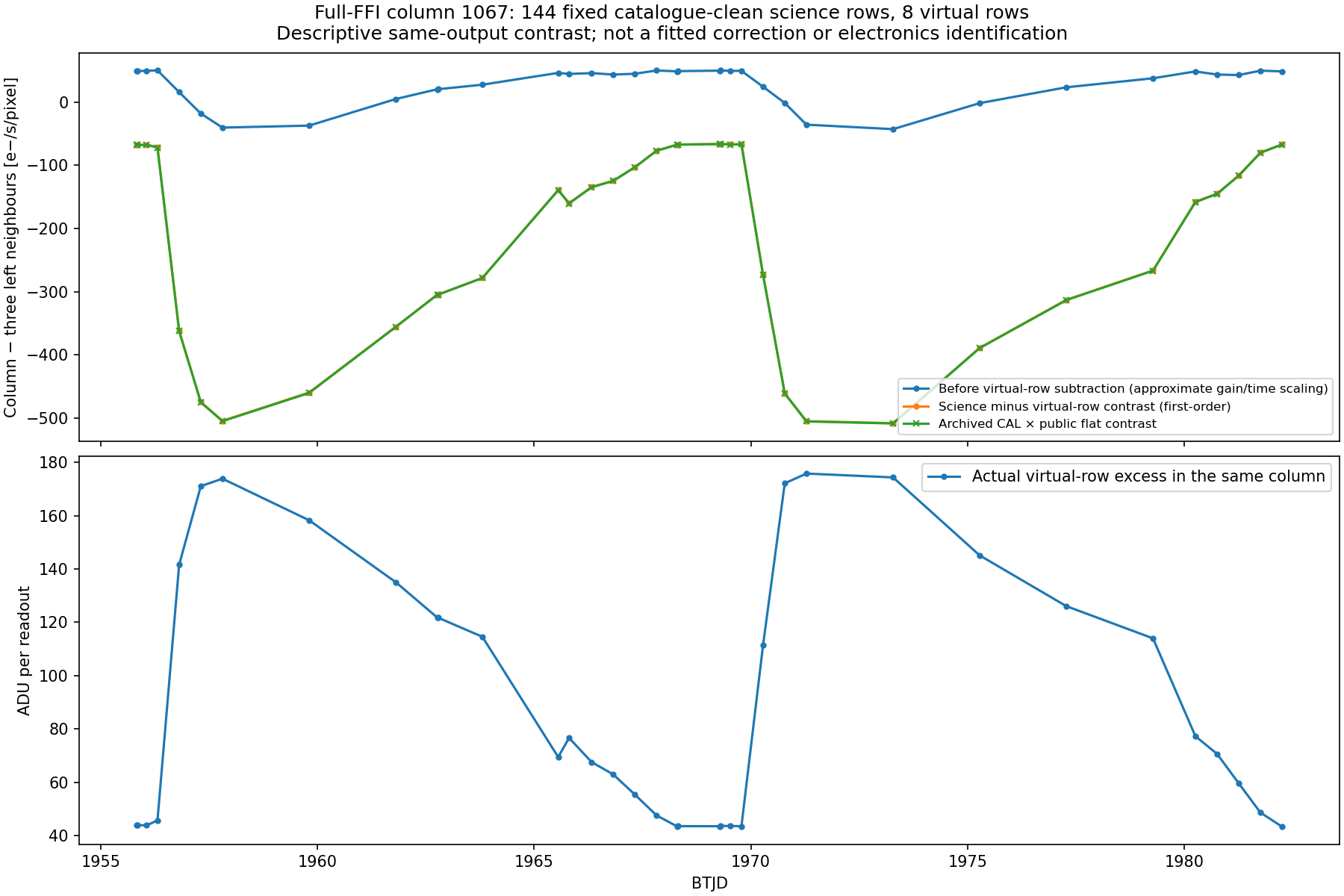
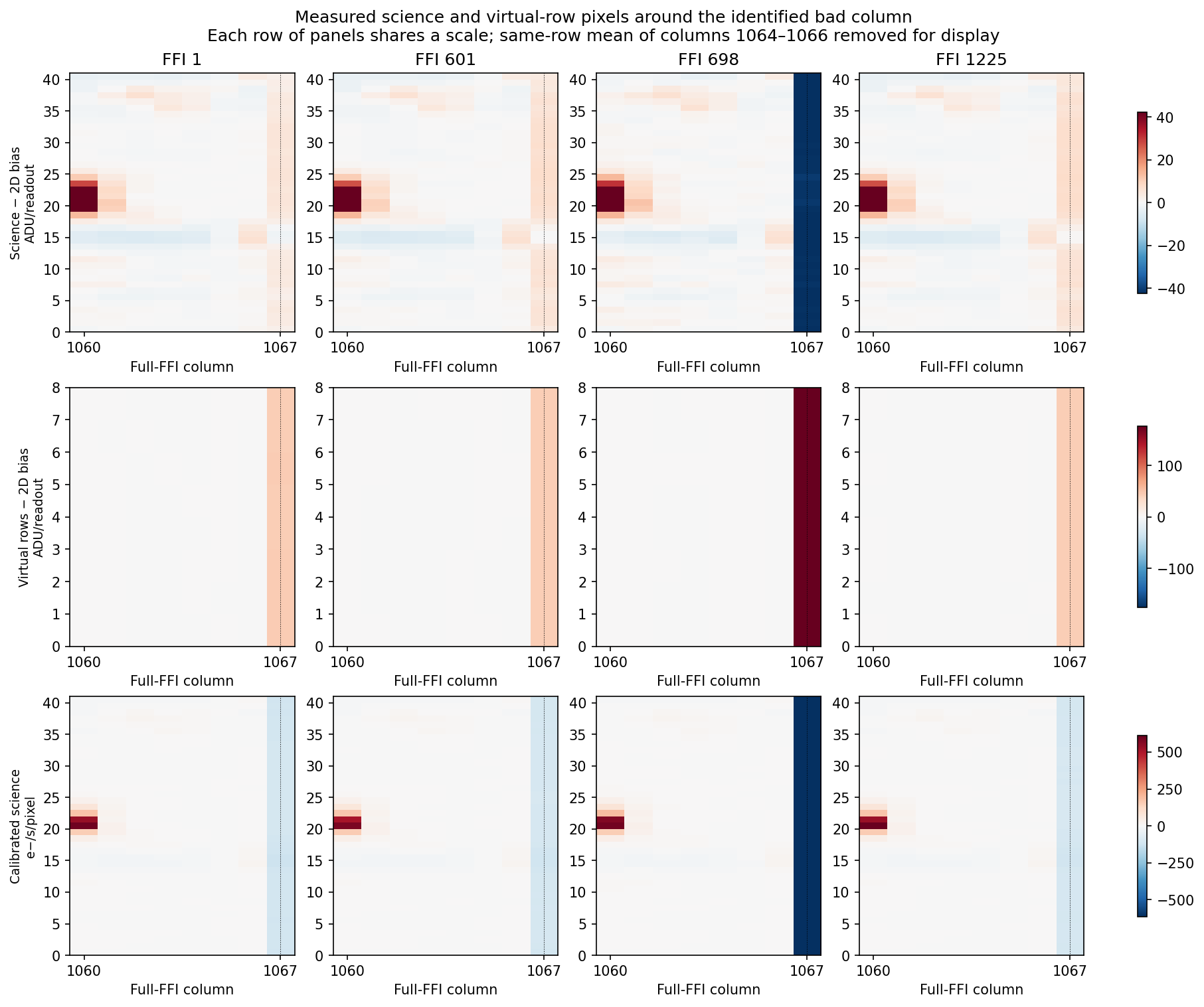
Calibration is spatial: four readout channels, 2-D bias, exposure-dependent collateral terms and pixel flats. Our “RAW” extraction uses calibrated _ffic images. The matching uncalibrated _ffir counts expose a specific problem in full-FFI column 1067 (crop 1023), not a demonstrated single CCD-wide gain error.
Across 36 fixed epochs, compare that column with three left neighbours in the same output using 144 fixed catalogue-clean science rows and eight virtual rows. The excess in virtual rows rises from about 44 to 176 ADU/readout. A first-order science-minus-virtual contrast closely follows the depressed calibrated column: at FFI 698 it predicts -504.76 e−/s/pixel versus -505.24 in archived CAL multiplied by the public flat. This is a local processing comparison, not detector truth; nonlinear terms, row-bias differences and flat-reference ambiguity remain.
The science pixels themselves also change before CAL. The result does not authorize simply adding back the virtual term or establish an upstream software bug. Conclusion: the defective-column processing route is identified and its inappropriate use as background is repaired in shadow products; the electronics origin and all remaining stellar systematics remain unresolved. Calibration and subtraction evidence with exact scope.
Actual hp_d regeneration: the background repair survives full kernel refits
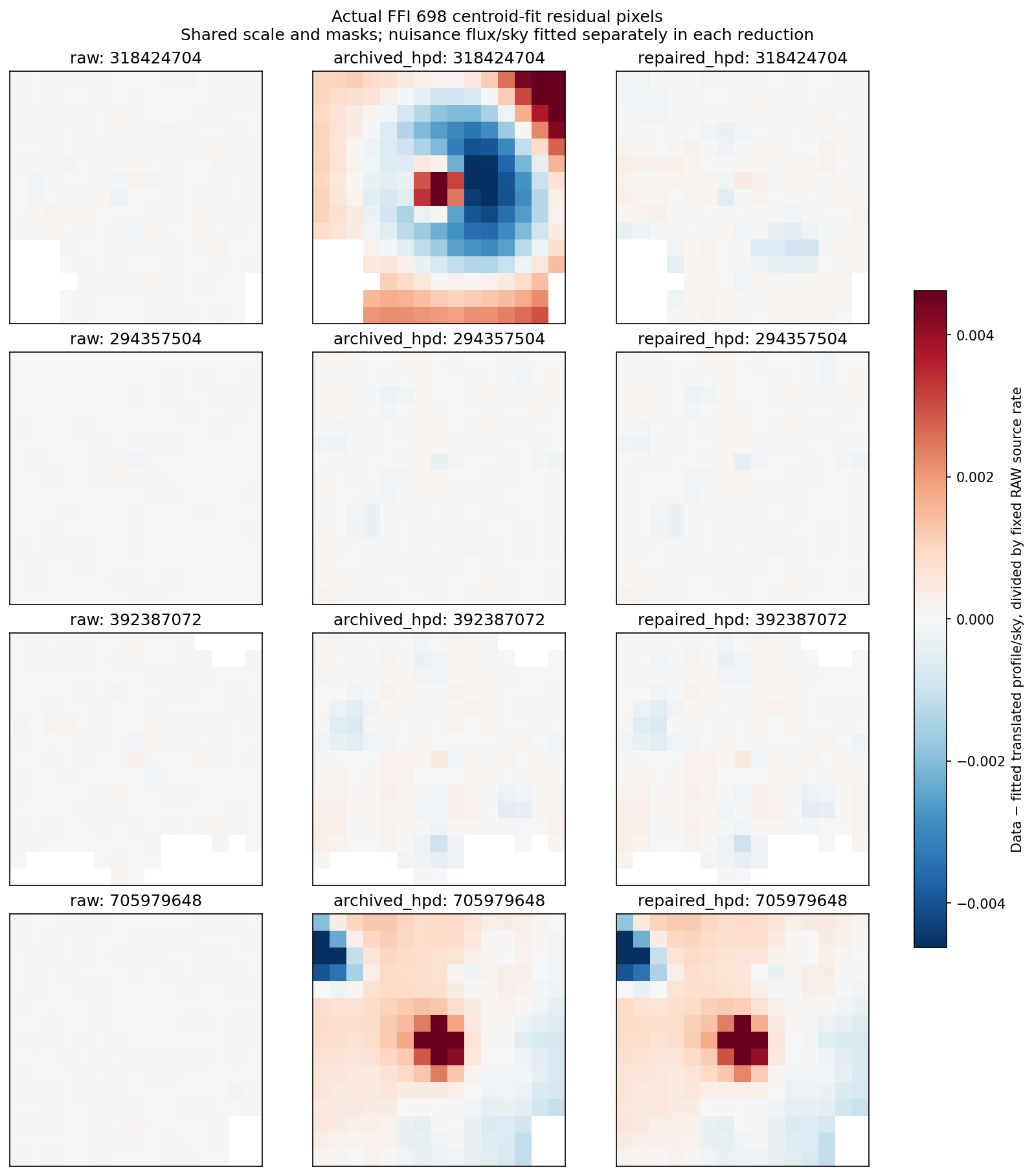
The saved legacy kernels independently reproduce four archived frames only with their original eight-pixel padded geometry. Fresh complete baseline fits then reproduce every archived pixel exactly. Matched corrected-background fits separately hold the old kernel, refit it, and add the existing S24 C2K2 detector-column exclusions to the Hotpants mask.
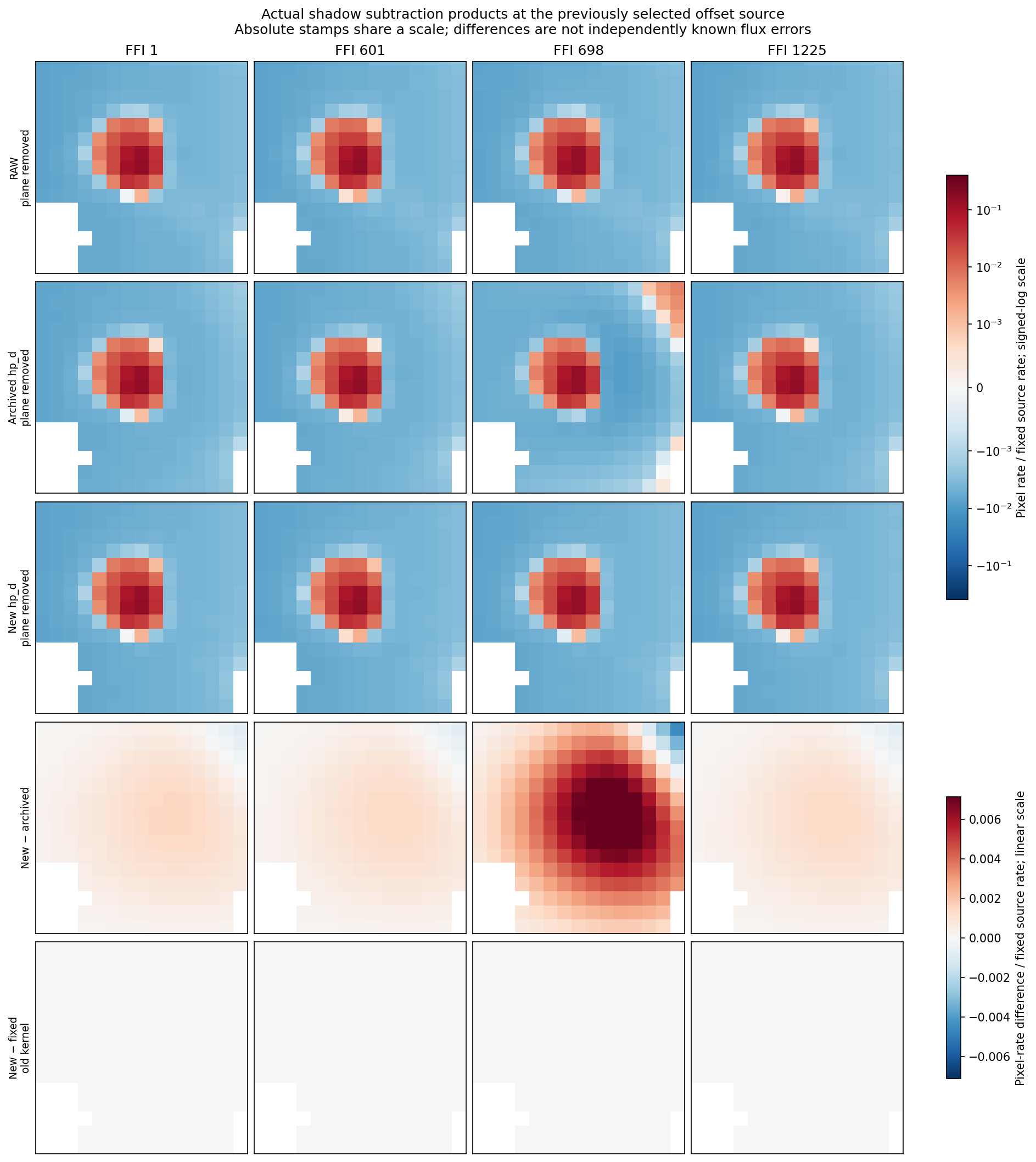
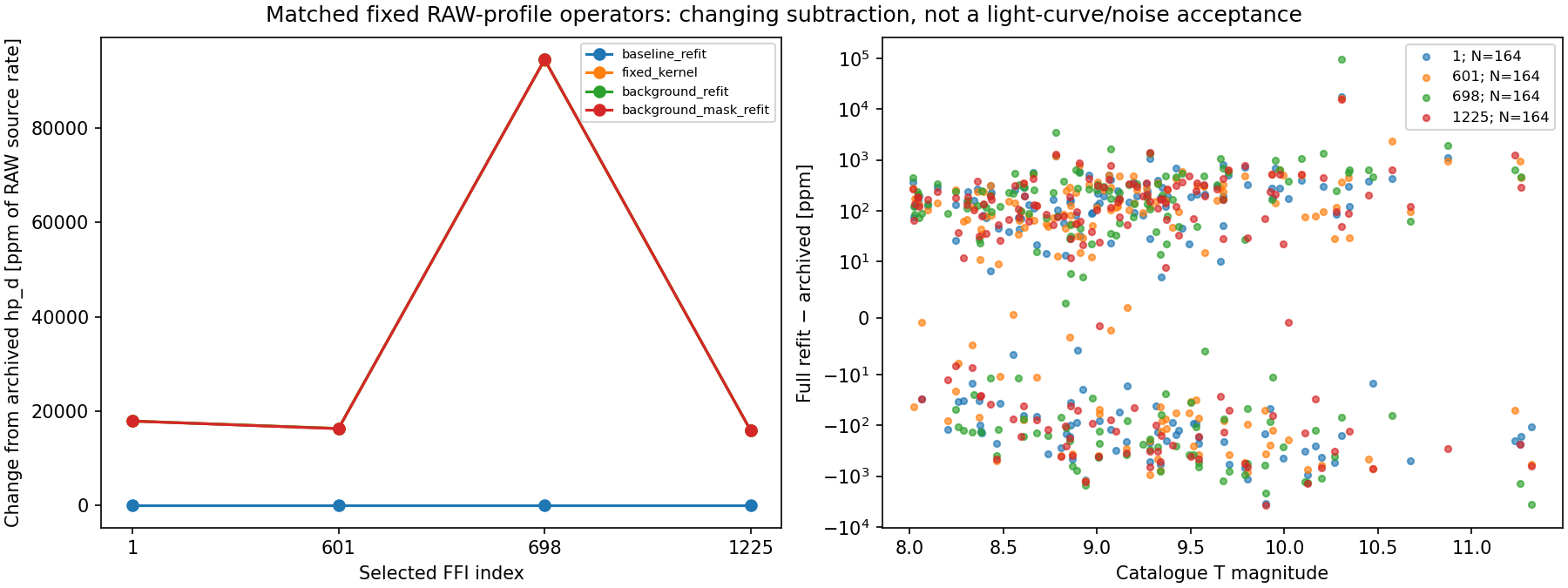
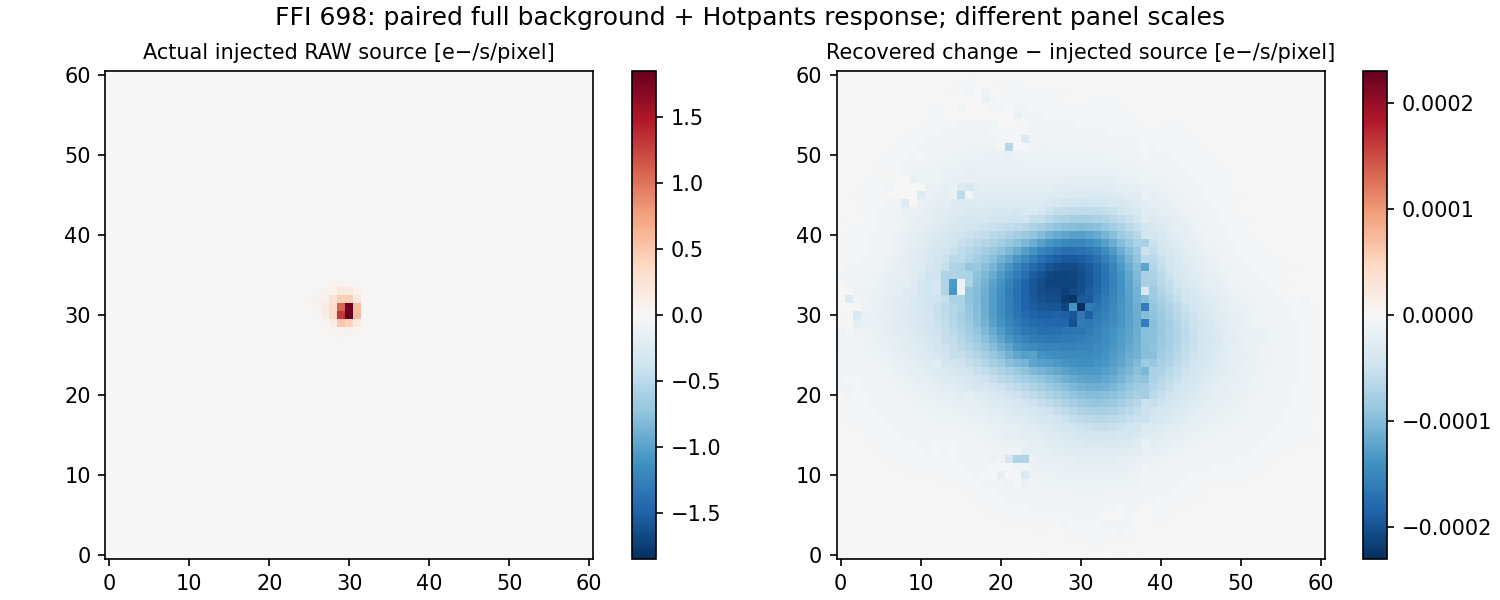
At the previously selected offset source, full repaired-minus-archived changes are +17880/+16267/+94529/+15854 ppm of the fixed RAW source rate at FFIs 1/601/698/1225. Fixed-kernel changes are nearly identical there. These are differences between reductions, not errors relative to known true stellar flux. The total repair combines the prior harmonic/component/positive-RMS changes with detector exclusions; the preceding controlled mask-only comparison isolates the column contribution.
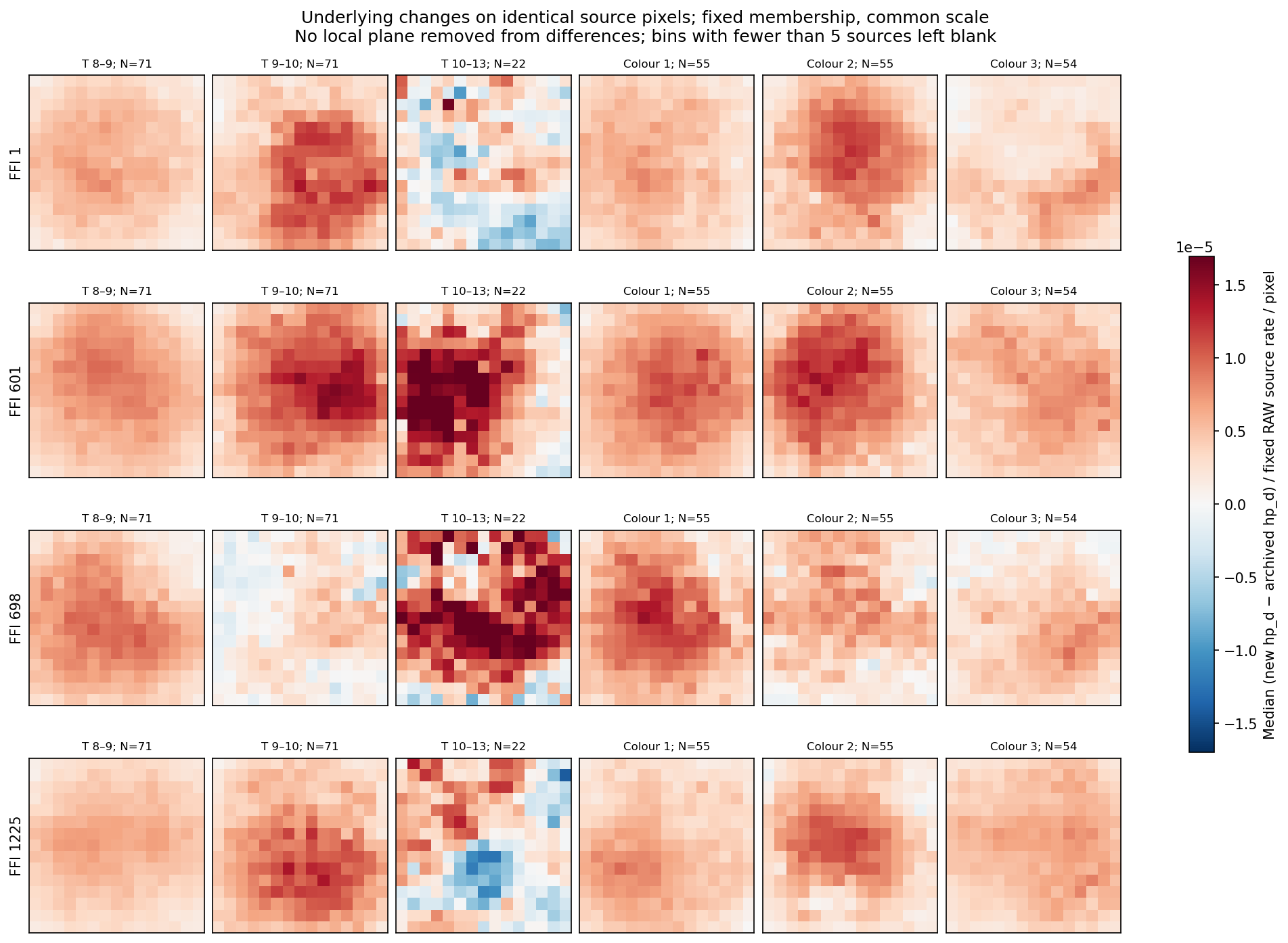
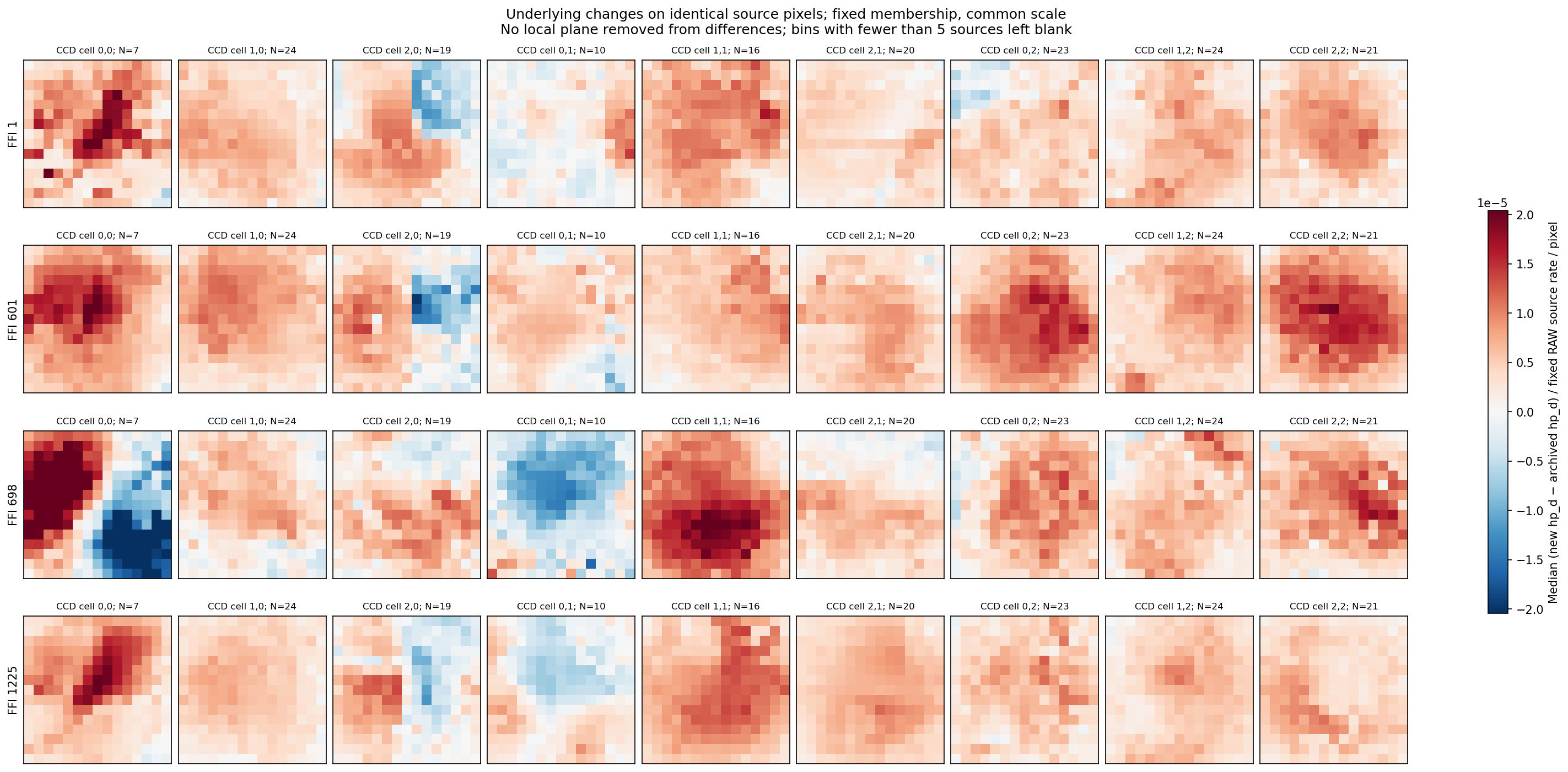
The unchanged eligible cohort contains 165 sources; 164 have common nonfatal support in these products. Median absolute full changes span 142–205 ppm, with per-frame p95 782–1335 ppm. Underlying changes by fixed magnitude, colour and spatial membership follow. They are not proof that every changed pixel is more accurate.
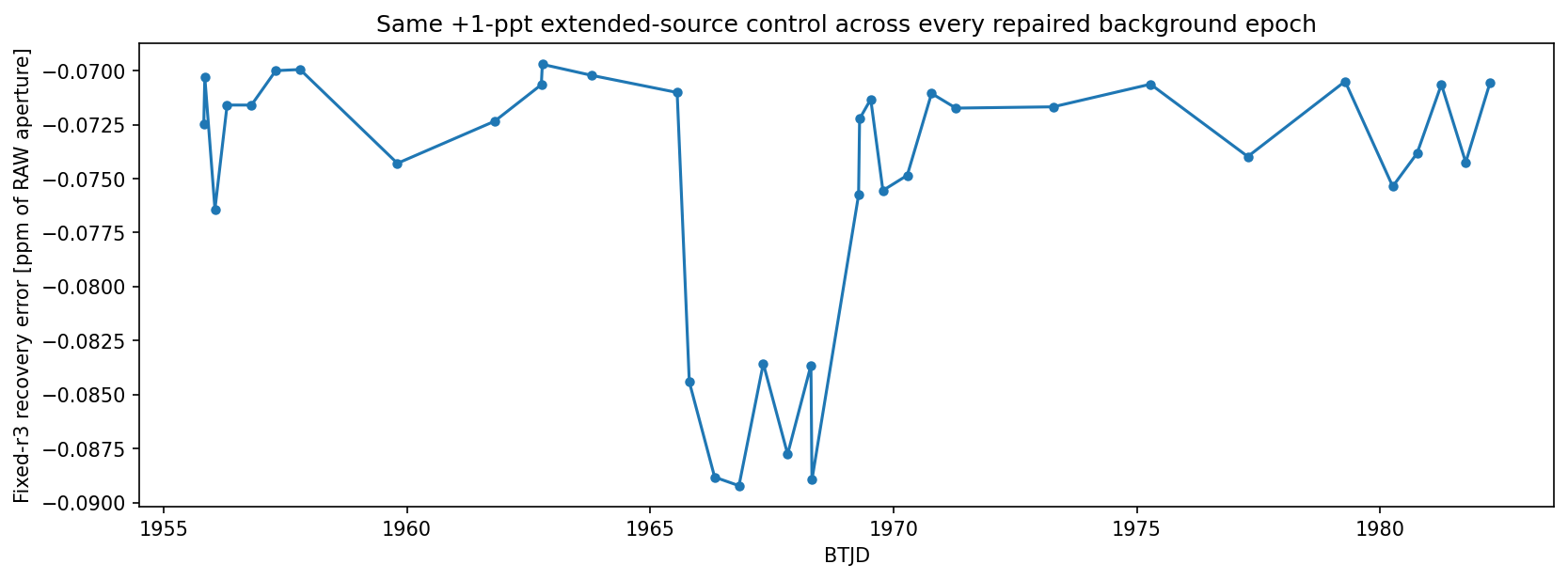
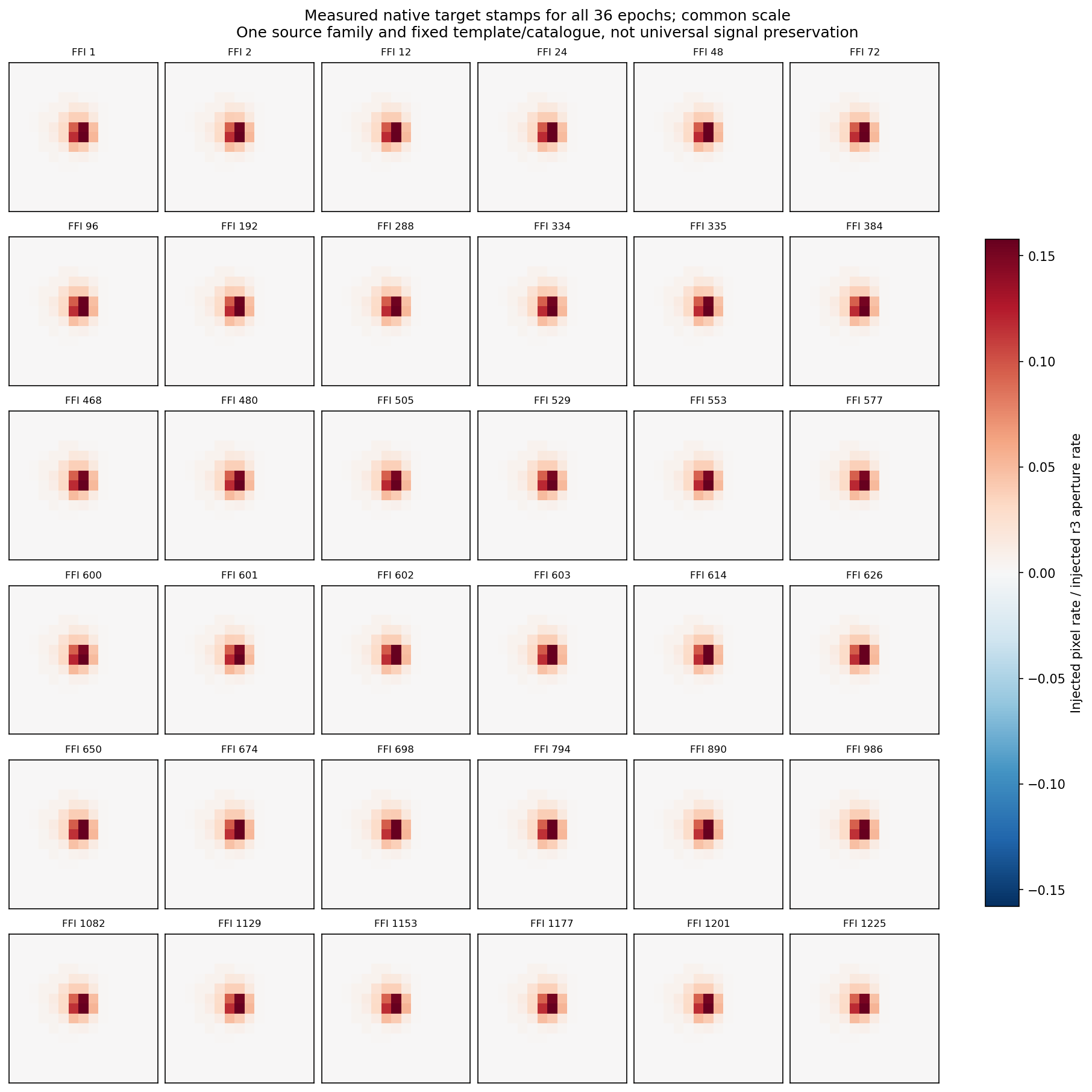
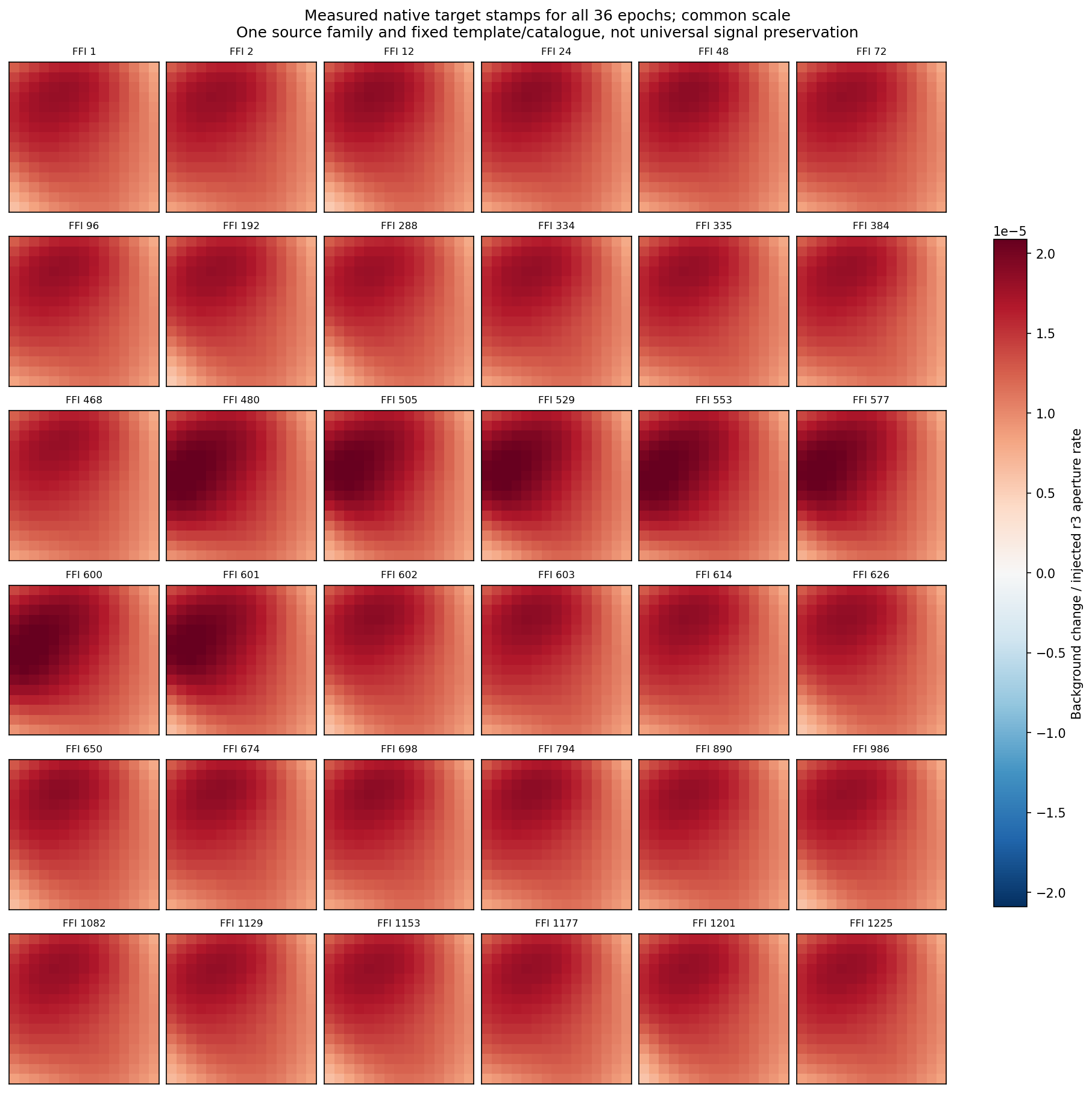
A +1-ppt extended-source perturbation at FFI 698 repeats background generation and kernel fitting: fixed-r3 recovery error is -0.08045 ppm of the original aperture rate (-0.008045% of the injected amplitude). WCS, template, catalogue and uncertainties remain fixed. This is one conditional source-family check, not universal signal/noise closure.
Conclusion: selected full hp_d products now exist and support the repair beyond an algebraic map adjustment. Full temporal regeneration, fresh astrometry, missing-light accounting, broader source/signal coverage and physical noise acceptance remain open. The original photometry product and production images are unchanged. Method, source support, equations, software replay, failures and remaining work.
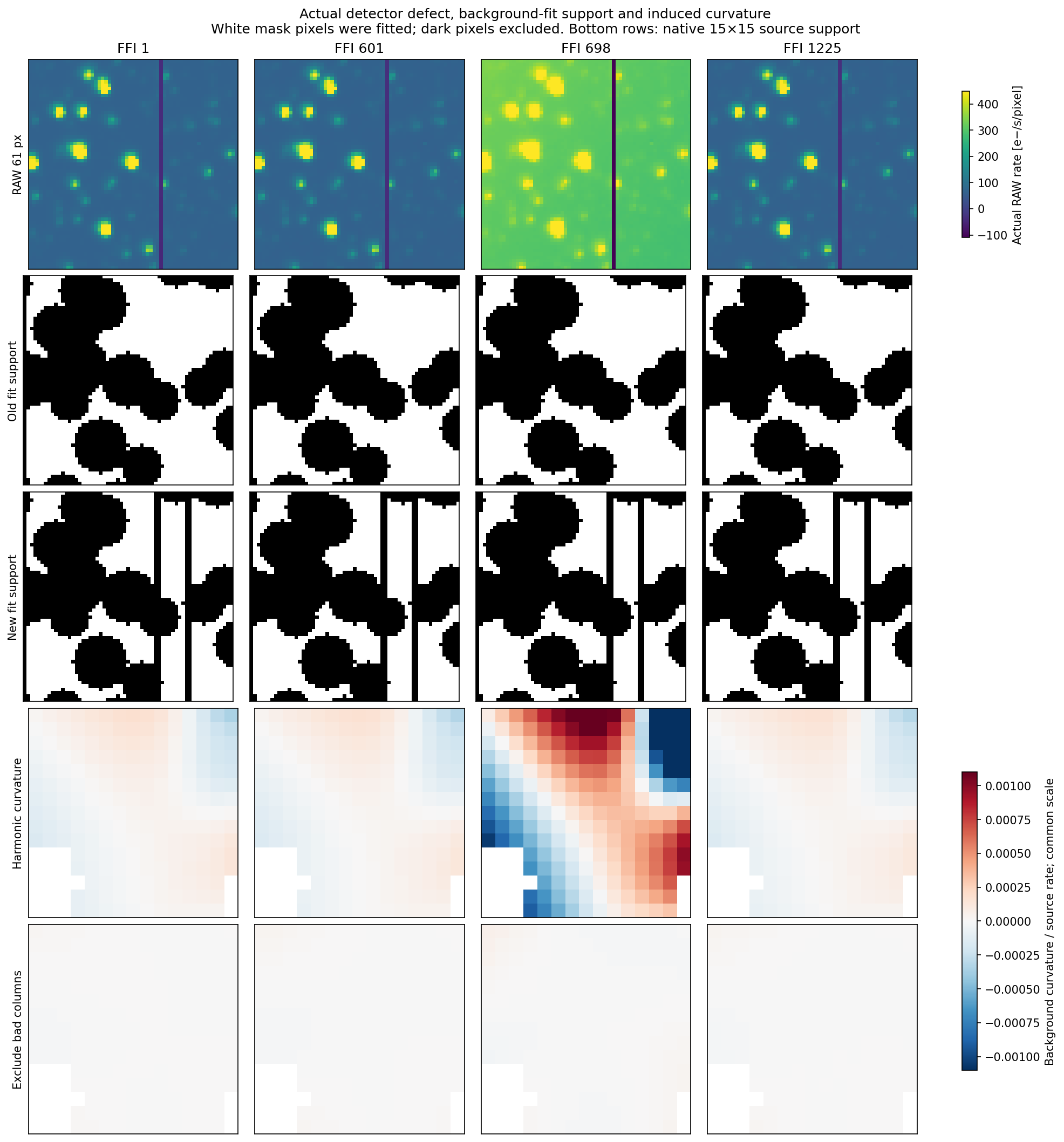
The historical background fit admits 9,170 pixels in columns already excluded by the stellar extraction. At FFI 698, crop column 1023 (full-FFI 1067) alone contributes 1,103 fitted pixels with strongly negative RAW-minus-template values. Direct RAW reads confirm the abnormal column values; this is not merely a convolved-template feature.
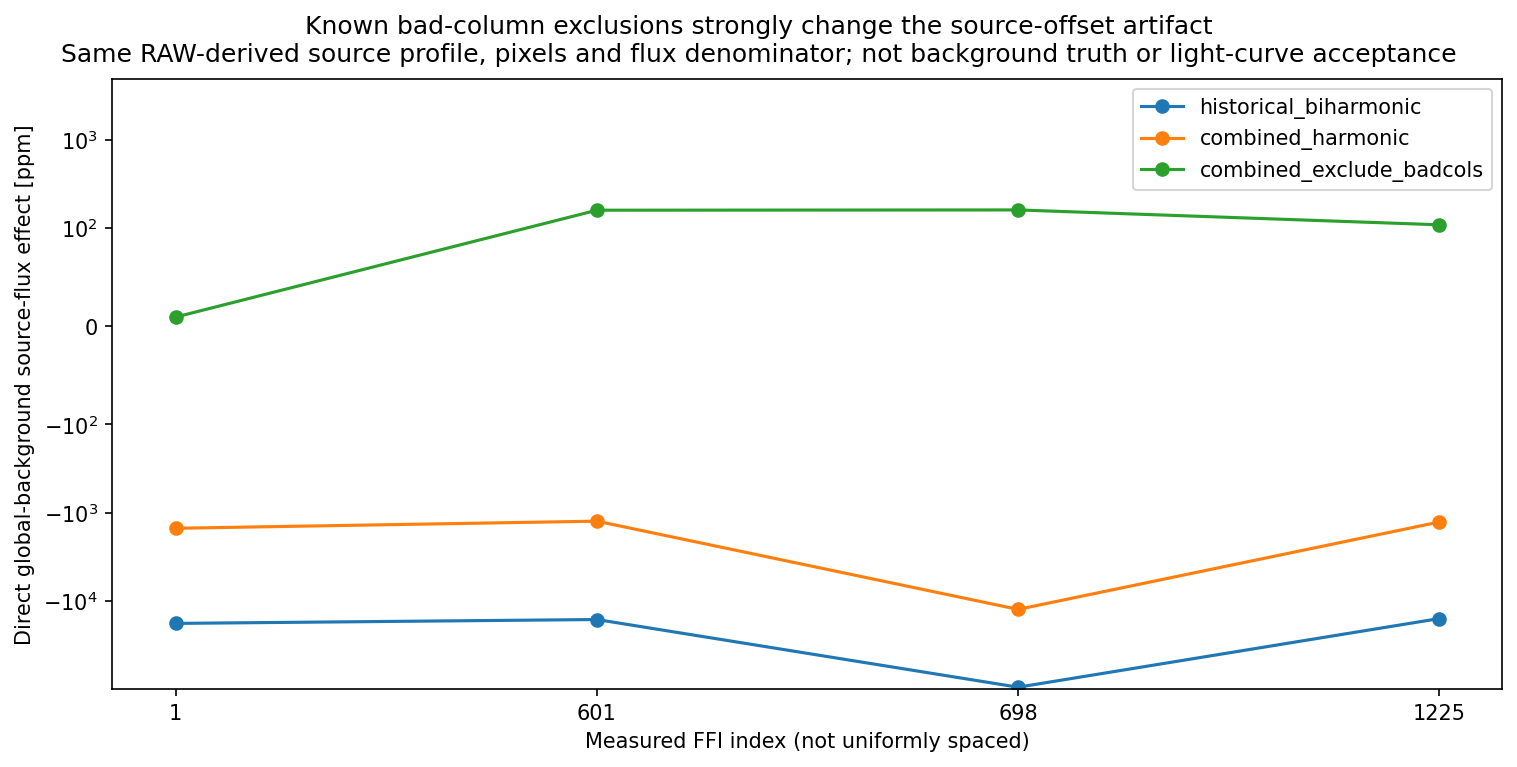
A shadow test adds the existing stellar bad-column set to background-fit exclusions while keeping all measured source pixels and model conventions fixed. At the previously selected hp_d-offset outlier, the harmonic candidate's direct projected background effect changes from -1499.73/-1245.55/-12417.80/-1272.64 ppm to +9.30/+159.12/+160.25/+108.77 ppm at FFIs 1/601/698/1225. These are effects of subtracting modeled backgrounds, not known absolute errors or corrected light-curve scatter.
The conspicuous high-background curvature beneath the source largely disappears when the invalid columns stop teaching the sky model. Paired source controls remain small and harmonic solves converge. Conclusion: this identifies a causal component of the background-offset artifact and a concrete shadow repair. Proper per-CCD mask provenance, selected Hotpants regeneration with kernel controls, fresh astrometry and full photometry/noise validation remain required. Production masks/images and the photometry below have not been replaced by this test. Exact values, equations, masks, job records and remaining repair work.
Carry the background response through full-cadence profile learning and photometry
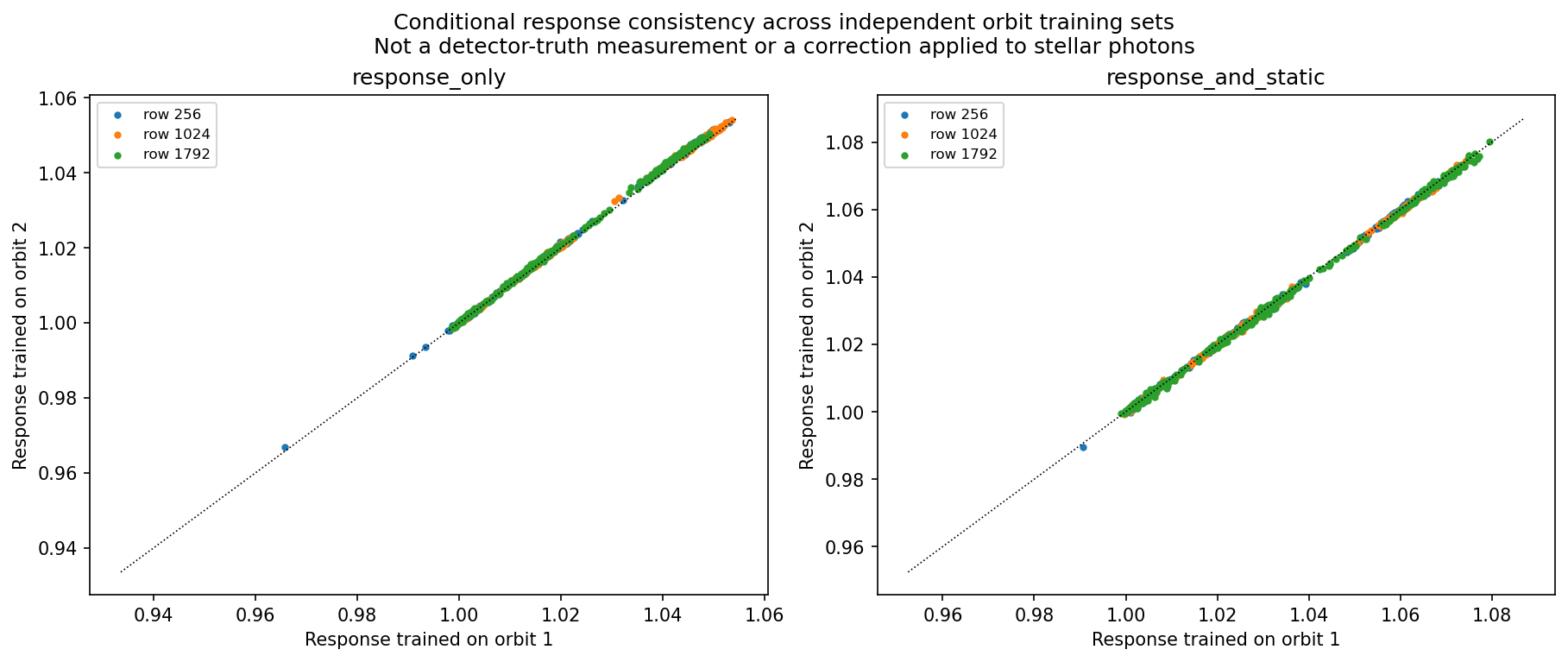
A 36-epoch pixel model separates a quadratic column response proportional to the pre-strap surface from static additive residual light. Whole two-day blocks and whole opposite orbits are withheld. On 110,806 common usable sky pixels, response plus static light predicts much better than either alone: pad-6 held-out MSE is 0.5646 for two-day blocks and 0.5482 for opposite orbits, versus 24.2157 for the surface alone. Units are (electrons/second) squared per pixel. These are conditional prediction errors, not photon variance or detector-truth calibration.
Changing only the local sky basis while keeping the old profiles leaves column residuals. The complete follow-up therefore relearns all 172 science profiles across 1,224 FFIs, with response-aware outer-ring sky and matching r5 normalization. The response is trained on the opposite orbit; profiles use other interleaved exposures within the evaluated orbit. WCS conventions stay fixed. Static residual light is never filled under stars. The old flux extraction replays within 3.80e-13 fraction, and physical count-loss images are projected into the changed aperture weights. Photon expectations are not resimulated.
The same 235 references and 165 eligible science stars are retained. Aperture transport is refitted with source-fold/two-day exclusions; fixed old reference precision and refitted precision are both shown. Independent analytic primary injections repeat profile learning and reference refitting. Worst amplitude error is 0.1748% before the reference step and 0.4998% after it; paired signal-error median/p95 is 1.686/3.497 ppm. Global response, WCS and photon means remain fixed, so this is not full physical signal/noise closure.
Median six-hour source scatter changes from 0.53490 to 0.49476 ppt with refitted precision; full-cohort median scatter changes from 0.07661 to 0.07282 ppt. Three selected large-excursion stars change from 4.027/5.498/3.492 ppt to 0.406/0.896/0.694 ppt. The quiet comparison remains near 0.45 ppt. These measured scatters include astrophysics and shared-reference covariance.
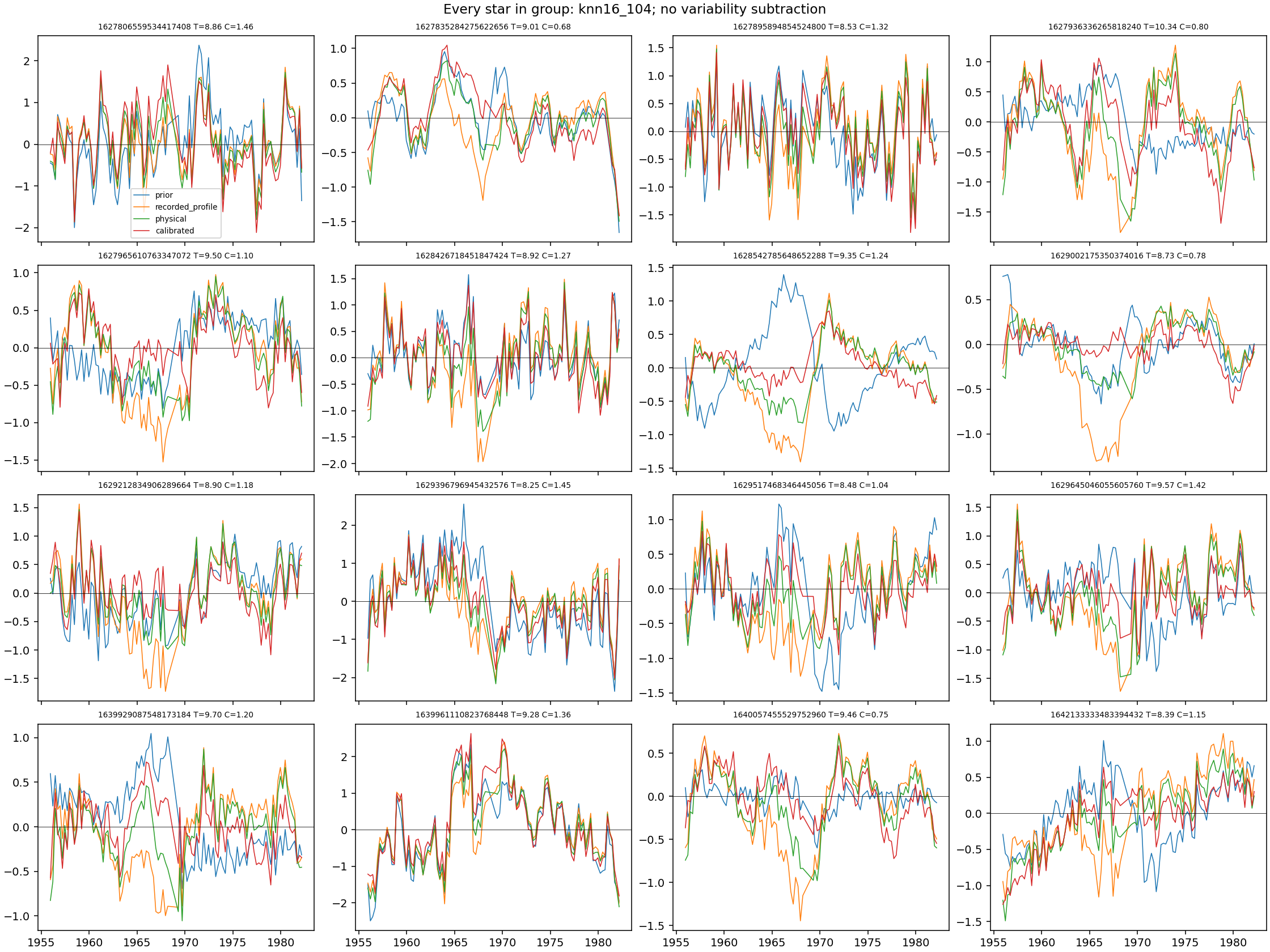
The preselected 10/16-star group RMS values improve only modestly, from 0.13663/0.19484 to 0.12264/0.18328 ppt. Two conditional sign-association flags remain (knn16_93 and knn16_104); shared calibration and stellar covariance prevent identifying their cause from that statistic. Reference-variable injection imports median/p95 87.82/120.15 ppm, and independent reference halves differ by 91.14/109.59 ppm RMS. Those are finite-ensemble sensitivities, not a pure detector-noise floor.
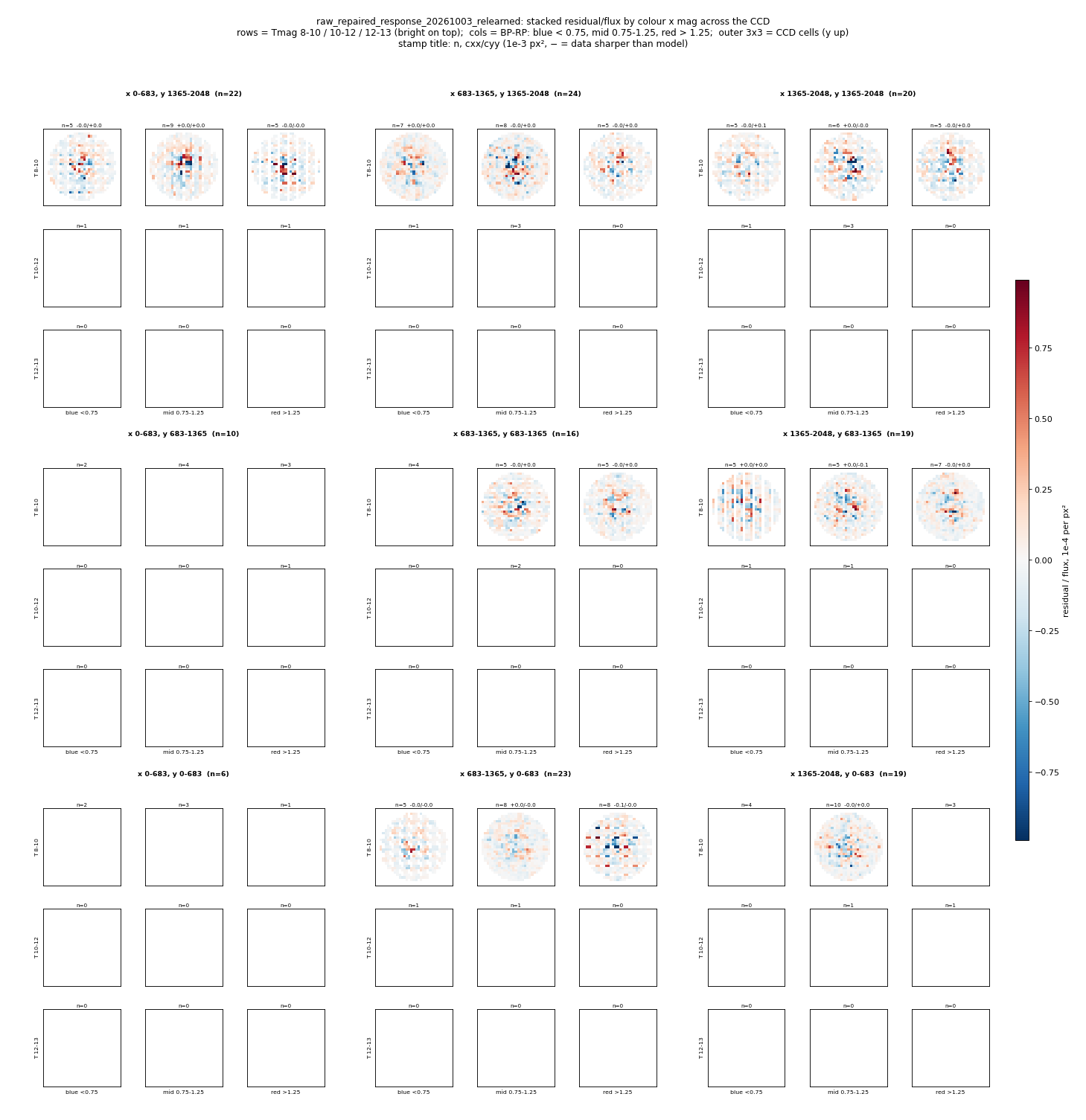
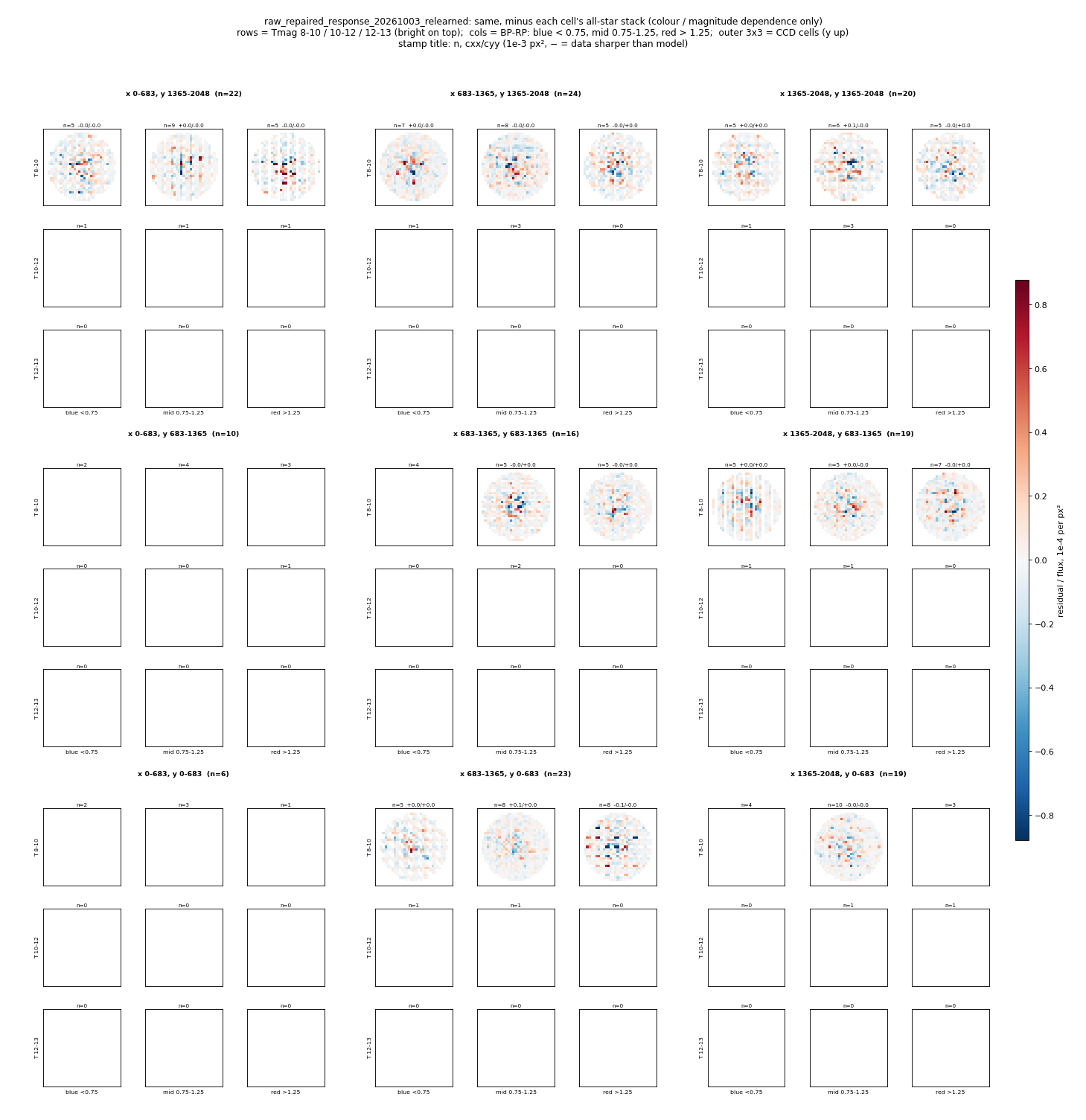
Standard colour/magnitude/3×3-CCD residual grids use identical old flux denominators and bin membership. The canonical range represents 159 of the 165 input sources; many bins remain sparse. Relative panels remove the cell-wide residual and are not absolute residuals. Native before/after images above share scales; canonical plots retain their standard per-plot limits.
The shared private comparison gallery contains all three new labels; 115 prior entries were preserved. The external Claude Artifact mirror was not republished. Conclusion: this is a substantial partial correction for selected stars and a modest population improvement, not instrument-free/photon-limited acceptance. Updated noise/covariance, remaining group trends, broader populations and hp_d generation repair remain. Complete equations, inputs, validation, job records and remaining gates.
Held-out sky validation: distinguish usable pixels from a misleading bad-column gain
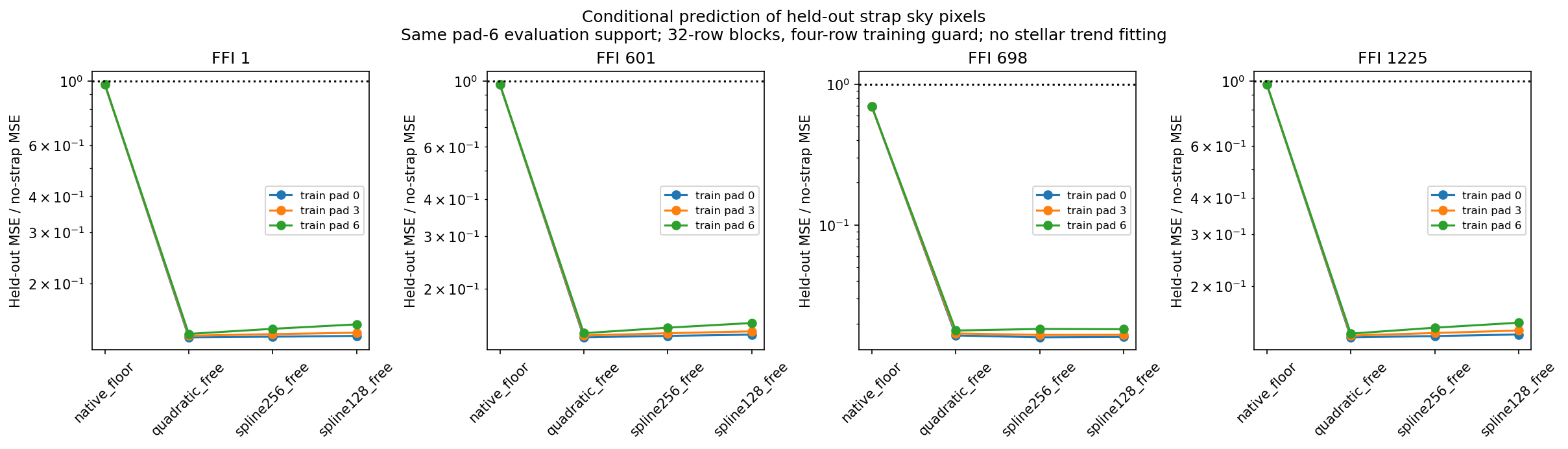
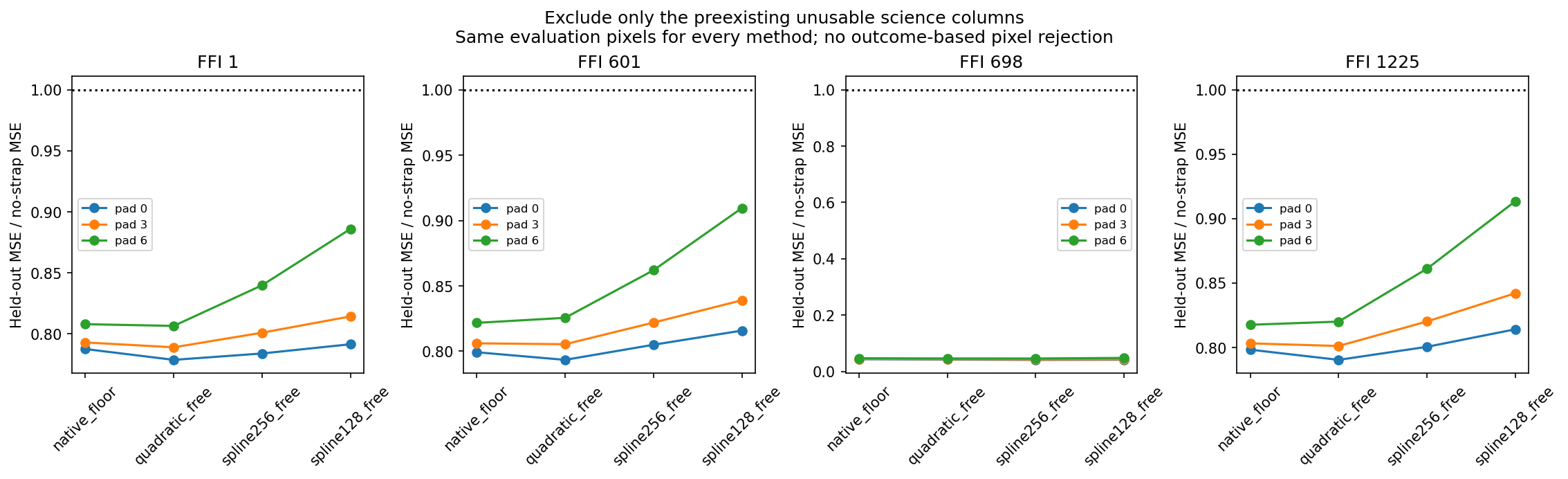
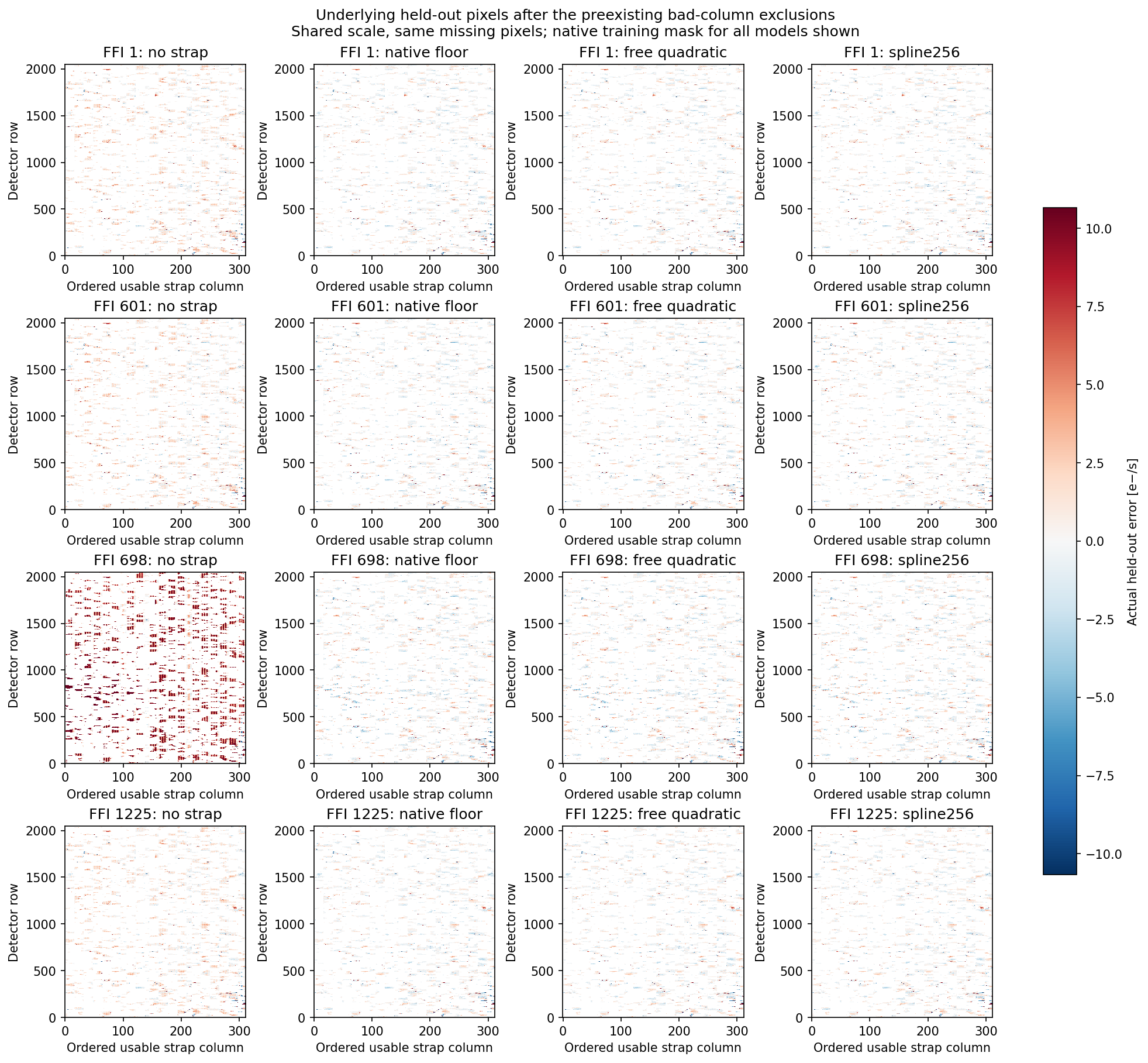
Four epochs, alternating 32-row holdout blocks with a four-row training guard, three mask expansions and identical evaluation pixels across models. No stellar trend trains or selects the response. The pre-strap surface stays fixed, so this is conditional column prediction, not a holdout of the entire background pipeline.
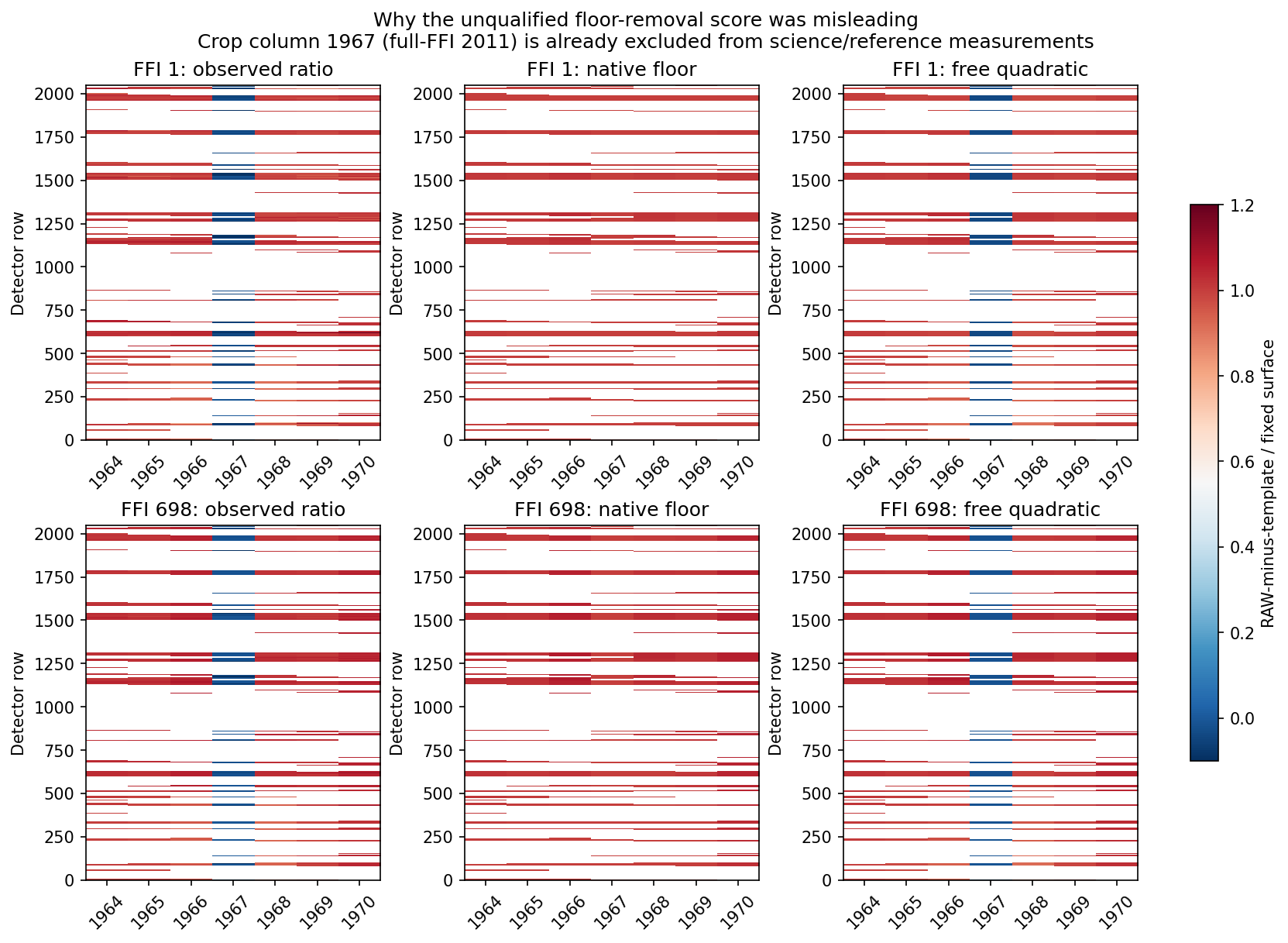
The unqualified all-column score suggested a dramatic benefit from removing the response floor. Attribution finds 99.86–99.94% of that improvement on the preexisting bad-column set, almost all on crop column 1967 (full-FFI 2011). Its negative/near-zero calibrated values are unlike the neighboring sky. The actual stellar masks and reference weights already exclude those pixels.
With only the preexisting unusable columns removed, 312 columns and 110,806 identical evaluation pixels remain per frame. Native-model MSE relative to no strap correction is 0.7875/0.7992/0.0433/0.7983 at FFIs 1/601/698/1225. Removing the floor gives only a small additional gain on these usable columns. Splines help slightly at high background but worsen the low-background cases; expanding the training masks does not improve this pilot.
Known-response and holdout-isolation checks pass. The numerical fit job completed its arrays but failed on a pandas plotting-name collision; the corrected renderer verifies the saved scores without refitting. Results are descriptive and correlated; they do not establish photon noise or truth beneath stars.
Conclusion: strap response now has conditional held-out-pixel support, but greater spatial flexibility is not a demonstrated solution. Next distinguish a background-proportional response from a stable additive scene residual using held-out epochs, then validate the complete pixel/profile/photometry chain. Equations, support provenance, failure records, complete scores and next model.
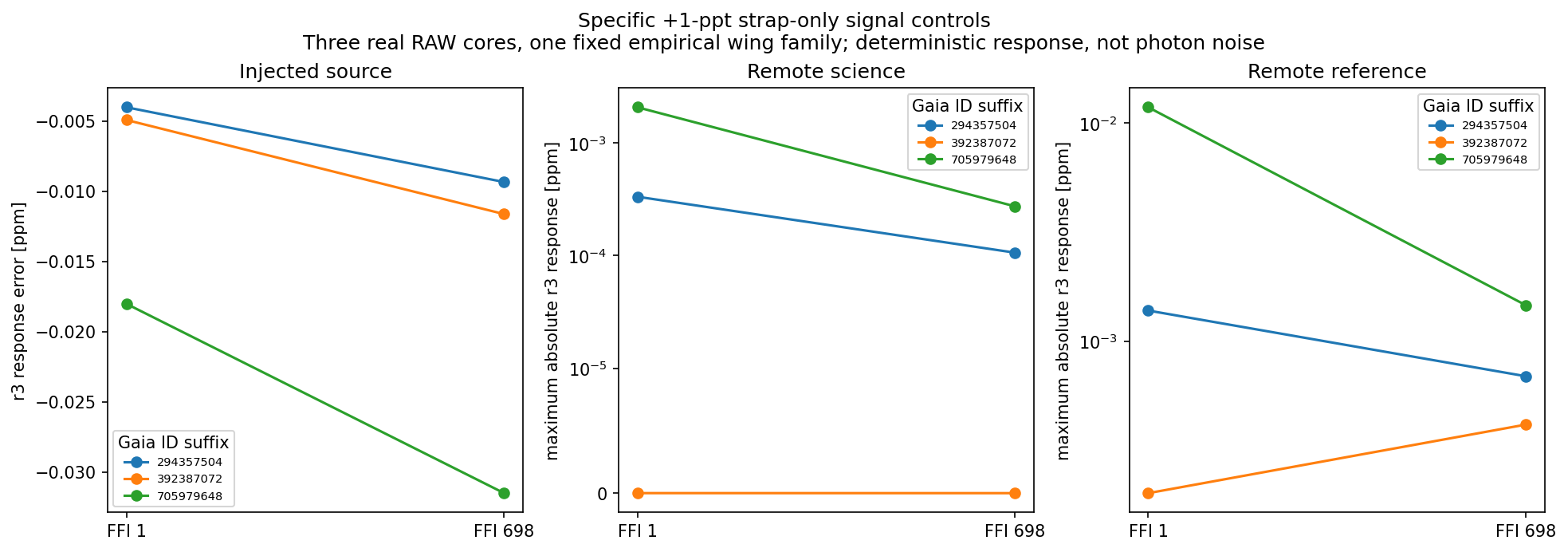
Specific strap-only signal checks
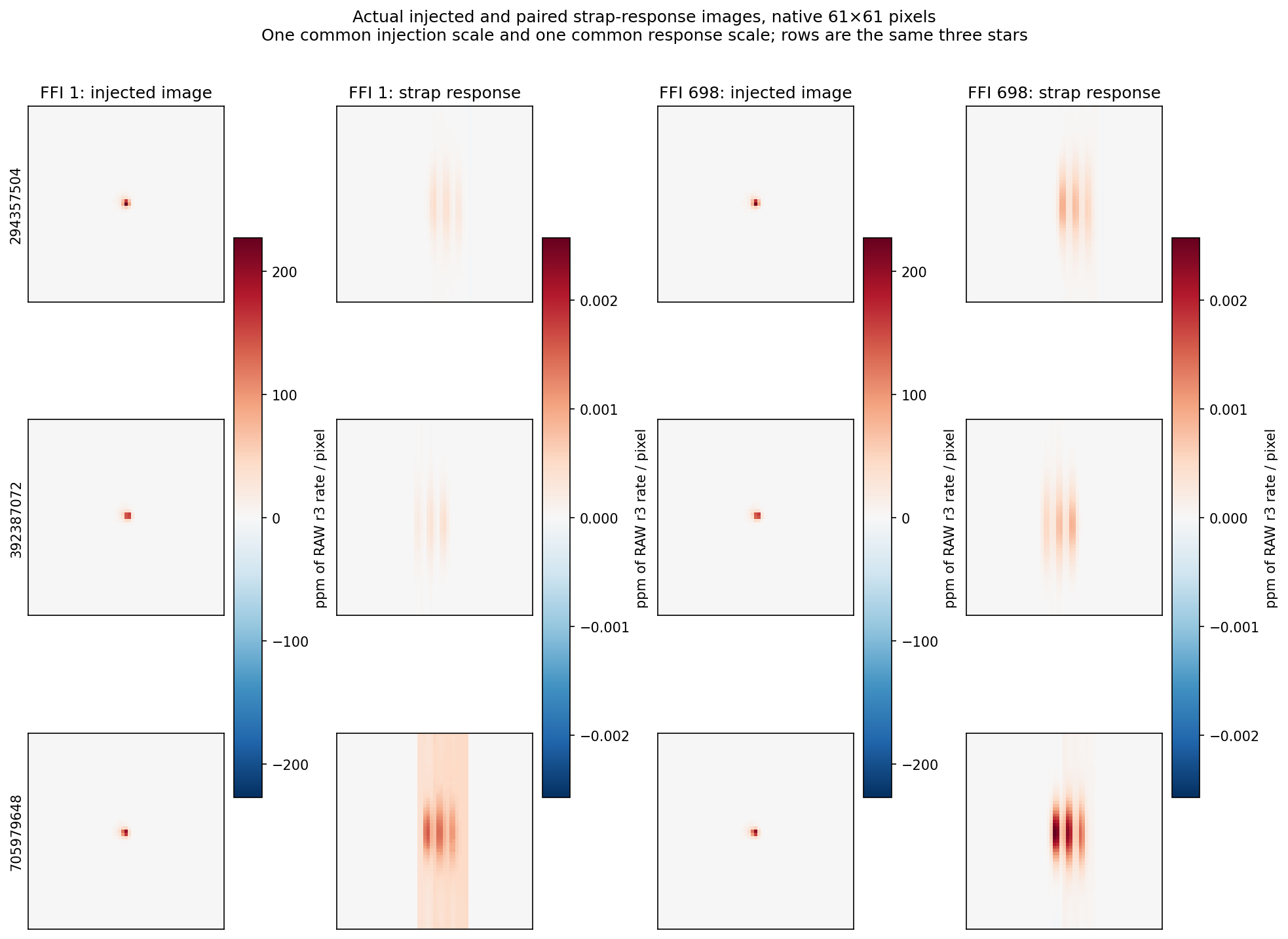
Three previously selected affected sources, two actual epochs and +1-ppt perturbations, recomputing the complete estimator before measuring its strap increment. The fixed-r3 target errors are -0.00401 to -0.03150 ppm; maximum remote-reference response is 0.01181 ppm with exactly zero remote injected light. Each source uses its actual RAW core and the same conditional empirical outer-wing family. These are deterministic responses, not a photon-noise result or universal signal validation.
Original jobs failed only while writing metadata; corrected jobs replay every saved array exactly. A subsequent plotting-only failure is preserved and corrected with an identical numerical table. Broader colours/shapes/amplitudes, independent sky pixels and the complete learned-profile/reference-calibration chain still need validation. Conclusion: these limited signal tests support further investigation of strap response; they do not establish instrument-free photometry.
Separate the strap response from harmful background-surface curvature
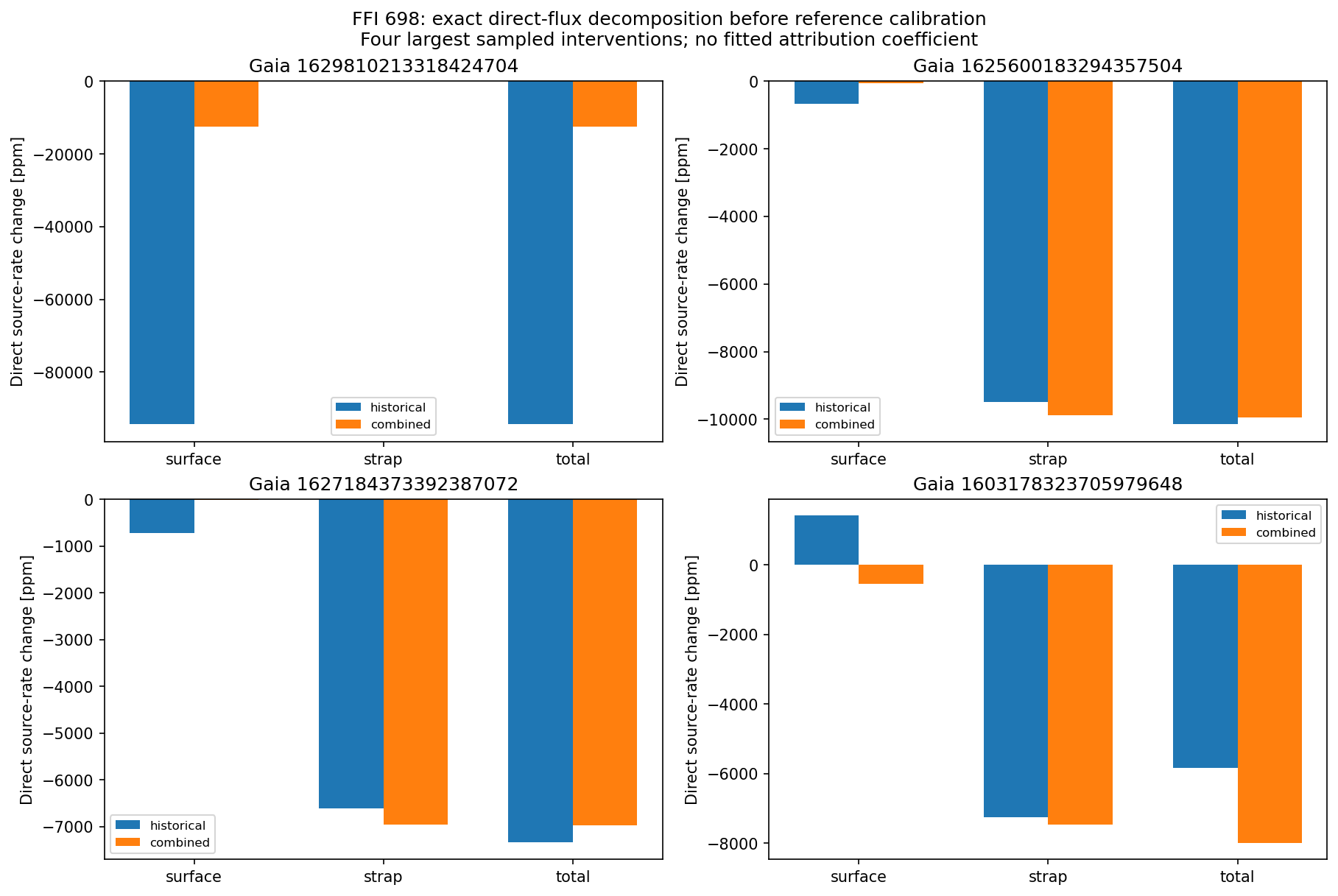
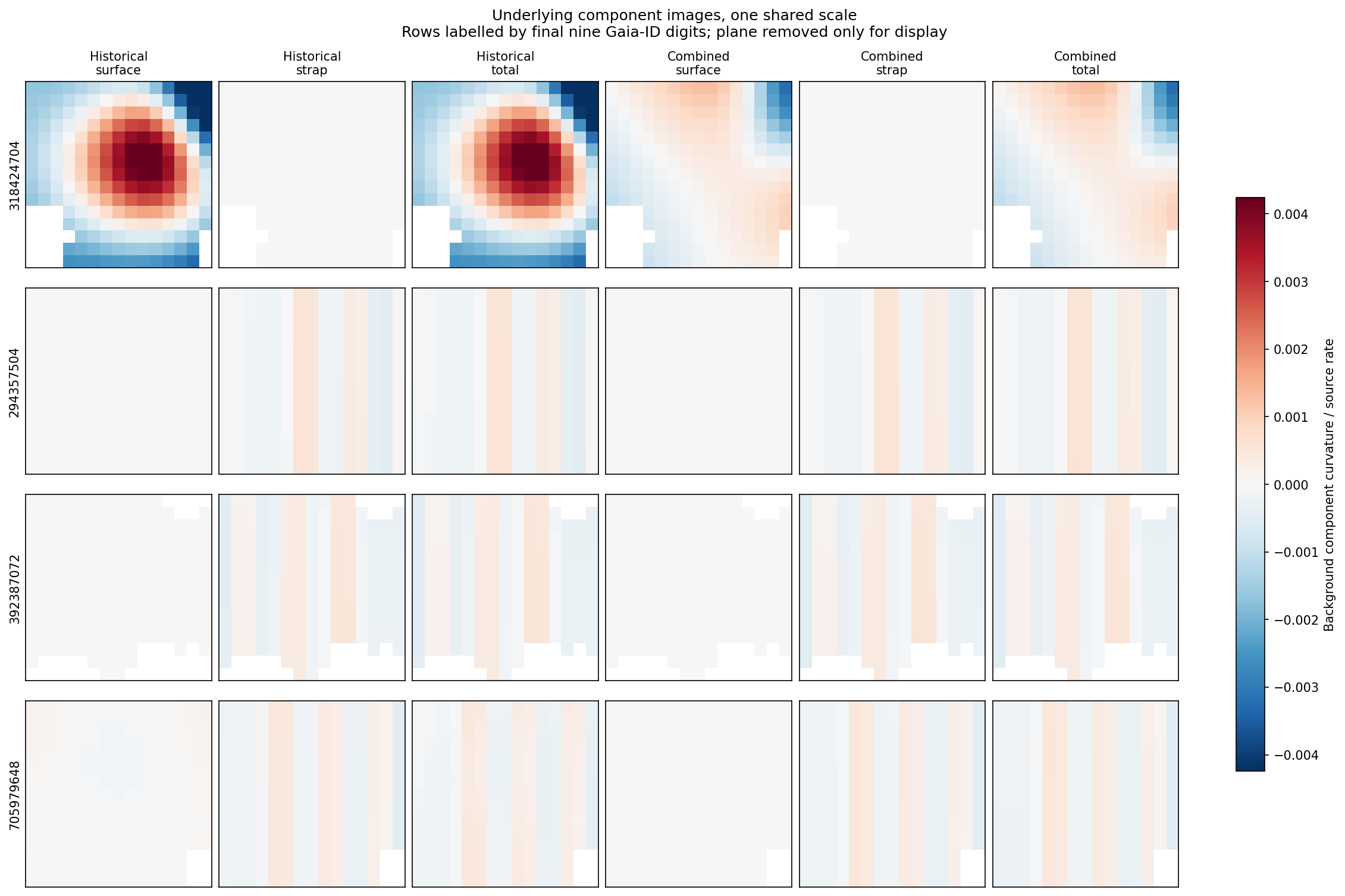
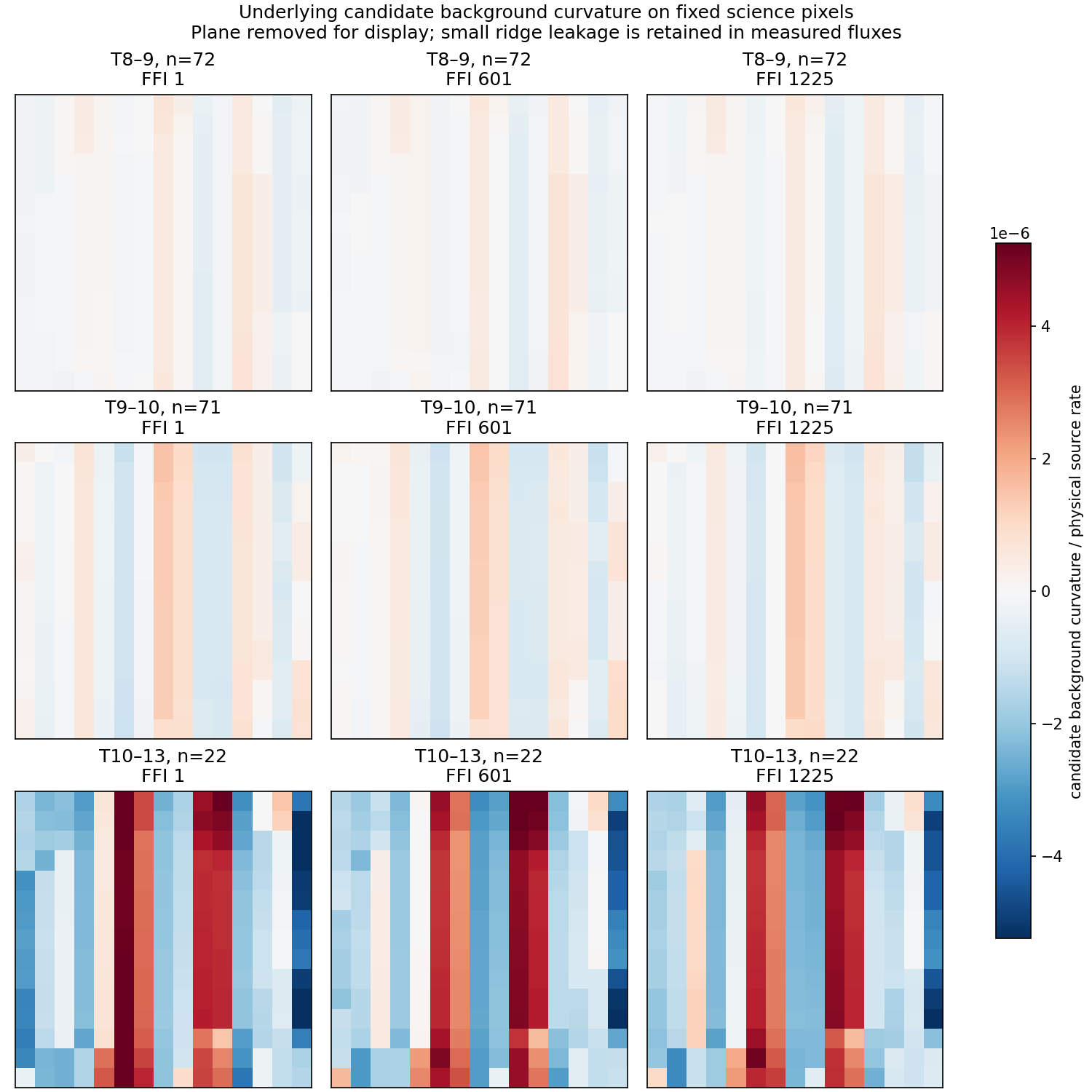
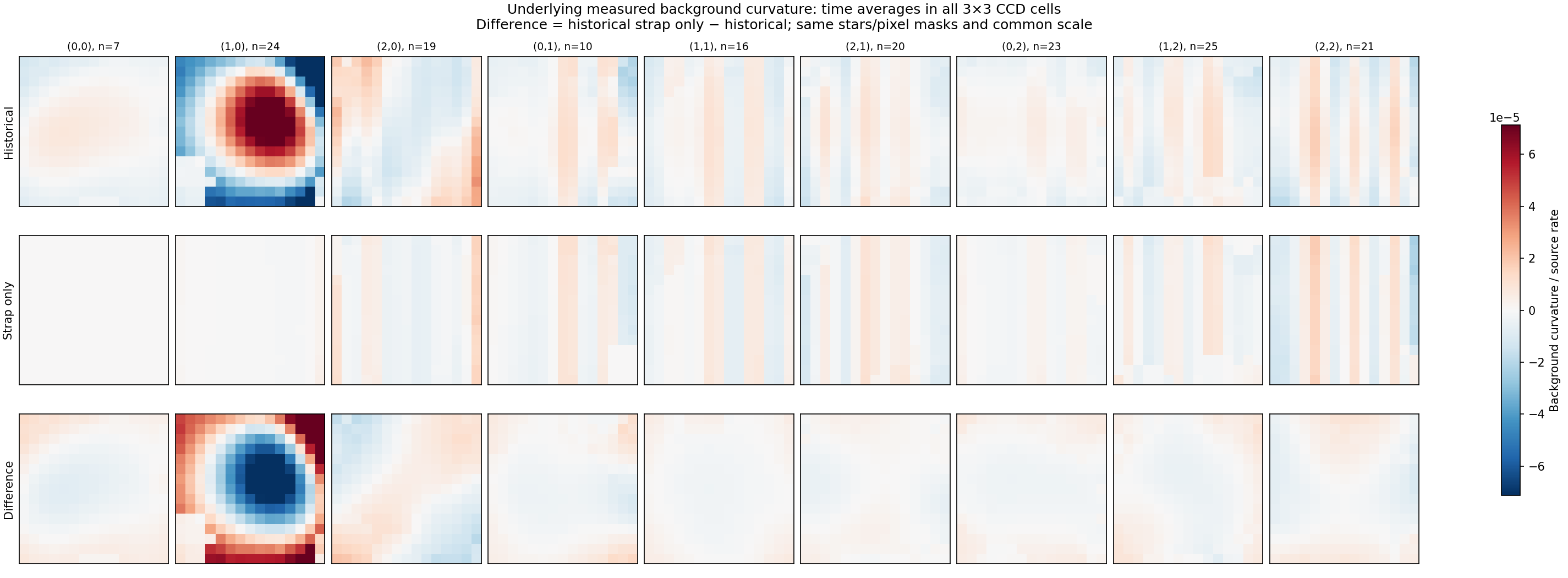
At FFI 698, exact stage attribution distinguishes two effects. The star made worse by full-background subtraction has no strap contribution on its stamp; its intervention comes from the spatial surface. For the other three large-intervention sources, the column-shaped strap term dominates. The high-background branch makes no SEP anomaly-detector or positive-RMS calls at this epoch, so this is distinct from the earlier low-background deblending failure.
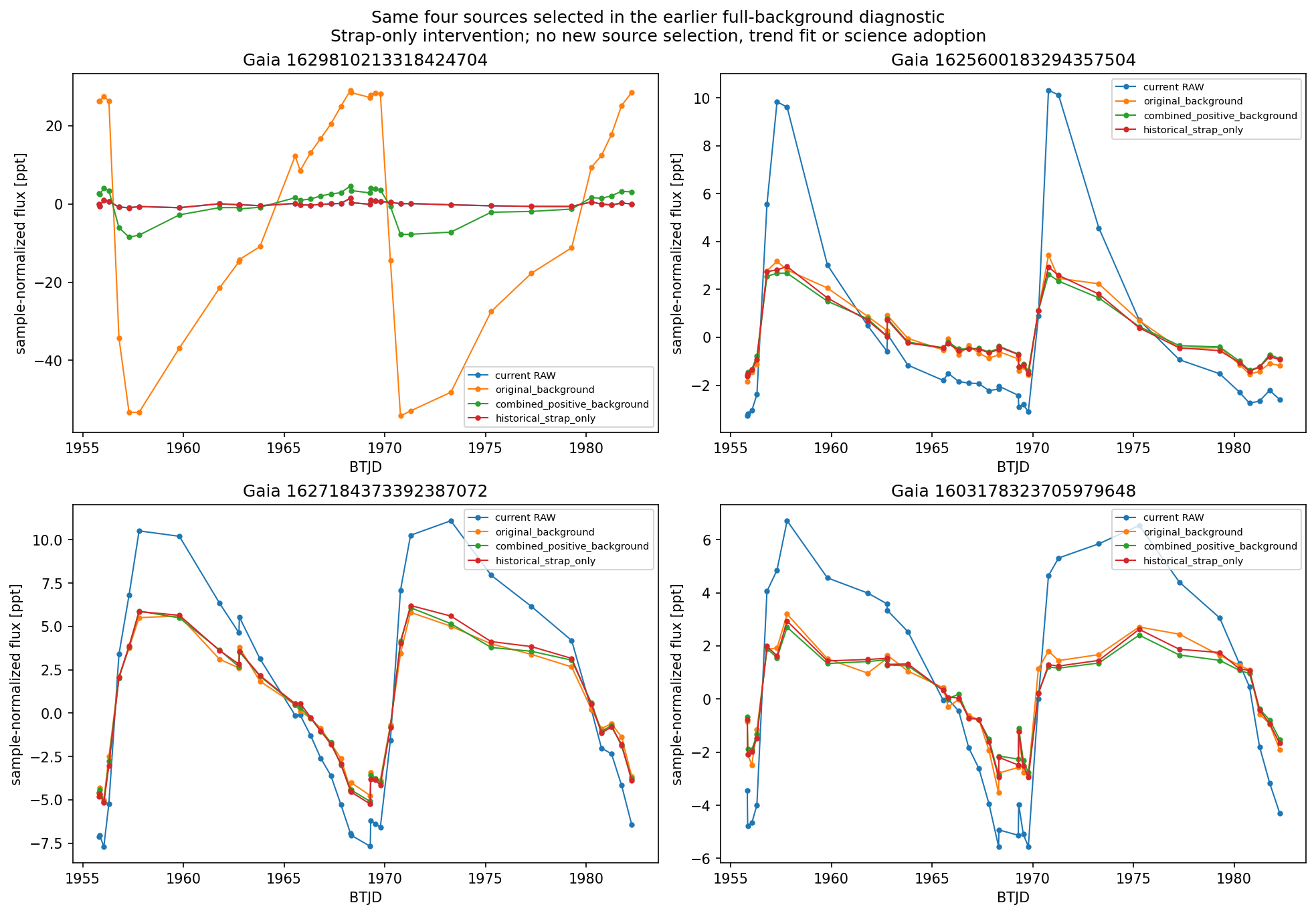
A 36-epoch diagnostic subtracts only the historical strap increment and leaves the local sky-plane fit in place. All source/reference membership, WCS/ePSF, physical count restoration and reference handling remain fixed. All rates remain positive, and both preceding full-background control arrays reproduce exactly. The downstream fitted strap ratio is not the SPOC flat or a certified stellar sensitivity map.
On the same four previously selected sources, sampled RMS changes from 0.561/4.067/6.143/4.060 ppt to 0.562/1.394/3.661/1.678 ppt. The large variations shrink in three stars, while the comparatively flat source avoids the harmful full-background intervention. These are selected development examples with astrophysics still present, not population acceptance or photon-noise measurements.
The predefined 10/16-star group RMS values remain 231.18/246.96 ppm, compared with 228.56/252.03 ppm originally. The group structures remain. All 354 overlapping groups are retained.
Conclusion: column-dependent residual response is a useful physical lead for particular stars, but the full objective remains unmet. Specific strap-only signal controls follow; withheld sky-pixel prediction and broader source-wing controls remain required before adoption. No science product or upstream calibration is replaced. Equations, precise scope, validation, job records and next gates.
36-epoch RAW comparison: background effects vary substantially between stars
All 36 preselected orbit-edge and middle epochs completed, with the same 165 eligible science stars, 235 disjoint references and 354 predefined groups. Historical replay is bit-exact across 34 full images and every measurement stamp in all 36; the remaining three pixels are explicitly qualified single-float32-step differences outside all measurement stamps. Both stopped workers were resumed with preserved failure records.
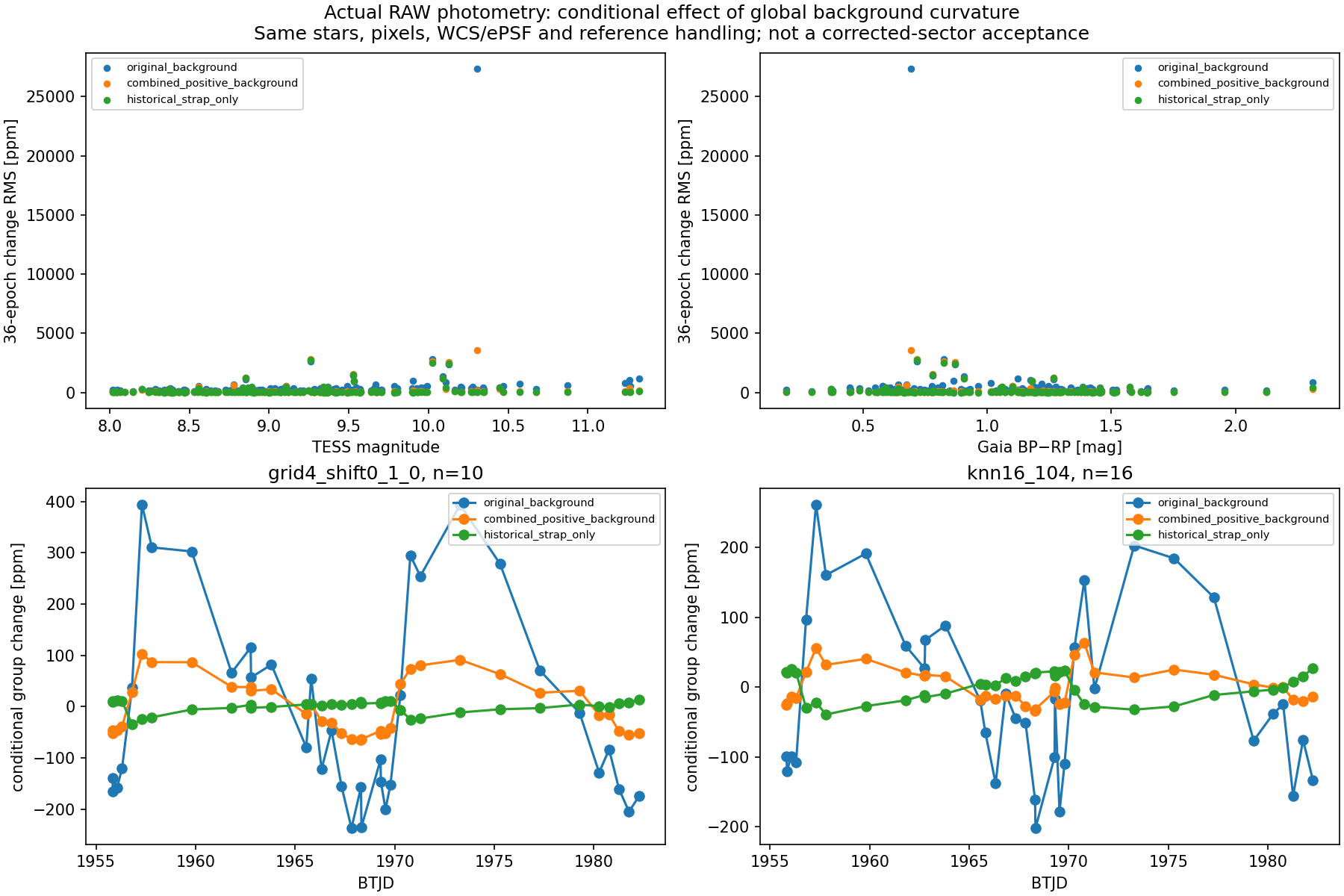
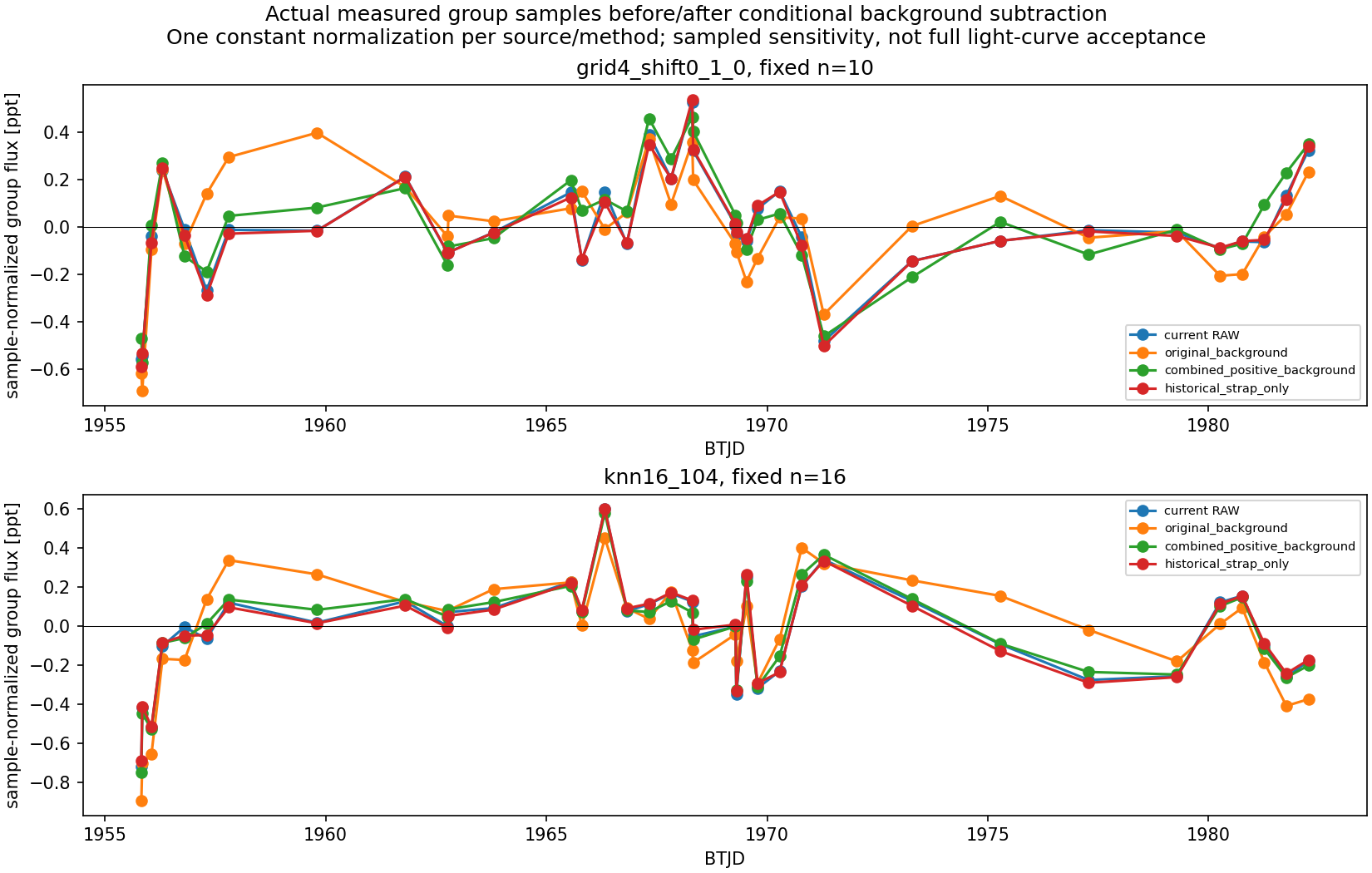
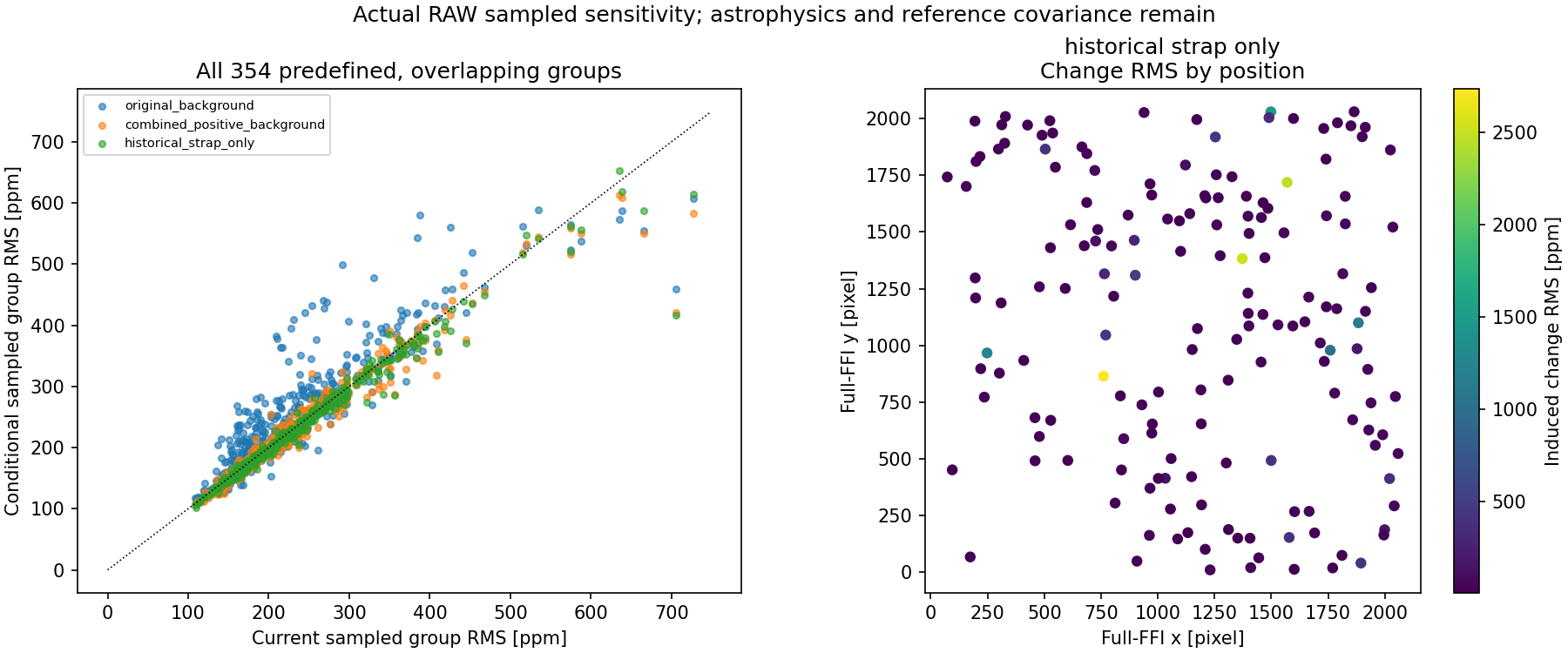
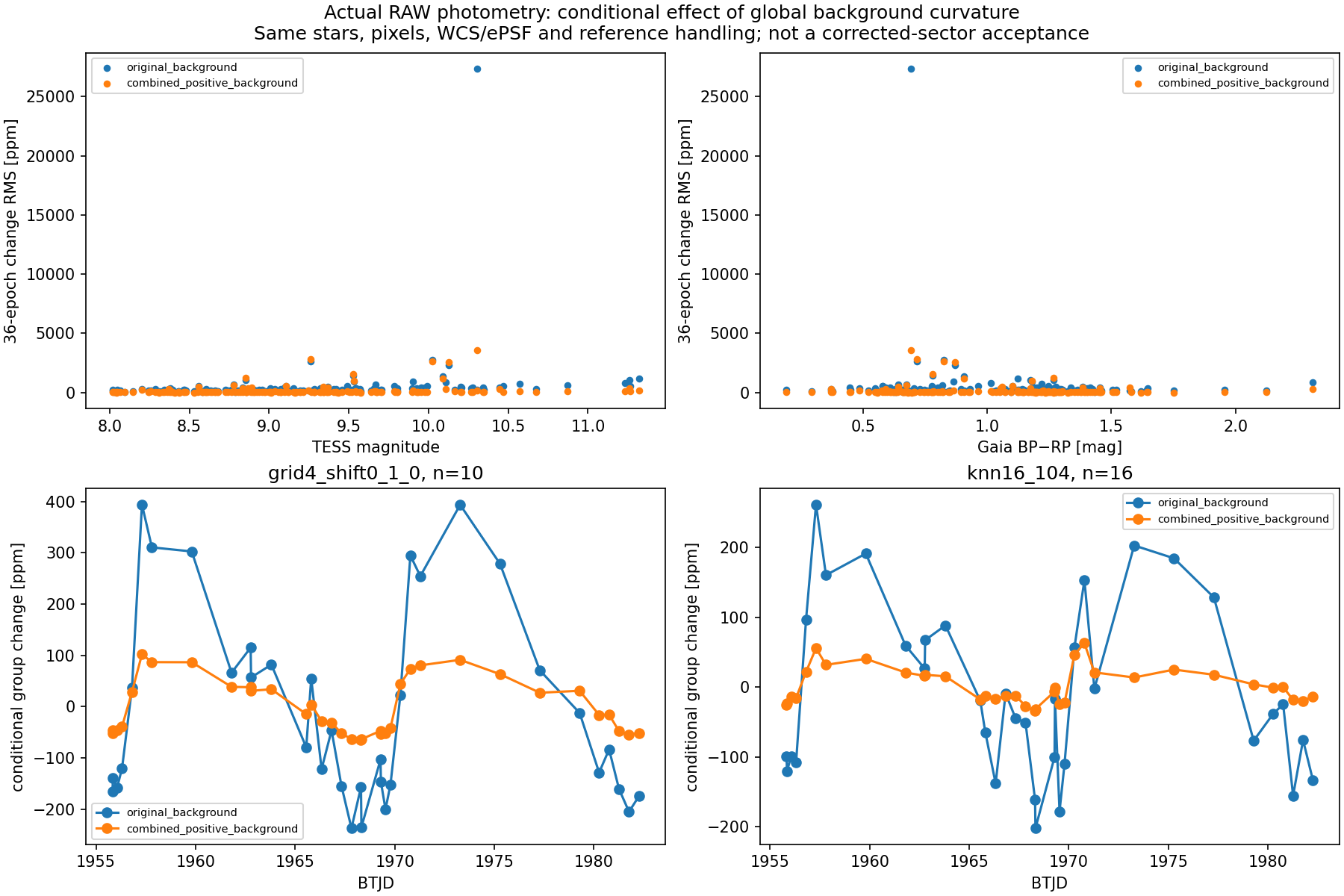
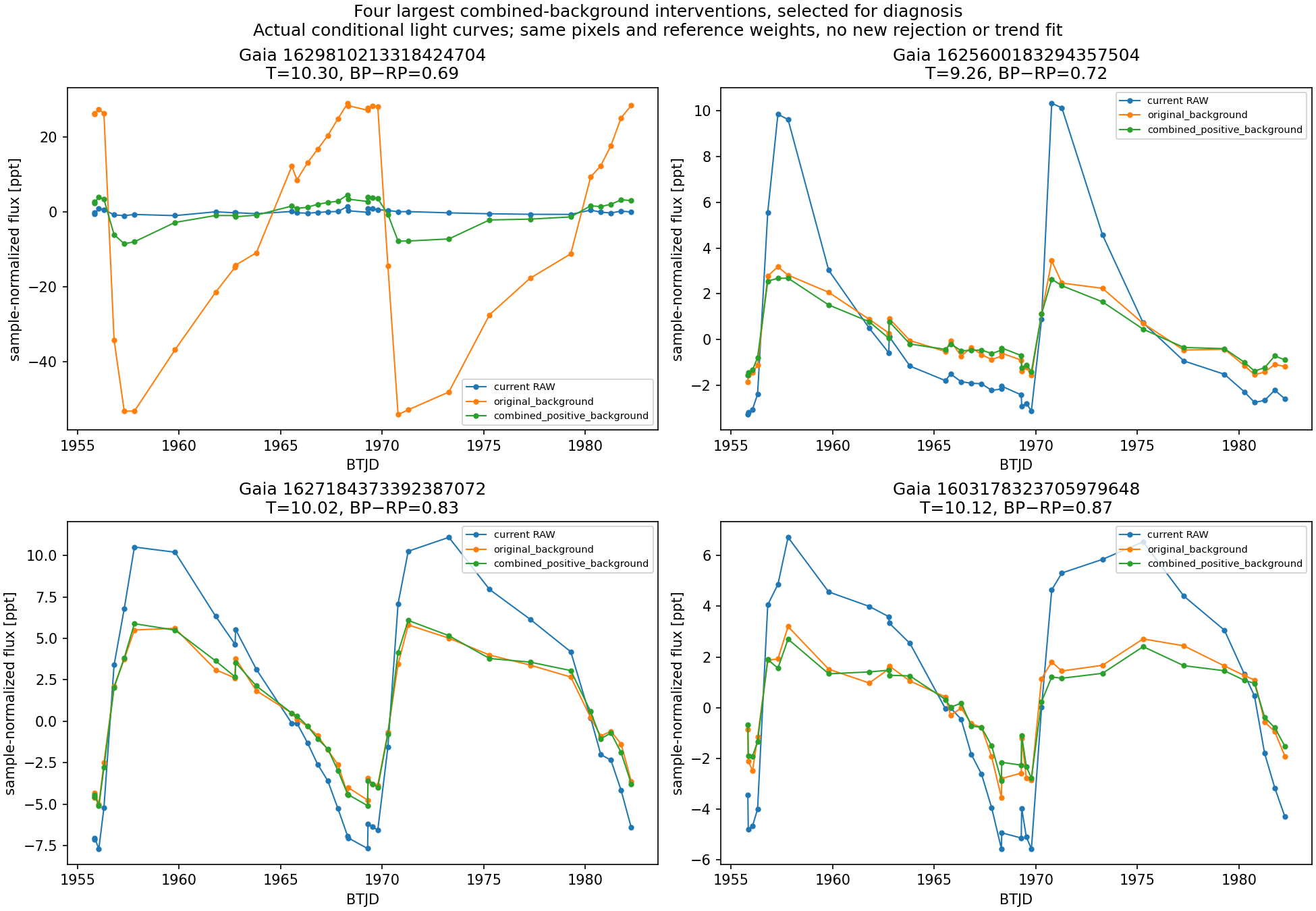
Subtracting the historical/combined background induces median temporal changes of 213.91/43.78 ppm RMS, with 95th percentiles 1021.18/597.08 ppm. These numbers measure the intervention, not corrected scatter. The broader sample reveals effects missed by the three-epoch pilot.
The actual 10-star group RMS changes from 228.56 to 233.55 ppm; the 16-star group changes from 252.03 to 253.12 ppm under the combined candidate. Their patterns remain. These sampled values include astrophysics and reference covariance and are not instrumental-significance tests.
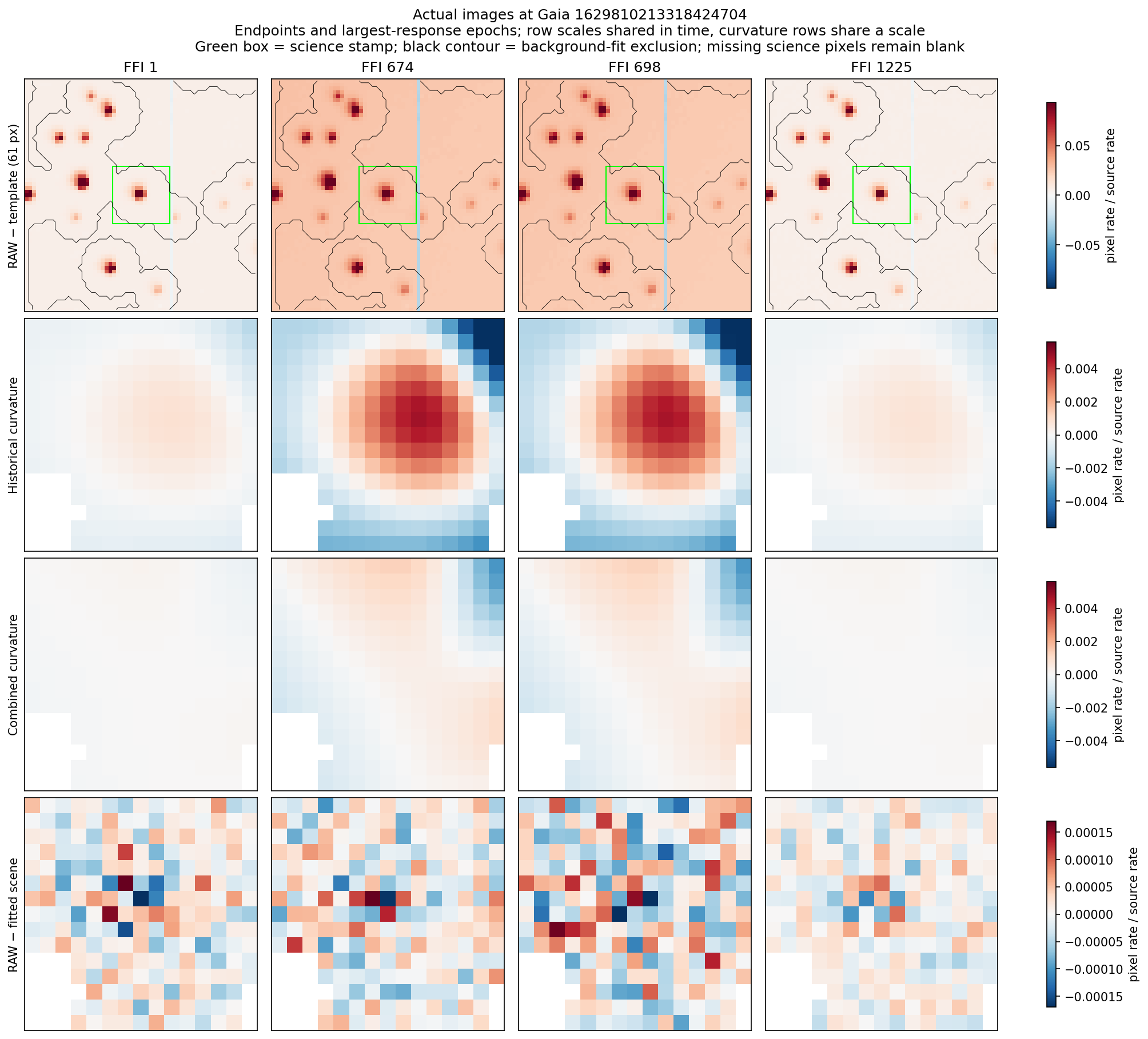
The four largest individual interventions are shown for diagnosis, without excluding any source. Large orbit-shaped variations shrink in three, but another comparatively flat star acquires variation. The actual images show a broad historical-background feature beneath that star in high-background epochs. The combined estimate reduces it but retains structure. Passing a small differential stellar-signal injection does not establish absolute background accuracy.
Conclusion: this candidate is not a general solution and is not adopted for RAW photometry. Background curvature matters for selected stars, but the persistent groups remain. Separate the interpolated surface from strap response and validate the responsible term independently before extending a correction. Full method, evidence, failures, validation and next tests.
Actual RAW photometry with the experimental background
Three verified epochs (FFIs 1, 601, 602), the same 165 eligible science stars, 235 disjoint references and 354 predefined groups. WCS/ePSF, pixels, count restoration and reference handling remain fixed. Direct RAW remeasurement agrees with the linear flux operator. All source/reference rates remain positive.
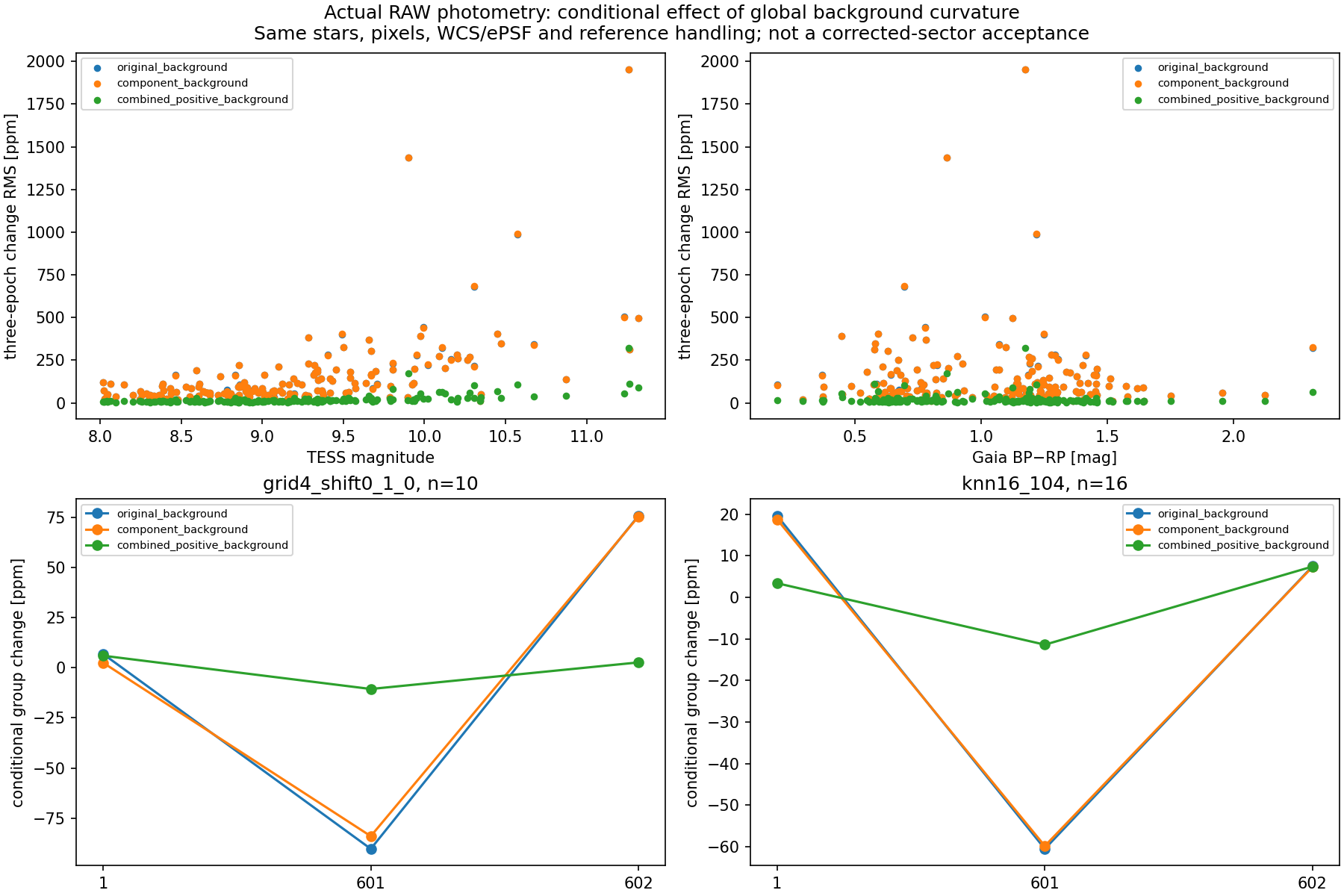
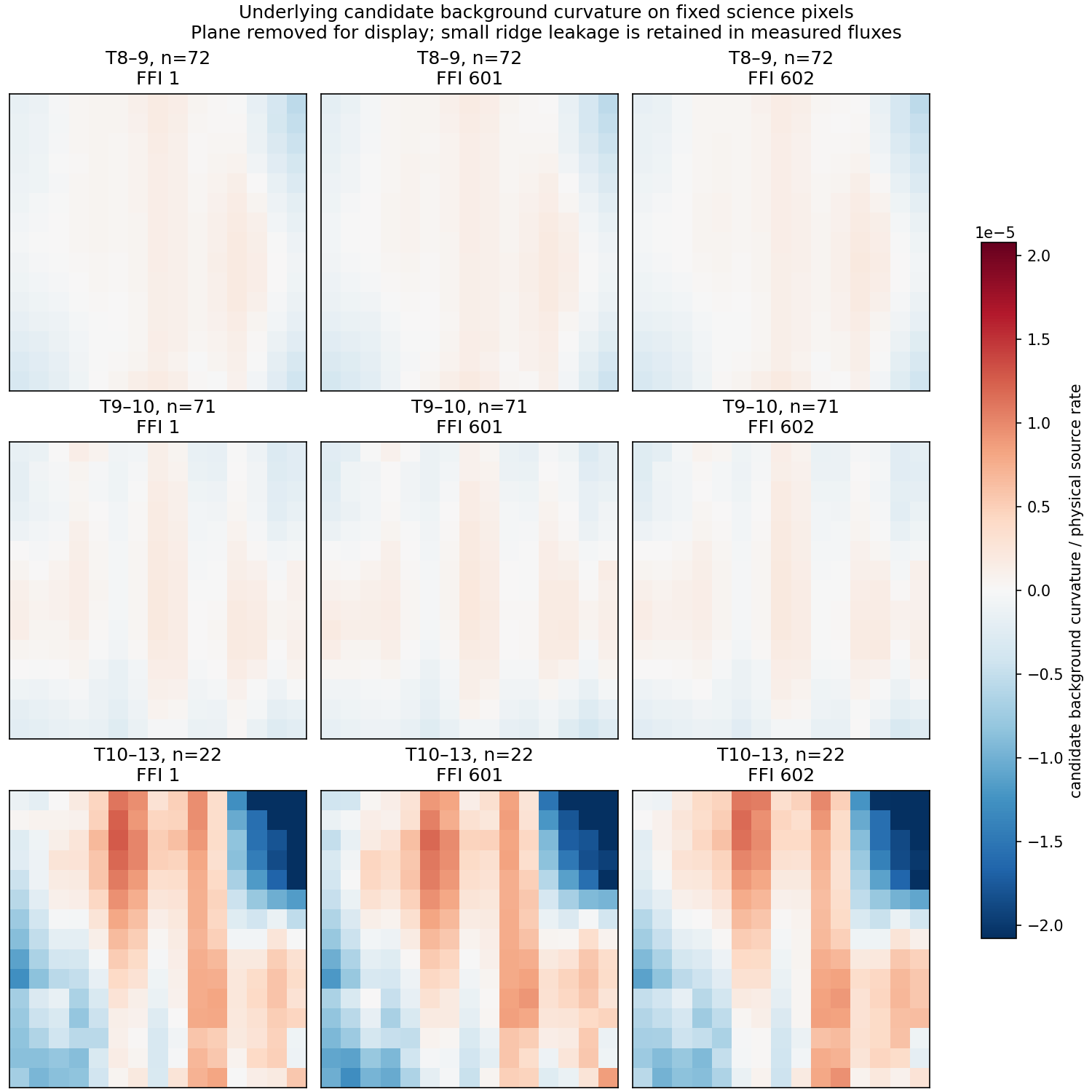
The median/p95 RMS of the induced temporal change is 85.96/399.59 ppm for the historical background, 86.25/400.53 ppm for the component-only background and 11.31/63.77 ppm for the combined positive-RMS candidate. These are sensitivities, not corrected light-curve scatter or noise floors. A failed assertion exposed the archived solver's tiny ridge leakage; it is now accounted for explicitly, with no threshold loosening or source deletion.
Conclusion: the two persistent group histories remain non-flat. This background repair does not resolve their variation in the tested epochs. The already selected 36-epoch extension, source-preservation checks and full noise accounting remain in progress; no accepted science product changes. Equations, validation, numerical failure and exact records.
Repair candidates: preserve detections, test new epochs, and enforce positive RMS
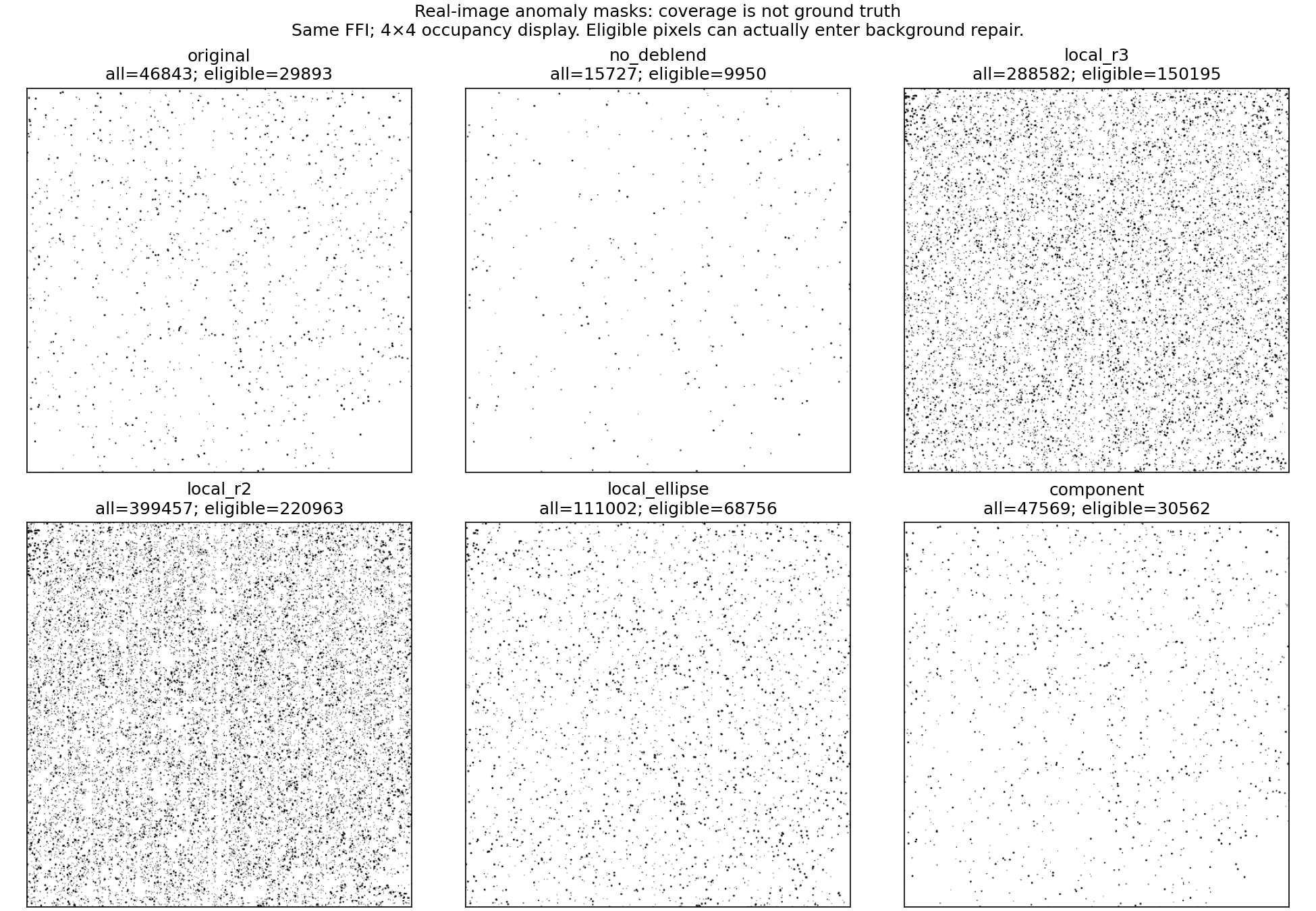
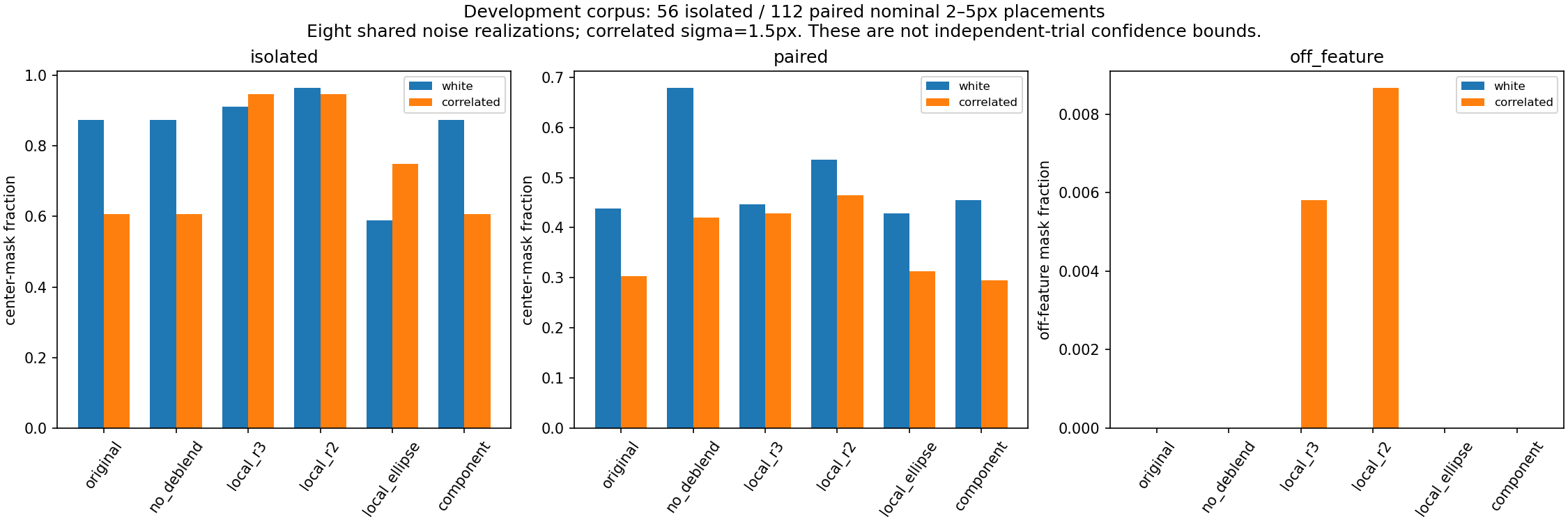
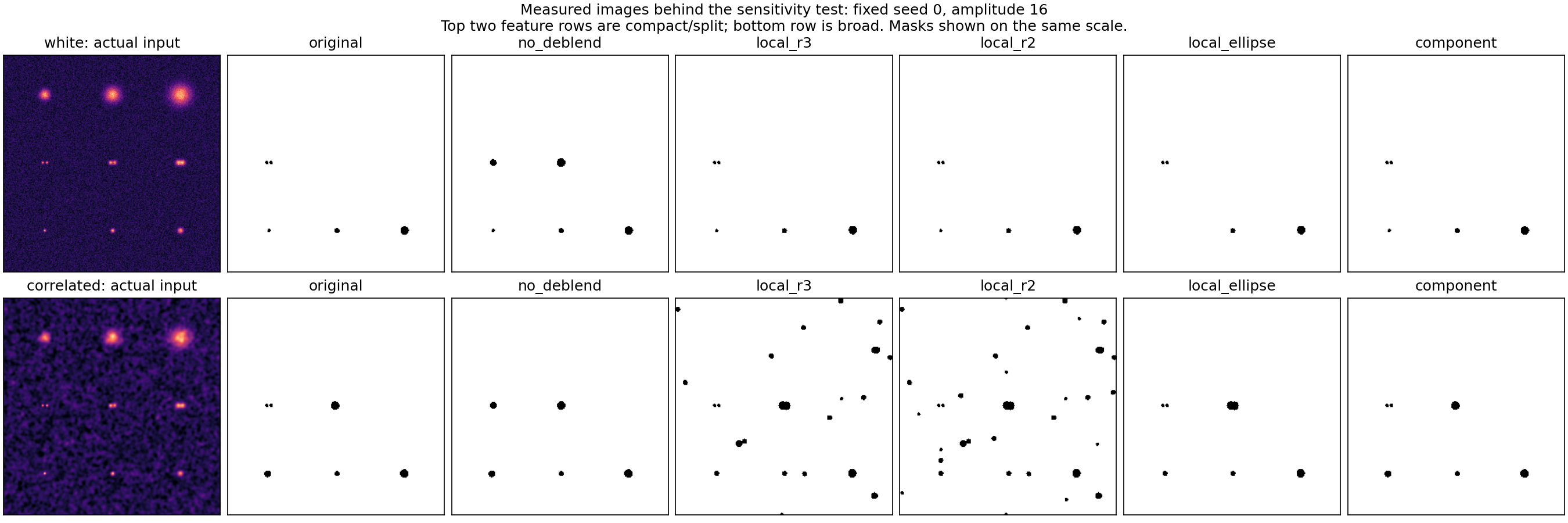
Local circular gates remove the demonstrated distant coupling but mark far more pixels and fail the correlated-noise development check: off-feature mask fractions are 0.5805%/0.8661% for radius 3/2, versus zero for the other tested methods in that finite corpus. They are not adopted. A local ellipse has a compact-feature sensitivity tradeoff.
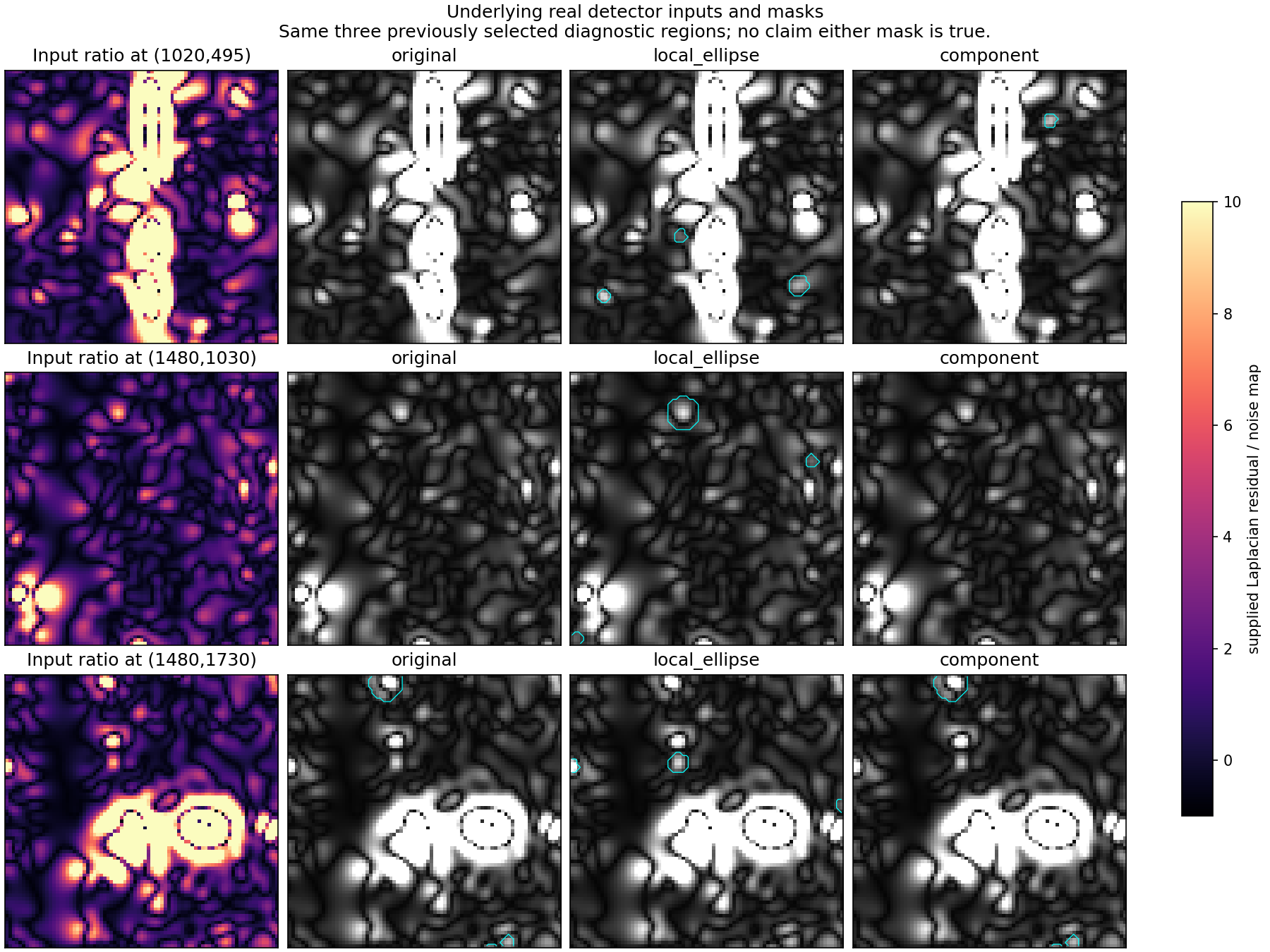
The component-crop candidate retains SEP morphology but runs each detected parent in its own bounding box plus two guard pixels, keeping only children assigned to that parent. It marks 47,569 pixels versus 46,843 originally and retains 97.0% of the original mask. Eligible repair counts are 30,562 versus 29,893, with 97.4% overlap. Agreement is not truth. Overlapping or large crops can still interact; this is not a universal fixed-radius locality guarantee.
Known-feature tests use eight shared noise realizations, white and Gaussian-correlated noise, several amplitudes/widths, close pairs and broad controls. Component isolated-centre coverage matches the original at 87.5%/60.7% for white/correlated noise; paired-centre rates are 45.5%/29.5% versus 43.8%/30.4%. These are development tests, not independent-trial confidence bounds or real-sky completeness.
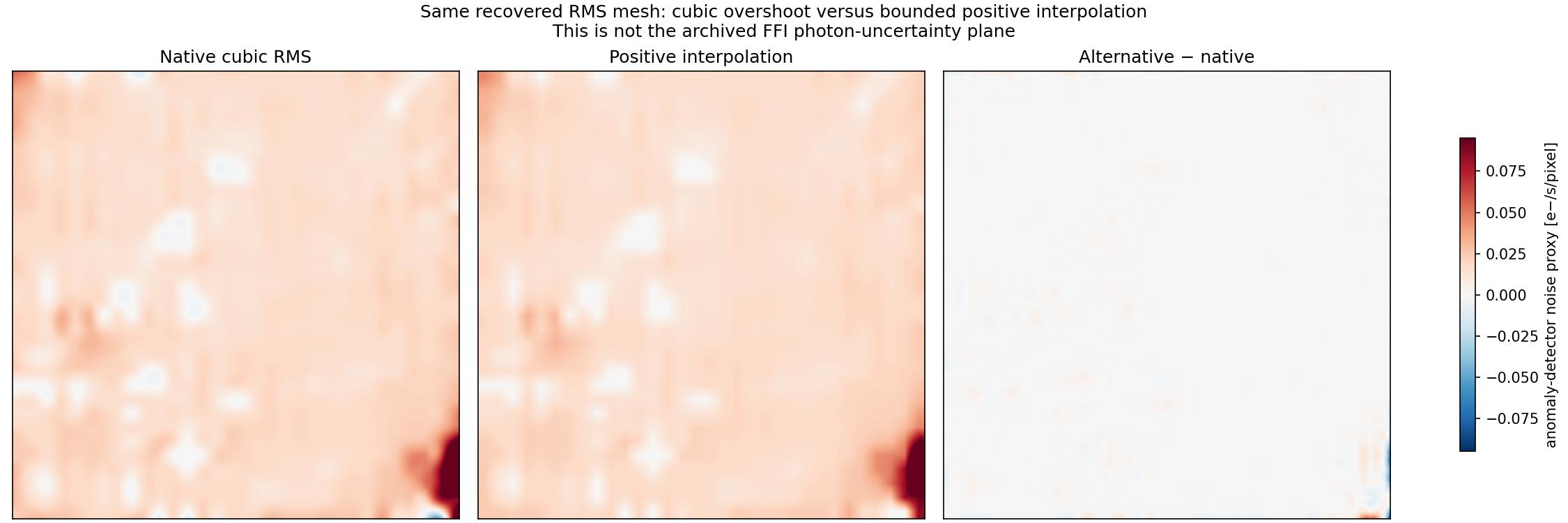
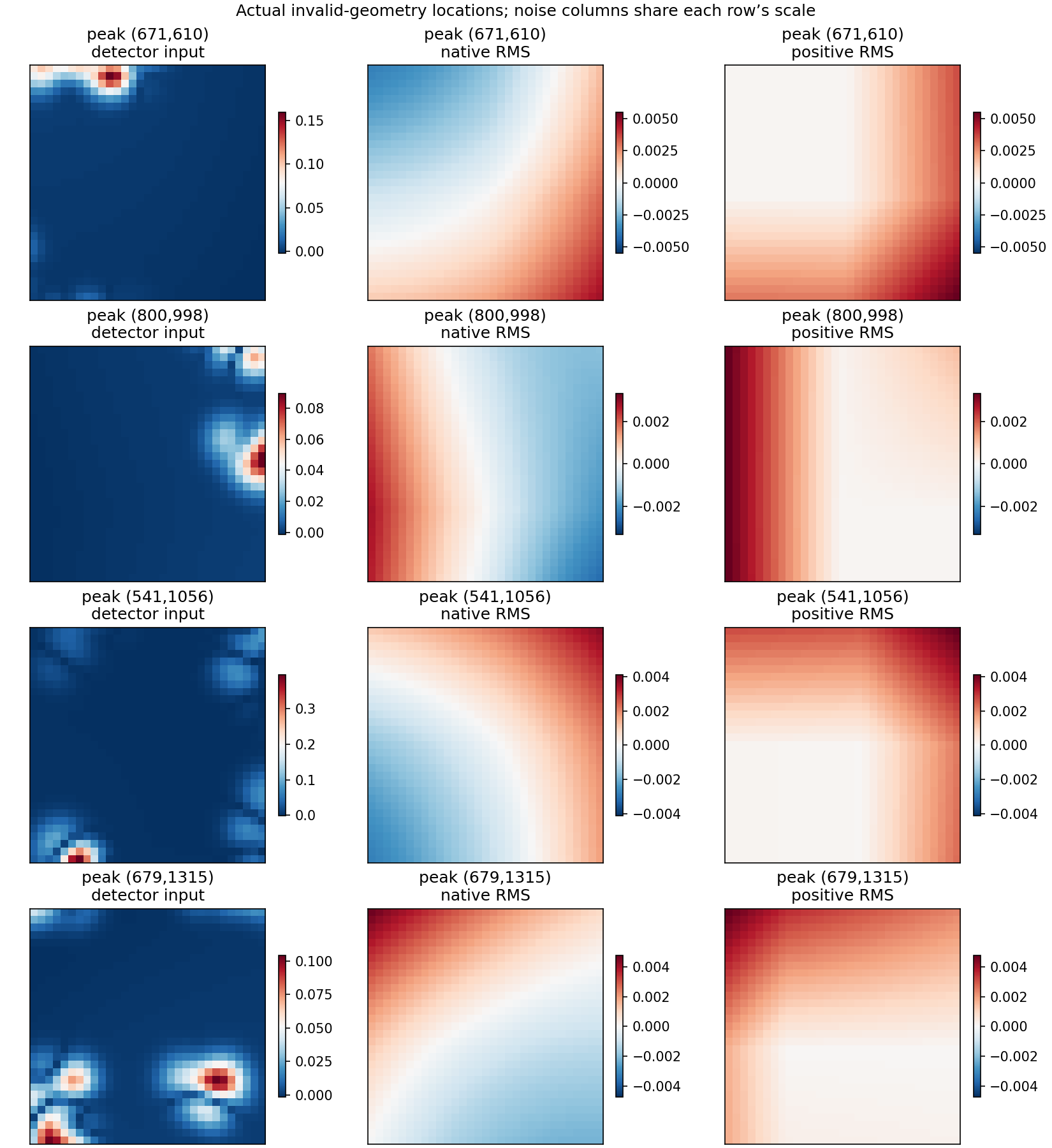
New first-/late-first-orbit backgrounds replay bit-exactly. A combined component+harmonic first-FFI run failed on four undefined ellipse shapes. Audit found all four peaks on negative interpolated RMS values: 68,775 pixels were nonpositive, including 22,722 eligible pixels. This is the anomaly-detector RMS proxy, not the archived FFI photon-uncertainty plane.
A positive alternative reconstructs the existing positive mesh using the pinned SEP recurrence, verifies dense replay, and interpolates those same values bilinearly with edge clamping. It adds no arbitrary floor and excludes no input pixel. Standard natural-spline reconstruction failed and was rejected; the pinned evaluator passes the unchanged guard. Recomputed detection has no invalid shapes in the first-FFI audit. Weak detections can change; they were not manually dropped.
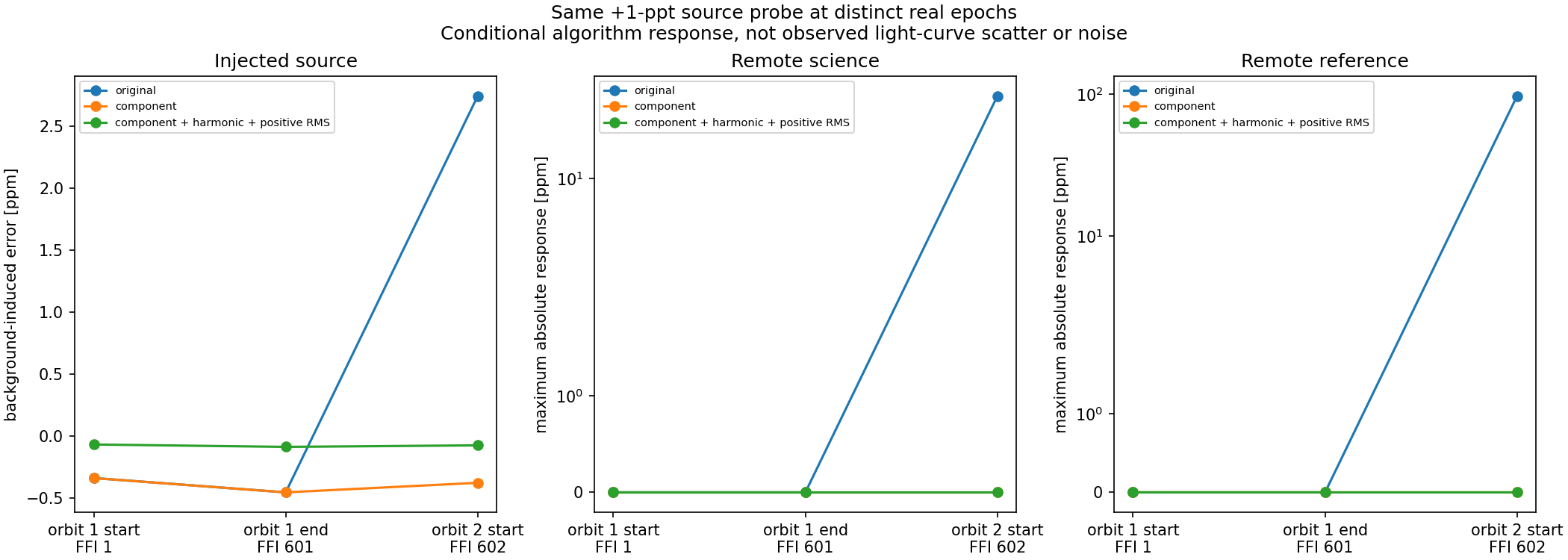
The combined candidate completes the same-source +1-ppt test at FFIs 1, 601 and 602 using each epoch's actual RAW core and normalization. Target errors are -0.065943/-0.085143/-0.072832 ppm; maximum remote-reference effects are 3.30e-5/3.93e-5/3.02e-5 ppm in the deterministic calculations. The original failure is triggered on 602 but not by this probe on 1/601. These are algorithm responses, not stellar scatter or noise floors.
Conclusion: there is a concrete experimental repair candidate with preserved detection behaviour and successful limited temporal controls. More sources/epochs, crop/cleaning checks, actual RAW/hp_d photometry comparisons, signal-preservation and noise-budget gates remain. No production or accepted light-curve product is changed. Methods, equations, negative results, numerical/implementation failures and exact records.
Localize the failure: deblended anomaly shapes drive distant masks
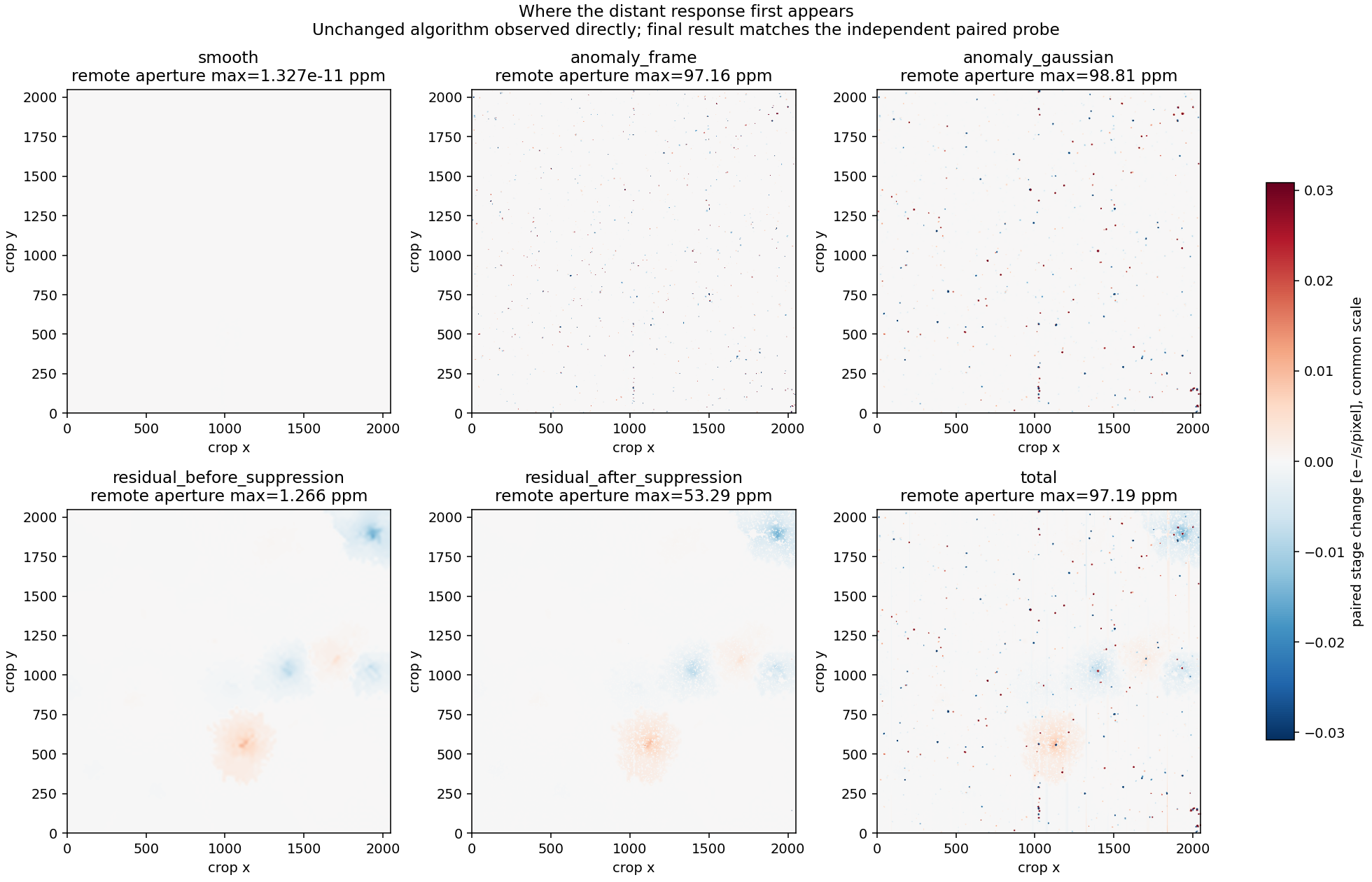
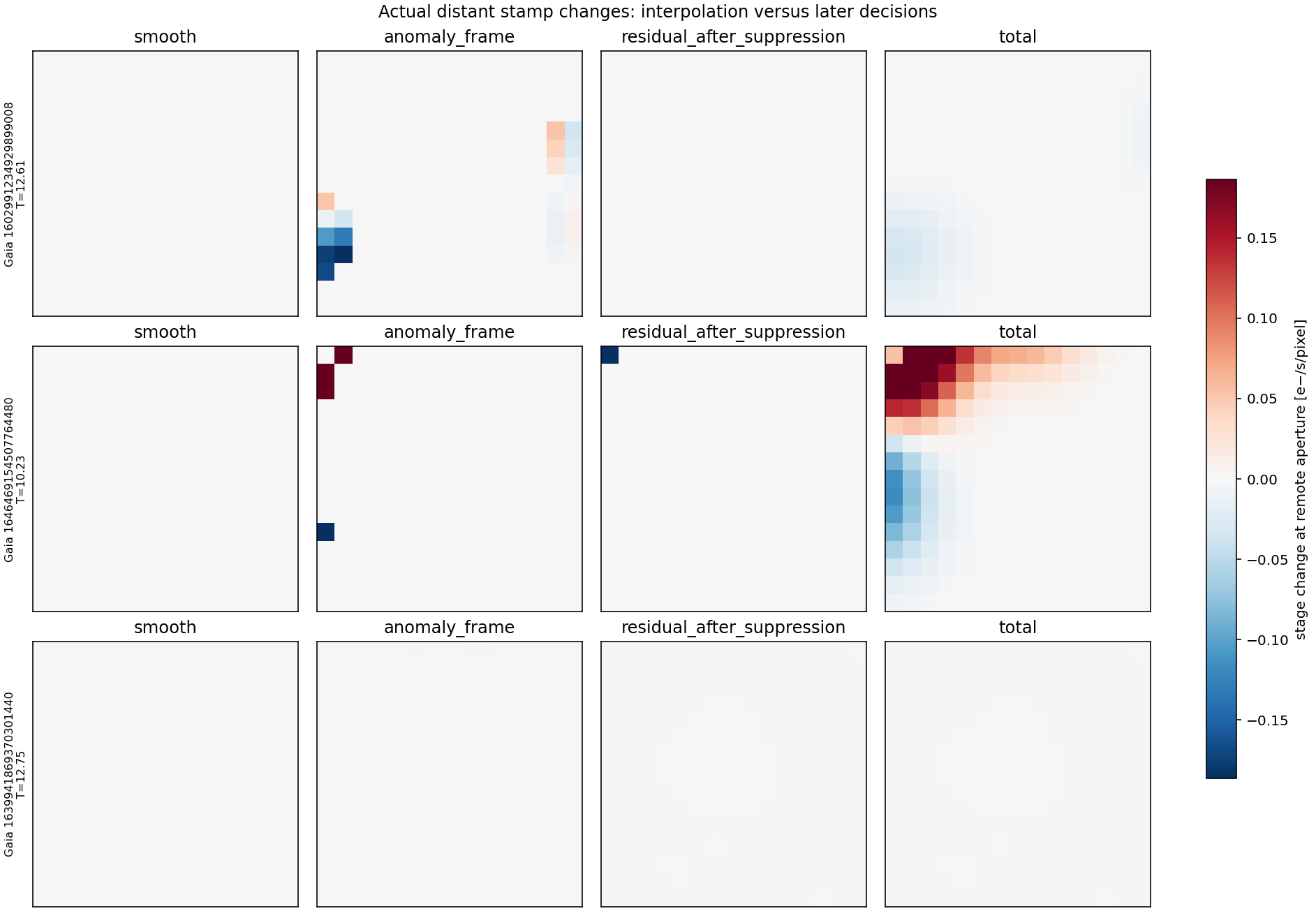
An observation-only trace of the frozen background code reproduces the independent paired response exactly. The filled/smoothed image has only floating-point-scale distant changes. The first large response appears in anomaly repair; residual suppression adds another contribution. These are coupled processing stages, not independent physical causes.
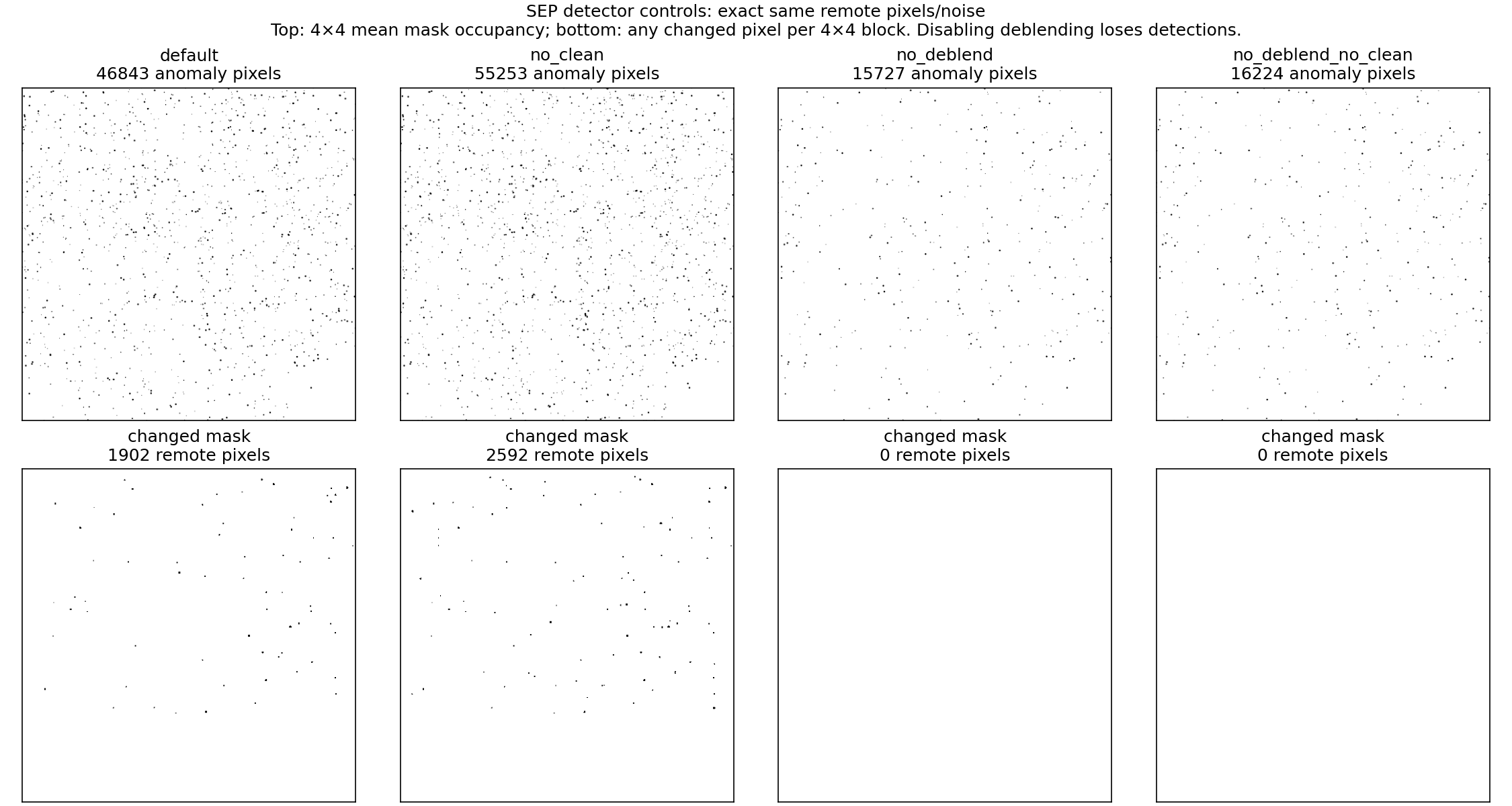
The SEP anomaly masks are reproduced exactly. Keeping the original object catalogue eliminates the changes, while keeping only original maps/noise does not. The global growth-curve noise value is unchanged. Sealing data and noise outside 200 pixels still leaves 1,902 changed default-mask pixels more than 400 pixels away. Disabling cleaning leaves 2,592; disabling deblending leaves zero.
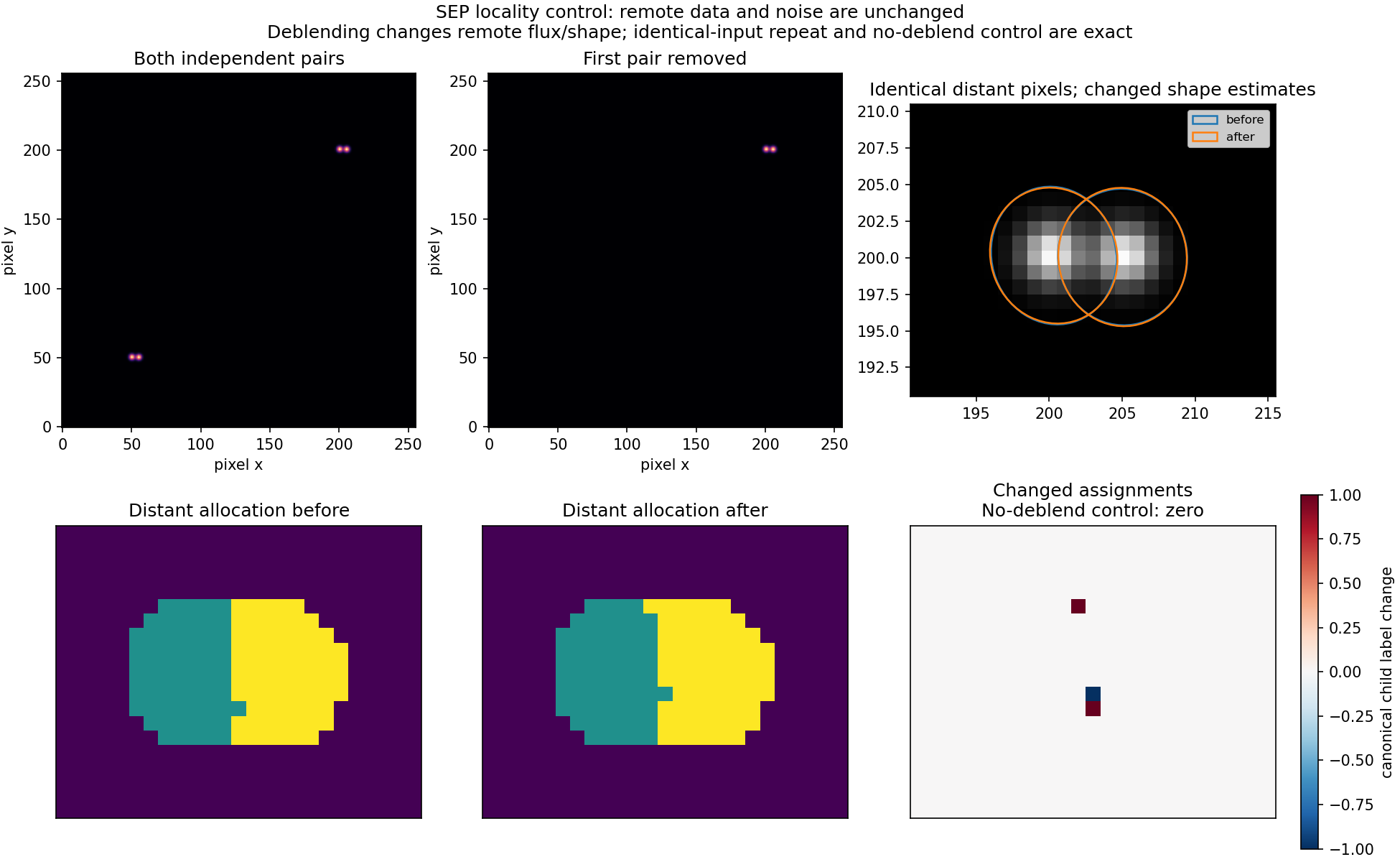
A minimal independent-pair test confirms the locality issue with exactly identical distant pixels and noise: removing only the first pair changes three remote assignments and ellipse-axis estimates by up to 0.02259/0.01841 pixel. Centroids stay unchanged, and identical-input repeats are exact. The version-matched SEP source uses a shared extraction-wide random sequence in deblend reassignment. Those randomized shapes feed the background helper's hard ellipse acceptance test. This does not imply every use of SEP is invalid.
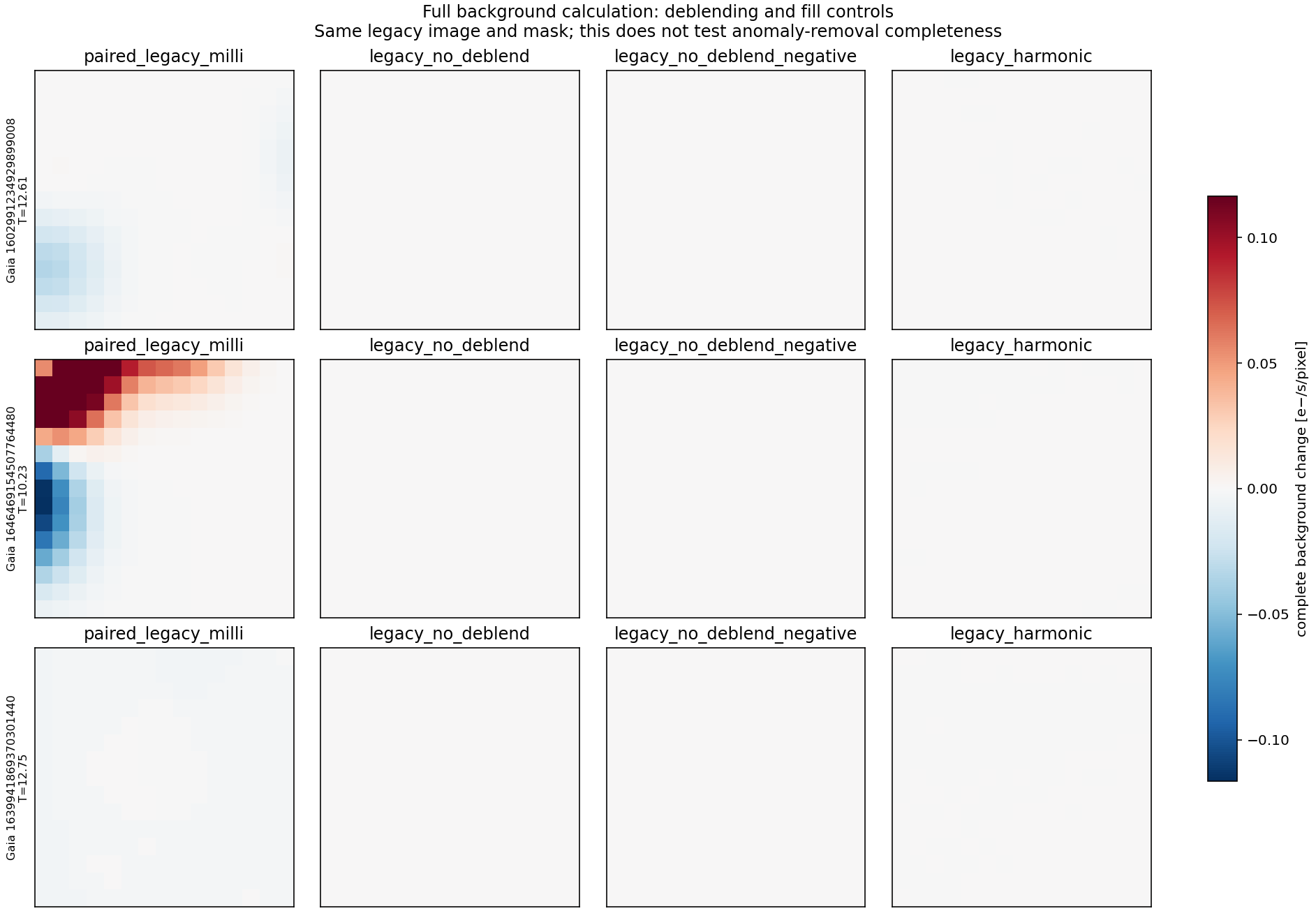
The full historical background calculation with only deblending disabled gives approximately odd target errors of -0.374660/+0.374660 ppm for +/-1-ppt inputs, and maximum remote reference response 6.53e-6 ppm in the positive deterministic control, versus 97.186 ppm originally. Baselines and perturbations are recomputed in the same process. This is not a light-curve noise floor.
Conclusion: the failure is now localized to a concrete anomaly-detection pathway. Disabling deblending suppresses this response but reduces baseline anomaly-mask coverage from 46,843 to 15,727 pixels; detection efficacy is untested. A deterministic local decision or validated alternative must preserve useful repairs before adoption, followed by broader temporal and photometric checks. Current RAW photometry and the original goal remain unchanged and unmet. Equations, primary source links, controls, tradeoffs and exact records.
Known-input test exposes a nonlocal background-processing response
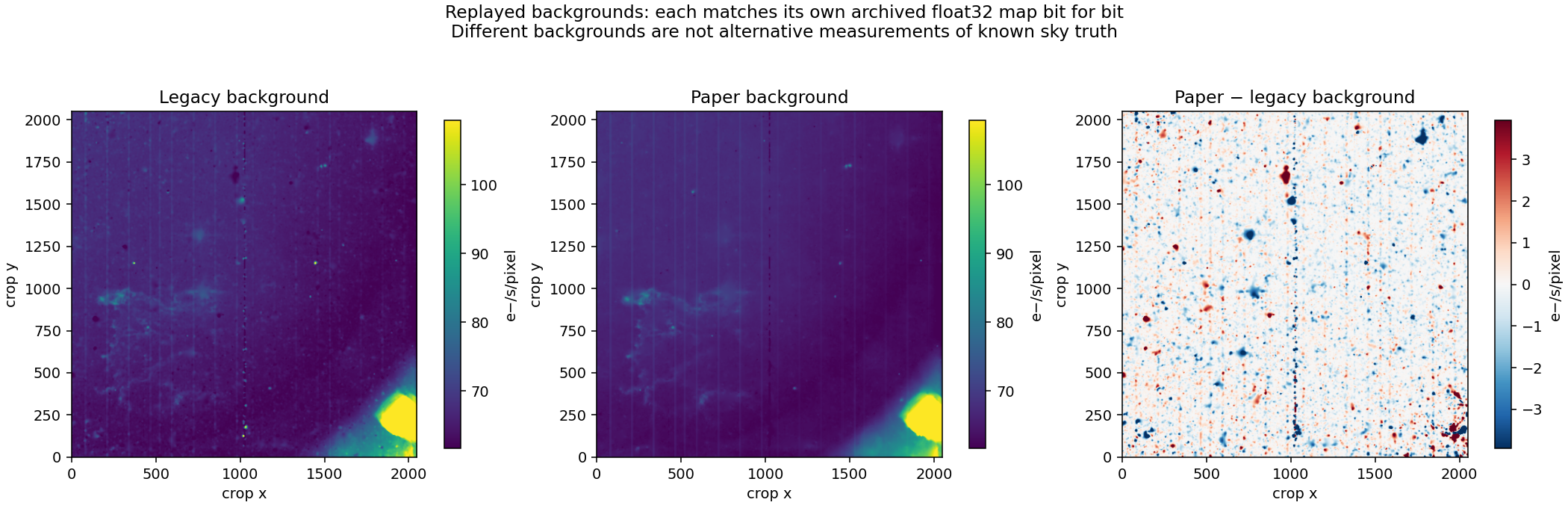
The historical and paper background operators now replay their own archived FFI-602 maps bit for bit over all 4,194,304 pixels. The producing module, masks, residuals and package versions are frozen. This establishes the implemented calculation, not true-sky accuracy.
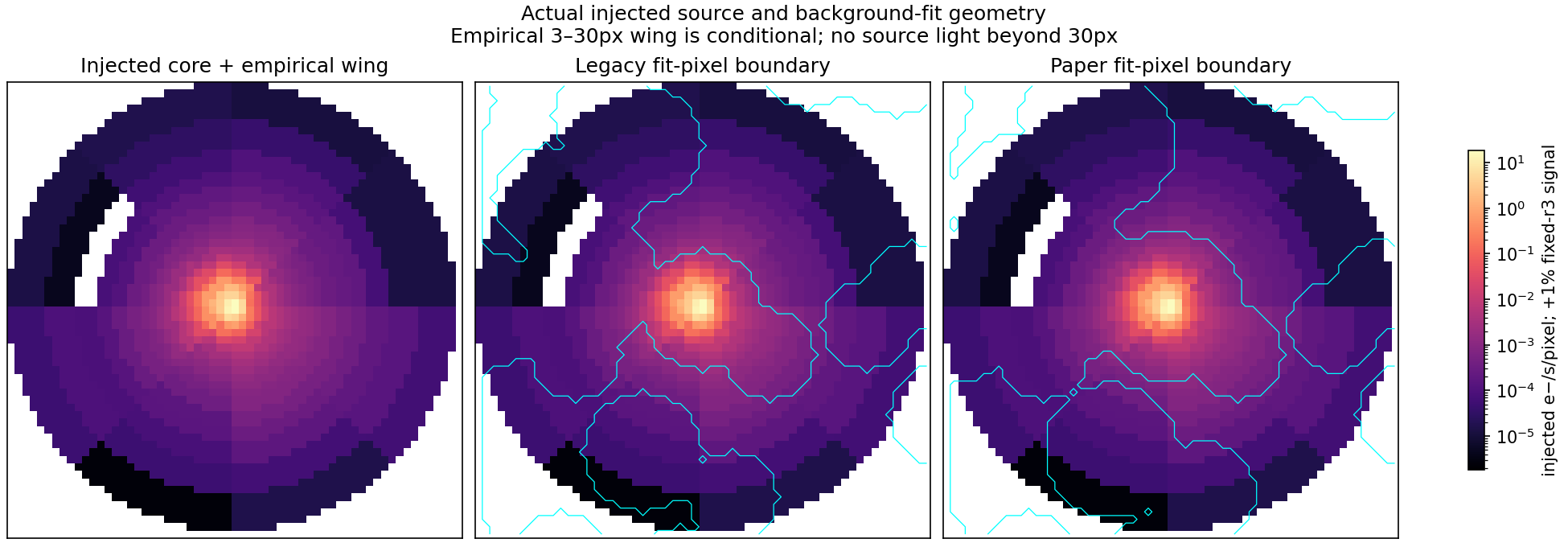
A conditional extended stellar profile is injected at Gaia 1629810213318424704, selected before the injection outcomes. Its core uses the archived RAW profile; its 3–30px wing uses an earlier empirical F1 fit, with one negative bin clipped and no flux outside 30px. Amplitudes are defined by the same fixed-r3 aperture operator. The background step is rerun on the full CCD with its convolved template and catalogue masks fixed.
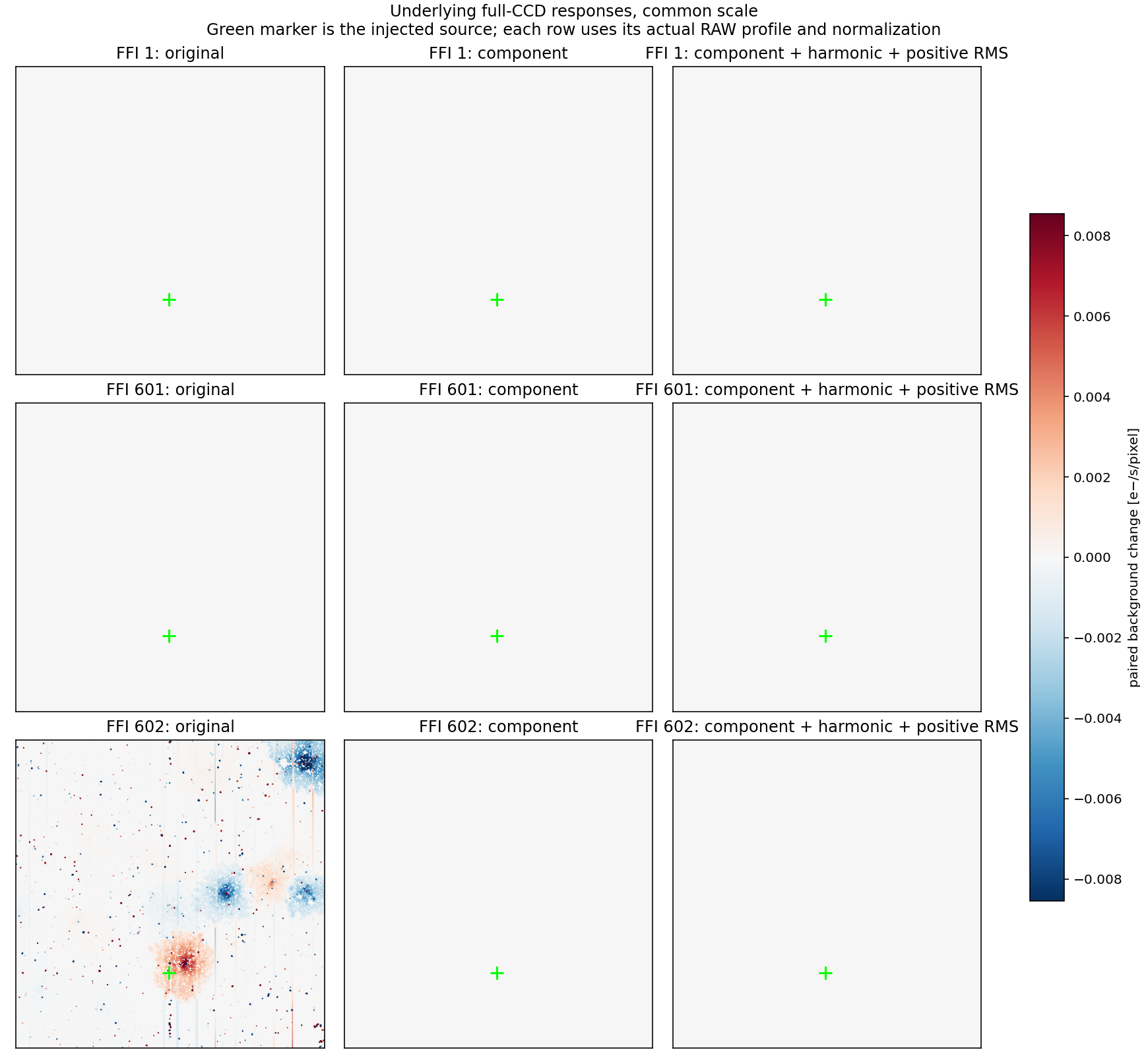
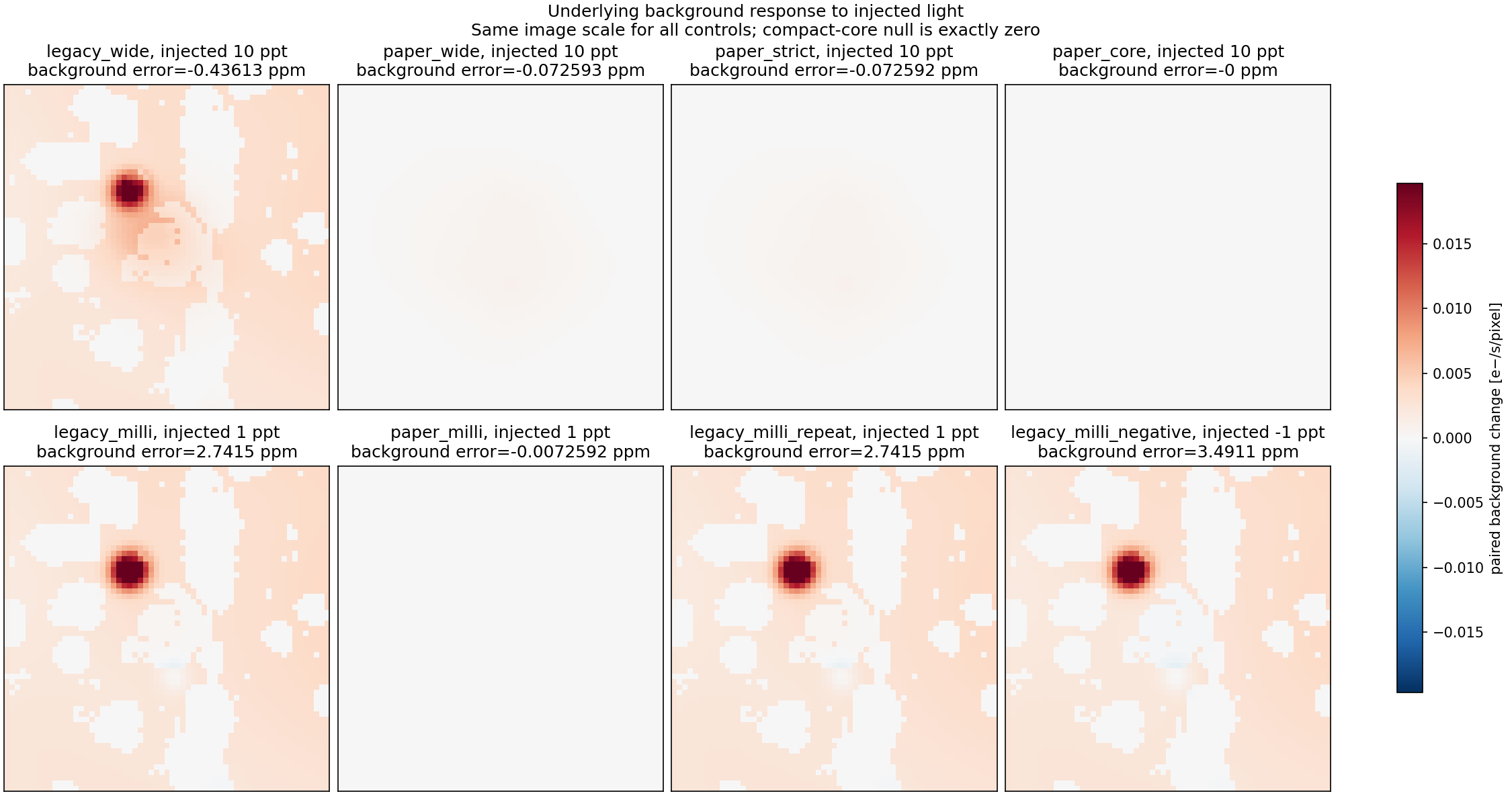
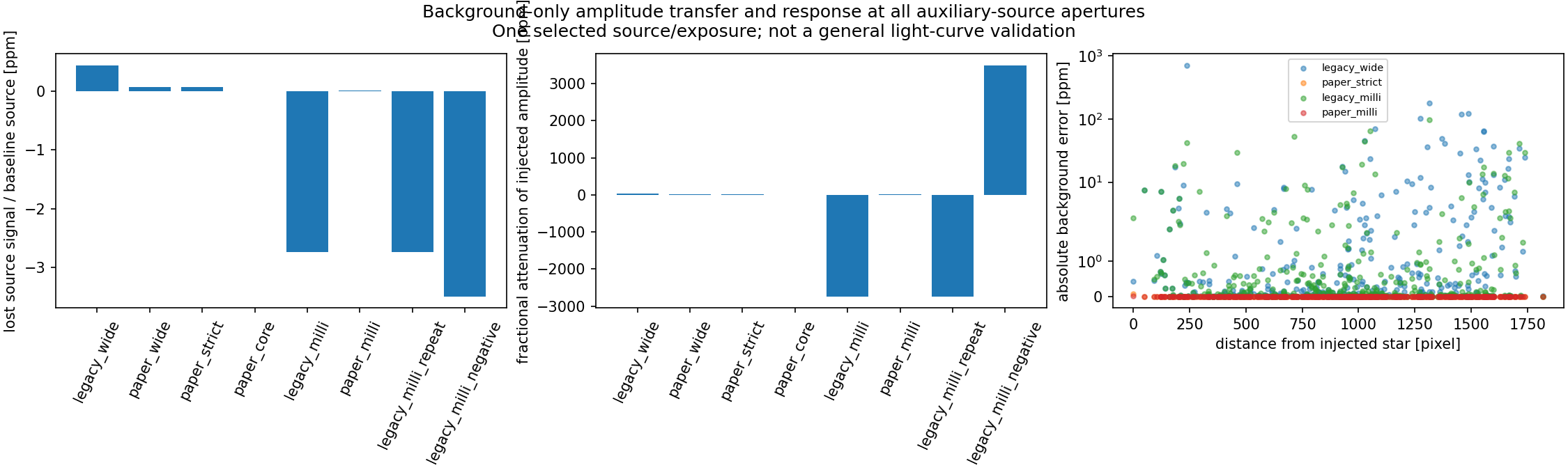
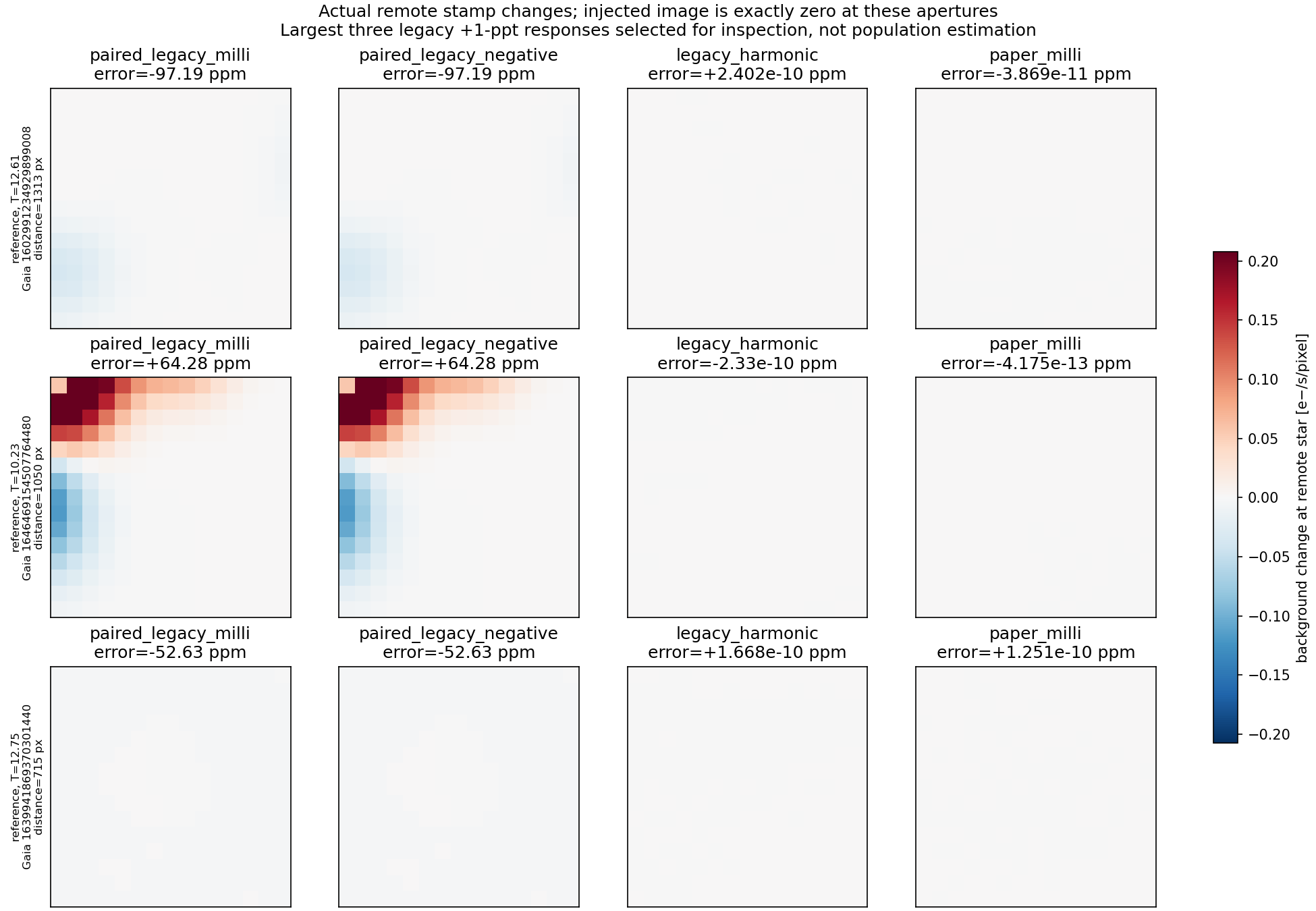
The historical target response is nonlinear: +10-ppt, +1-ppt and -1-ppt signals induce -0.436, +2.741 and +3.491 ppm background errors relative to the target's baseline RAW r3 rate. Baseline and perturbation were repeated together in the same process; their full response images exactly reproduce the earlier results. Zero and fully masked-core controls give exactly zero response everywhere. The original cross-host comparison was provisional until these checks passed.
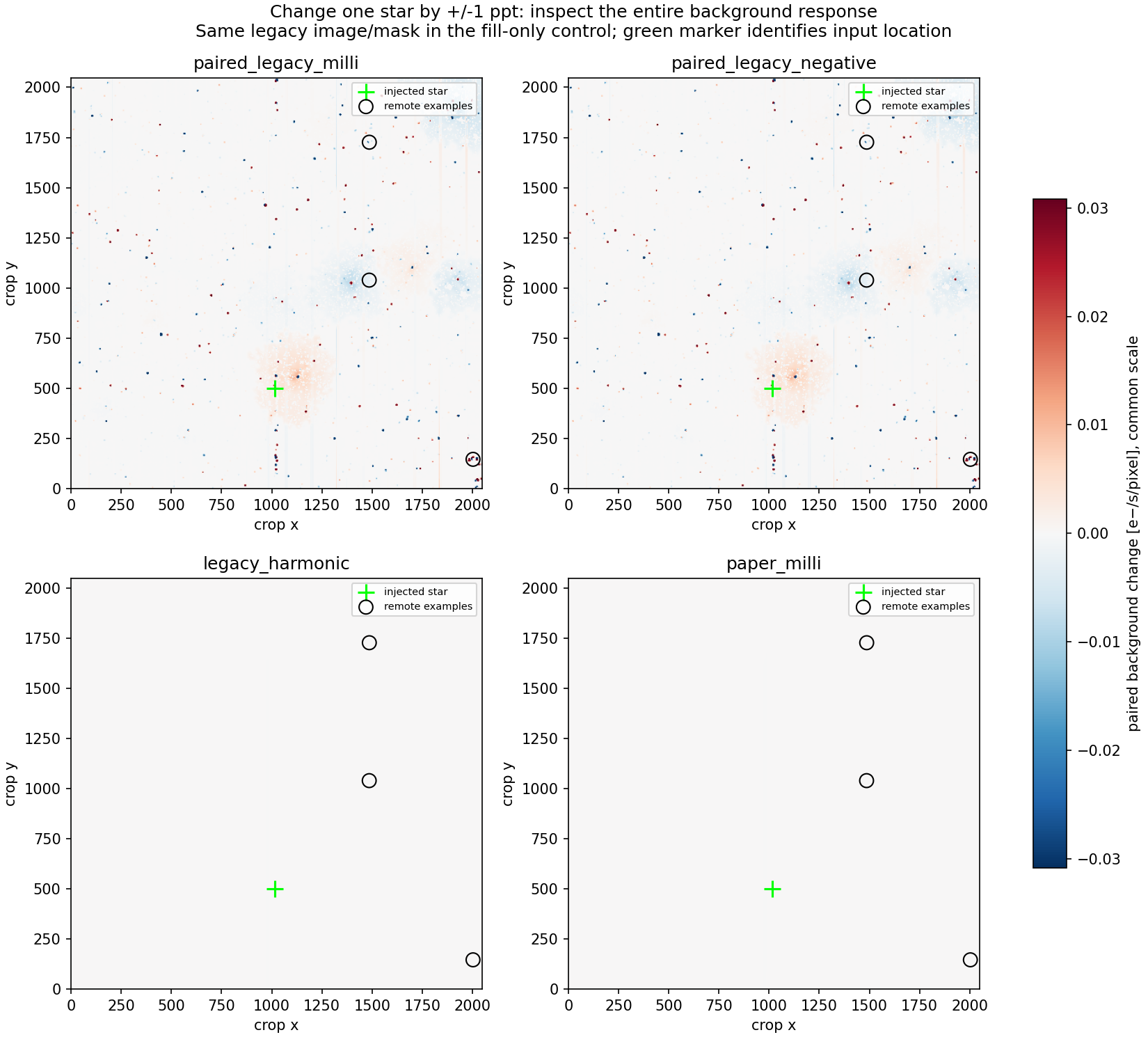
The more serious effect is distant: 163 science and 234 reference apertures more than 100 pixels away receive exactly zero injected counts, yet the historical +1-ppt probe changes their background measurements. Science p95/maximum errors are 3.276/29.766 ppm; reference values are 10.440/97.186 ppm. The negative probe gives the same remote summaries. Changing only the historical hole fill to harmonic, with the same input and mask and a converged baseline, reduces the maximum remote reference response to 3.02e-5 ppm in this calculation. These tiny control values are not real light-curve noise or universal bounds.
Conclusion: a causal failure of the historical background route is demonstrated for this probe, and a matched fill change suppresses it. The exact downstream nonlinear decision still needs tracing; the result does not imply the linear interpolator alone is nonlinear. One profile/exposure cannot certify a replacement time series. The present RAW photometry does not subtract this background, so its remaining systematics are not thereby explained or removed. Equations, controls, numerical convergence, normalization caveat and exact job records.
The actual temporal hp_d differs from the newer paper bootstrap
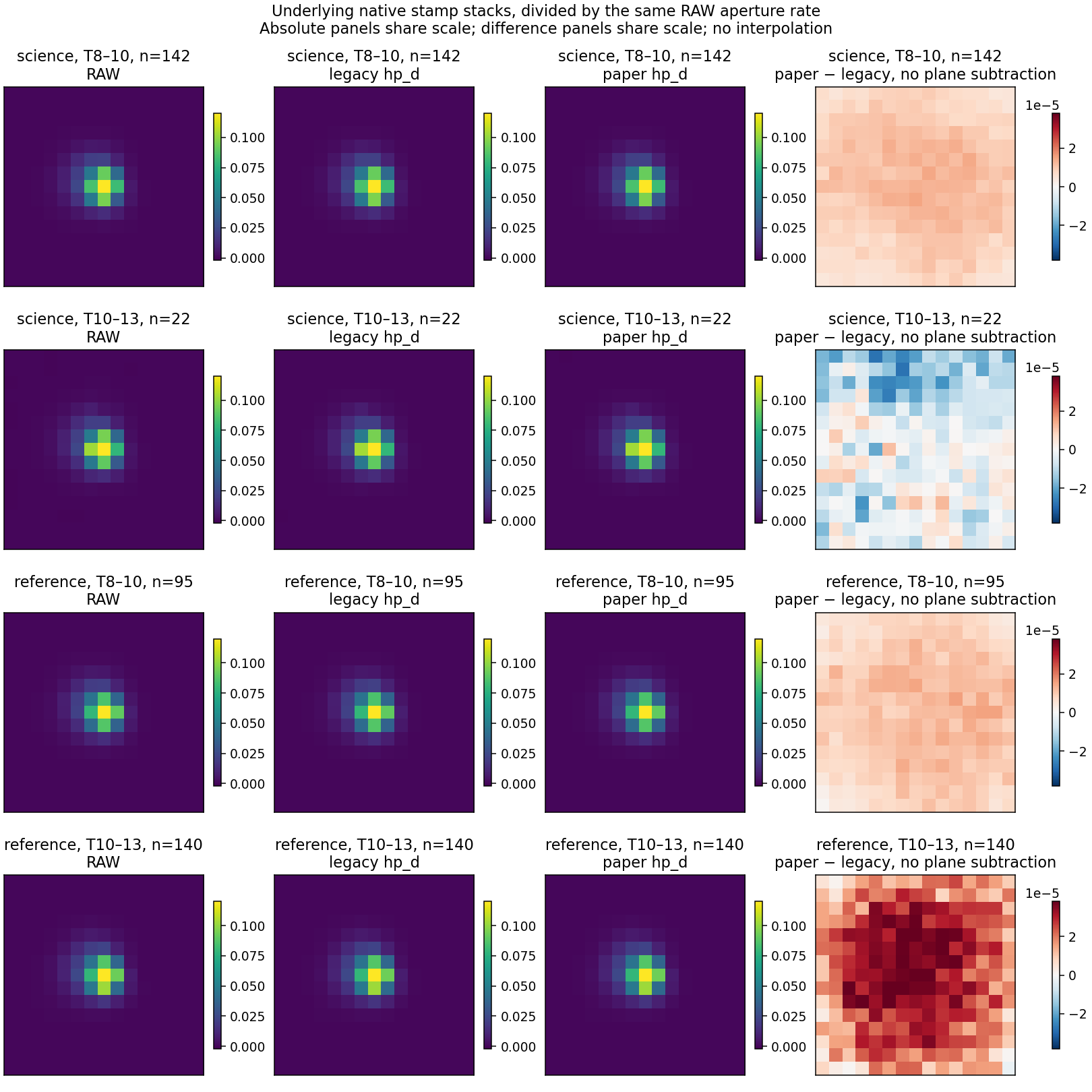
The historical stamp cube comes from production diff_linear with native-resolution templates. The newer F1 neighbour/removal audit uses a separate oversampling-4 paper bootstrap. At their common FFI 602 the underlying RAW files/pixels are identical, and direct historical stamps reproduce the cube exactly. The paper raw/background/hp_c/hp_d identity closes at float32 precision. Its removal ledger cannot be assumed to describe the historical template.
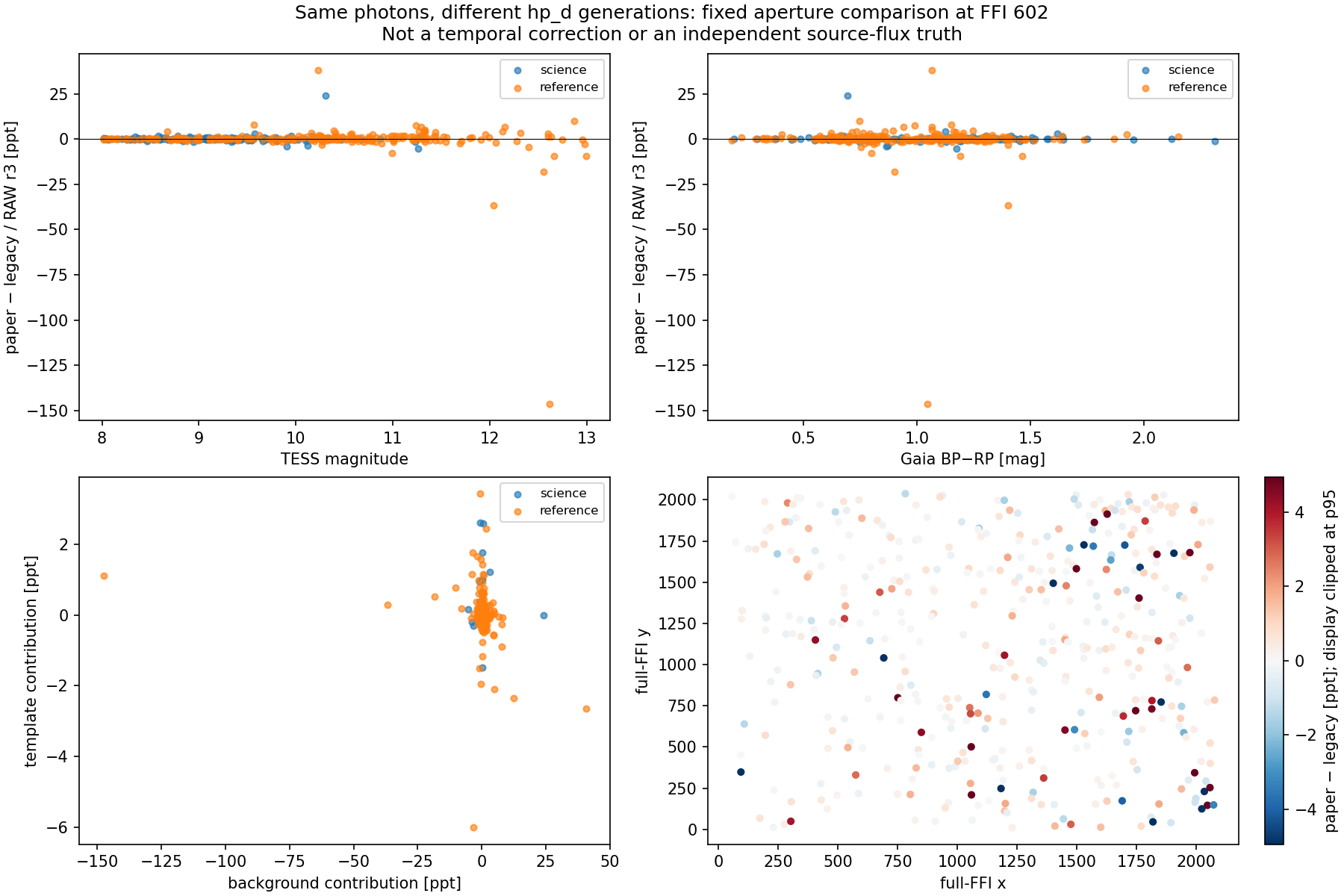
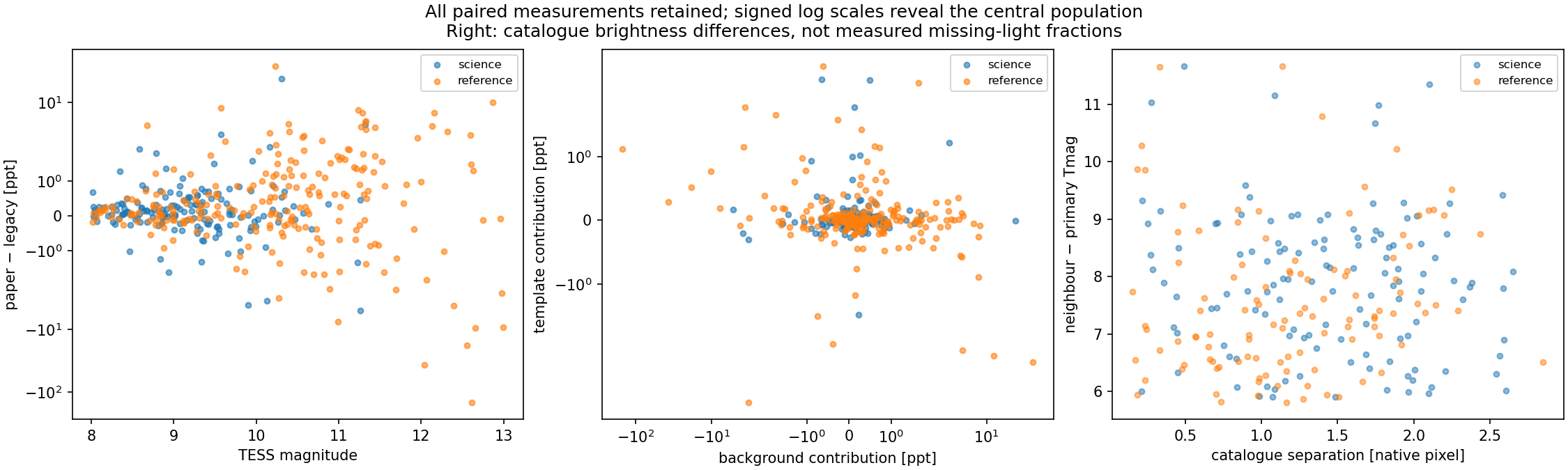
Using identical existing r3 aperture/sky weights, median/p95 absolute paper-minus-legacy differences are 0.272/1.766 ppt for 164 complete science targets and 0.632/5.540 ppt for all 235 references. One of the 165 science targets has a fatal hp_d pixel in both generations on this support; it is flagged only in this comparison, with no change to the RAW cohort. These are single-exposure generation differences, not temporal RMS or calibrated missing-light estimates.
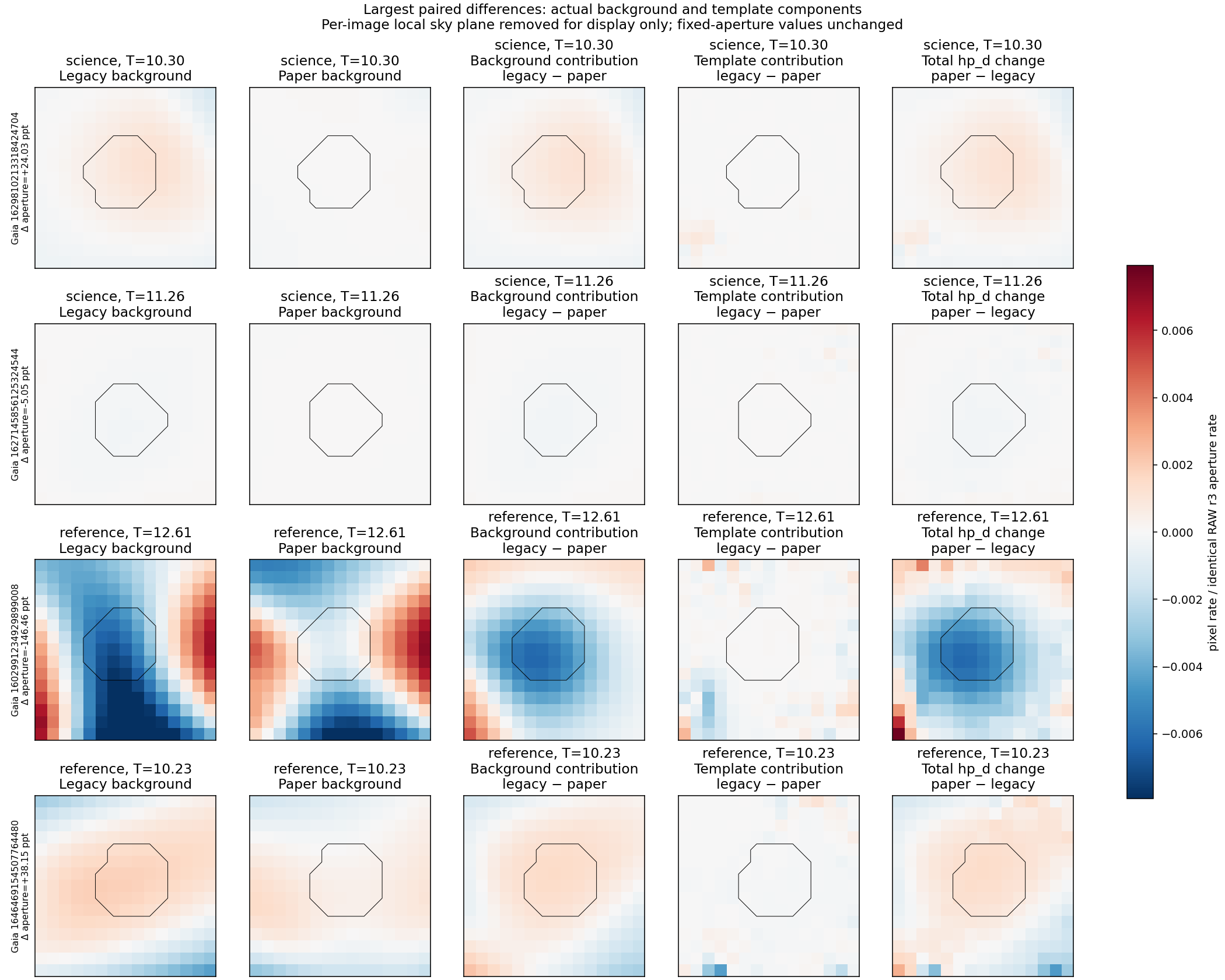
Background changes dominate several large differences. The two largest science cases change by +24.03 and -5.05 ppt, with background contributions +24.04 and -5.21 ppt. The two largest reference cases change by -146.46 and +38.15 ppt, with background contributions -147.58 and +40.80 ppt. These selected outliers are shown below. A structured difference does not establish which background is physically right. Our present RAW extraction does not subtract either saved background map.
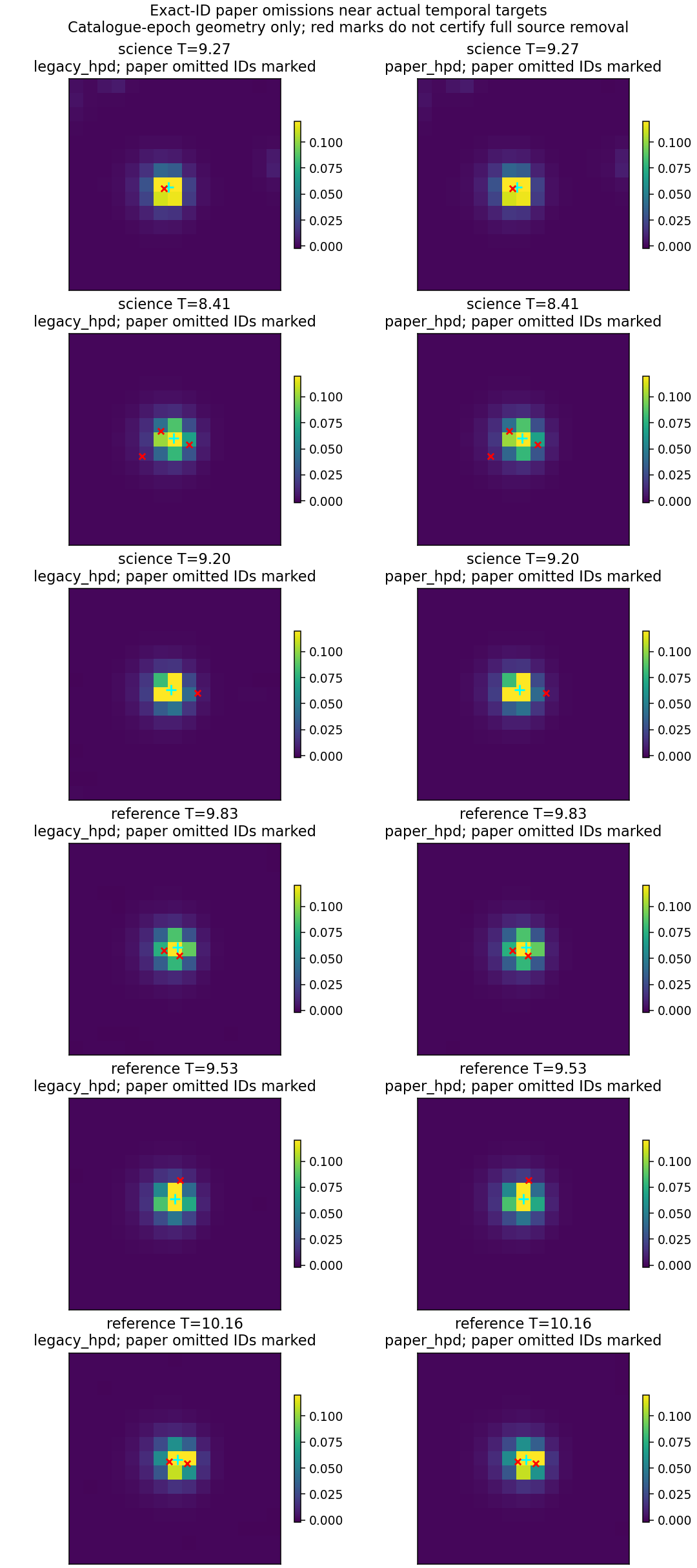
Exact Gaia IDs identify at least one recorded paper-scene omission within three native pixels of 81/165 science targets and 83/235 references. This is catalogue-epoch geometry only, not certified fully erased source light. The counts refer to the newer scene and cannot be assigned to the old removal operator.
Conclusion: the next hp_d repair must test the actual background/removal light transfer rather than transplanting a newer ledger or assuming the newer image is correct. This bridge exposes relevant processing differences but is not a correction. Current RAW photometry remains unchanged; the instrumental-systematics objective is unmet. Method, equations, source hashes, support limitations and reproducibility.
Calibration is spatially structured: column sensitivity
The science inputs called RAW are already SPOC-calibrated, unsubtracted FFIs. Their calibration contains a two-dimensional black map, per-output row bias, four gain/nonlinearity responses, per-column smear, and a pixel flat. It is not one scalar per CCD. A common stellar trend alone does not identify which component is wrong. The laboratory flat is monochromatic compared with the broad stellar bandpass, so chromatic response remains a physical possibility.
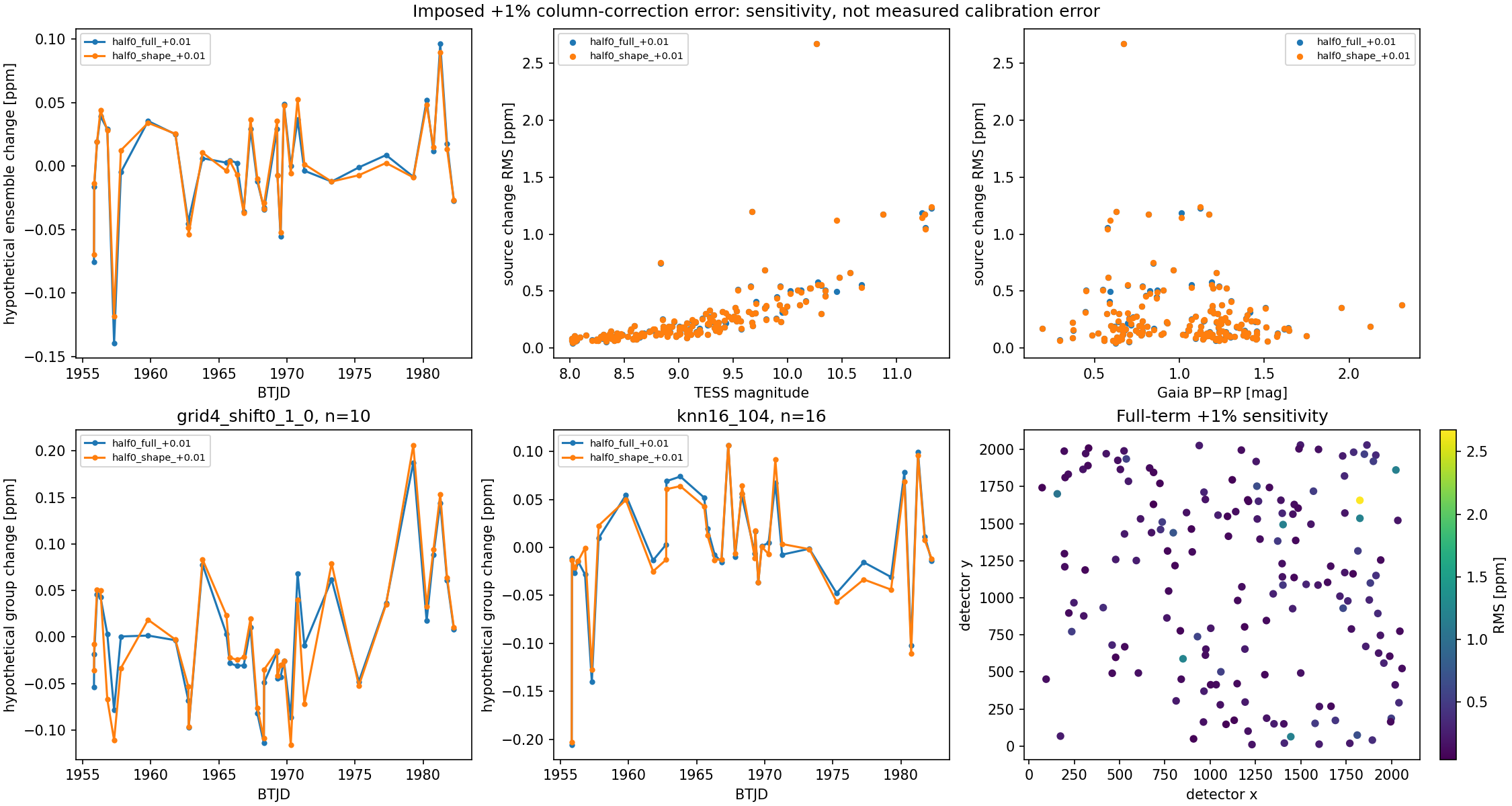
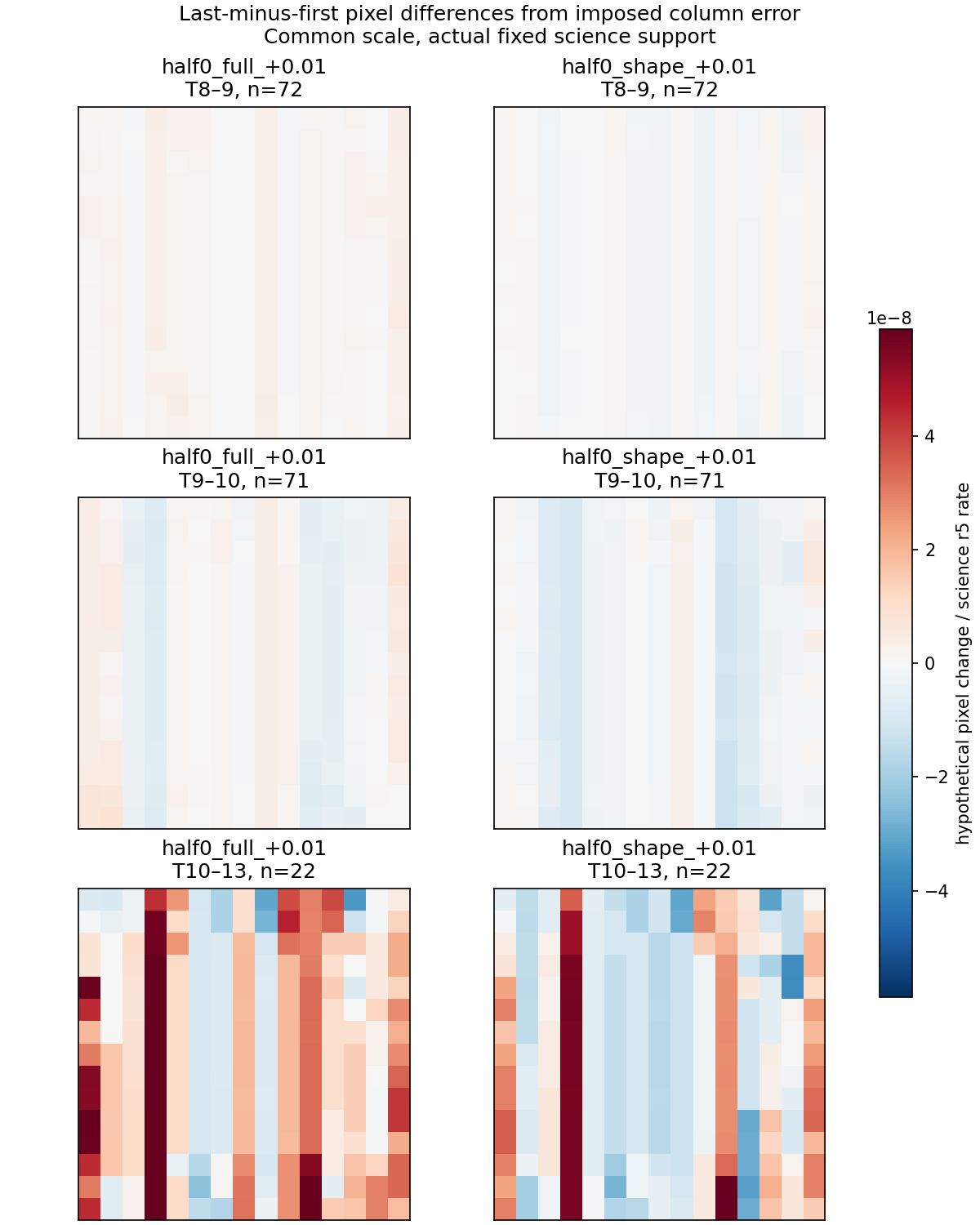
A new sensitivity control imposes +/-1% errors proportional to the reconstructed column correction, using both independently fitted pixel halves. The 1% is a chosen test amplitude, not a measured error or upper bound. Full-term and mean-centered shape controls retain all 165 eligible science stars and 235 references, with actual column support required on every measured pixel. No light curve determines the perturbation.
Imposed +1% column error
Median/p95 source RMS [ppm]
Maximum [ppm]
Ensemble RMS [ppm]
Full term
0.177 / 0.679
2.672
0.0407
Shape only
0.175 / 0.735
2.669
0.0392
The 10/16-star preselected groups change by 0.0647/0.0611 ppm RMS in the full-term control. Both pixel halves agree; numerical checks validate sign, units, detector-output boundaries, zero error, uniform-flat sky rejection and nonuniform-flat coupling. The archived profile measurement is replayed before propagation. Neither ePSF nor stellar trends are refitted.
Conclusion: this specified error pattern is too small at the tested amplitude to explain the larger residuals. It does not bound arbitrary column errors or clear gain drift and chromatic flat response. No calibration repair is adopted; the full photometric goal remains unmet. Method, scope, figures and exact job record.
Applied-CAL reconstruction: processing agreement, not flattened light curves
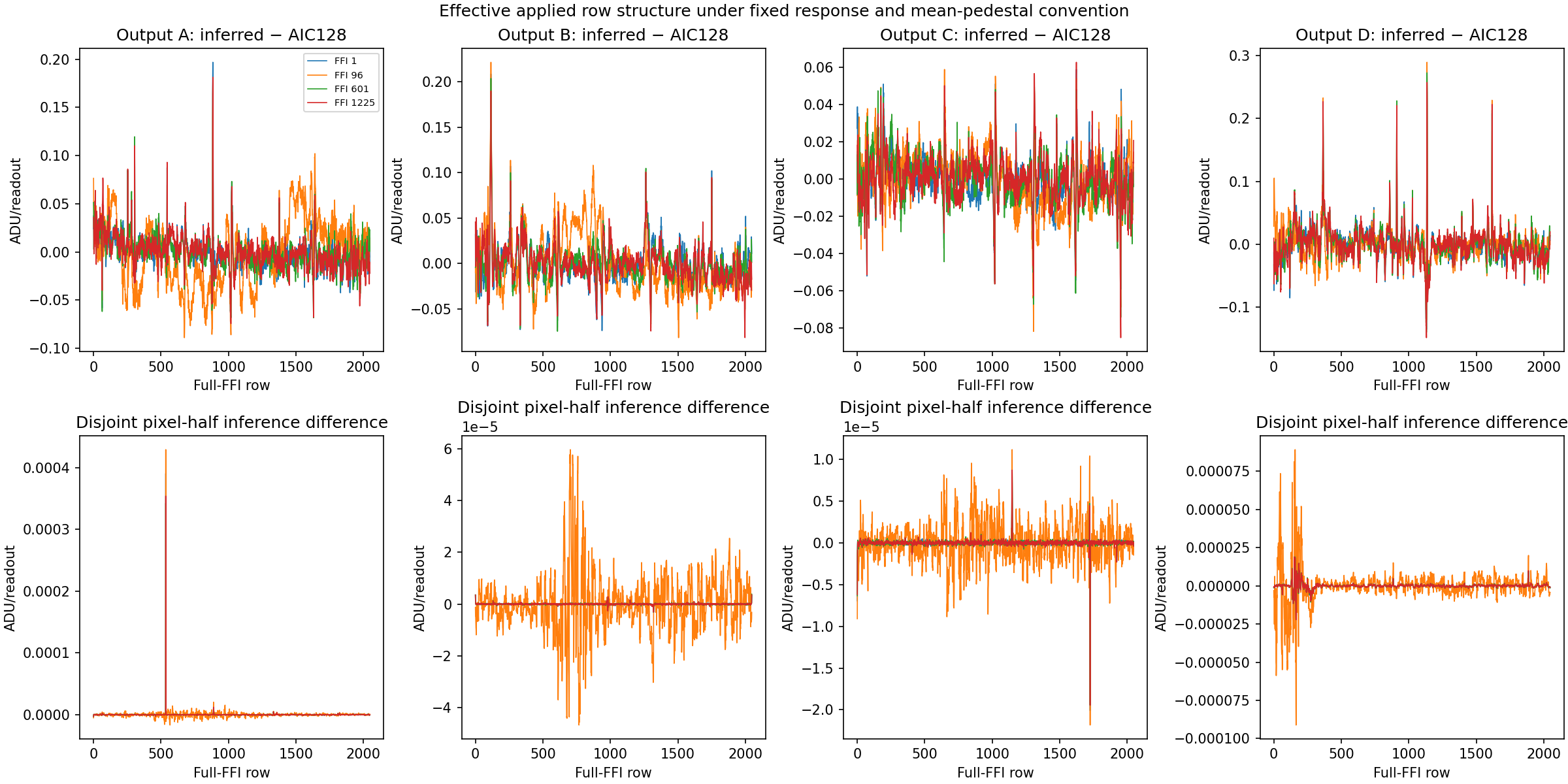
Matched raw/calibrated pixels now identify effective row and column terms under fixed response/flat conventions. No stellar temporal signal is fitted: the background mask excludes science stamps and guards, two connected random detector-tile halves test one another, and stellar apertures are held out. All 165 eligible apertures retain complete support. Ordinary least-squares pilot/sample fits converge within three iterations. Incomplete robust controls are retained separately and are not reported as converged.
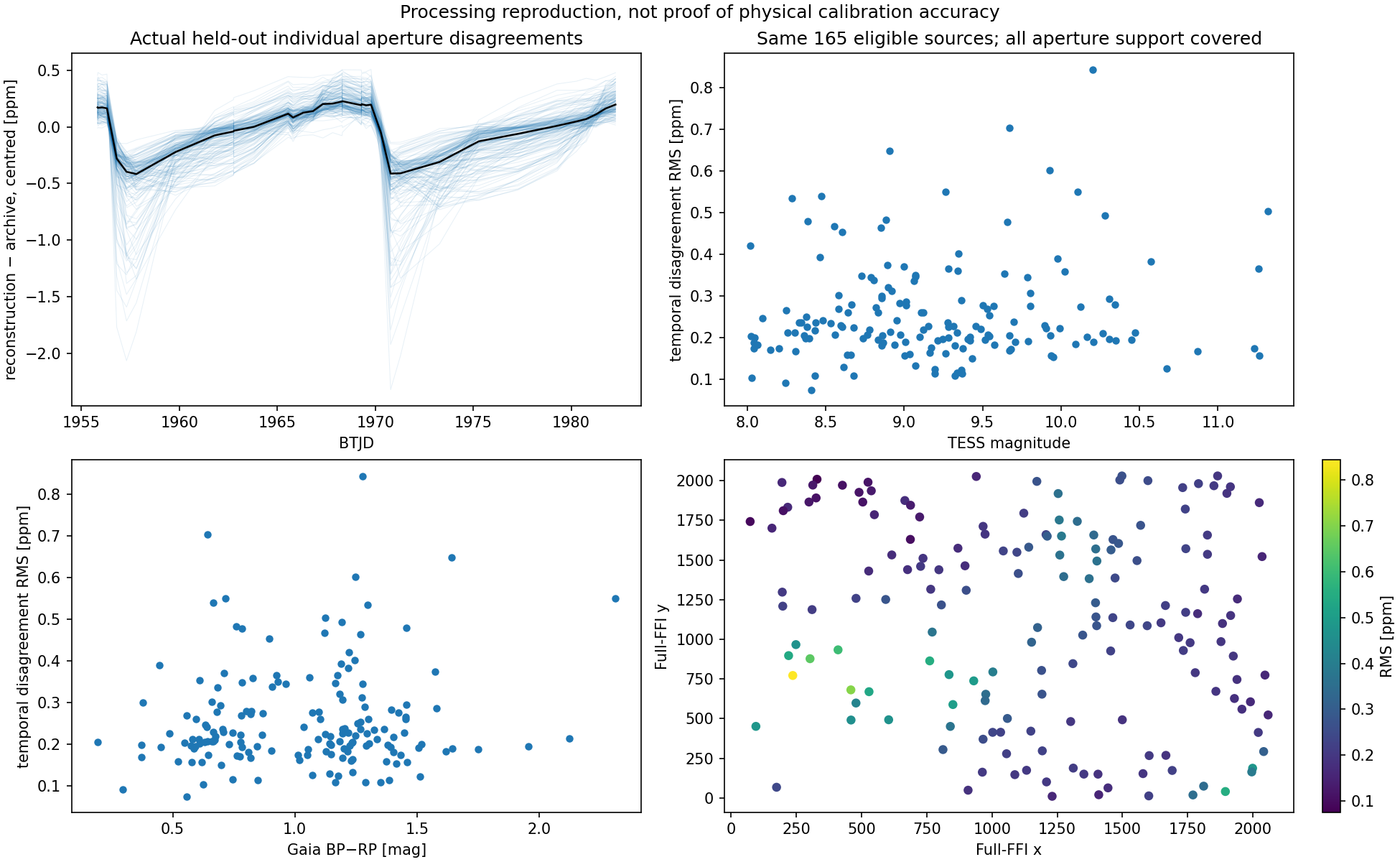
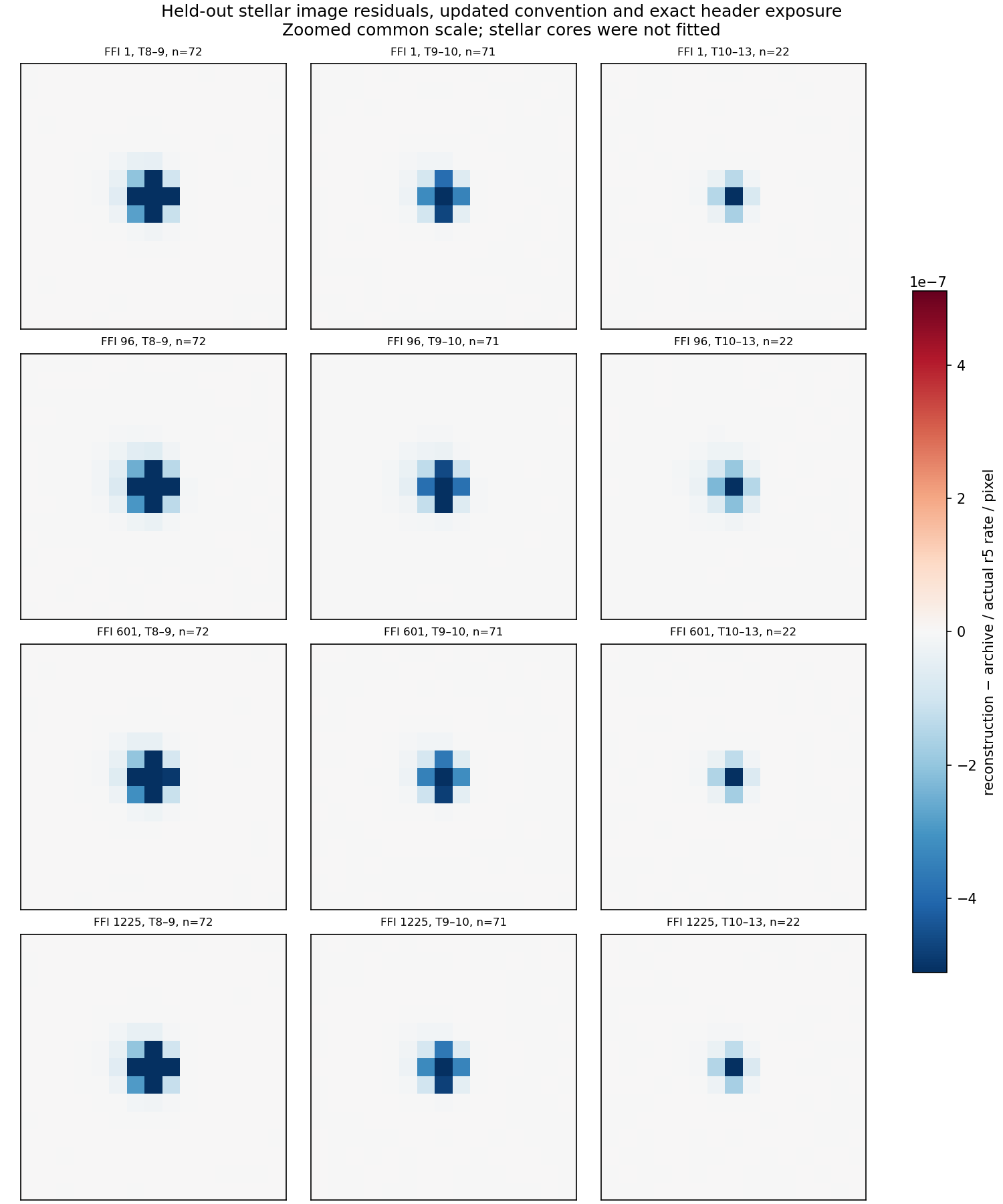
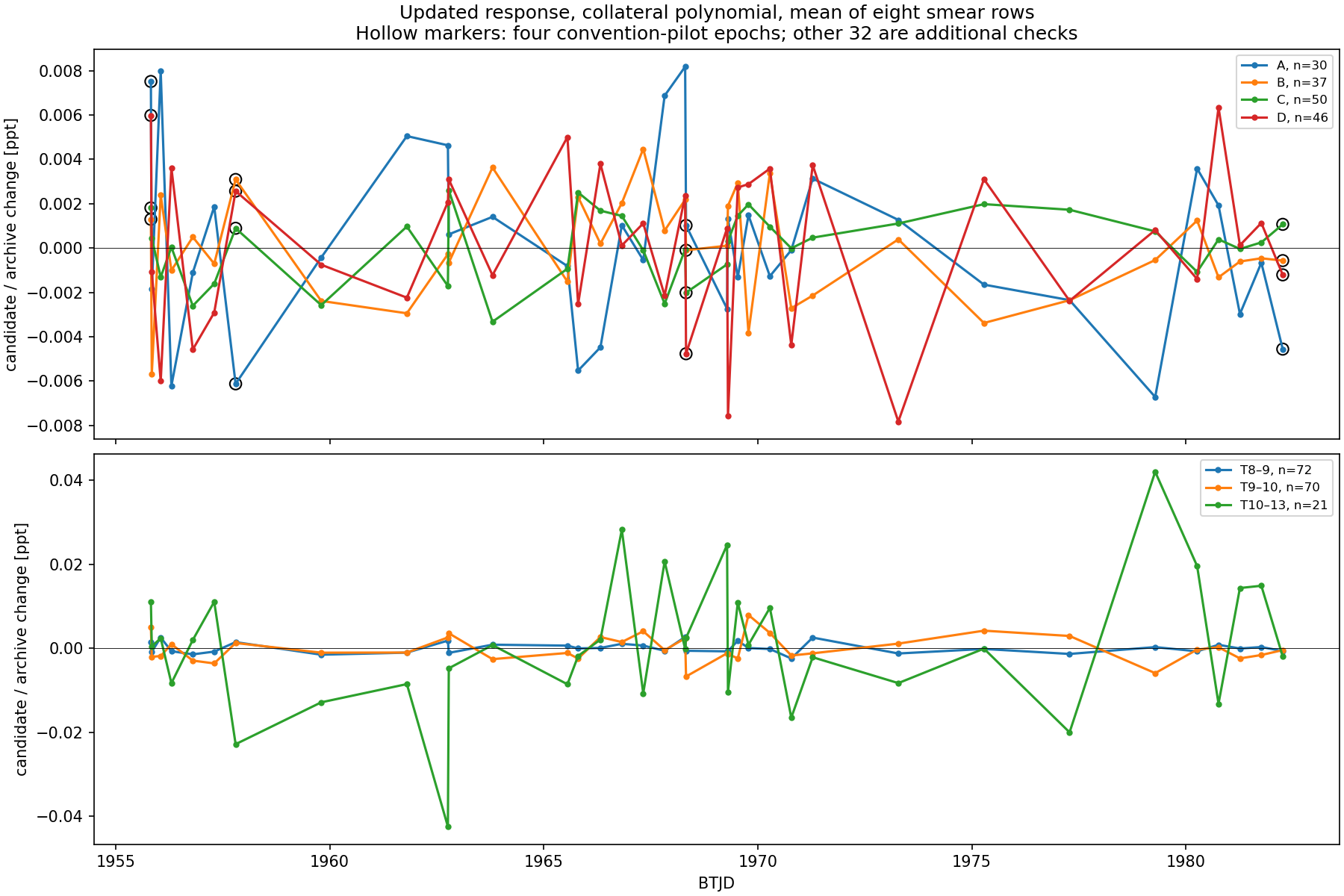
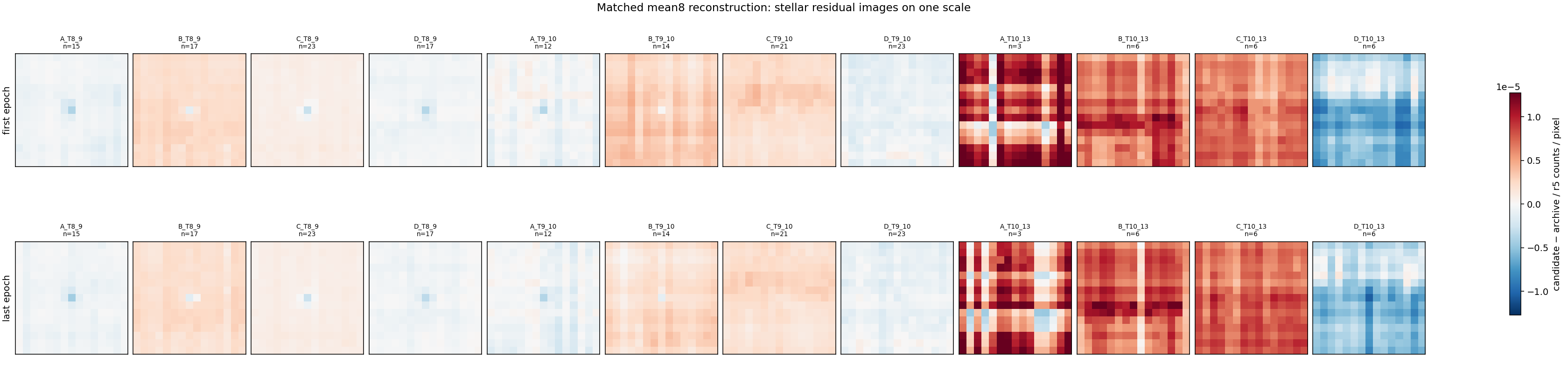
The reconstructed aperture histories agree with the archive to median/p95 0.221/0.501 ppm temporal disagreement on 36 FFIs (0.212/0.473 on the 32 added epochs). This is not light-curve noise or detector-truth accuracy: both versions contain the same original variability and instrumental errors. The median/p95 absolute pixel-half prediction disagreement is 0.000932/0.0184 ppm. A small static stellar-core mismatch remains.
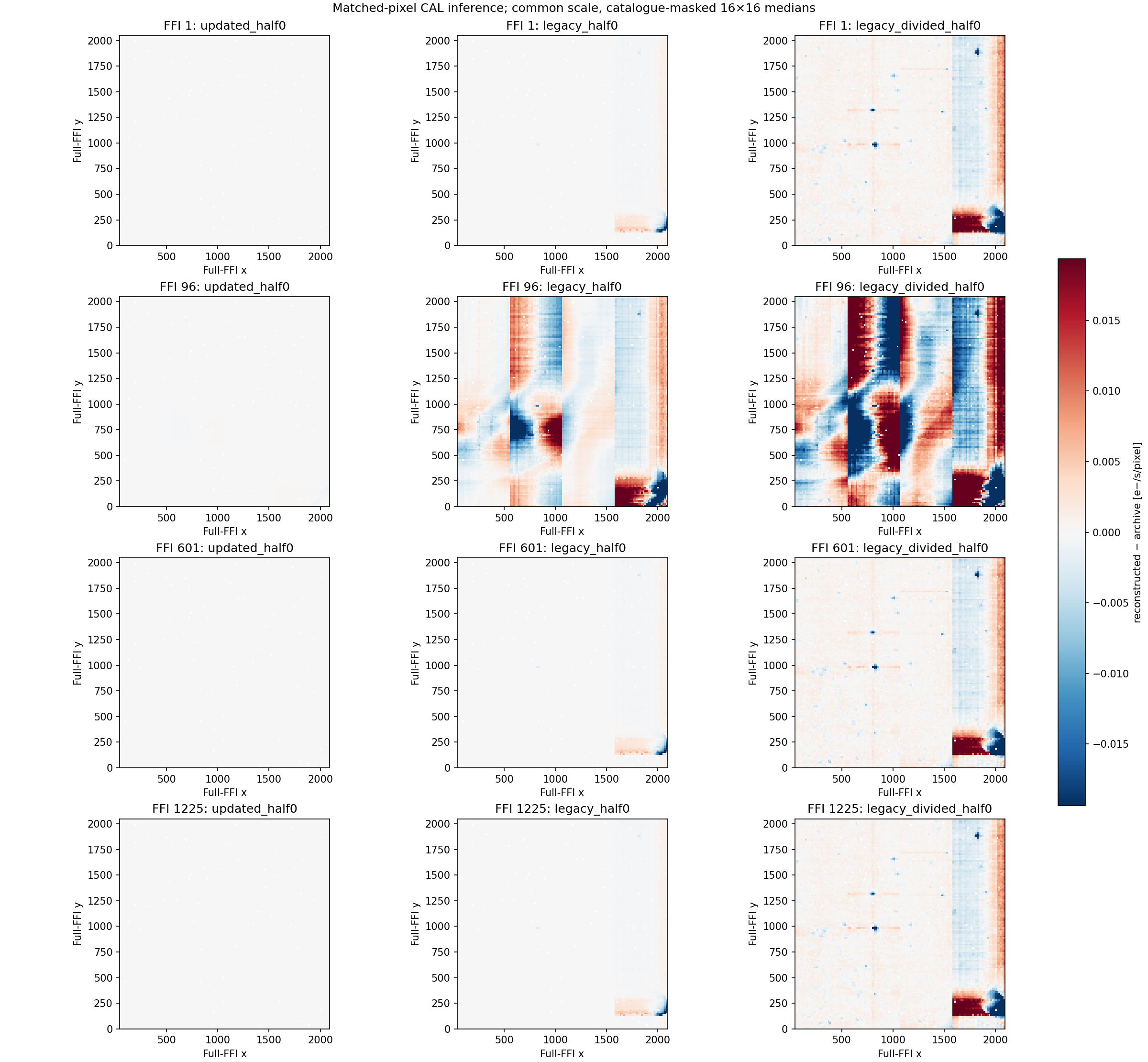
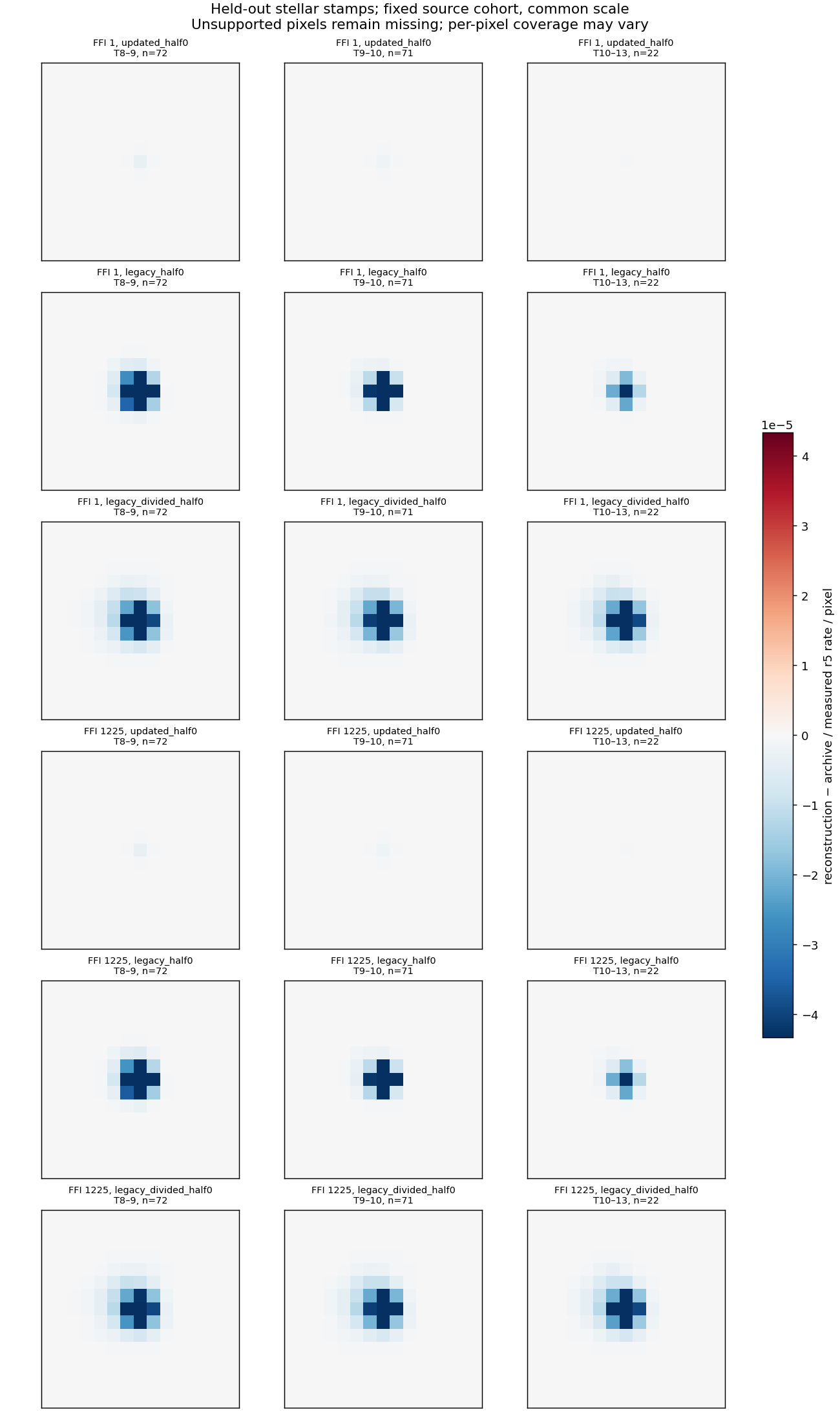
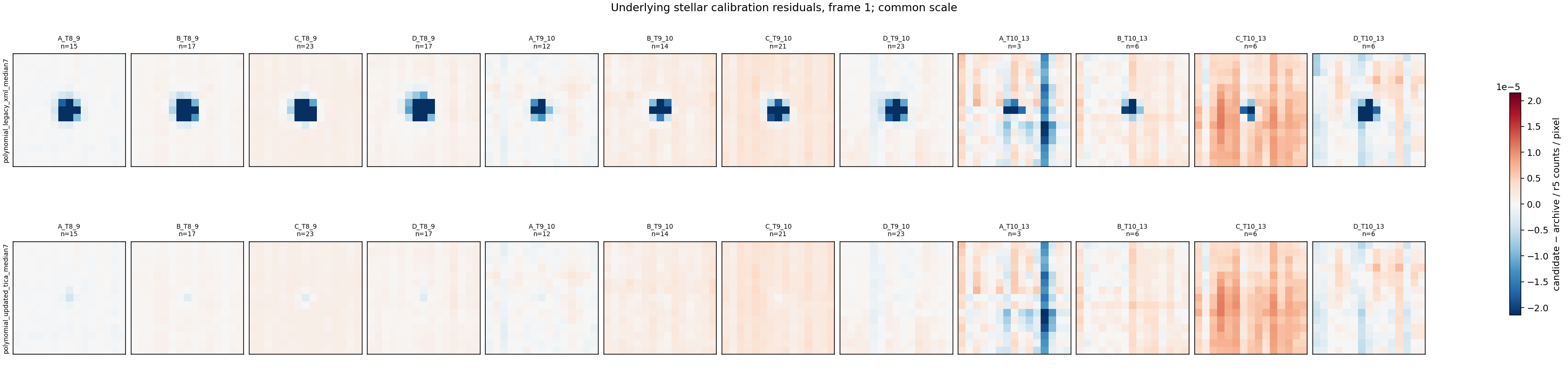
Response-convention qualification: the original archived-XML arm used its polynomial directly. Older TICA divides two terms by two and three; that alternative is now tested explicitly under the declared shared count normalization. Both tested older-table conventions leave larger residuals than the updated convention, but this does not uniquely identify a reference-file version or exclude every possible older recipe.
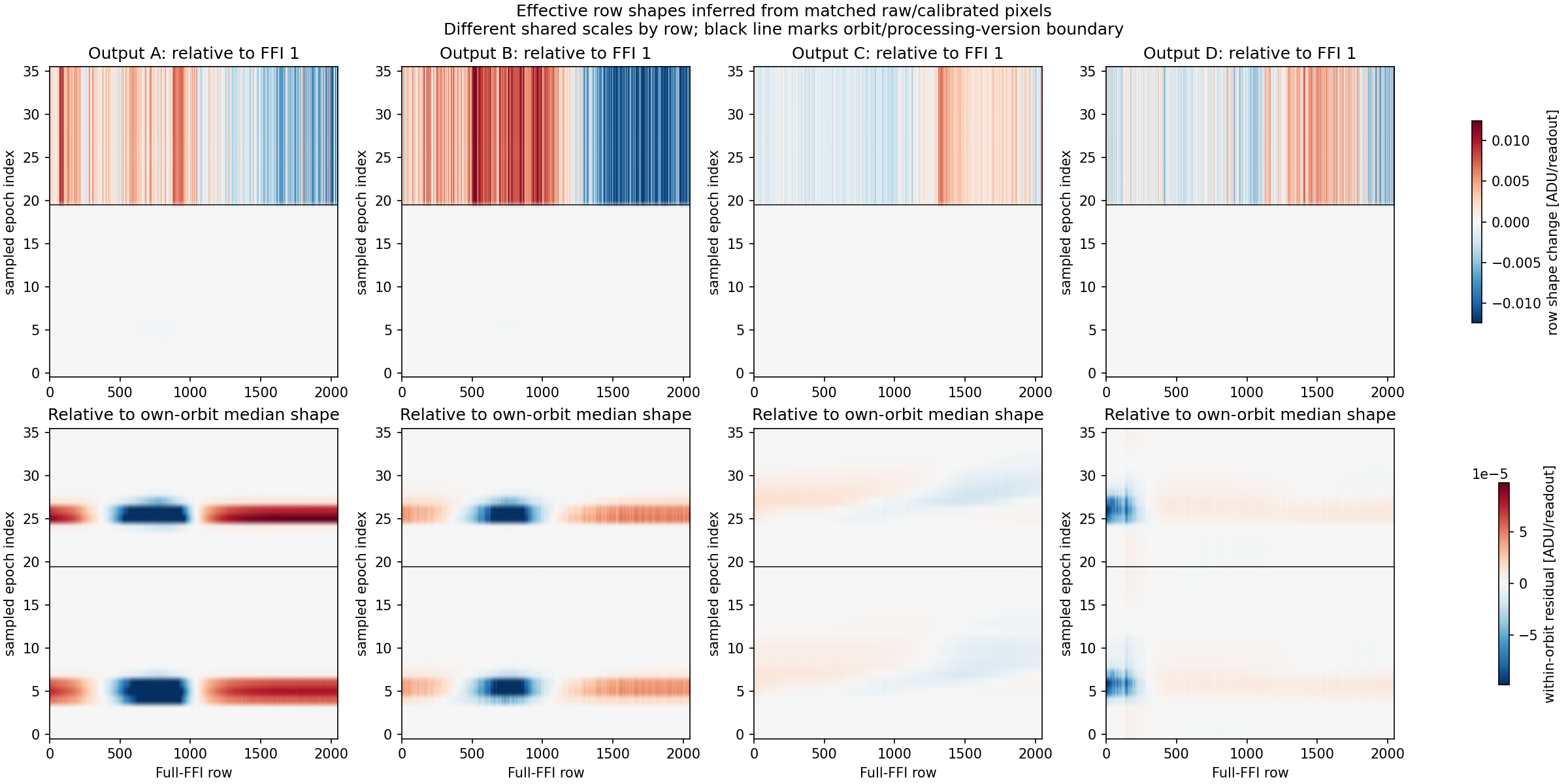
The effective row shape is nearly fixed within each orbit. Between-orbit template differences are 0.00438/0.00784/0.00246/0.00362 ADU/readout RMS for A/B/C/D. The orbit and processing-version boundaries coincide; neither a software bug nor a physical detector change follows from this association. Row/column components of an assumed black reference can trade with the inferred terms, and the mean-pedestal convention remains explicit.
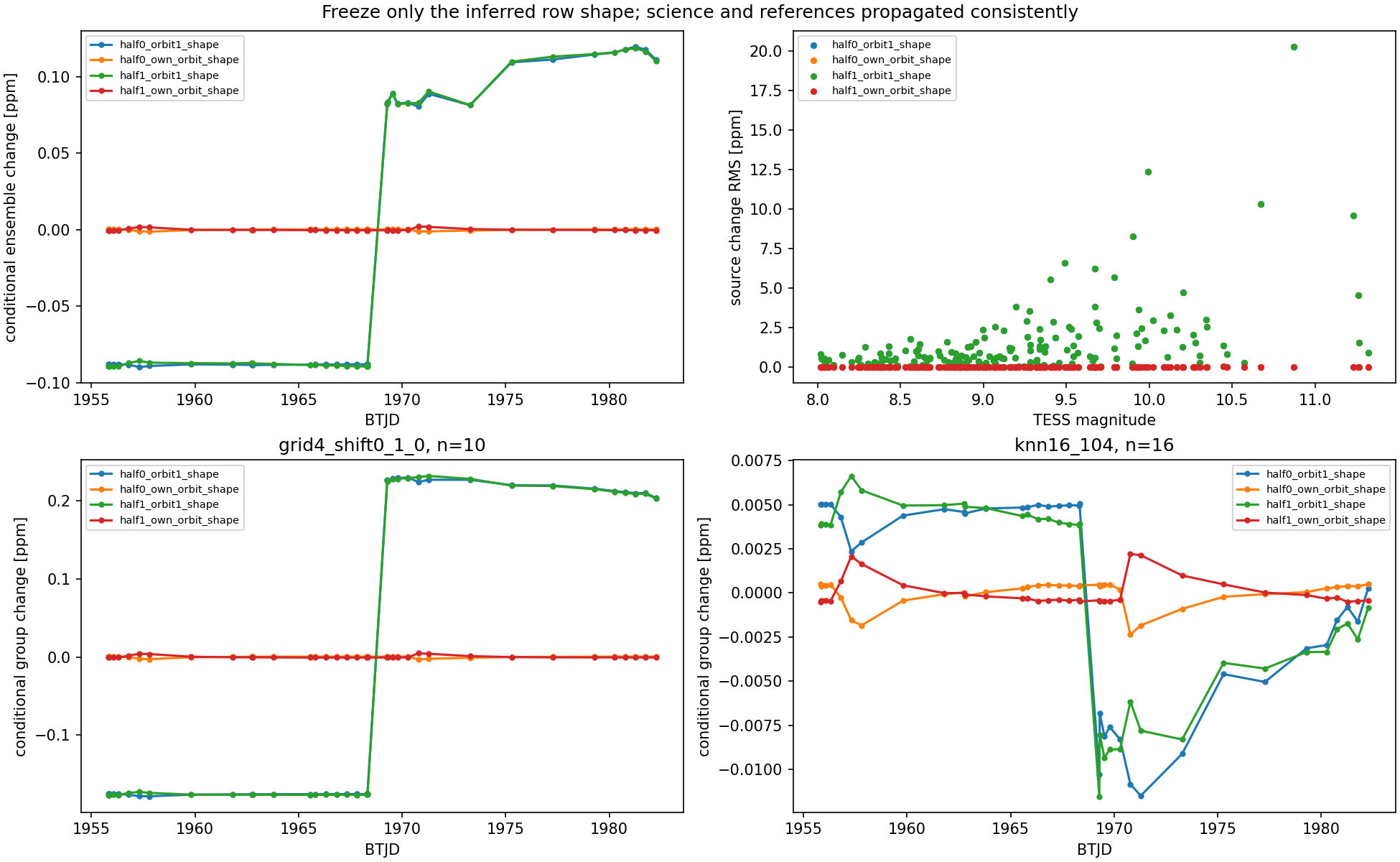
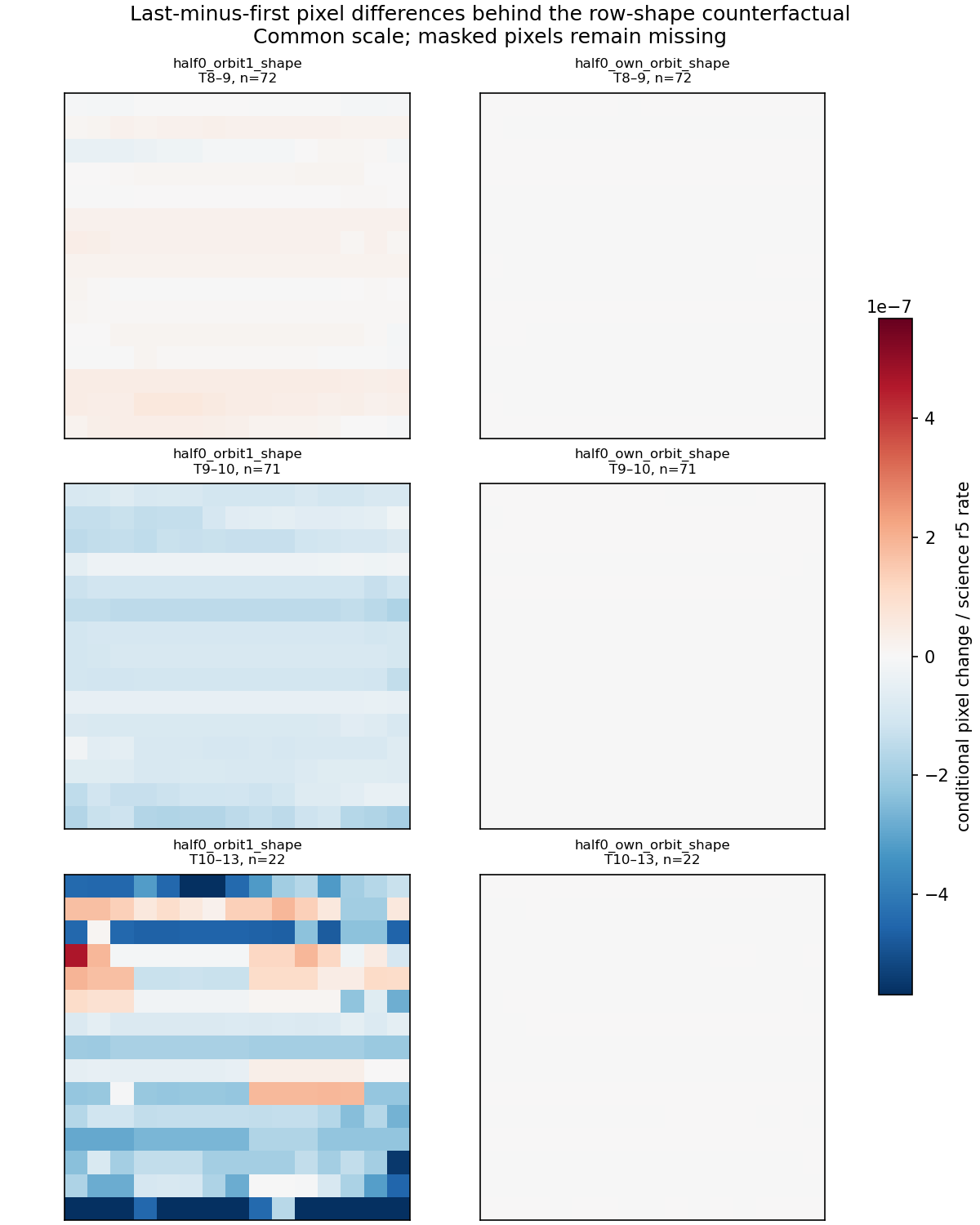
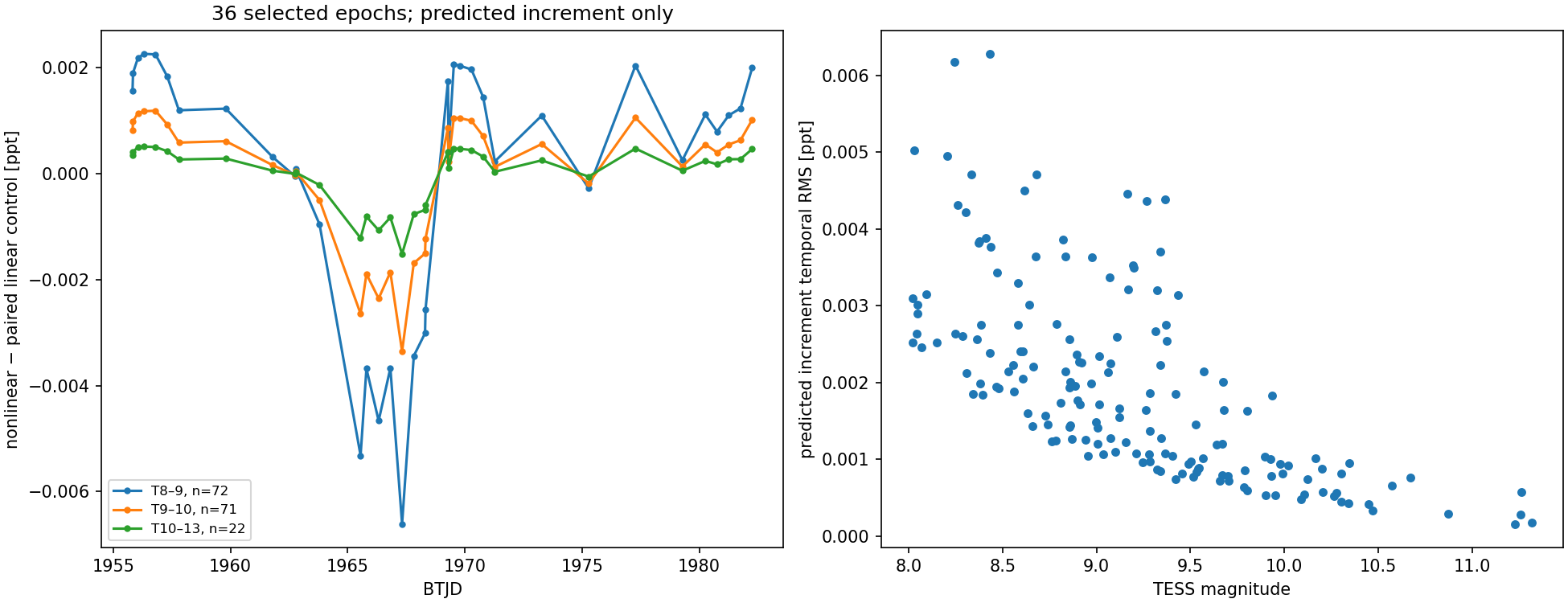
A counterfactual freezes only the row shape to the first-orbit template, preserving each exposure's mean pedestal and every column/flat/response term. Exact pixel differences are propagated through science and disjoint reference measurements with existing profiles and weights. Median/p95 relative-curve change is 0.724/5.370 ppm RMS, maximum 20.27 ppm, ensemble 0.094 ppm. The preselected 10/16-star groups change only 0.197/0.0057 ppm RMS. Within-orbit shape freezing has still smaller effects. All 354 groups are evaluated descriptively.
Conclusion: this isolated applied row-shape change is too small to explain the larger persistent group variations in the stated fixed-model calculation. Freezing it could remove a needed calibration term, so it is not a recommended repair. The processing reconstruction is now much more precise; physical calibration accuracy, PSF/scene effects, hp_d missing-light repair, wider coverage and the full noise budget remain open. Equations, validation, numerical failures, scope and reproducibility.
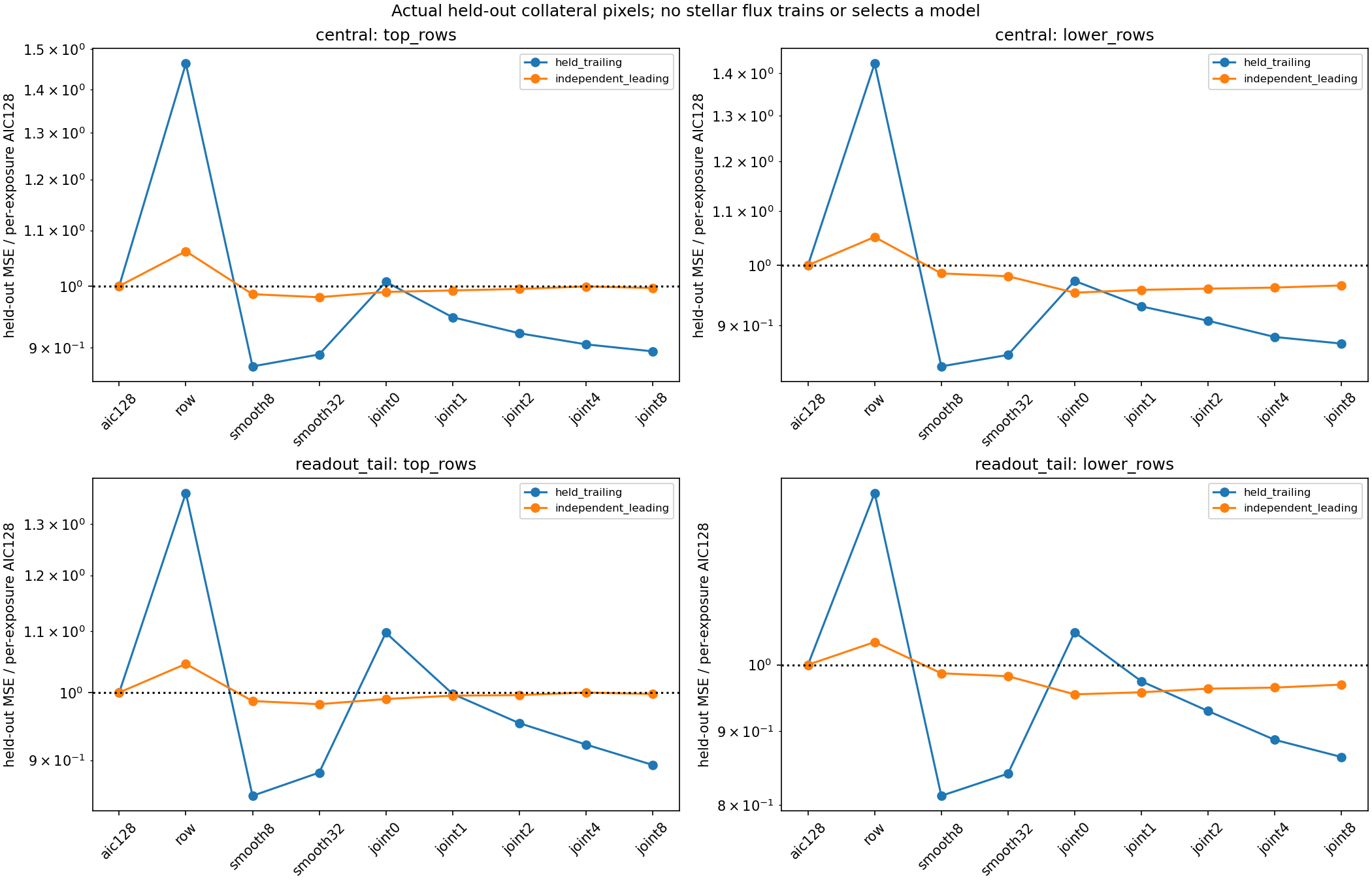
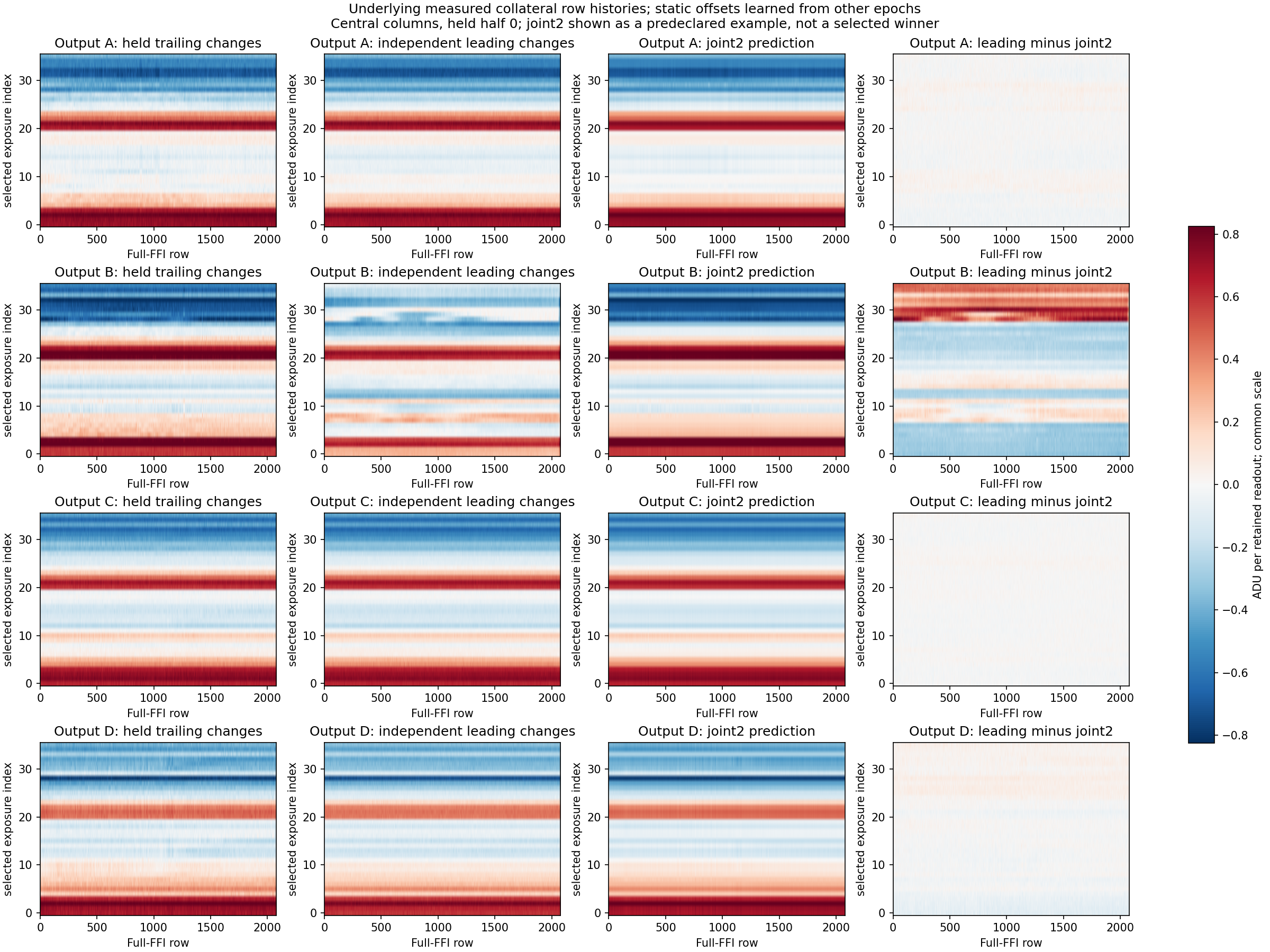
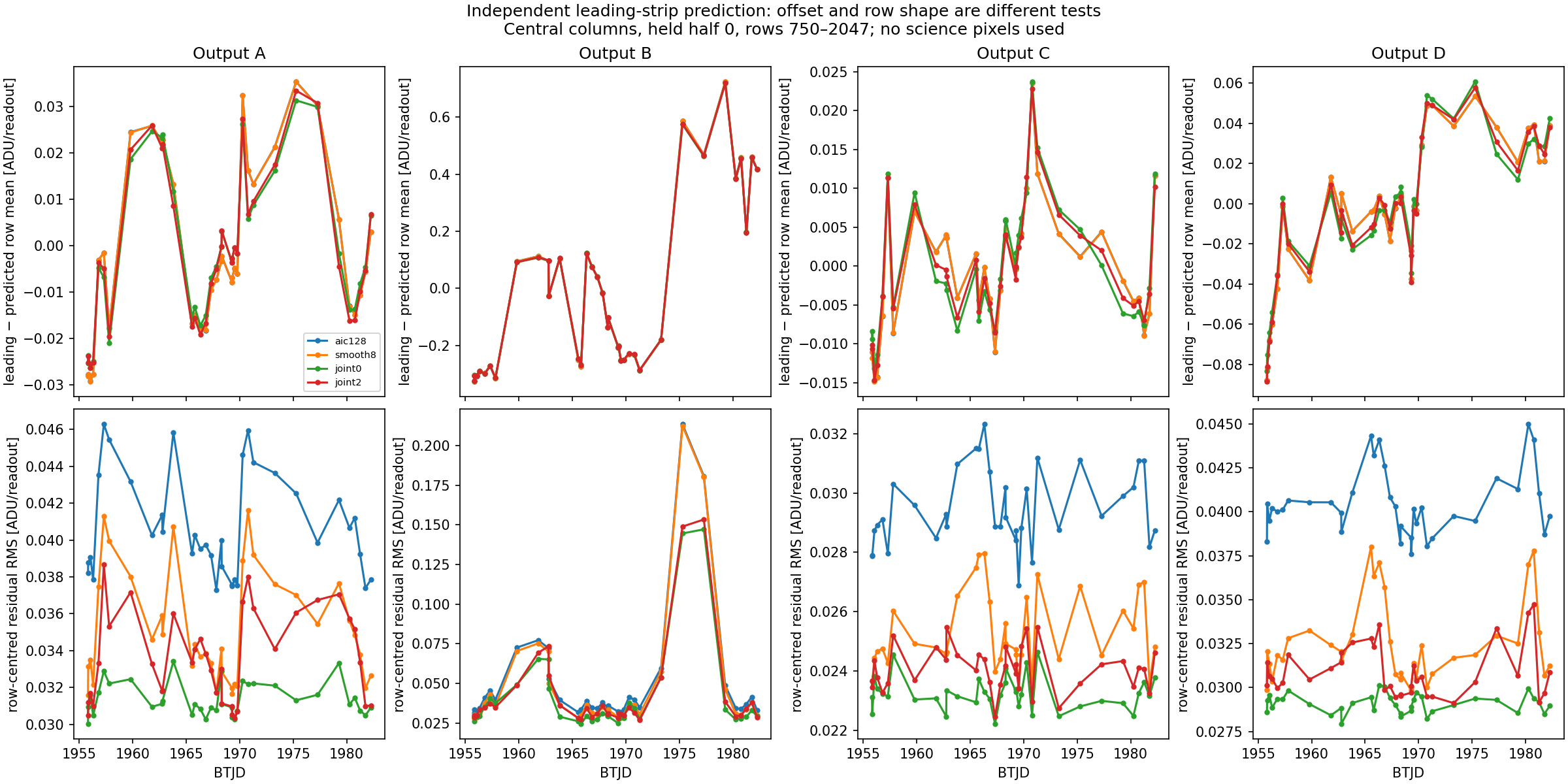
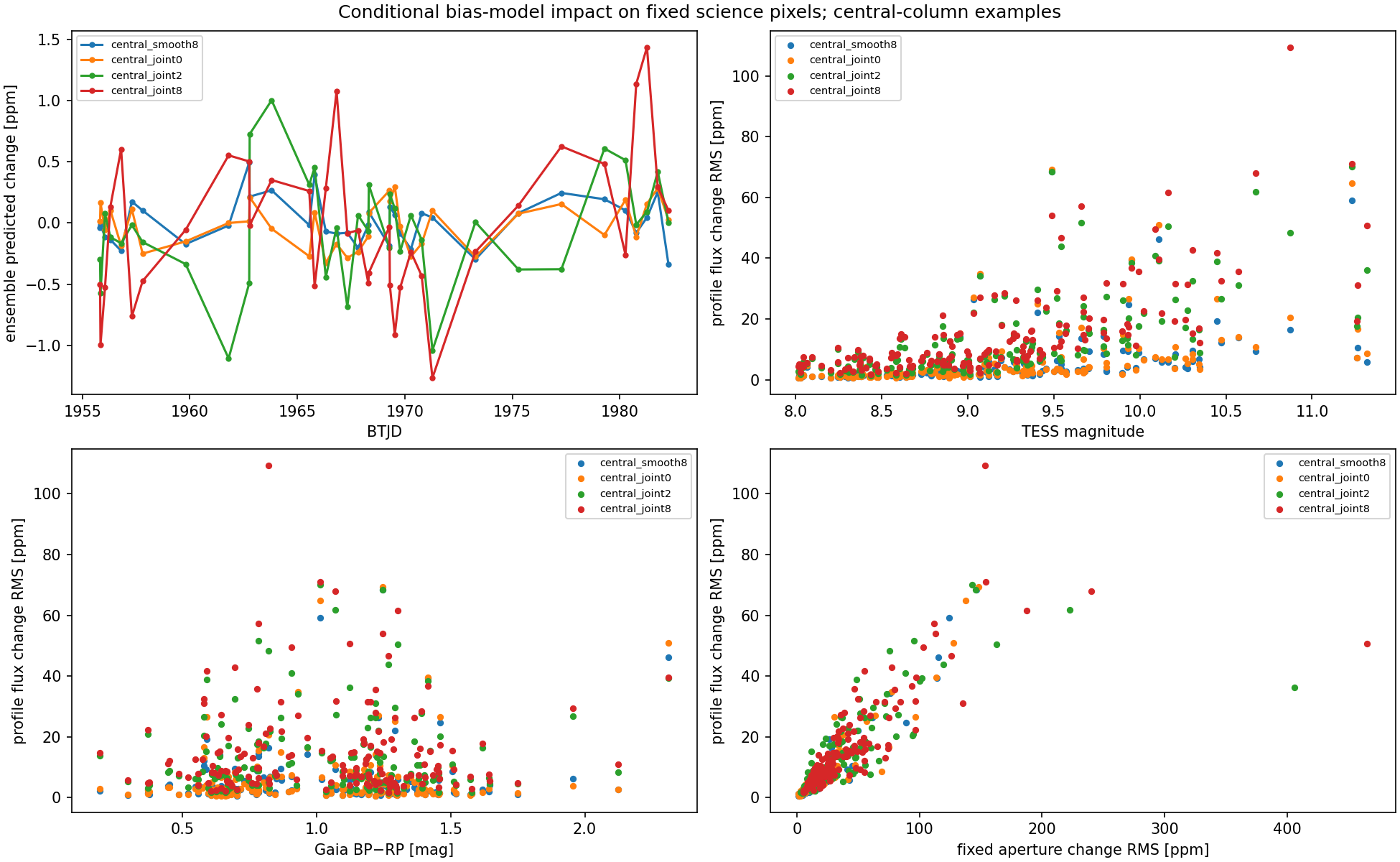
Independent detector-bias prediction and stellar impact
The same 36 raw FFIs now test row-bias estimates on unused trailing columns and physically separate leading columns. Central-five and readout-tail-eight selections are both retained, with B/D order handled explicitly. Static templates and row modes exclude the evaluated two-day block plus a 0.25-day guard. No stellar light curve trains or selects the calibration. Nine predeclared models include per-exposure AIC polynomials, noisy row means, template-plus-smoothing and 0/1/2/4/8 row modes.
Template-plus-eight-row smoothing improves held-trailing MSE to 0.837 of the AIC128 control for central columns and rows 750–2047. The corresponding leading-strip ratio is 0.986. Output B has a much larger temporal strip offset than A/C/D; improvement within trailing columns does not independently certify transfer to illuminated pixels. The polynomial cap is hit in 188/864 fits. Whole-time-block intervals and all alternatives are recorded, with no science-flatness selection.
Every alternative is propagated relative to its own full-column AIC128 reconstruction through the updated nonlinear response, gain, mean-eight-row smear correction and candidate flat. The actual archived-profile flux operator reproduces RAW photometry within 0.0368 ppm; reference r3 extraction and overlapping science r5 increments reproduce exactly. A constant channel bias cancels in the tested linear-response/smear limit, so a visible strip offset is not automatically a stellar flux error.
Central-column alternative
Profile-only median/p95 change RMS [ppm]
After fixed reference ensemble [ppm]
Template + eight-row smoothing
2.70 / 18.64
3.08 / 18.85
Template + pedestal only
2.81 / 24.13
3.41 / 23.14
Template + two row modes
7.52 / 39.17
8.83 / 39.09
Template + eight row modes
9.34 / 45.87
10.36 / 43.07
All 172 science sources, 165 eligibility mask and 235 disjoint references are retained. These are conditional changes, not measured archive errors; some alternatives can add calibration noise. Original reference weights, aperture transport, WCS/shape and count restoration remain fixed. No corrections are invented for the unsampled epochs. The smoothed control changes the two preselected 10/16-star groups by only 1.24/0.69 ppm RMS.
Conclusion: calibration uncertainty can matter at tens of ppm for some sources, but these tested alternatives do not remove the larger group structure or establish a correct science-pixel bias. Next reconstruct the archive's actually applied row/column terms from matched raw/calibrated images, then compare against independent collateral predictions. This is required to replace the approximate AIC baseline with verified processing provenance. No CAL or science product is promoted. Full method, limits and job record.
Observer-motion photon response: a small physical contribution
The saved definitive TESS ephemerides used by the WCS analysis also predict a photometric observer-motion term. This is distinct from geometric WCS aberration and from moving-source orbital beaming. Specific intensity and apparent solid angle must both be transformed before integrating detected photons. The calculation has no fitted light-curve amplitude.
Gaia XP provides spectra for 430/431 sources, including all 165 eligible science stars. One reference uses a marked GSP-Phot blackbody fallback. The TESS v2 response extends past the 1020-nm XP limit, so four explicit red-tail continuations are tested. The source archive and extracted inputs are hashed; all 1,224 exposures and fixed source IDs are retained.
With the nominal tail, direct observer response has median/p95 science RMS 3.54/7.47 ppm, maximum peak-to-peak 23.79 ppm. After correcting science and references consistently and recomputing reference precision, relative curves change by median/p95 0.98/2.69 ppm RMS, maximum 4.29 ppm. Correcting only science would double-count much of a signal already absorbed by references.
The largest direct-rate temporal sensitivity among the four tail choices is 0.285 ppm; these scenarios are not a full spectral uncertainty posterior. The first uniform-grid calculation failed a 0.01-ppm convergence guard and was rejected. Splitting at response and Doppler-shifted spectral knots resolves that numerical error; nominal four/eight-point quadrature agrees at floating-point precision. Power-law, moving-boundary, photon/energy and angular-area tests pass. Numerical agreement does not imply equivalent physical calibration accuracy.
Conclusion: observer motion is too small to explain the remaining hundred-ppm structure within this measured-spectrum calculation. It is a physical prediction, not an independent detection or a promoted calibration. Aperture transport, pixel WCS/shape and physical count predictions remain fixed in the conditional control. Detector bias/smear, response/PSF/scene effects and the broader goal remain open. Equations, source references, exact jobs and limitations.
Reference variability versus missing physical response
A new control trains throughput only on disjoint references using measured jitter, temperature, sky and WCS motion. Three predeclared fits use levels, adjacent-exposure differences, and six-hour differences. Aperture transport and response coefficients both exclude the evaluated two-day block plus a 1.5-day guard; the science fold is also excluded from transport. Two balanced reference halves predict one another and are averaged for science. A matched full-history control uses the same nested exclusions, halves and injection bookkeeping.
Method
Six-hour ensemble RMS [ppm]
Median imported 1-ppt reference signal, 5–30 d / 45–120 d [ppm]
Sign flags / 354 groups
Matched reference histories
81.18
89.13 / 44.55
1
Engineering levels
137.67
79.83 / 66.81
6
Adjacent engineering differences
135.35
0.762 / 0.051
10
Six-hour engineering differences
177.43
14.76 / 0.697
23
Ensemble values use the same 165 eligible sources; injection statistics cover all 172 science targets and 235 references. They are sensitivity results, not calibrated confidence intervals on real contamination. The same 4,096 sign randomizations reproduce the earlier baseline p values exactly. This conditional audit assumes independent sign-symmetric histories; it does not identify instrumental causes and cannot certify their absence.
The adjacent fit greatly suppresses injected reference variability and reduces median half-disagreement from 165.4 to 78.7 ppm, but leaves a visible slow decline in both held-out reference halves. The ±3-ppt display limits do not remove sources from the analysis. Worst primary-amplitude errors are 0.332% for the matched histories and about 0.581–0.582% for the engineering fits; affected normalization and learned coefficients are refitted, while pixel WCS/shape and physical count predictions remain fixed.
Conclusion: the current linear engineering response cannot replace full reference histories. Those histories carry useful time-dependent information absent from this predictor set, together with unwanted stellar variability. No arm is promoted. The persistent neighbourhood still flags in the matched history control (family-adjusted p=0.0334); the broader photometric goal remains unmet. Record: method, validation, exact jobs and next physical tests.
Calibration scope and current four-output histories
Our RAW inputs are unsubtracted SPOC-calibrated FFIs, not uncalibrated digital counts. CAL uses a two-dimensional CCD bias map, exposure/output-specific row bias, separate gain and nonlinear responses for four outputs, column smear estimates, and a pixel flat. A CCD reference map is not a single CCD-wide scalar; most reference maps/coefficients are reused rather than inferred anew for each star.
The same 165 eligible stars and 1,224 exposures now show a six-hour ensemble-median RMS of 76.6 ppm, with output medians at 153.4, 95.7, 135.5 and 153.5 ppm (A/B/C/D). These descriptive scatters include astrophysics and shared-reference uncertainty. They are not gain-drift measurements, confidence limits, or independent photon-noise floors.
The individual-history display shares pooled 95th-percentile limits; no sources or full values are removed from the saved numerical arrays. The early all-output decline is reduced, but the latest output histories still differ, including a positive late-first-orbit feature in A and D. Stellar populations, residual image effects and reference calibration can all contribute.
Conclusion: calibration is neither one CCD-wide number nor independently certified at the required precision. The remaining histories do not uniquely identify gain drift. Continue tests that separate multiplicative response, additive bias/smear, and WCS/PSF-dependent pixel response, using fixed stars and independent calibration information. Exact source and command: condor/calibration_readout_followup, cluster 1056 on plscience3, exit 0.
Paired source, background and flat photon-rate test
The physical count-loss simulation now tests photon means anchored by RAW core counts and an outer-ring background plane, with the candidate public detector flat applied before photon draws and reversed after retained-count averaging. This tests consistency within an assumed flat map, not unknown errors in that map. The plane is constrained to keep total photon rates nonnegative on all measured pixels/readouts; no sources are dropped. All 431 sources and 36 preselected exposures retain their fixed masks, WCS/jitter tracks, original seed indices and eight replicates.
The old simulation replays with zero pixel difference. The four overlapping pilot exposures also preserve the combined-arm increments exactly when selecting that arm alone and extending the time list. Changes use validated Poisson addition/thinning and identical read-noise deviates. The first unconstrained pilot failed on a negative total mean; the constrained fit fixes the invalid photon input rather than excluding the source.
Population
Sources
Median/p95 temporal increment RMS [ppm]
Median/p95 per-epoch paired MC SE [ppm]
science
165
5.67/17.25
3.24/8.87
references
235
7.03/24.26
4.43/19.25
The separate four-frame source, background and flat controls are retained below. The flat-only increment is mostly comparable to Monte Carlo uncertainty; the absolute source-count mismatch does not translate directly into a percent-scale light-curve error.
Conclusion: input-mean consistency produces small predicted changes within the tested model. This is not a measurement of upstream gain/flat error and does not remove the remaining shared histories. Core closure is imposed, the instantaneous PSF remains approximate, and variable-source injections through recomputed photon inputs remain required. No replacement science curve or photon-limited product is promoted.
Next physical-model check: does its mean photon budget match RAW?
An exact four-FFI replay of the existing jitter-averaged positive profile, constant source normalization, scalar sky and saved count-loss image predicts median science r3 counts 1.27% below the measured RAW counts. The 5th-percentile ratio is 0.9508. This is an absolute model-input discrepancy; it does not imply a time-varying light-curve error of the same percentage.
A diagnostic r3 amplitude anchor plus an outer-ring sky plane reduces the mean mismatch, but the r3 match is imposed and structured centre/wing residuals remain. The clean science r5 median ratio changes 0.9834 to 0.9954. Reference r5 points use incomplete masked estimators and must not be interpreted as total-flux calibration errors.
Conclusion: the next test must resimulate count loss with controlled source/background normalization and correct detector-flat handling. A diagnostic amplitude rescale is not a physical correction. No science curve or saved count-loss prediction has been changed by this audit; photon-limit and instrument-free claims remain unproven.
October 3: evaluate response at the reference stars, not a proxy target
The aperture response is now evaluated at each actual reference location, colour and magnitude before building its relative r5 history. The same source-fold/time-block-excluded ratio model is used, and the old science predictions reproduce to 3.81e-17 before this evaluation change. No target light-curve amplitude fits the ensemble.
In the preselected ten-star lower-CCD group, robust six-hour group-median RMS changes from 0.2110 to 0.1366 ppt with 80 references (0.1352 with 160). The 16-star neighbourhood changes only 0.2000 to 0.1948/0.1974 ppt. These quantities include astrophysics. The neighbourhood remains flagged by the same conditional sign audit; the lower-CCD group no longer flags. This is a partial improvement, not instrumental absence.
After recomputing affected flux normalizations and refitting the learned corrections for injections, worst primary-amplitude errors are 0.404% and 0.348% for 80/160 references. Physical count predictions and inherited WCS/shape fields remain fixed. A deliberately large ±10% reference-normalization sensitivity changes typical source histories by only a few ppm; it is not a confidence interval on the proxy.
There are 83 independent references with complete r4 support. Their ratios never train the model: prediction improves 73/83 sources, median ratio RMS 0.4097 to 0.2529 ppt. Improvement persists at both orbit edges and in the middle. Only one reference has complete r5 support, so full r5 transfer still requires extrapolation.
Exact integrated-profile translation alone misses the first-orbit ratio excess. Adding independently measured blur/focus fields recovers much of it, but does not decisively beat the empirical ratio model. The visible native-grid changes are largely dipolar; they are not pure PSF broadening.
Conclusion: reference evaluation location matters and a controlled correction reduces one added spatial trend while preserving the tested signals. A candidate neighbourhood signal, reference variability, incomplete wider-aperture coverage, physical-model uncertainty and the broader photon-noise/repair requirements remain open.
Important verification correction: slow stellar variability can invalidate the phase test
Known-truth tests use the actual bin times and all 354 groups. Across 128 independent datasets per case, with the original 512 randomizations, the legacy phase test flags 128/128 datasets of independent slow sinusoids and 128/128 datasets of independent linear variations, despite zero common instrumental signal. The 95% lower bound on each false-positive rate is 97.09%. Earlier phase flags cannot by themselves be interpreted as instrumental failures.
A complementary whole-history sign test, valid under independent sign-symmetric histories, flags 5/128 slow-sine and 7/128 linear null datasets, consistent with the nominal 5% family threshold. It detects 127/128 known shared 0.3-ppt seven-day signals and 128/128 known orbit steps in these synthetic populations. This does not certify its assumptions for every real star or quantify sensitivity to smaller/local signals or mixed-sign instrumental responses. Pixel/telemetry evidence remains necessary.
The null comparison itself changes no flux. On the earlier physical-reference arm, a supplementary 4,096-draw sign audit flags two groups: grid4_shift0_1_0 (10 sources, family p=0.01782) and knn16_104 (16 sources, p=0.02148). This is not removal of ten systematics. Shared calibration error, genuine stellar variability and physical instrument response still require attribution; non-detection is not a photon-limit guarantee.
Conclusion: requiring every phase flag to disappear would risk flattening real astrophysics. The physical objective and all measured histories remain intact; validate false positives, detection limits, calibration covariance and signal preservation before claiming instrumental absence. The broader goal remains active and unmet.
Physical-reference counts: full-cadence control completed, not a solution
The new calculation covers 431 sources and 1,224 FFIs, preserving the original science corrections exactly. Matching the count convention changes the 80-reference phase flags from 14/354 to 12/354; the original source-fold scopes change 6/194 to 4/194 and 1/261 to 2/261. These are conditional phase statistics, not established counts of instrumental causes; the known-truth qualification below applies.
Primary-injection worst amplitude error changes only slightly, 0.563% to 0.555% across 172 injected sources. The 165-source ensemble RMS changes 92.33 to 94.02 ppm. Physical count restoration and the altered reference correction largely cancel in the net result. Source membership and the variable exclusion remain fixed.
Using the measured ratio directly still gives 12/354 phase flags and worsens the primary-injection amplitude error to 5.31%. Seven phase-flagged groups overlap the shared-ratio arm. This direct-observable control is rejected; its zero ratio residual is an identity, not validation.
The corrected-reference bootstrap has median/p95 six-hour source uncertainty 0.0761/0.0955 ppt. Both reference halves retain substantial selected-group structure. These bands are calibration uncertainty, not a new photon-noise floor.
Conclusion: correcting the count convention alone is insufficient. The next transfer test must evaluate aperture response at the actual reference-star properties, rather than assume the target response represents a weighted reference population. No replacement science product is promoted.
S25 does not provide complete clean-sky coverage for a simple flat-response test
The inherited S25 response fit set star-contaminated pixels to zero error. That cannot rule out errors on those unmeasured pixels. A new gate recomputes source positions from sky coordinates, checks the saved cube against three actual FFIs, and measures header-WCS motion at every quality-zero exposure. Crop-local versus full-FFI coordinates are explicitly accounted for.
Under a moderate catalogue mask, median coverage of absolute fixed-r5 aperture/sky weights is 13.57%; under a strict faint-star mask it is zero. Neither prescription gives complete support for any of the 172 science locations. These are mask sensitivity choices, not calibrated bounds on stellar-wing contamination. Unknown responses remain missing.
Conclusion: the old zero-filled prediction cannot exclude flat-field errors. A credible next response test needs a joint stellar/background model, extra illumination data, or a quantitative contamination and missing-support uncertainty budget. This is not evidence that flat-field errors are the cause, and no S24 light curve was modified.
Does the collateral-noise mismatch change the physical count correction?
A fixed read-noise amplitude sensitivity uses the median collateral variance from four image pairs. It changes only the noise amplitudes in the physical ten-readout rejection model; photons, Gaussian deviates, source support and pointing are paired. Undoing the increment reproduces the frozen baseline pixel prediction. This is a conditional sensitivity, not a new measured gain calibration.
Across 36 FFIs and 165 eligible sources, median/p95 temporal changes are 0.203/0.950 ppm. The maximum source change is 3.504 ppm. Median/p95 per-epoch paired Monte Carlo standard errors are 0.168/0.853 ppm, comparable to many individual increments. These values do not establish a precisely resolved sub-ppm systematic. Uncertainties in the collateral-to-science noise mapping are not included.
Conclusion: this tested read-noise change is far too small to explain the remaining hundreds-of-ppm group trends through the modeled count-loss mechanism. It does not validate gain stability, exclude other electronic effects, remove the remaining trends, or promote a replacement light curve.
Raw noise audit: gain drift is not yet measured
Four adjacent uncalibrated FFI pairs test background-pixel variance, independently of stellar light curves. The forward noise budget includes exact continuous Poisson/read-noise trimming moments and the verified onboard requantization table. Local sky-fit covariance is propagated. Conditional gain intervals remain about a percent wide; they cannot certify 100-ppm gain stability. The stricter background mask lacks enough support for an independent lag-four check.
The collateral pixels expose a model mismatch: B and C have lower difference variance than predicted from header read noise. These are noise-power ratios, not measured photometric gain errors. The raw strip images below show the underlying offsets and row structure; column differences reject row-common offsets for the variance statistic.
An exact discrete-order-statistic control includes integer rounding before the ten-readout rejection. For two possible header conventions and eight ADC phases, digitization increases the predicted retained variance; it does not explain the low measured B/C variance. Enumeration with ties, independent rounded-readout simulations and the fine-ADC limit validate the calculation.
Readout geometry and strip-end controls
Handbook section 4.1.3 states that B/D virtual columns are reversed relative to readout order. Reversing the selection and separately using only the central five columns retain the B/C deficit, with wider uncertainty for the smaller selection. This does not prove a true gain change or establish that science and virtual pixels have identical noise.
Conclusion: a header-based photon-transfer estimate is not yet an independent high-precision gain measurement. Small gain drift is neither detected nor excluded. No stellar fluxes have been rescaled from this diagnostic; correlated electronics, header conventions and science/collateral differences remain possible explanations of the noise mismatch.
Calibration follow-up: response version and readout order
The original comparison finds much better agreement with the updated response than with the literal archived-XML polynomial. The literal arm leaves stellar-core deficits. Qualified October 3: older TICA evaluates two terms with divisors of two and three, so a table alone does not define its recipe; that convention is tested separately in the applied-CAL reconstruction. No reference-file version is uniquely identified. The original candidate bias/smear reconstruction still has residual structure. On 32 epochs outside its convention pilot, median/p95 temporal aperture disagreement with the archive is 16.45/60.91 ppm. Archive agreement is not accuracy against detector truth.
A separate physical simulation now follows detector electrons to raw ADU, ten-readout rejection/coaddition, nonlinear CAL response and flat division. Both alternatives use identical detected counts. Across 36 FFIs and 165 eligible stars, the additional nonlinear-order term has median/p95 source temporal RMS 1.72/4.38 ppm, maximum 6.28 ppm. Paired Monte Carlo standard error is about 0.003 ppm, conditional on the response/pointing model. No light-curve response coefficient is fitted.
TICA and the public reference maps provide equivalent information on this fixed support, so swapping them is not an independent calibration validation. High-order collateral fits often hit their degree cap; exact bias/smear reconstruction is not closed.
Conclusion: the tested updated response reproduces the archive better than the literal-XML convention, and the modeled coaddition-order term is too small to explain the remaining hundreds-of-ppm group trends. This does not identify an original reference-file version or certify detector accuracy. Gain drift, sky-dependent pixel response, shared calibration uncertainty and ePSF/scene effects remain under investigation. The full goal is not achieved.
Calibration effects measured over 36 actual FFIs
The applied calibration transfer has 104.4-ppm median individual-star RMS and 24.5-ppm ensemble-median RMS over the preselected orbit-edge/middle epochs. These are corrections that CAL applies, not proven errors. A candidate archival-flat reversal separates an 80.4-ppm median source contribution from a 51.1-ppm remaining contribution; the components are correlated and must not be added in quadrature.
The per-star raw/calibrated comparison largely cancels stellar brightness changes. The master-flat split assumes the public map is the one used; exact original CAL reference provenance still requires reconstruction. A true gain drift omitted by CAL is present in both images and is not bounded by this transfer test.
Conclusion: calibration operates at a relevant precision scale. The next test reconstructs bias, smear and nonlinear response from collateral pixels and archived models, without fitting stellar trends. No calibration repair or systematics-free photometry is claimed.
Upstream pixel calibration: an explicit remaining hypothesis
The inputs called RAW in this investigation are unsubtracted SPOC-calibrated _ffic images in electrons/second. Uncalibrated _ffir coadds are a different product. CAL is not one scalar per CCD: it combines a spatial bias map, per-exposure/output bias fits, four gain/nonlinearity responses, column-dependent smear and a pixel flat-field map. See the NASA calibration description.
All 1,226 headers are DR35. The first orbit uses SPOC 4.0.34, the second 4.0.35; recorded gain and integration constants stay unchanged. A software-version label is not proof of a calibration discontinuity. The output-channel histories share a large component, with different amplitudes, and our own empirical throughput correction is another layer that must be checked.
Direct uncalibrated/calibrated pairs for the first and last good FFIs give a median transfer change of +2.9 ppm across 163 eligible single-output stamps, with 5th/95th percentiles −152.4/+120.7 ppm. This measures what CAL applied, not its error. An uncorrected gain drift remains in both images and is not ruled out by a small transfer. The original calibrated science-image arrays and our local compressed copies match exactly at these two epochs. The 36-epoch extension includes the high-jitter period.
Conclusion: calibration remains a credible hypothesis requiring stage-by-stage and time-dependent checks. Neither a common CCD trend nor two small endpoint medians identifies or excludes it.
Latest review: aperture transfer helps, but the goal remains unmet
The original candidate has 13/194 and 6/261 detected groups in the two separate source folds. A correction learned from simultaneous aperture ratios, combined with an independent reference ensemble, reduces these to 6/194 and 1/261. The combined expanded audit still detects 14/354 overlapping groups. These are conditional phase-null tests, not counts of independently established instrumental causes.
The new arm's worst primary-injection amplitude error is 0.563%, versus 27.2% after refitting the original calibration. Its reference-star variability remains a substantial uncertainty. The frozen candidate has not been replaced; neither method has demonstrated photon-noise-dominated, instrument-free photometry.
Below: the measured aperture ratio and its held-out prediction, the two independently evaluated science folds after correction, and primary-injection recovery. The rest of this report retains the earlier evidence and the failed physical alternatives, including RAW pixel stacks.
The ePSF is learned from RAW calibrated FFI pixels. The hp_d fits supply the astrometric starting point; their ePSF is not reused. Per-frame RAW position, blur and focus fields are learned from other stars. Flux and background remain free in every exposure.
A separate empirical throughput calibration uses jitter, camera temperature and an additive sky term. Each correction excludes the target’s star fold and its two-day block from training. It improves the ensemble, but does not eliminate the star-specific orbit pattern.
The table below is the earlier 552-star baseline. The newer matched 172-star candidate and October 2 group tests follow separately.
Method
Ensemble RMS [ppt]
Median adjacent-exposure noise [ppt]
Median dwarf daily RMS [ppt]
Prior Claude final_F1
0.144
0.334
0.566
New static RAW reference
1.343
0.465
1.517
New temporal RAW ePSF + WCS
0.452
0.326
0.701
Temporal RAW + held-out throughput calibration
0.115
0.317
0.561
Daily scatter includes real stellar variability. One ppt is 0.1%. The paired real-stamp injection test preserves median 1-ppt amplitudes to within 0.5%, but the shared calibration adds about 0.071-ppt median recovery error and has larger individual errors. This modulation test is not an independent crowded-scene source injection.
October 2: multiscale acceptance test fails
The 83-ppm ensemble result hides spatial and colour-dependent trends. A fixed 20-ppt amplitude criterion excludes seven massive variables, retaining 165 stars. We test 319 unique groups across magnitude, colour, shifted CCD grids and 8–64-source neighbourhoods. Sixteen overlapping groups show shared phase beyond the conditional multiple-group null threshold. This is not a count of independent mechanisms. The phase null does not include all calibration uncertainty, does not identify causation, and is exploratory across the hypotheses tried. Sparse cells are explicitly untested.
Changing the massive-variable threshold to 10 or 50 ppt still leaves coherent groups. Temperature-channel, thermal-lag, spatial chromatic, charge-response and finite-aperture model arms do not solve the problem. Spatial sky calibration improves ensemble scatter but increases the detected group count, illustrating why scatter alone is insufficient.
Robust medians below trace the same groups through recorded fixed-aperture counts and each correction. The orbit pattern exists before profile-weighted extraction; the curves are not all independent measurements.
Final-profile residuals, distinguished from inherited WCS diagnostics
The older few-millipixel WCS plot came from the latent-reference model. This new check re-fits the actual archived temporal profiles with aperture-neutral position-like modes. Native-gradient dipoles change group flux by 3–7 ppm RMS. Later analytic controls show that sampled derivatives are inaccurate translations, so this alone is not an absolute WCS sensitivity limit. Exact integrated-reference translation tests are reported below.
Physical onboard-stacking test
The engineering times are spacecraft TDB; the FFI BARYCORR must be removed before selecting the pointing samples. This gives exactly 900 consecutive samples in all 1,224 quality-zero FFIs. RAW centroid changes independently establish the quaternion-to-image sign.
On the preselected 36 FFIs and 552 stars, subtracting a simulated onboard-stacking pixel bias and refitting the temporal ePSF/WCS reduces ensemble RMS from 0.444 to 0.240 ppt, before empirical throughput calibration. Remaining magnitude and position groups still show trends. The simulation uses recorded two-second pointing and photon/read noise, without fitting a light-curve correction amplitude. Its instantaneous PSF, unresolved pointing and cosmic-ray event approximations remain under investigation.
After the same held-out calibration, the individual-star residual mode is unchanged (median absolute amplitude 0.292 to 0.293 ppt). The physical correction helps common throughput but does not explain the remaining star-specific trend.
Full-cadence temporal profiles plus physical stacking correction
The matched clean-source candidate covers 1,224 quality-zero FFIs and 172 stars. The RAW ePSF changes with measured WCS/shape state and local time, while flux is free in every exposure. A separate forward calculation restores predicted onboard stacking losses, using the measured two-second pointing, photon noise and read noise, with no amplitude fitted to light curves.
Common scatter falls from 0.442 ppt to 0.206 ppt with the physical correction alone, and to 0.083 ppt with the held-out shared calibration. Median daily scatter is 0.464 ppt and includes intrinsic stellar variability. Three of 21 bright catalogue dwarfs exceed their own within-orbit p95 gap-change control, versus twelve in the prior result. This small sample does not prove absence of residual instrumental trends.
The physical model has 0.019-ppt median aperture Monte Carlo error per source/exposure; its instantaneous PSF and unresolved pointing remain approximations. The shared calibration's finite-source uncertainty also matters. No per-star slow light-curve template or PCA component is subtracted.
The candidate product contains light curves, WCS positions, temporal pixel profiles, identities and hashes. Primary-only RAW injections preserve pixel-stage median amplitudes within 0.05%; refitting the shared calibration adds 0.076-ppt median recovery error and larger individual errors. Downweighting variable calibration references worsened signal recovery and is not adopted.
Local temporal pixel profiles: matched clean-star test
This separate cohort has 172 catalogue-selected sources with complete clean five-pixel apertures. Each normalized ePSF is predicted from other exposures in the same orbit; per-exposure flux remains free. It uses measured WCS/shape state and local time to model the pixel profile, not a fitted stellar light-curve trend.
Across all 1,224 FFIs, the calibrated ensemble RMS is 0.102 ppt and median daily RMS 0.479 ppt. Among 21 bright catalogue dwarfs, two exceed the within-orbit p95 gap-change control. First/last-day offsets still require assessment. These numbers must not be compared directly with the 552-star table below.
Independent changing-width synthetic controls preserve median 5–30-day amplitudes within 0.23%. On identical noisy pixels, learned-profile daily error is 0.036 ppt, versus 0.024 ppt with the exact PSF. The paired difference is 0.028 ppt; this test holds WCS and throughput calibration fixed.
Full-cadence ensemble
All 1,224 quality-zero FFIs and the same 552 stars. The shared calibration excludes each target star fold and two-day time block.
The unresolved orbit-locked mode
PCA diagnoses the residual and is never subtracted. The principal orbit-locked mode remains: 34.7% of standardized variance in the prior final result, 27.6% in the new calibrated RAW result.
Catalogue-selected dwarfs
The 134 FGK dwarfs are selected by colour, absolute magnitude and parallax quality, not by measured flatness. The displayed target is the brightest dwarf in each detector cell.
Earlier latent-reference astrometry
These residuals belong to the earlier latent-reference fit. They were inherited by later product files and must not be interpreted as freshly measured residuals of the final local temporal pixel profiles. See the new direct-profile diagnostic above. Static per-source centroid conventions are removed.
All-star light curves
Brightest catalogue star per cell, with the shared throughput correction and no individual temporal fit. Intrinsic variability remains. Fixed axes may clip variables.
Uncertainty after refitting the ensemble calibration
Whole-source resampling preserves temporal correlations and refits each held-out calibration. The all-star late-orbit offset remains −0.117 ppt, but its pointwise 95% interval is −0.273 to +0.029 ppt. None of the 20 fixed group/endpoint contrasts excludes zero in the simultaneous band. This is conditional on one sector and does not prove absence of instrumental trends.
Sky convention checked against the original FFIs
On 43 sources with sufficient unmasked annulus pixels, the same fixed r5 source counts use near, 8–11-pixel, or 11–15-pixel sky planes. The common change is only 0.015–0.025 ppt RMS; the large RAW common decline remains. Unresolved neighbours and sky noise prevent treating the wider annuli as exact background truth.
Independent large-aperture counts
Fixed detector-pixel sums use a fixed outer-ring sky plane and no PSF aperture correction. Among the 21 bright catalogue dwarfs with clean five-pixel apertures, 1/21 exceeds its within-orbit p95 gap-change control, versus 8/21 in calibrated PSF photometry. This is a small, noisier control sample. The comparison centres temporal contrasts across stars; a common throughput jump remains.
Numerical representation floor
Known analytic profiles isolate interpolation error from estimation. Maximum false variability falls from 0.204 ppt at half-pixel spacing to 0.005 ppt at quarter-pixel spacing. A trained one-third-pixel reference improves the 95th-percentile constant-star error from 0.362 to 0.246 ppt; reference estimation remains a limitation.
Brightness-dependent reference: negative temporal result
RAW width is associated with catalogue brightness, but including this static dependence does not materially improve temporal photometry on the same 36 epochs and 552 stars. This arm is not promoted.
Measured variability versus propagated noise
The recorded RAW uncertainties propagate through the actual flux and background fit. The median exposure floor is 172 ppm, versus a 152-ppm source-Poisson component. Stellar variability remains in these curves; excess RMS is not all instrumental. Profile/WCS/calibration-learning covariance is not included in this conditional floor.
Additional gap-aware noise test
These first and second differences are diagnostics, not output detrending. Median candidate exposure contrast/noise ratios are 1.269 and 1.231, respectively. Dwarfs selected from catalogue properties still exceed the conditional floor. The photometry does not pass a photon-noise acceptance claim.
Actual RAW PSF stacks
430 stars, 36 selected FFIs, identical masks and normalization across time. The displayed four epochs span orbit starts and ends. Membership is held fixed. Absolute brightness-width comparisons remain affected by the inherited relative-isolation selection.
RAW temporal PSF differences across the CCD
Each image subtracts the first selected epoch in the same CCD cell. Both redistribution between core and wings and position-like structure are visible. Units are per-pixel fractions of RAW r3 aperture flux.
Registration and pixel-phase control
A static analytic profile is sampled and registered at the actual WCS positions. Nonzero differences expose registration and pixel-phase effects. Its morphology is not exact truth for real TESS profiles; compare the colour-bar scales with the RAW differences.
Temporal PSF width by fixed star groups
The same-source RAW width evolves through the orbit and resets near startup. The dotted static-profile control is generally smaller. These are windowed moments, not a claim of complete physical PSF calibration.
Sector 24 physical WCS transfer
Definitive spacecraft velocities and a new S24 thermal fit predict existing measured distortion fields. VA reduces RAW residual RMS from 4.209 to 1.873 millipixels; buffered time+barrel cross-validation gives 0.209 millipixels. This is agreement with existing fields, not independent absolute WCS accuracy. Measured attitude is retained.
Exact-rendering WCS sensitivity
Two pixel-integrated reference grids agree closely on the VA+thermal arm: median source six-hour flux change about 16 ppm, and CCD-group changes about 2–9 ppm RMS. Passing this arm through the unchanged count and shared-calibration corrections still leaves 16/319 group detections, with 13/194 and 6/261 in the separate source folds. This specific WCS substitution fails to remove the trends; joint WCS/profile errors remain outside this test.
Completed PS1 processing trace: the actual images
The same saved PS1 patches pass through the original image, background selection, footprint removal, convolution and padding correction. Bright-footprint removal creates the central absence before convolution. This does not alone measure how much hidden field light should have survived.
Where the template contrast appears
Only 88 covered sources and two calibrators survive the eight saved cells. These are contrasts normalized by each stage’s local level, not an asserted absolute flux conversion. Most of the contrast is present by I1.
Retained catalogue scene explains much of the template feature
Actual template, retained-source prediction and their difference use the same star/control estimator. Even the zero-deleted-neighbour subset has a strong deficit in the retained-source model. It predicts about 80% of the mean feature; substantial residuals remain. The inherited magnitude-dependent calibration performs worse.
Calibration excludes the disputed bright-star positions
Response and sky are calibrated using pixels over eight TESS pixels from every bright source, with spatial tile holdouts. About 85% of the mean feature is predicted; residuals of roughly 5–15 e−/s remain across these bins. This improves the explanation but is not a production hp_d fix.
Review: include noise from learning the temporal PSF
The exact exposure-mixing operator propagates recorded pixel noise through aperture normalization, profile prediction and flux fitting. The conditional exposure floor rises from median 172 to 191 ppm; the observed first/second-difference ratios become 1.128/1.089. This changes uncertainty accounting, not the light curves. Long-term variability and shared group structure remain.
New shape-state control: observed images
Matched RAW images by magnitude, colour and 3×3 CCD region, on 36 selected FFIs. Of 81 combinations, 12 are empty and 68 contain fewer than eight sources. Sparse cells do not count as validated coverage.
New shape-state control: predicted profiles
Profiles learned from independent exposure groups using measured pointing, quaternion covariance and barrel temperature. Flux remains free; normalization within r5 does not determine total throughput.
New shape-state control: mean residuals
Residuals use the same fixed colour scale, ±0.0005 per pixel in units of fitted r5 flux. A small mean image residual is not a test for absence of temporal throughput trends.
New shape-state control: temporal residuals
Late-minus-early orbit-1 residual images reveal structure that can cancel in the mean. This arm still leaves 15/319 coherent groups; stronger regularization alone leaves 16/319. Neither is accepted.
Magnitude/colour template calibration: negative result
Ten retained-source populations are calibrated on ordinary pixels more than eight pixels from bright stars, with spatial holdouts. The remaining template deficit is almost unchanged. This simple flux-conversion hypothesis does not close the discrepancy.
Independently measured footprint light budget
PS1 footprint occupancy and independently measured faint-light densities predict part of the remaining deficit. The third and fifth columns show that residual structure remains. This statistical mean-footprint model is not an exact per-star reconstruction or a validated hp_d repair.
Acceptance audit with calibration refitted in every null draw
The 128 conditional null draws preserve individual residual histories while shifting their within-orbit phase, then refit the full held-out calibration. Twenty-five of 354 overlapping groups remain detected under this null. Grey bands are pointwise, not simultaneous curve bands; listed probabilities refer to the group-coherence statistic. This is still a failed acceptance test.
Rapid shared response: better signal preservation is insufficient
A response estimated from disjoint two-hour changes, with source-fold and guarded time exclusions, reduces the primary-injection worst gain error to 2.60%. Ensemble RMS is 75.9 ppm, but 22/354 groups remain detected versus 18/354 for the matched candidate audit. It is not adopted as a systematics-free solution.
Larger RAW patches: the underlying wing changes
Fixed-neighbour-mask 61-pixel RAW patches, normalized by the same r3 observable. The residuals are patchy and displaced; background and neighbour structure remain. These images do not justify a simple radial aperture correction.
Wide-wing radial measurements and sky choices
Two independent sky-annulus conventions, mask-only coverage selection and whole-star bootstrap intervals. The r3–5 change is measurable; outer-wing inference becomes strongly sky-dependent. Intervals omit neighbour-model and multiple-comparison uncertainty.
Directional strips and their sidebands
Red is the directional strip and blue its sidebands. Actual per-star weights additionally reject constant and linear sky terms and exclude masked pixels. These are measurement regions, not observed residuals; inspect the RAW image stacks above.
Directional RAW contrasts
Most directions remain consistent with zero; the small negative-x feature is exploratory and has no established charge-transfer interpretation. Mask coverage and unresolved neighbours can mimic anisotropy.
Independent-camera jitter amplitudes
All 1,224 C2 exposures have comparison tracks from the other cameras, transformed into C2 axes with the staggered readout times respected. Their strong correlation and often larger amplitude do not support treating the difference as removable independent C2 guide noise.
Actual staggered pointing tracks
The measured short-time tracks underlying the amplitude summary. These compare different camera measurements; they do not establish exact sub-readout pointing or absolute astrometric accuracy.
Matched alternative-minus-baseline predicted count-loss images. The comparison-camera change includes dipolar structure. A change in the integrated count prediction cannot automatically be interpreted as a pure PSF-width change.
Matched nonlinear stacking light curves
Same 36 exposures and same eligible sources. Predeclared cosmic-hit charge scenarios worsen this diagnostic; comparison-camera tracks help modestly before empirical calibration. The full-cadence comparison-camera arm nevertheless retains all 16 original group detections and a 27.2% worst refitted-calibration injection error.
Fixed inverse-variance extraction on known noisy pixels
The exact-PSF oracle and learned profile use identical noisy pixels and matching weights. Exposure error improves, but learned-profile uncertainty remains and the real-data multiscale audit still fails. This is a synthetic extraction diagnostic, not a photon-limit certification.
Bounded intra-pixel response: signal loss remains
This response arm has fewer group detections but distorts some injected amplitudes by 29.4%. It is not adopted. The high-frequency latent profile and detector sensitivity remain insufficiently identified.
Measured detector-background maps
Differential backgrounds inferred from pixels outside the science stamps. Row and column structure is visible, but only its projection through the sky-subtracted aperture weights can affect these light curves. The original display has separate colour limits; use it for morphology, not precise panel-to-panel amplitudes.
Independent background-pixel halves
Two disjoint checkerboard sets estimate each correction. Narrow smoothing produces substantial disagreement, while broader smoothing agrees better without removing the residual. The original throughput calibration is held fixed.
Background-only rank selection
Rank is selected by predicting one background-pixel half from the other, without consulting stellar flatness. Both smoothing scales select the highest tested rank. The resulting corrections remain unaccepted; shared faint-star contamination is not excluded by the split.
Constant coefficients do not eliminate the shared trends
One coefficient vector per source fold removes block switching, yet 17/354 overlapping groups retain shared phase under the fixed conditional null. All epochs train this control: it is not a held-out-epoch success. Its worst primary-injection gain error remains 27.45%.
Rapid response with the nonlinear count predictor
Source and guarded epoch exclusions are retained. Median primary-injection recovery error is 0.00544 ppt and worst gain error 2.49%, but 24/354 groups remain detected. Lower ensemble scatter does not close the investigation.
Aperture transfer measured without assuming constant stars
Simultaneous r5/r3 counts constrain a held-out shape response. The reference ensemble excludes all science targets. Median ratio scatter drops from 0.389 to 0.212 ppt; primary-injection worst gain error is 0.563%. Reference variability still contaminates the correction, and the 80/160-reference arms retain 14/34 detected groups out of 354. Neither is a solution.
More reference stars through smaller cores: not a solution
Catalogue-clean r2 cores provide 505 references after science-target and massive-variable exclusions. Their stronger aperture response is harder to transfer: the 80/160-reference controls retain 21/25 groups out of 354, and the primary-injection worst gain error rises to 1.41%. The science aperture remains r5; these extra sources are reference observables, not validated additional science targets.
Reference uncertainty does not erase the remaining histories
The shaded bands are pointwise 95% whole-reference bootstrap intervals, conditional on the ratio response and science pixels. Two disjoint reference subsets still leave the strongest group histories. Median source-level six-hour bootstrap change is 0.0774 ppt. This is finite-calibration uncertainty, not a new photon-noise floor or a causal explanation of every residual.
Trace the new residuals through RAW counts
Robust group medians, without per-star trend subtraction. In the strongest new group, the physical r5 aperture correction reduces RMS from 0.3285 to 0.1655 ppt; reference-calibrated profile RMS is 0.2165 ppt. The new reference method improves some acceptance tests but can reintroduce structure already reduced physically. These selected-group values are diagnostic, not an overall ranking.
Every star in the strongest new group
Actual individual histories underlying the preceding group statistic. Different vertical scales expose both small residuals and larger variability. The red curve is the aperture-transfer reference correction; green is the physical count correction. Their difference motivates placing science and auxiliary reference counts in the same physical convention before a combined test.
Run record and provenance
Code stays local on codex/temporal-raw-epsf. Every Condor submission has a frozen code snapshot and SHA256 manifest. The run README contains the individual experiments, validation failures and current limitations.
# RAW temporal ePSF investigation — 2026-10-01
**2026-10-02 verification correction:** known-truth tests show that the
within-orbit phase null can flag independent slow stellar variations. Earlier
phase counts are conditional statistics, not established counts of instrument
effects. See COHERENCE_NULL_VALIDATION.md. The measured light curves are
unchanged; physical validation, noise accounting, signal preservation, wider
population coverage and the hp_d repair remain required. The goal is unmet.
Code branch: `codex/temporal-raw-epsf`, starting at temporal-epsf `8abc539`.
Run data: `/astro/armin/koji/syndiff/dev_runs/temporal_raw_epsf_20261001/`.
Current candidate: `products/temporal_epsf_wcs_candidate_v1/` contains 1,224
quality-zero exposures × 172 catalogue-selected stars, calibrated and
intermediate light curves, per-exposure WCS positions and the archived
temporal ePSF cube. Calibrated ensemble RMS is 0.08313 ppt (83 ppm).
**2026-10-02: active multiscale follow-up.** This ensemble statistic hides
coherent group trends and is insufficient for acceptance. See the multiscale
audit and diagnostic-provenance correction below; the v1 candidate is retained
as a frozen comparison, not promoted as a systematics-free product.
Individual stellar variability and finite-ensemble calibration errors remain;
this is not a claim that every light curve is trend-free. The export manifest
links the endpoint, gap, noise and primary-only injection validations.
The question is whether RAW-calibrated-FFI ePSF measurements, with validated
per-frame WCS, can remove the orbit-linked photometric trends without removing
stellar variability. No claim of a trend-free solution is made at initialization.
Inputs: the existing S24 C2K2 1226-frame RAW stamp cube, uncertainties,
catalogue and 22 WCS-only checkpoints in `temporal_epsf_20260929`.
The first pair is frame 1 (BTJD 1955.82444) and 601 (1968.32433).
Sampling subsequently resolves the first and last two days of each orbit,
with every-two-day middle samples and adjacent-frame controls.
`prepare.py` records input identities, WCS checkpoint hashes, pixel conventions,
fixed two-fold star assignments, and sampling. Existing per-FFI polynomial
astrometry is saved as an initialization, with historical per-star offsets
separate; RAW validation is still required.
`spline.py` started as a snapshot of the independent empirical B-spline
implementation from `epsf_atlas_20261001/code/bfw.py`, original SHA256
`b0d0aedd3f2d79c408399c3dad74886cdeeb923cf6c5fec147214275bff7bcba`.
Its earlier static-shape null tests did not all pass for sharp PSFs. Consequently
its use here requires new *temporal differential* null and injection tests at
the actual pointing offsets; reuse of code is not evidence of validity.
Validation requirements:
- RAW position residuals by detector location, colour, brightness, and phase;
distinguish static centroid conventions from temporal WCS errors.
- Hold out stars from shape fitting and epochs from temporal-law fitting.
- Constant-shape synthetic data at the observed pointing must yield no temporal
change; injected changes must be recovered without spurious shifts or flux.
- Compare the underlying residual stamps as well as their moments.
- At full cadence, assess ensemble AND per-star orbit-linked residuals, including
long-period signal injection/recovery. Freely detrending every star until it is
flat is not an acceptable success criterion.
## Progress log (2026-10-01)
- Input preparation completed: 6571 catalogue matches, 1226 frames, 36 selected
temporal epochs. All 22 WCS-only checkpoint hashes are in `inputs/manifest.json`.
- First RAW reference failed because the inherited circular isolation criterion
left bright neighbours in the *corners* of square stamps. Added a paired
catalogue neighbour-core mask, including faint sources, and rejected masked
target cores. This leaves 552 T8–11.5 stars. This pilot is an isolated-star
experiment; crowded stars still require explicit neighbour modelling.
- `pilot_v2_*`: noiseless/noisy temporal nulls pass the registered aggregate,
magnitude-bin, and 3×3 spatial thresholds. Synthetic injection response near
0.9–0.95 prompted a smoothing sensitivity test. The real RAW response was much
more sensitive to smoothing than the simple analytic injection.
- `pilot_smooth10_raw`: stronger smoothing (`lam=10, lamk=100`) substantially
improves the 36-frame photometry; the matching `smooth10_validation_*`
injected blur is recovered at approximately 0.99 and 0.98 in the two axes.
- `phot_sample_smooth10`: held-out per-frame shape-field regression lowers the
undetrended ensemble RMS from 1.351 to 0.602 ppt. The multi-day dip remains.
- `phot_sample_joint`: fitting the RAW pixels jointly for shift, blur, focus,
flux and background (profile out each star's flux/background) lowers ensemble
RMS further to 0.499 ppt. Median per-star daily RMS is 1.103 ppt, INCLUDING
stellar variability. This is **not** a trend-free result.
- Full photometry null tests are stricter than the two-frame shape test:
`phot_null_joint` leaves median/p95 per-star artificial RMS 0.131/0.976 ppt
even without noise. Largest failures cluster near the sharp optical-axis
corner. Cubic spatial-reference tests (`cubic10_*`) are running to address
this model-representation floor. Do not interpret these artificial trends
as detector intra-pixel response.
- The regression-based synthetic variable-source test
`phot_signal_smooth10` has median gains 1.008/1.002/0.992/0.995 at
5/10/20/30 days, but individual errors remain broad. This does not certify
the newer joint solver or establish a precision floor on real sky.
Figures are in each `results/<tag>/` directory: `differential_maps.png`,
`residual_stamps.png`, `ensemble_lightcurves.png`, `grid10_lightcurves.png`.
Each submission has a frozen source snapshot plus SHA256 manifest under
`condor/` or `code_<version>/`, and its exact executable commands in `job.sh`.
The initial residual-stamp plotting code included pixels excluded from the fit;
`diagnose.py` now explicitly reapplies the saved common mask even for old files.
## Current conclusion
RAW-only empirical ePSF photometry with per-frame astrometry and shape changes
is implemented and has been exercised on 36 sampled FFIs. It improves the
ensemble but still shows instrumental trends. The noiseless synthetic test
identifies a spatial/phase-dependent reference-model error that must be reduced
before claiming star-by-star precision or scaling this into a final product.
## Pixel-integrated model test
The direct ePSF spline can have a phase-dependent pixel sum. The synthetic
photometry test measured that contribution, as well as larger errors near the
sharp optical-axis corner. `integrated_v1_*` tests a different representation:
a latent cubic-spline PSF on a 0.5-px grid, analytically integrated over each
unit square detector pixel. This is a test of a uniform pixel response; it is
not evidence that the actual detector has uniform intra-pixel sensitivity.
`test_integrated.py` verifies total-flux invariance under sub-pixel shifts,
zero-sum position derivatives, first/second derivatives against finite
differences, and agreement of the sparse fit design with the renderer. These
tests pass; end-to-end photometry validation is still required.
The working photometry model is
$$D_{tsp}=f_{ts}\left[P_s(p;\boldsymbol r_{ts})+
\sum_k \eta_{tk}(x_s,y_s)G_{sk}(p;\boldsymbol r_{ts})\right]
+b_{ts,0}+b_{ts,x}u_p+b_{ts,y}v_p.$$
Here $D_{tsp}$ is the measured RAW pixel value (electrons/second) for exposure
$t$, star $s$, pixel $p$; $f_{ts}$ is its independently fitted flux; $P_s$ is
the RAW-trained unit-flux reference; $\boldsymbol r_{ts}$ is the hp_d-derived
position plus the RAW-fitted per-frame correction (pixels). $G_{sk}$ are
position, blur, and focus derivatives of the reference; $\eta_{tk}$ are
per-frame spatial-polynomial coefficients (pixels for shifts, square pixels
for blur, dimensionless for focus). $x_s,y_s$ are detector coordinates.
$b_{ts,0},b_{ts,x},b_{ts,y}$ are fitted background-plane coefficients in
electrons/second per pixel, with $u_p,v_p$ dimensionless stamp coordinates.
The reference and temporal fields for every scored star are fit to the other
star fold. No target-specific temporal light-curve regression is applied.
Local commit `980ef43` preserves the initial prototype. The user explicitly
requested keeping code local after automatic approval review blocked the
remote push. Do not push this branch without new authorization.
## Integrated-model results and next diagnostics
- `integrated_v1_*`: injected variance recovered as 0.005985/0.003981 px²
for true 0.006/0.004 px². Noiseless two-frame median false variance is below
0.000006 px². This does not establish the full photometric precision.
- The focus operator was corrected to dilate the latent PSF BEFORE integration
using analytic pixel-boundary terms. Its total flux is invariant and its
derivative agrees with finite differences (`test_integrated.py`).
- `phot_sample_integrated2`: 36 frames, 552 held-out stars. Ensemble RMS is
1.391 ppt static versus 0.444 ppt temporal; temporal range 1.729 ppt.
The trend is still visible, particularly late in orbit 1. Median per-star
daily RMS is 0.881 ppt and includes intrinsic variability.
- `phot_null_integrated2`: noiseless median/p95/max artificial per-star RMS
0.0478/0.362/0.861 ppt. The median is improved, but the tail still fails a
stringent star-by-star precision requirement.
- `phot_signal_integrated2`: median recovered gains 1.0039/1.0021/1.0009/1.0008
for injected 1-ppt sinusoids at periods 5/10/20/30 days. Individual amplitude
errors remain appreciable; this is a neighbour-free analytic scene test.
- `phot_full_integrated2`: all 1224 quality-zero FFIs submitted as job 1504.
Superseded and stopped after about 200 frames. `phot_full_integrated3`
(job 1516, 16 processes) includes the independent aperture controls and
atomic progress checkpoints; it uses the same primary PSF/WCS model.
- `integrated_weak_*`: tests weaker smoothing (0.0001/0.001), jobs 1505/1506.
- `phot_sample_curvature` / `phot_signal_curvature`: second-order translation
and Gaussian-blur expansion, with analytic third/fourth spatial derivatives.
Focus remains first order. These are tests, not accepted improvements.
- `phot_sample_apertures`: independent background-plane estimates from r>5.5
px, with aperture radii 2/3/4/5 px. The same sky-removal linear functional is
applied to model and data, accounting for reference wings in the sky ring.
In the 36-frame integrated2 sample the ensemble residual correlates -0.864
with telemetry vxx and +0.871 with vxy. Its correlation with the existing
PSF-background aperture control is 0.971. Correlation alone does not distinguish
unmodelled wings/background from detector response. Independent aperture
backgrounds and higher-order model tests are therefore running.
## Throughput diagnostics (still not a trend-free solution)
The curvature test changes RAW ensemble RMS only from 0.444 to 0.421 ppt.
Weaker reference smoothing improves the analytic constant-PSF test (median/p95
artificial RMS 0.0338/0.147 ppt) but worsens RAW PSF photometry to 0.556 ppt.
It is therefore not adopted as the reference for the full-cadence run.
Independent outer-background apertures of radius 3/4/5 px have ensemble RMS
0.368/0.376/0.390 ppt. The persistent common residual is not solely due to the
PSF-fit core weighting or use of its fitted background. These aperture
estimates include model-based corrections for masked pixels and finite radius;
they are not wholly model-free measurements.
`telemetry_calibration.py` tests a SEPARATE empirical throughput calibration.
Each correction excludes the target's star fold and the entire contiguous
two-day time block from training. Global coefficients multiply measured jitter
covariance, a predeclared camera-temperature channel, smooth detector/colour/
magnitude covariates, and optionally background/stellar-flux ratio. Training
fits one constant per star, never an individual temporal coefficient.
On the 36-epoch sample, held-out ensemble RMS is 0.258 ppt with jitter alone,
0.240 with temperature added, and 0.115 with an additive sky term added.
The last has up to 6.35-ppt corrections for some faint targets. The spatial
medians still show excursions of several tenths of a ppt. This is a diagnostic
calibration, not proof of a detector mechanism or removal of every trend.
Adding phase harmonics gives ensemble RMS 0.113 ppt and slightly worsens
median per-star scatter; quadratic spatial covariates give 0.118 ppt. Neither
extra complexity is adopted. In the analytic sinusoid test, the simpler
calibration has median amplitude gain 1.0034 and 16–84% interval 0.951–1.060.
Its median artificial residual grows to 0.100 ppt from the pixel-only 0.052 ppt,
illustrating finite-ensemble calibration noise. A paired modulation of actual
RAW stamps (`phot_raw_signal`) tests this on the observed scene; it modulates
background-subtracted isolated-star stamps, including residual neighbours,
and must not be described as an independent crowded-scene source injection.
`audit.py` reports early/late-orbit offsets relative to the middle, with
bootstrap uncertainty across stars, daily per-star scatter, adjacent-exposure
noise, catalogue-selected 10×10 grids, and held-out RAW astrometric residuals.
The central index's earlier mostly-stellar/J22-pending claims were corrected
to match the original run's §§20–21 and completed J22 restart.
## Full-cadence result and unresolved mode
`phot_full_integrated3` completed all 1224 quality-zero FFIs for 552 sources,
with no invalid fitted flux. On these IDENTICAL stars/exposures:
| Method | Ensemble RMS (ppt) | Median adjacent noise (ppt) | Median dwarf daily RMS (ppt) |
|---|---:|---:|---:|
| prior `final_F1` | 0.144 | 0.334 | 0.566 |
| new static RAW reference | 1.343 | 0.465 | 1.517 |
| new temporal RAW ePSF/WCS | 0.452 | 0.326 | 0.701 |
| + held-out throughput calibration | 0.116 | 0.316 | 0.561 |
There are 134 catalogue-selected FGK dwarfs. Daily scatter includes intrinsic
stellar variation. `audit/` holds the endpoint bootstrap, per-star grids,
astrometry and PCA comparison. The old orbit-locked mode remains: its variance
fraction changes 34.7%→27.6%, and its median absolute per-star amplitude changes
0.307→0.242 ppt (dwarfs 0.292→0.262 ppt). Late orbit 2 still has an ensemble
offset of −0.193 ppt relative to its middle (star-bootstrap 95% interval
−0.252 to −0.122 ppt). This is NOT a trend-free result.
Held-out RAW astrometric residuals, after removing only static per-star centroid
conventions, have ensemble RMS 0.132/0.179 millipixel in x/y. A corner has
0.961-millipixel y RMS. `phot_sample_wcs3` tests cubic spatial corrections:
it reduces that sampled corner from 1.163 to 0.915 millipixel but worsens the
ensemble astrometry and gives no photometric improvement. It is not adopted.
## Additional controlled tests
- `personalize.py` learns a static per-star latent PSF from the OPPOSITE orbit,
leaving every exposure's flux/background free and holding temporal fields
fixed. The sparse renderer agrees with the main model at machine precision.
An unconstrained refinement improves held-out pixel RMS but worsens photometry.
Compact r<3.5-px refinements enforce exactly zero added total flux at every
sub-pixel phase. On the same random 64 stars, regularization 1 and 0.1 improve
pixel RMS by about 20% and 46%, but daily photometric RMS goes from 0.611 to
0.615 and 0.645 ppt. Neither is accepted as an improvement. The slow loader
in job 1532 was stopped and replaced by subset-only job 1541.
- `fast_response.py` estimates source-specific position sensitivity from
disjoint adjacent-exposure pairs, excluding all pairs touching the target
two-day block and all throughput-calibration block boundaries. A mean first
difference is profiled out; no slow light-curve template is fitted. Linear
gradients repeat across independent pair sets (correlations about 0.69/0.80),
but do not reduce the dominant orbit mode. Quadratic position terms are poorly
constrained and do not improve the result.
- Adding independently measured blur/focus predictors to that rapid-response
model (`fast_response_shape`) reduces median daily scatter 0.567→0.505 ppt;
ensemble RMS is 0.113 ppt. Median amplitude of the old orbit mode is 0.199 ppt,
but the dwarf amplitude is still 0.265 ppt. The mode remains in
`audit_fast_shape/`. Flux-stage injection median gains at 5/10/20/30 days are
0.9997/1.0015/0.9992/0.9994; median/p95 paired error is 0.0029/0.0087 ppt.
These tests validate this extra calibration only, not the entire image model.
Background-dependent response interactions worsen the median result and are
not adopted. Formal response errors condition on the measured WCS.
## New physical test: onboard cosmic-ray mitigation (CRM)
The old run did not model the nonlinear onboard stacking operation. Actual S24
FFI headers give `CRMITEN=True`, `NUM_FRM=900`, `NREADOUT=720`, `INT_TIME=1.98 s`,
`FRAMETIM=2 s`, and `DEADC=0.792`. The official [TESS Instrument Handbook
v0.1](https://archive.stsci.edu/missions/tess/doc/TESS_Instrument_Handbook_v0.1.pdf),
§§5.1 and 9.2.1, describes per-pixel removal of the highest and lowest readings
from groups of ten, and explicitly identifies a possible interaction with
pointing jitter. [NASA's CRM tutorial](https://heasarc.gsfc.nasa.gov/docs/tess/TESS-CosmicRayPrimer.html)
also documents the operation. This is a hypothesis for the remaining trends,
not an established explanation.
`crm_forward.py` uses the archived camera-2 2-second quaternions, an exact
pixel-integrated spline renderer, the camera/CCD Jacobian from `tess_stars2px`
FPG geometry, Poisson noise and the header's amplifier read noise. It predicts
the difference between clipped and ordinary coadds, without fitting observed
light curves. Two-FFI pilot jobs 1553/1554/1555 test noisy, deterministic, and
zero-jitter cases. The 900 consecutive quaternion samples per FFI are checked.
The reference is RAW-trained and already contains baseline jitter/CRM, so its
use as an instantaneous optical PSF is approximate; it is clipped positive and
normalized before this forward test. Reference sensitivity, grouping phase,
quaternion sign, Monte Carlo convergence and actual cosmic-ray events remain
to be assessed before accepting a correction. The public handbook and extracted
text are recorded in `inputs/references/`.
### CRM validation and an inherited telemetry timing error
The first pair and 36-FFI CRM experiments (`crm_pair*`, `crm_sample`, and
`phot_sample_crm_plus`) are retained as exploratory controls, **not accepted
corrections**. They used the FFI barycentric time window directly against the
engineering time series. `crm_sample_minus` (job 1566) was stopped when this
error was identified. The original run's `jitter_temp.py` uses the same
mismatched windows; its archived jitter/temperature tables and the calibration
scores above therefore require a comparison with corrected telemetry.
Evidence for the corrected convention comes directly from the files:
- FFI headers have `TIMEREF=SOLARSYSTEM`, `TIMESYS=TDB` and `BARYCORR` ranging
from 79.48 to 103.10 seconds in the sampled data.
- The engineering quaternion header's numerical `TSTART` agrees with its
UTC `DATE-OBS` converted to TDB to 40 microseconds. Its column's BJD label
is misleading: no target-dependent light-travel correction is present.
- Subtracting FFI `BARYCORR` aligns all 36 sampled exposures with exactly 900
consecutive quaternion samples, at the same 1.96332-second first-readout
offset. The earlier 899-sample boundary anomaly disappears; no padding or
boundary extension is needed or retained.
`crm_astrometry.py` checks the quaternion-to-image sign using 1,222 adjacent
RAW centroid differences, without photometric regression. With corrected
timing, correlations are −0.976/−0.970 for positive vector rotation in x/y.
The physical image displacement therefore uses the **negative** sign.
Diagnostic slopes are −1.147/−1.110, so the amplitude calibration is not exact;
these slopes are not used to tune a photometric correction. The unit-scale
negative-sign centroid residuals are 0.485/0.864 millipixel RMS. Results are
in `results/crm_astrometry_tdb/`.
The corrected simulations `crm_pair_tdb` and `crm_sample_tdb` use the negative
sign and spacecraft-TDB alignment. On 36 exposures and 552 stars, applying the
fixed-template PSF flux prediction at coefficient one changes ensemble RMS
0.444→0.332 ppt and median star RMS 0.947→0.886 ppt (dwarfs 0.910→0.857).
For FFI 601 relative to FFI 1, the median predicted PSF change is −0.347 ppt,
against an observed −0.752 ppt; Spearman correlation is 0.257 overall and
0.345 among the 134 catalogue dwarfs. The median Monte Carlo uncertainty is
0.025 ppt per prediction. This is partial improvement, not an explanation of
all residual trends. `crm_score.py` saves the comparisons with no fitted
amplitude or individual temporal detrending.
The pixel correction in `crm_pixels.py` subtracts the simulated clipped-minus-
ordinary image, using one constant flux per source. Both reference training
and subsequent per-frame WCS/ePSF fitting use corrected pixels. The corrected
reference `integrated_crm_tdb_raw` and `phot_sample_crm_tdb` have completed.
Refitting WCS/ePSF after the pixel correction reduces the sampled ensemble RMS
from 0.444 to **0.240 ppt**, with a 0.786-ppt peak-to-peak range. The median
per-star daily RMS is 0.771 ppt, including intrinsic variation. Magnitude and
spatial groups still show temporal trends; this is not accepted as trend-free.
The matched held-out comparison (`compare_crm_sample`) improves ensemble RMS
0.1145→0.1036 ppt, but **does not improve the remaining individual-star mode**:
its median absolute amplitude is 0.2921→0.2934 ppt; dwarf daily RMS changes
0.7306→0.7476 ppt. Thus this physical stacking model explains part of the common
throughput variation but is not the solution to the remaining per-star trend.
`telemetry_tdb.py` rebuilt all 1,224 quality-zero FFI engineering predictors:
every frame has 900 consecutive samples and first-readout offsets agree to
10 microseconds. `telemetry_calibration_tdb` on the original full-cadence RAW
photometry gives ensemble RMS **0.1147 ppt**, versus 0.1161 using the inherited
windows. The timing fix by itself does not solve the residual photometry.
On the fixed random 64-star pair, shifting the corrected ten-exposure grouping
by five samples changes individual differential CRM predictions by 0.206-ppt
RMS, despite a median change of only 0.010 ppt. First-order removal of reference
jitter changes predictions by 0.042-ppt RMS, comparable to Monte Carlo error.
Phase zero is the natural grouping at the FFI start; the phase-five experiment
is a sensitivity control. A 1.12 jitter-amplitude control is motivated by RAW
centroid slopes rather than fitted photometric trends.
`--jitter-remainder` computes the exact recorded-track convolution minus its
second-moment Taylor approximation, before positivity clipping. It is an
independent physical test of asymmetric and higher-order temporal PSF changes
missing from the low-dimensional blur model. Its zero-jitter null and sampled
RAW predictions have completed. The null maximum absolute correction is
4.1e-15 of source flux. `phot_sample_crm_jitter` gives ensemble RMS 0.2337 ppt
before throughput calibration and 0.1012 afterward, but its calibrated mode
amplitude is 0.2957 ppt, again not an improvement. A full-cadence CRM run is
not justified as a fix for the remaining individual-star mode by these results.
`test_crm_forward.py` checks the fast renderer against the general integrated
basis, finite-difference derivatives, the expected fourth-order scaling of
the symmetric-jitter remainder, and the exact zero-jitter limit. It passes.
Atomic per-star checkpoint/restore is also tested: all 8 control stars restore
without recomputation, and the output NPZ is byte-identical. Job 1593 exposed
a NumPy-integer JSON serialization error; 1596 fixes it and the restore check
passes. Comparison job 1591 started before its calibration dependency was
ready; 1594 reran successfully after the dependency completed.
CRM simulations still approximate the instantaneous PSF with the RAW-trained
reference, clip negative wings, and omit actual cosmic-ray hits. A first-order
inverse reference-jitter convolution is a sensitivity test, not a validated
reconstruction of the optical PSF.
### Gap diagnostic independent of the PCA interpretation
`gap_audit.py` compares six-hour binned flux changes across the orbit gap with
92 within-orbit pairs having the same 1.250-day lag. Every temporal contrast
is centred across stars for the star-specific test; the uncentred ensemble
jump is also saved. The catalogue selection does not use measured flatness.
For the 41 T<10 catalogue FGK dwarfs:
| Method | Median absolute centred gap change (ppt) | Median absolute within-orbit change (ppt) | Fraction exceeding own within-orbit p95 |
|---|---:|---:|---:|
| prior final | 0.601 | 0.180 | 46% |
| temporal RAW + corrected telemetry calibration | 0.680 | 0.200 | 39% |
| + rapid position response | 0.371 | 0.192 | 27% |
| + rapid position/shape response | 0.349 | 0.181 | 27% |
`gap_audit_tdb/` and `gap_audit_fast/` contain the controls and figures. These
support an excess gap change beyond normal equal-lag variations, even when
the ensemble median is close to zero. The controls overlap in time and assume
comparable intrinsic variability; this is not a proof that every slow trend
is instrumental. The rapid-response runs in the table use the previously
recorded calibration. Matched reruns with corrected telemetry and a test using
all adjacent pairs are underway. The latter accounts for shared-exposure
photon-noise covariance, retains target-block exclusion and the independent
disjoint-pair coefficient checks, and passes the synthetic gradient-recovery
and 30-day signal-preservation test (median gain 0.99999).
The all-pair full-cadence run `fast_response_shape_all_tdb` is now complete:
ensemble RMS 0.1138 ppt, median adjacent noise 0.3059 ppt, median daily RMS
0.5014 ppt (catalogue dwarfs 0.5191). Median gains for the paired 1-ppt
5/10/20/30-day injections are 1.00007/0.99995/0.99985/0.99983; median/p95
paired recovery error is 0.00055/0.00165 ppt. Its old-mode amplitude is still
0.1964 ppt overall and 0.2674 ppt among dwarfs. In `gap_audit_all_pairs`, the
bright-dwarf gap change is 0.338 ppt versus 0.180 ppt within-orbit, and 19.5%
exceed their own within-orbit p95. This improves the gap residual but does not
meet a no-instrumental-trend criterion. Matched disjoint-pair TDB values are
0.351/0.182 ppt and 24.4%, respectively.
### Current checks: static brightness dependence and independent count sums
The current 13-component reference includes cubic position and linear colour
dependence but no brightness term. `brightness_diagnostic.py` regresses its
per-star round-width residual on fixed catalogue flux and flux×position,
controlling cubic position, colour and four subpixel-phase harmonics. The RAW
coefficient at the detector centre is 0.00668/0.00629 px² in FFI 1/601, with
conditional star-bootstrap intervals [0.00460,0.00891]/[0.00446,0.00834]. The
same synthetic-null coefficients are 0.00025/0.00024 px², consistent with zero.
The proxy is `(10**(-0.4*(Tmag-10))-1)/3`; these numbers are not coefficients
per electron, and do not by themselves establish a detector mechanism.
`integrated_brightness_*` tests a 16-component reference adding that constant
catalogue-flux proxy and its linear position interactions. It adds no temporal
light-curve coefficients. Its synthetic photometry null gives median/p95/max
artificial RMS 0.0463/0.3678/0.8474 ppt, similar to the existing integrated
model; the numerical tail remains a limitation. The signal test retains median
5/10/20/30-day gains 1.0037/1.0030/1.0013/1.0008. On 36 RAW frames, ensemble
RMS is 0.4486 ppt before calibration and 0.1123 afterward. The matched
calibrated daily RMS changes from 0.7655 to 0.7824 ppt, and old-mode amplitude
from 0.2921 to 0.2952 ppt. This static brightness term does not solve the
temporal residual and is not promoted to the main model.
`oracle_grid.py` separately isolates spline representation error from
spatial/reference estimation using known per-source analytic profiles. The
median/p95/maximum artificial RMS is 0.0308/0.1177/0.2041 ppt at 0.5-pixel
spacing; 0.00273/0.00834/0.01822 at 1/3 pixel; and
0.00068/0.00243/0.00504 at 0.25 pixel. This establishes a representation limit
even before estimation errors. `integrated_grid3_null_clean` tests a trained
1/3-pixel reference. Its second-difference penalties are multiplied by 2.25
to preserve approximately the same continuous roughness penalty in two
dimensions. The finite-integral, derivative, sparse-design and flux-conservation
tests pass at all three spacings. This finer reference remains under test.
The previous `ap2..ap5` outputs use an independently fitted sky plane but
**divide by a PSF-predicted aperture fraction**. `aperture_control.py` instead
extracts fixed detector-pixel sums and a fixed outer-ring sky plane, with no
PSF correction, moving boundary or temporal detrending. Its weights exactly
annihilate a sky plane. Clean-r5 flags identify sources with no masked pixels
inside the large aperture. The full-cadence extraction is complete, with no
invalid fluxes and 172 clean-r5 stars. `gap_audit_apertures` compares the same
29 clean catalogue dwarfs (21 bright dwarfs) across extraction methods. For
the 21 bright dwarfs, independent r5 counts give median absolute centred gap
change 0.335 ppt versus 0.252 ppt for equal-lag within-orbit controls; 1/21
exceeds its own p95. For all 29 clean dwarfs those values are 0.244/0.343 ppt
and 1/29. In contrast, calibrated PSF flux on those same 21 bright stars gives
0.742/0.203 ppt and 8/21 above p95. The clean sample is small and large
apertures are noisier, but the radius dependence supports an extraction or
encircled-energy problem rather than a gap feature necessarily present in
the total recorded source counts. The common, uncentred r5 jump remains
0.660 ppt for these bright dwarfs; the diagnostic centres contrasts across
stars and does not demonstrate absence of common throughput changes.
### Simultaneous aperture-ratio response experiment
`aperture_response.py` fits log(fixed-aperture flux / PSF flux) against measured
position and PSF-shape fields. For an isolated source, intrinsic variability
cancels in that ratio. Each prediction excludes either its entire two-day
block or its entire orbit, and no time trend is included as a predictor.
The resulting correction is separate from the underlying pixel PSF model.
Its interpretation is restricted to the clean-aperture subset; using masked
apertures can worsen the all-star result.
The two-day-block r5 experiment reduces the clean-star daily RMS from
0.5244 to 0.4357 ppt (21 bright dwarfs: 0.5092 to 0.4079). Held-out ratio RMS
falls from 0.3804 to 0.2096 ppt. However, the bright-dwarf gap residual remains
0.687 ppt, with 8/21 above the equal-lag p95, so this is not a solution.
The opposite-orbit test is weaker and also leaves excess gap changes.
Paired multiplicative signal tests preserve isolated-source signals exactly
by construction; a 2% constant aperture-contamination sensitivity test is
recorded separately and is not a replacement for pixel-level validation.
An extended control adds quadratic pointing terms and independent jitter,
temperature and background predictors to this measured ratio, still with
held-out time blocks/orbits. Its two-day result reduces clean-star ratio RMS
to 0.1776 ppt, but the bright-dwarf gap residual remains 0.496 ppt and 6/21
exceed the inside-orbit p95. The whole-orbit test is worse. This is not a
validated replacement for the primary photometry. `test_aperture_response.py`
recovers known synthetic response to 0.0099-ppt median RMS and verifies that
changing a held-out block's aperture flux cannot change its own prediction.
`aperture_matched.py` recalibrates each extraction on the same 172 clean
sources rather than reusing throughput coefficients from the original
extraction. The resulting `phot_full_clean_*` and `gap_phot_full_clean_*`
records retain all controls. On the 21 bright dwarfs, baseline/independent
r5/ratio/extended-ratio median absolute gap changes are
0.570/0.366/0.616/0.407 ppt; the fractions above within-orbit p95 are
7/21, 4/21, 8/21 and 6/21. Even recalibrated independent aperture counts are
not certified trend-free. Empirical throughput calibration can itself change
this small-sample statistic, so it must be evaluated alongside raw counts.
### Finer reference and per-source shape controls
The trained `integrated_grid3_null_clean` reference gives median/p95/maximum
constant-star RMS 0.0387/0.2462/0.6401 ppt over 36 epochs. The corresponding
variable-star test has median gains 1.0009/0.9987/1.0014/1.0011 at
5/10/20/30 days. This improves the half-pixel representation but leaves a
large estimation tail compared with the known-profile oracle. The RAW
reference (`integrated_grid3_data_raw`) does not improve the sampled
calibrated result: daily RMS 0.7880 ppt and old-mode amplitude 0.3174 ppt,
versus 0.7655/0.2921 for the baseline. The weaker-regularization synthetic
reference (`integrated_grid3_weak_null_clean`) reduces constant-star
median/p95/max RMS to 0.0149/0.0724/0.2244 ppt, with variable-star median gains
1.0003/0.9989/1.0012/1.0010. Better numerical accuracy alone is not sufficient
evidence of improved RAW photometry.
Two pixel-level diagnostic extractions are now saved alongside the primary
held-out field model: `local_shape` keeps the independently fitted WCS and
allows each source's blur/focus coefficients to vary in each exposure;
`individual` also frees its centroid. Both leave each exposure's flux free
and fit no light-curve trend. Their source shapes are not held out, and noise
can increase substantially. The one-third-pixel null gives `local_shape`
median/p95 error 0.0232/0.1778 ppt and `individual` 0.0160/0.0746 ppt. On RAW
samples, both are noisier and their calibrated old-mode amplitudes worsen
to 0.3516/0.3209 ppt. These free-per-exposure extractions are not promoted.
The primary `temporal` extraction is unchanged.
`shape_response.py` instead learns each source's blur/focus response to the
measured WCS/shape state from its normalized pixel-shape coefficients in
other two-day blocks. No flux trend is a regression target. Its sufficient-
statistic reconstruction matches the saved baseline flux to below 8e-13 in
the synthetic controls. On the one-third-pixel null, median/p95/max errors
are 0.0160/0.0880/0.4415 ppt; median variable-star gains differ from unity by
less than 0.2%. The baseline-grid control gives 0.0222/0.1022/0.4607 ppt.
Known-response recovery and strict target-block exclusion pass in
`test_shape_response.py`. The full RAW run reconstructs the original extraction
to 1.8e-12 fractional accuracy but does not improve photometry: calibrated
daily RMS 0.5935 ppt, old-mode amplitude 0.2580 ppt, and bright-dwarf gap change
0.833 ppt versus 0.200 ppt within-orbit. It is not promoted. Paired real-stamp
modulation is preserved by the pixel extraction to numerical precision, as
expected for this normalization; the shared empirical calibration adds
0.0686-ppt median paired recovery error.
### Flexible temporal ePSF on the observed detector pixels
`pixel_response.py` tests a broader source-specific shape family on the 172
stars with complete clean r5 apertures. It normalizes training stamps by
independent fixed-aperture counts, fits each detector pixel against measured
WCS/shape state plus cubic pointing terms, and predicts each target two-day
block from the other epochs. It then fits a free flux and background on every
target image. Stellar variability cancels from the normalized shape target
for an isolated source. This is a local model for the observed small motion;
it is not a reconstructed optical PSF or an independently measured detector
intra-pixel response map.
The first ridge=0.001 control had a 0.195-ppt p95 artificial error while direct
aperture counts had 0.014 ppt. Reducing ridge to 1e-6 gives median/p95/max
constant-star errors 0.0062/0.0145/0.0165 ppt. Normalizing the predicted profile
over all unmasked stamp pixels (`stamp_model`) gives 0.0049/0.0110/0.0196 ppt.
The variable-star control has median/p95 error 0.0164/0.0507 ppt, with median
5/10/20/30-day gains 0.9998/1.0063/0.9986/0.9999. Full RAW extraction is complete
in `phot_full_pixel_response`, with no invalid fluxes. Its independent aperture
sums agree with `aperture_control` to 1.5e-15 fractionally. On the same 172
clean sources, calibrated daily RMS improves from 0.5447 to 0.4403 ppt and
old-mode amplitude from 0.1843 to 0.1507 ppt. Ensemble RMS is 0.1016 ppt and
median adjacent noise 0.2344 ppt. Among 21 bright dwarfs, median absolute gap
change improves from 0.570 to 0.296 ppt, but 5/21 remain above their own
within-orbit p95. First/last-day contrasts also remain nonzero: all-star orbit-1
early-minus-middle +0.106 ppt (conditional bootstrap [0.046,0.193]), orbit-2
late-minus-middle -0.142 ppt ([-0.239,-0.033]). It is not trend-free.
The paired real-stamp modulation is preserved by the pixel extraction to
numerical precision; after calibration, median gains at 5/10/20/30 days are
0.9851/1.0052/1.0046/1.0090 and median recovery error is 0.1104 ppt. These
normalization-based injections include scaled unresolved neighbours and shot
noise; they are not independent single-source crowded-field tests. Finite
aperture, masked outer wings, unresolved neighbours and noise in normalized
training stamps remain limitations. `stamp_model` does not improve the gap
criterion: calibrated median 0.418 ppt, with 6/21 above p95.
Local temporal profile interpolation is the next controlled test. It uses
interleaved exposure groups, excludes all target-group pixels from training,
and interpolates normalized shape residuals only within the same orbit.
No light curve is a fitting target. The initial full-cadence synthetic control
mixed hp-only generated positions with already corrected RAW WCS predictors;
the corrected-coordinate null reduces median error from 0.0213 to 0.0049 ppt.
However, the independently changing-width signal control still has about
0.208-ppt median error, so local time/pointing interpolation alone is not
accepted. `pixel_local_fullstate_*` additionally fits local measured shape
states and is under evaluation. The generated-image controls now explicitly
list valid extraction methods so copied RAW baseline arrays are not scored
as if they came from the synthetic images.
The spline renderer now uses separable one-dimensional weights instead of
repeating them at every stamp pixel. Agreement with the expanded reference,
derivative, flux-conservation and CRM renderer tests passes at 0.5, 1/3 and
0.25 pixel spacing. Frozen earlier jobs retain their original renderer.
All code remains local at the user's request. No push or PR is authorized.
### Direct local temporal profiles and full-cadence noise control
The accepted local profile control fits normalized detector pixels directly
within a 0.5-day Gaussian window (truncated at 1.5 days), using the opposite
interleaved exposure group in the same orbit. Predictors are quadratic local
time, the six measured position/shape states, and quadratic pointing; local
ridge is 1e-6. The earlier global-plus-local-residual interpolation is not
accepted: its changing-width control retained 0.097-ppt median error even
with all six local states. `pixel_local_direct_null` instead has median/p95/max
constant-star error 0.00491/0.01307/0.01742 ppt; `pixel_local_direct_signal`
has 0.01147/0.01818/0.02255 ppt and median 5/10/20/30-day gains
0.99941/1.00147/0.99776/1.00052. Synthetic source positions include the same
recorded RAW WCS corrections as the state predictors.
Full RAW result `phot_full_pixel_local` has no invalid fluxes. With the same
held-out TDB calibration, ensemble RMS is 0.10204 ppt and median daily RMS
0.47865 ppt (29 catalogue dwarfs: 0.56376 ppt). The old diagnostic-mode
amplitude is 0.15053 ppt. On 21 bright clean-aperture dwarfs, median centred
gap change is 0.31628 ppt versus 0.23987 ppt for equal-lag within-orbit
controls; 2/21 exceed their own p95, and the median gap percentile is 0.435
(conditional star-bootstrap 0.304–0.707). This improves the gap diagnostic,
but is not evidence of trend-free photometry: the all-star orbit-2 late-minus-
middle offset is -0.11712 ppt (conditional interval -0.24594 to -0.04604).
The 29-dwarf late offset is -0.43707 ppt (-0.86352 to -0.01138). These initial
intervals hold the fitted calibration fixed. A whole-source bootstrap that
refits the calibration is separately recorded in `calibration_uncertainty`.
`pixel_local_direct_noisy_fixed` adds one independent Gaussian realization
using the recorded uncertainty cube and extracts an exact-PSF oracle from
the identical noisy pixels. Per-exposure median errors are 0.22637 ppt for
fixed aperture, 0.19125 for learned temporal profile, and 0.16500 for oracle.
At daily averaging they are 0.03284/0.03598/0.02429 ppt. The learned-minus-
oracle error has daily median/p95 0.02824/0.09141 ppt. This quantifies profile
estimation noise conditional on the known WCS; it does not include WCS or
shared-calibration estimation errors. The failed preceding job
`pixel_local_direct_noisy` stopped at a NumPy string-array concatenation bug;
its corrected rerun is the valid result. `noise_audit.py` saves the binned
comparison and its limitations.
Rapid response calibration was tested on this local profile extraction with
a 1.5-day additional guard around each held-out two-day block, so training
fluxes cannot share target-block pixels through the local shape window.
Neither arm is adopted. `fast_position_guard` raises daily RMS from 0.47865
to 0.51077 ppt and gap outliers to 4/21; `fast_shape_guard` raises it to
0.51821 ppt and 5/21. Median signal gains remain within 0.04% of unity and
median paired errors below 0.0007 ppt, so signal preservation alone is not
sufficient grounds to adopt the correction.
The independent physical CRM prediction, projected through the exact fixed
r5 sky-subtracted weights, reduces the sampled local-profile ensemble RMS
from 0.41682 to 0.21403 ppt, without a fitted amplitude
(`crm_pixel_local_sample`). `crm_full_clean_tdb` extends the same physical
model to all 1,224 epochs and the same 172 sources, with eight Poisson/read-
noise replicates and aperture-specific Monte Carlo errors. It is under
validation; no improvement from this full-cadence arm is yet claimed.
### Calibration uncertainty and a wider RAW sky control
The completed `phot_full_pixel_local/calibration_uncertainty` audit resamples
whole stellar histories within the fixed folds and refits every held-out
calibration, rather than treating its coefficients as known. Its reconstructed
nominal prediction agrees with the saved calibration exactly. In 128 source
bootstrap replicates, the all-star orbit-2 late offset is -0.11712 ppt with
pointwise 95% interval [-0.27318,+0.02942]; the dwarf interval for -0.43707 ppt
is [-0.88054,+0.02657]. Two of 20 fixed group/endpoint contrasts exclude zero
pointwise; none does in the simultaneous bootstrap band (maximum standardized
departure critical value 3.054). These results weaken evidence for a remaining
common endpoint trend; they do not establish that it is absent. The inference
is conditional on this sector, the pixel model and telemetry, and the small
source groups limit sensitivity. No light curve changes in this audit.
`outer_sky_sample` reopens the 36 preselected original RAW FFIs and keeps the
same fixed r5 source aperture while replacing the small-stamp sky pixels by
fixed 8–11 or 11–15 pixel annuli. Catalogue neighbour masking and an 80-pixel
minimum in each sky annulus leave 43 sources; selection never uses light-curve
flatness. Near-sky flux agrees with the existing cube to 8.9e-16 fractionally,
and no flux is invalid. The common change from widening the sky region has
RMS 0.01546/0.02543 ppt and maximum absolute 0.03958/0.07846 ppt, respectively.
The large common RAW count decline remains in both controls. Individual
changes are larger (median RMS 0.10491/0.14842 ppt; p95 1.164/1.425 ppt), so
neighbour wings and sky noise prevent treating either annulus as an exact
background truth. This control does not justify adopting a wider sky region
as the solution, or extrapolating its 43-source result to the whole detector.
### Primary-only RAW injection and full physical count correction
`pixel_local_primary_signal` adds an independent analytic primary to the
actual RAW scene, at the measured WCS, with 1-ppt 5/10/20/30-day signals.
Neighbour pixels, sky and the existing noise realization are unchanged.
The Gaussian-mixture injection is normalized to the fixed r5 convention;
the aperture identity is checked to 1e-12 relative precision. This is stronger
than modulating the whole source stamp, but WCS remains fixed and the analytic
primary need not have the unknown real star's exact profile. Relearning the
local temporal ePSF preserves median amplitudes with gains
1.000402/0.999995/1.000005/1.000004. Median/p95 paired error is
0.000231/0.001991 ppt; maximum absolute individual gain error is 0.178%.
Refitting the shared calibration after injecting the whole ensemble gives
median gains 0.998063/0.995007/0.998586/1.002970, but 0.07467-ppt median paired
error and a 27.7% worst individual gain error. Holding the calibration fixed
leaves the pixel-stage gains unchanged. Thus the finite training ensemble,
not the temporal pixel-profile extraction, limits these injections. The
frozen-calibration control is not a validation of calibration refitting.
`crm_full_clean_tdb` completed all 1,224 epochs for the same 172 stars, with
eight Poisson/read-noise replicates and fixed r5 aperture Monte Carlo errors.
No photometric correction amplitude was fitted. `phot_full_pixel_local_crm`
restores the simulated count deficit to the recorded-profile photometry:
uncalibrated ensemble RMS 0.44228 -> 0.20586 ppt; median daily RMS
0.66794 -> 0.50758 ppt. The same held-out TDB calibration gives ensemble RMS
0.08313 ppt, adjacent noise 0.22676 ppt, median daily RMS 0.46425 ppt and dwarf
daily RMS 0.56745 ppt. Median old diagnostic-mode amplitude is 0.14704 ppt
(all stars), 0.22241 ppt (dwarfs). Aperture Monte Carlo SE median/p95 is
0.01871/0.04559 ppt per source/exposure, conditional on the simulated model.
Among 21 bright dwarfs, the physical correction alone gives centred median
gap change 0.31177 ppt versus 0.23639 within orbit, with 2/21 above their own
p95. With calibration these become 0.26972/0.24266 ppt and 3/21; prior final_F1
has 12/21. A small gap-control sample and overlapping equal-lag controls do
not establish absence of instrumental variability. Conditional all-star
first/last-day offsets are -0.02226/-0.10461 ppt (orbit 1) and
-0.06831/-0.12681 ppt (orbit 2). Calibration-refitting uncertainty and paired
primary-only recovery are being completed for this combined candidate.
The instantaneous-PSF approximation, positivity clipping, unknown sub-readout
pointing and omission of actual cosmic-ray events remain physical-model
limitations. This is a measured improvement, not a zero-trend claim.
The combined candidate's whole-source bootstrap is complete. Its all-star
orbit-2 late contrast has pointwise 95% interval [-0.27509,+0.01661] ppt;
none of the 20 group/endpoint contrasts excludes zero in the simultaneous
band (critical value 3.343). Two dwarf contrasts exclude zero pointwise,
so these tests must not be summarized as proof that every star is flat.
`pixel_local_primary_crm` carries the additive primary-only signal through
the same fixed count correction, transforming the expected signal to the
restored-aperture count convention. Pixel-stage gains remain unchanged;
after refitting the shared calibration, median gains at 5/10/20/30 days are
0.998049/0.994484/0.999190/1.001143. Median recovery error is 0.07635 ppt and
worst individual gain error 27.2%. This test does not inject before the
nonlinear onboard stacking algorithm. A metadata-only repair, with before/
after hashes and array-equality verification in `metadata_repair.json`,
excludes the uncorrected stamp-normalized diagnostic from these physical
products. Numerical photometry arrays were unchanged.
`phot_full_pixel_local_archived` repeats the identical extraction to persist
the predicted temporal detector-pixel profiles (`epsf_profiles.npy`, float32).
`export_candidate.py` requires bitwise agreement with the original flux,
fields, source IDs and epochs and checks an archived-profile photometry
round trip on endpoint/interior samples. The self-described candidate export
is `products/temporal_epsf_wcs_candidate_v1/`: calibrated and intermediate
light curves, per-frame WCS positions, the profile cube, source/FFI tables,
provenance hashes and explicit limitations. This is a candidate for review,
not an assertion of zero residual instrumental trend.
A residual-variance weighting of calibration reference stars was tested using
only the training stars and training epochs (`telemetry_calibration_starwise`).
Known-response synthetic recovery improves from 0.0270 to 0.00669 ppt, and
arbitrary perturbations of held-out stars or epochs leave fitted coefficients
unchanged (`test_telemetry_calibration.py`). On the actual candidate, however,
this arm is not adopted: ensemble RMS 0.08621 ppt, daily RMS 0.44626 ppt,
dwarf daily RMS 0.57291 ppt, and primary-injection median recovery error
0.12137 ppt versus 0.07635 for the retained calibration. Worst individual
amplitude error worsens to 37.0%. A smaller light-curve scatter is insufficient
if signal recovery becomes less reliable. The v1 exported candidate is unchanged.
The exported temporal profiles reproduce sampled original fluxes to
2.96e-8 fractional accuracy after float32 storage; the rerun's original
float64 fluxes and fields are bitwise identical. Units from the source FFI
header are electrons/s. The larger-reference experiment checks every existing
catalogue target through T=13 with the same isolation and complete-r5 criteria.
`reference_ensemble_raw` retains all 172 validation targets but adds only two
stars (174 total). Its original-target aperture counts match the previous
extraction. It therefore does not provide a materially larger independent
reference ensemble. Broadening further requires modelling neighbours or
additional detector/sector data; simply loosening the clean-aperture criterion
would reintroduce the contamination that invalidated the first pilot.
### Neighbour-model pilot for additional calibration sources
`neighbour_pair` tests 32 catalogue-clean controls and 64 sources with clean
r3 cores but neighbour masks intersecting r5, on FFIs 1 and 601. Detector
positions and temporal fields remain fixed at the validated RAW/hp-derived
WCS; all PSF templates come from the new RAW reference. Per-exposure target
flux and sky plane are free. Only neighbour fluxes have weak catalogue priors
(50% width), with nonnegative source amplitudes. The restored r5 aperture
retains the conservative original sky mask. No time-dependent flux trend is
fitted or used in selection.
This pilot is not accepted as a way to expand the calibration ensemble.
Synthetic neighbours vary by 20%. With matched templates, false temporal
RMS has median/p95 0.00332/0.05467 ppt in clean controls and
0.01289/0.09770 ppt in neighbour targets. With independent analytic profiles,
these rise to 0.23495/1.00041 and 0.43098/3.27157 ppt, with a 20.3-ppt worst
case. This independent family is deliberately a strong template-mismatch
stress test; it does not measure the exact unknown mismatch of real neighbours.
The result demonstrates that passing a same-template subtraction test alone
is insufficient. A weaker-prior control separates regularization bias from
shape-model sensitivity. No neighbour-pilot flux enters the exported candidate.
The weaker-prior test (`neighbour_pair_weak_prior`, 500% rather than 50%
width) reduces the matched-template neighbour-target median/p95 error to
0.000427/0.003988 ppt, but the independent-profile error remains
0.52195/3.24288 ppt. With constant neighbours (`neighbour_pair_constant`),
the matched control is zero to numerical precision while independent-profile
error is still 0.33922/1.30847 ppt. Therefore this failure is not solely the
20% variable-neighbour stress or catalogue-prior shrinkage.
Excluding the primary's fixed r<3 core only when estimating neighbour fluxes
(`neighbour_pair_outerfit`) also fails to resolve the issue: independent-profile
median/p95 errors are 0.28493/5.00220 ppt in clean controls and
0.35528/3.71278 ppt in neighbour targets. The scientific r5 aperture remains
unchanged in this test. These two-FFI pilots are negative results, not a
validated crowded-scene extension. Accurate neighbour-specific profiles or
independent calibration data are still needed before expanding the reference
pool through such sources. None of these tests modifies the v1 candidate.
## 2026-10-02: multiscale systematics investigation
The user requested magnitude, colour and CCD-position partitions at many
scales, exclusion of massive variables, and coordination with the concurrent
velocity-aberration/thermal-WCS investigation. That task's S20 report is
`dev/paper/paper2_temporal_photometry/wcs/RESULTS.md` in the main dev checkout.
A shared `TEMPORAL_PHOTOMETRY_HANDOFF.md` records S24 inputs and the requested
model-transfer contract. Direct task messaging is unavailable in this session;
writing the handoff is not evidence of receipt. S20 coefficients are not
assumed valid for S24.
`multiscale_audit.py` uses a fixed 20-ppt 5–95% amplitude cut after removing
only the common signal for selection. Seven of 172 sources are excluded;
the same 165 targets and source membership are used for every comparison.
Light curves themselves are not detrended. Tests cover magnitude widths
0.5/1/2, colour widths 0.25/0.5/1, quantiles, shifted 2–10 CCD grids,
8/16/32/64-nearest-source groups and magnitude/colour × spatial partitions.
At least eight stars are required; untestable small cells are recorded in
`coverage.csv`, not interpreted as absence of a trend. There are 319 unique
tested groups, many overlapping.
The statistic is cross-power between disjoint halves of each group in 6-hour
bins. A 512-draw independent circular-phase null within each orbit preserves
individual time correlation approximately. A maximum standardized statistic
accounts for the inspected group family. It tests coherent phase conditional
on the measured histories and fixed calibration, not physical causation or
all calibration uncertainty; orbital nonstationarity limits the null.
`test_multiscale_audit.py` passes massive-variable, common-trend retention,
disjoint-membership and injected-coherence checks.
| Arm | Coherent groups, conditional family p<0.05 | Median group RMS [ppt] |
|---|---:|---:|
| Prior final_F1 | 13 | 0.26303 |
| RAW temporal + physical count correction | 105 | 0.38013 |
| v1 calibrated candidate | 16 | 0.28427 |
| Exclude massive variables from calibration training | 24 | 0.28674 |
| Same, exposure-averaged hood sensor | 24 | 0.28691 |
| Same, lens-barrel sensor 2 instead of hood | 24 | 0.28606 |
| Same, hood and barrel | 23 | 0.28779 |
| Same, barrel and causal six-hour relaxation | 24 | 0.28794 |
The thermal hypotheses are not adopted. The independent S20 finding motivated
sensor 2 before this photometric comparison; it was not selected by minimum
light-curve scatter. `telemetry_lens` averages correctly aligned exposures with
18–30 retained samples and saves all four camera-2 temperature channels.
The last five rows all retain target-star-fold and target-two-day-block
exclusion; the massive-variable mask is frozen from the physical baseline.
`group_attribution` traces the strongest groups through raw profile flux,
fixed-r5 aperture counts, physical correction and empirical calibration.
The strongest 19-star spatial/colour group's robust median RMS is
0.589→0.389→0.261 ppt across those stages, versus 0.151 ppt in prior final_F1.
Its raw aperture and raw profile curves agree closely. Mean curves can be
larger than median curves because moderate variables remain; both are shown,
with every star and leave-one-source-out correlations saved. The remaining
orbital signal is already present in recorded fixed-aperture counts, not
created solely by the new profile-weighted extraction.
### Correction to the inherited WCS diagnostic interpretation
The `audit_tdb/wcs_residuals.png` arrays were copied from the earlier latent
reference-model fit by `pixel_response.py`. They are **not freshly measured
residuals of the final learned detector-pixel temporal profiles**. Thus those
few-millipixel tracks do not establish that residual miscentring in the final
profile extraction causes the photometric trends. The exported WCS retains
that reference convention, while the learned profiles can absorb additional
position-like changes. Absolute astrometry remains a separate validation.
`profile_dipole_audit.py` re-extracts the actual archived profiles with two
additional native-pixel derivative modes, each constrained to zero fixed-r5
aperture integral. The archived baseline reproduces to 4.00e-8 fractional
accuracy; a known-flux/known-dipole control passes. Freeing these modes changes
6-hour per-star flux by median/p95 0.01714/0.05086 ppt RMS and 3×3 group
medians by only 0.0029–0.0065 ppt RMS. It therefore does not explain the much
larger group trends in this diagnostic. Native derivatives approximate
displacements and can mix other shape errors; this is not an independent
absolute-WCS measurement or an adopted correction.
`encircled_energy.py` is the next physical control: predict fixed-aperture
losses from the independent RAW latent reference, separating position-only
and blur/focus contributions, without fitting a light-curve response. On the
36-epoch pilot, predicted full-shape response reduces the median r3/r5 ratio
RMS from 0.4466 to 0.2563 ppt, while r4/r5 changes only 0.14175→0.14002 ppt.
Finite-support, sky-wing and recorded-reference gauges limit interpretation.
No candidate is changed on this evidence alone.
The full-cadence encircled-energy test confirms the limitation. r3/r5 ratio
RMS improves 0.3893→0.2405 ppt with the full shape response, but r4/r5 only
0.1358→0.1317 ppt. After matched empirical calibration, position-only and
full-shape corrections leave 18 and 22 coherent groups, with median group
RMS 0.28899 and 0.29218 ppt; both are worse than the frozen candidate.
Additional predeclared response families test colour/magnitude × position
and catalogue-charge × position, keeping reference-star and two-day-block
holdouts. They leave 15/14 coherent groups, but median group RMS worsens
to 0.29009/0.29513 ppt and the strongest shared pattern remains. A quadratic
spatial additive-sky response decreases ensemble RMS but increases coherent
groups to 37. None is promoted. These repeated hypothesis comparisons are
exploratory; the within-arm phase-null family correction does not account for
searching all model families.
Massive-variable cut sensitivity retains 158 stars at 10 ppt and 172 at
50 ppt, giving 15 and 16 coherent groups respectively. Group membership and
the number of valid groups change with the cut; these counts are not directly
comparable rates. Residual coherence persists under either choice.
`crm_shape_amplitude` tests a different observable: the nonlinear stacking
model's predicted pixel-shape signature. Each exposure has free source flux,
background plane, displacement, blur and focus. Static per-pixel residuals
are projected out using training epochs. On 36 fixed FFIs and 172 stars,
the pooled amplitude is -0.355 (whole-source bootstrap interval -0.587 to
-0.172), rather than physical unit amplitude. Coefficients differ strongly
between source folds; adding the learned signature slightly worsens held-out
weighted pixel RMS. The algebraic known-amplitude control passes to 6.7e-11.
This does not show that onboard rejection is absent or has a negative physical
amplitude: the instantaneous reference is already processed, and unmodelled
optical shape/position response can confound the projected signal. It does
mean the existing forward model is not independently validated by this shape
test. A training-only state-projection control is running to separate these
reference-model errors. No sign reversal or light-curve flattening is applied.
The training-only full-state projection control is now complete. Removing
pixel residuals predictable from position and the independently fitted shape
state changes the CRM-shape amplitude to +0.266 on the sample and +0.2245
on all 1,224 epochs (whole-source interval 0.1798–0.2786). Full-cadence
held-out weighted pixel RMS changes only 0.0003967465→0.0003967041.
This strong dependence on nuisance projection exposes confounding; it is not
a reason to multiply the physical count correction by this fitted amplitude.
Repeating the sampled forward model with the earlier CRM-corrected reference
gives a shape amplitude 0.3263 [0.2424,0.4081], still below unity. Its sampled
ensemble RMS is 0.2163 ppt, versus 0.2140 for the original reference control.
Neither reference iteration nor shape-amplitude fitting is adopted.
### Disjoint reference ensembles and signal preservation
Reciprocal reference corrections must be audited separately by source fold:
subtracting each fold from the other can artificially cancel the combined
ensemble. The frozen candidate has 13/194 and 6/261 coherent groups in folds
0 and 1, respectively. These are overlapping group counts, not independent
effects or comparable rates between folds.
`local_ensemble.py` predicts each star from catalogue-near sources in the
opposite fold, without fitting target temporal coefficients. Position, colour
and magnitude define the fixed distance. Weighted-median k=20/40/80 arms
leave 2/2, 4/2 and 5/0 coherent groups in the two folds. Their all-source
1-ppt injection tests have median paired RMS errors 0.267/0.210/0.148 ppt,
with worst amplitude errors 37.3/29.0/16.7%. Fixed-in-time variance-weighted
means improve those errors to 0.192/0.132/0.096 ppt, but still reach worst
30.6/25.3/13.7% amplitude errors and retain 5/2, 4/1 and 5/0 coherent groups.
An isolated target injection leaves its own prediction unchanged; that alone
does not validate contamination from variable references. No arm is adopted.
`auxiliary_core_references` extracts 431 catalogue-selected clean-r3 sources
on all epochs, including all 172 science targets and 259 additional sources.
Science aperture conventions remain r5. After excluding all science targets
and applying the fixed 20-ppt massive-variable threshold, 235 auxiliary
sources supply independent temporal predictors. Their core-aperture response
and unresolved wing contamination are not assumed to equal r5 throughput.
`auxiliary_modes.py` learns one, two or four common time vectors exclusively
from those 235 auxiliary histories. Shared catalogue-dependent response
coefficients exclude the target science fold and its two-day block. The
resulting fold-wise group detections are 17/7, 20/13 and 15/6, respectively.
Primary-only pixel injections, with shared coefficients refitted, give median
errors 0.0449/0.0591/0.1031 ppt and worst amplitude errors 22.1/31.1/30.4%.
None solves the multiscale residuals. These modes are empirical proxies, not
identified instrument causes; their prominent orbital shapes do not prove
that every source trend is instrumental.
Two further controls are running: `auxiliary_local.py` uses fully disjoint
references at unit fractional response, so no science flux trains correction
coefficients; primary and auxiliary injections are tested separately.
`crm_forward.py --temporal-shape` adds independently measured per-frame RAW
blur/focus increments, then subtracts the current exposure's jitter covariance
before simulating the readouts. This tests the static instantaneous-profile
approximation without fitting light-curve amplitudes. Algebraic covariance
gauge and inverse/forward-blur controls pass; first-order deconvolution,
recorded CRM distortion and sub-readout motion remain limitations. Neither
control changes the frozen v1 candidate.
Both controls have completed. Unit-response disjoint r3 reference correction
fails: k=80/160 leaves 45/82 and 43/82 coherent groups in the two science
folds. Primary-only injection fidelity remains the pixel extraction's 0.178%
worst gain error, but independent 1-ppt reference injections contaminate the
science curves by median 0.0904/0.0502 ppt; independent reference halves
disagree by median 0.1410/0.1183 ppt. Different r3/r5 response cannot be ignored.
The temporal-optical-shape CRM control changes sampled ensemble RMS only to
0.21268 ppt, versus about 0.2140 before; its conditional pixel-shape amplitude
is 0.3877 [0.3340,0.4407], still not unity. Reference-only deblur gives
0.21233 ppt. Neither establishes a complete physical count-loss model.
### October 2 continuation: temporal stacks, noise budget and S24 physical WCS
`temporal_stacks.py` implements the requested paired RAW/hp_d atlas across
36 FFIs, retaining 430 sources with fixed clean-r3 cores. Both lanes use the
same stars, detector masks, ring-plane pixels, RAW r3 normalization and RAW-
refined alignment. The common mask excludes hotpants OUTPUT_ISBAD (0x8000),
not the INPUT_MASK bit 32. Magnitude, colour, 2/3/4/6-grid spatial groups and
3-grid interactions are saved when at least eight sources are available.
The images, moments and per-source registered stamps are in
`results/temporal_paired_stacks/`. The width changes strongly through orbit 1
and around orbit edges; a static analytic PSF sampled at identical positions
shows much smaller changes. It is a registration/phase control for that
analytic shape, not proof of absolute moment accuracy. The paired hp_d−RAW
feature is largely persistent and stronger fractionally in the faint bins.
Do not infer absolute brightness-width laws from a relative-isolation sample.
`real_noise_budget.py` propagates every recorded RAW pixel uncertainty through
the archived profile's actual linear flux weights, including fitted sky-plane
covariance. The original flux reproduces to 3.99e-8 fractionally. At the sample
median, per-exposure source-Poisson noise is 0.15245 ppt, sky/read component
0.05294 ppt and propagated recorded uncertainty 0.17213 ppt. The separate
analytic components approximate the clipped coadd; recorded uncertainties
are the primary conditional floor. The 0.5-hour to 4-day star/group audit
does not detrend astrophysical variability. Candidate median source RMS/noise
is 3.62 at 0.5 h, 10.46 at 6 h and 17.21 at 1 d. These ratios include real
stellar variability and exclude calibration/profile-refitting covariance;
they are not an instrument-only excess-noise measurement. The multiscale
split-source coherence tests remain necessary. Even ideal finite Poisson
realizations need not all lie below their expected RMS.
The hp_d offset request was traced to the later `epsf_atlas_20261001` record.
Its R2e **withdraws** the earlier catalogued-deleted-neighbour explanation,
and R2c withdraws the earlier extended-hole/level-scaling interpretation.
We must not implement either withdrawn hypothesis as an established fix.
`template_mask_audit.py` tests a separate concrete mechanism on eight saved
C4 PS1 skycells: bit-12 zeroing after convolution. For 88 geometrically
covered removed stars, the median removed flux divided by local convolved
surface brightness is only 0.00369 TESS-pixel area, versus an existing
pre-mask median deficit of 9.59 such units. Thus this final mask operation
cannot dominate that cohort's deficit. The local annuli and small bright
sample limit generalization. No production template or hp_d image was altered.
Saved images and per-star measurements are in
`results/template_postconvolution_mask/`; the upstream cause remains open.
The WCS agent's latest S20 endpoint experiment separates full spacecraft
velocity, delayed temperature, guiding and attitude, and exports a sector-
specific thermal evaluator. Its S20 coefficients are not copied into S24.
`download_s24_kernels.py` obtains six definitive MAST TESS kernels, with hashes,
and `s24_wcs_physics.py` reuses the exact aberration method on all 1,224 S24
epochs and 552 source positions. S24 thermal coefficients are fitted using
astrometry alone, buffered blocked holdouts and separately withheld first/
last days. Physical VA reduces attitude-removed RAW-field RMS 4.209→1.873
mpx; the time+barrel model predicts blocked residuals to 0.209 mpx. First-day
errors are 0.456/0.345 mpx and last-day errors 0.225/0.268 mpx. The Earth-orbit
velocity component contributes 1.151 mpx RMS differential distortion here.
The amplitude-free VA law is retained: a free diagnostic amplitude of 1.45
is confounded with thermal evolution and is not a physical scale adjustment.
This one-CCD test predicts the existing RAW-refined fields, not independent
centroid truth or absolute WCS accuracy. No production WCS is replaced.
The next test measures these astrometric alternatives' photometric effect.
### October 2: acceptance still fails; completed Claude's trace and tested retained scenes
**Headline: no claim of photon-noise-dominated or systematics-free photometry.**
The current 172-star candidate is unchanged. Its 165-source eligible cohort
still has 16/319 overlapping group detections, with explicit sparse coverage.
These conditional phase tests address shared structure; they do not identify
every cause or establish a universal zero-systematics limit.
`noise_differences.py` adds gap-aware first and second temporal contrasts,
with the actual recorded-pixel variance propagated through the extraction.
No curve is modified by the diagnostic. The median candidate adjacent-FFI
contrast/noise ratio is 1.26885, and the second-difference ratio is 1.23095;
robust standardized widths are 1.24455 and 1.22265. At six-hour averaging,
the corresponding RMS ratios are 4.94697 and 3.49161. Catalogue-selected FGK
dwarfs have less excess than the whole sample, but also remain above the
conditional floor. Learning covariance and true stellar variability remain
in the numerator and are not all in the denominator. Overlapping contrasts
are correlated; no independent-sample chi-square significance is asserted.
Figures and tables: `results/noise_differences/` (job 1805).
`wcs_photometry_control.py` initially shifted sampled profiles with native
gradients (job 1800). Analytic controls expose appreciable derivative error:
for the VA-only arm, median per-frame median error is 0.0404 ppt and median
p95 error 0.2457 ppt. The VA+thermal arm is smaller but still has median
p95 approximation error 0.0222 ppt. Do not treat that arm's 0.0145-ppt median
six-hour flux change as an accurate physical sensitivity. The earlier
archived-profile free-dipole audit also uses native derivatives and cannot
establish an absolute astrometric or flux-bias limit. Exact pixel-integrated
reference translation increments are now tested in
`wcs_integrated_control.py`, with coarse and one-third-pixel references
(jobs 1807 and 1808). These remain sensitivity tests, not a joint refit.
The WCS task finished its S20 startup analysis. Its final conclusion is that
VA+thermal distortion is useful, while temperature alone fails to forecast
the initial pointing state reliably. Measured pointing constraints must be
retained, especially at startup. Its empirical 4–6-hour startup relaxations
are fitted descriptions, not independent forecasts. Our new S24 physical
test retains measured attitude; it does not copy S20 coefficients.
Claude's unfinished stage trace is now completed without overwriting its
inputs: `hpd_stage_trace.py` freezes the original estimator and saves to
`results/hpd_stage_trace/` (job 1801). Eight PS1 skycells yield 88 valid star
apertures, 45 large individual patches and only two isolated calibrators.
`hpd_stage_score.py` compares local-level-normalized contrasts rather than
pretending these two calibrators provide reliable absolute unit conversion
(plotting job 1802 failed, corrected job 1804 completed). The deficit is
already visible immediately after bright-footprint removal (I1), before
convolution, padding correction or TESS downsampling. This local-stage
diagnostic does not identify how much hidden neighbouring light was removed.
**New evidence revises the inference from the zero-deleted-neighbour split.**
`hpd_retained_scene.py` renders the full retained Gaia scene rather than only
the recorded deleted neighbours (job 1803). It uses 373,755 retained faint
sources, the inherited empirical hp_c PSF and its independently selected
retained-star flux calibration. On the same C4 bright-star/control samples,
the retained model reproduces 80–83% of the mean deficit. For the
zero-deleted-neighbour subset, data/model r<3 contrasts are −102.64/−82.56,
−63.86/−51.06, −68.40/−55.41 and −35.85/−28.87 e−/s in T8–10, 10–11,
11–12 and 12–13. Per-source slopes are 1.110–1.122, versus approximately
0.03 in the earlier deleted-only prediction. The all-faint catalogue before
removal also predicts a deficit in the zero-neighbour subset. Thus selecting
zero deleted neighbours conditions the pre-existing field and is not a
random-field null. This does **not** establish that the earlier deleted-light
flux estimate is correct or that every deficit is now explained.
`hpd_scene_calibration.py` then fits response and sky only on 101,341 pixels
more than eight TESS pixels from every T<13 source, withholding spatial tile
classes (job 1806). Global and smooth spatial calibrations give similar
results. In the zero-neighbour cohort, global calibration leaves −15.24±2.49,
−9.81±2.01, −9.75±1.36 and −5.28±1.02 e−/s residuals in those magnitude
bins. Errors are paired star-bootstrap errors, not full model uncertainty.
The model accounts for roughly 85% of the mean feature but still fails full
closure. A spatially averaged PSF, partial clipping of retained-source wings,
catalogue completeness and PS1/TESS flux/colour calibration remain possible
causes of the residual. No offset was fitted at the removed-star positions,
no pipeline code or hp_d product was changed, and no upstream fix is claimed.
Supporting images (all inspected):
- `results/noise_differences/noise_differences.png`
- `results/hpd_stage_trace/stage_contrasts.png` and `stage_images.png`
- `results/hpd_retained_scene/closure_zero_deleted.png`
- `results/hpd_scene_calibration/closure_zero_deleted.png`
- `results/temporal_paired_stacks/absolute_raw_stacks.png`,
`raw_temporal_difference_stacks.png`, `null_temporal_difference_stacks.png`
Next: finish exact-rendering WCS sensitivity checks; distinguish retained-wing
clipping and catalogue/PSF calibration errors with processing-aware template
counterfactuals; quantify profile-learning noise and retest any correction on
the same fixed multiscale cohorts and independent injected signals. Keep all
code local, retain negative results, and do not promote a correction solely
because it flattens the ensemble.
The exact-rendering WCS controls have now completed. Coarse versus finer
reference grids give median/p95 source six-hour VA+thermal changes
0.015992/0.051370 and 0.016042/0.051316 ppt, respectively. CCD-group medians
change by about 2–9 ppm RMS. `wcs_propagate.py` passes the finer-grid arm
through the **unchanged** additive CRM restoration and multiplicative shared
calibration. The same multiscale audits still find 16/319 full-cohort groups,
13/194 fold-0 groups and 6/261 fold-1 groups (jobs 1809–1811), identical
detection counts to the candidate. Full-cohort ensemble RMS is 0.08422 ppt,
slightly worse than 0.08286 on the corresponding baseline audit. This
specific physical WCS substitution does not solve the trends and is not
promoted. It does not rule out all WCS/PSF degeneracies or justify discarding
measured startup pointing. Saved arms:
`results/phot_full_pixel_local_crm/wcs_physical_sensitivity/`.
### October 2 review continuation: learning noise, hardware groups and stricter nulls
**Headline: goals remain unachieved.** No new arm is promoted and the frozen
candidate is unchanged. The 319-group audit remains available for historical
comparison. A new, explicitly requested readout-region extension has 354
unique groups; it must not be compared numerically with 319-group counts as
if the multiple-comparison family were identical.
`profile_noise.py` recovers the exact linear exposure-mixing operator of the
current normalized-pixel profile learner, differentiates aperture/sky
normalization and the final flux/sky fit, and propagates recorded pixel
uncertainties through both paths. Eight-source pilot 1813 and full 172-source,
64-realization job 1814 completed. Target exposures have identically zero
self-profile weight. The independent operator matches the production
predictor to roughly 1e-13 and reproduces archived profiles to float32
precision. Nonlinear profile refits validate the flux Jacobian: the worst
linearization error is 1.63% of the noise RMS in the checked draws. Across all
172 sources, empirical/analytic variance ratios have p5/median/p95
0.98916/0.99995/1.00983. The original flux round-trip is about 1e-10.
Learning contributes a median 14.54% of the conditional exposure variance.
The effective noise-averaging support is often only about 4.5 exposures,
despite the half-day local window. The full eligible cohort's median exposure
noise is 0.17164 ppt with the profile fixed and 0.19134 ppt with profile
learning included. Including the temporal covariance lowers the median
adjacent-difference observed/noise ratio from the earlier 1.269 to 1.1278,
and the second-difference ratio to 1.0893. At daily averaging, the unmodified
curve/noise ratio is still 13.46, including genuine stellar variability.
WCS/state estimation, shared-calibration refitting and CRM simulation
uncertainty remain outside this conditional calculation. **This is better
uncertainty accounting, not a newly flattened light curve or Poisson-limit
claim.** Results and inspected figure: `results/profile_noise_full/`.
The high profile weights motivated two predeclared extraction controls:
stronger local ridge (1e-3 versus 1e-6), and replacement of the four fitted
shape states by independently measured local quaternion covariance plus
barrel temperature. Measured WCS remains in both. Jobs 1815–1821 cover
constant/variable analytic sources, identical noisy pixels and actual RAW
data. Noiseless variable-source median/p95 errors are 0.01978/0.03157 ppt for
engineering states and 0.01937/0.03134 ppt for regularized RAW states, versus
about 0.0115/0.0182 for the old noiseless control. On the identical noisy
pixels, per-exposure median errors improve only from 0.19125 to 0.18846 and
0.18973 ppt; the known-profile oracle is 0.16500 ppt. Engineering-state daily
error is 0.03695 ppt, versus 0.03598 before and 0.02429 for the oracle.
The trade-off does not solve the residuals.
`evaluate_profile_arm.py` applies the identical physical CRM aperture
restoration, refits the original held-out calibration and repeats full and
separate-fold audits (1823–1826). Engineering states retain 15/319 full,
14/194 fold-0 and 5/261 fold-1 detections; regularized RAW states retain
16/319, 13/194 and 6/261. This small change in detection count is not a
successful correction or an independent discovery across the model search.
`profile_atlas.py` saves the actual observed/model/residual images and late-
minus-early residuals on a common scale (1827–1828). The 81 colour × magnitude
× 3×3 CCD cells contain only one cell with ≥8 stars, 68 sparse populated
cells and 12 empty cells. Those coverage gaps explicitly preclude claiming
validation for all colours/magnitudes/positions. Normalized-profile residuals
alone cannot reveal missing total throughput by construction.
Two further hp_d light-budget tests are negative or partial:
- `hpd_spectral_scene.py` (1822) calibrates ten retained-source magnitude/
colour populations on the same >8-pixel-away training pixels and spatial
holdouts. Its zero-neighbour residuals remain −15.48, −9.95, −9.91 and
−5.39 e−/s in T8–10, 10–11, 11–12 and 12–13. Simple magnitude/colour flux
conversion does not explain the remaining deficit.
- `hpd_untracked_footprints.py` (1829) uses 266 single-star PS1 footprints to
predict radial occupancy versus magnitude, forms an oversampled union over
the C4 bright stars and convolves it with the inherited empirical hp_c PSF.
One faint-light density comes from translated PS1 footprint controls outside
Gaia apertures; a second uses the independently fitted ordinary-template
pedestal. Neither is fitted to the hole. The first predicts another
8.97/4.75/2.81/1.74 e−/s in the zero-neighbour bins, leaving
−6.27±2.43/−5.06±2.09/−6.94±1.34/−3.54±1.09 e−/s. The pedestal alternative
leaves −3.86±2.43/−3.78±2.09/−6.19±1.34/−3.07±1.09. These are conditional
star-bootstrap errors, excluding footprint/scene-model uncertainty. The
footprint model uses mean radial shapes from eight cells, not each actual
footprint. It predicts part of the remaining feature but does not close it.
No production hp_c/hp_d image is replaced and no upstream fix is claimed.
Reviewing the WCS agent's `edge_models.py` identified physical temperature
channels absent from our earlier four-sensor photometric tests. The archived
S24 engineering file has nine pt1000 channels: 1–7, 9 and 10; sensor 8 is
absent. `telemetry_lens.py --max-sensor 10 --tag telemetry_all` now exports
them (1830 failed on optional absent sensor 8; corrected 1831 completed).
The inherited physical mapping is barrel mean 2–5, hood 1, detector mosaic
10, focal-plane housing 9 and electronics housing mean 6–7. The native
CCD2 ALCU thermometer is also present and has been inventoried, not yet used
in a fit. These channels were not previously ruled out by the hood/barrel
tests and must not be described as such.
New FPE-temperature/global, FPE/amplifier and electronics/amplifier response
arms (1832–1834) retain 25, 27 and 19 detections in the expanded 354-group
audit (1836–1838), versus 18 for its matched baseline (1835). Thus these
specific replacements do not resolve the trends. The original 319-group
definition is unchanged by default. Readout groups add amplifier membership,
row subdivisions and within-amplifier magnitude/colour splits. Hardware
coefficients are shared, never fitted individually per star.
`calibration_refit_null.py` addresses another acceptance-test limitation:
the original phase null freezes the learned calibration. In each of 128 new
draws, an estimated common response is added to independently shifted
within-orbit residual histories, and the complete source-fold/time-block
calibration is refitted (1839). Exact nominal reconstruction agrees to
4.44e-16. The observed candidate still has 25/354 family-adjusted detections
under this conditional null. Its count is not directly interchangeable with
the frozen-null count: the null model and number of draws differ. It retains
orbit means and assumes within-orbit stationarity; it is not proof of every
instrumental cause. Shared correlations cannot simply be dismissed as the
omitted calibration-refitting uncertainty.
`global_fast_calibration.py` estimates one shared throughput response from
disjoint rapid differences, removing each training star's mean difference
and excluding its source fold plus the target two-day block with a 1.5-day
guard. It therefore avoids identifying response from constant stellar
slopes. The independent primary-only pixel injection is recalibrated in each
arm. For 0.5-hour and 2-hour separations (1840–1841), median/p95 paired errors
are 0.00255/0.00773 and 0.00548/0.01211 ppt; worst gain errors 1.76% and 2.60%,
substantially smaller than the slow-fit candidate's 27.2% but still above
the pixel-only 0.178%. The expanded audits retain 23/354 and 22/354 groups
(1842–1843). The two-hour arm lowers ensemble RMS to 75.9 ppm while leaving
more detected groups than the matched 82.9-ppm baseline. **Lower ensemble
scatter and better injection fidelity still do not establish a solution.**
Tests: independent profile-operator reconstruction, self-fold exclusion,
normalization, analytic/Monte-Carlo noise variance, nonlinear noise refits,
existing known-response calibration and multiscale injected-coherence tests
all pass. Figures inspected include the full profile-noise plot, engineering
observed/model/residual atlas, template spectral and footprint comparisons,
the refitted-null group curves and both rapid-response injection plots.
Remaining direction: use larger RAW image patches to measure temporal PSF
wings and sky together, since a profile normalized inside r5 cannot determine
light migrating beyond that boundary. Continue processing-aware hp_d closure;
do not install a statistically averaged footprint fill as an exact repair.
Keep calibration-preservation and expanded spatial tests separate from
scatter minimization. The investigation remains active and code stays local.
## 2026-10-02: camera timing, RAW wings, detector backgrounds and aperture transfer
**Headline / conclusion:** the requested end state is still not achieved.
None of the controls below removes the group trends while meeting the signal
preservation and coverage requirements. The frozen v1 candidate is unchanged.
Results stay under this run's `results/`; code remains local. The report is
`canvas/temporal_raw_epsf.html`, also registered in the shared private website
portal as `temporal-raw-epsf` (entry `canvas/temporal_raw_epsf.html`).
The Condor submission host changed from plscience4 to plscience3 during this
work. Old 18xx and new 2xx/3xx cluster numbers refer to different schedulers.
New `submission.json` records include the submission hostname. Authoritative
job logs and result identities were checked before any continuation; completed
jobs were not restarted when an interactive tool handle disappeared. Each
`condor/<job>/job.sh` records the exact command, and its `code/SHA256.json`
identifies the frozen source. Inputs remain the same archived RAW images,
aperture weights, catalogue selection and engineering data.
### Wider images and directional structure
`wide_temporal_stacks` extracted 61×61 RAW patches for 386 eligible stars in
36 selected FFIs, with fixed neighbour masks, two sky annuli and a static
analytic PSF control. The final original plotting step failed because a
50%-coverage threshold removed entire outer annuli; extraction products were
preserved. `wide_stack_score.py` uses a mask-only minimum of 20% and at least
three contributors per pixel. `analysis_v2/` holds the completed analysis.
The all-star first-orbit late-minus-early r3–5 contrasts are
1.195±0.390 ppt and 1.658±0.615 ppt for the two sky choices (conditional
whole-star bootstrap). Outside r5, errors and sky-choice dependence grow.
The images contain patchy and displaced residual structure, not an isolated
radial halo that can simply be installed as an aperture correction.
`wide_trails.py` measures narrow directional strips against parallel sidebands,
projecting out a constant and both sky slopes. Its completed `directional/`
analysis has a roughly 16-ppm median negative-x r5–12 contrast; most other
directions are consistent with zero. These exploratory intervals do not
include the multiple-comparison penalty or neighbour-model uncertainty.
There is no demonstrated charge-transfer mechanism. See the RAW difference
stacks, `analysis_v2/radial_changes.png`, `directional/measurement_masks.png`
and `directional/directional_curves.png` together in the report.
### Independent-camera pointing and nonlinear stacking
`quaternion_consensus.py` maps all cameras' spacecraft-coordinate residuals
to the native C2 axes and respects their staggered readouts. The fixed
rotation is independently checked against paired native/spacecraft columns.
All 1,224 C2 exposures have usable comparison tracks, with no fallback.
Agreement is strong, but the comparison tracks often have a larger amplitude;
the difference cannot be subtracted as an estimate of independent C2 guide
noise. Source: local `inputs/references/TESS_Instrument_Handbook_v0.1.pdf`,
§8.2.1; figure `quaternion_consensus_full/staggered_tracks.png` shows the
actual tracks behind `camera_jitter_comparison.png`.
Four full-cadence CRM partitions (new scheduler 278–281) were merged only
after validating the static-reference hash, configuration, identities and
exact frame coverage. With the comparison tracks, the calibrated extraction
still has 16/319, 13/194 and 6/261 group detections (combined, fold 0, fold 1).
The paired primary-injection worst gain error is 27.20% after refitting
calibration, versus 0.178% with the calibration fixed. Thus changing this
pointing input does not resolve either acceptance failure.
`crm_forward.py` also evaluates the expected trimmed mean conditional on one
cosmic-ray hit. Explicit enumeration of every hit location verifies the
finite-charge formula and its infinite-charge limit. Predeclared 1,000,
10,000-electron and infinite-charge scenarios use a heuristic hit probability,
not a measured S24 energy/rate distribution. On the identical 36-frame,
165-star selection they increase ensemble scatter relative to the original
CRM model. Finer latent-PSF, brightness-dependent and time-dependent-profile
controls also do not resolve the residual. The comparison-camera control
slightly improves the uncalibrated sample but fails the full-cadence tests
above. See `crm_controls_compare/lightcurves.png` and the underlying
`pixel_prediction_differences.png`; changes include dipoles, not pure blur.
### Pixel weighting, subpixel response and detector backgrounds
Fixed inverse median-pixel-variance weights reduce the synthetic noisy-pixel
median exposure error from 0.1913 to 0.1850 ppt. Its matching exact-PSF oracle
is 0.1586 ppt; changing weights also changes the oracle. Primary-only
extraction preserves the tested amplitudes to within 0.0944% worst case.
The full empirical calibration still leaves 17/319, 15/194 and 5/261 group
detections. This is an extraction improvement, not accepted final photometry;
calibration-refitted primary validation remains outstanding for this arm.
Bounded sinusoidal intra-pixel sensitivity controls based on fine/coarse RAW
latent profiles leave 12/354 and 18/354 group detections, with worst injected
gain errors of 29.4% and 54.0%. The unresolved high-frequency profile response
and severe signal errors prevent adopting either arm. Fewer detected groups
alone does not establish a physical response map.
`background_rows.py` masks bright-source cores and every science stamp, then
estimates row/column structure separately from disjoint checkerboard pixel
sets in 36 RAW FFIs. The resulting background is projected through the fixed
r5 sky-subtracted weights; constant and linear sky terms cancel. Narrow
2-pixel smoothing gives large half-to-half differences. Wider 8-pixel
smoothing agrees better but does not flatten the residual. Low-rank selection
using only cross-half background prediction chooses rank 16, the largest
tested; this does not provide strong denoising. Neither correction is adopted.
See `background_rows_sample/detector_maps.png`, `lightcurves.png` and
`denoised/validation.png`. Faint-star contamination and common reference-image
construction remain limitations; this does not rule out all background errors.
### Explicitly approved calibration controls and measured aperture transfer
After the user's explicit local-job approval, jobs 294–296 completed normally.
Their follow-up audits/injection measurements (298–300) give:
| Control | Detected groups / 354 | Eligible ensemble RMS [ppm] | Worst injected gain error |
|---|---:|---:|---:|
| Baseline, source/time-block calibration | 18 | 82.9 | 27.2% |
| One coefficient vector per source fold | 17 | 76.8 | 27.45% |
| Rapid shared response plus nonlinear count-loss basis | 24 | 76.3 | 2.493% |
The constant-coefficient control uses all epochs in training: it diagnoses
block changes but is **not** a held-out-epoch validation. Its original output
plot title and generic report warning mistakenly inherited the two-day
exclusion wording; the source and presentation labels are corrected by
`refresh_constant_calibration_labels.py`, with unchanged fitted-array hashes
recorded in `presentation_correction.json`. The recorded configuration
(`time_holdout: none`) is authoritative. The report uses the correctly
captioned group audit instead. It establishes that coefficient block changes
are not the sole cause. The nonlinear-count arm uses the guarded time/source
exclusions and improves injection fidelity, but not the group audit. Figures:
`multiscale_constant_coefficients/group_trends.png` and
`global_fast_physical_basis/comparison.png` under `phot_full_pixel_local_crm/`.
`auxiliary_aperture_transfer.py` (301) tests a different observable: simultaneous
log(r5/r3) counts, in which multiplicative stellar variability cancels. A
shared jitter/temperature/sky/WCS response is fitted with the target source
fold and two-day block excluded. It transfers the previously independent
235-source r3 reference ensemble to the science r5 aperture convention;
there is no science-light-curve amplitude fit. Median ratio scatter falls
from 0.3893 to 0.2123 ppt on held-out predictions. The independent primary-only
pixel injection reconstructs its r3 integral and refits the ratio model:
median recovery error is 0.002403 ppt, worst gain error 0.563%.
Separate 1-ppt auxiliary-history injections contaminate science predictions
by median 0.0904/0.0502 ppt for 80/160 references. Their expanded group audits
retain 14/354 and 34/354 detections, respectively (302–303). Both still fail;
source-fold audits of the 80-reference arm retain 6/194 and 1/261 detections
(304–305), compared with 13/194 and 6/261 for the frozen candidate. This is
a partial improvement, not an accepted endpoint. Figures:
`auxiliary_aperture_transfer_k160/validation.png` and the corresponding
`multiscale_auxiliary_aperture*/group_trends.png`. Faint neighbours, mismatched
reference properties and finite reference variability remain hypotheses.
The next reference control keeps the science aperture at r5 but expands only
the independent reference observable to catalogue-clean r2 cores. The same
isolation and neighbour masks yield 712 sources including the unchanged 172
science targets; all overlapping r2 sums match the previous extraction
exactly. After removing the science targets, the extra references can test
whether finite-reference variability explains the remaining calibration
error. Job 306 completed extraction; 308 completed the same measured-ratio,
held-out and primary/auxiliary injection controls. After removing all science
targets and massive variables, 505 independent references remain. The r2
ratio scatter falls from 0.9138 to 0.4497 ppt, but worst primary-injection
gain error increases to 1.412%; the two expanded audits retain 21/354 and
25/354 groups (309–310). Simply enlarging the reference pool by using smaller
cores is not a solution. The additional sources do not yet have validated
science light curves. Figure: `auxiliary_aperture_r2_k80/validation.png`.
`aperture_reference_uncertainty.py` tested the r3/80-reference arm with
disjoint reference halves and 256 whole-reference bootstrap draws, refitting
reference weights (311). It holds the aperture-ratio model, science pixels
and WCS fixed. Median/p95 source-level six-hour reference-bootstrap change
RMS is 0.0774/0.0954 ppt. Median/p95 group differences between the disjoint
reference halves are 0.1055/0.1259 ppt. The strongest remaining group curves
persist with both reference halves, so the residual cannot be dismissed as
only the finite-reference variation measured here. The displayed bands are
pointwise; a simultaneous envelope is saved separately. Its bands measure conditional finite-reference uncertainty,
never an inflated photon-noise denominator or proof that an instrumental
cause is gone. Figure: `auxiliary_aperture_transfer_k80/reference_uncertainty/reference_uncertainty.png`.
The attribution check (313) traces these residual groups through RAW
apertures and individual source histories, including robust group medians
and leave-one-source-out correlations, using the same frozen selections.
For the strongest new group, `grid4_shift0_1_0` (10 stars), the r5 recorded
group-median RMS is 0.3285 ppt, physical-count-corrected aperture RMS 0.1655
ppt, and the new reference-calibrated profile RMS 0.2165 ppt. Individual
curves and robust medians show that this is not simply a mean dominated by
one rejected massive variable. The reference-only correction can reintroduce
structure already reduced by the physical model; its smaller overall group
count is not a uniformly better result. Figures:
`group_attribution_aperture_transfer/robust_group_stages.png` and
`strongest_group_stars.png`.
Next physical test: put the auxiliary reference counts and the science
counts in the same physically restored onboard-stacking convention before
learning aperture ratios or a residual common response. Apply the correction
to both populations; do not add it on top of a reference trend that already
contains it. Preserve the original absolute flux scale on overlapping stars
and validate the new reference flux normalization and injections before any
candidate replacement. Finite reference variability and separate-sector
validation remain independent requirements.
Validation: the standalone renderer, temporal-shape, known-response
calibration and injected-coherence scripts all pass, including the new
explicit finite/infinite cosmic-hit check. The aperture-ratio control also
passes known-response recovery, multiplicative stellar-flux cancellation,
and source-fold/epoch-block perturbation exclusion tests. An initial pytest invocation
collected no tests because these files use standalone `main()` entry points;
it was not counted as a test pass. Every scientific output above remains a
diagnostic, and no production data have been replaced.
**Conclusion:** several physical and calibration alternatives are now more
tightly constrained, and aperture-ratio transfer preserves signals much
better than the baseline empirical calibration. Shared residuals, uncertainty
in the hp_d background repair, sparse stellar coverage and independent-sector
validation still prevent claiming the full objective. Continue from these
negative and partial results; do not flatten individual stellar histories.
## 2026-10-02: user-requested upstream image-calibration audit
The user asked whether the remaining CCD-wide trends could come from pixel
calibration and whether one calibration is used per CCD. This is now an
explicit hypothesis, separate from our empirical throughput calibration.
The inputs called “RAW” in this experiment are unsubtracted SPOC-calibrated
`_ffic` images in electrons/second. Uncalibrated `_ffir` ADU coadds are a
different archive product; two were retrieved and compared directly.
`calibration_provenance.py` (314) audited all 1,226 headers. Every file is
DR35; frames 0–601 use SPOC 4.0.34 and 602–1225 use 4.0.35. This exactly
coincides with the orbit boundary and does not by itself prove a pixel
calibration change. Gains A/B/C/D are constant across the sector at
5.22/5.28/5.32/5.22 electrons/ADU. The channel curves share a large first-orbit
component with different amplitudes; the physical stacking correction reduces
much of it, but neither that fact nor the version labels isolate the cause
of all remaining residuals.
SPOC CAL uses a per-CCD 2-D bias map, exposure-dependent bias fits per output,
gain/nonlinearity parameters for each of four outputs, a column-dependent
smear correction and a pixel flat-field map. A master map per CCD is not one
scalar per CCD. Official documentation, retrieved reference models and exact
file identities are recorded in `inputs/calibration_audit/` and
`forward_epsf_wcs/docs/SPOC_CALIBRATION_AUDIT_20261002.md` in the code worktree.
See the documented flat-field colour limitation and separate uncorrected
gain-drift hypothesis before interpreting a residual as a PSF effect.
`calibration_transfer.py` compares the same fixed sky-subtracted r5 sums
before/after CAL on frames 1 and 1225. Raw counts use header gain/exposure
conversion only. The 163 eligible single-output stamps give a median
late-minus-early log-transfer change of +2.9 ppm, with 5th/95th percentiles
−152.4/+120.7 ppm. Output medians are +0.5/+25.2/−17.5/+8.0 ppm. This
measures the applied correction, not its error. In particular, an uncorrected
true gain drift would appear on both sides and is not ruled out. The original
uncompressed calibrated science-image arrays match our compressed copies
exactly at these two epochs. The initial NumPy solve-shape error (321)
produced no result; corrected job 322 completed. The 36-frame raw-data
expansion and transfer measurement completed (323–324), including the
high-jitter period and orbit edges. Across those epochs, applied CAL transfer
has ensemble-median RMS 24.5 ppm and median per-star RMS 104.4 ppm.
`calibration_flat_split.py` (326) reverses a last-stage flat division using
the public archival master flat and the identical aperture/sky weights.
This is conditional on that being the map used; the original complete
calibration manifest is unavailable. Cube/aperture counts match the directly
read calibrated FFIs for all 36 exposures. The candidate flat contribution
has 80.4-ppm median per-star RMS and 4.7-ppm ensemble-median RMS; remaining
steps have 51.1 and 23.6 ppm respectively. Correlations mean these components
must not be added in quadrature. Their temporal effects are relevant at the
desired precision, but are not measurements of calibration error. The
remaining component includes bias, smear, nonlinearity and reference-model
mismatch. See `calibration_transfer_sample/transfer_time.png`,
`calibration_flat_split/flat_split.png` and its `flat_difference_stamps.png`.
The DR35 notes independently list our first two science FFIs as Camera 2
firefly-event epochs; this is a reason to inspect transient illumination,
not to label the visible lower-right feature a calibration error.
Figures already inspected: `results/calibration_provenance/calibration_layout.png`,
`readout_trends.png`, and `results/calibration_transfer_pair/transfer_by_properties.png`
plus the underlying `transfer_stamps.png`. The shared report includes these
images. Primary references:
[NASA product/calibration description](https://heasarc.gsfc.nasa.gov/docs/tess/data-products.html),
[Instrument Handbook](https://archive.stsci.edu/files/live/sites/mast/files/home/missions-and-data/active-missions/tess/_documents/TESS_Instrument_Handbook_v0.1.pdf),
[DR35](https://archive.stsci.edu/missions/tess/doc/tess_drn/tess_sector_24_drn35_v02.pdf),
[DR73](https://archive.stsci.edu/missions/tess/doc/tess_drn/tess_reprocessing-sector_14_26_drn73_v01.pdf).
**Conclusion:** the upstream calibration has spatial and temporal structure
and must be tested explicitly. The first paired images do not identify a
large uniform CAL-induced endpoint jump, but do not certify calibration
accuracy or exclude omitted gain/flat/background effects. Continue the
multi-epoch transfer and calibration-stage reconstruction alongside the
photometric acceptance and signal-preservation tests.
## Calibration reconstruction and physical readout-order control — 2026-10-02
**Headline:** the calibration investigation has narrowed two hypotheses, but
has not achieved systematics-free or photon-limited photometry. The older
public linearity XML is inconsistent with the stellar cores compared with
the updated response; the modeled nonlinear-coaddition effect is too small
to explain the remaining group trends. No frozen candidate is replaced.
The full method, equations, sources and inspected figures are in
`forward_epsf_wcs/docs/SPOC_CALIBRATION_AUDIT_20261002.md` in the worktree,
copied to this run's `CALIBRATION_AUDIT.md`. All new jobs below were submitted
on plscience3 with frozen code and explicit resource requests.
| Test | Evidence / outcome | Supporting figures under results/ |
|---|---|---|
| Public 2018 XML versus updated TICA/SPOC response | Four-FFI matched reconstruction: approximately 0.77 versus 0.02 ppt mean per-frame median absolute aperture disagreement with archive | `calibration_reconstruct_high_order/stellar_residual_stacks.png` |
| Collateral bias estimators | Row-wise estimates reduce map structure but worsen aperture agreement; many polynomial fits hit caps 8 or 128, so convergence is not established | `calibration_reconstruct_rows/reconstruction_maps.png` |
| 32 epochs outside the four-frame convention pilot | Updated-response reconstruction: median/p95 temporal aperture disagreement 16.45/60.91 ppm; archive agreement is not detector-truth accuracy | `calibration_reconstruct_sample/validation/archive_agreement.png`, `matched_stellar_residuals.png` |
| TICA bias/flat reference substitution | Same effective references on fixed support; same-recipe apertures agree within 1.63e-14 fractionally. This is not independent calibration validation | Same pixel comparisons; source/model manifests in inputs/calibration_audit/tica_reference/ |
| Nonlinear ADC response before clipping/coaddition, then CAL | 36 FFIs, same 172 sources / 165 eligible: median/p95 extra temporal term 1.72/4.38 ppm, maximum 6.28 ppm | `crm_detector_sample/score/detector_increment.png`, `detector_increment_stamps.png` |
`calibration_reconstruct.py` estimates the pedestal from collateral data,
not stellar curves. The updated numerical response table was parsed from
the pinned public TICA commit `1910591aead158c26ee1c696294a7676f6af9d9c`;
downloaded code was not installed or executed. Its license, source hashes
and input manifests are retained. The TICA bias image divided by 720 differs
from the public single-readout bias by constants per output; the pedestal
estimate removes these. The flat maps match on the fixed evaluation support.
The one invalid TICA column is already outside both the background mask and
every used science-aperture pixel. No support was silently dropped.
Legacy DVC hashes normalize CRLF sequences while hashing. The binary bias
file's ordinary MD5 therefore differs from the DVC key, but its legacy hash
matches. The FITS bytes were never newline-converted; raw SHA256 checksums
are in `model_manifest.json`. The generic public mean-black table is marked
`ffiTable=false` and is not used by the reconstruction.
`detector_response.py` implements the fixed per-readout ADC response and its
inverse. `crm_forward.py --detector-response calibrated` now generates detected
charge after the flat response, converts each readout to raw ADU, applies
ten-readout highest/lowest rejection, coadds, then applies the updated CAL
polynomial and flat division. The alternative linear-electron calculation
uses identical detected counts, providing a paired control. The saved
`detector_linearity_increment` isolates the order effect. No response
coefficient is fitted to light curves. The ordinary linear mode is unchanged.
The four-frame pilot (334; score 336) gave 1.32/3.56-ppm median/p95 source
temporal RMS; the 36-frame test (338; score 340) gave 1.72/4.38 ppm. Median
paired Monte Carlo standard error is 0.0029 ppm, conditional on the response
model and pointing. Unmeasured gain changes, intra-readout pointing, cosmic
ray mixtures, quantization and remaining bias/smear errors are not included
in this comparison. The term is retained as a physical model option, but
does not solve the hundreds-of-ppm group residuals.
Validation: response/inverse round trips, exactly linear and constant-readout
limits, original renderer and temporal-shape controls pass. A known synthetic
row field is recovered with large-pedestal shift invariance. Exact commands
and snapshots: `calibration_reconstruct_pilot` (328), `calibration_reconstruct_rows`
(329), `calibration_reconstruct_high_order` (330), `calibration_reconstruct_sample`
(331), `calibration_reconstruct_tica` (333), and `calibration_reconstruction_score`
(342), besides the detector jobs above. All required outputs and terminal
statuses were checked. All-NaN display bins are explicitly masked regions,
not silently imputed scientific measurements.
**Conclusion:** the archive already agrees closely with the updated
nonlinearity response. Simply replacing it with the older XML or swapping
equivalent reference maps is not a repair. Nonlinear coaddition contributes
a resolved but small term. Unmeasured gain drift, sky-dependent pixel
response, calibration uncertainty and remaining ePSF/scene effects still
need discriminating tests. The goal remains active.
## Raw noise and calibration identifiability — 2026-10-02
**Headline:** calibration is not one scalar per CCD, and gain drift remains
unmeasured at the needed precision. Raw background variance depends on a
noise model that the collateral pixels do not fully support. This does not
establish a flux-calibration error or a repair.
| Test | Result | Inspected figures under results/ |
|---|---|---|
| Four adjacent raw-FFI pairs, fixed background pixels | Conditional gain intervals are percent-scale; tight-mask lag-four support is insufficient; no 100-ppm stability conclusion | gain_variance_pilot/gain_precision.png; gain_residual_maps_loose.png |
| Overclock time/column contrasts | B/C variance below independent header prediction; column-direction and central-strip selections retain the discrepancy | overscan_noise_pilot/overscan_noise.png and overscan_difference_images.png; matching files in overscan_readout_order/ and overscan_central_columns/ |
| Exact integer-ADC / ten-readout rejection calculation | Both tested header-noise conventions increase predicted variance; neither explains the B/C deficit | adc_noise_control/adc_noise_control.png; actual collateral images above |
| Propagate conditional noise amplitudes through physical count loss | 36 FFIs, 165 eligible stars: median/p95 temporal change 0.203/0.950 ppm; per-epoch paired Monte Carlo SE 0.168/0.853 ppm, so many changes are not resolved above simulation uncertainty | crm_readnoise_sample/score/readnoise_increment.png; readnoise_increment_stamps.png |
The full derivation, limitations, images and exact frozen-job references are
in CALIBRATION_AUDIT.md and the worktree's
forward_epsf_wcs/docs/SPOC_CALIBRATION_AUDIT_20261002.md. New scripts:
trimmed_noise.py, gain_variance_pilot.py, overscan_noise.py,
discrete_trimmed_noise.py, adc_noise_control.py, readnoise_response_score.py;
crm_forward.py adds a fixed, paired read-noise sensitivity option.
Validation covers converged continuous quadrature, independent simulation,
exact discrete enumeration including ties, a fine-ADC limit, the full
background-fit covariance operator and known gain injection. Undoing the
physical read-noise increment reproduces frozen baseline pixels to 3.3e-19.
The renderer and temporal-shape controls pass. The gain image export was
corrected to display the loose mask actually used by the measured curve;
scientific tables were not changed.
Owned frozen Condor jobs, all on plscience3 and checked exit 0: 355, 382,
383, 422, 429, 430, 438, 443, 449 and 458. No production artifacts or frozen
candidate light curves were overwritten. All code remains local, as requested.
**Conclusion:** the observed collateral-noise mismatch needs explanation,
but its tested coupling through onboard count loss is far too small for the
remaining hundreds-of-ppm group trends. Unmeasured gain drift and other
calibration/scene effects are still open. The photometric goal remains unmet.
## Physical count convention for auxiliary references — 2026-10-02, running
Question: does learning the r5/r3 ratio and reference throughput after the
same fixed onboard count correction avoid reintroducing residuals?
Preparation job 477 on plscience3 checks all 388 overlapping sources exactly
in position, masks, catalogue folds, sky and covariates. It preserves their
original absolute reference fluxes and Monte Carlo seeds. The 43 new sources
use measured r3 counts divided by the positive RAW reference's core fraction;
that normalization is approximate and explicitly recorded. The 431-source
cohort retains all 172 science targets and 235 disjoint references after the
same recorded-count massive-variable exclusion.
Code: local codex/temporal-raw-epsf, prepare_physical_references.py and the
source/radius extensions of crm_forward.py and crm_aperture.py. Inputs are
auxiliary_core_references and the unchanged original 552-star reference.
Prepared output: results/auxiliary_core_physical_input. Frozen commands and
hashes are in condor/prepare_physical_references and
condor/crm_auxiliary_overlap_pilot. A four-FFI physical overlap gate must pass
before the full-cadence campaign. No result or candidate improvement is
claimed from preparation alone. The previous goal turn made progress by
measuring and bounding calibration/noise hypotheses; the goal remains active.
Physical-reference update: pilot job 484 and gate job 491 completed exit 0.
All 172 science pixel predictions and projected r5 corrections reproduce
the baseline exactly on four FFIs. Default full-cadence calibration regression
job 507 also completed exit 0, reproducing every prior saved array for the
80/160-reference arms (maximum science-flux change zero). Inspected figures:
results/crm_auxiliary_overlap_pilot/gate/physical_reference_inputs.png and
physical_reference_stamps.png. They show predicted changes, not validation
of corrected new light curves. Detailed method and gates:
PHYSICAL_REFERENCE_COUNTS.md.
Full-cadence jobs 494–497 are confirmed running on the plscience3 scheduler;
each uses 16 CPUs / 8,000 MB, with separate code snapshots and source
checkpoints. Manifest: condor/crm_auxiliary_full_partitions.json. They retain
all 431 sources and all 1,224 selected epochs in four disjoint frame chunks.
The downstream physical-aperture transfer and same multiscale/injection
audits are prepared but await these predictions. No candidate is promoted.
## S25 sky-response coverage gate — 2026-10-02
S25 has different stars at the S24 detector positions. Recomputed catalogue
sky-coordinate positions, full-sector header motion and three direct FFI/cube
round trips establish the coordinate convention. No response is fit here.
A moderate catalogue mask retains median 13.57% of absolute fixed-r5/sky
weight support; a strict faint-star mask retains median zero. Neither leaves
complete support for any of 172 science locations. Radii are sensitivity
choices, not calibrated stellar-wing contamination bounds. Unknown pixel
responses remain missing, not zero.
Inspected figures: results/s25_flat_coverage/coverage.png and
masked_s25_stamps.png. Detailed mask definitions, data and uncertainty limits
are in CALIBRATION_AUDIT.md. Frozen code: condor/s25_flat_coverage, cluster
548 on plscience3, checked exit 0. No S24 light curve was changed.
Conclusion: the inherited zero-filled S25 slope prediction cannot exclude
flat-field response errors. A quantitative next test needs a joint star/sky
model, extra illumination data, or explicit contamination/missing-support
uncertainty. This does not identify flat-field errors as the cause.
## Physical-reference full-cadence result and verification correction — 2026-10-02
The four physical-reference jobs and merger completed: 431 sources, 1,224
FFIs, unchanged science predictions. Matched calibration 566 preserves the
original physical r5 science counts. With 80 references the phase statistic
changes 14/354 to 12/354; original source-fold scopes change 6/194 to 4/194
and 1/261 to 2/261. Worst primary-injection amplitude error is 0.555% across
172 injected stars. The direct observed-ratio control still gives 12/354
phase flags and worsens worst injection error to 5.31%; it is rejected.
The main common physical correction largely transfers between the direct
count correction and the reference prediction, leaving a modest net change.
Detailed results and inspected figures: PHYSICAL_REFERENCE_COUNTS.md.

The source-bootstrap diagnostic uses the actual corrected reference arrays:
median/p95 six-hour correction uncertainty 0.0761/0.0955 ppt. This does not
become an inflated photon-noise floor. Independent reference halves retain
substantial selected-group structure. No science product is promoted.
A separate known-truth validation changes how the phase results must be
interpreted. On 128 datasets of independent 45–120-day sinusoids and on 128
of independent linear variations, the existing phase test flags 128/128 in
each case despite no shared instrumental signal. The original 512 null draws,
actual time bins, fixed source mask and all 354 groups are used. A whole-history
sign test gives 5/128 and 7/128 false positives under those explicitly
sign-symmetric populations, and detects 127/128 shared 0.3-ppt seven-day
signals and 128/128 shared orbit-step injections. Real-population assumptions,
small/local detection limits and calibration covariance remain to validate.


The supplementary real-data sign audit changes no flux: two groups are
flagged among the same 354, grid4_shift0_1_0 (10 stars, family p=0.01782) and
knn16_104 (16 stars, p=0.02148). This is not removal of ten systematics.
Neither those detections nor the other non-detections alone establish
instrumental causation or absence. Per-source histories for both groups are
in results/phot_full_pixel_local_crm/group_attribution_sign_persistent/.
Detailed assumptions, confidence intervals and figures:
COHERENCE_NULL_VALIDATION.md.

Owned terminal jobs checked exit 0 on plscience3: full partitions 494–497,
merge 561, calibration 566, audits 570/571 and 573/575, comparison 576,
matched original-scope folds 580/581, direct ratio 590 and audits 595/596,
reference uncertainty 618, synthetic null pilot 611 and validation 620,
supplementary sign audit 628, source attribution 642. Exact command/snapshot
records remain under condor/. All quoted figures were inspected.
Conclusion: the physical-reference convention is not the main solution,
and direct ratios harm signal fidelity. The old phase null is not a valid
sole acceptance rule in the presence of independent slow astrophysics.
The actual objective is unchanged: remove measurable instrument effects
while preserving stellar signals. Instrument-free, photon-limited photometry
and the broader coverage/repair requirements remain unproven.
## Aperture response at the reference-star locations — 2026-10-03, running
Question: does substituting a science target's r5/r3 response for its weighted
reference population introduce the remaining trends? Job 708 on plscience3
fits the same source-fold/time-block-excluded ratio coefficients, verifies
that old science predictions are recovered, evaluates those coefficients at
each actual reference, and builds relative r5 reference histories before
ensemble calibration. No target ratio is multiplied a second time.
The sky feature's r5 normalization uses recorded r3 counts and an explicit
positive-RAW-profile r5/r3 fraction for disjoint references; original science
normalizations remain exact. Proxy accuracy on the science overlap is measured.
Inherited WCS/sky, normalization proxies and physical predictions remain fixed
for matched injections; ratio coefficients and reference precision weights
are refitted. This retains the previous injection boundary, not a full
variable-source rerender through nonlinear readouts. The same 235 reference
IDs and 80/160 neighbour choices are used.
Source: local codex/temporal-raw-epsf,
temporal_raw_epsf/reference_aperture_transport.py. Frozen command and SHA256:
condor/reference_location_transport/. Outputs will be under
results/phot_full_pixel_local_crm/reference_location_transport_k{80,160}/.
No improvement is claimed before the actual photometry and physical,
statistical and injection checks are inspected.
## Reference-location transfer completed — 2026-10-03
A controlled correction evaluates r5/r3 response at each actual reference
rather than substituting the target's response. Old science predictions
reproduce to 3.81e-17 before this change. On the preselected lower-CCD group,
robust six-hour median RMS improves 0.2110 to 0.1366/0.1352 ppt for 80/160
references. The 16-star neighbourhood changes only 0.2000 to 0.1948/0.1974.
These RMS measures include astrophysics. The neighbourhood remains flagged
under the conditional sign test; the lower-CCD group no longer does.

The stricter injection test recomputes affected flux normalizations and
refits ratio and reference corrections, giving worst amplitude errors
0.404%/0.348% across all 172 science sources. Physical count predictions and
inherited astrometric/shape fields remain fixed. The same 235 reference IDs
and the same 165-source group mask are retained. The 80-reference original
source-fold scopes give phase counts 2/194 and 2/261, and no sign flags in
either separate fold. Those smaller-sample non-detections do not override
the combined neighbourhood signal or certify instrumental absence.
Independent r4/r3 measurements validate transfer on 83 references whose
ratios never train the coefficients: 73 improve; median RMS 0.4097 to
0.2529 ppt. The model improves the first and last two days and orbit middles.
Only one independent reference has complete r5 support. No claim is made
that unseen reference r5 pixels have been directly validated. The underlying
native-grid stacks are primarily dipolar; image changes are not pure blur.


A direct integrated-profile control supports including both WCS and measured
shape evolution, but does not decisively outperform empirical ratio transfer.
Full method, equations, figures, source masks, normalization sensitivities
and limitations: REFERENCE_APERTURE_TRANSPORT.md.
Owned terminal jobs checked on plscience3: transfer 708, phase audits
719/720, feature preparation 721, sign audits 731/733, independent validation
734, stricter assessment 755, direct geometry 786, original-scope fold phase
checks 818/819 and sign checks 825/826. All required outputs and displayed
figures were inspected. No frozen v1 product or production artifact changed.
Conclusion: correcting where the reference response is evaluated reduces
one added spatial trend and improves tested signal fidelity. It remains a
partial improvement; the broader goal is active and unmet.
## Absolute photon-rate input audit — 2026-10-03
The exact existing forward mean was replayed on FFIs 1, 96, 601 and 1225.
For 165 fixed eligible science stars, its median r3 prediction/data ratio is
0.98735, with 5th/95th percentiles 0.95082/1.00219. This is a static/mean
model-budget discrepancy, not an inferred light-curve error of the same size.
A diagnostic core anchor and outer sky plane reduce the clean-science r5
median ratio error (0.98336 to 0.99537), but structured residuals remain.
Matching the core is imposed, not independent validation. References often
have incomplete r5 support; their r5 ratios compare masked estimators only.


Job 855 on plscience3 completed exit 0, with frozen code in
condor/photon_mean_audit. No count-loss correction or science curve changed.
PHOTON_MEAN_AUDIT.md describes the next paired source-normalization,
background-plane and detector-flat controls. Source/background/profile
ambiguity and real stellar variability must be separated. The older
nonlinear-order result compared two flat-aware arms; it was not a bound on
the flat/noise effect relative to the default simulation.
Conclusion: photon-rate consistency is a concrete remaining model check.
Its temporal photometric impact has not yet been established. Do not rescale
a saved count correction or declare photon-noise dominance from this audit.
## Paired photon-mean controls — 2026-10-03, running
The previous turn made progress by identifying a reference-transfer effect,
validating independent aperture responses, and measuring a mean-model count
mismatch. The physical goal is unchanged and unachieved.
paired_photon_means.py now separates source-rate anchoring, an outer-ring
background plane, both, detector-flat handling alone, and both plus the flat.
The four fixed FFIs and all 431 source IDs retain their original masks and
random seed indices. Every baseline pixel prediction must reproduce the
frozen eight-replicate control before results can finish. Invalid total
photon means on measured pixels abort the comparison rather than dropping
sources. Outside measured support the old model is retained explicitly.
The addition/thinning Poisson coupling is validated on independent large
samples for marginal mean, variance, covariance, zero-rate and exact identity
limits. A mixed broadcast-shape test caught and fixed a shared-draw bug before
any physical job was submitted. Common read-noise deviates are reused after
the original photon draws, preserving the exact old Monte Carlo realization.
No actual science curve is changed by this pilot.
Frozen code and exact command: condor/paired_photon_mean_pilot/ on plscience3;
eight CPUs and 6,000 MB requested, based on earlier four-FFI measurements.
Results will be under results/paired_photon_mean_pilot/. Paired increments,
Monte Carlo errors and recorded-count closure must be assessed before any
new correction is considered.
### Paired photon-mean pilot completed; 36-FFI extension — 2026-10-03
The first pilot (cluster 970) correctly aborted on a negative total photon
mean for source 37, frame 1. No source was removed. The revised plane fit
constrains total source plus background to be nonnegative at every measured
pixel/readout; the background component itself may be negative. Analytic
small examples and coordinate rescaling validate the constraint solver.
The revised pilot (992) and score (1013) completed with exact baseline replay
on all 431 sources, four frames and eight replicates. Science eligibility
remains 165 sources; 235 disjoint references are evaluated separately.
Median science temporal increments for source anchoring, background plane,
both, flat alone, and all three are respectively 3.786, 1.977, 4.722, 1.308,
and 5.060 ppm. The combined arm's p95 is 17.249 ppm; paired per-epoch MC
standard errors have median/p95 3.211/9.081 ppm. These are model sensitivity
increments, not measured residual errors. All three pilot score figures
were inspected; background/flat-only increments are mostly MC-limited.
Core closure is imposed by anchoring and is not an independent validation.
The extension retains the preselected 36 sample FFIs, all 431 sources,
eight replicates and original random seed indices. Only the physically
combined source_plane_flat arm is extended, preserving its original arm-4
seed. The baseline is crm_auxiliary_full, with exact pixel replay required.
The sky ring is tied to the saved reference-frame positions, independent
of the selected epoch list. Resources: 16 CPUs, 6,000 MB; pilot runtime was
243 seconds at eight CPUs for five arms. Exact command and frozen source:
condor/paired_photon_mean_sample/ on plscience3. Results:
results/paired_photon_mean_sample/. No science light curve is replaced.
Conclusion: the pilot finds small input-mean sensitivity, not a cure for
remaining shared trends. Calibration accuracy and astrophysical signal
preservation remain open; the extended temporal test is running.
## Calibration follow-up completed — 2026-10-03
The latest matched four-output diagnostic retains 165 eligible sources and
1,224 FFIs. Six-hour median histories have RMS 153.4/95.7/135.5/153.5 ppm
for A/B/C/D, and 76.6 ppm for the full-cohort median. These contain real
stellar variability and shared-reference uncertainty; they are not inferred
gain errors or noise floors. Underlying individual histories are included.
Job 1056 on plscience3 completed (exit 0, 14 s, two CPUs/2,000 MB).
The paired photon-mean extension (1051, exit 0, 402 s) retains all 431
sources across 36 preselected frames with eight replicates. Science
median/p95 temporal increment RMS is 5.67/17.25 ppm; per-epoch paired MC SE
is 3.24/8.87 ppm. The 235 references have 7.03/24.26-ppm increments and
4.43/19.25-ppm MC SE. The exact old baseline replays with zero pixel
difference, and all four pilot-overlap combined-arm increments are identical.
Constraints are active for 35/5,940 science and 14/8,460 reference source-
exposures; none are dropped. Score 1067 completed exit 0 in 13 seconds.
Figure-title refresh 1075 preserves numerical summaries. All figures are
inspected before reporting. No updated physical correction is promoted.
See [calibration follow-up](CALIBRATION_FOLLOWUP.md) for methods, figures,
noise/attribution limits and the next discriminating tests. The public flat
is a candidate reference consistent with archive reconstruction, not an
independently certified true detector response. The frozen simulation's
phrase 'applied flat' means this supplied model, not a complete original CAL
reference-manifest match.
Conclusion: the current input-mean control produces only small predicted
changes. It does not explain the larger residual histories or exclude
unknown gain/flat/bias/smear errors. Calibration is not one CCD-wide scalar.
Independent calibration constraints, signal-preservation through recomputed
means, broader stellar coverage and hp_d repair remain open. Code stays local.
Local code checkpoint: 901f9e3 (no push). Existing private canvas refreshed
by cluster 1078 on plscience3, exit 0; all 117 image references resolve.
The title-only score refresh 1075 exited 0 with identical summary values.
All task-owned jobs for this calibration follow-up are complete. The research
goal remains active and unachieved; NEXT_TESTS.md records the next controls.
## Reference-only engineering response — 2026-10-03, running
Question: do full reference histories import avoidable stellar variability,
and can a shared response learned from disjoint references predict science
photometry without it? This differs from the old global_fast calibration,
which trained on science light-curve amplitudes. Three arms are predeclared:
levels, adjacent-exposure differences, and 12-cadence (six-hour) differences.
All use the same measured jitter/temperature/sky/motion design and pooled
Huber weighting. No per-star trend or gain coefficient is fitted.
Aperture-ratio transport is refitted inside each outer science-fold/two-day
block exclusion, including a 1.5-day guard. This avoids importing the held
block through previously cross-fitted transport coefficients. The throughput
response then trains only on disjoint references outside the same interval.
Reference halves, balanced within readout using fixed seed 821937, predict
one another; their science predictions are averaged. Full star identities,
counts, coefficients and half disagreement are saved.
Primary pixel-signal recovery refits affected normalization, ratio and
response coefficients; inherited WCS/shape and physical count predictions
remain fixed and are explicitly outside this injection scope. Separate
1-ppt reference injections at 5–30 and 45–120 days quantify contamination.
All 172 science sources, 165 eligibility mask and 235 references are fixed.
No arm is promoted based on ensemble flatness alone.
Known-response tests recover coefficients within 0.2%; changing excluded
star/time values leaves predictions exactly unchanged. Rapid pairs reject
cadence/orbit gaps and constant source slopes. Eight workers, one BLAS thread
each, 8,000 MB requested after current pool capacity inspection. Frozen job
and exact command: condor/reference_engineering_response/ on plscience3.
Results: results/phot_full_pixel_local_crm/reference_engineering_response/.
The first three engineering arms completed in cluster 1100 (exit 0, 67 s).
A matched history control was specified before interpreting their plotted
results: same nested ratio fit, time guard, balanced reference halves and
injection bookkeeping. It averages 40 local references from each training
half (80 total); reference precision is trained outside the guarded block.
Instantaneous reference fluxes at the evaluated exposure remain available,
as in the existing full-history method. A fixed r3 median normalization is
used across outer blocks; zero-mean modeled aperture ratios are added to it.
This avoids redefining an aperture normalization separately in each block.
Exact job: condor/reference_nested_history_control/; results under
results/phot_full_pixel_local_crm/reference_nested_history_control/.
## Reference engineering response completed — 2026-10-03
The three engineering fits and matched nested history control are complete.
All retain the same 172 science sources, 165 eligible sources, 235 disjoint
references, 1,224 FFIs and 354 audit groups. Nested aperture conversion and
response fitting exclude the evaluated two-day block plus 1.5-day guard;
science amplitude never trains the throughput response. Independent
reference halves contain 119 and 116 sources.
| Method | Six-hour ensemble RMS [ppm] | Median import of 1-ppt 5–30-day reference signals [ppm] | Conditional sign flags / 354 |
|---|---:|---:|---:|
| Existing reference k80 | 76.61 | See prior matched injection record | 1 |
| Nested reference histories | 81.18 | 89.13 | 1 |
| Engineering levels | 137.67 | 79.83 | 6 |
| Adjacent engineering changes | 135.35 | 0.762 | 10 |
| Six-hour engineering changes | 177.43 | 14.76 | 23 |
The sign audit uses the same 4,096 draws and reproduces old baseline p values
exactly. It assumes independent sign-symmetric histories; counts do not
identify instrumental causes. Adjacent fitting reduces median reference-half
disagreement from 165.4 to 78.7 ppm and rejects slow injected reference signals,
but both held-out halves retain a visible slow decline. The preselected
16-star neighbourhood worsens from 0.1852 ppt RMS with nested histories to
0.2702 ppt with adjacent engineering response. It remains sign-flagged in the
history control (family-adjusted p=0.0334). These scatters include astrophysics.
Worst primary amplitude errors are 0.332% (nested histories) versus about
0.581–0.582% (engineering arms). Recovered-minus-known time histories show
localized errors near the late-first-orbit jitter episode; amplitude recovery
alone is insufficient. Pixel WCS/shape and physical count predictions remain
fixed in these injections. No new science product is promoted.
Exact frozen jobs on plscience3: 1100 engineering (exit 0, 67 s), 1110 history
control (exit 0, 50 s), 1119 full assessment (exit 0, 30 s), 1137 primary
validation image (exit 0, 12 s). Tests of known shared response, constant-slope
rejection, cadence/orbit gaps and excluded source/time invariance pass.
All eight figure exports were inspected. See REFERENCE_ENGINEERING_RESPONSE.md
and the same canvas for methods, actual individual histories and limitations.
Conclusion: these linear engineering models cannot replace full reference
histories. Full histories carry useful time variation missing from the
predictors, together with unwanted stellar variability. This rejects the
proposed replacement as a complete correction; it does not clear unknown
calibration/PSF/scene effects. The original scientific goal remains active.
Local checkpoint: 74486d7; owned worktree paths are clean and nothing was
pushed. Report refresh 1144 completed on plscience3 with exit 0 (20 s);
all 123 image references and the new primary-validation section resolve.
This reference-response milestone is complete; the research goal is not.
## Physical observer-motion photon response — 2026-10-03, running
Question: does the actual TESS observer velocity produce a missing coherent,
colour-dependent photon-rate signal distinct from the WCS aberration already
modeled? The calculation will use the saved definitive S24 barycentric
velocities in results/s24_wcs_physics/fields.npz and existing Gaia XP spectra
for the same S24 C2K2 field. No light-curve response amplitude is fitted.
Moving-observer flux must be derived with its apparent-solid-angle transform;
a moving-source beaming coefficient is not assumed.
The selected 431 auxiliary/science source IDs are extracted by streaming the
existing 5.1-GB field_xp.csv, retaining a SHA256 of the whole source archive
and the selected CSV. No other agent's inputs are changed. The existing
GaiaXPy 2.1.4 venv calibrates the subset from 336 to 1020 nm; the TESS v2.0
response and GSP-Phot entries are copied into this task's input directory.
Missing spectra, finite wavelength support and tail assumptions will be
reported explicitly. Outputs: inputs/observer_photometry/. Frozen command:
condor/prepare_observer_spectra/, plscience3, two CPUs/4,000 MB. This is an
independent task-owned read-only input reuse, not a production calibration.
The spectrum export completed in cluster 1166 (exit 0, 56 seconds): 430/431
sources have XP. All requested IDs have GSP-Phot rows; the sole missing XP
source, 1629901678941155456, has Teff=6198.953 K and uses an explicitly marked
blackbody sensitivity fallback. Every measured XP spectrum is positive and
finite on the nonzero TESS-response support. No source is silently removed.
The moving-observer law follows intensity invariance plus source solid-angle
aberration, with the wavelength factor for photon counting. Equations and
all symbol/unit definitions are in OBSERVER_PHOTOMETRY.md. Power-law,
all-wavelength photon/energy, exact angular-Jacobian, zero-velocity and sign
tests pass. Moving-source beaming is not substituted for observer motion.
The physical job integrates the measured spectrum through the copied TESS
v2 response for all 1,224 actual Doppler factors, without fitting a light-curve
amplitude. Four explicit red-tail continuations beyond 1020 nm test finite
XP support (40/80-nm fitted power laws and 2500/15000-K blackbody tails).
0.5/0.25-nm quadrature must agree within 0.01 ppm. A conditional photometric
control divides both science and reference rates by the physical response,
refits reference precision, and holds aperture transport, WCS/shape and count
predictions fixed. It is not a promoted barycentric photometry product.
Frozen command: condor/observer_photometry/, four CPUs/4,000 MB, plscience3.
The first physical job (1186) terminated with exit 1 on the declared
quadrature guard: the first source differed by 0.0243 ppm between uniform
0.5/0.25-nm grids. It produced no accepted predictions and dropped no source.
The revised integration splits at every response-curve knot and every
Doppler-shifted spectral knot, including the red-tail join. Gaussian
quadrature is then exact for the polynomial part and high-order for analytic
tails. Independent adaptive integration of a spectrum with a moving derivative
break, power laws, and the bolometric photon/energy limits all pass. Four-
versus-eight-point quadrature is checked at each source's minimum, median
and maximum actual Doppler factor. Frozen retry: condor/observer_photometry_quadrature/.
### Observer photon-rate calculation completed — 2026-10-03
Accepted job 1194 completed with exit 0 in 124 seconds on plscience3. It
retains 431 sources and 1,224 FFIs. All 165 eligible science stars have XP;
the one blackbody fallback belongs to the disjoint reference population.
Nominal science observer-rate RMS has median/p95 3.54/7.47 ppm, maximum
peak-to-peak 23.79 ppm. After a consistent science/reference correction and
reference-precision refit, relative curves change by median/p95 0.98/2.69 ppm
RMS, maximum 4.29 ppm. The largest temporal sensitivity to four explicit
red-tail continuations is 0.285 ppm in direct photon rate; this is not a
complete spectral-error posterior.
The previous coarse-grid result was rejected. Nominal four/eight-point
piecewise quadrature now agrees at floating-point precision, and exact
observer angular/photometric limits pass. This numerical precision does not
certify physical calibration accuracy. The saved ephemerides are midpoint
states; Gaia spectra are fixed means. No light-curve amplitude is fitted.
All three figures were inspected: predicted_photometry.png, input_spectra.png,
and actual_curve_comparison.png under results/observer_photometry/. The
spectral-difference panels are predictions, not measured epoch spectra.
See OBSERVER_PHOTOMETRY.md and the same canvas for equations and provenance.
Conclusion: the physically predicted observer-motion term is too small to
explain the larger residual structure in this field. The conditional
correction is not promoted; bias/smear, detector response, WCS/PSF/scene
limitations, hp_d repair and broader validation remain open.
Observer-response report refresh 1226 completed (plscience3, exit 0, 19 s).
All 126 canvas image references resolve. The observer diagnostic is complete;
the full research goal remains active and unachieved. Owned code is committed
locally, with no push or production-data change.
## Independent collateral row-bias prediction — 2026-10-03, running
Question: can a shared row/time representation estimate temporal bias more
accurately than independent capped per-exposure polynomials, and does a
trailing-column signal transfer to independent leading calibration columns?
No science flux is fitted or used to select a model.
The existing 36 raw FFIs are divided by NREADOUT and have the public static
2-D black map subtracted, matching the earlier reconstruction convention.
Both eleven-column leading and trailing strips for all four outputs are
retained. Two predeclared selections are evaluated: central five columns,
and the eight trailing readout-order columns after omitting the first three
(B/D order reversed). Each splits into alternating-column halves; an
additional full-column prediction is saved for later conditional propagation.
Models: AIC-selected Legendre degree 0–128, the noisy row-mean control,
training-template plus row smoothing at 8/32 pixels, and training-template
plus 0/1/2/4/8 learned row modes. Each row basis and static strip/column offset
uses only epochs outside the evaluated two-day block plus a 0.25-day guard.
The evaluated exposure's available training columns fit its mode amplitudes,
as normal image calibration uses same-exposure collateral data. Held columns
and the leading strip do not train that exposure's correction.
Validation measures full and row-centred errors separately in rows 0–749,
750–2047 and smear rows 2060–2067. All models are reported; no winner is
selected from science flatness. Time-block paired bootstrap intervals are
conditional and not family-adjusted model-selection evidence. Agreement
between trailing halves alone is insufficient: serial-location effects and
correlated electronics may prevent transfer to illuminated pixels.
Synthetic known row-mode recovery, constant-pedestal invariance, the noisy-row
identity and guarded time exclusions pass. The cached polynomial calculation
must reproduce the earlier implementation on actual frames. Four workers,
one BLAS thread each, 4,000 MB requested after capacity inspection. Frozen
command: condor/collateral_bias/ on plscience3. Outputs:
results/collateral_bias/. No stellar correction or replacement CAL is applied.
Collateral validation 1258 completed (exit 0, 48 s). The nine predeclared
models are retained, with both column selections and both held halves. The
AIC cap is hit in 188/864 fits. Training-template smoothing improves held
trailing-column MSE, but the leading strip has a large output-B temporal
mismatch; its errors favour simpler row structure. Both figures were
inspected. No shared transfer to illuminated pixels is presumed from this.
The next conditional calculation propagates every alternative relative to
its selector's full-column AIC128 reconstruction through the updated
nonlinear response, mean-eight-row smear correction and candidate flat.
It evaluates both fixed-r5 sums and the actual archived temporal-profile
linear operator, whose RAW flux must reproduce the saved result before any
new impact is scored. The physical count restoration and learned reference
calibration are held fixed. Pixel differences and matched magnitude-bin
stamps are saved; no source or method is selected by resulting flatness.
A synthetic test verifies that a channel-constant bias cancels through the
linear-response/smear limit, even with a nonuniform flat, and that arbitrary
row-bias choices preserve a known additive science-pixel signal in that
limit. Actual nonlinear-response sensitivity is retained in propagation.
Frozen command: condor/collateral_bias_photometry/, two CPUs/4,000 MB,
plscience3; outputs results/collateral_bias/photometry/.
Science propagation 1274 completed (exit 0, 38 s), with archived-profile
flux replay within 0.0368 ppm. Central smooth8 changes profile photometry by
median/p95 2.70/18.64 ppm RMS; joint0 gives 2.81/24.13 ppm. Higher-rank modes
and the noisy row control change individual sources more, but do not have
better independent leading-strip support. These are differences from the
controlled AIC128 reconstruction, not measured errors in the archive.
The two stellar-impact/pixel-difference figures were inspected.
The reference propagation now uses the same alternatives on all 431 sources,
verifies exact r3 reference extraction and overlapping science r5 increments,
and updates the log ensemble with the original fixed weights. Only 36 raw
FFIs are available for this test: unsampled epochs are not assigned invented
corrections and full-history precision weights are not refitted. Aperture
transport, WCS/shape and physical count restoration also remain fixed.
All 354 existing groups receive a conditional response calculation, not a
new instrumental-attribution significance test. Frozen command:
condor/collateral_bias_references/; two CPUs/4,000 MB, plscience3. No model is
selected or promoted by the resulting science curves.
## Collateral-bias milestone completed — 2026-10-03
Independent pixel prediction and conditional stellar/reference propagation
are complete. Central-column smooth8 has held-trailing MSE ratio 0.837 and
leading-strip ratio 0.986 relative to AIC128 over rows 750–2047. Output B
has a large leading/trailing temporal offset: the displayed half-0 joint2
row-mean discrepancy has RMS about 0.295 ADU/readout. That is not an inferred
science-pixel gain/bias error. Correlated electronics and serial-location
response limit transfer. Capped polynomial convergence is not established.
| Central-column alternative | Profile-only median/p95 RMS [ppm] | Post-reference median/p95 RMS [ppm] |
|---|---:|---:|
| smooth8 | 2.70 / 18.64 | 3.08 / 18.85 |
| joint0 | 2.81 / 24.13 | 3.41 / 23.14 |
| joint2 | 7.52 / 39.17 | 8.83 / 39.09 |
| joint8 | 9.34 / 45.87 | 10.36 / 43.07 |
These are conditional changes from each selector's AIC128 reconstruction,
not measured archive errors. Alternatives may add calibration noise; blocked
row templates themselves have finite-sample uncertainty. The physical count
restoration, WCS/shape, aperture transport and existing reference weights
remain fixed. No changes are invented for unsampled epochs. All 354 groups
are evaluated descriptively, not subjected to a new attribution test.
For smooth8, the preselected 10/16-star groups change only 1.24/0.69 ppm RMS;
their sampled group RMS remains about 0.224/0.237 ppt. The 36-epoch values
must not be compared as if they were full-cadence six-hour-bin RMS.
The science profile replay is accurate to 0.0368 ppm; auxiliary r3 extraction
and overlapping science r5 increments reproduce exactly. No calibration or
science product is promoted.
Frozen jobs: 1258 collateral CV (exit 0, 48 s), 1274 science propagation
(exit 0, 38 s), 1298 reference propagation (exit 0, 37 s), 1314 assessment,
1316 exact display and 1322 detector map (all exit 0). All nine final figures
were inspected. See COLLATERAL_BIAS.md and the same canvas for equations,
underlying measured collateral images, science/reference difference stamps,
actual stellar histories, detector maps and uncertainty limits.
Conclusion: row-bias estimation can affect individual sources at tens of ppm,
but these alternatives do not remove the larger shared histories. Next infer
the calibration terms actually applied to matched raw/calibrated pixels;
archive agreement will establish processing provenance, not detector truth.
The hp_d missing-light repair and broader population/noise validation remain
explicit unfinished requirements. The original research goal remains active.
Local collateral-bias checkpoint is committed with owned worktree paths
clean; nothing pushed. Report refresh 1353 exited 0 on plscience3 (20 s).
All 135 image references resolve. The collateral milestone is complete;
actual CAL provenance and the full research objective remain unfinished.
## Effective applied CAL row/column reconstruction — 2026-10-03, running
Question: can matched raw/calibrated pixels identify the row bias and column
term effectively applied in the archive, conditional on known response and
flat conventions? This is processing provenance, not detector truth. Four
preselected FFIs (1, 96, 601, 1225) cover both processing versions and the
large-jitter interval. No temporal stellar signal is fitted.
The catalogue/background mask excludes every science stamp and its guard.
Two fixed random 8x8-tile pixel halves train and evaluate the same row/column
model. Bright stellar stamps are independent checks. Entirely unsupported
columns are flagged; partial aperture coverage is reported explicitly.
Updated and legacy nonlinear-response tables are compared. The row mean is
anchored to the overclock AIC estimate; +/-1 ADU gauge controls expose its
nonlinear ambiguity rather than claiming an absolute pedestal measurement.
Known-truth testing caught a plain-checkerboard trap: it gives two disconnected
row/column gauges despite covering every row and column. A connected random
tile split and explicit bipartite connectivity test fix that design. The
coupled row/column update is solved jointly with a projected row-mean gauge;
premature robust reweighting in an alternating-coordinate prototype was also
rejected by the synthetic recovery test. Linear/nonlinear recovery, analytic
derivatives, unsupported support and invariance to changed held pixels now
pass. No real-image result was accepted before those checks passed.
Exact frozen command and code: condor/applied_calibration_pilot/ on plscience3.
Four CPUs, one BLAS thread per worker, 6,000 MB requested after a fresh capacity
check. Output: results/applied_calibration_pilot/. No archived pixels, CAL
products or saved photometric candidate are overwritten.
The first applied-CAL pilot (1415) terminated with exit 1 at the declared
80-iteration cap for FFI 1, output D, updated half 1. Its last parameter step
was 7.9e-8 ADU, above the unchanged 1e-8-ADU tolerance; training pixel RMS
was already about 8.2e-6 ADU. No result is accepted from that incomplete run.
The retry raises only the cap to 400, preserving model, masks, gauge and
tolerance, and saves any nonconverged parameter/history checkpoint explicitly.
Frozen retry: condor/applied_calibration_pilot_converged/; distinct outputs
results/applied_calibration_pilot_converged/.
The 400-iteration retry (1428) also terminated with exit 1: FFI 1225,
output D, legacy half 0 ended at a 3.24e-7-ADU step. Its nonconverged
parameters/history are saved; the directory name is not a convergence claim.
The adaptive residual-MAD/centre update changed the robust objective between
parameter steps. The revised solver first converges ordinary least squares,
estimates its residual-MAD scale, then freezes that scale and uses a fixed
Huber objective centred on zero. Model parameters, pixel split, gauge and
1e-8-ADU parameter tolerance are unchanged. A noisy/outlier known-truth test
now verifies convergence, fixed scale and nonincreasing robust loss in
addition to all previous identifiability/recovery tests.
Frozen fixed-objective retry: condor/applied_calibration_fixed_huber/;
outputs results/applied_calibration_fixed_huber/. Failed attempts remain
separate and are not used as accepted reconstruction results.
The fixed-Huber all-case run (1445) and same-objective single-case numerical
probe (1467) reached their parameter-step caps in a literal-XML control;
these are not accepted complete pilots. Their small-step histories are
retained. The well-defined ordinary least-squares reconstruction is now
reported as a separate loss choice with the same physical parameters,
connected masks, held-out pixels and 1e-8-ADU tolerance. It must satisfy its
own convergence gate; no tolerance is relaxed and no science population is
narrowed. Robust results remain an incomplete sensitivity, not a substitute
for the ordinary-loss result.
Code inspection also identified an evaluation-convention ambiguity: the
pinned older TICA SpocLinearity routine divides the linear/quadratic terms
by two/three, whereas SpocLinearity_Updated uses revised coefficients directly.
The earlier 'legacy_xml' test was the literal archived polynomial applied
directly. That comparison alone cannot identify a reference-file version or
exclude every use of that older coefficient table. A separate divided-term
control is now included with explicit common coadd/deadtime normalization;
this is an evaluation-convention test, not a claim to reproduce every detail
of an older pipeline. Existing updated-response physical controls are unchanged.
Frozen ordinary-loss pilot: condor/applied_calibration_ordinary/;
outputs results/applied_calibration_ordinary/. All eight cases, four outputs,
two pixel halves and four FFIs are retained, including the original literal
control and mean-pedestal sensitivities.
Ordinary-loss pilot 1490 completed (exit 0, 41 s). All 128 fits converged in
at most three iterations, with all 165 eligible stellar apertures covered.
The updated model gives about 6-ppm median stellar aperture disagreement;
the two explicit older-table conventions leave much larger core deficits.
This supports the tested updated response, not unique identification of a
reference-file version. The three pilot figures were inspected.
The inferred row shape is nearly identical between FFIs 1 and 601, despite
independent fits, while a different shape appears at FFI 1225. This is a
new processing-provenance observation to verify over the original 36-FFI
sample; it is not yet a calibration-error attribution. The nominal rate
normalization also differs from the actual EXPOSURE header by a nearly
constant 0.445 ppm. The extension uses the header exposure explicitly,
retains both updated-model pixel halves and all sources, and does not repeat
already-discriminated response controls at every epoch. No spectral response
coefficients or source light curves are refitted to obtain flatter histories.
Frozen extension: condor/applied_calibration_sample/, four CPUs/6,000 MB,
plscience3; output results/applied_calibration_sample/. All epochs remain
independent pixel-mapping fits; a held-out pixel prediction is not the same
as detector-truth validation or a held-out-time light-curve claim.
Sample job 1529 failed before fitting because the new optional case list
collided with a same-named configuration key. The empty task-created output
directory was removed with rmdir, preserving the failed job/source/logs.
The configuration now separates requested case names from full case recipes.
Retry: condor/applied_calibration_sample_configfix/; identical scientific
settings and intended results/applied_calibration_sample/ destination.
The 36-frame extension (1541) completed with exit 0 in 61 seconds; all 288
ordinary fits converged within three iterations. All 165 eligible stellar
apertures retain complete support. Temporal aperture disagreement with the
archive has median/p95 0.221/0.501 ppm over 36 epochs, or 0.212/0.473 ppm on
the 32 epochs beyond the original pilot. The two pixel halves agree much more
closely than that. Assessment 1559 completed exit 0 in 16 seconds; its actual
stellar residuals, per-source differences and row-time images were inspected.
Effective row shapes are nearly fixed within each orbit, with an orbit-
associated change of 0.00438/0.00784/0.00246/0.00362 ADU per readout RMS for
A/B/C/D. These are conditional applied-transform components, not uniquely
identified physical bias: row/column parts of an assumed black map can trade
with them. The public 2018323 and 2018324 black arrays are identical. Neither
a software bug nor a detector change is established from the orbit boundary.
A counterfactual now isolates that measured row component: replace its shape
with the first-orbit median, or with its own-orbit median, while retaining
each exposure's mean pedestal and all column/flat/response terms. Both pixel
halves supply independent inferred shapes. Exact nonlinear pixel differences
are propagated through the archived science profile and disjoint r3 references
with existing weights. No model is fitted to a light-curve trend, and removing
a row-shape change may remove a needed correction. This tests its amplitude,
not a recommended repair. Frozen command: condor/applied_row_counterfactual/;
two CPUs/4,000 MB, plscience3. Outputs: results/applied_calibration_sample/row_counterfactual/.
## Applied-calibration milestone completed — 2026-10-03
The ordinary-loss reconstruction and independent checks are complete:
128 four-frame pilot fits and 288 36-frame sample fits converge within three
iterations with unchanged 1e-8-ADU tolerance. All 165 eligible stellar
apertures are covered and excluded from fitting. Sample aperture histories
reproduce the archive to 0.221/0.501 ppm median/p95 temporal disagreement;
the 32 added epochs give 0.212/0.473 ppm. This is NOT light-curve noise or
detector-truth accuracy: both versions contain the original astrophysical
and instrumental variations. The small static core mismatch remains.
The inferred effective row pattern is almost fixed within each orbit and
changes at the orbit/processing-version boundary. Mean-pedestal convention
and candidate black/flat maps remain assumptions, so this is not unique
physical-bias identification or attribution of a software bug. An isolated
row-shape counterfactual changes final relative flux by 0.724/5.370 ppm
median/p95 RMS (maximum 20.27 ppm, ensemble 0.094 ppm). The two preselected
10/16-star groups change only 0.197/0.0057 ppm. Both pixel halves agree;
within-orbit shape freezing is much smaller. Other processing components
and the pixel/profile/reference models are held fixed. No repair is promoted.
The earlier archived-XML comparison is qualified: it tested a literal
polynomial convention, while older TICA divides two terms by two and three.
That divided-term convention is now explicitly tested; it also disagrees
more than the updated convention. This supports a tested response function,
not unique reference-file-version identification. The calibration audit and
canvas wording are updated; existing updated-response physical results stand.
Accepted jobs: 1490 ordinary pilot (exit 0, 41 s), 1541 sample (exit 0, 61 s),
1559 assessment (exit 0, 16 s), 1581 row counterfactual (exit 0, 24 s), all
plscience3. Numerical failed attempts 1415/1428/1445/1467 and configuration
failure 1529 are preserved. All published figures were inspected. Full
methods, equations, limitations and exact paths: APPLIED_CALIBRATION.md.
Conclusion: the effective archive transformation is reconstructed precisely;
its isolated row-shape change is too small for the larger residuals. The
original instrument-free/Poisson-dominated objective remains unachieved.
The applied-CAL source/records are committed locally with owned worktree paths
clean; no push. Report job 1604 exited 0 on plscience3 (20 s), and all 143
image references resolve. This processing-provenance milestone is complete;
the original instrumental-systematics/Poisson-noise goal remains active.
## Applied column calibration sensitivity — started 2026-10-03
Following the user’s calibration-scope question, measure the photometric
response to an explicitly imposed +/-1% multiplicative error in the effective
applied column correction. Compare the full column term and its spatial
shape after centering on columns supported in both independent pixel halves
at all 36 epochs. The chosen 1% is neither an error estimate nor an upper
bound. Full-term interpretation depends on the previously declared row-mean
gauge. These controls do not fit or remove stellar trends.
Keep the same 165 eligible science stars and 235 references, all original
WCS/ePSF, flat, gain, count restoration and reference weights. Require inferred
column support on every measured science/reference pixel. Propagate exact
pixel differences through the archived profile operator and fixed reference
apertures. Numerical checks passed for direct pixel recalibration, output
boundaries, units/sign/zero, uniform-flat sky rejection and nonuniform-flat
coupling. No production image or photometric candidate is replaced.
Code: local codex/temporal-raw-epsf, temporal_raw_epsf/applied_column_sensitivity.py.
Frozen job: condor/applied_column_sensitivity/ on plscience3, two CPUs/4000 MB,
matched to the prior 24-second row propagation. Destination:
results/applied_calibration_sample/column_sensitivity/.
Conclusion pending execution and image inspection; full science goal remains unmet.
The column-sensitivity job 1648 completed on plscience3 (exit 0, 24 seconds
on plscience15). All 165 eligible science stars and 235 references have
complete column support. Imposed full-term +1% error gives median/p95
0.177/0.679 ppm temporal relative-flux RMS, maximum 2.672 ppm; shape-only
gives 0.175/0.735 ppm. Both pixel halves agree. The 10/16-star groups change
by 0.0647/0.0611 ppm. These are conditional sensitivities to a chosen error
pattern, not measured calibration errors or uncertainty bounds. The actual
pixel differences show columns and stronger fractional signals for fainter
stars. Figures were inspected; synthetic propagation/sky/flat checks pass.
Conclusion: the specified proportional column-error mode at 1% is too small
for the larger residuals; arbitrary column errors, gain drift and chromatic
flat response are not ruled out. No science candidate or calibration changes.
Full scope, equations, figures and reproducibility: APPLIED_COLUMN_CALIBRATION.md.
The existing canvas includes this result. The main photometric goal remains unmet.
Local checkpoint da775db contains the column sensitivity, tests, report source
and method record; owned worktree paths are clean. Nothing pushed. Report
job 1657 exited 0 after 22 seconds; all 145 image references resolve.
## Actual hp_d generation bridge — started 2026-10-03
The completed peer neighbour/ePSF pilot remains inconclusive for magnitude
closure, and its C4 field differs from the S24 temporal field. Even the peer
F1/S24 source-removal audit belongs to a separate oversampling-4 paper
bootstrap. Our historical hp_d cube is extracted from production diff_linear
with oversampling-1 templates. Its removal ledger cannot be replaced by the
paper ledger without proving matching lineage.
New own diagnostic: compare the exact common FFI 602 (tess2020120182919),
requiring identical underlying RAW arrays, paper input hashes, historical
cube stamp identity and raw/background/hp_c/hp_d pixel closure. Measure
legacy-versus-paper hp_d with the same fixed r3 aperture/sky weights for
science and reference targets; separate background and effective removed
template terms. Flag incomplete fatal-mask support explicitly. The legacy
hp_c was not saved, so its effective image is algebraic, not independently
replayed. Cross-match paper omitted-source IDs onto the actual targets, using
explicit catalogue-epoch geometry only. Do not infer fully erased source
flux or a temporal correction from these single-exposure differences.
Code: local codex/temporal-raw-epsf, temporal_raw_epsf/hpd_generation_bridge.py.
Job: condor/hpd_generation_bridge/, plscience3, two CPUs/4000 MB; output
results/hpd_generation_bridge/. Inputs include the frozen peer manifests,
production lane diff_config.yaml, linear_mode_assembly.json, and original
RAW/hp_d cubes. No peer files, running jobs, production pixels, masks or
scientific models are changed. Conclusion pending measured bridge.
Bridge job 1686 completed exit 0 in 23 seconds; assessment 1695 completed
exit 0 in 16 seconds, both plscience3. Exact RAW file/pixel identity and
historical cube stamp identity pass. Paper pixel closure is within 0.962
float32-epsilon-scaled units. Historical hp_c is reconstructed algebraically,
not independently replayed.
The same r3 aperture weights give median/p95 absolute generation differences
of 0.272/1.766 ppt for 164 complete science targets and 0.632/5.540 ppt for
235 references. One science target has a fatal hp_d pixel in both versions;
its exclusion is limited to this paired summary, not the original RAW cohort.
Some large differences are dominated by curved background structure, shown
in actual component stamps. This is not evidence that the new background is
correct, nor an error measurement for the current unsubtracted RAW curves.
The newer paper scene omits recorded neighbour IDs within three pixels of
81/165 science targets and 83/235 references, using explicit catalogue-epoch
geometry. The paper ledger does not certify the historical removal or whole
source removal. The corrected peer C4 joint-training result is inconclusive
for magnitude-shape closure and cannot be adopted as an S24 correction.
Conclusion: a provenance mismatch and material background-dependent product
differences are verified, but no hp_d repair or photon-limited result is
claimed. Next isolate actual background/removal light transfer with paired
source tests and reconstruct historical source-response lineage. All five
figures were inspected; full equations, limitations and source/job hashes:
HPD_GENERATION_BRIDGE.md. Existing canvas updated, no production or peer
products changed. Code remains local.
Local checkpoint dabed94 records the hp_d generation bridge and assessment;
owned worktree paths are clean, nothing pushed. Report job 1700 exited 0
after 21 seconds on plscience3; all 150 image references resolve. The shared
WCS handoff was appended with the verified generation distinction; no claim
is made that another agent has read it. The full goal remains active.
## Background operator transfer — started 2026-10-03
Following the actual hp_d generation bridge, freeze the original background
estimator inputs on FFI 602 for legacy and paper reductions. The paper
producer is paper-pin-diff a3d50a0070c504dd9ccc58d0c38236b58759f77f, confirmed
against its execution provenance. Snapshot the self-contained estimator
module, package versions, actual residual, per-frame mask, wing exclusion
and saved background. Require raw-minus-template versus ks_d+ks_b closure
and then compare an actual replay against the archived background before
interpreting any source injection.
The prior localbg/maskfoot experiments already establish a masked-rim wing
mechanism and compared harmonic, padding and magnitude-sized masks. Reuse
that evidence. The new required test concerns transfer of injected stellar
light on these exact historical/paper operators, not a repeat of choosing
the visually flattest map. Compact injections hidden entirely inside large
masks are insufficient; extended wings and convergence sensitivity must be
explicit before any signal-preservation claim.
Preparation: temporal_raw_epsf/prepare_background_transfer.py, frozen job
condor/prepare_background_transfer/, plscience3, two CPUs/4000 MB. Frozen
inputs live at inputs/background_transfer/. Planned numerical replays use
background_operator_replay.py and fail upon logged CG nonconvergence.
No production source/data, peer job, mask or science candidate is changed.
Conclusion pending exact baseline reconstruction.
Preparation 1724 completed (exit 0, 33 seconds), with saved subtraction
closure below one float32-epsilon-scaled unit in both generations. Actual
background replays 1728/1729 reproduce both archived maps bit for bit over
all 4,194,304 pixels. Estimator evaluation plus output times are 44.2/40.7
seconds; frozen commands and input/module hashes are retained.
The first paired probe selects Gaia 1629810213318424704, the largest science
generation difference, before looking at injection outcomes. Inject a known
+1% fixed-r3 signal through the real full-frame background step, holding
its convolved template and catalogue masks fixed. The core comes from the
archived RAW ePSF; the 3–30px polar wing comes from the prior F1 empirical
wing fit. Clip its one negative fitted bin explicitly; no light outside
30px is assumed. This is a conditional profile, not a certified stellar PSF.
Compare both original operators, a fully masked compact-core null in the
paper operator, and a stricter paper CG solve (1e-10 versus original 1e-6)
with a separately recomputed baseline. Require actual numerical convergence.
Unit injection amplitude is defined by the exact existing aperture/sky
weights, so loss and cross-source coupling can be measured without fitting
a stellar trend. This tests only the background step, not the full upstream
kernel/Hotpants/ePSF chain, and is not yet a proposed repair.
Jobs: background_probe_legacy_wide, background_probe_paper_wide,
background_probe_paper_core, background_probe_paper_strict; two CPUs/8000 MB
each on plscience3, outputs results/background_transfer_probe/.
The initial transfer jobs completed: 1745 legacy +10ppt, 1746 paper +10ppt,
1747 paper compact-core null, 1748 paper tighter-CG +10ppt, 1752 legacy
+1ppt, 1753 tighter paper +1ppt, 1767 legacy +1ppt repeat, 1768 legacy -1ppt.
All exit 0. Assessment 1773 (18 seconds) and spatial assessment 1789
(15 seconds) generated inspected images. A matched legacy-input harmonic
control (1780, exit 0, 145 seconds total) also completed.
IMPORTANT: the initial legacy derivative comparisons reused a baseline
from another process/compute host. They showed a reproducible nonlinear
response and changes at remote apertures, but repeat agreement does not
exclude a host-dependent numerical baseline. These causal interpretations
are PROVISIONAL and must not be promoted. Paper strict and legacy harmonic
controls already recomputed each baseline in-process. New probe code now
always recomputes baseline and perturbation in one process and supports an
exact zero-injection control. Same-process reruns: 1796 zero, 1797 +1ppt,
1798 -1ppt, 1799 +10ppt, 1800 compact-core +1ppt, all plscience3. Preserve
earlier products and distinguish any corrected interpretation explicitly.
Normalization is also separate: the selected star's archived legacy/paper
hp_d r3 baselines are 0.976213/1.000245 of its RAW r3 measurement. Preserving
absolute injected counts does not alone validate normalized stellar
amplitudes, and the RAW aperture is not certified isolated-primary truth.
No background correction or photometric candidate is promoted.
The same-process controls 1796–1800 completed exit 0. The positive/negative/
large-injection full background maps AND float64 source stamps exactly match
the initial legacy results. Zero and compact-core controls are exactly zero
everywhere. Final paired spatial verification 1802 passed (exit 0, 18 s),
resolving the cross-host baseline concern. The initial causal interpretation
is now supported within this conditional operator test, not generally.
At the injected star, historical +10/+1/-1-ppt probes give -0.436/+2.741/
+3.491 ppm background-induced error. More consequentially, 163 science and
234 reference apertures >100px away contain exactly zero injected light,
yet have historical +1-ppt p95/max errors 3.276/29.766 and 10.440/97.186 ppm.
The same-input/mask harmonic control suppresses this distant response
(maximum remote-reference effect 3.02e-5 ppm in the deterministic test).
This is not a measured photometric noise floor. The downstream nonlinear
trigger is not yet isolated; no claim that biharmonic interpolation alone
is nonlinear is made. Both original backgrounds still replay bit-exactly.
All six published figures were inspected, including whole-CCD and remote
response stamps. Full method, solver checks, conditional-profile limits,
normalization distinction and source/job records: BACKGROUND_TRANSFER.md.
Next trace the nonlinear stage and validate a same-input harmonic repair
on more actual epochs/stars before adopting a replacement hp_d sequence.
Current RAW photometry does not subtract these backgrounds, so this test
does not alone explain its residuals. Full goal remains unmet.
Local checkpoint ecc995b contains the frozen-input preparation, operator
replays, paired probes, null controls, spatial verification and write-up.
Owned worktree paths are clean; nothing pushed. Report 1806 exited 0 after
20 seconds; all 156 image references resolve. WCS handoff appended with
the qualified result; no claim another agent has read it. The background
transfer milestone is complete, but the overall photometric goal remains active.
## Locate the nonlinear background response — started 2026-10-03
Use Python observation hooks on the frozen estimator module to capture its
unchanged boundary mask, filled/smoothed image, anomaly-repair image,
residual correction before/after suppression, pre-QE and final maps. Capture
threshold scalars and changed decision masks. Recompute both baseline and
+1-ppt input in one process, using the exact stored float64 injection profile.
Require the final full-frame float32 difference AND float64 source stamps to
match the previously verified paired probe exactly. No copied reimplementation
of the scientific algorithm is substituted for the trace.
Script: temporal_raw_epsf/background_stage_trace.py. Frozen job:
condor/background_stage_trace/, plscience3, two CPUs/12000 MB, allowing
headroom above the measured ~4.4-GB baseline peak for captured full-CCD maps.
Output: results/background_stage_trace/. The goal is to locate the earliest
stage with distant response before deciding which repair to validate broadly.
No production source/output or science candidate changes.
The unchanged stage trace 1810 completed exit 0 in 159 s and reproduces the
independent full-frame and float64 stamp differences exactly. Distant errors
first appear in anomaly repair (~97 ppm maximum aperture effect), while the
filled/smoothed image is unchanged there to numerical precision. Residual
suppression adds another coupled contribution; it is not an independent
physical cause. Anomaly-mask reconstruction 1813 exited 0 in 77 s: freezing
only the object catalogue removes all mask changes; freezing only maps/noise
does not, and the global growth-curve noise value is identical.
Sealed-input SEP locality test 1818 (exit 0, 84 s) leaves data/noise outside
200px exactly fixed but changes 1,902 default mask pixels beyond 400px.
Cleaning disabled: 2,592; deblending disabled: zero. The minimal independent
blend test 1823 (exit 0, 12 s) independently shows changed far-object
ellipse shapes/assignments with identical far pixels/noise and cleaning off;
identical-input repeat and no-deblend controls pass exactly. SEP v1.4.1
source links document its extraction-wide random sequence and reassignment.
Full paired no-deblend controls 1827/1828 (exit 0, 97/113 s) suppress the
distant response (positive maximum remote-reference effect 6.53e-6 ppm in
the deterministic test), with +/-1-ppt target errors approximately
-0.374660/+0.374660 ppm. However baseline anomaly-mask coverage falls from
46,843 to 15,727 pixels. No detection-completeness validation or production
repair is claimed. The next test should preserve useful anomaly detection
with a deterministic local decision, then validate full temporal response.
Figure/score job 1830 exited 0 in 20 s. All five figures were inspected;
the synthetic figure's clipped title was redrawn from unchanged saved
arrays. Full equations, source links, exact paths, controls and limits:
BACKGROUND_ANOMALY_LOCALITY.md. Earlier BACKGROUND_TRANSFER.md points forward.
This is an algorithmic diagnosis and mitigation study, not removal of all
RAW light-curve systematics. The goal remains active; code stays local.
Local checkpoint 094e866 contains the exact stage/anomaly traces, locality
controls, synthetic independent-blend demonstration, complete background
controls and method record. Owned worktree paths are clean; no push. Report
1838 exited 0 after 21 seconds; all 161 image references resolve. The WCS
handoff was appended, without claiming another agent has read it. No
science candidate or production operator has been replaced. The full
instrumental-systematics/photon-noise goal remains active.
## Deterministic local anomaly candidates — started 2026-10-03
Implement a finite-support detector using local signal/error maxima, a
3x3 quadratic peak refinement, and local circular acceptance/radial growth.
It does not use SEP deblended shapes, cleaning, image-wide candidate ranking
or a global growth-noise statistic. The original 2–5px growth acceptance is
retained. Fixed core radii 3 (primary) and 2 (sensitivity control) are tested
before choosing any replacement. All writes stay task-local.
Standalone numerical checks pass: quadratic-peak recovery, remote invariance,
known compact-feature recovery, local plateau ties, invalid/empty support.
Compare actual, baseline and sealed-input masks on the same FFI; require
exact sealed remote invariance. Original-mask agreement is not a truth test.
A predeclared detector corpus spans eight noise seeds, amplitudes 8/16/32,
compact widths 1/1.6/2.2, overlapping pairs and broad 4/6/8-pixel controls.
Measure center-mask rates and off-feature mask rates for original,
no-deblend and both local candidates. Fewer masks alone cannot pass.
Code: temporal_raw_epsf/local_anomaly.py, test_local_anomaly.py,
local_anomaly_validation.py. Job condor/local_anomaly_validation/, plscience3,
two CPUs/6000 MB; outputs results/local_anomaly_validation/. No full
background or photometric correction is accepted from detector checks alone.
The first real-image circular gates preserve sealed-input locality but
mark 288,582 (r3) / 399,457 (r2) pixels versus 46,843 originally. This
may over-repair; mask count is not an acceptance metric. Add a distinct
local-ellipse candidate before adoption: estimate positive-signal moments
inside radius 5 after a 4–5px median pedestal subtraction, retaining the
fixed local peak and the original three-axis-radius acceptance scale.
A 0.35px variance floor prevents degenerate one-pixel ellipses; this is not
a PSF-width estimate. All geometry/noise still comes from bounded local
pixels. Locality and compact-recovery numerical checks pass for this gate.
Evaluate it on the same development corpus for direct comparison; do not
call this model-selection corpus an independent held-out validation.
Correlated-noise development corpus (Gaussian smoothing sigma=1.5 px with
analytic unit-variance normalization) finds off-feature mask fractions
0.005805/0.008661 for circle3/circle2, versus zero for original, no-deblend
and local ellipse in this finite corpus. Circular candidates are not
accepted; no unsupported significance bound is inferred from zero counts.
Ellipse compact isolated center coverage is worse in white noise but
better in this correlated corpus. Both results remain visible.
Full-background pilot jobs 1854–1856 failed before outputs: their callback
captured a radius variable later reassigned to the 61x61 injection radius
map. Bind configuration inside an independent detector-hooks factory; an
integration regression now verifies compact recovery with unrelated caller
arrays present. Unit checks pass. Preserve failed jobs; retry the ellipse
only because circular gates already fail the correlated-noise quality test.
No scientific result comes from the failed jobs.
A second strategy retains SEP deblending/morphology while separating
independent parent islands: discover undecomposed islands without cleaning,
then run the original extraction within each bounding box plus a two-pixel
guard, retaining children whose filtered peaks belong to that parent. Each
call resets SEP’s random sequence independently. It is not fixed-radius
locality when an island is large, and per-island cleaning/crop edges need
validation. No upstream library or pipeline is patched.
The independent-blend control now preserves remote flux/shape exactly;
integer coordinate translations and empty input also pass. Compare actual
mask coverage and both development noise corpora before any operator
adoption. This alternative addresses the lost detections / false masks
seen in the first candidates; it is not selected just for low response.
Component real-image validation 1866 was explicitly cancelled before any
result because a full-image median was mistakenly recomputed for every
object. Scheduler history and the aborted event confirm it stopped; its
empty owned output directory was removed with rmdir. Hoist that identical
scalar outside the object loop and rerun with a new frozen job record. The
independent correlated-corpus job 1867 was left running. This is a runtime
fix, not a change to the scientific calculation.
First-FFI combined control 1899 failed on non-finite SEP ellipse axes; it
is not accepted. Geometry audit 1908 (exit 0, 111 s) finds four component
candidates with invalid axes/centroids. Their peaks all lie on negative
interpolated RMS values, inside masked regions. The RMS map has 68,775
nonpositive pixels, including 22,722 eligible background-fit pixels, and
minimum -0.05453. This is the anomaly-detector noise map, NOT the archived
FFI photon-uncertainty plane. No invalid candidate is silently dropped.
The pinned SEP RMS evaluator uses cubic interpolation. A standard SciPy
natural-spline reconstruction did not reproduce its actual recurrence and
was rejected by the unchanged reconstruction guard. Implement the pinned
recurrence explicitly, infer its positive mesh from dense samples, and
require dense-map replay agreement before any alternative interpolation.
The actual first-FFI map now reconstructs within 1.54 float32-peak units;
its recovered mesh minimum is positive (3.9985e-5). Bilinear interpolation
of those same nodes with edge clamping is positive, without a new noise
floor or pixel exclusion. Known-mesh, constant-map, installed-SEP and
unsupported-geometry tests pass. This is an experimental representation
change, not a certified true-noise model. Source reference: SEP v1.4.1
src/background.c; preserve the original failed attempt and native map.
Test the component+harmonic candidate with positive RMS interpolation on
frames 1, 601 and 602. Require positive nodes, reconstruction agreement,
converged harmonic solves and complete same-process paired evaluation.
These are task-local controls; no production uncertainty, image or curve
is modified.
## Candidate-development milestone — 2026-10-03
Circular local gates fail the correlated-noise development control and are
not adopted. Local ellipses have a sensitivity tradeoff. The component-crop
method retains 45,453/46,843 original anomaly pixels (97.0%) and 29,109/
29,893 original eligible pixels (97.4%), with 47,569 total / 30,562 eligible
marked pixels. Mask agreement is not truth. Its isolated planted-centre
rates match the original in white/correlated noise (87.5%/60.7%); close-pair
rates are comparable in the simplified corpus. Data and scores remain
visible for all candidates. Boxes can overlap and large islands remain
large; component calls are not a universal fixed-radius locality proof.
The component sign control is approximately odd (-/+0.374672 ppm target
error for +/-1-ppt input), and its exact-null response is zero everywhere.
Additional FFIs 1/601 replay their original full-CCD backgrounds exactly.
Their component-only tests complete; the original +1-ppt remote pathology
is not triggered there, whereas it is triggered at 602.
Combined first-FFI run 1899 failed on invalid geometry. Audit 1908 traces
four bad shapes to negative anomaly-RMS pixels. Positive RMS interpolation
from the reconstructed positive mesh removes that failure; candidates were
not manually dropped, but recomputed detection changes which weak peaks
pass. All input pixels remain. Positive-RMS tests 1921–1923 complete, with
target errors -0.065943/-0.085143/-0.072832 ppm at frames 1/601/602, and
maximum remote-reference responses 3.30e-5/3.93e-5/3.02e-5 ppm in these
deterministic controls. All harmonic solves converge below 1e-10. Those
small numbers are not stellar noise floors or general uncertainty bounds.
RMS assessment 1924 and epoch assessment 1933 complete (exit 0). All nine
published evidence figures were inspected. Full method, equations,
implementation failures, rejected alternatives, exact data/commands and
limitations: BACKGROUND_CANDIDATES.md. Source, baseline generation, shape
family and RAW normalization are explicit. No production/background/WCS/
noise plane or accepted photometry is replaced. The full goal remains unmet.
Local checkpoint 3a321b9 contains candidate detectors, their negative/
positive controls, epoch input/replay extensions, RMS recovery/positivity
checks and the full method record. Owned worktree paths are clean; no push.
Report 1943 exited 0 after 21 seconds; all 170 image references resolve.
The WCS handoff and NEXT_TESTS.md are updated without claiming another
agent has read them. No accepted photometry or production product changed.
The overall instrumental-systematics/photon-noise goal remains active.
## Actual RAW global-background curvature comparison — started 2026-10-03
Apply original, component-only and combined-positive background maps to
the actual RAW measurements at frames 1/601/602. Hold WCS/ePSF, pixels,
physical count restoration and reference transport/weights/normalizations
fixed. Replay the archived RAW profile flux, derive its linear pixel
operator and verify direct remeasurement agrees with operator propagation.
The profile and reference-aperture estimators reject planes, so this tests
background curvature. Propagate both science and all disjoint references
consistently; flag nonpositive counts without silently dropping sources.
Use candidate-minus-archived maps retained in float32 and report their
rounding sensitivity separately from scientific uncertainty. Save actual
three-epoch conditional fluxes and all preexisting group sensitivities,
with measured images and before/after group samples. No unsampled epoch
gets a correction. Three-point changes are not light-curve acceptance;
count-mean/normalization refits, broad signal preservation, stellar-wing
contamination and the full noise budget remain required.
Script temporal_raw_epsf/background_curvature_photometry.py; frozen job
condor/background_curvature_photometry/, plscience3, two CPUs/4000 MB;
output results/background_curvature_photometry/. No science product or
production image is replaced.
### Three-epoch actual RAW result and sample extension — 2026-10-03
Job 1955 failed before outputs because the archived profile solver's 1e-10
scaled ridge does not reject planes exactly. The revised calculation accounts
for its plane response explicitly; maximum leakage is 4.64e-5 ppm. Job 1962
completed (exit 0, 18 seconds). Archived RAW rates replay within 2.84e-8
fraction and direct subtraction agrees with operator propagation within
8.74e-11 electrons/second. No source/reference rate becomes nonpositive.
For 165 fixed eligible stars and 235 disjoint references, historical versus
combined-positive background subtraction induces median/p95 three-epoch
change RMS 85.96/399.59 versus 11.31/63.77 ppm. These are RMS values of the
change, NOT corrected light-curve scatter. Both preselected groups remain
visibly non-flat. All three supporting figures were inspected. See
BACKGROUND_CURVATURE_PHOTOMETRY.md and results/background_curvature_photometry/.
No science or production product is replaced; full goals remain unmet.
Last-epoch extension 1965 completed (exit 0, 299 seconds), including bit-exact
historical replay and paired signal control. Thirty-two remaining preselected
epochs run in eight bounded workers, clusters 1966–1973 on plscience3.
Cluster 1973 stopped at FFI 288: two pixels differed by one adjacent float32
value, at crop (945,1635) and (1783,1870), outside every science/reference
stamp. A separate guard explicitly verifies this one-step bound and exact
agreement on all 431 complete stamps; it does not relabel the whole image
bit-exact. A new batch7_roundoff job reuses completed inputs/replay, then
continues with same-process paired candidate tests. Original failure retained.
All other workers remain frozen at their submitted code.
## 36-epoch RAW background comparison and strap split — 2026-10-03
All 36 epochs completed. Jobs 1965–1973 and replacements 1978/1985 preserve
original failures and complete the sample. Frames 288/600 differ from their
historical background replay only at two/one adjacent-float32 pixels outside
all 431 source/reference stamps; 34 full frames and all measurement stamps
replay exactly. Strict harmonic solves pass throughout. Generalized evaluator
1984 reproduces every original three-epoch array exactly.
Actual photometry 1992 and group assessment 1993 complete (exit 0). For 165
eligible stars, median/p95 change RMS is 213.91/1021.18 ppm for historical
background subtraction and 43.78/597.08 ppm for the combined candidate. These
are changes, not corrected noise/scatter. The predefined 10/16-star actual
sampled group RMS changes only 228.56/252.03 to 233.55/253.12 ppm. The groups
remain non-flat. Outlier diagnostics 1998/2000 show three reduced orbit-shaped
histories but variation induced in another comparatively flat source. The
second image export fixes clipped labels and shows the full fit exclusion;
all preceding image evidence arrays are identical.
Component export 2001 and score 2005 split FFI 698 into its spatial surface
and downstream strap increment. The troublesome flat source has exactly zero
strap contribution; the three other selected interventions are strap dominated.
That epoch takes the high-background route and makes zero anomaly-detector/RMS
calls, so its large intervention is not the earlier deblending failure.
Strap-only photometry 2010 and assessment 2011 keep all sources/references and
reproduce the preceding control arrays exactly. On the same four sources,
actual sampled RMS changes 0.561/4.067/6.143/4.060 to
0.562/1.394/3.661/1.678 ppt. This is a selected development result, not an
accepted correction or proof of astrophysical signal preservation. The two
predefined groups remain essentially unchanged, at 231.18/246.96 ppm RMS.
Specific strap-only signal probes 2014–2019 failed in metadata serialization
(the source_id CLI keyword was duplicated in the summary constructor). Their
arrays/logs are retained. Corrected jobs 2022–2027 complete; final assessment
checks exact equality with the original arrays and evaluates the specific
r3 signal response, not full-profile/ref-calibration or universal preservation.
No production data or accepted photometry is replaced. Full goals remain unmet.
Full figures, equations and provenance: BACKGROUND_CURVATURE_PHOTOMETRY.md and
STRAP_BACKGROUND.md. All displayed evidence figures have been inspected. Code
remains local; checkpoint 819e3ea records the initial actual-RAW diagnostic,
with later component/strap work being recorded separately.
### Strap-only paired controls complete — 2026-10-03
Corrected probes 2022–2027 finish with exit 0 and every saved array equal to
the original metadata-failed outputs. Assessment 2032 wrote the numerical
table but failed on a Matplotlib linthresh keyword; corrected plot assessment
2033 exits 0 with the same table. Both figures are inspected. For the three
affected sources at FFIs 1/698, +1-ppt fixed-r3 injection errors are
-0.00401 to -0.03150 ppm; maximum remote-reference response is 0.01181 ppm.
These deterministic conditional responses are not photon noise or validation
of the complete learned-profile/ref-calibration chain. Broader colours,
wing shapes, amplitudes and independently withheld background pixels remain.
Records: STRAP_BACKGROUND.md and results/background_strap_sample/paired_controls_checked/.
No science product or production calibration is replaced.
Local checkpoint 6b3189e records the completed 36-epoch, outlier, component
and strap-only work plus its controls and figures. Owned worktree paths are
clean; nothing pushed. Report job 2037 completed with exit 0, and all 190
image references resolve. The same private portal URL is updated. All jobs
started in this milestone are terminal, with original failures preserved.
The goal remains active and unachieved; next work is independent strap-model
background prediction and broader/complete-chain signal preservation.
## Conditional held-out strap sky validation — started 2026-10-03
Question: does the strap response predict background pixels withheld in
32-row blocks, and is the response>=1 floor or strongly smoothed quadratic
adequate? Four fixed epochs (1,601,698,1225), three training mask expansions
(0,3,6 pixels), and one common pad-6 evaluation mask. Opposite 32-row blocks
train with a four-row guard. Columns require at least 20 geometrically valid
training pixels in each half at the strictest mask; excluded columns remain
explicit, and no method gets a more favorable evaluation sample.
Models: native quadratic with floor one, same quadratic without that floor,
and fixed quadratic B-spline bases with 256/128-pixel knots and a fixed
second-coefficient-difference penalty. No hyperparameter or stellar trend is
fitted using evaluation pixels. Clipping sees training pixels only. The
pre-strap surface is fixed, so this is conditional column prediction, not
independence of the whole background pipeline or proof of pure sky. Faint
uncatalogued light and source wings remain possible in retained pixels.
The frozen estimator's mask constants are used (FAINT_CAT=32, STRAP_BIT=4),
and its saved q map must replay before fitting alternatives. Known quadratic
recovery, basis unity, below-one response, held-out perturbation invariance
and boolean-array axis alignment checks pass. The worker additionally
perturbs actual withheld pixels to verify unchanged column predictions.
Code: temporal_raw_epsf/strap_column_models.py, strap_sky_validation.py and
test_strap_column_models.py. Frozen job condor/strap_sky_validation/, cluster
2043 on plscience3, two CPUs/4000 MB. Output results/strap_sky_validation/.
No stellar correction or production data changes.
### Held-out sky result and corrected support — 2026-10-03
Numerical fits for all four epochs finished in 2043, but plotting failed
because scores.pad resolved to a pandas method. Render 2048 uses explicit
column indexing, verifies saved predictions against every MSE/count, and
completes without refitting. Support audit 2053 completes with exit 0.
The first all-column score was misleading for photometry: 99.86–99.94% of
the free-quadratic advantage over the floored quadratic came from known bad
columns. Crop column 1967/full-FFI 2011 dominates. The bad-column list comes
from the preexisting pilot.py, not the new outcomes; saved science masks and
reference weights have exactly zero support on it. The original result is
preserved and qualified.
On 312 usable columns and 110806 identical held-out pixels per epoch, native
MSE/no-strap MSE is 0.78751,0.79923,0.04332,0.79833 at FFIs 1,601,698,1225.
The free quadratic gives 0.77865,0.79341,0.04212,0.79043. More flexible
splines help slightly at high background but worsen the low-background
cases; wider training masks do not improve this pilot. A measurement-column
subset and interpolation-only row subset agree qualitatively. These are
conditional predictive scores, not independent confidence intervals or
photon-noise measurements. All relevant figures were inspected.
Full record, equations and measured images: STRAP_SKY_VALIDATION.md. No new
stellar correction is adopted and the overall goal is still unmet. Next
separate a background-proportional response from static additive scene
residuals using held-out epochs/orbits, then validate a response-weighted
local background and relearn temporal profiles. That next model is not yet run.
Local checkpoint c3aedbe records the held-out sky models, tests, support audit
and complete write-up. Owned worktree paths are clean; no push. Report 2063
completed with exit 0; all 194 image references resolve at the existing
private portal. This milestone's jobs are terminal, with the plotting failure
preserved. The full goal remains active and unachieved; the next temporal
response/static-residual model is specified but has not yet been executed.
## Temporal strap response versus static light — started 2026-10-03
The next model is now implemented. Frozen 36-epoch RAW-minus-template and
pre-strap surface inputs retain 312 usable strap columns and 110806 common
pad-6 evaluation pixels. Native/pad-6 training masks remain fixed across all
epochs. Input array and surface-file hashes are recorded in
inputs/temporal_strap/manifest.json; no bad-column values train this test.
Compare surface only, a per-pixel static additive residual, a pooled quadratic
column response alone, and quadratic response plus static per-pixel residual.
The latter profiles out the training-epoch pixel means before solving the
response coefficients. Static light remains undefined beneath masked stars;
it is not silently filled or subtracted from stellar flux. Known-response,
static-light recovery, time-holdout invariance, unit rescaling and zero-
illumination-degeneracy tests pass.
Validation withholds whole two-day blocks with 0.25-day guards and separately
trains on each orbit to predict the other. Every method sees identical test
pixels. Illumination leverage, coefficient conditioning and nonpositive
response rows are recorded. Historical pre-strap surfaces remain fixed and
template generations may vary, so inferred q is conditional rather than a
detector-truth map. No stellar time history trains/selects this response.
Scripts temporal_strap_model.py, test_temporal_strap_model.py,
prepare_temporal_strap.py, temporal_strap_validation.py. Frozen jobs
condor/prepare_temporal_strap/ and temporal_strap_validation/ on plscience3;
validation requests two CPUs/6000 MB. Results go to
results/temporal_strap_validation/. No production or accepted photometry changes.
### Temporal response and full profile re-learning progressed — 2026-10-03
Preparation 2071 and temporal validation 2076 complete with exit 0. The
response-plus-static-residual model transfers between orbits and predicts
withheld sky pixels better than either term alone. All 36 epochs and 110806
common usable pixels are retained; numerical illumination leverage is finite
and no inferred response row is nonpositive. Figures in
results/temporal_strap_validation/ were inspected.
Fixed-profile response-plane remeasurement 2085 completes on 36 epochs with
exact aperture replay and archived profile-flux replay within 3.68e-8. It
reduces large excursions in three diagnostic stars but leaves the two
predefined group histories largely unchanged; actual residual images show
that changing only the background while retaining old profiles is inadequate.
No frozen-profile correction is adopted.
Response-profile preparation 2094 verifies the old r3/r5 weights, WCS/source
identities and original physical count-loss projection. Full-cadence pilot
2099 reconstructs the old profile extraction and repeats independent analytic
primary injections. The subsequent full run completes all 172 science
profiles and all 431 auxiliary aperture measurements. Inputs are
inputs/response_profile/; results are response_profile_pilot/ and
response_profile_full/. New profiles are normalized in response-aware r5
apertures; the stored physical count-loss image is reprojected consistently.
Photon means and global sky response are not re-simulated/re-fitted during
these injections. The static residual model is never filled beneath stars.
Reference calibration 2109 completes with unchanged 165 eligible science
stars and 235 references, rebuilding aperture-ratio transport with source
fold/time exclusions and checking primary/reference-variable injections.
Its results are under response_profile_full/reference_calibration/. The
remaining group variations have not disappeared; no science product is
promoted. Figures, multiscale assessment and publication are being completed.
Canonical residual grids were generated for matched baseline/relearned
165-star cohorts and the eligible software-pilot subset. Both residual/model
normalization and standard flux-derived magnitude bins use the same old
source rates. The exact standard rasterizer is used; only empty-bin handling
in a local plotting snapshot changes, keeping MIN_N=5. Grids are in
response_profile_full/residual_grids/ and await inspection/publication.
## Full-cadence response/profile result and detector-mask defect — 2026-10-03
RESPONSE_PROFILE_RELEARN.md now records the complete method and inspected
evidence. Full profile job 2104, calibration 2109 and assessment 2119 complete
with all original cohorts. The median six-hour source RMS changes from
0.53490 to 0.49476 ppt; three preselected large-excursion stars change from
4.0266/5.4977/3.4923 to 0.4058/0.8958/0.6945 ppt. These include astrophysics
and calibration covariance. The two predefined groups improve modestly but
remain structured. Two conditional sign-association flags remain, not a proof
of detector causation or instrumental absence. The new physical noise budget
is still required. No accepted science product is promoted.
Analytic primary signals repeat profile learning and reference refitting;
worst amplitude error is 0.1748% before and 0.4998% after reference calibration.
Global sky response/WCS and photon means stay fixed. Reference-variable and
reference-half sensitivities remain material and are shown in the report.
All standard baseline/relearned/pilot grids have been inspected and published
to the existing private residual-grid gallery. The 115 prior entries were
preserved; the external Claude Artifact mirror was not updated. Canonical
Tmag bins represent 159 of 165 eligible input sources, with sparse bins explicit.
BACKGROUND_DETECTOR_MASK.md records a distinct causal background issue.
Eight columns in the existing stellar bad-column list still supplied 9170
background-fit pixels. Crop column 1023 is severely abnormal in the actual
RAW high-background image. Four shadow extra-exclusion tests 2151/2156/2157/2158
complete, and assessment 2167 shows a large reduction of the source-shaped
background curvature at the earlier hp_d-offset outlier. At FFI 698 the
harmonic candidate's direct source projection changes -12417.80 to +160.25
ppm. This is an estimator projection, not known background truth or final
photometric error. Actual Hotpants regeneration and consistent pipeline mask
policy remain required. Production arrays/configs are untouched.
### 2026-10-03: checkpoint and selected hp_d replay started
Local-only commit `4fcdfe2` records temporal response/profile relearning and
background detector-mask evidence. Report job 2182 exited 0; all 210 image
references resolve. The canonical grids are also in the existing shared
residual gallery. No push, merge or production replacement occurred.
The next diagnostic (`hpd_saved_kernel_geometry`) independently convolves the
actual legacy templates with their saved per-FFI kernels at FFIs 1, 601, 698,
1225. Native versus 8-pixel-padded geometry is explicitly tested because the
persisted kernel files omit fit shape. The current pipeline padding behavior
cannot be silently imposed on historical products. Actual Hotpants Python
and extension files are copied and hashed into the output before execution.
This is a replay gate before shadow background/kernel refits, not a correction.
The producing frozen mask settings contain no explicit bad-column layer;
the existing extraction's S24 C2K2 list is used only in this SCC-specific
shadow investigation. No universal detector policy has been established.
### 2026-10-03: actual hp_d regeneration and column-calibration trace completed
Read [HPD_SHADOW_CALIBRATION.md](HPD_SHADOW_CALIBRATION.md). Independent saved-
kernel replay identifies original 8-pixel padding; complete fresh baseline
refits reproduce all 4,194,304 archived pixels exactly at each of FFIs
1/601/698/1225. The combined background candidate survives full kernel refits
and explicit bad-column Hotpants masking. The original offset source changes
by +17880/+16267/+94529/+15854 ppm relative to historical hp_d; these are
reduction changes, not known flux errors. 164/165 eligible sources have
common nonfatal support. Magnitude/colour and nine-cell difference stacks
are inspected. A +1-ppt empirical source perturbation through background
and kernel fitting has -0.08045-ppm r3 recovery error at FFI 698; this limited
conditional test is not universal signal preservation or a noise floor.
The 36-frame calibration trace reads actual uncalibrated science and virtual
rows. On 144 fixed source-masked rows, the column-1067 virtual excess rises
from about 44 to 176 ADU/readout. A first-order science-minus-virtual contrast
tracks the calibrated deficit, including -504.76 versus -505.24 e-/s/pixel
at FFI 698 after undoing the public flat. The physical electronics origin,
valid science/collateral response and exact calibration references remain
unresolved. The bad column must not be used as sky; adding back its smear
term is not an accepted pixel repair. No CCD-wide scalar correction is inferred.
Successful plscience3 jobs: replay 2192; complete refits 2197,2200,2201,2202;
assessment 2203; expanded/readable evidence 2209; column trace 2208; plot-only
label update 2212. Prior failures 2189 (C threshold),2193 (pandas pad accessor),
2194 (incorrect double-precision assertion for float32 subtraction) remain
recorded; none produced accepted measurements. Every corrected baseline
passes exact replay. Both assessment source tables and saved measured arrays
are identical after plot improvements. New plots were inspected before
publication. The latest Hotpants aggregate x2norm is nonfinite and is not used
as scientific evidence; its conditional noise output does not update our
physical noise budget. Code remains local, production untouched, goal active.
Checkpoint: local commit `080a145`; report job 2217 exited 0. All 217 image references resolve. Publication record: `results/hpd_shadow_assessment/publication.json`. No push or promotion.
### 2026-10-03: corrected-background temporal response follow-up running
Previous goal turn classification: progress (four complete shadow hp_d refits,
exact baseline replay, and a new observed collateral-count trace). The broad
photon-noise/systematics objective remains unachieved and active.
Extend the combined harmonic/component/positive-RMS plus known-column
exclusions to the remaining 32 epochs of the original 36-frame sample.
Eight owned jobs, four sequential epochs each, request 2 CPUs/8000 MB and
retain fresh-process paired +1-ppt source controls and saved pre-QE surfaces.
The four completed epochs are reused only after checking their recorded flags.
No production code/masks are edited. Exact submissions are
condor/background_badcols_sample_00 through _07 on plscience3.
Then prepare inputs/temporal_strap_badcols on EXACTLY the original usable
pixel/epoch support. Invalidated original support is a failure, not permission
to shrink the cohort. Refit the unchanged q+C response model with the same
whole-two-day and opposite-orbit holds, comparing predictions and response
images to the historical-surface result. This is running/planned evidence,
not a demonstrated improvement or a replacement photometry product.
Covariance implementation pilot 2232 completed on the same eight diagnostic
stars: flux replay max 9.94e-11 fraction; central finite-difference/Jacobian
mismatch at most 1.04e-4 of noise RMS. Both one-sigma and 0.1-sigma signed
perturbations refit sky, aperture normalization and temporal profiles. Full
431-auxiliary-source propagation is now launched with 64 draws. Philox seeds
are tied to absolute detector pixels, so 55 science-overlap pixels and 280
all-auxiliary overlap pixels share identical noise realizations. This uses
archived uncertainty, not a Poisson-only truth or independent calibration
covariance. Reference aperture perturbations are retained for the next stage.
Owned background sample job 2223 hit its 8064-MB cgroup limit. Its live
RequestMemory was changed to 16000 and the SAME cluster released; no duplicate
job was submitted. Frozen worker verifies completed entries, if any, before retrying unfinished
epochs; this chunk begins at frame 480 (frame 468 belongs to job 2222). Sparse/inpainting transient allocations can
exceed the sampled RSS; the scheduler's explicit memory failure is retained.
### 2026-10-03: full conditional covariance and all repaired background epochs complete
Read RESPONSE_COVARIANCE.md. Recorded pixel errors now propagate through
response-aware sky, r5 normalization, learned temporal profiles and reference
ratio/precision refits. Absolute-pixel random streams preserve stamp overlap.
The full 64 draws cover 172 science stars and 235 references; all 354 groups
remain. This is conditional archived uncertainty, not a photon-only budget.
The two original groups retain measured six-hour RMS 0.12592/0.18717 ppt
versus propagated 0.04626/0.05208 ppt. Real astrophysics remains; no causal
instrumental-absence claim or noise inflation is made. Three inspected figures
show timescales, actual constituent curves, and actual pixel/error inputs.
The pool collector became unreachable. Jobs 2226 and 2237 had not executed;
only these owned jobs were removed directly through the local schedd, and
abort events verified. Their exact frozen commands then completed locally
with exit 0 (local_recovery.json). All other background workers continued;
2223's 16-GB recovery completed. All 36 backgrounds and paired controls now
exist, all harmonic solves converge. Full response/reference noise and its
assessment completed science checks, but their newly added local launcher
failed to write metadata after spawning them (duplicate host keyword).
That wrapper bug is fixed. Independent saved-array validation confirms exact
pilot/full overlap and finite complete draws; missing child exit capture is
explicit in completion_validation.json. No blind duplicate execution occurred.
Now preparing inputs/temporal_strap_badcols with exact original support;
new response validation is pending. The current full-cadence photometry is
unchanged until that scientific comparison is complete. Code local only.
### 2026-10-03: repaired-surface response and full 1224-FFI chain completed
Read REPAIRED_BACKGROUND_RESPONSE.md. Every original sky pixel/time holdout
is preserved. The joint response+static-light model improves held-out MSE
0.56458→0.38823 (two-day) and 0.54821→0.36404 (opposite orbit), while simpler
controls worsen. The actual before/after residual images and response maps
are inspected. Full 172-source profiles, 235-reference transport/precision,
primary/reference injections and all 354 groups are remeasured. Latest curves:
results/response_profile_badcols_full/reference_calibration/photometry.npz.
They remain development products; exported candidate v1 is unchanged.
Two diagnostic RMS values improve 0.40577→0.26605 and 0.69446→0.53982 ppt;
median source RMS 0.49476→0.48799 ppt. The persistent 10/16-star group RMS
values remain 0.12332/0.18360 ppt, effectively unchanged. Both conditional
sign-association flags remain. Worst analytic primary amplitude error is
0.4812%; reference-variable import is still 86.67/119.05 ppm median/p95.
These tests keep WCS/global response and physical photon means fixed, and
are not instrument-free/photon-noise acceptance.
The required standard absolute/relative grid is inspected and published as
raw_repaired_response_20261003_relearned; 118 prior gallery entries preserved.
159/165 sources lie in canonical bins; many bins are sparse. First rendering
failed on CLI variable shadowing after saving a raster; corrected raster
arrays are exactly identical. All later local execution.json files record
exit 0. The 36 paired background controls were independently remeasured from
saved pixels; all their injection/response stamps are shown and inspected.
The separate RESPONSE_COVARIANCE.md calculation applies to the preceding
response generation, not automatically to this latest changed estimator.
No push, merge, production overwrite or new WCS solution is claimed.
Checkpoint: local commit `47ce7da`; private report rebuilt successfully with 238 valid image references. Required shared grid published, previous 118 entries preserved. All scientific work in this milestone is terminal; no replacement job is pending. Full goal remains active and unmet.
### 2026-10-03: illumination-dependence hypothesis running
Previous goal turn classification: progress (all repaired surfaces, complete
full-cadence profile/reference refit and conditional covariance). The full
photon-limit/systematics goal remains active and unmet.
New test illumination_response_validation adds one quadratic-in-illumination
response term, with quadratic row coefficients, while profiling static pixel
light. Training-only illumination reference and scale are explicit; masks,
36 epochs, 312 columns, all 110806 evaluation pixels and existing temporal
holds are unchanged. Independent known-response tests recover nonlinear and
static components, reject degeneracy, preserve unit scaling, reproduce the
linear baseline, and show no influence of held-out counts or backgrounds on
training coefficients. No stellar flux curve chooses these coefficients.
The existing WCS handoff was re-read; no new peer astrometric result appears.
Fresh matched RAW/repaired-hp_d astrometry remains required.
### 2026-10-03: illumination hypothesis, centroid transfer and two-minute pilot
Read ILLUMINATION_CENTROID.md. Quadratic illumination response passes known-
truth/holdout/unit/conditioning checks and improves held-out sky MSE only
about 5%. Its 36-epoch conditional photometry, with explicit changing-aperture
normalization and reprojected count loss, leaves the major source/group
histories largely unchanged. This arm is not adopted; profiles and reference
transport remained fixed. Actual sky and source residual images are inspected.
Fresh matched RAW/archived/repaired-hp_d centroid fits use the same RAW profile
and exact integrated translation increments. All 2064 fits converge; 164/165
eligible sources have common support. At the known background outlier the
FFI 698 displacement drops 34.09→2.33 millipixels and four-snapshot temporal
RMS 11.4966→0.0944 millipixels. Cohort median/p95 temporal transfer RMS changes
0.0664/0.4951→0.0440/0.1791 millipixels. These shared-photon model-conditioned
differences are not absolute Gaia/WCS precision; mostly static offsets and
source/neighbor-shaped residuals remain. No WCS header is changed.
Covariance is now recomputed for the actual latest response_profile_badcols_full
estimator: 64 shared-pixel/profile/reference draws, baseline replay and finite-
difference checks pass. Median exposure conditional noise is 0.19318 ppt;
original group conditional RMS 0.04590/0.05200 ppt versus observed
0.12532/0.18751 ppt (orbit-aligned log-flux bins). Astrophysics remains and
recorded uncertainty is not a pure photon budget. All current local jobs
record terminal exit 0, except the explicitly failed initial independent-
comparison coverage gate described next.
Official two-minute target-list cross-match (downloaded once, local match)
finds 58/172 science and 56/235 reference candidates. One of the four diagnostic
stars matches: Gaia 1625600183294357504/TIC 198208038. Its public DR35 LC and
TP products are downloaded with hashes and archive-manifest URLs under
inputs/short_cadence_comparison/{pilot,pilot_tp}/. Download scripts are parsed,
never executed. The LC header retains 48/60 readouts, so no untrimmed-photon
reference is assumed.
Spacecraft-time overlap correctly covers all 1,224 FFIs geometrically, and finite
SAP covers all. Only 758 have >99.5% quality-zero finite SAP/PDC support, so
the planned 70%-coverage gate fails and remains failed. A diagnostic-only
rerun preserves that failure, missing bins, and separate flagged SAP views;
our primary FFI population is unchanged. 4,739 LC cadences have target-specific
scattered-light flag 4096. On 78 populated six-hour common bins, our calibrated
and PDC RMS are 0.2762/0.2574 ppt but correlation only 0.185 and log-ratio RMS
0.3288 ppt. Similar scatter does not establish the same stellar signal. The
next comparison must use identical TP/FFI pixels/apertures and separate
calibration from background/crowding/processing. No external LC is truth.
Exact frozen executions are condor/illumination_response_validation,
illumination_response_images, illumination_photometry_sample,
illumination_photometry_groups, hpd_centroid_transfer, hpd_centroid_assessment,
response_profile_badcols_noise_full, response_reference_badcols_noise_full,
response_badcols_noise_assessment, short_cadence_inventory,
fetch_short_cadence_pilot, fetch_short_cadence_pilot_tp,
short_cadence_pilot_compare (failed coverage gate), and
short_cadence_pilot_coverage (diagnostic only). All figures inspected.
Additional controlled hypothesis: stellar_column_response_pilot tests
Q_star=Q_sky against Q_star=1, with unchanged raw-space sky fit. Opposite-orbit
sky coefficients supply the response; no stellar time coefficient is fitted.
Aperture gauge and physical count-loss projection change consistently. The
36-epoch source/group excursions remain (group RMS 0.22461→0.22548 and
0.24430→0.24316 ppt). This is not adopted and does not rule out finer or
colour-dependent stellar flats. Three actual profile/history figures are
inspected. Do not silently apply the sky response as established stellar truth.
The public pilot TP file has now completed its download, matching TIC, sector,
camera/CCD and DR35/readout metadata. Its same-pixel/aperture validation is the
next concrete step. Every computation in the current milestone is terminal;
there is no pending replacement job. Goal remains active, code local only.
Checkpoint: local commit `49913cb`; private report rebuilt with 255 valid image references. All current jobs terminal; the failed short-cadence coverage gate remains explicitly failed. Matching TP inputs are downloaded for the next identical-pixel test. Full goal active and unmet; nothing pushed or promoted.
### 2026-10-03: identical TP/FFI pixel bridge running
Previous goal turn classification: progress (fresh centroid transfer, two
qualified response hypotheses, latest covariance and an independent-product
coverage diagnosis). The full goal remains active and unachieved.
The pilot TP physical WCS maps origin to full-FFI zero-based (756,860), an
11×11 footprint wholly inside the existing RAW star stamp. Its 32-pixel SAP
aperture replays the downloaded LC to float32 precision. Actual raw coadds
have different FXDOFF metadata: FFI 3355400 versus 15×TP 209700, a difference
of 209900 ADU that must be removed before a raw-count comparison.
The first target_pixel_bridge preflight stopped on a timing check, before
accepted products: naive nominal cadence envelopes differ from FFI integration
endpoints by ±10.0267ms. Direct inspection over all1224FFIs finds exactly15
TP cadences each. The 20-ms readout boundary and nominal-versus-measured
cadence clock rate explain this discrepancy. The corrected run uses measured
adjacent spacecraft-time centres, removes half a readout at each outer edge,
and requires integration endpoints to agree within0.2ms. No photometric
quality gate or source selection is relaxed. It will separate same-pixel
calibration/count differences from background differences on every original
FFI and inspect the36 already-downloaded uncalibrated counterparts.
### 2026-10-03: calibration scope and identical-pixel bridge completed
[Current calibration report](CALIBRATION_PIXEL_BRIDGE.md) and the existing
[canvas](http://localhost:18888/temporal-raw-epsf/canvas/temporal_raw_epsf.html)
contain the inspected pixel images and latest channel/property histories.
The checked bridge covers all 1,224 original FFIs, exact 32-pixel SAP aperture,
and 15 matching TP samples per FFI. Timing, pixel-origin controls, SAP replay
and direct cached-to-FITS equality pass. The previous failed clean-PDC
coverage gate remains failed; all-flag TP data are diagnostic only.
The large same-aperture discrepancy is dominated by background treatment:
six-hour RMS total 2.99072 ppt, calibrated/count term 0.02875 ppt, background
term 2.99426 ppt. The response increment and smooth-plane difference partly
cancel. No independent true sky or detector-calibration accuracy is inferred.
The fixed RAW offset difference of 209,900 ADU must be removed before raw
coadd comparison. Requantization and archived uncertainty accounting remain
pending tests; both official lookup tables are cached.
The latest unchanged candidate retains channel-median six-hour RMS
159.61/96.18/117.19/161.38 ppm (A/B/C/D; 31/37/51/46 stars); all-star
median RMS is 74.26 ppm. Individual curves and catalogue-only magnitude/colour
splits accompany these statistics. These include astrophysics and reference
covariance. Reference correction can absorb a true global drift, so the
small final common component cannot demonstrate stable physical gain.
Frozen local jobs target_pixel_bridge_checked, target_background_attribution
and current_calibration_channels all exit 0. Earlier failed timing/plotting
attempts remain recorded. Source under temporal_raw_epsf on the local
codex/temporal-raw-epsf worktree; no push or production changes.
Conclusion: calibration is structured, not one scalar per CCD. Background
treatment explains this large pilot processing discrepancy; shared CAL errors
and broader population systematics remain unresolved. Full goal active/unmet.
Checkpoint: local commit `5f28cae`; existing private canvas rebuilt successfully with 263 valid image references. Inspected new figures and publication hash recorded in `results/current_calibration_channels/publication.json`. Full goal remains active and unmet; nothing pushed.
### 2026-10-03: paired coadd requantization and all-science projection
Previous goal turn: progress, with completed channel and identical-pixel
calibration evidence. Full goal remains active and unmet.
[Requantization evidence](REQUANTIZATION_BRIDGE.md) completes the previously
pending coadd-table diagnostic. Every tested count is an exact table entry;
all 4,356 paired pilot pixels lie within nearest-cell allowed bounds.
Continuous-cell standardized RMS is 1.02255. Integer upper ties predict the
small signed offset without a fitted parameter, leaving mean 0.00789 and
RMS 1.00971; lower ties leave mean 0.20562. Synthetic exhaustive encoder
controls validate both integer formulas. This supports a convention, not
independent flight-software or detector truth.
The same current flux operator is evaluated for all 172 science sources,
reporting the unchanged 165 eligible stars on 36 preselected FFIs. Median
quantization/archived direct variance is 5.248%; maximum source/exposure
5.742%. Even if entirely missing and independent, its largest direct RMS
increment would be 2.83%. Flux and archived-variance replay pass at
3.67e-8/6.47e-8 fraction. Profile-learning/WCS/global-response/reference
covariance is not included in this conditional ratio. Archived inclusion
is unresolved, and no noise floor or photometry is changed.
Frozen local jobs requant_pixel_bridge and requant_followup both exit 0
with two CPUs and 2,000/3,000-MB resource hints on plscience3. All four
figures inspected. Conclusion: coadd compression accounts closely for the
raw-product mismatch but is not a large missing direct-noise cure. Static
CAL covariance and the remaining slow physical/PSF/reference trends remain
required work. Code stays local; no production changes.
Checkpoint: local commit `cafc6ac`; private report rebuilt with 267 valid image references. New diagnostic and report jobs are terminal with exit 0. Publication hash is in `results/requant_followup/publication.json`. Full goal active/unmet; no push or production replacement.
### 2026-10-03: readout-boundary reference hypothesis running
Previous goal turn was progress: coadd-table bounds, integer convention
controls and an all-science fixed-profile noise projection were completed.
The full goal remains unachieved. No new WCS result appears in the shared
handoff beyond the previously incorporated centroid-transfer evidence.
New hypothesis: current reference mixing crosses physical output boundaries
and could dilute a real output-specific throughput change. Predeclared arms
are global k=80, a 50/50 mixture, and same-output references (45/49/57/84
available A/B/C/D). All retain the original science/reference populations.
Reference precision excludes each evaluated two-day block; the exact existing
source-fold/block ratio coefficients are evaluated throughout that same
outer training set. Source-disjoint reference halves assess prediction, and
primary, independent-reference, and known-output-gain injections test transfer.
Constant full-history normalizations and upstream pixel models remain fixed;
these are limitations, not independent detector truth. No arm is chosen by
flattening the science histories. Primary amplitude tolerance is predeclared
at 0.5%; full covariance/physical-validation gates still apply.
Code: temporal_raw_epsf/readout_reference_control.py in the local worktree.
Frozen execution: condor/readout_reference_control (four processes, 6,000-MB
local resource hint with measured spare host capacity). Outputs will be
results/readout_reference_control/. Existing science products remain intact.
### 2026-10-03: readout-boundary reference control completed
[Readout reference evidence](READOUT_REFERENCE_CONTROL.md) records all seven
inspected figures, equations, controls, source/time holdouts and limitations.
All 1,224 FFIs, 172 science sources (165 eligible), 235 references and 354
predefined science groups remain. Three arms were declared before evaluation.
An injected output-specific gain is poorly transferred by the global k80
reference mixture (residual median/p95 302.69/514.50 ppm), versus 1.09/1.80 ppm
for same-output references. All three primary amplitude gates pass the
predeclared 0.5% tolerance; same-output reference-variable contamination rises
from 83.61/114.49 to 94.81/140.32 ppm median/p95. These are conditional
calibrated-aperture injections, not new detector-gain measurements.
Actual persistent-group RMS changes 0.12342→0.17116 and 0.18378→0.16119 ppt
from the time-held global control to same-output references. No general
source/held-reference improvement is established. Do not adopt an arm because
one group became flatter. Precision training excludes the evaluated block;
full-history static normalizations/upstream pixel fields remain inherited.
Reference-half aggregate medians may partly cancel algebraically; use their
individual residuals and retain astrophysical uncertainty.
Exact one-reference deletion with renormalized frozen remaining weights gives
maximum group changes 9.02/8.10 ppm against mean-log group RMS 142.65/199.00 ppm.
These are means of log histories, not the primary median-group statistic.
No individual reference dominates; collective reference effects remain. No
reference is removed and no covariance/noise floor is changed.
Frozen local jobs readout_reference_control, readout_reference_evidence and
reference_influence_audit all exit 0. Readout control used four processes and
a 6,000-MB resource hint; display/influence jobs two CPUs and 2,000 MB.
The known all-NaN warnings mark deliberately blank orbit-gap bins, not lost
measured data. No PSF training or WCS/production change occurred.
Conclusion: readout mixing has a demonstrated transfer limitation, but
restricting references does not cure real systematics. Goal active/unmet;
next prioritize validated larger reference support and fine spatial/colour/
background/PSF effects, preserving the original full-population requirement.
Checkpoint: local commit `e6a9ad7`; existing private canvas rebuilt with 274 valid image references. All jobs from this checkpoint are terminal with exit 0; publication hash recorded in `results/readout_reference_control/publication.json`. No arm promoted, no push, full goal active/unmet.
### 2026-10-03: partial-reference support inventory and mask benchmark
Previous turn: progress (readout transfer and reference-influence tests).
New inventory explicitly exposes incomplete cores while preserving existing
loader defaults, catalogue cuts and actual masks. It finds 2,522 candidates
with adequate geometric sky support: all 431 existing complete-r3 sources
replay exactly, plus 2,091 partial-r3 candidates. Existing masks and IDs
match exactly on every overlap. Two inventory figures were inspected.
The old isolation statistic counts only neighbours brighter than T=13;
actual masks include fainter neighbours and can remove the entire r3 core.
The selected four zero-core examples have actual nearby fainter catalogue
sources, so their holes are not assumed arbitrary defects or evidence for
a mask bug. No new reference has been accepted.
Next fixed test: use 16 real candidate mask patterns (per output, nearest
retained-area fractions 0.25/0.5/0.75/0.95), plus identity, on all 172 already
clean science stars at the original 36 sample FFIs. Geometry selects these
cases before measuring time ratios. Compare actual masked/complete-r3
changes against the existing opposite-source-fold population PSF with
measured WCS/blur/focus. A full-support empirical profile is an explicitly
nondeployable oracle, not a correction for new references: its erased pixels
would be unavailable there. Response-aware sky weights and noise covariance
of the paired aperture ratio are retained. No neighbour is subtracted or
masked pixel filled in this diagnostic. Existing science products unchanged.
Code: local temporal_raw_epsf/partial_reference_inventory.py and
partial_aperture_benchmark.py. Frozen jobs use matching names under condor/.
Benchmark requests four workers and a 4,000-MB local resource hint.
### 2026-10-03: partial-aperture benchmark completed
[Broader-support evidence](PARTIAL_REFERENCE_SUPPORT.md) includes the
qualified inventory, actual neighbour mask trace, measured temporal ratios,
underlying pixel redistribution and the active-support score figure.
All four frozen local jobs exit 0: partial_reference_inventory,
partial_aperture_benchmark, partial_aperture_evidence, partial_mask_active_summary.
The benchmark preserves all 172 science stars (165 eligible) at the 36
original sample FFIs. Sixteen geometry-selected real masks plus identity
are tested with unchanged response-aware sky weights. The old opposite-fold
population PSF uses the measured WCS/blur/focus. It improves 99.71% of
2,424 nonidentity source/mask comparisons, but two half-area masks still
leave median 0.452/0.679-ppt errors after removing most of the observed
9.674/18.470-ppt changes. Severe masks leave 0.746–2.232 ppt. An empirical
full-support oracle is better but unavailable for genuinely masked new stars.
No missing pixel is filled and no new reference is accepted.
A subpixel-support qualification is explicit: transferred patterns become
identities for 53/165 stars in B/0.95 and 163/165 in C/0.95. The latter
has only two affected stars and is not population validation. Active-support
statistics exclude identities using geometry only, preserving all original
arrays and reporting both denominators. Complete-aperture replay, identity
control, sky-basis annihilation and positive-rate gates pass.
Nearby fainter Gaia catalogue sources explain selected core exclusions. The
old cont8_13 cut is only a bright-neighbour cut; the inventory's initial
'catalogue-isolated' figure label is qualified by the published replacement.
Catalogue flux ratios are not true aperture-contamination measurements.
The current 2,091 additional candidates need genuine partial-support/
neighbour modeling, complete-cadence validity, physical count-loss and
signal/covariance validation. No broad acceptance or photon-limit claim.
Conclusion: the temporal PSF/WCS model predicts most irregular-mask variation,
but remaining missing-light error is a material gate for larger references.
Checkpoint: local commit `40debc2`; private canvas rebuilt with 279 valid image references. All current jobs terminal with exit 0. Publication hashes and the exact 2,417/2,424 improvement count are recorded in `results/partial_aperture_benchmark/publication.json`. No expanded reference ensemble adopted; no push; full goal active/unmet.
### 2026-10-03: retained-pixel static PSF refinement running
Previous turn was progress: support inventory, independent population-model
mask benchmark and effective-identity correction completed. Full goal remains
active and unmet.
New model: five static zero-sum latent coefficient modes (two first and
three second finite-difference modes) around the existing opposite-source-fold
population PSF. Every mode is transported with the same per-epoch exact
pixel integration and inherited WCS/blur/focus. Only retained pixels on
the other orbit fit the static coefficients; flux and response-aware sky
are free in every training exposure. Hidden pixels and evaluation-orbit
data are indexed out before optimization. No light-curve trend is fitted.
Predeclared cases are mask 2 (roughly half aperture area) and mask 4
(lightly masked), all 172 clean controls, original 36 FFIs. Unlike the
preceding aperture-only benchmark, the pattern now also excludes masked
outer-ring pixels from fitting and extraction; baseline is remeasured on
the same stricter support. Full clean-source aperture is evaluation truth,
not a training normalization. A measured full-support empirical profile is
used only to add a known 1-ppt source signal; shape refinement is repeated
using retained pixels. No actual new references are yet accepted.
Analytic variable-projection Jacobian, known-shape/free-variable-flux
recovery, and hidden-pixel/held-epoch invariance unit checks pass (3 tests).
Independent starts and real-data invariance checks are included for four
catalogue-spaced sources. Solver convergence, bound activity and positive
model aperture checks are recorded, not silently dropped. Required standard
colour × Tmag × 3×3 residual grids will compare baseline and fitted models
on identical full clean-control evaluation pixels, including hidden pixels.
Frozen local job: condor/partial_static_psf; four processes, 6,000-MB
resource hint. Source: partial_static_model.py and partial_static_psf.py
on local codex/temporal-raw-epsf worktree. Outputs: results/partial_static_psf/.
### 2026-10-03: retained-pixel static PSF correction fails validation
[Complete retained-pixel model evidence](PARTIAL_STATIC_PSF.md) documents
the five-mode latent correction, exact source/time exclusions and all figures.
All 1,376 fits converge; eight reach a parameter bound. Three unit tests,
sixteen real hidden-pixel/held-epoch invariance checks and independent starts
on four catalogue-spaced sources pass. They do not establish a useful model.
The aperture branch retains its sky-support failures: 164/165 eligible
sources per mask. Joint flux/background fitting uses all retained pixels
and covers all 165. Mask-2 aperture error median/p95 worsens
0.4851/1.5230→0.7689/4.4528 ppt; joint error worsens
0.6343/2.5751→0.8482/5.6636 ppt. Mask-4 joint error changes
0.2609/0.8764→0.2732/1.0325 ppt. These compare with the observed
complete-r3 measurement on the same clean controls, not detector truth.
Worst primary amplitude errors across all 172 sources are 0.5323% and
0.0718%; the heavier-mask case fails the existing 0.5% criterion.
Images show the specific failure: retained pixels can improve while hidden
cores worsen. All four standard baseline/fit grids (absolute and relative,
eight inspected PNGs) are in the shared residual gallery, preserving all
119 prior entries for a total of 123. Normalization/support match within
each comparison; canonical grid colour scales are automatic. Common-scale
actual image panels accompany them. 165 input stars, 159 in the standard
magnitude-position range; sparse bins remain explicit. Artifact mirror
not updated because the tool is unavailable.
The first partial_static_psf execution aborted on ring support; its failure
is preserved. The next completed numerical outputs but failed NumPy-integer
JSON serialization. The authoritative partial_static_psf_checked_v2 exits 0,
exactly replaying all 94/172 saved source arrays from the earlier attempts.
Assessment and primary-signal display jobs also exit 0. The unsupported
aperture rows are flagged rather than dropped or made acceptable.
Conclusion: reject this static five-mode correction. More flexible or
stronger priors must be tested on hidden pixels and held-out epochs, not
selected by training residuals. No WCS, accepted references, production
pixels, exported candidate or uncertainty floor changed; goal active/unmet.
Checkpoint: local commit `780dbd1`; private canvas rebuilt with 292 valid image references. Shared residual gallery preserves 119 earlier entries and adds four matched labels (123 total). Authoritative computation, assessment, signal display and report jobs are terminal with exit 0; the two failed attempts remain explicit. Publication hash in `results/partial_static_psf_checked_v2/assessment/publication.json`. Model rejected, no push, full goal active/unmet.
### 2026-10-03: source-excluded population shape prior running
Previous turn: progress, a converged but rejected weak-prior static PSF
correction with hidden-pixel and signal validation, plus required residual
grids. Full goal remains active and unmet.
New model learns a mean and covariance for the five static shape modes
from fully observed eligible stars in the opposite SOURCE fold and opposite
ORBIT. Crucially, each prior trainer uses the SAME population-template fold
and state convention as the evaluated target, not its reverse-fold model.
A coordinate replay matches the existing target positions within 4.51e-13 px.
The new prior uses fixed catalogue x/y/colour/brightness features, ridge
1e-3, 20% diagonal covariance shrinkage, and scaled-coordinate variance floor
1e-6. No science temporal residual chooses these settings.
Declared arms are prior-only and a retained-pixel posterior fit. Nominal,
all-source primary injection and prior-training-star-only variability are
separate evaluations. Both prior and posterior stages are refitted for the
known signals. Original 172 controls, 165 eligible, 36 FFIs and masks 2/4
remain; aperture support failures stay explicit. Five unit checks pass,
including the correlated-prior Jacobian and exact exclusion of target
coefficient rows from learned priors. Inherited global WCS/response/initial
templates stay fixed, so this remains a conditional layer test.
Frozen local job: condor/partial_hierarchical_psf, four workers / 6,000-MB
resource hint. Output: results/partial_hierarchical_psf/. Required paired
residual grids and source/signal evidence will precede any acceptance.
### 2026-10-03: other-star population prior completed, not adopted
[Population prior evidence](PARTIAL_POPULATION_PRIOR.md) gives the equations,
actual training-source exclusions and inspected image/signal comparisons.
All 660 full-support prior fits and 2,064 retained-pixel fits converge.
No prior bounds; twelve target bound-active fits. Five unit tests pass;
sixteen real hidden-pixel/held-epoch invariance checks and independent starts
on four sources agree. The same target-fold template/state convention is
used for prior trainers, avoiding reverse-fold hidden-data leakage.
Same 172 controls, 165 eligible, 36 FFIs and masks 2/4. Baseline photometry
replays exactly; target coordinate replay is within 3.61e-13 px. The original
mask-2 joint error median/p95 is 0.6343/2.5751 ppt; prior-only gives
0.7743/2.6538 and posterior 0.8433/5.6674 ppt. Mask 4 also does not improve.
Worst primary amplitude errors (all sources) are 0.04443%/0.02402% for
prior-only masks 2/4, versus 0.53494%/0.07169% for posterior. The heavier
posterior fails the existing 0.5% criterion. All-source signal and separate
prior-training-star variability injections refit both learned stages.
No uncertainty floor is added; no new references or science products adopted.
Four new paired-model standard grids (eight inspected PNGs) are published
to the existing shared gallery, preserving all 123 prior entries for a total
of 127. Matching complete clean evaluation support includes hidden pixels;
165 inputs, 159 in standard bins. Automatic per-image scales and sparse bins
remain explicit. Artifact mirror unavailable. Training and assessment local
jobs both exit 0, with four/two CPUs and 6,000/4,000-MB resource hints.
Conclusion: the tested population prior preserves signals well when used
alone, but does not cure photometric errors. The posterior retains the old
hidden-core failure. Next prioritize an actual controlled expansion using
lightly masked references and the better-performing population baseline,
with source/neighbour and full-chain validation. Heavily masked/crowded
stars and richer temporal shape constraints remain in the full goal.
Checkpoint: local commit `09baf86`; private canvas rebuilt with 304 valid image references. Shared residual gallery preserves 123 earlier entries and adds four matched labels (127 total). All current computation/assessment/report jobs terminal with exit 0. Publication hash in `results/partial_hierarchical_psf/assessment/publication.json`. Neither new arm adopted; no push; full goal active/unmet.
### 2026-10-03: lightly masked reference pilot selection running
Previous turn was progress: the other-star static prior was implemented,
source/orbit exclusions and paired refits verified, and its photometric
failure recorded with required grids. Neither prior arm was adopted.
New staged expansion uses the better-performing original population PSF
with measured WCS/blur/focus and current opposite-orbit response-aware sky.
Before looking at science light curves, the primary pilot criterion is:
new source outside all 431 current auxiliary IDs, complete original r2
support, full nominal r3 aperture inside the CCD, and maximum absolute
partial/complete-r3 model response departure <=0.005 over all 36 fixed FFIs.
Sensitivity counts at 0.001/0.002/0.01 are diagnostic only. No threshold will
be chosen for science flatness. Positive-clipped profiles are a recorded
sensitivity, not independent truth. Sample pixel validity/positive flux is
a separate integrity gate; full-cadence validity and neighbour/count-loss/
signal checks are still required before reference acceptance.
All 2,522 inventory candidates are modeled; the original 431 masks, sky
responses and aperture weights must replay, as must original science WCS
positions. The source list is only a pilot, not a narrowed final objective:
heavily masked/fainter/crowded sources remain in scope. Frozen local job
condor/light_reference_inventory, four workers / 6,000-MB resource hint,
with outputs under results/light_reference_inventory/.
The fixed 0.005-departure pilot selects 51 new sources (A/B/C/D: 9/9/13/20),
all valid on the 36 sampled FFIs. The diagnostic 0.001/0.002/0.01 thresholds
yield 7/15/101 sources; the primary threshold is unchanged. Twenty of the
full 2,522 inventory sources have invalid model aperture responses and are
not eligible. Existing masks/responses replay exactly, weights at 2e-12,
and science positions within 3.61e-13 px. Selection and mask/model-response
figures inspected. These are candidates, not accepted references.
Full-cadence extraction now reads the original 431 plus all 51 candidates
on every one of the 1,224 exposures. Original response-aware r3 counts must
replay. The same 0.005 model criterion and finite/positive measured-pixel
criteria extend to all cadences; no epoch is dropped. A broad 20-ppt
reference-only unresolved-variability screen is applied only to new stars,
keeping all original 235 reference IDs unchanged. It does not establish
that excluded variability is astrophysical.
Physical-input preparation preserves old flux/sky/seed values and original-
552 overlap conventions for applicable new sources. Remaining new-source
normalization uses measured plain partial-r3 counts divided by the positive
unit-stamp population profile's corresponding fraction. These means are
approximate and are not a physical accuracy claim. No full-cadence physical
prediction for the new stars is assumed or borrowed from another source.
Frozen local job condor/light_reference_full, four workers / 6,000-MB hint;
output results/light_reference_full/, physical_input/ includes exact inputs
and source selections for a matched pilot with eight old controls.
Full-cadence extraction completed with exit 0. All 51 candidates pass the
same model/pixel support gate on all 1,224 FFIs; all 431 old response-aware
r3 curves replay exactly (zero fractional difference). Four new candidates
exceed the existing 20-ppt unresolved-variability threshold, leaving 47
provisional new references (A/B/C/D 9/7/13/18). No cause is assigned to those
four exclusions. All 51 histories remain recorded. New-source magnitude
range is 8.66–12.77 for the provisional reference subset.
Thirty-four of the 51 overlap the original 552-source input extraction and
retain its flux/sky/seed convention; the remainder use the stated positive
partial-profile normalization. Old physical CSV coordinate/colour/magnitude/
fold columns replay exactly. Saved all-frame physical predictions exist for
the old 431 sources, not the new candidates; no correction is borrowed.
The Condor collector remains unavailable (network-interface/collector
resolution failure). Local host has 64 logical CPUs, about 108 GiB available
RAM and low measured load. Next matched physical pilot uses eight old
controls plus 47 new references, six FFIs (1,96,601,602,698,1225), eight
replicates and the same sign/readout/normalization convention as the current
physical model. Frozen local job condor/crm_light_reference_pilot, eight
workers / 6,000-MB resource hint. Per-pixel outputs must reproduce the old
controls before the new full-cadence physical campaign is launched.
Physical pilot and overlap gate both completed with exit 0. All eight old
controls reproduce their six-frame normalized pixel predictions bit for bit;
flux/seed/geometry and physical recipe also match exactly. For the 47 new
references the six-frame full-r3 count-loss temporal RMS median/p95 is
0.2076/0.3481 ppt, so count restoration cannot be omitted. The simulated
pixel-change images and magnitude plots were inspected. This is a numerical
recipe gate, not physical calibration truth or reference acceptance.
Operational correction: the sandboxed condor_status probe failed because
it could not access the configured network interface/resolve the collector.
An authorized elevated probe succeeds; the pool is reachable. That earlier
probe does not establish a pool outage. Future pool operations use the
required network access. No daemon/service was changed. A fresh probe finds
plscience2 with 64 unclaimed CPUs, 128380-MB slot memory, 123688-MB available
memory and load 0.1. The full new-reference job therefore requests 16 CPUs
/6,000 MB there, leaving other slots/users untouched. Pilot elapsed wall time
was 14.7 s (about 8 s for the source loop), consistent with a roughly ten-
minute full campaign at the selected concurrency, subject to scheduling.
Frozen next job: condor/crm_light_reference_full, same exact physical recipe,
47 new references, all 1,224 FFIs, eight replicates and per-source checkpoints.
Existing 431-source predictions remain unchanged and will be combined only
by explicit source/frame mapping after full-output and pilot-overlap checks.
### 2026-10-03: completed lightly masked reference expansion; not adopted
Condor 2414.0 (schedd plscience3, execute plscience2) finished normally with
exit 0: 47 sources × 1,224 FFIs, 16 requested CPUs, 854 MB recorded memory,
690 seconds execution. The reference-feature extension also finished with
exit 0, replaying old science features exactly and old reference features
to 3.33e-16. No active job remains from this milestone.
The first full-output gate failed by comparing fingerprints whose definition
includes intentionally different source/epoch selections. The corrected gate
compares actual shared predictions, physical scalars and frozen renderer code:
all six shared epochs replay bitwise. Physical restoration now uses the SAME
partial-aperture/response estimator as the measured data. The earlier pilot's
complete-aperture projection is a sensitivity only (median/p95 temporal
difference 5.91/22.69 ppm), not substituted for the actual estimator. Original
235 reference counts replay within 2.22e-16 relative difference.
The fixed k=80 comparison on all original science stars, 165 eligible and
354 groups, does not remove the persistent group histories. The ten-star
group changes 0.12332→0.12858 ppt and sixteen-star group 0.18360→0.17859 ppt.
Worst primary amplitude error increases 0.48120%→0.53318%, failing the 0.5%
gate for Gaia 1643404334564563712. Imported reference variability and matched
half disagreement increase slightly. The expanded 282-source arm is not
adopted. No threshold was tuned to science flatness; no star/noise exclusions
were changed. Current candidate and production remain unchanged.
Figures inspected: selection, actual masks/model responses, actual candidate
light curves, simulated pixel increments, group/individual science histories,
and actual paired primary recovery. The signal figure's second-orbit colours
were made consistent with its legend; science arrays are unchanged. All
commands/exits and the failed gate remain recorded in condor/.
[Full milestone record](LIGHT_REFERENCE_EXPANSION.md), including equations,
paired-signal limits and exact source/jobs. [Existing canvas](http://localhost:18888/temporal-raw-epsf/canvas/temporal_raw_epsf.html).
Next: independent-profile neighbour leakage and variable-neighbour tests for
the newly measurable references, before any revised reference correction.
The full population, WCS, detector calibration and physical photon-noise
objectives remain active/unmet. Code stays local.
Calibration question reaffirmed: these inputs are SPOC-calibrated _ffic, not
uncalibrated _ffir. CAL has output-channel gain/nonlinearity, row bias, column
smear, and pixel flat maps, not a single CCD scalar. Current channel histories
remain different after empirical reference correction. That correction can
absorb a common drift, so small all-CCD residuals do not certify gain accuracy.
The existing CALIBRATION_AUDIT.md, APPLIED_CALIBRATION.md and
CALIBRATION_PIXEL_BRIDGE.md retain the direct raw/archive tests and their
physical-identifiability limits. No fresh VA/thermal peer result was found
in the inspected WCS handoff; no new coefficient has been transplanted.
### 2026-10-03: neighbour leakage diagnostic running
The previous goal turn was progress: the full reference expansion was
executed, exact controls and signal tests completed, its failure published
and source committed locally as be51969. It is not adopted.
Next experiment fixes the existing 482-star extraction population and
original 36 FFIs. A small pilot selects the first catalogue source in every
role/readout combination; the full diagnostic will include every source,
without a new flatness/variability cut. Catalogue neighbours within 20 pixels
and relative catalogue flux >0.001 are separated into <=13 and 13–20 pixel
annuli. The original <=13, >0.005 neighbour-core mask must replay. IDs are
strings; self entries are excluded. Missing colours are flagged and assigned
1.0 only for this sensitivity. The original WCS catalogue/epoch convention
is retained and cannot establish absolute catalogue astrometry.
Three profile families: signed population, positive-clipped population, and
an independent asymmetric Gaussian mixture with analytic pixel integrals
and derivatives. Two independent numerical tests pass: baseline agreement
with the separate analytic implementation, finite-difference x/y/cross/
dilation derivative checks, and cutout translation/normalization controls.
Each population neighbour is normalized once on its OWN centred first-epoch
stamp, never on its truncated target cutout. One static catalogue-to-electron
scale uses existing science/reference means; a shared neighbour has the same
absolute flux and deterministic 20% variable signal in every target cutout.
Four states separate full measured WCS/shape, motion only, shape only, and
static neighbours. All use the same time-dependent target aperture/response
operator; differences from static isolate changes in neighbour illumination.
The 5/10/20/30-day variable-neighbour signal is a sensitivity, not measured
variability. Actual pixel insertion must reproduce the linear projection.
No replacement calibration or subtraction is applied. Below-threshold,
beyond-20px and extended light, neighbour shot noise and joint onboard count
loss remain outside this diagnostic. A 4-worker, 6-GB local frozen pilot
uses measured spare host capacity before scaling.
### 2026-10-03: neighbour sensitivity completed; primary injection coupling incomplete
Condor 2424.0 on schedd plscience3, execute plscience2, completed normally
with exit 0. All 482 targets × 36 FFIs are measured; 24,556 neighbour links,
23,455 unique neighbours. Target coordinate and mask replay pass, and all
16 pilot targets replay bitwise. Two independent analytic-profile/derivative
tests pass. The first pilot's inherited ZipFile seek failure is preserved;
loading arrays before fork corrected it without changing any input.
Original-reference fixed-weight sensitivity to changing constant-neighbour
light is median/p95 science RMS 19.65/35.37 ppm (signed population),
14.27/24.67 (positive), 4.93/12.83 (analytic). The 20% variable-neighbour
injection produces 130.76/464.65, 55.16/141.67, 49.29/86.82 ppm. These are
conditional predictions, not measured variability, actual corrections or a
refitted acceptance test. Far-wing profile disagreement remains large.
A direct shared-pixel check changes the next action. All three profile/weight
rankings select donor Gaia 1622915828734016128, science index 50/cube 1956,
already excluded from quiet science. Reference Gaia 1622824775427569408,
cube 1933, remains. Their 66 intersecting raw pixels match exactly on all
1,224 FFIs; 61 are retained in the reference mask. The donor has observed
5th/95th-percentile variation −16.93/+14.97 ppt, but no physical cause or
wing amplitude is established from the histories alone. The catalogue
support contains 16 science-to-reference links and four science-to-science
links. Existing primary injection code changes only a source's own cutout,
so the earlier amplitude pass is conditional on that narrower test. It does
not establish source-consistent signal preservation through overlapping
reference light. No earlier numerical result was overwritten.
All five new figures were inspected, including actual raw pixels/histories
behind the overlap result and modeled pixel changes behind sensitivity
statistics. Sampled orbit line breaks were corrected using recorded orbit
membership; numerical summaries were asserted unchanged.
[Full record](NEIGHBOUR_LEAKAGE.md); outputs results/neighbour_leakage_full/;
[existing canvas](http://localhost:18888/temporal-raw-epsf/canvas/temporal_raw_epsf.html).
No new correction is adopted. All owned jobs are terminal at this checkpoint.
Next: source-consistent primary injections on all illuminated cutouts, then
profile/ratio/reference refits and the same fixed science gates. Full
calibration, WCS, population and photon-limit goals remain active/unmet.
### 2026-10-04: source-consistent injection preparation running
Previous turn was progress: neighbour sensitivity and actual shared-pixel
checks exposed a missing spatial coupling in primary injections. Local
commit 8bcba46 and NEIGHBOUR_LEAKAGE.md record the result; no correction
was adopted. No inherited job remains live.
Prepare the same analytic 1-ppt signals for all172 science sources on one
absolute detector grid, then insert them into all431 original cutouts. Each
source has one trajectory, profile and time-dependent charge normalization
fixed by its original recorded r5 aperture. New primary amplitude thresholds
or source exclusions are not allowed. No catalogue20px/relative-flux cut
defines injection support. Positive Gaussian-mixture box bounds over the
full motion envelope limit omitted absolute charge and aperture increments
to 1e-6 ppm per cutout (not a nonlinear-estimator error bound). Connected
overlapping cutouts receive the union of source sets in the same order,
so their shared detector-pixel additions must be bitwise identical.
Four focused tests cover independent analytic derivatives, cutout translation,
conservative tail bounds and overlap-component support. Prepared arrays and
input hashes are under results/source_consistent_inputs; frozen local job
condor/source_consistent_prepare uses4 workers/6GB resource hint. Follow with
exact own-only replay and paired coupled profile/ratio/reference refits.
Global WCS/response/photon means and pixel masks remain fixed, so closing
this gap alone does not establish detector-truth or Poisson acceptance.
### 2026-10-04: source-consistent signals fail; sky normalization identified
Preparation, five-source pilot, full172-source refit, calibration refits,
standard grids and attribution all finished with exit0. Condor2429.0 on
plscience3/plscience2 completed the full refit. Each donor has one absolute
trajectory/profile/charge history; all14 overlapping cutout pairs have
bitwise identical additions. Conservative tails meet the predeclared bound.
No catalogue20px cut defines support. Two science cutouts and15 references
receive cross-source additions under this analytic profile. Four targeted
analytic/geometry tests pass. Nominal fitted fluxes replay exactly, original
local injections to1.11e-15 fraction; pilot/full output arrays replay bitwise.
After relearning profiles and refitting science ratios/reference precision,
worst amplitude error across all172 rises0.48120%→1.55152%, failing the
unchanged0.5% gate for Gaia1626038957153297152(index71). Neighbour
Gaia1626038201239063936(index70) also receives a smaller cross-source error.
No science source was removed. The source50-only reference-donor control
imports at most0.569ppm RMS to another science source for a1ppt injection;
it is not the dominant failure in this test. Global WCS/response/profile
predictors and physical count-loss/photon means remain fixed.
Derivative attribution, checked against the actual nonlinear refits, identifies
neighbor light in the sky ring and the resulting aperture normalization of
the learned profile. For source71 the nonlinear effect is14.8416ppm RMS;
ring contribution14.8763, aperture contribution0.03472 partly cancelling.
The profile-normalization pathway contributes14.8428ppm; direct-fit/profile-
data pathways almost cancel. Agreement with nonlinear refits is better than
3.91e-5ppm max for the actual perturbation (fixed tolerance0.05ppm). This is
a mechanism proof for the known injection, not a real-neighbour amplitude.
All four diagnostic plots and twelve standard residual grids were inspected.
Shared gallery preserved127 prior entries and added6labels(133total). Pilot
has4eligible inputs/3in standard range, so all MIN_N5 bins are blank; full
has165eligible inputs/159in range. Empty cells are not acceptance. External
Artifact mirror was unavailable and not republished.
[Full record](SOURCE_CONSISTENT_SIGNALS.md); results/source_consistent_inputs/,
source_consistent_refit_{pilot,full}/, source_consistent_residual_grids/.
[Existing canvas](http://localhost:18888/temporal-raw-epsf/canvas/temporal_raw_epsf.html).
Current nominal science products remain unchanged and the stronger signal
gate is failed. Next protect sky-based normalization from neighbour light,
retaining all source IDs and primary aperture support, then retest actual
photometry, noise, shared trends and source-consistent signals. The full
instrument/calibration/WCS/population/Poisson objective remains active/unmet.
### 2026-10-04: neighbour-aware sky normalization recipe fixed before comparison
The previous goal turn was progress: spatially consistent injections failed
the unchanged signal gate and identified sky-ring-driven normalization.
Current local checkpoint is 8ebbbfd; nominal science products unchanged.
The first corrective recipe is now fixed: exclude from the original sky
ring all pixels within 5 pixels of catalogue neighbours with flux ratio
>0.1 relative to the target. The original target IDs, primary r3/r5 aperture
pixels and stellar fit masks are preserved. Use the same catalogue WCS
convention and response-aware plane; no science curve chooses exclusions.
Audit all 431 targets for >=15 sky pixels, rank/condition <1e8, exact old
operator replay and unchanged-mask identity, plus archived-noise sensitivity.
Unsupported stars cannot be removed to pass or silently restored to old sky.
Frozen local job neighbour_sky_prepare, two CPUs/4GB resource hint, outputs
inputs/neighbour_sky/. Actual physical/profile/reference refits follow only
after the support audit. No correction is adopted at preparation stage.
The hard-mask support audit fails for three targets (10,6,14 clean sky pixels).
All IDs remain; no photometric fit has used that incomplete arm. A separate
explicit weighted-support extension is now prepared. Clean sky has weight1,
original excluded sky receives the minimum geometry-only weight floor needed
for Kish effective sky count>=15, and non-sky pixels remain weight0. Floors
are0.08155/0.25396/0.01375; weighted design conditions20.54/4.96/26.67. All428
hard-supported operators and216 unchanged operators replay exactly. This
retains some contaminated information in those3 targets and is not a claim
that their sky is clean. The arm must pass the same signal/photometry tests.
Before viewing new light curves, also fix an independent broader injection
family:65% narrow component, core widths1.08x and0.95y relative to the first
analytic family;35% wings, both wing widths multiplied by1.25 and wing
offset(-0.18,+0.14)px. Source positions, periods/phases and1ppt own-aperture
signal convention stay identical. This is a stress profile, not fitted
instrument truth. Conservative support bounds and shared-pixel identity
are repeated. Five analytic/geometry tests pass. The second family is not
used to choose sky support. Frozen source_consistent_broad_prepare creates
results/source_consistent_broad_inputs/, leaving the original injections
unchanged. Both families will be evaluated under old/new sky operators.
### 2026-10-04: first neighbour-aware sky correction tested; not adopted
All 431 original targets and 1,224 FFIs were processed under the original
and proposed sky operators. Full Condor job 2436.0 (schedd plscience3,
execute plscience2) exited 0. Pilot/full outputs replay bitwise; old nominal
and coupled-injection fluxes replay exactly. All 110 unchanged science
operators give identical old/new arrays. Profiles, matched physical pixel
corrections, ratios and reference precision were recomputed.
The geometry-only weighted-support extension preserves the three hard-mask
failures visibly rather than dropping sources. A second broader injection
family was fixed before examining the new light curves and uses identical
source-consistent support/overlap checks. Five analytic/geometry tests pass.
Across all 172 science sources, original-family worst amplitude error falls
1.55152% to 0.43669%, passing the unchanged 0.5% criterion. The broader family
falls 2.57761% to 0.64280%, still failing for Gaia 1626038957153297152. That
source remains included; its original-family error itself is now 0.23121%.
The ten-/sixteen-star group RMS values change 0.12332→0.12510 and
0.18360→0.18626 ppt; their actual histories persist. Median six-hour science
RMS changes little and its high-scatter tail worsens. No new correction is
adopted and the original candidate is unchanged.
All 24 required grids and eight diagnostic figures were inspected. Pilot
has five eligible inputs/four in canonical range, no bin reaches MIN_N=5;
full has 165/159. The shared gallery preserves 133 prior entries and adds
12 labels (145 total). Main report includes actual input pixels/operators,
paired errors, individual light curves and common-scale residual images.
External Artifact mirror was unavailable and not republished.
[Full record](NEIGHBOUR_SKY.md); inputs/neighbour_sky{,_weighted}/ and
results/neighbour_sky_refit_{pilot,full}/, neighbour_sky_residual_grids/.
[Existing canvas](http://localhost:18888/temporal-raw-epsf/canvas/temporal_raw_epsf.html).
All scientific jobs are terminal. Next test directional neighbour avoidance
or explicit nuisance-light modeling in sky estimation, auditing geometry and
variance first and adding independent profile controls. Do not simply enlarge
a radius until the current validation passes. Full calibration/WCS/population/
photon-noise goals remain active/unmet. Code remains local. No new VA/thermal
peer update was found in the inspected handoff; its prior limits still apply.