Faint neighbours included during actual ePSF training
Completed local C4 pilot · 2026-10-02 · S23 C4 K2 · one FFI
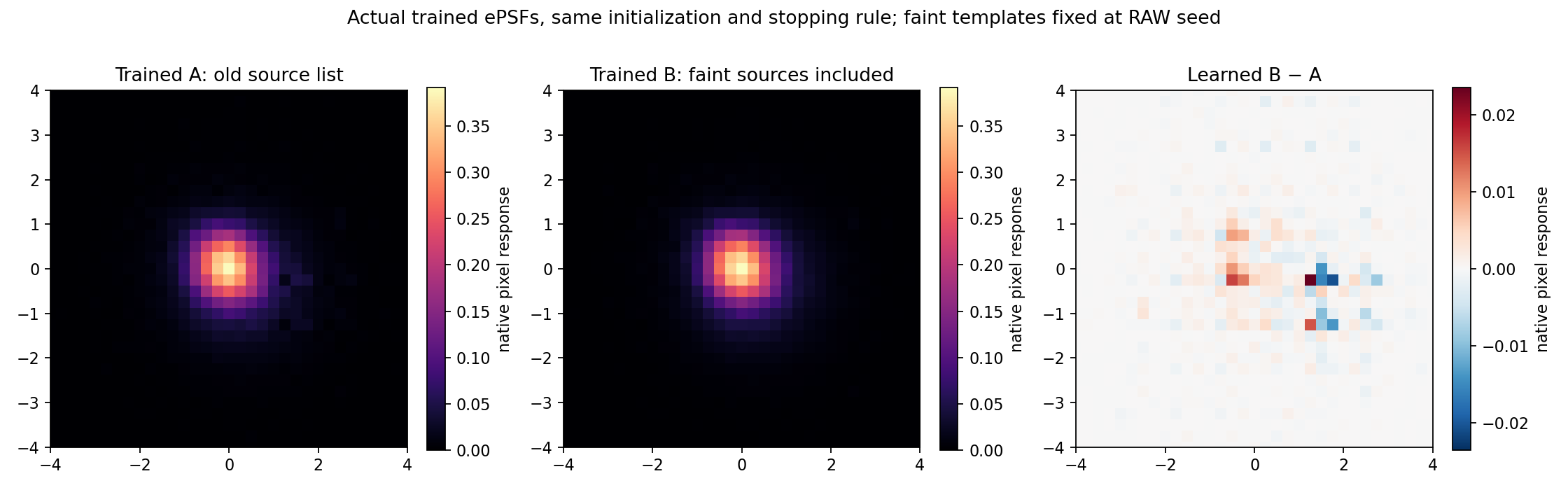
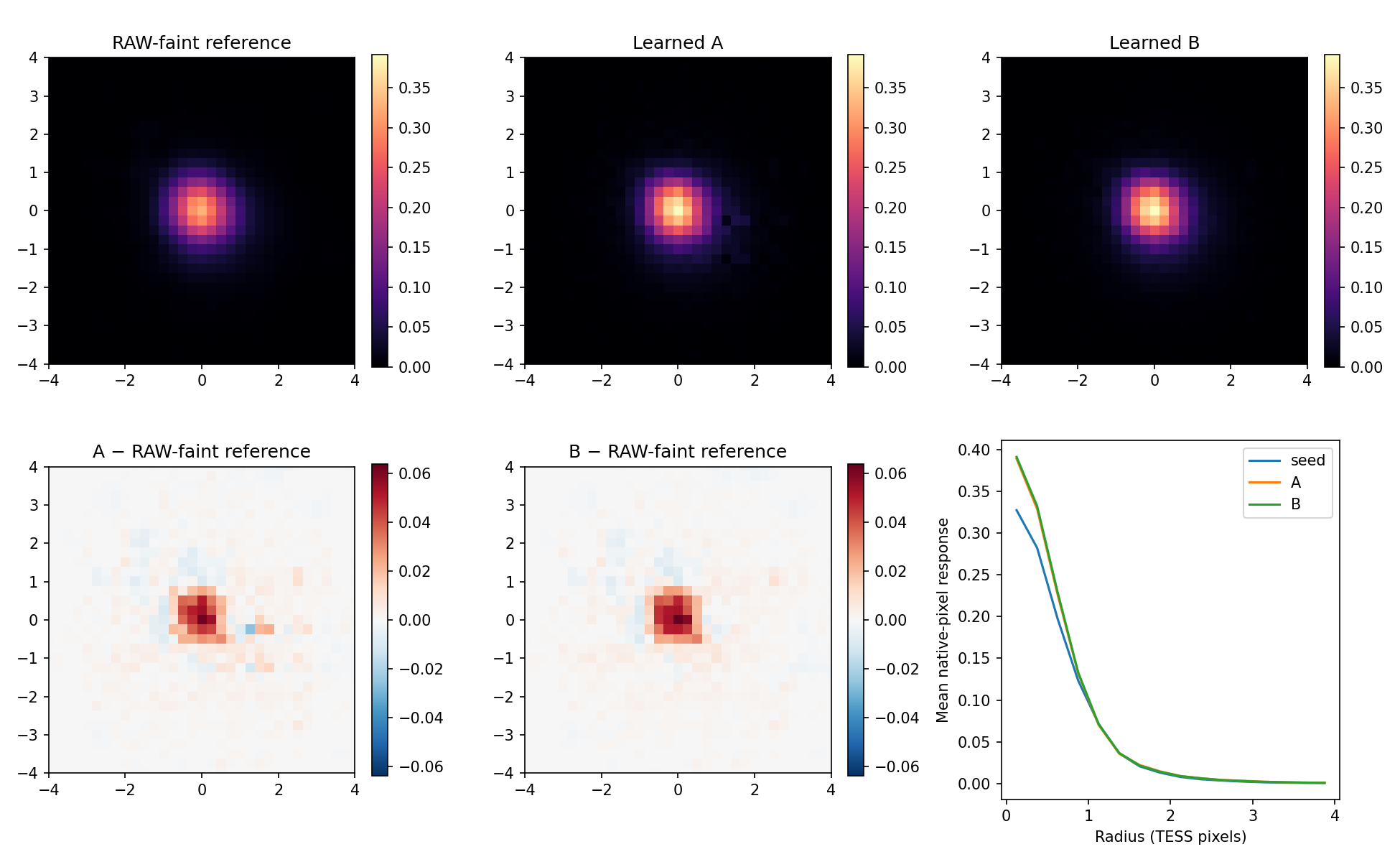
Conclusion: Adding faint neighbours changes the learned shape. This pilot does not establish that it removes the magnitude-dependent shape difference. The learned B profile's RMS distance from the shared RAW-faint reference is 1.037 times A's distance (radius <3 pixels). The held-out bright-core population is too small for a reliable magnitude-law claim. Better whole-scene residuals, if present below, are not equivalent to convergence toward the faint-star shape.
What was actually trained
A: original 252-source list. B: the same list plus 75 T13–18 neighbours (43 intersect training, 32 intersect validation). One local ePSF is learned from 17 original contributors. Other source profiles are frozen at a shared RAW-faint reference, while source fluxes are solved jointly at every iteration. This is gradient training from the first iteration with neighbours present, not post-training stamp subtraction.
Both arms start from the same reference made from 11 faint RAW stars. Identical WCS, observations, masks, source roles, priors and regularization; 18,903 unique training pixels. A 20-pixel guard separates source supports. Validation excludes potential seed-calibration footprints and scores 6,666 identical unique pixels on the same augmented scene. WCS remains conditioned on the pre-existing C4 solution.
The reference is not assumed to be the true PSF. Existing Gaia/Tmag data supplied nominal brightness priors; no new PS1 catalogue photometry is used. Every source uses 15,000 e−/s at T=10 with the usual magnitude scaling. Gaussian prior_kappa=0.1 scales each nuisance template's inverse-variance information; it is not a 0.1-mag error. Flux solutions can be negative.
Learned shape and comparison to faint stars
A and B share the absolute colour scale; the difference has a separate symmetric scale. Maximum pointwise B−A difference is 6.05% of A peak. This is not a width change or a recovered-flux fraction.Absolute profiles, difference images, and radial means. Core-region RMS difference from the RAW-faint reference: A=0.010113, B=0.010487 native-pixel response. This comparison is conditional on the shared seed and fixed nuisance shape, not an independent PSF-truth test.
Held-out validation
Evaluation family
A mean squared normalized residual
B
B/A−1
95% paired block interval
Training-family validation
537.901
536.138
-0.328%
[-1.624%, +0.299%]
Transfer to all original targets
461.655
456.228
-1.175%
[-4.800%, -0.105%]
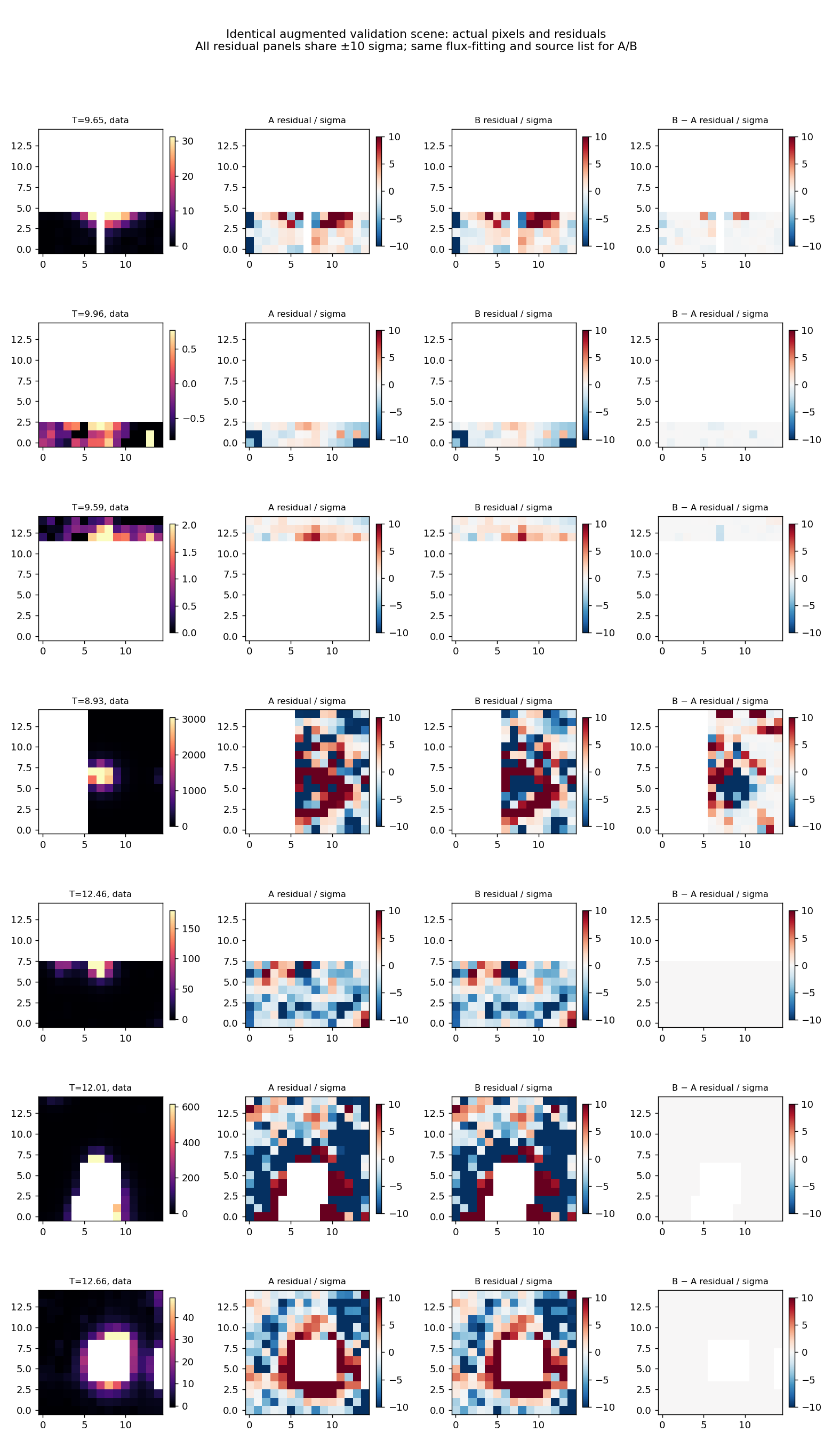
Negative changes favour B. Intervals use 2,000 resamples of 77 spatial blocks of 16×16 pixels, conditional on this small region and shared calibration. They do not measure field-to-field uncertainty. Large absolute normalized residuals indicate substantial remaining model/noise mismatch; these are not acceptable absolute fits.
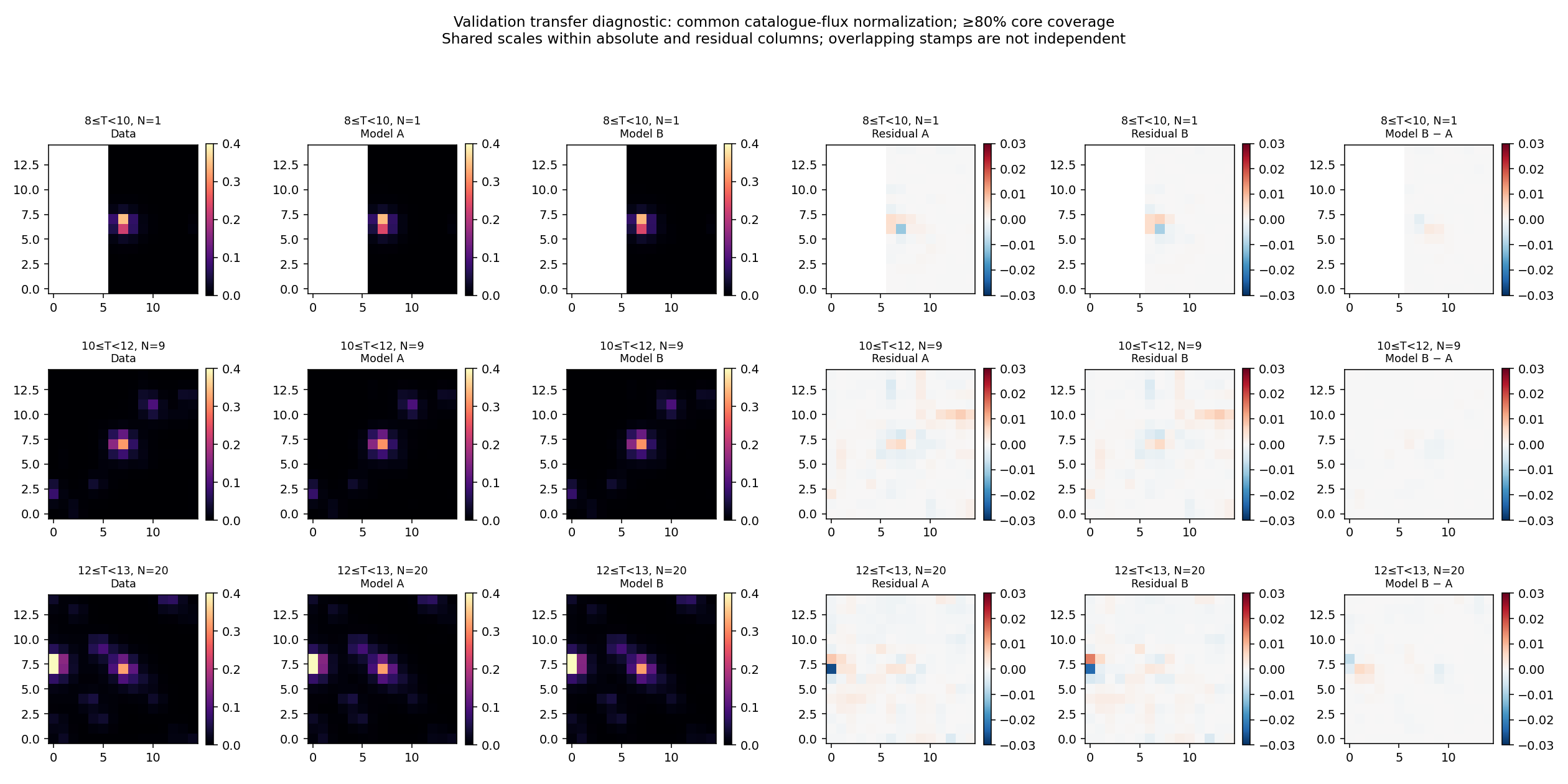
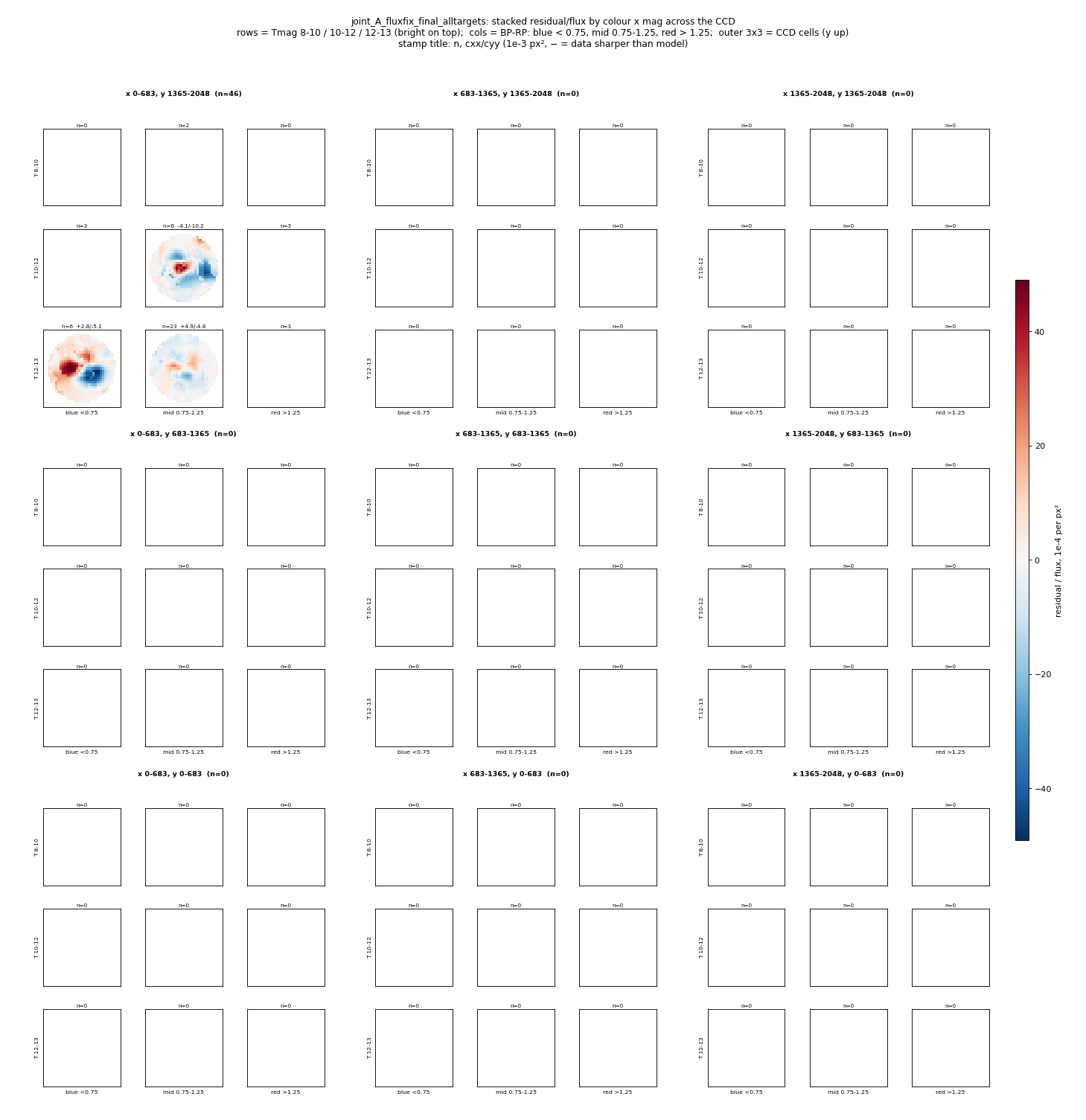
The primary evaluation retains the training model family: anchors and nuisances have the fixed faint-reference profile. The transfer diagnostic instead applies the learned profile to all original non-nuisance targets, keeping nuisance profiles fixed. It is a separate generalization question, not an interchangeable primary score.
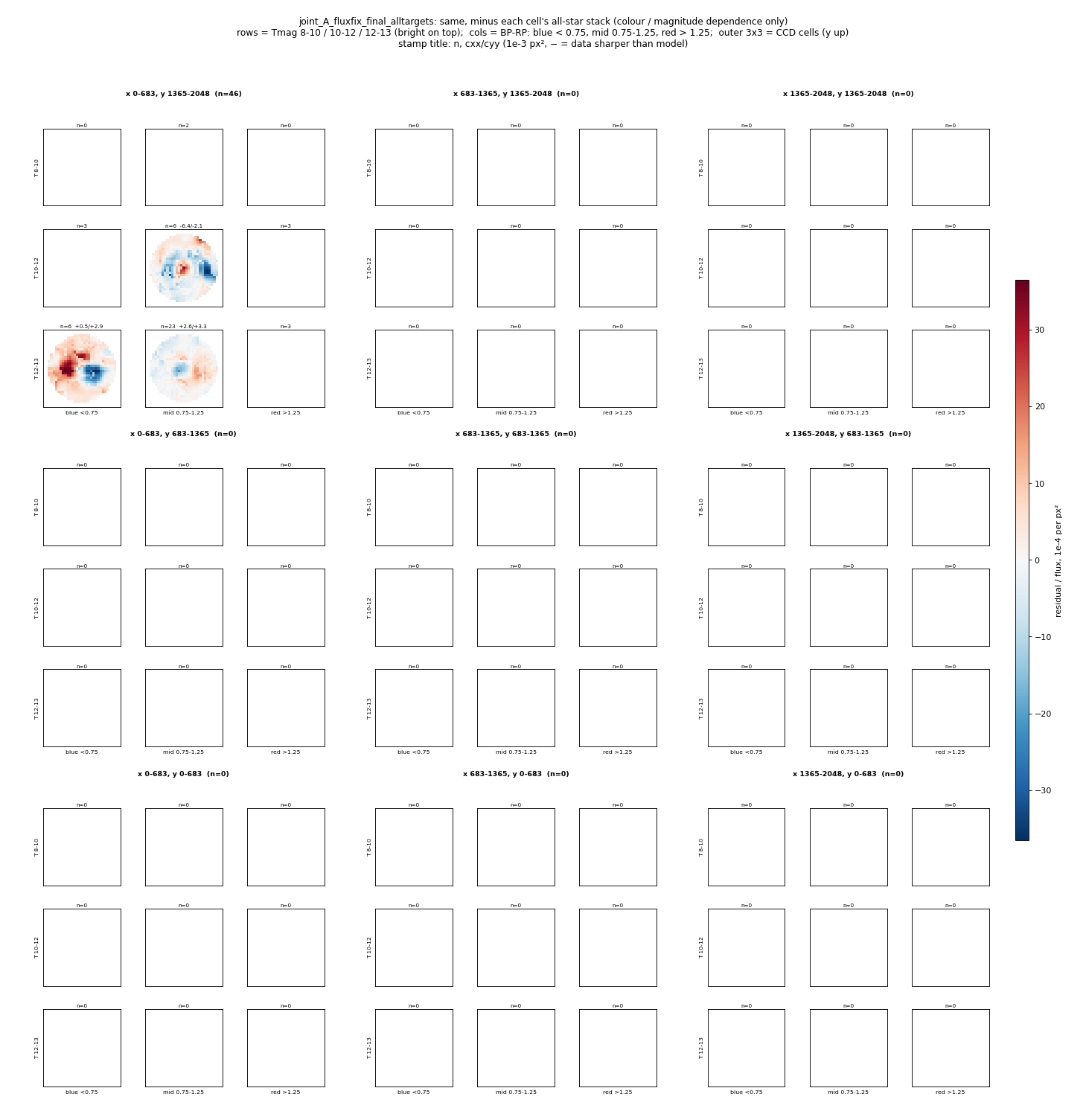
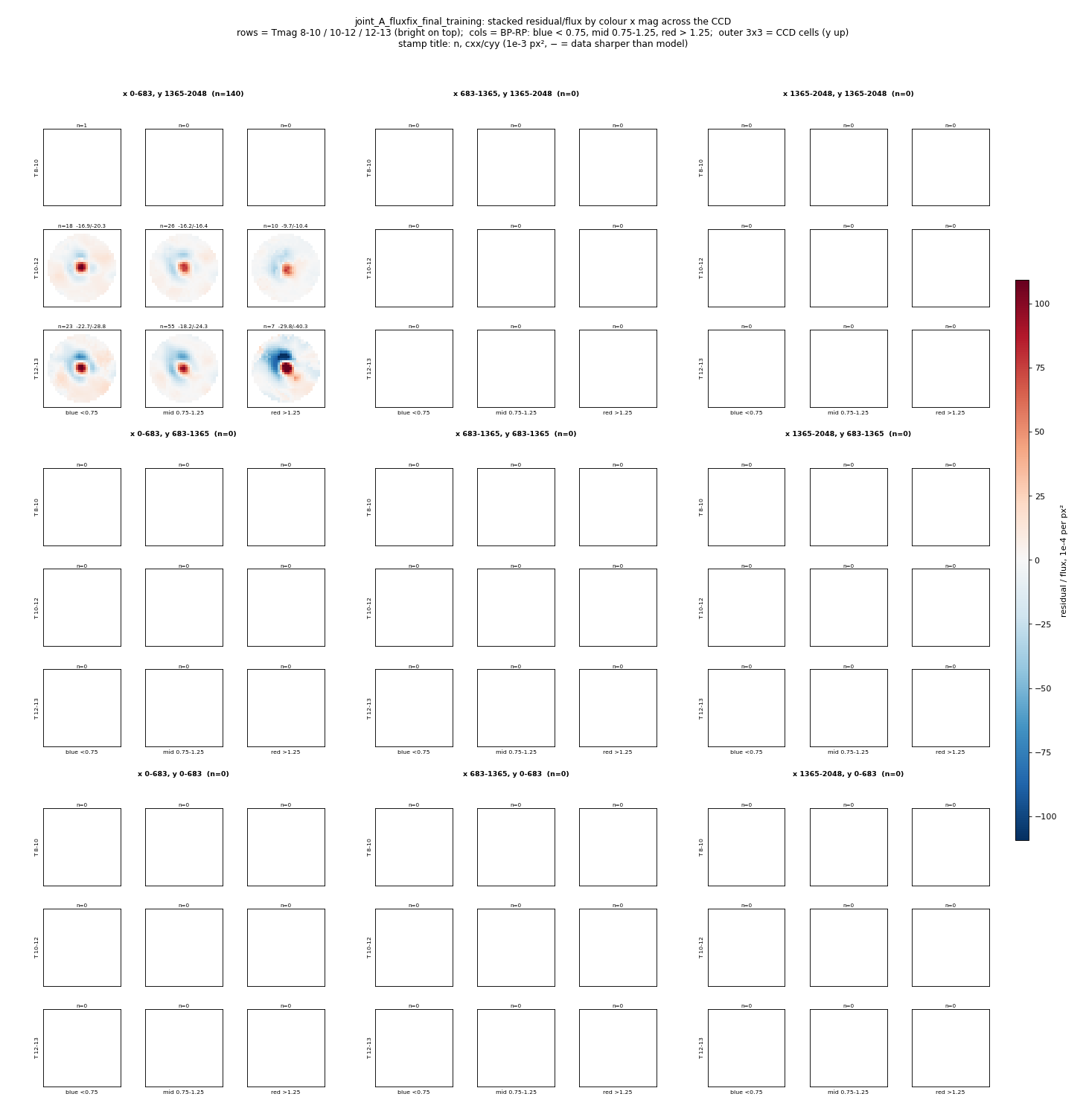
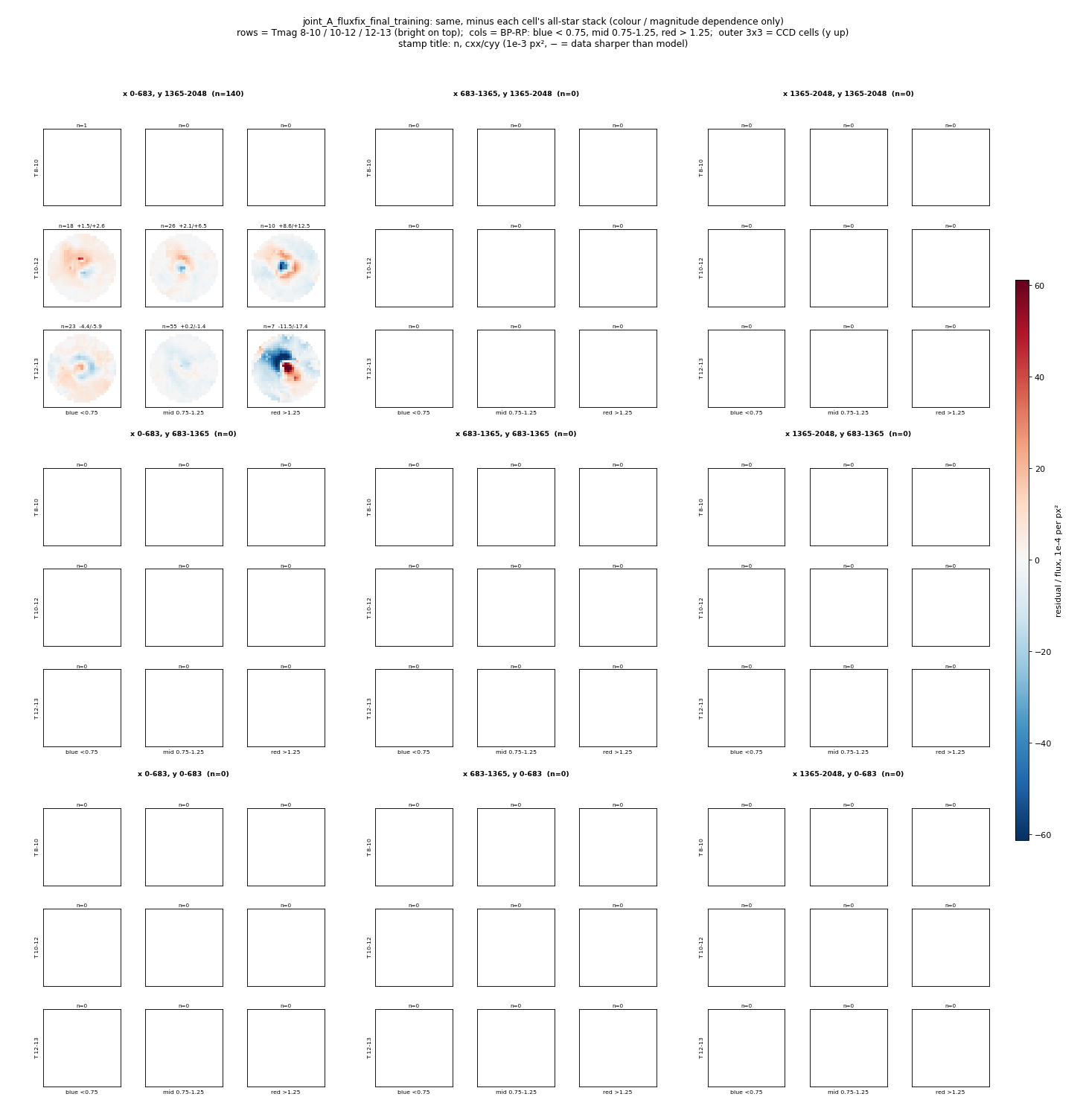
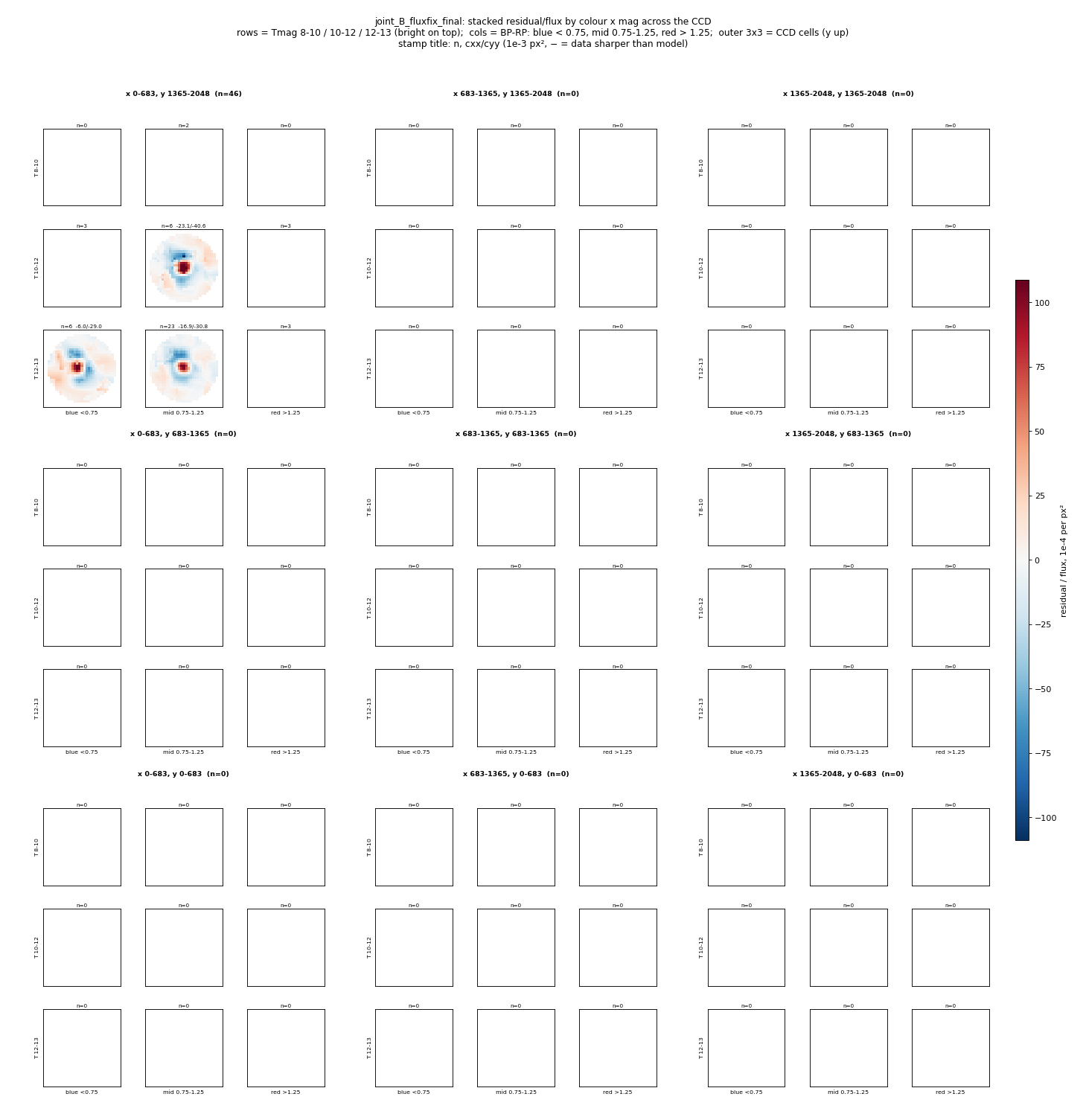
Individual validation data and normalized residuals with a shared ±10-sigma residual scale. Saturated colours indicate values beyond that range. Several bright footprints contain only wings or partial cores; this is visible directly.Transfer diagnostic: data, total models, residuals and model difference on matched masks. Stamps are divided by the same nominal magnitude-derived flux. Require ≥80% of the central radius-2-pixel core; counts are 1, 9 and 20 for T=8–10, 10–12 and 12–13. Overlapping stamps are correlated. These are integer-centred diagnostic stacks, not precision subpixel ePSF estimates.
Optimization and limitations
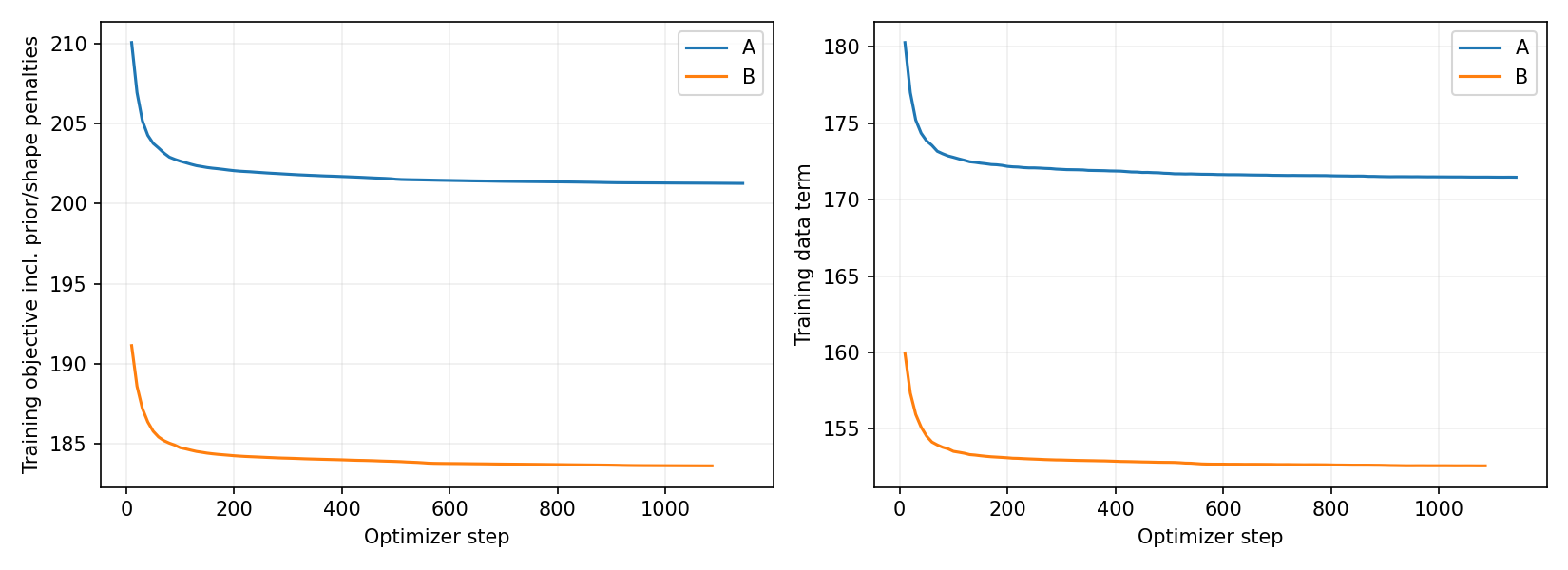
Final L-BFGS phase, after identical 1,200-step Adam schedules. Training data loss is not a held-out shape score. Both arms use the same stopping rule; iteration counts may differ.
A: 1143 L-BFGS iterations; CONVERGENCE: RELATIVE REDUCTION OF F <= FACTR*EPSMCH; gradient infinity norm 0.07428. Objective-tolerance success does not prove a unique optimum.
B: 1086 L-BFGS iterations; CONVERGENCE: RELATIVE REDUCTION OF F <= FACTR*EPSMCH; gradient infinity norm 0.008022. Objective-tolerance success does not prove a unique optimum.
The new-source check establishes zero-valued finite 51×51 PS1 support at every recorded contributing occurrence. It does not establish infinite-wing removal, all-cell completeness, or a complete sky catalogue.
One region, one FFI, one constant local ePSF. No separate ePSF per magnitude/spatial bin was learned. One usable bright validation core cannot close the original magnitude-shape question.
Initial runs named A/B, *_polish and *_converged are superseded: the inherited original-source flux field had incompatible units. Corrected final runs are *_fluxfix_final. Plot normalization and prior means were corrected; old numerical comparisons must not be reused.
No temporal photometric or transit-signal preservation claim is made. No production template was modified.
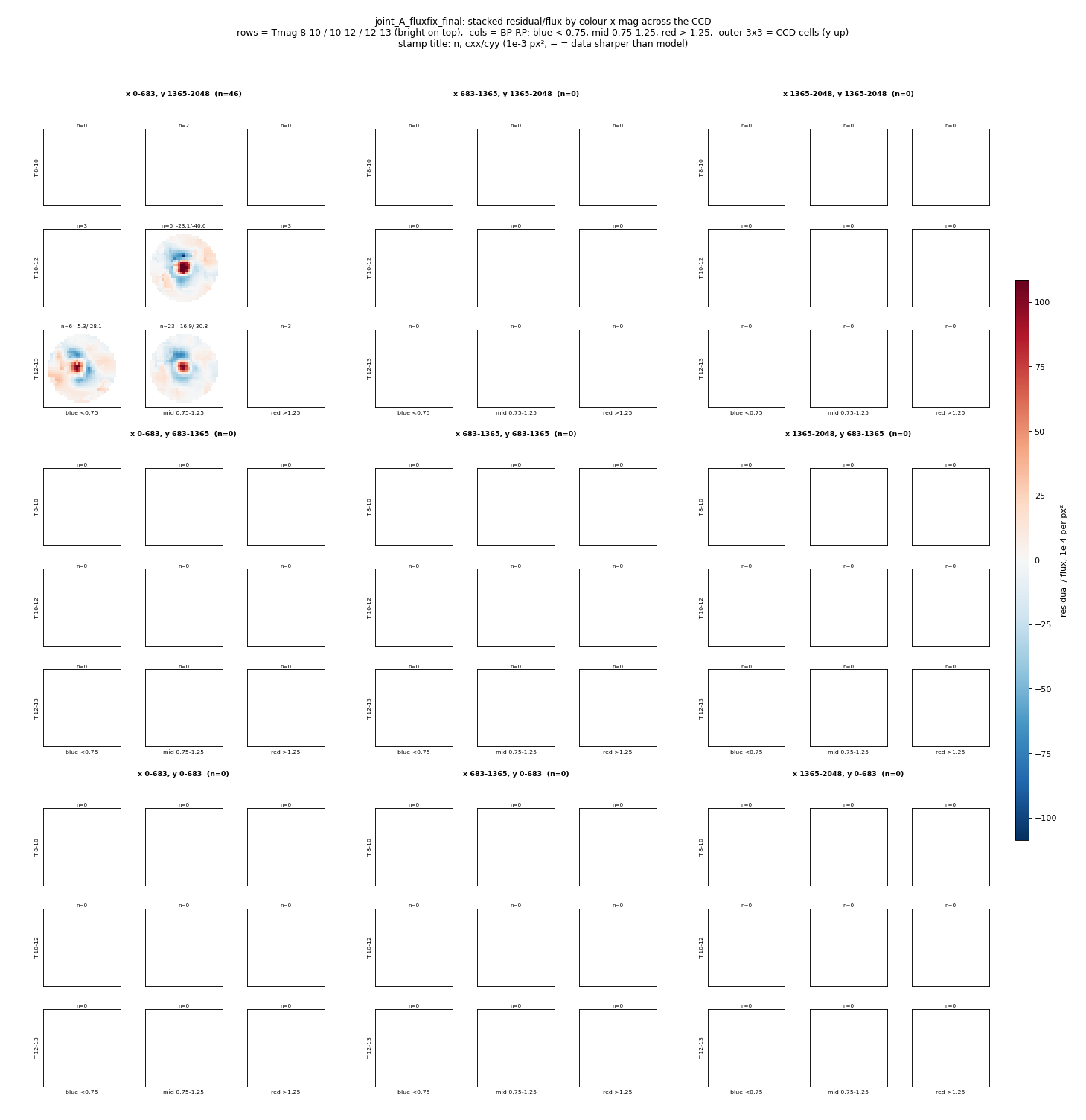
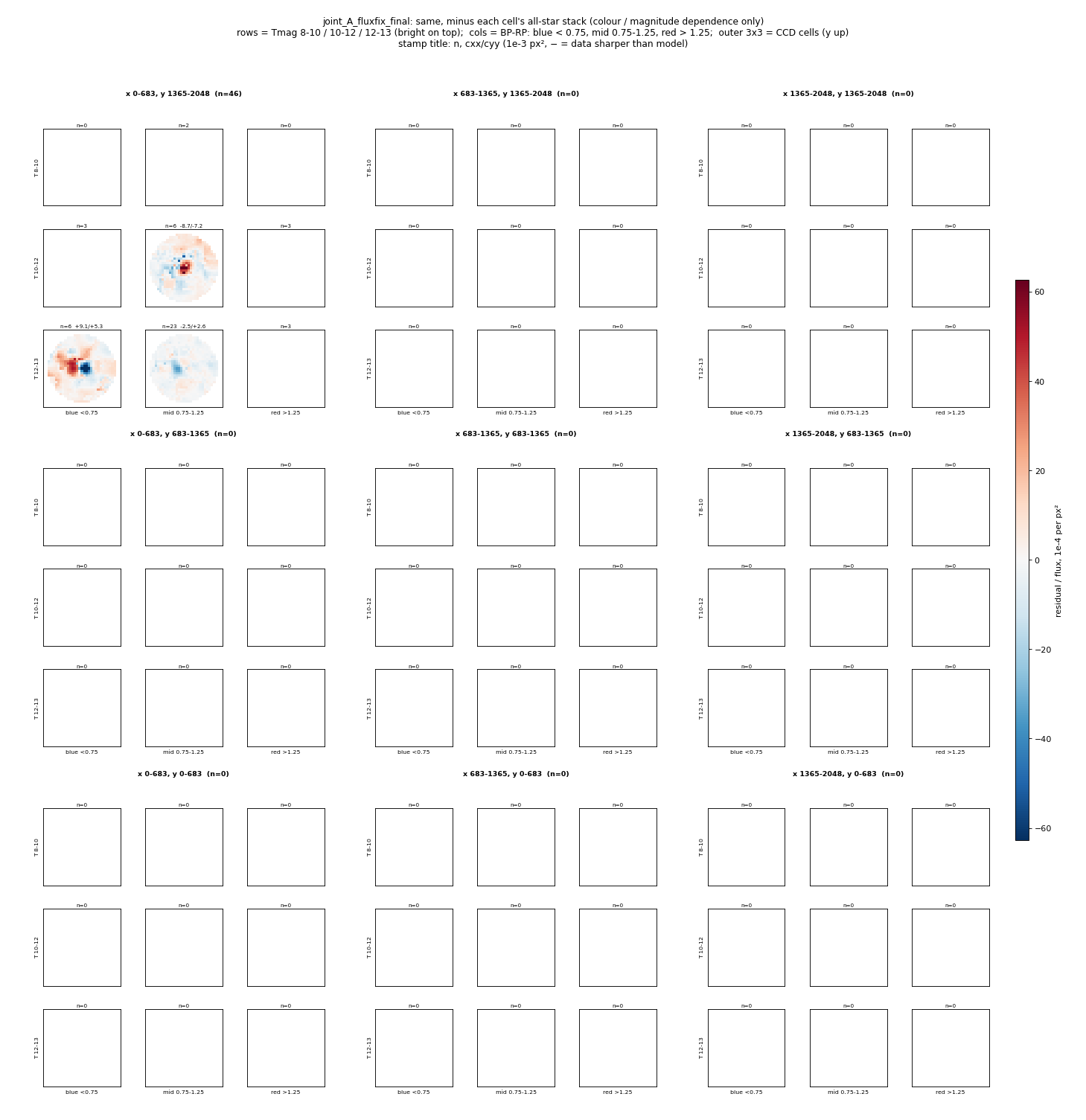
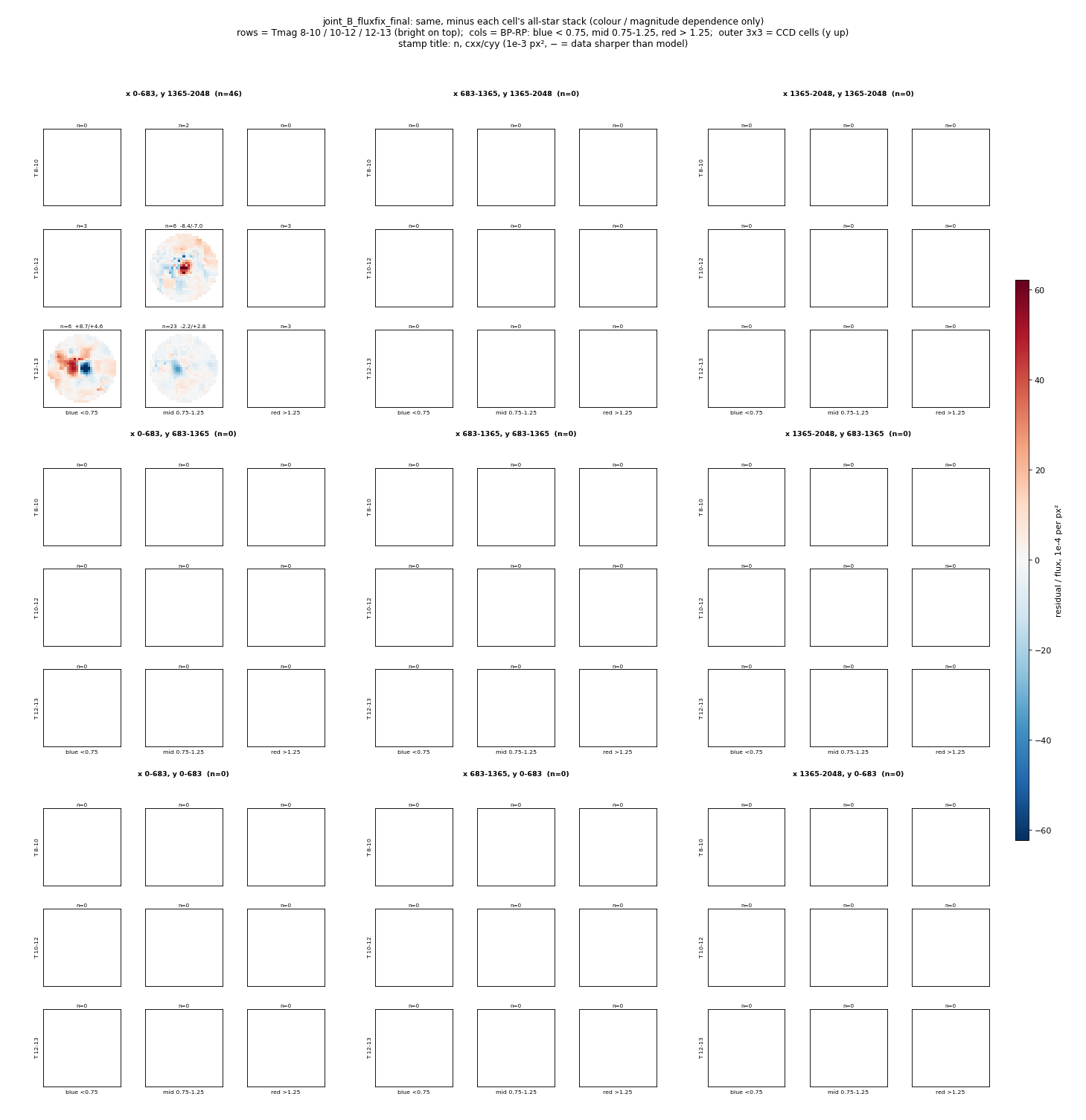
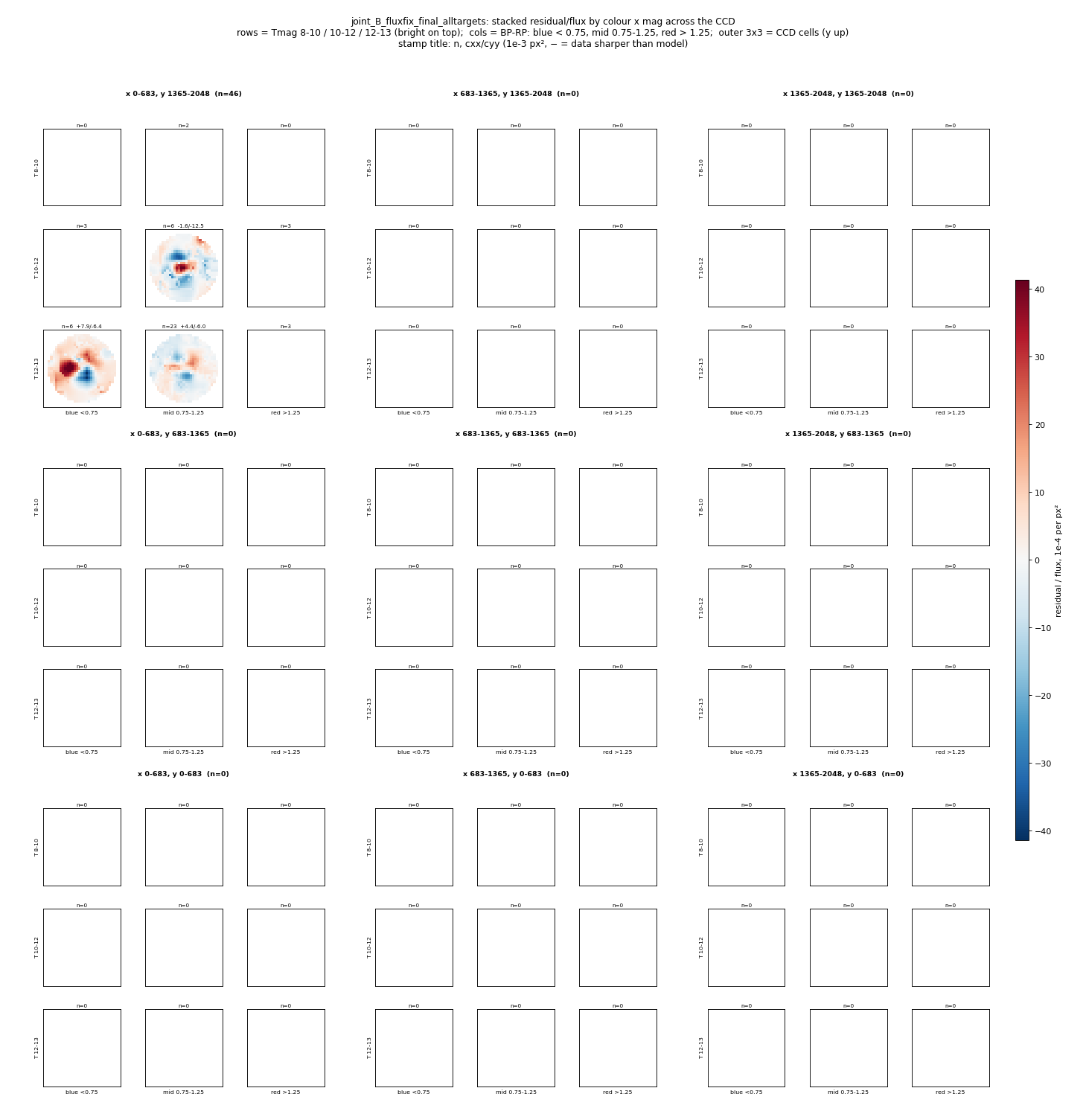
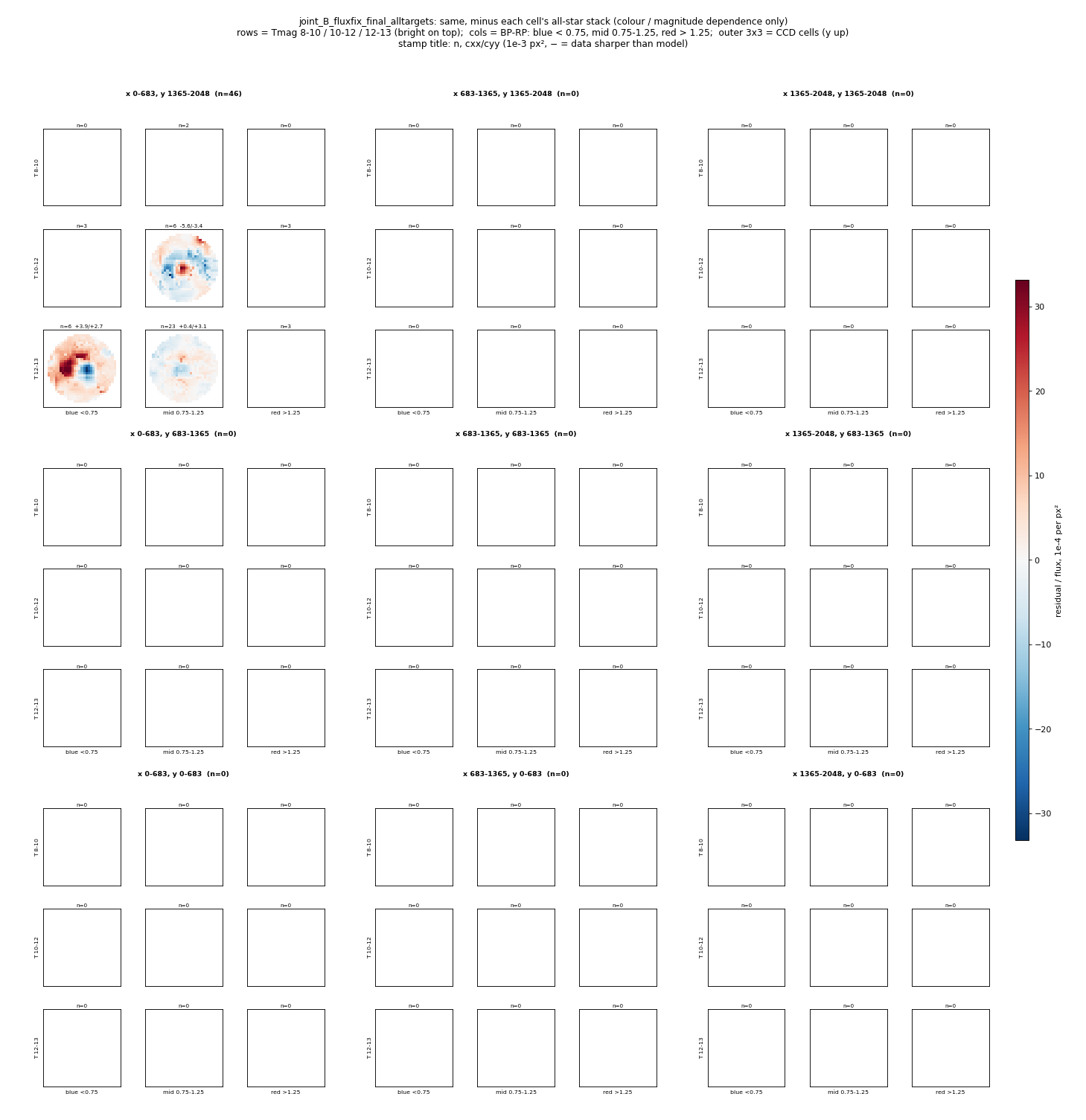
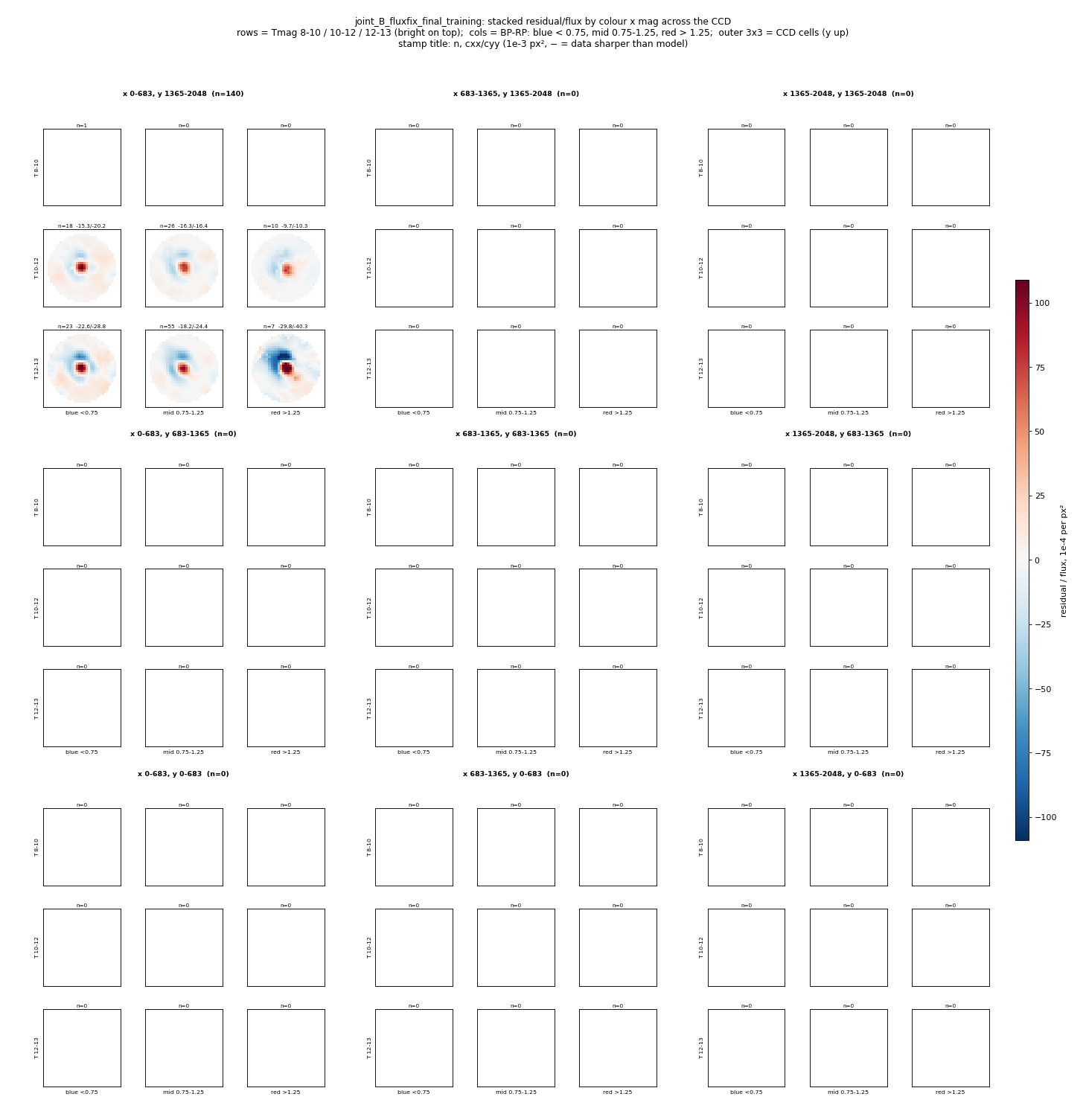
Standard residual grids
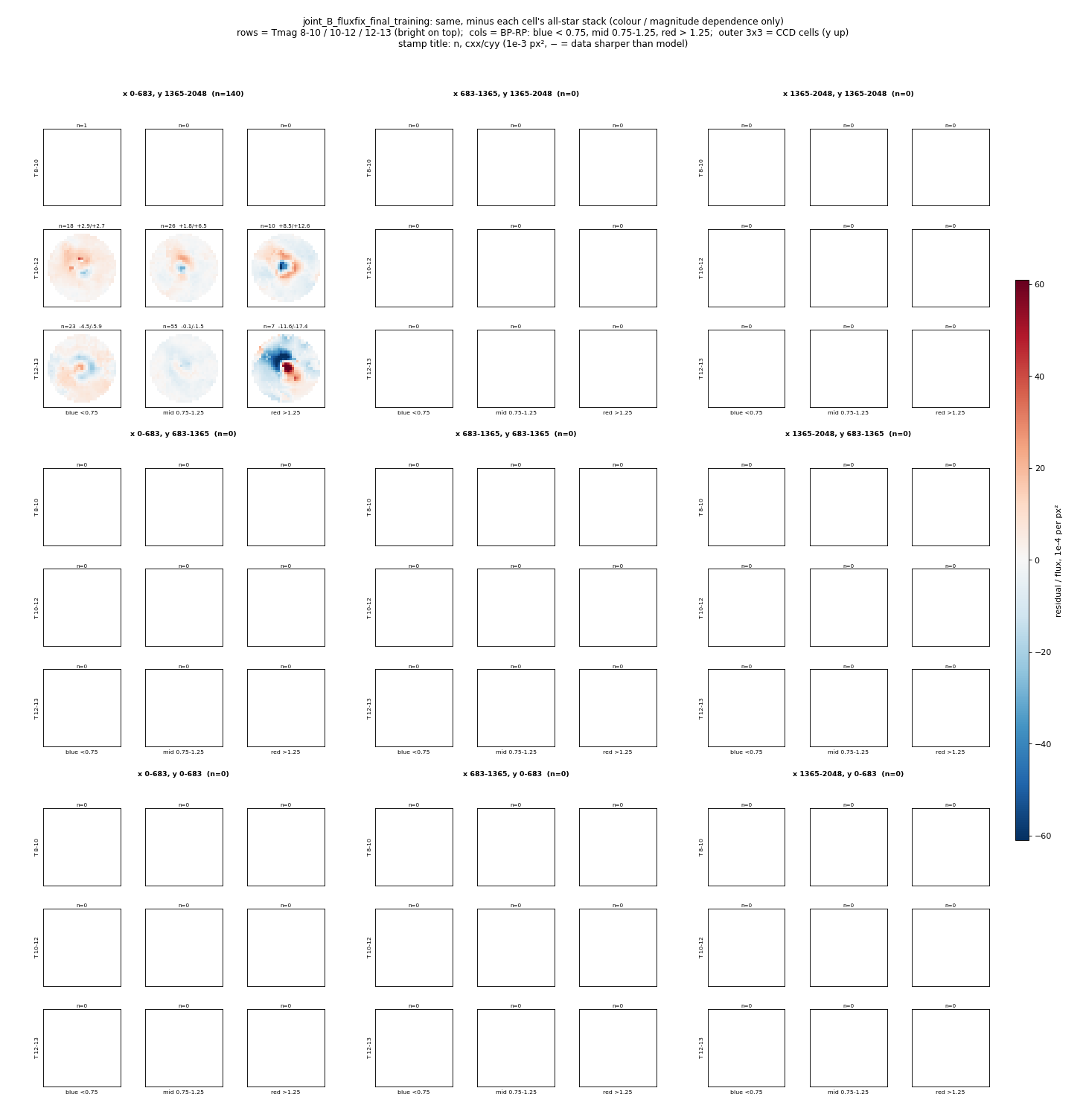
Colour is scene BP−RP. Magnitude bins and display normalization use the same nominal magnitude-to-flux conversion. Empty bins mean insufficient data, not zero residual. Absolute and relative grids are distinct; relative subtracts the cell's all-star stack. Shared comparison: residual-grid gallery. The external Claude Artifact mirror could not be updated with the available tools.
Next: use the improved neighbour catalogue and calibrated brightness uncertainties, then repeat with enough disjoint, intact bright and faint cores in each spatial cell. Compare learned shapes and held-out magnitude residuals together. The present pilot establishes a working training comparison and its limitations; it does not settle the physical cause of all magnitude-dependent effects.