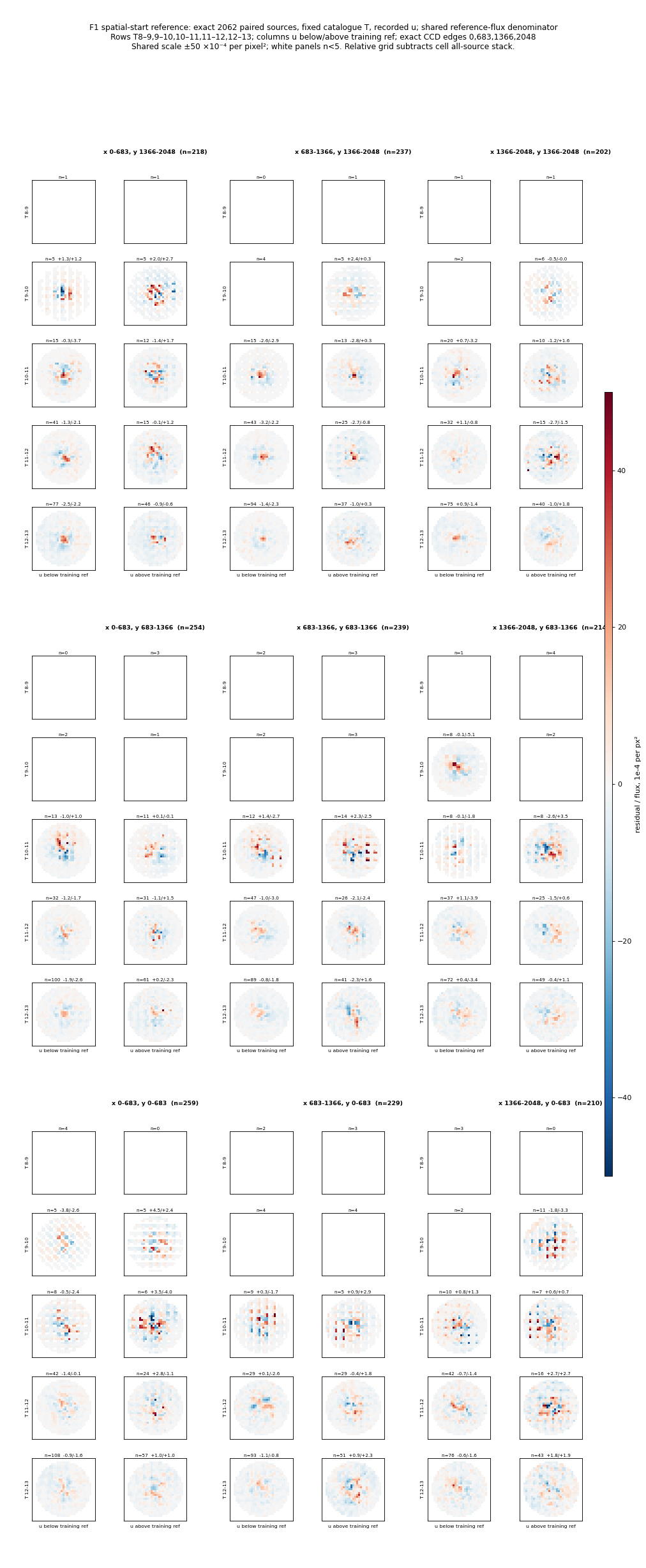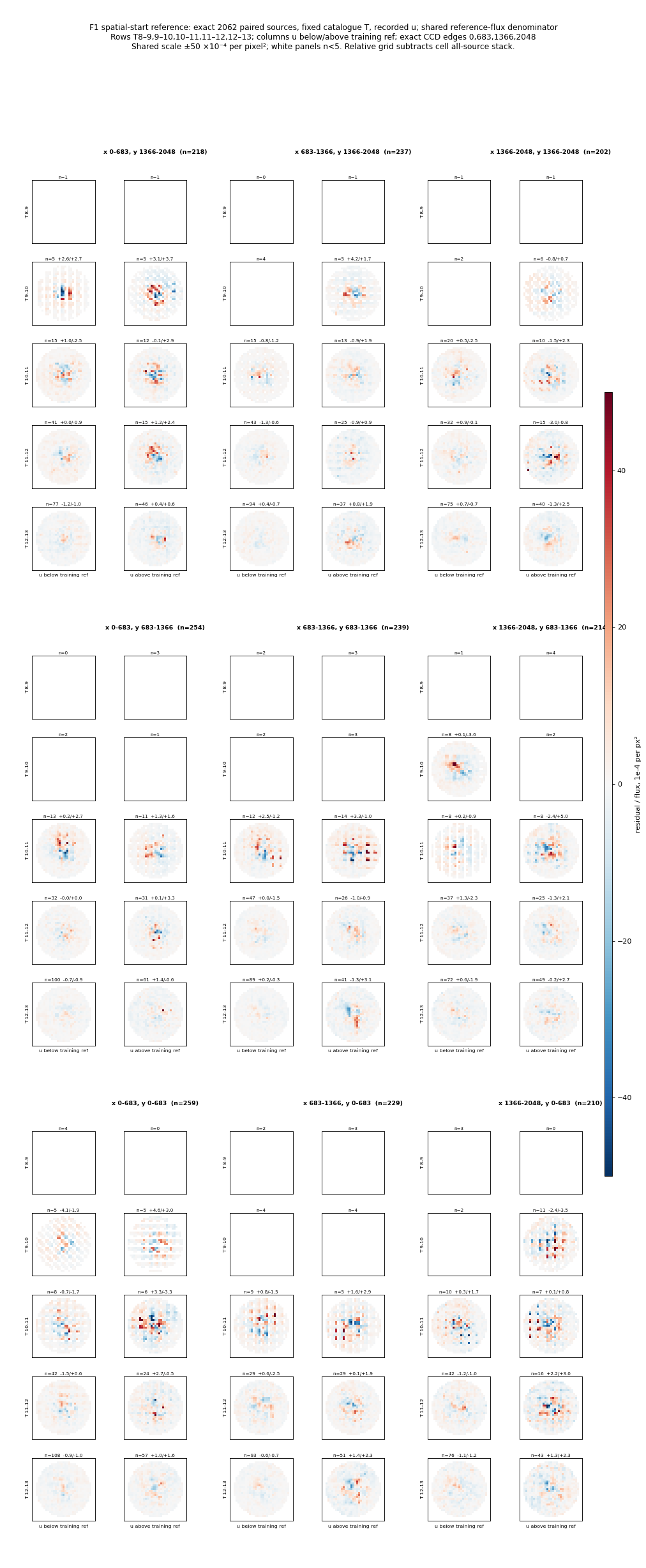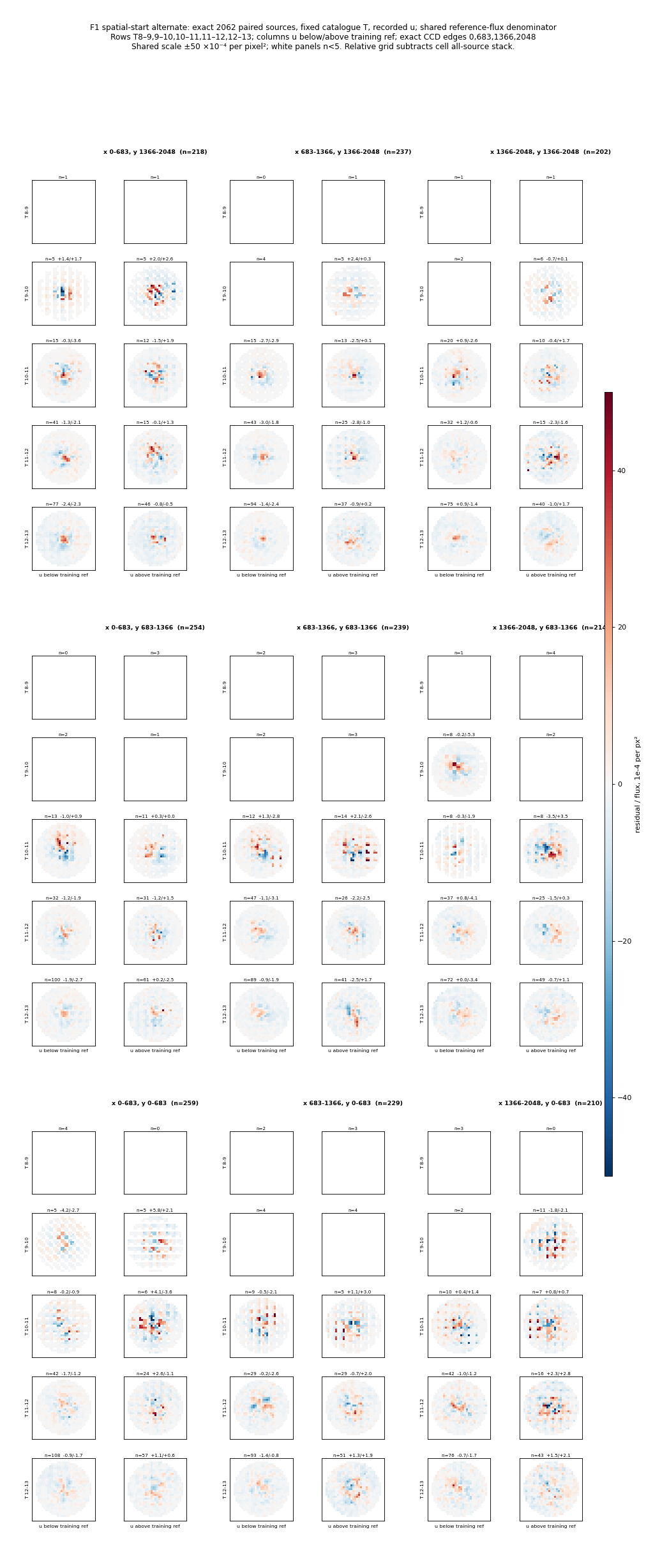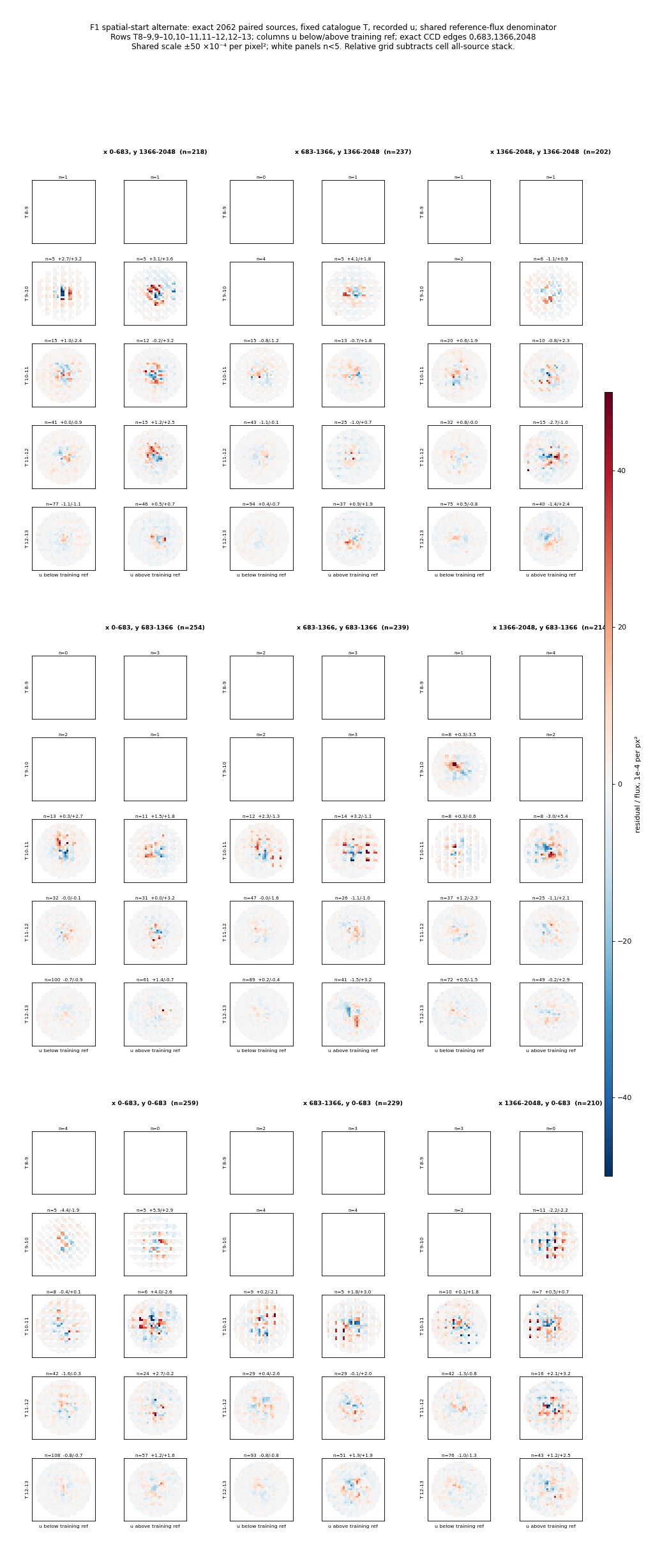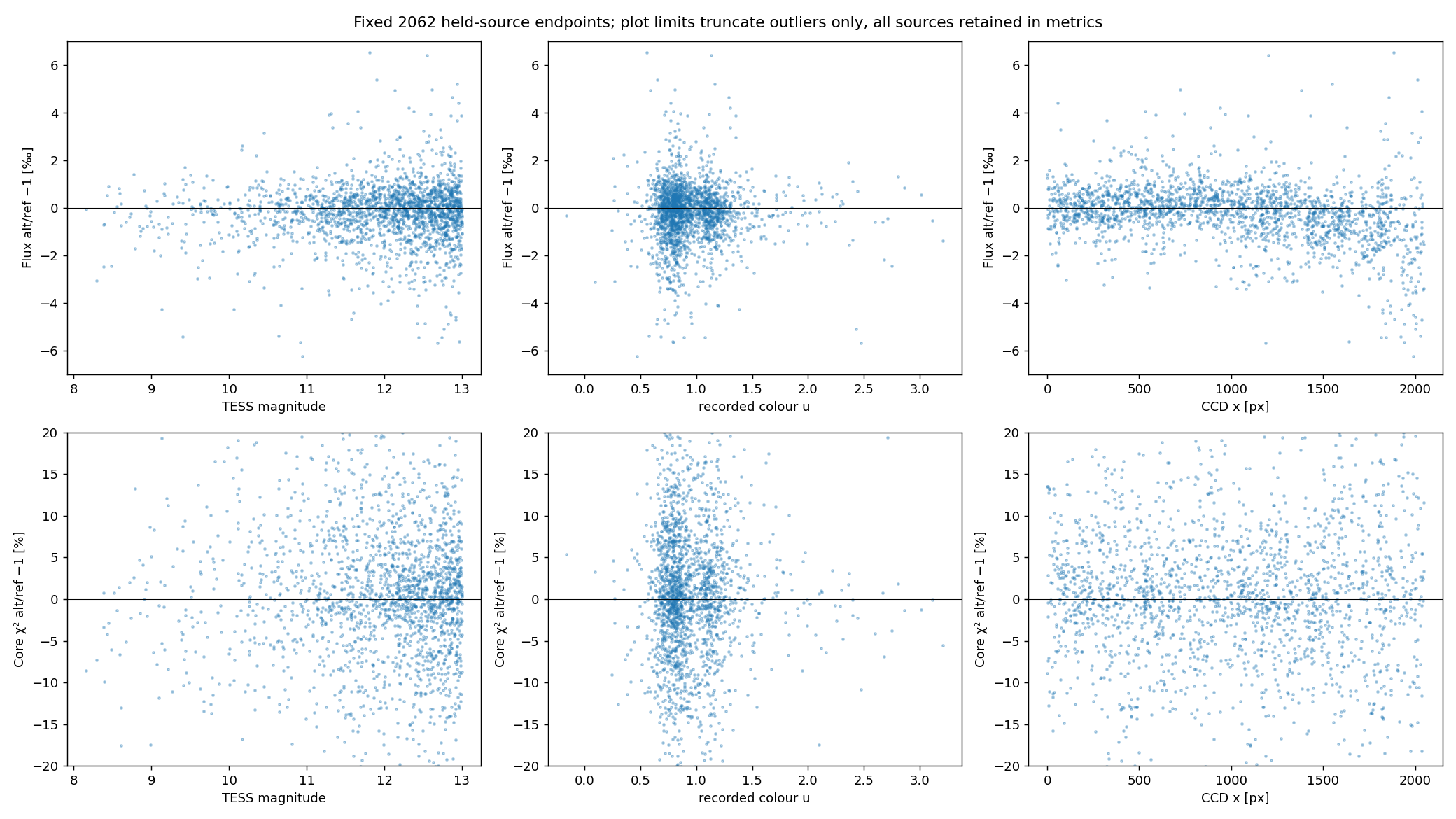
2026-10-04. Conclusion: global held-core χ² is close, but sub-0.5‰ source-flux route equivalence is not demonstrated. Spatially structured flux/WCS/profile differences remain. This is a bounded spatial-start sensitivity comparison, not proof of convergence or independent fine-profile correctness.
Both fits use native A3, the same training-only fold0 scene and prescribed 300/3000/2000 stage caps. The alternate start uses a spatially constant node average of the SAME fold's training-only photutils ePSF and header-only WCS. It retains the empirical fine/wing shape. One startup prior-refresh suppression preserves exactly the reference initial prior. Independent verification confirms all prior, mask, star-free and fixed-flux arrays match the reference initial state at all three saved stages in both runs; both added CCD-colour coefficients are zero.
The same 2062 source rows and IDs are evaluated on whole-held physical radius≤3-pixel cores with at least 15 original-valid pixels. Native evaluation re-solves every source flux and recalibrates the global nuisance prior on the full evaluation scene. All intervals below condition on these models and realized evaluation calibration. They do not propagate model, calibration or noise covariance uncertainty.
$$r_i = \chi^2_{i,\mathrm{alt}}/\chi^2_{i,\mathrm{ref}}, \quad d_i = 1000\left(f_{i,\mathrm{alt}}/f_{i,\mathrm{ref}}-1\right).$$
Here $i$ indexes a fixed held source; $\chi^2$ is its dimensionless native mean squared noise-normalized residual on fixed core pixels; $f$ is the evaluation re-solved source flux in electrons per second; $r_i$ is a dimensionless paired ratio; and $d_i$ is the paired flux difference in per mille relative to the reference endpoint. Both quantities are measured, not training objectives or acceptance thresholds.
| Fixed-source endpoint measure | Result | Conditional 95% interval |
|---|---|---|
| Median paired core χ² ratio | 1.003527 | 0.998360–1.009578 |
| Median signed flux difference | −0.104068‰ | −0.266086 to +0.053703‰ |
| Median absolute flux difference | 0.591751‰ | 0.521242–0.702321‰ |
| 95th percentile absolute flux difference | 2.946483‰ | Not bootstrapped |
Intervals use 10000 draws of 49 existing dependence components, seed 20261004; largest component 4.898% of sources. These are conditional sampling intervals, not an equivalence margin. Historical 0.5‰ flux/3% χ² criteria are reference context only, not automatic noise acceptance. Cell x2,y0 has 210 sources and signed median−1.225199‰; cell x2,y1 has 214 sources and −0.614283‰. All bin statistics are in summary.json; bins use fixed catalogue T8–9 through12–13, recorded colour $u$ below/above the training reference 0.95553608, and CCD edges[0,683,1366,2048]. Here $u$ is the fitter's recorded dimensionless colour coordinate from the supplied F1 colour file.
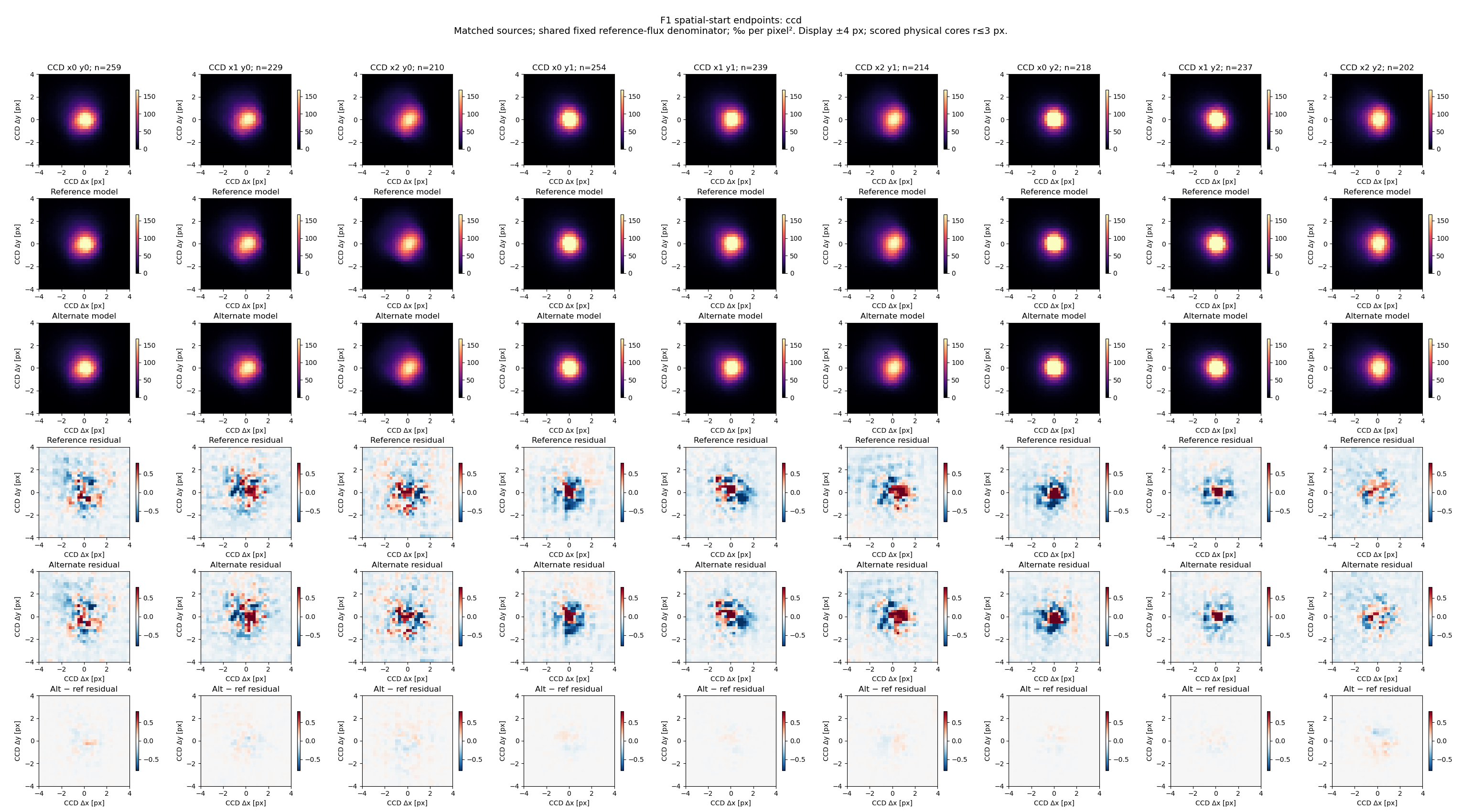
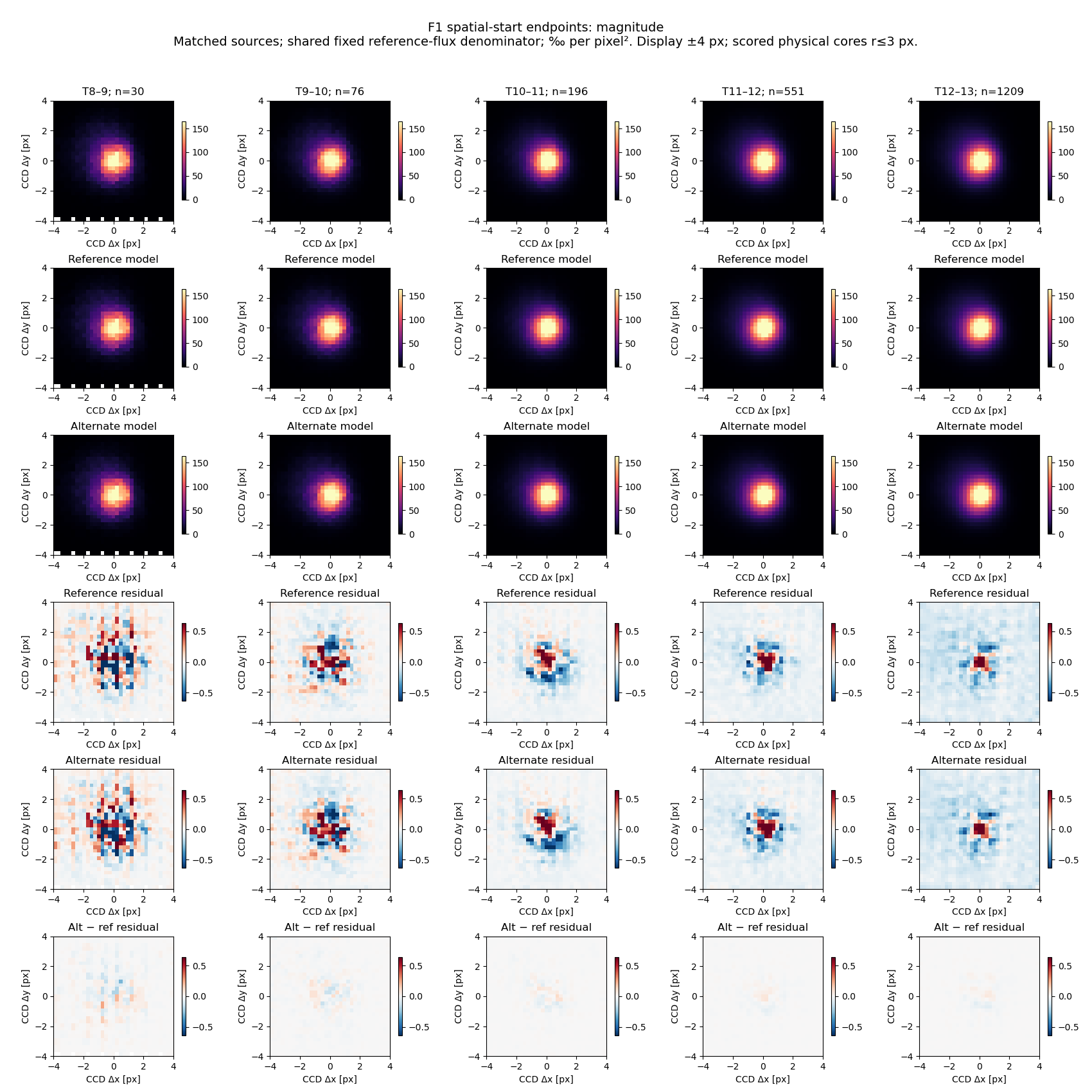
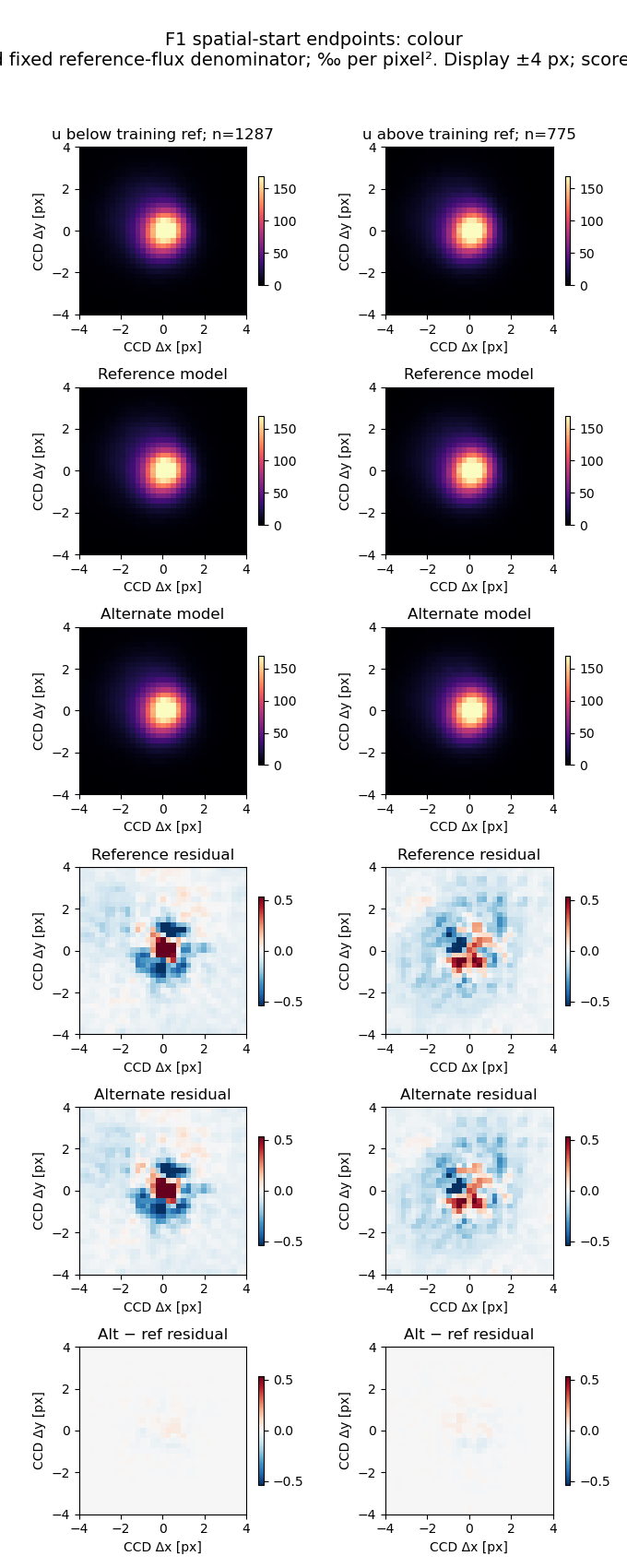
Every primary image stack uses the same sources and reference endpoint flux denominator. The rows show data, reference model, alternate model, reference residual, alternate residual, and median paired alternate-minus-reference residual. Residual rows share a colour scale within each figure. Displayed stamps extend to±4pixels; primary scalar scores use only the exact physical radius≤3cores. Outer displayed wings are descriptive, not additional held scoring support. The common residual morphology persists in both fits: central/annular and asymmetric structures remain much larger than the route-difference stacks. No route eliminates the observed residuals.
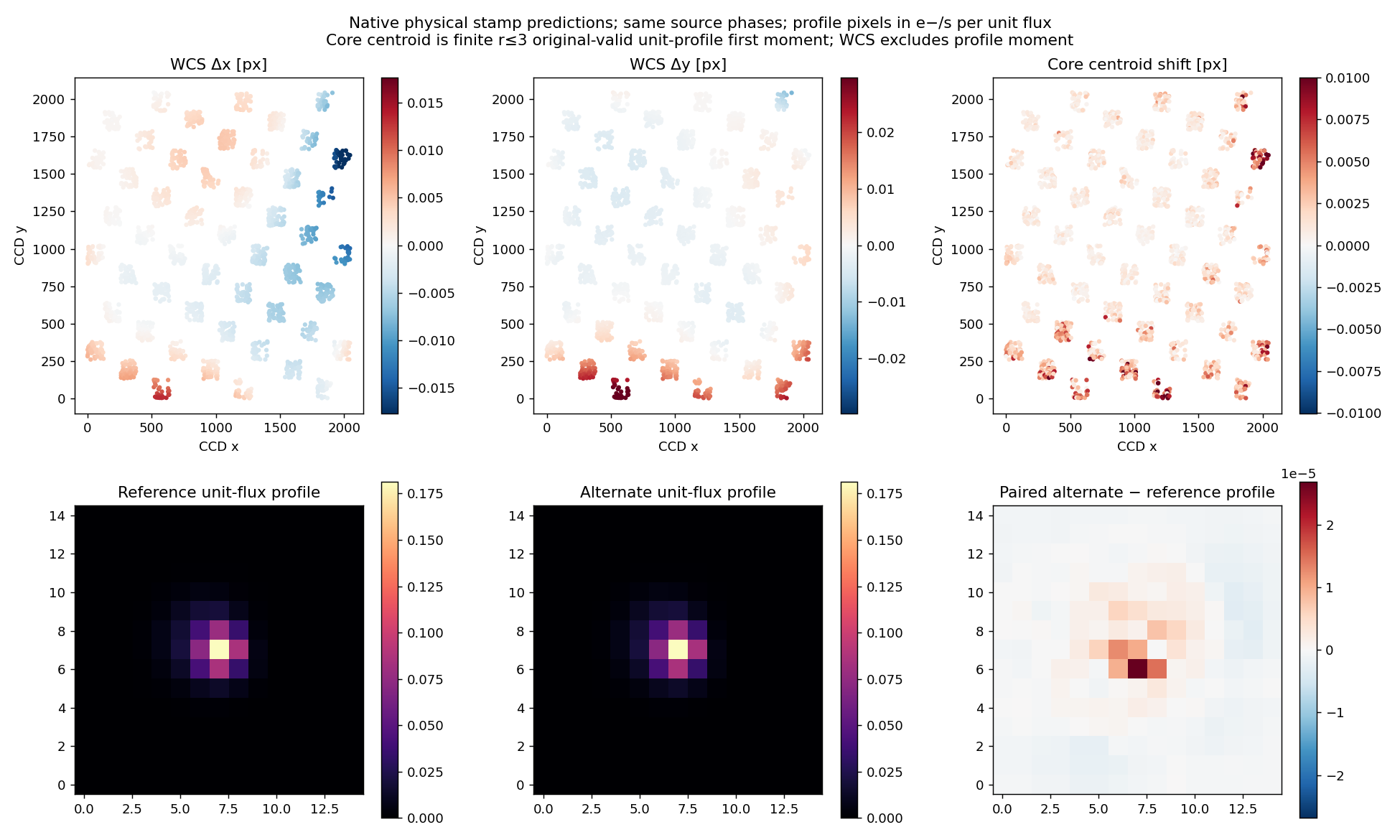
WCS displacement has median 0.004356pixels and95th percentile 0.018195pixels. The displacement of the finite-core unit-profile first moment has median 0.001160pixels and95th percentile 0.005713pixels. The median sum of absolute unit-profile differences over the original-valid physical core is 0.001963 of unit flux. These describe different quantities: WCS predictions exclude the profile first moment; the finite-core centroid depends on core truncation and valid pixels. This is not an independent astrometric truth comparison.
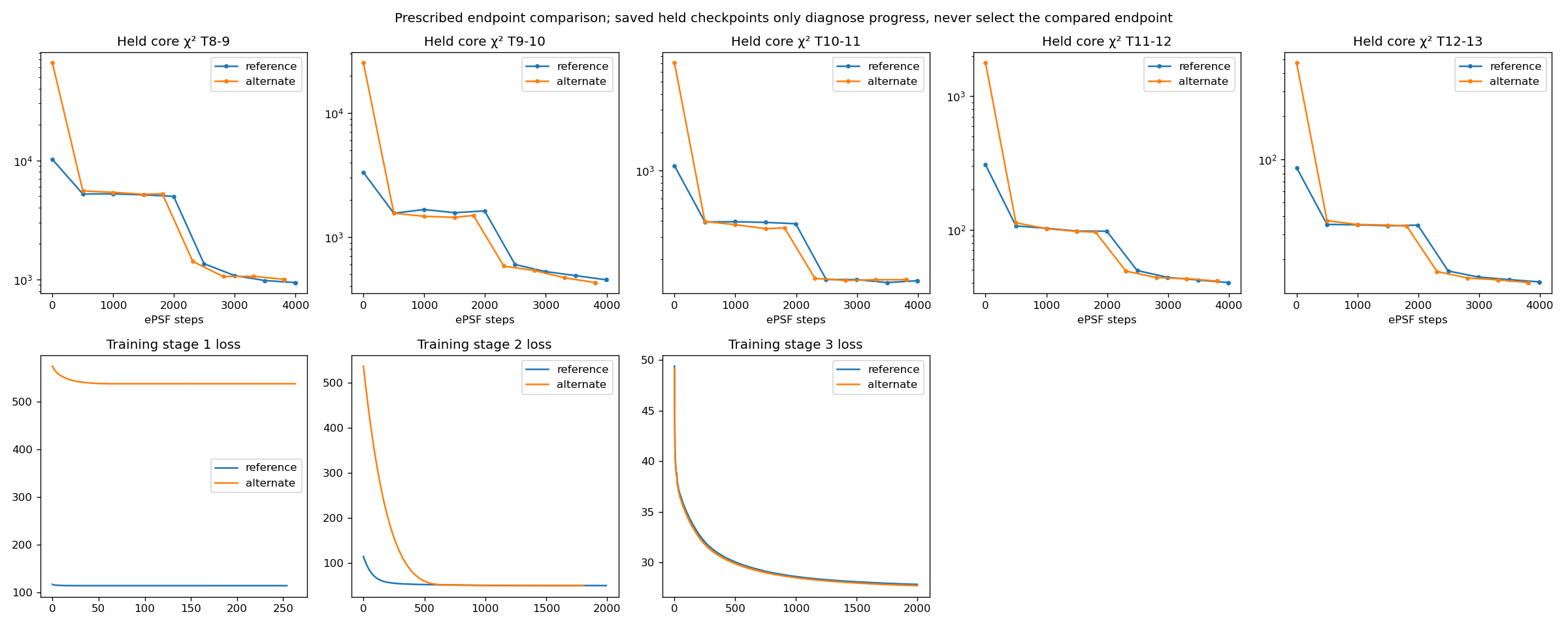
| Route | Stage1 actual/cap | Stage2 actual/cap | Stage3 actual/cap | Final training loss |
|---|---|---|---|---|
| Reference | 255/300 | 1994/3000 | 2000/2000 | 27.816404 |
| Alternate | 264/300 | 1809/3000 | 2000/2000 | 27.694353 |
Stages 1/2 satisfy the configured relative-loss early-stop rule; both stage 3 runs hit their caps. No scalar stationarity certificate follows. The prescribed final endpoint is compared in all results; held checkpoints were never selected to improve scores. Four of five magnitude bins reach their minimum recorded held median at the endpoint in each route. T10–11 endpoint/minimum is 1.033163 for reference(minimum stage 3step 1500), and1.015316 for alternate(minimum stage 3step 1000). Summary.json records every endpoint and minimum. These checkpoint medians are not the same estimator as the median of paired endpoint χ² ratios.
- Runtime is immutable production 3609d467a7f17c9ed56a434d71f131ca5cf15528 at crossfit/pin, with the process-local CCD-colour adapter installed before checkpoint loading.
- Score/source/ncore/catalogue position/colour equality assertions passed. Exact prior parity is saved in prior_parity_verified.json.
- Condor 2605 on plscience3 wrote valid primary scores, then failed only in an auxiliary JIT profile renderer due to a StaticContext argument. A task-local closure correction fixed it; 2606 completed evaluation. 2607 rendered the primary figures. No fit was rerun.
- Stock residual grids infer magnitude from fitted flux and use legacy Gaia BP−RP bins; their populations may migrate between arms. They are retained only for legacy compatibility. The published primary fixed-support tabs use catalogue T, recorded u, exact CCD edges, common reference flux and shared image scales; white sparse panels do not establish absence of structure.
- All 6 primary figures and the standard absolute/relative grids were inspected. No reserved confirmation image was accessed.
- Data and source records: `/astro/armin/koji/syndiff/dev_runs/epsf_model_closure_20261004/crossfit/start_control_report/`. The README records inputs and exact commands. External Artifact/SendUserFile tools are unavailable; use the existing shared portal.
Conclusion: The two completed spatial starts produce close aggregate held χ² and similar residual morphology, but retain measurable, spatially structured flux and position differences. Numerical route agreement at a sub-0.5‰ flux scale and full convergence remain unestablished; independent fine-profile starts and a justified stability/equivalence criterion would be needed for a stronger claim. This bounded control does not authorize further fitting or confirmation use.